You are currently browsing the category archive for the ‘Picture Books’ category.
 by
by I have a confession to make.
But you can’t tell anyone, OK?
I’m not fond of historical fiction.
I’m a huge reader with wide-ranging interests, so it pains me to say there’s a genre I don’t particularly like—especially when I know many writers who are working hard to create very valuable books in it. It also pains me because I’m smart enough to know that there’s probably historical fiction out there I would like if I got past my prejudice that historical fiction is all 800-page tomes full of hoop skirts, archaic language and obscure references.
So knowing that about me, what genre would you guess my latest picture book belongs to?
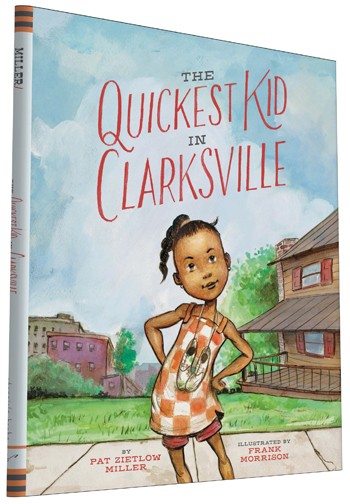
Yup. Historical fiction.
What can I say? Life is funny sometimes.
Interestingly enough, it’s not like I set out to write historical fiction. I kind of stumbled into it. I was initially writing a book called THE FASTEST FEET ON FLEET STREET, set in current times, about two girls competing to see who was the better runner, jumper and double-dutch rope skipper.
But the story needed something more. I wasn’t sure what.
The answer came from a discussion with an editor at a writing conference. She suggested anchoring it in a specific time. That one suggestion set off the proverbial light bulb. I immediately thought of Wilma Rudolph.
I knew the outline of Wilma’s story—overcoming polio and other illnesses as a child to become a three-time Olympic gold medalist and the fastest woman in the world—but not exactly when it had taken place. Research was obviously required.
I used to work as a newspaper reporter, so I know how to conduct research and interview and generally find things out. That part felt familiar as I read books, searched online and emailed experts.
And, as happens anytime I conduct research, l learned things. Things that fit right in with the story I was writing. My research filled in the gaps in my story, strengthened the weak parts and gave it the needed oomph, for want of a more technical term. Soon, the story’s title was THE QUICKEST KID IN CLARKSVILLE, a nod to Wilma’s hometown of Clarksville, Tennessee.
I was able to weave in facts about the poverty Wilma grew up in and how her hometown was segregated during her youth. I also learned that Wilma paved the way for the town’s eventual integration by insisting that her victory parade in 1960 be open to everyone.
I wrote an author’s note. Got the rights to use a photo of the real-life Wilma riding in her parade.
Before I knew it, I had a historical fiction picture book. That I liked. Maybe it was time to rethink my priorities.
So, when my middle-school daughter came home and grumpily said she had to read a historical fiction book and she didn’t want to because all historical fiction was “boring,” I did not agree with her.
Instead, I put out a call to my online friends and soon had a list of more than 50 historical fiction middle-grade titles they recommended. My daughter and I spent an evening at the library looking some up. She left with THE BOY IN THE STRIPED PAJAMAS and TWERP, while I left with TURTLE IN PARADISE and AL CAPONE DOES MY SHIRTS.
While I still wouldn’t say historical fiction is my favorite genre, I now know that I like it more than I used to.
And I’d certainly be open to writing some again.
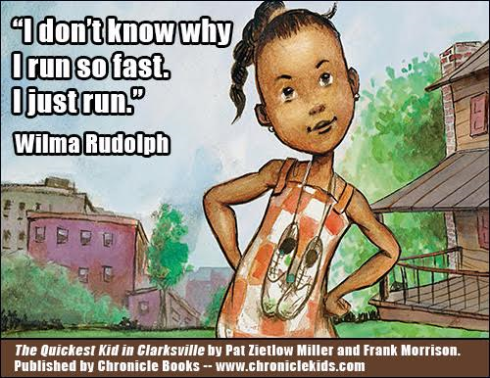
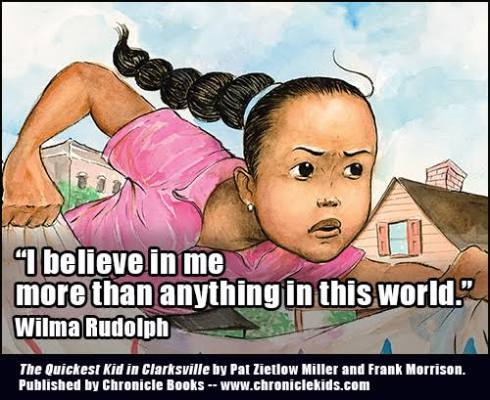
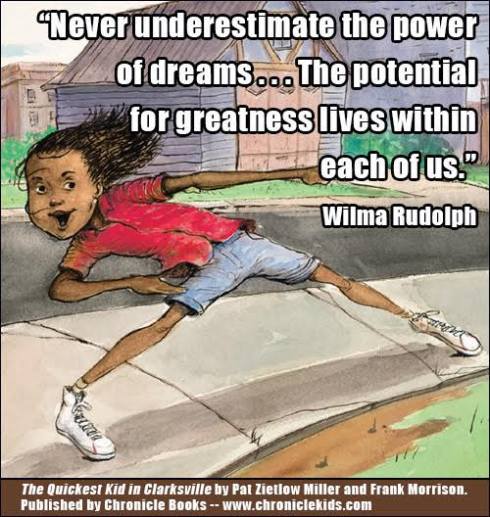
As I researched, I found great quotes by Wilma that apply to any era. Here are a few:
Thank you, Pat! Sometimes agents and editors advise writers, “This story needs another layer.” You found yours in historical fiction!
I’m giving away a copy of this spunky book! Just leave a comment to enter and a winner will be randomly selected in early March!
I find it fascinating when kidlit authors can hop into other genres. My mind is perpetually caught in 2nd grade so I could never envision writing young adult novels. But as my agent reminds me, never say never. Clever, Joan, ever clever.
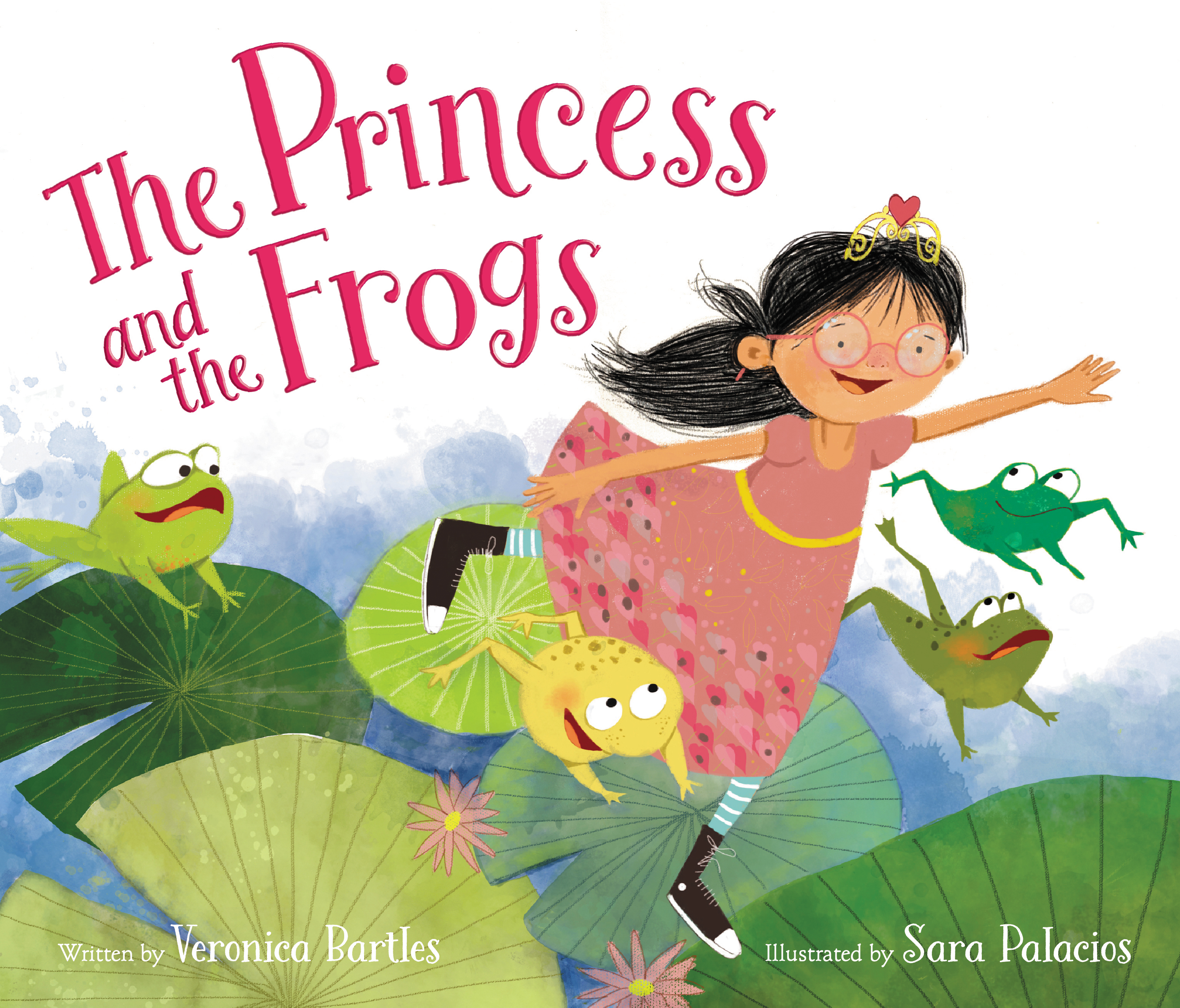
 Veronica Bartles is one of those age-group-jumping frogs. Err, I mean authors. Sorry, I’ve got froggies on the brain because today she’s revealing the cover of her upcoming picture book THE PRINCESS AND THE FROGS (Balzer + Bray), illustrated by Sara Palacios. And GET THIS–the idea for the book came from her participation in PiBoIdMo. It’s another success story!
Veronica, you write YA novels! And now, a picture book! How difficult was it for you to write for a much younger age group?
Well, I’ve been accused of being very young at heart, so luckily it’s not too difficult for me to slip into a younger voice. But there’s definitely a shift between writing YA novels and picture books. I wouldn’t say one is harder to write than the other, but writing a picture book is definitely not easier than writing a full-length novel, just because it’s shorter. You’d think (at least, I used to think) that it would be a lot harder to write a 50,000-word novel than a 500-word picture book, because the novel has 100 times more words. But with a picture book, every single word counts. When you have only 500-700 words (or less!) to tell a story, with fully-developed characters, plenty of conflict, and a plot that keeps an audience’s attention through multiple re-readings, even the smallest word choice questions make a difference.
Although I can usually jot down a picture book first draft in a few days, while it takes a month or more to finish a YA novel’s first draft, I discovered that the revision process is so much more intense for my picture books. When all is said and done, writing and revising a picture book takes as long as it takes to write and revise a full YA novel. (Maybe even longer.) That was definitely something that took some getting used to.
OK, now I’m really going to test your YA loyalty! How is writing a PB “better” than writing a novel?
Tough question!
I think the best part about writing a picture book is that I can be surprised by the final story too. Writing YA is really fun, and I absolutely make friends with my characters by the time we reach the end of the story together. But since I write all the words, there isn’t anything in the final novel to surprise me. With THE PRINCESS AND THE FROGS, my words only tell half of the story. The rest is the work of my fabulous illustrator, Sara Palacios. I love the way her pictures and my words fit together to tell a story better than either of us could do on our own.
What was it like when you first saw Sara’s illustrations?
Way back before Sara was officially signed on as my illustrator, my editor sent me some sample artwork with the most adorable frogs you’ve ever seen, and I was immediately smitten. When I got the word that Sara had agreed to illustrate THE PRINCESS AND THE FROGS, I saved those frog pictures as the background wallpaper on my phone, so I could look at them several times a day. Of course, this made waiting for the official illustrations just a teensy bit harder, because I knew something absolutely fabulous was coming.
So I started following Sara’s Facebook page, watching for any hints of frogs and princesses in her artwork.
One day, she posted a picture of her desk with several sketches for the book she was currently working on, and up in the corner of the picture, there was a pencil sketch of the most adorable little girl I’ve ever seen. I remember thinking, “I want Princess Cassandra to look just like that.” And I’ll admit, I was kind of sad to see this perfect princess in a pile of sketches for someone else’s book. But a couple of days later, my editor, Kristin Rens, emailed me some rough, preliminary sketches of Sara’s concept art for Princess Cassandra … and it was the sketch I had fallen in love with from her Facebook post!!! I sent my daughter outside to do lots of cartwheels for me in celebration. (I’ve never had good enough balance to pull off a proper cartwheel, so I always have to designate a proxy cartwheel performer when celebrations call for one.)
What suggestions do you have for MG or YA authors who want to take on a PB?
Read lots and lots of different kinds of picture books to familiarize yourself with the PB voice. Read them aloud, so you can hear the rhythm of the narrative, even in the books that don’t rhyme. Read them to small children (if you don’t have small children of your own, you can always volunteer to read for story time at your local library), and pay attention to the way they interact with the books. And don’t be afraid to use big words. Kids love creative vocabulary choices!
Also, if possible, make friends with some illustrators. Their critique is invaluable when you’re trying to write a book that’s both fun to read and still leaves enough room for the illustrator to tell her part of the story.
THE PRINCESS AND THE FROGS sounds like an adorable fractured fairy tale, where a princess loves frogs so much, she can’t help kissing them. What was your inspiration for this one?
Well, in November of 2010, I was gearing up for NaNoWriMo (National Novel Writing Month). I’d written my first YA manuscript during NaNoWriMo in 2008, and I’d attempted to write another one (but failed miserably) in 2009, so I felt like I had to “win” again in 2010 to redeem myself. But I was querying that first YA manuscript, knee-deep in revisions on other YA manuscripts, and I didn’t have any great ideas for the next big thing. The thought of subjecting myself to NaNoWriMo made me want to curl up under my desk and sob. So when one of my friends posted a link to something called PiBoIdMo (Picture Book IDEA Month!), I decided I would do that instead. Come up with 30 ideas in 30 days? How hard could it be?
I didn’t actually intend to write picture books, but I wanted an easy way to give myself a writing win, and I told myself that coming up with thirty PB ideas was sure to spark my brain and give me plenty of ideas for YA manuscripts as well. But ideas don’t always come just because you want them to!
Suddenly, it was almost the end of the month, and I still had a nearly-empty PiBoIdMo idea notebook. But I had started collecting query rejections on my YA manuscript, KISSING FROGS, and I desperately needed some kind of validation. I was NOT going to let this challenge beat me, so I started looking everywhere for the slightest glimmer of an idea. And as I thought about my “failed” novel (I had almost TEN whole rejections!!) I started to wonder, “Well, what if the princess didn’t WANT that clichéd Happily Ever After? What if she wasn’t looking for a prince? What if she really just wanted a frog? But what if she loved frogs so much she couldn’t help kissing them goodnight? What if the poor princess had a castle full of princes, all proposing marriage, but really just wanted a pet to love? By the end of the week, my PiBoIdMo idea book was brimming with ideas for fractured fairy tales, including two or three ideas for YA novels.
And I fell in love with a spunky Princess Cassandra, who wanted a frog, not a prince.
So let’s meet Princess Cassandra and her beloved froggies!
You know I’ll be first on line to buy this one. I’m a frog fanatic. (Which I tend not to reveal because everyone starts buying me frog-themed gifts. I’ve got a big box of ugly porcelain frogs, hidden away. Maybe I’ll try smooching them into royalty!)
Thanks, Veronica, for revealing your cover here today. Congratulations!
Princess Cassandra and frogs are coming via Balzer + Bray on November 15, right smack dab in the middle of PiBoIdMo 2016. Be sure to hop back here then to win a copy!
 You’re a lovely person. Simply charming. I mean that, I really do. You read my blog and leave nice comments and buy my books and write like you can’t go wrong. But I have to tell you:
“It’s not you. It’s me.”
In short, that’s what a literary rejection means. It’s not about YOU. Remember, YOU are lovely! It’s about the editor and whether the proposed project fits with her taste and imprint list.
Subjective, it’s all subjective! One editor’s rejection is another editor’s next book!
But editors and agents often provide writers with rejection statements that we want to understand. We feel the need to analyze, to determine what we can do better. But don’t over-analyze. Sometimes a rejection is just a way of saying “no, it’s not for me.”
Here is a list of common rejections heard by picture book writers (and other writers), plus an interpretation of what they mean. (Note that I said “interpretation”! Your mileage may vary.)
“It feels familiar.”
The editor is reminded of another book (or books) while reading your manuscript, but he can’t quite put his finger on it. Maybe it’s the character, the theme or the structure, but it’s impossible to pinpoint. In short, the story doesn’t feel unique enough. The editor doesn’t think it will stand out in the marketplace. There’s too much similar competition. If you wrote about a common theme (new sibling, moving to a new house, first day of school, etc.) without a fresh new twist, this could be the problem.
“It’s too slight.” or “It’s too one-note.”
The editor feels your story doesn’t have enough meat to it. It may be lacking a universal emotional theme (friendship, being yourself, perseverance, etc.) or a clear story arc. The editor may feel there isn’t enough going on to encourage re-readings. The story feels more like a one-line joke than a fully fleshed-out tale. The main character may not have struggled enough before finding the resolution, which is sometimes why an ending can “fall flat”. Also rejected as “needs more layers.”
“It’s not right for our list.”
Every imprint within each publisher has a specific “style”. Some are commercial, some are literary, some are message-driven, some are wacky and humorous. Know which imprint publishes what.
“It’s too similar to…”
Your story competes too closely with a book on the editor’s list or a wildly popular book by another publisher that’s already in the marketplace.
“It’s not right for us at this time.”
See above. They might have projects in the hopper that compete too closely with what you submitted. (You submitted a story about a bowling ball. They just signed a bowling ball book! What are the odds???) They may have recently contracted multiple projects and no longer have room on their list. They may be moving away from “older” picture books into the younger set (ages 2-5 vs. 4-8). Unfortunately, this rejection is also used as a polite catch-all or a form rejection.
“It’s too quiet.”
The imprint you submitted to might not publish literary fiction. The editor feels your manuscript doesn’t have a strong hook, something that will make your book marketable. They don’t feel it will stand out in the marketplace. It cannot be easily summarized into an elevator pitch, which is what their salespeople will use to market the book to stores, schools and libraries. It’s not a commercial or high-concept story.
“It’s too commercial.”
The imprint you submitted to might not publish commercial fiction. Commercial books have a strong marketing hook, are often high-concept (can be boiled down to an immediately understood, succinct statement), have a clear plot struggle and appeal to a wide range of readers. Literary fiction features artistic prose and often contains an internal conflict and more meandering plot.

“It doesn’t resonate with me.”
This is really a case of “It’s not you. It’s me.” The editor may think the story is well-written and even enjoy it, but it isn’t tugging at her heartstrings. Being an editor is like dating, like finding a potential mate—the story has to light something within her to want to devote passion and commitment to it. Remember, the editor has to spend two or more years with your story, bringing it to life. They need to feel sincerely attached to it. You want them to LOVE it, you want them to be EXCITED so they can create the best book possible. Examine your emotional theme—is it strong enough?
“I didn’t quite connect with this in the way I’d hoped.”
See above. The editor may have liked your concept and pitch, but not the execution of the story. Again, the story isn’t tugging at his heartstrings. Examine the POV, voice and the emotional theme (often referred to as a “layer”). A revision might be necessary…or not. Another editor may connect. Also rejected as, “It doesn’t have that WOW factor” or “I’m not getting that YES! feeling.”
“This needs a stronger voice.”
Voice is the unique way an author combines words and strings together sentences. It is your story’s personality, its manner of expression. It’s the difference between “Oh, shucks!” and “Oh, slippery slush!” (Little Red Gliding Hood) It’s the difference between “Charmaine’s showing off” and “Charmaine’s strutting hard enough to shame a rooster.” (The Quickest Kid in Clarksville) It’s the difference between “Pancake raced away” and “Pancake rappelled down a rope of linguini.” (Lady Pancake and Sir French Toast)
Go ahead and play with your words—use stronger verbs, alter the sentence structure, use alliteration, internal rhyme, onomatopoeia and uncommon words. Heck, make up a word every once in a while! Think of voice the way a poet thinks about meter—there’s a certain beat that the reader can dance to.
Pretend YOU are the main character. How would he or she TALK? Does the way you’ve written the story—the cadence of the words—match the character, the setting, the situation?
“There’s no current market for this.”
Your story’s subject matter and/or theme is either too popular or too obscure.
Remember when vampires were all the rage in YA? Same thing with pirates in picture books. There were a slew of well-received books featuring gangplanks that sold gangbusters. (Hey, there’s “voice” again!) But then that ship sailed. The market got soaked with pirates. So guess what? Editors didn’t necessarily buy a lot of pirate titles because there was too much existing, well-established competition. But everything is cyclical. I spot new pirate books on the horizon, captain! Land, ho!
Also, your manuscript might not be a picture book because it’s too long or too descriptive, yet it doesn’t fall neatly into another kidlit category, either.
Form Rejection vs. Personal Rejection
Most will send a form rejection. There’s just not enough time in the universe—or even in the flux capacitor—to personally respond to every manuscript. But if you receive a personal rejection, the editor or agent sees something promising. You haven’t hooked him, but he sees potential. Think of it as encouraging. You’re on the right wave. Just keep swimming; just keep swimming.
On the other hand, getting only form rejections doesn’t mean you DON’T have potential. It just means the editor or agent is crunched for time.
I mean, imagine this is what gets dumped on your desk every day!

One thing you should know: if an agent or editor wants to see more of your work, they will ask. No need for interpretation; it will be there in black and white. If they complimented your story but did not ask for a revision, DO NOT send one anyway thinking they just forgot to ask. If they want it, they WON’T FORGET. And if you send something they didn’t ask for, THEY WILL REMEMBER.
Let’s face it, the fact that you’re even receiving rejections is good. Yes, GOOD! You’re putting your work out there. And the sting of each rejection will lessen with every new one you receive. So let them pile up. Read ‘em. Move on. You WILL get rejections for the rest of your life if you’re a writer. Bottom line: learn to live with them, their brevity and their occasional ambiguity. Ever onward.
And, in case you forgot, you’re a lovely person.
Been snowed in this week and going stir crazy?
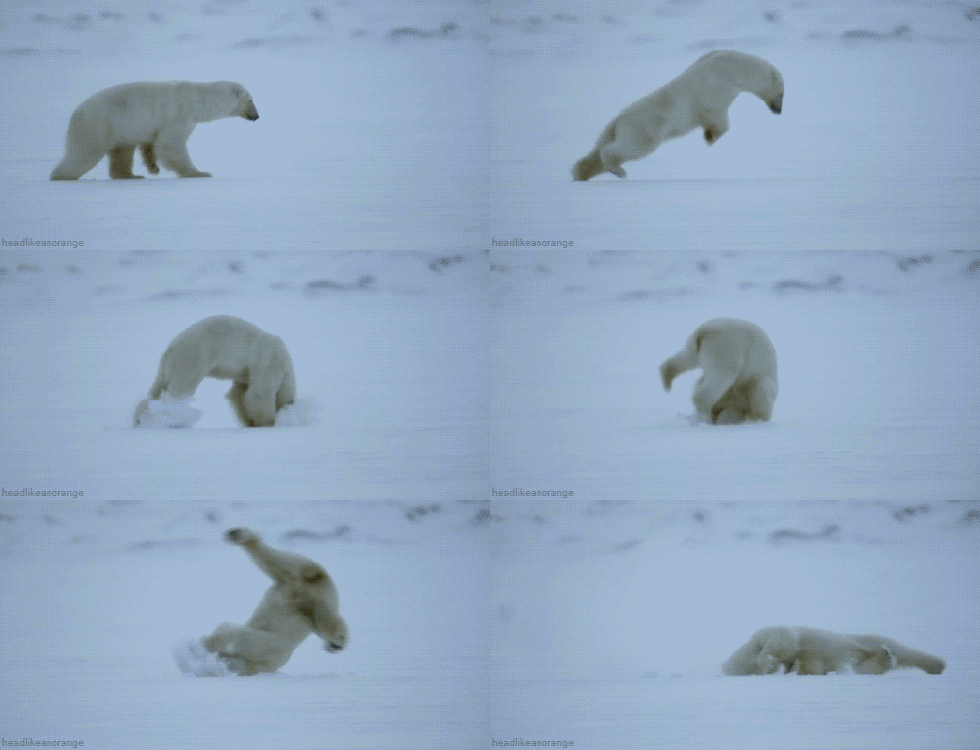
Yowie! I think you may have fractured something there, buddy.
Speaking of fractures, all along I’ve been calling LITTLE RED GLIDING HOOD a fractured fairytale, but I think I’ve been WRONG. Yes, folks, I’m admitting my mistake. Somebody turn up The Biebs!

LITTLE RED is actually a fairytale MASH-UP. (This is probably a sub-segment of a fracture, like a bone chip.)
I didn’t merely retell LITTLE RED, I inserted a flock of fairytale and nursery rhyme characters into a whole new story starring Red and The Big Bad Wolf.
During revisions, editor Heidi Kilgras asked me to create a chain reaction after the boy cried “Wolf!”. I immediately whipped this up, which Troy Cummings illustrated brilliantly:
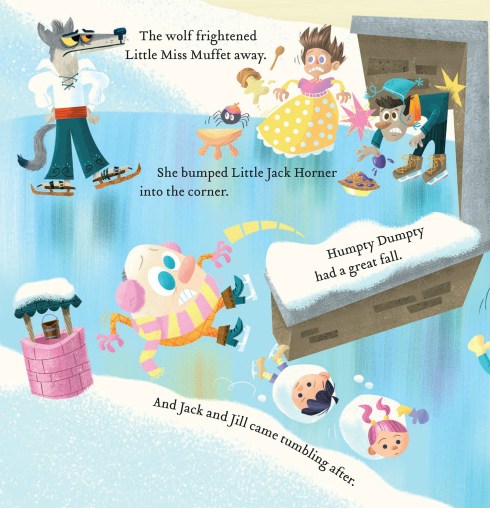
I’m wondering if maybe I haven’t marketed this book correctly. Do people think it’s the same story as the original, just taking place on ice??? No, it’s so much more than that!
Again, self-doubt creeps into the creative’s mind. Self-doubt, which I talked about last week, happens not just when you’re writing, but through every part of the book-making process…even when the process is over! I still think self-doubt is healthy, as long as it’s not overwhelming or paralyzing. Those slices of doubt help you create a better book…and perhaps also help you market the title more effectively!
So now I’m doing the mashed potato.

Oh wait, not THAT mashed potato. I’ll leave that for an alien book.
OK, enough hijinks (which is a FABULOUS word for a picture book text)…onto the final winners of the PiBoIdMo daily prizes. I will be emailing the remaining winners (from this week) later today to arrange delivery!
Day 21: Nancy Tupper Ling Winner
LANE ARNOLD (Double Happiness)
Day 22: Anna Staniszewski Winner
CAROL GWIN NELSON (Power Down, Little Robot)
Day 23: Katy Duffield Winner
SELENA SPAIN (Loud Lula)
Day 24: Jesse Klausmeier Winner
ANNIE CRONIN ROMANO (Open This Little Book)
Day 25: AJ Smith Winner
ROBYN CAMPBELL (Even Monsters)
Day 26: Pat Zietlow Miller Winner
LISA CONNORS (Share the Bread)
Day 27: Kelly DiPucchio Winner
AMY BRADSHAW (Everyone Loves Bacon)
Day 28: Paula Yoo Winner
CHRISTINE RODENBOUR (Twenty-Two Cents…the book, not $0.22!)
Day 29: Arree Chung Winner
SARA WEINGARTNER (Ninja!)
Day 30: Kim Norman Winner
KIM PIDDINGTON (This Old Van)
Congratulations to all the winners…and that includes all those who completed the 30-ideas-in-30-days challenge. Remember you can honor your gumption (ooh, another great word!) with a prize at the PiBoIdMo CafePress Shop! Like this snazzy mug! Every purchase via our link makes $3.00 for RIF (all proceeds).
In 2015, PiBoIdMo donated $230.39 to Reading is Fundamental, helping to put new books into the hands of underprivileged children. A sincere thank you to those who snapped up PiBoIdMo goodies. You did a good thing.

Thanks to everyone for participating! That’s all, it’s OVAH!
Now I think I’ll go hibernate with this guy!
Let’s talk about text, baybee…
Let’s talk about you reading…
Let’s talk about all the word play & the rhyme schemes that could be…
Let’s talk about TEXT!

Photoshopping by Jason Kirschner
I was feelin’ very Salt-n-Pepa this morning as I salted and peppered my omelet. This little ditty would make an excellent segue into a discussion of picture book text, right?
OK, so you talked me into it! I’ll talk about text!
If you’re writing picture books, have some fun with the text, with the words you choose. Let them tumble over the tongue. Use alliteration, internal rhyme and challenging vocabulary. Yes, you can insert difficult words. Here is a list of surprising words that have appeared in my books and manuscripts:
- formidable
- highfalutin
- desolation
- flibbertigibbet
- mayhem
- exceptions
- exceedingly
- sluiced
- schmutz (yes, schmutz!)
Don’t be afraid to sprinkle in more difficult words. There’s context to help the child (and parent/caregiver) figure it out, in the form of words and pictures.
But please note I said SPRINKLE–like salt and pepper, use them sparingly. Let them enhance, not overpower.
Now let’s move onto more PiBoIdMo Winners!
Day 11: Joe McGee Winner
CHAD WONSIK (Peanut Butter & Brains)
Day 12: Denise Fleming Winner
VAL MCCAMMON (book)
Day 13: Sarvinder Naberhaus Winner
AMY HOUTS (Boom Boom)
Day 14: Julie Gribble Winner
LISA CHARLEBOIS (KidlitTV Prize Pack)
Day 15: Carter Higgins Winner
ANNA LEVIN (picture book critique)
Day 16: Katya Szewzcuk Winner
POLLY RENNER ( “Kat” mug)
Day 17: Ryan Hipp Winner
HEIDI YATES (original sketch)
Day 18: Liza Woodruff Winner
CAROL JONES (Twelve Days of Christmas in New England)
Day 19: Ame Dyckman & Adam Lehrhaupt Winner
PATRICIA ALCARO (books, critique and possibly lunch LOL)
Day 20: Carolyn Fisher Winner
DEBORAH ALLMAND (Skype session)
And bonus! I forgot to give away Tammi Sauer’s second prize, a picture book critique. That winner is:
MARY WORLEY
I’ll be emailing y’all shortly! Congratulations!
If you’re seeking to understand the significance of yesterday’s Newbery Medal being awarded to a picture book, grab a cuppa and settle in.

Photo courtesy of author Carter Higgins from AlltheWonders.
Five years ago, The New York Times published an article that caused consternation among picture book creators: “Picture Books No Longer a Staple for Children.” In fact, the words within plunged a dagger directly into our hearts.
Parents have begun pressing their kindergartners and first graders to leave the picture book behind and move on to more text-heavy chapter books. Publishers cite pressures from parents who are mindful of increasingly rigorous standardized testing in schools.
It felt as though No Child Left Behind was leaving we authors and illustrators behind. A children’s bookseller was even quoted as saying that picture books sat languishing on their shelves, dying sad little deaths.
OUCH.
As a parent of young kids, I saw it happening. I’d be at the library and witness tots being steered toward thicker books that didn’t have pictures, children being told they’re smarter than 32 pages. Parents suggesting, “You don’t want this,” while in the picture book section. The word “this” dripping with disdain. At the school, parents bragging about their 2nd graders finishing the entire Harry Potter series.
And I remembered being in 2nd grade myself and being told to abandon picture books…and being devastated.
What parents were missing, and some may still be missing, is that chapter books, while perhaps longer, aren’t necessarily more “difficult” than picture books. In fact, I just had a discussion with my agent this week about the pros and cons of revising a manuscript and turning it into an early chapter book series. Since these books are for newly independent readers, the language is far simpler to allow autonomy. I expressed my concern over having to simplify my sentences and vocabulary. I felt my word play and structure would be limited. That’s right, writing a chapter book would force me to be less complex in my storytelling. (I should emphasize I’m talking about early chapter books here, not middle-grade novels which are for older children and are the standard Newbery fare.)
Back in 2010, the economy also played a role in what some saw as the picture book’s demise. The recession lingered and families had less discretionary income. Some publishers reported signing fewer picture book projects. No one was quite sure what to make of ebooks and iPads competing for kiddie eyeballs in the coming years, either. Would everyone migrate to digital books and snub hard copies?
Fast forward five years. Juvenile ebook sales have actually declined (by 1.4m units in 2014, according to Nielsen). iPads did not replace a parent’s lap and a physical book. The economy bounced back and children’s books have emerged as the bright spot in publishing. “The Children’s/YA market in 2014 represented 36% of the overall print market…slightly bigger than the adult fiction market,” reports Nielsen. Moreover, the price of children’s books has remained unchanged for over a decade. In other words, picture books are a terrific financial value. Now let’s talk about their intellectual, artistic and just plain JOYFUL value.
With yesterday’s announcement of Matt de la Peña and Christian Robinson’s LAST STOP ON MARKET STREET winning the Newbery Medal, an honor typically bestowed upon middle-grade novels, librarians are sending a clear message that debunks the NYT article of yore:
PICTURE BOOKS ARE IMPORTANT CONTRIBUTIONS TO CHILDREN’S LITERATURE.
They are not simple little books with cute drawings. They are art. They are motion and emotion. They introduce children to the complexities of the world around them in a charming, engaging manner. They teach life skills while they entertain. They relay a story both visually and contextually, challenging children to solve their playful puzzle. They introduce children to irony and satire, history and innovation, wit and wisdom. They expand the imagination and teach storytelling skills. And they do all this while amusing parents, grandparents and caregivers as well. How’s that for a nifty little package?
They’re for ANY AND ALL AGES. ANY TIME. ANYWHERE.
As Dr. Seuss once said, you can read them in a box. You can read them with a fox. (Or was that something to do with breakfast?)
So bravo to Matt de la Peña, Christian Robinson and the ALA. We all won yesterday, folks. WE ALL WON.
Historical notes: The Newbery Medal was awarded to a picture book once before in 1981, although A VISIT TO WILLIAM BLAKE’S INN can be categorized as an illustrated collection of poetry and, at 48 pages, not necessarily a traditional picture book. Other picture books have received Newbery Honor recognition: MILLIONS OF CATS (1929, prior to the Caldecott), FROG & TOAD TOGETHER (1973), DOCTOR DE SOTO (1983), SHOW WAY (2006) and DARK EMPEROR AND OTHER POEMS OF THE NIGHT (2011).
I’ve done several dozen classroom Skype visits and I keep refining my techniques. (Yes, I have actual techniques!) I found that many author friends were nervous about doing Skype visits and I’m here to tell you—they’re the best thing since sliced smoked-meat knishes from Caplansky’s! (What can I say, I’m hungry and I just saw them on Food Network.)
Skype visits allow you to stay at home while spreading the joy of reading all over the world! I’ve visited Sicily, Brazil, Kuala Lumpur, and yes—even Canada—from the comfort of my laptop.
Here are my best tips for planning a fun and memorable author Skype visit…

FOR AUTHORS
Create anticipation.
I love Skype visits because I don’t have to get dressed up. I can stay in my jammies all day! I tell the kids as a children’s book author, pajamas are my “office uniform.” No suit and tie or fancy-schmancy pearl necklace for me!
I have several pairs of cute themed jammies and I let the class predict which ones I’ll be wearing for their visit. Some teachers use this as a math exercise, plotting the results on a chart, like this Kindergarten:
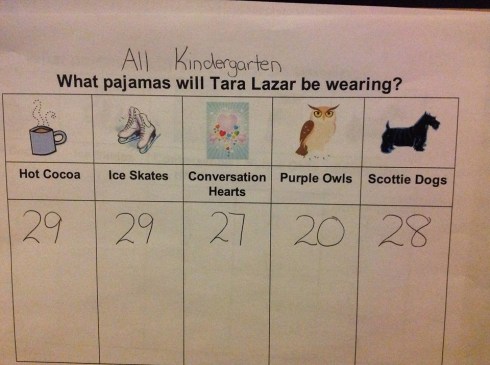
And I wore purple owls that day!
Other classes have even worn jammies to school on the day of my visit!
Sometimes a teacher will read one of my other books prior to the Skype. Suggest something the class can do in advance to create anticipation! Goodie, goodie gumdrops!
Add magic and secrets.
Besides reading my book, I perform a magic trick during the visit, but I won’t tell you what that is. A magician never reveals her secrets.
But, I promise to tell the children a secret about the book once we’ve read it. Every book has at least one. Mine typically have to do with the book’s creation. For instance, I let the illustrator choose what kind of animal NORMAL NORMAN should be. I was giddy with glee when S.britt made Norman a purple orangutan! And the character “Mr. Scruffles” is named after my daughter’s favorite stuffed animal. Speaking of stuffed animals…

Sterling Children’s Art Director Merideth Harte and Executive Editor Meredith Mundy with NORMAL NORMAN. He’ll be joining me for Skypes soon.
Be spontaneous.
When I visited a school in Florida, it was snowing here and most of those children had never seen the fluffy white stuff. So guess what? I took my laptop outside! I threw a few snowballs at my husband’s car. They loved it! (Husband, not so much.)
I’ve showed the kids my bookshelves, made popcorn and even interviewed my own children. There are a ton of fun things to do—you’re only limited by your imagination. And if I know you, you have one outrageous imagination!
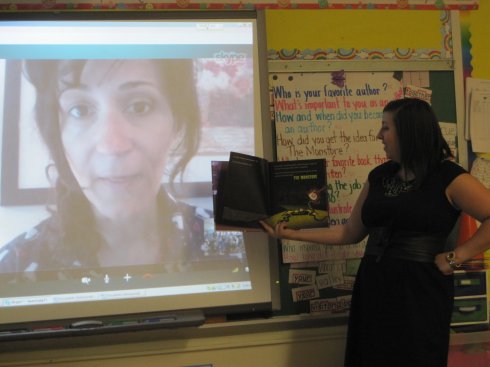
Ensure the teacher/class has the book you’re reading.
It’s difficult to hold up your book for the webcam. And if you display an electronic copy from your screen share, the kids aren’t seeing YOU. (I make tons of funny faces while I read dramatically.)
It’s preferable for the teacher to have a copy (or two or three for a large group) to show to the kids as you read aloud. Do character voices! Comment on the illustrations!
Back in the 70’s when we viewed slide shows at school, the recording beeped, signaling the teacher to forward the slide. Now I beep for the teacher when it’s time to turn the page! (Because sometimes I comment A LOT on the illustrations.) Plus, the kids get a kick out of it.
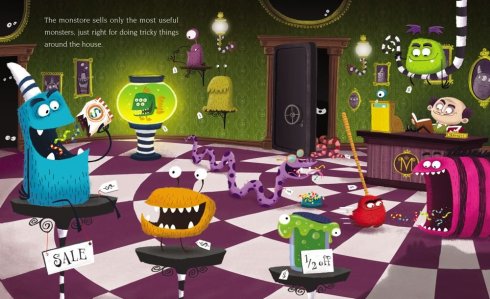
How could I NOT comment on this page?
Have the kids participate.
I prompt the kids to knock when reading THE MONSTORE at the “knock five times fast” part, which happens twice. I also ask them to read the repetitive refrain with me. With LITTLE RED GLIDING HOOD, I ask students to listen for the other nursery rhymes and fairy tales and count how many there are. Other authors have kids act out character parts. Create some way for the kids to interact with your story.
Have the class develop author questions prior to the visit.
I used to open the floor to questions at the end of the visit, but then I might have kids asking repetitive questions, or, with the preschool and Kinder-crowd, just making statements. (My favorite: “My grandpa has hair in his ears!”) It works best for the class to arrange questions ahead of time. I ask them to come up with about 4-5. The teacher can pick students to ask the questions.
Reading my book, performing my schtick and answering five questions usually takes up the entire 20-minute time slot. (I’ve been known to go over!)
Provide a follow-up activity.
Email the teacher afterwards with a thank you and an activity sheet for the class to do following the visit. (Or you can email the activity in advance.) Some authors also send bookplates, bookmarks or other SWAG to the class.

Coordinate your visit with special days.
Is your book about doughnuts? Well, promote Skype visits on National Doughnut Day! Ninjas? International Ninja Day! Of course, there’s also World Read Aloud Day and International Literacy Day for non-doughnut-and-ninja books. (“The Doughnut Ninja” should be my next project.)
Don’t limit yourself to an age group or group size.
I write picture books but I’ve done Skype visits for middle schools and high schools. With older students, I share writing tips and talk about life as a children’s book author. I adjust my presentation for the age group.
Many schools display the Skype session on a large screen or Smartboard, so you’re really not limited to the size of group you can accommodate. All the kids can see you well. I’ve Skyped with over a hundred students at once and it’s been no different from a class of 18.
Ask the teacher to share your info with parents and other teachers.
You’d like the parents to know that you visited, right? Ask the teacher to provide that info in their class newsletter or other missive. Some teachers will even send home a book flyer so the parents can purchase your books. Create one to have ready should they request it.
FOR TEACHERS AND LIBRARIANS
I’m not the only author who will do Skype visits for free. Check out Kate Messner’s list and education.microsoft.com for the Skype Education site. Subject matter experts are also available.
Have the book ready the day of the Skype visit.
Ask the author if you should read the book with the class in advance or not. I often have the teacher read one of my other books prior to the visit.
Test out your Skype connection in advance.
Many authors will visit via alternative services, like Facetime or Google Hangout. Just ask.
Create an activity the students can do prior to the visit and/or afterwards.
Ask the author if they have ready-made activities or suggestions.
If you enjoyed the visit, let others know.
Tell teacher friends, suggest that author for an in-person visit or a paid Skype seminar, write a testimonial or tell the parents about the visit. Do whatever feels right. Authors are taking time out of their day to do these visits and they appreciate the support.
So, do you want to Skype with me for free on World Read Aloud Day on February 24th? I’m available for any grade or preschool and can adjust my content to meet your needs.
Just email me at tarakidlit at gmail dot com to schedule it! Should I run out of slots on the 24th, I’ll gladly do a Skype visit another day that week.
I also do more in-depth Skype sessions to teach writing concepts, for a nominal fee.
If you have questions, suggestions or knish recommendations to add, please leave them in the comments.
SKYPE ON!
Did you know that PiBoIdMo is one of Oprah’s favorite things?
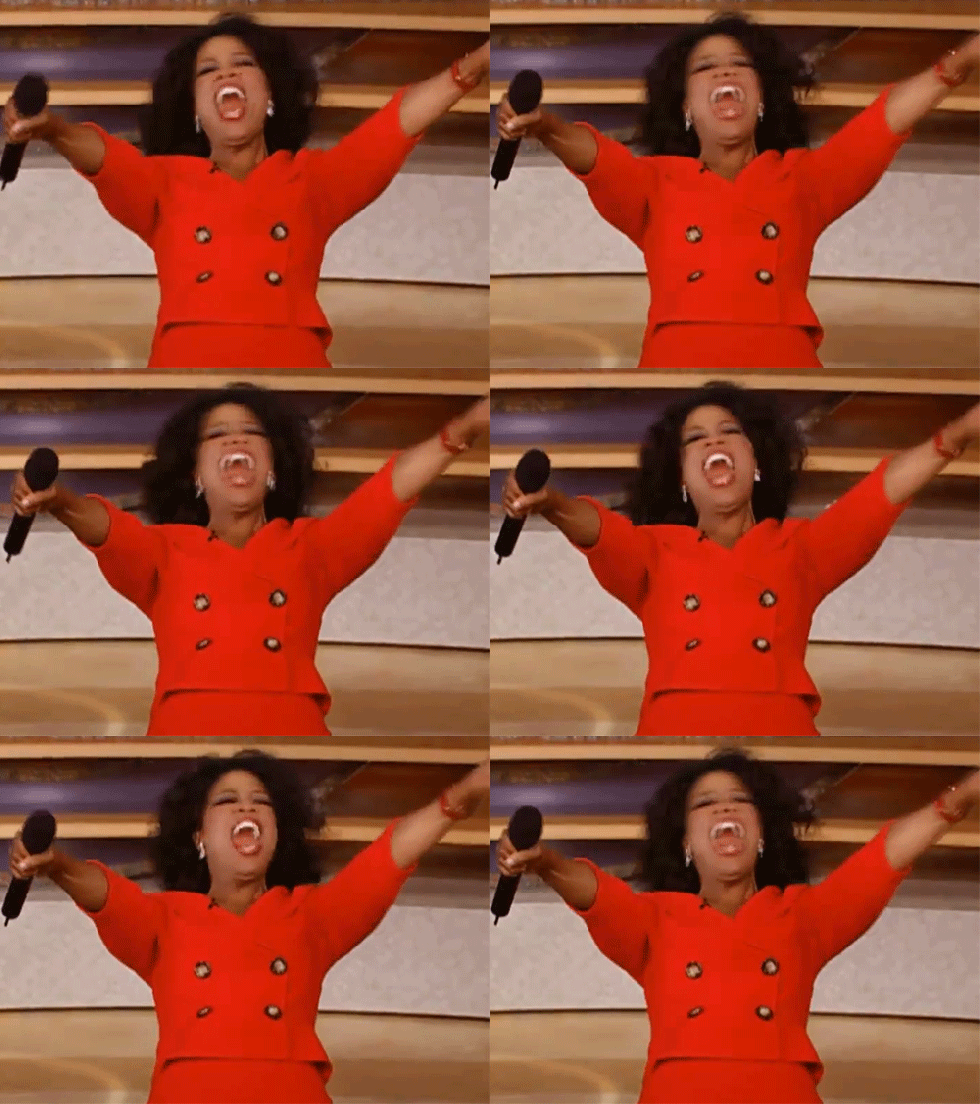
Totally. Even Amy Poehler’s head is exploding.
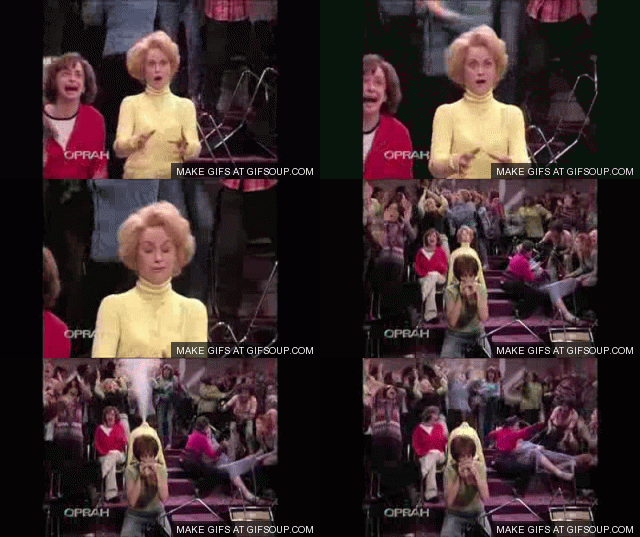
And lawyers are sending cease and desist letters. Whoa. Those Oprah folks work fast.
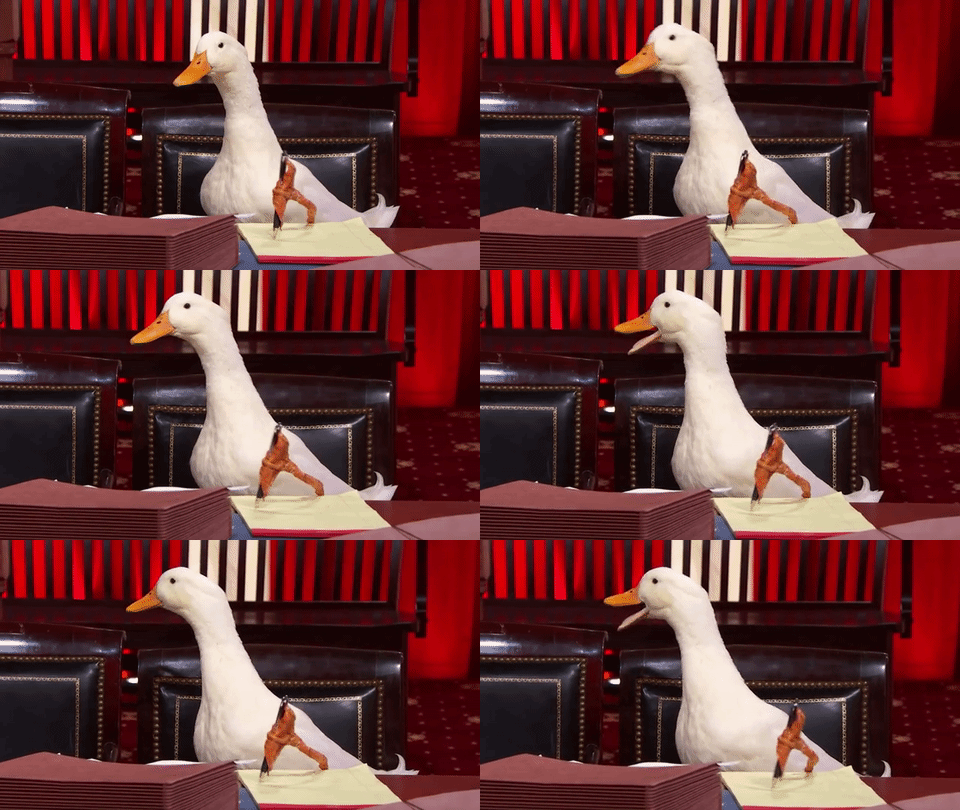
(This is obviously her kidlit practice lawyer. I hear he also works for Aflac.)
Okay, while PiBoIdMo might NOT be one of Oprah’s favorite things, or something Oprah has even heard of…I know it is one of YOUR favorite things.
And so, without further ado (or flying feathers), here are the 13 GRAND PRIZE WINNERS for PIBOIDMO 2015! Please congratulate them!
CARRIE FINISON
ELLEN SIRIANNI
DEBORAH HOLT WILLIAMS
MARTI JOHNS
LYN MILLER-LACHMANN
KEILA DAWSON
JENA BENTON
KASSY KEPPOL
DANIELA WEIL
PAMELA BERKMAN
JENNIFER BOWER
TONY WILLIAMS
KIM ERICKSON
You may be asking: How were the PiBoIdMo 2015 GRAND PRIZE WINNERS selected?
Every participant who signed the PiBoIdMo Winner’s Pledge was assigned a number based upon the order in which they commented. I then used Random.org to generate 13 random numbers from 1 to 888 (the total number of pledge comments). The numbers were matched to their corresponding name, then I ensured that name was on the PiBoIdMo registration post. If the name had been registered, then I double checked to make sure they had not commented on the winner’s pledge multiple times (thus giving them extra chances to win). If all checked out, the winner was verified. (And they all checked out!)
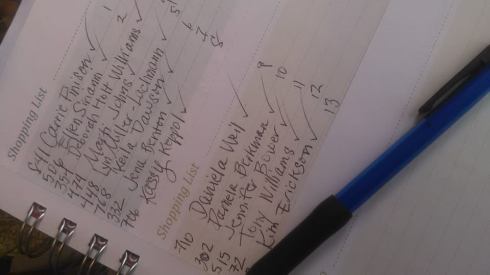
In the interest of full disclosure, I will note that one of the winners is related to me by marriage. It just worked out that way. This is no way influenced the winner selection. It was all done by random selection.
If you are a grand prize winner, please read the following carefully:
I will pair each one of you with a participating agent and contact you via email. You will have until the end of this calendar year to contact your agent with your FIVE best ideas. I suggest you flesh them out into a paragraph each, like an elevator pitch. Something short and snappy. The agent will then provide feedback on which idea(s) may be the best to pursue as manuscripts. The agent may provide short and sweet feedback like a simple “Go for it!” or more lengthy feedback providing suggestions. I don’t know what’s in store for you–but there’s one thing for certain–their feedback will help you determine what to begin writing!
Thank you all for participating this year!
Remember there are PLENTY more prizes to come. I will be giving away all the prizes you saw during PiBoIdMo, nearly 50 of them, through the end of the year. Who knows what you may win! (You get a car! You get a car! YOU GET A CAR!)*
*You will not get a car.
Ooh, tantalizing title for a blog post!
Picture book writers eager to be represented scour the web for info about the tastes and preferences of kidlit agents. Well, stop searching and look no further.
I asked the picture book agents participating in PiBoIdMo as grand prizes to talk about a client’s new or upcoming release that they’re excited about.
And if you’re wondering about PiBoIdMo GRAND PRIZES, they will be announced on Monday, December 14th!
Lori Kilkelly, Rodeen Literary Management
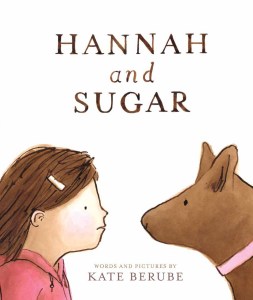 I began representing my own clients 2.5 years ago and, as publishing has a long cycle from sale to publication, have only had two (EARLY BIRD and NIGHT OWL by Toni Yuly!) publish to date. Next calendar year will see 14 of “my” books publish. It’s hard to pick just one but HANNAH AND SUGAR (Abrams, 3/16) is author/illustrator Kate Berube’s debut, sold in a 2-book deal, at auction. I first read about Kate on the blog “7 Impossible Things Before Breakfast.” She and husband Mark live in Portland with their beloved one-eyed wonder-dog, Sugar, the book character’s namesake.
Every day after school, Hannah’s school bus is greeted by her classmate’s dog, Sugar. All the other kids love Sugar but Hannah just can’t conquer her fear of dogs. Then, one day, Sugar goes missing, so Hannah joins the search with her classmates. Will Hannah find a way to be brave, and make a new friend in the process?
Kate worked at Portland’s famous Indie bookstore Powell’s—please consider pre-ordering from your favorite Indie!
Deborah Warren, East/West Literary Agency
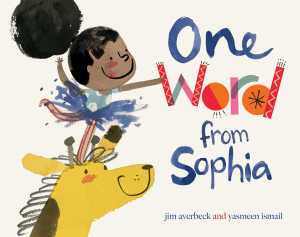 Some of East/West Literary’s clients have excelled in all three PB creator roles, as an illustrator, as an author, and as an author/illustrator. To that end—and in honor of PiBoIdMo—we are proud to highlight award-winning Jim Averbeck and his latest book ONE WORD FROM SOPHIA (Atheneum/S & S), a Kirkus Best Book of 2015, illustrated by Yasmeen Ismail.
Averbeck’s 2015 “must read” IndyNext Top 10 ONE WORD FROM SOPHIA, is about a girl who uses very creative means to ask for a pet giraffe–from her mother (a judge), father (a businessman), Uncle Conrad (a politician) and Grand-mama (who is very strict!). Yasmine’s illustrations brilliantly add another layer to the story. And Jim created a text that engages the audience with well-placed page turns, pacing and performance possibilities, creating a book that has been embraced for its celebration of words.
And it’s been embraced in more than one way! We’re more than thrilled that SOPHIA has just been extended to a 3-book series by his publisher (Margaret K. McElderry/S & S). Look for TWO PROBLEMS FOR SOPHIA and the third SOPHIA sequel, soon! Oh; and how incredibly cool is it that the Northern California Children’s Booksellers Alliance selected ONE WORD FROM SOPHIA as one of two titles to be included in their national, inaugural #Diversity, hand-selling initiative, #MirrorsAndWindows. [Thank you, indies—diverse books DO sell!]
Ammi-Joan Paquette, Erin Murphy Literary Agency
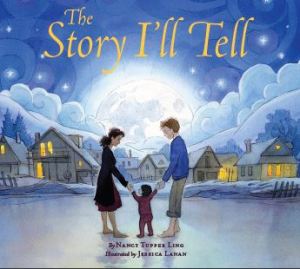 How do you pick just one of your authors’ projects to spotlight? I’m going to circumvent that decision by going with the book that’s been most recently released, Nancy Tupper Ling’s THE STORY I’LL TELL, which is exquisitely illustrated by Jessica Lanan. This book is really a love letter from parent to child, a poetic telling of how that child came to be part of their family.
Words and art alike are unforgettable, and mark my words—this is a book that’s going to be around a long, long time. Don’t miss it!
Kathleen Rushall, Marsal Lyon Literary Agency
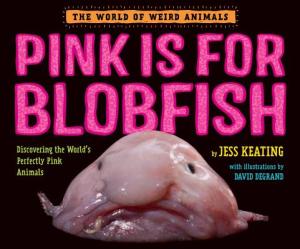 I’m really looking forward to seeing Jess Keating’s PINK IS FOR BLOBLISH hit shelves this February 2nd, 2016 from Knopf Book for Young Readers. Jess’s voice and vision for this project had me excited about it from day one.
In this debut nonfiction picture book, Jess highlights all manner of unusual pink creatures that readers never knew existed. It’s fascinating and funny, but what also makes it so special is that it goes deep. Yes, PINK IS FOR BLOBFISH is full of incredible animal facts, but it also carries a subtle sociological message that pink is not just for girls—it’s for everyone and anyone.
Pink is often associated with princesses, and Jess’s book lets readers know that pink is also the color of monster slugs and poisonous insects. I don’t know about you, but I love that expanded world view!
I admire how Jess manages to engage readers with her humor and fresh voice, provide little-known animal facts, AND deconstruct outdated gender stereotypes—with a clear passion for the material and a wit all her own. And with the talented David DeGrand adding his dynamic, hilarious illustrations, what’s not to love?
Susan Hawk, The Bent Agency
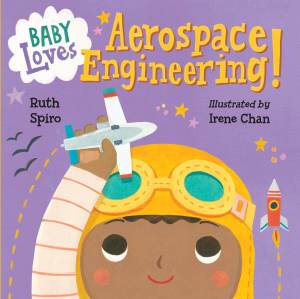 I’m very excited about an upcoming project BABY LOVES SCIENCE by Ruth Spiro, with illustrations by Irene Chan. In the first two books of this picture book series, Ruth explains some complex ideas—Quarks and Aerospace Engineering—in terms so clear that even the very youngest listener can understand.
This is the first project that I sold for Ruth, and the one that she sent me with her initial query. I was very taken with the books, of course, but also with the savvy way Ruth approaches the picture book business; she’s continued to wow me ever since! These books are sweet, gentle and smart, and I can’t wait for them to be out in bookstores and libraries.
The first two are coming in fall 2016—keep your eyes out for them.
Tricia Lawrence, Erin Murphy Literary Agency
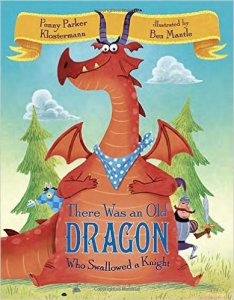 Well, I have to go with Penny Parker Klostermann’s THERE WAS AN OLD DRAGON WHO SWALLOWED A KNIGHT which just won The 2015 Best in Rhyme Award in NYC at the RPB Revolution Conference.
Why I think DRAGON is so special? It’s been a long road to publication for Penny. She’s been working tirelessly the past few years to really learn the picture book craft and to hone her skill. Adding to that, DRAGON is in rhyme, so Penny’s not only had to figure out picture book plot, she’s had to learn poetry and rhyme (not easy) and I think there’s been more days of no big success than there have been days with success.
DRAGON exists because Penny didn’t give up. And now DRAGON has a life of his own. I’m still a bit terrified of him, so here’s hoping he steers clear of me. 😉
Holly McGhee, Pippin Properties
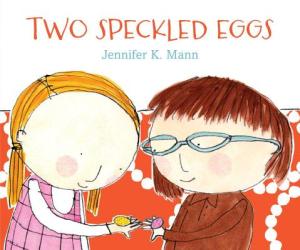 One of our new-ish releases is Jennifer K. Mann’s TWO SPECKLED EGGS, winner of the Washington State Book Award this year; it’s the story of an unlikely friendship that’s sparked when two girls find they have more in common than they thought at first.
Jennifer K. Mann came to Pippin through the slush pile (it really happens!) and this is her second picture book. When her query came in, her artwork immediately caught our attention, and then her letter was so exquisitely written and charming and she had clearly done her research . . . it was a no brainer. Here’s to more well crafted slush-pile treasures!
Lisa Fleissig & Ginger Harris, Liza Royce Agency
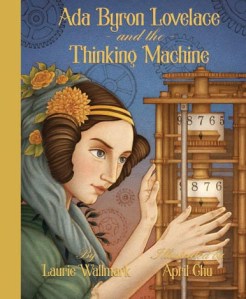 We are both mothers of 1st graders; so, as much as they are moving onto chapter books, picture books are still alive and kicking in our homes. One particular recent publication that stands out is ADA BYRON LOVELACE AND THE THINKING MACHINE (Creston Books, 2015). It’s a biography of the world’s first computer programmer—and she’s a GIRL!
Ada was born two hundred years ago, long before the invention of the modern electronic computer. At a time when girls and women had few options outside the home, Ada followed her dreams and studied mathematics. Especially now with schools incorporating “STEM” in the classroom and empowering girls to develop into strong women, this book hits all the right notes. It is written by Laurie Wallmark and stunningly illustrated by April Chu. Ada Byron Lovelace and the Thinking Machine is not only a remarkable story of triumph, but marks a turning point in our agency—it is our first book to receive THREE STARRED REVIEWS (Kirkus, PW & Booklist) along with NYT praise.
Jodell Sadler, Sadler Children’s Literary

Sketch by Phil Gosier
A recent picture book publication would have to be a newer contract, a two-book deal, for Phil Gosier as an author-illustrator package: SNOW BEAST (Roaring Brook Press, 2017).
Phil marked the quickest pull from my submission bin so far. He’s a huge talent and his cover letter sported part unreliable narrator (sending only to you and will not send out until polished more) and part personality punch (I cry at most Tom Hank movies). But what really called me to his project and what is true of every submission: it’s all about the work, and in this case, his work stood on its own merits: breathtaking, amazing, and professional. SNOW BEAST will be published by Roaring Brook Press in 2017.
Remember, come back on Monday for the GRAND PRIZE announcements. There will be 13 PiBoIdMo Winners to be paired with one PB literary agent each for an email consult about their five best story ideas.
Good luck, everyone!
by Tara Lazar
When I first began writing picture books, I’d get hit with an idea—BAM! KAPOW!—and then immediately sit down and start banging it out.

NO. Just NO.
I didn’t stop to think—is this a good idea? Will it make a worthwhile story? I thought the idea would be my only flash and I had to grab it while it was glowing.
Now, I write the idea down. And then I PAUSE.
I let the idea sit in my brain for a while. I might not be actively thinking about it, but I know it’s in there, jiggling around. Bouncing off brain cells, colliding with other unused ideas.
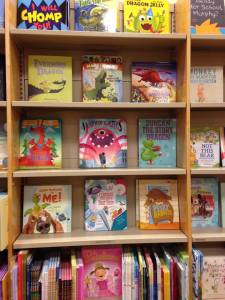
Competition on the shelf.
After the initial incubation period, the first thing I consciously imagine is what might go on the cover. Will that cover stand out in the book store? Will a child make a beeline to my book? I think about the OTHER covers that are also calling to that kid—with race cars and ballerinas and pandas and monsters. Is what I’ve chosen strong enough to compete? If the images that come to mind aren’t appealing enough, I let the idea jiggle ‘round some more. I know I need to add something else.
Eventually, something tells me it’s time to sit down to write. It may be a few days, weeks or even months after the initial strike of lightning. But there’s a gut instinct that kicks in—you can do it now. You’re ready.
I know I already have one piece of the ginormous puzzle that is a picture book.
And what I do is put that puzzle together. Where do I start? Not necessarily at the beginning.
When you’re putting a jigsaw puzzle together, you start where you recognize the image. You find a couple pieces that together make up the balloon in the puzzle. Or the elephant’s trunk. Or the birthday cake. You see something you know is SOMETHING and you work outwards from there.

I do this with my story idea. I begin writing where I recognize that I have SOMETHING SPECIAL.
I may begin jotting down a repetitive refrain that I want to be after certain page turns. I may go straight to the climactic scene. Sometimes, I even begin at the end. I don’t necessarily write chronologically, from opening line to “the end”.
For instance, with LITTLE RED GLIDING HOOD, the primary puzzle piece was the title. The next piece? I wanted the story to include multiple fairy tales and nursery rhymes. I envisioned the mashiest of mash-ups.
Then a scene came to mind. I imagined RED uttering the wolf’s line from The Three Little Pigs: “Little pigs, little pigs, let me in!” Then I saw the wolf tapping her on the shoulder with, “Excuse me, I think that’s my line.” I thought that was hilarious.

So I worked from there.
I had to get RED to the pigs’ brick house. But how? And why? These were the puzzle pieces I had yet to find.
But as the few pieces I did have clicked together, the full vision of the story began taking shape.
This is just something that often works for me. My real advice is not everything you read above but rather this: find what works for you. You can only discover it by seeking out ideas, examining them and, finally, writing. It may take months and years to find what grooves for you. It’s not going to be what necessarily works for me or for anyone else. Your voice is uniquely you and so is the method you employ to get that voice out there.
So you’ve sought your ideas. Now it’s time to examine. And then, write. Like a bottle of shampoo, rinse and repeat (even though you don’t know anyone who washes their hair twice in one shower).
Hopefully the idea-generating will continue beyond this month to become a regular habit. You need the ideas to flow like a bottomless shampoo bottle in order to have something to write, in order to discover who you are as a writer.
Thank you for participating in PiBoIdMo 2015!
The PiBo-Pledge is now closed and next week I will begin picking winners. In the meantime, we’ll have a post from the participating agents and a writer’s holiday gift guide as well. Stay tuned!
Until then, if you enjoyed PiBoIdMo, would you please consider nominating this blog for WritetoDone.com’s annual list of the best blogs for writers? Please be aware that you must nominate an actual blog POST written this year for the nomination to count. Go to writetodone.com/top-10-blogs-for-writers-2016 for instructions on how to nominate. And THANK YOU!





 Writing for Kids (While Raising Them)