You are currently browsing the category archive for the ‘Picture Books’ category.

by Sophie Chawluck
by Heidi Kilgras
Congratulations, PiBoIdMo participants. You made it! Give yourselves a round of applause before reflecting on your endeavor—to generate a bunch of new ideas for picture books, the greatest medium ever! Okay, I’m biased; I’m a children’s book editor! But, honestly…writing children’s books. Could there BE a greater privilege? I don’t think so. Knowing that your words and ideas are entertaining children, sparking their curiosity, creating lasting memories, impressions, and possibly a love of words/ideas/reading, or maybe even stimulating an interest in a subject that will influence their lives? Priceless. You are contributing to the literacy of the planet. You are reinforcing a loving bond between parent and child. And, in the simplest of terms, and no less important, you are delighting a child.
There is something I have to get off my chest. Sometimes children have terrible taste! There are some books that I never would have published in a million years. Bad writing, rotten plot, poor rhyme and meter, hideous illustrations.…And yet, for some reason the book is amusing enough for a child to want to hear it over and over. (“Who published this book and how did it get in my house?”) Even if a book doesn’t pass muster with me, at least I get to witness the joy it gives my son. Who am I to judge? Actually, I am one to judge whether books get published or not. And as such, I have a few tips to offer up.
 You’ve heard this one before: be “original.” I know…it’s really, really hard to be entirely original. So throw in a twist or two or three to surprise the editor and, we hope, the eventual reader. The importance of originality extends to your “voice.” An original voice can make an editor see beyond a story’s flaws, envisioning the rewrites that you most certainly will have to do that could bring you closer to a contract! Think of your “voice” as your “special sauce.”
Have more than just a good idea—respect the craft. Publishers don’t publish good ideas; they publish great stories, wonderfully written (for the most part—see above. Let’s aim high, shall we?). Show your fascination with language. Ignite this fascination in others. Make the words sing. Aim to make the grown-up reading your book aloud seem like the most talented storyteller ever! The writing’s the thing.
On the other hand, don’t forget to leave some stuff out! You can, initially, fill your manuscript with every idea you had to reflect the story in your brain. Then either you (or the editor) will likely need to take some words out. Consider that the art will show things that are mentioned in the text, and even some things that aren’t. Both text and art need breathing room. Sometimes my favorite part of a picture book is the text that isn’t there, but there is a suggestion of what could be there that the reader’s mind fills in. Here is an apt quote (attributed to both Claude Debussy and Miles Davis): “Music is the space between the notes. It’s not the notes you play; it’s the notes you don’t play.”

Where the Wild Things Are and Olivia are two great examples of picture books that have subtext flowing beneath the (minimalist) words. Give the reader moments of discovery, moments of participation. Great art considers the collaborator. Your collaborators are the editor, the illustrator, and, ultimately, the eyes and the mind of the reader.
Lastly, have fun! If you aren’t having fun, what’s the point? I hope you have as much fun generating your own ideas as you do when you are reading the picture books that inspire you. The more inspired you are, the greater chance that your inspiration and delight will reach across the space between book and reader and fill him or her right up.
Good luck!
Heidi Kilgras is an Editorial Director at Random House Children’s Books. She also has experience managing a Scholastic Book Club, running a children’s-only bookstore, and being a book-buyer for a chain of stores. Heidi also writes picture books and beginning readers, and lives in Brooklyn, NY with her family.

Heidi is giving away a copy of LITTLE RED GLIDING HOOD, the book written by Tara and illustrated by Troy Cummings that she acquired and edited.

Leave a comment below to enter. One comment per person, please.
This prize will be given away at the conclusion of PiBoIdMo. You will be eligible for this prize if:
- You have registered for PiBoIdMo.
- You have commented ONCE ONLY on today’s post.
- You have completed the PiBoIdMo challenge.
Good luck, everyone!
 by Josh Alves
I LOVE PiBoIdMo (Thank you, Tara)! I’ve always considered myself an idea person. I’ve got lots of them. I love coming up with ideas, thinking about how they’re formed, what sparks them, what’s behind them.
But taking them and making something out of them? That was another story (figuratively). How do you take an idea from concept to completion?
What I’ve learned over time is that my stories are a product of the process and constraint can cultivate creativity.
It’s great to think of ideas that are outside of the box, but those ideas eventually need a box to hold them. So, setup your sides. Build your box. Craft your story!
One of the most scariest constraints you can establish, and possibly the most beneficial, is “time”.
Give yourself time limits.
Give yourself a “lifeline”. (“Deadline” sounds SO foreboding and intimidating… instead, think about when you want your story to have life?)
Try this. Go through your ideas.Take one that jumps out at you first (ideas who are excited are the most fun to work with) or the one that you have the most questions about. Now set a timer for 7 minutes, press start, and brainstorm.

Write notes. Ask questions. Answer them.
What words come to mind? What feelings? What’s the story? Jot these down during the 7 focused minutes.
The first time you do this, your brain might go blank, distracted by the time. Being crushed by the pressure of the clock.
That’s OK.
If (or when) that happens, set the time for 3 minutes (What?!?!) and for 3 minutes write about the feelings the pressure is causing. Get those thoughts out of the way to make room for more productive ones. It will get easier to use the time limit to instigate inspiration.
You might want to give yourself a few 7 minute sessions to explore the story your idea is forming. Then bounce and share these thoughts with someone else (collaboration is another important key to creativity). You never know what might spark!
Now start giving yourself milestones. When do you want your story to have life? When do you want your outline done? When will the first draft be written? When will you show your critique partners?
Then, as the wise “swoosh” says, just do it.
One of my favorite personal projects was completed in a month (it doesn’t often happen that quickly – but I do work better with a fire lit under me).
Last year, I was preparing to present a workshop on creating interactive books at the NESCBWI conference. While researching the tools that creators can use to make their own (without coding), I came across TigerCreate. The tool looked AMAZING (it is) and they were hosting an international competition.
The prize was a trip to the Bologna Children’s Book Fair. I figured, “Why not?”. (My favorite two-word question!)
I just needed an idea to start with.

Going through my “Jar of Ideas”, one caught my attention.
“Surprise party.”
That could be fun (and interactive)!
Beginning my brain dump, I jotted the thoughts that came to mind. One thought was about people I know who DON’T like surprises. That sparked thoughts about types of animals you wouldn’t want to throw a surprise party for. Then I started thinking about what might happen if you DID throw a party for those animals. I ran thoughts by other people, each spark sparking more sparks.
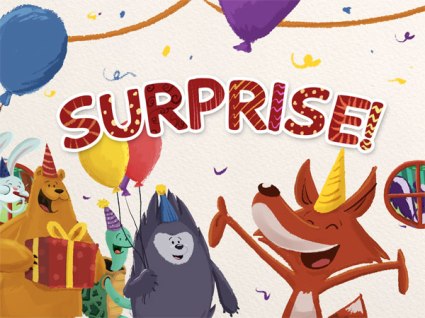
From those notes, “SURPRISE!” was born. A story about what happens when a group of forest animals throw a surprise party for their special friend, Skunk. What you think will happen happens, but that’s not the surprise!

This was the best book I’ve ever created in 30 days (easy to be the “best” when it’s also the “only”). The time constraint helped spur the story development and dictated the art style (it had to be simple to meet the deadline). The story was submitted just in time. To my pleasant surprise, it won!
In every category (Innovation, Interactivity, and Kid’s Favorite).
You are sitting on a treasure trove of ideas (I get excited just thinking about the potential). One of them could be someone’s favorite book. Another might be the catalyst that inspires a future creator.
These are stories that are waiting to be unfolded. Make it happen!
One of my ideas took me to Italy. Where will your ideas take you?
Josh Alves is a puzzle-loving, pictorial problem-solver with a penchant for propagating parables. He loves alliteration (a lot) and anything that leads to laughter. He’s the illustrator of D.L. Green’s 14 hilarious ZEKE MEEKS chapter books. He’s also the author/illustrator of other comics and picture books including LILLY BRISTOL, DINOSAUR WRANGLER, AND THE TOWN A TYRANNOSAURUS WRECKS. His latest interactive book, SURPRISE, is available for iPads/iPhones in the iTunes app store.
You’ll find sketches and project updates by following him on Facebook and Twitter @joshalves. Visit his site at joshalves.com and if you have any questions, drop him a note!
Josh is giving away 5 copies of SURPRISE. (iProduct download)
Leave a comment below to enter. One comment per person, please.
These prizes will be given away at the conclusion of PiBoIdMo. You will be eligible for these prizes if:
- You have registered for PiBoIdMo.
- You have commented ONCE ONLY on today’s post.
- You have completed the PiBoIdMo challenge.
Good luck, everyone!
You’re done! Woohooo! you say to yourself, riffling through the pages of ideas you’ve concocted during Tara’s awesome PiBoIdMo. Rubbing your hands together gleefully (and maybe cackling, too), you can’t wait to start writing the zingy text for the next Caldecott winner, and then you stop. Stop dead, actually. *headdesk* Bewildered, you stare with glazed eyes at each idea you jotted down, some followed by questions you wrote (good), some followed by extraneous comments and ditherings (still good), and others followed by a vast blankness (not so good, but, hey, who said this was easy?).
Good.
Still good.
Not so good.
 To prioritize and organize, it can help us to be disciplined *she says, shuffling madly through all the writing tips in search of the shiny ones* and apply some ‘litmus tests’ to see which of these ideas might actually fly. This is not to say that some of our golden ideas that don’t pass these tests won’t eventually spark other ideas, or that they can’t be reworked into something else, but to save time (and agony!), it can help us (our mileage may vary) to concentrate on three or four out of the thirty ideas just to begin with.
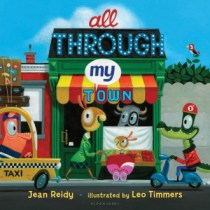
Test #1: Our first litmus test is thanks to Jean Reidy, author of fun picture books like TOO PURPLEY and ALL THROUGH MY TOWN. She asks in her Ten Power Premises: Will a kid like it? (Is it part of a kid’s world—real or imaginary? Is it relatable?) Aha! You may have seen this wonderful New York Times cartoon by Grant Snider, The Very Bad Picture Book.
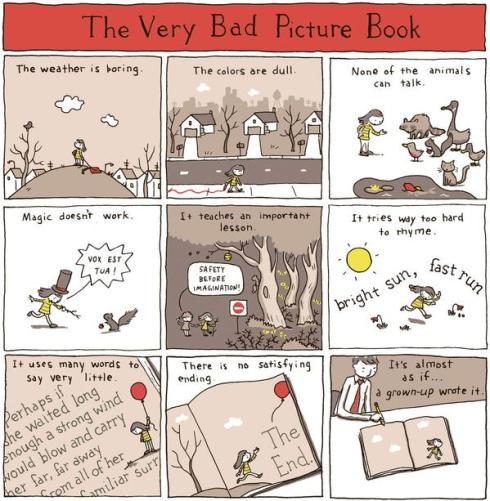
Yes, the last frame in the cartoon can be a wake-up call, can’t it? Does our idea seem didactic? Are we trying to teach children something they “should know”? Once we go through our ideas, one by one, asking that question, a number of ideas get shelved. This isn’t to say that from one or two of them, a connection to a kid’s world couldn’t be made in time, particularly by asking, “What if…?”, but, in the interests of prioritizing and efficient use of time, those can be put aside for now.
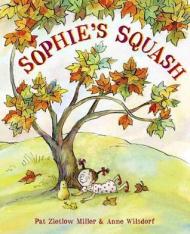 Test #2: The next litmus test, if we’re writing a story, not a concept book, is thanks to David Mamet, he of playwriting (Glengarry Glenross, etc.) and screenwriting fame. ‘Who wants what, and why? Why now? What happens if her [sic] don’t [sic] get it?’ To give substance to that framework, a good example would be what Pat Z. Miller, author of the wonderful SOPHIE’S SQUASH said: “Sonia’s love for her squash gave me the initial idea for the book. But by itself it wasn’t enough. If I had written the book exactly the way things happened in real life, it would have been an amusing anecdote, at best. And that’s kind of what my first draft was. It took me a while to build out a full story and figure out the problem (the rotting squash, a long winter apart) and the resolution (baby squash).”
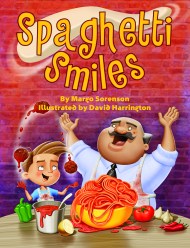 This step of plotting in our prioritizing takes more time, but the fun begins here. The metamorphosis from one of our daughters’ make-your-own pizza birthday parties (the amusing anecdote) to my most recent picture book SPAGHETTI SMILES took years to create, but, asking the right questions finally paid off. From my PiBoIdMo idea, “Click,” one of my written questions to myself generated the character of Little Bunny.
The story idea for TAIL-END BUNNY actually turned out to be the opposite of the thread of my initial questioning, but, that’s what’s exciting and mesmerizing(oh, and frustrating, too! ☺) about writing. We don’t often really know what we’re saying until we see it on the page.
Finally: Once we have a clutch of ideas that have passed our litmus tests of the moment, we can begin spending more time on each. Other good questions to ask about each idea are: (thanks, again, Jean Reidy!) “Is it highly visual? Can you imagine 14+ scenes coming from your story?; and (thank you, Tara!) Does it convey emotional truth? That is the kicker question! Ruminating, musing, writing as we think, taking a walk to clear our heads and letting ideas simmer on the back burners of our minds will end up helping us to cook up a great story.
Without Tara’s PiBoIdMo, though, we wouldn’t have thirty little lumps of coal, jostling each other to catch our attention, to rub and polish, so it’s with much gratitude that I thank Tara for continuing to inspire us and galvanize us as we embark on our own new writing adventures and pick just the right ones!
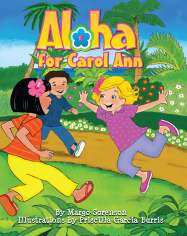 National Milken Educator Award recipient and author of twenty-nine books, Margo Sorenson’s most recent picture books are SPAGHETTI SMILES (Pelican Publishing) and ALOHA FOR CAROL ANN (Marimba Books/JustUs Books). Among Margo’s awards was being named a finalist for the Minnesota Book Award in YA Fiction. She enjoys Skyping and meeting with readers from Minnesota to California, Hawaii, the Philippines and the UK.
You can find Margo on the web at MargoSorenson.com and on Twitter as @ipapaverison.
Margo is giving away two books–one copy each of SPAGHETTI SMILES and ALOHA FOR CAROL ANN.
Leave a comment below to enter. One comment per person, please.
These prizes will be given away at the conclusion of PiBoIdMo. You will be eligible for these prizes if:
- You have registered for PiBoIdMo.
- You have commented ONCE ONLY on today’s post.
- You have completed the PiBoIdMo challenge.
Good luck, everyone!
So, you’re all dressed up with ideas now. Where will you go? An idea could take you anywhere and sometimes rockets without warning. Go with it, my friends, or poof! It may be gone. To me, it’s never a bad idea to brain dump or pants your way through a picture book idea. That’s what revision is for.

But sometimes, it’s worth a little research to see what’s already been done before investing the time. If you’re like me, many times an idea starts with a title. Like the PiBoIdMo light bulb, your hope beams!

With one eye peeking, you pull up Amazon and type your title one letter at a time.
P-L-A-N-E-T-A-R-Y. Lots of results in the planetary search. The lump in your throat tightens as you continue.
P. The search results begin to drop. This is a good sign.
O. Yes! It’s thinning even more. A verdict is at hand.
P. Woo-hoo! No results for that title! But you finish typing the rest of the word anyway. C-O-R-N. It only takes a few seconds to see if PLANETARY POPCORN is a keeper. From there, it’s easy to take your research one step further.
Since beginning my writing journey, I’ve heard the same piece of advice over and over again. You’ve probably heard it, too. Read. Then, read some more! In our case, it’s picture books. I got a head start during my teaching days. But, there are still thousands and thousands of picture books I have not read, and more and more are published each day. Therefore, I put most of my focus on the current market. After all, the bulk of what is selling today is very different than what sold 10, 20, and 30 years ago.
Back to your idea. PLANETARY POPCORN is ready to explode. So, while you’ve got your title sitting there in Amazon’s search bar, go ahead and hit SEARCH. What pops up? POPCORN by Frank Asch (2015 Reprint). Hmm. Reprint. Popcorn has some staying power. But, why not hit the bookshelves to see what it is about Frank’s book that keeps it fresh. This is a great way to start your concept research. You’ll want to know what’s already been done so that your idea is 100% fresh. This can also help you weed through your PiBoIdMo idea list and focus on the most unique concepts first. An evergreen concept like bedtime is bound to be featured 10,000 times more than, let’s say, PLANETARY POPCORN. Whatever you choose, find your unique angle and make sure it is something relatable for kids.

Once you’re beyond the concept, reading for research can take you even further. It’s one thing to write a picture book. It’s another thing to write a stellar picture book. Personally, I turn to mentor texts that are featured on lists, podcasts, and blogs. Every year, the CYBILS award committee reveals a huge list of the most current nominated books to pull from. You can even back track through to the last nine years of finalists to see which books the judges were most excited about. Sites like Kirkus and School Library Journal reveal great books through reviews. The past Caldecott winners list features outstanding mentor texts. And of course you can always find great recommendations on the Let’s Get Busy Podcast’s The Best Book Ever (this week.)

Logo by Lori Nawyn
Do you know what to look for? The Reading for Research blog and ReFoReMo challenge was designed especially for picture book writers who want to learn more about great writing through hands-on reading. We study elements like great beginnings, plot, characters, lyrical language, and so much more. While the blog provides free education year round, the actual ReFoReMo challenge takes place every March. Our goal is to develop a habit of studying current picture books, whether published or just getting started. We’ll kick-start our research by reading 105 books within the month.
You’re all dressed up with ideas, so it’s time to put the PJs on and tackle the freshest concepts first. Take comfort in knowing that most of your go-to places are accessible from home. But you might have to throw on your sweats for the library.
 Carrie Charley Brown juggles ideas and words every day as a children’s writer. She is the 2016 Regional Advisor for SCBWI North Texas and a professional critique mentor. As the founder of ReFoReMo, a picture book research challenge and blog, she encourages picture book writers to keep reading great mentor texts. She blogs on various writing sites including Writer’s Rumpus] and contributes as a CYBILS fiction picture book judge. You can find her blogs and subscribe to her newsletter at www.carriecharleybrown.com/reforemo or follow her on Twitter @carriebrowntx and Facebook.
Carrie is giving away a picture book critique.
Leave a comment below to enter. One comment per person, please.
This prize will be given away at the conclusion of PiBoIdMo. You will be eligible for this prize if:
- You have registered for PiBoIdMo.
- You have commented ONCE ONLY on today’s post.
- You have completed the PiBoIdMo challenge.
Good luck, everyone!
♬ You’ve got a long list…you’re counting it twice…
…gotta have 30…or ten times thrice…
…’cause the PiBo Pledge is online to sign! ♬
You can qualify for one of our AMAZING PiBoIdMo prizes just by taking the following pledge. Put your right hand on a picture book and repeat after me:
I do solemnly swear that I have faithfully executed
the PiBoIdMo 30-ideas-in-30-days challenge,
and will, to the best of my ability,
parlay my ideas into picture book manuscripts.
Now I’m not saying all 30 ideas have to be good. Some may just be titles, some may be character quirks. Some may be problems and some may create problems when you sit down to write. Some may be high-concept and some barely a concept. But…they’re yours, all yours! Give them a big, fat, juicy smacker! SMOOCH!
You have until Dec 5th at 11:59:59PM EST to sign the pledge by leaving a comment WITH YOUR FULL NAME on this post. PLEASE COMMENT ONLY ONCE.
The name you left on the registration post and the name you leave on this winner’s pledge SHOULD MATCH.
Again, please COMMENT ONLY ONCE. If you made a mistake, contact me instead of leaving a second comment.
Remember, this is an honor system pledge. You don’t have to send in your ideas to prove you’ve got 30 of them. If you say so, I’ll believe you! Honestly, it’s that simple. (Wouldn’t it be nice if real life were that straightforward.)
If your name appears on both the registration post AND this winner’s pledge, you’ll be entered into the grand prize drawing: feedback on your best 5 ideas from a literary agent. There are LUCKY THIRTEEN grand prizes! Check out the agents here.
So what should you do now? Start fleshing out your best ideas! Write them as elevator pitches. Get ready because YOU might be a CHOSEN ONE.
Other prizes include picture books, manuscript critiques, art prints—all the stuff you saw during the month. All winners will be randomly selected by Random.org and announced NEXT WEEK.
And guess what, PiBoIdMo doesn’t end here! From today through Dec 6th, stop in for Post-PiBo, which offers daily posts about organizing, prioritizing and fleshing out your ideas.
Plus—you can claim your first prize now: a winner badge for your website, blog or social media site, designed by Troy Cummings. You can make it larger or smaller to fit anywhere. And if you want it on a mug, don’t forget to stop by the PiBoIdMo shop where every purchase benefits Reading is Fundamental (RIF).

Don’t be naughty…be nice! Go ahead and sign below!
And don’t forget to come back for Post-PiBo!

Kim and Bookie
by Kim Norman
In a not-very-long-ago life, I was a graphic artist. The first order of business in the ad agencies where I worked: strong slogans. If you were a fan of AMC’s Mad Men, you probably know leading man Don Draper’s alliterative name is no accident. Alliteration is a handy gadget in the ad copywriter’s tool bag. The human ear is tuned and attracted to alliteration. There’s no question alliteration makes a tag line memorable:
“Put a tiger in your tank”
“Melts in your mouth”
“Fly the friendly skies…”
Why not open Don Draper’s bag of tricks for ourselves? First, let’s play with alliteration. Through a random Google search of “things that start with g,” I landed on this helpful page of alphabetically arranged objects:
actionalphabet.com/alphabetobjects.html
Scanning the G list, pairing words, my mind positively pops with possibilities.
Gorilla Garden
Grizzly Girl
Golden Galoshes
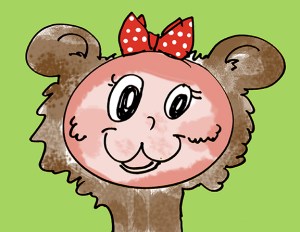
Open a new browser window and search for “adjectives that start with G,” and you access a further trove of ideas. Add those to your nouns:
Giggly Goldfish
Groovy Grapes
Gassy Grasshopper
(Oops, sorry. I have an 8-year-old’s attraction to scatology.)
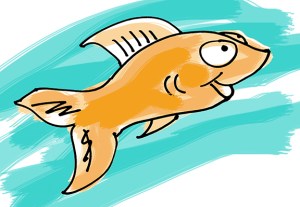
Don’t tie yourself to that one alphabetical collection above. It’s missing lots of useful nouns. Search the net for other lists, too.
The one thing I suggest you avoid in this exercise is alliterative names, (Squeaky Squirrel, Rowdy Raccoon and the like). Because they can feel old fashioned and clichéd, many editors are skittish about alliteratively-named characters, although I was unconsciously guilty of it myself with my story about Percy, the pug. But the book was simply titled Puddle Pug, and we don’t learn the main character’s name until we open the book.
Next in the copywriter’s bag of tricks is rhyme. Social science studies reveal rhyme as a powerful persuasion technique. Whether it’s classic end rhyme:
“The best part of waking up is Folgers in your cup”
“Plop plop. Fizz fizz. Oh, what a relief it is”
…or clever internal rhyme:
“Please don’t squeeze the Charmin…”
…rhyme works.
Let’s go back to that alphabetical list of nouns above. When you spot an object that catches your eye, (preferably an animate rather than inanimate object) open a new browser window and go to rhymezone.com.
Paste in your chosen word. I’ll try “puppy.” A slim selection rhymes with the entire word, but if I search with just one syllable, “pup,” I spy great possibilities:
Buckle up, pup!
What’s up, pup?
Even slant rhyme or borrowed vowel sounds will work:
Grumpy puppy
Puzzle puppy
Puppy hunt
 Two of my books coming out next year benefited from rhymes that popped into my head. I don’t know exactly what sparked Still a Gorilla, (Orchard, 2016) except I remember scribbling the words on a scrap of paper while wandering around an elementary school library. The paper stayed in my wallet for weeks. After I discovered it during another school visit, I mulled over the idea during a long drive. By the time I got home, I’d outlined the basics of the book in my head, as well as a few of the rhyming stanzas.
A robot manuscript based on “The House that Jack Built” was also improved by a rhyming title tweak. My editor, Meredith Mundy, suggested I come up with a different name for the main character, since “Jack-built” stories are becoming ubiquitous. I’m glad she did. I think The Bot that Scott Built (Sterling, 2016) is even more catchy!
The picture book that evolves from this exercise may end up with a title very different from the Don-Draper-inspired pairing that sparked your story. That’s fine, although I would argue that editors are people, too, who may be as subject to advertising psychology as the rest of us. If a Draperesque title attracts an editor to your manuscript? Presto! Perfect payoff!
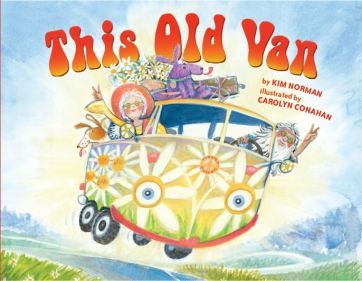
Kim Norman (posing with Bookie, one of her half-pug muses) is the author of more than a dozen children’s books published by Sterling, Scholastic and two Penguin imprints. Among them is TEN ON THE SLED, (Sterling, 2010), I KNOW A WEE PIGGY (Dial Books for Young Readers, 2012), a Texas “2×2 Reading List” selection. Her most recent title is THIS OLD VAN, published by Sterling Children’s Books, and illustrated by Carolyn Conahan. Kim is represented by the Andrea Brown Literary Agency in San Diego. Because Kim visits dozens of schools around the country every year, she maintains a website devoted helping authors learn the ropes of school visits at coolschoolvisits.com.
Kim’s own website is at KimNormanBooks.com.
Kim is giving away a signed copy of THIS OLD VAN!
Leave a comment below to enter. One comment per person, please.
This prize will be given away at the conclusion of PiBoIdMo. You will be eligible for this prize if:
- You have registered for PiBoIdMo.
- You have commented ONCE ONLY on today’s post.
- You have completed the PiBoIdMo challenge.
Good luck, everyone!
by Arree Chung
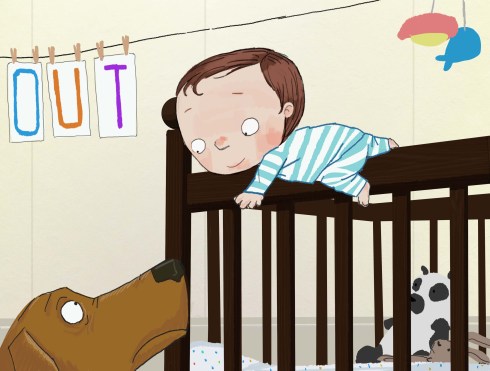
Has this ever happened to you? You’re working on an idea. You’re excited about it. You share it with your agent or editor and then they tell you that it’s not working. Thud, thud, thud (that’s the sound of my head hitting against the wall).
Back to the drawing board. Well, not always. Developing an idea and refining it is really hard but sometimes you can make it work. This happened to me, on the book I’m currently working on. It’s titled OUT.
In this post, I’ll share a few tips on developing an idea and how to make an idea work when it’s not working.
START WITH THE FEELING
Stories come from many places but sometimes, I like to start with the feeling. OUT began as a story tilted BREAKOUT.
At the start, I knew I wanted to make an adventure story. As a kid, I loved watching the Great Escape with my dad. I loved the humor and the near chances of getting caught.
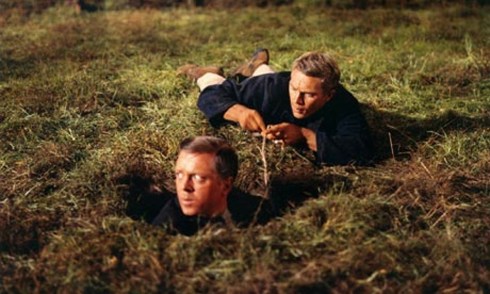
Kids love to play cops and robbers all the time so I started to think about an adventure of escaping prison. At first, I imagined braking out of prison with a quirky set of animal characters.
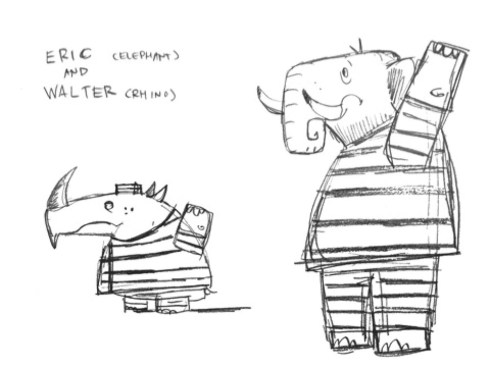
I worked really hard and made a full picture book dummy of BREAKOUT. I excitedly shared my idea with my agent. He wasn’t in love with it and brought up some good points. Prison is probably a subject to avoid in picture books- some kids have incarcerated parents and we want to be sensitive. But I was disappointed. I had come up with all these ideas that I loved and I didn’t want to scrap them completely.
SALVAGING AN IDEA
I was frustrated and stuck. I shared my idea with a good friend who taught kindergarten and 1st grade. We started to brainstorm.
We asked ourselves:
- How could we adapt this idea to something more age appropriate?
- How could we retain the same sense of adventure, escape and mischief?
Still thinking graphically about black bars and shadows, I thought about how cribs are like little prison cells for infants and toddlers. And I know lots of kids hate being stuck in them when they want to roam.
TRANSFORMING YOUR STORY
I made a few new thumbnails to map out the new story. At this moment, I thought about how a baby and his favorite toy could break out of the crib. It wasn’t a fully developed story yet but we were on our way.

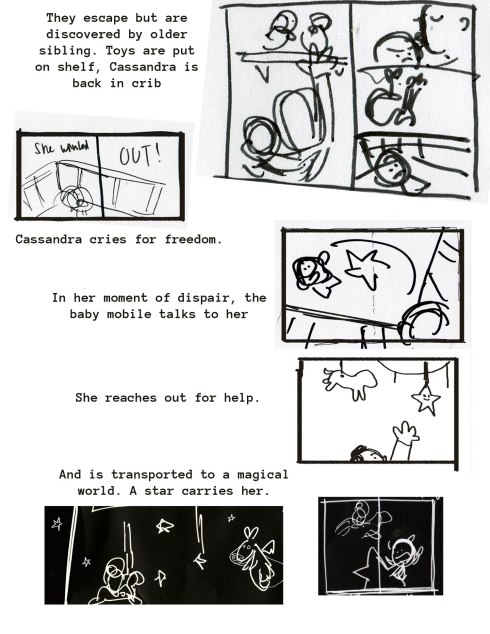
STEP AWAY AND COME BACK WITH FRESH EYES
I shared this with my agent. I knew it wasn’t working yet but wanted feedback. One of the most helpful aspects of sharing your ideas with story experts is that they ask you smart questions. In this case, Rubin asked me what could happen once the baby is out of the crib.
I could feel ideas percolating. I didn’t have the solution yet and sometimes it’s helpful to step away for a bit. I had a few other books to illustrate so I spent my days working on those. But I always had this idea in the back of my mind. Then it all came together.
PUZZLE PIECES AND INSPIRATION
Stories are like puzzle pieces that perfectly fit together in a narrative. The tough part is you never know where to get all the pieces from. Sometimes a picture you see will be a piece. This picture did it for me.
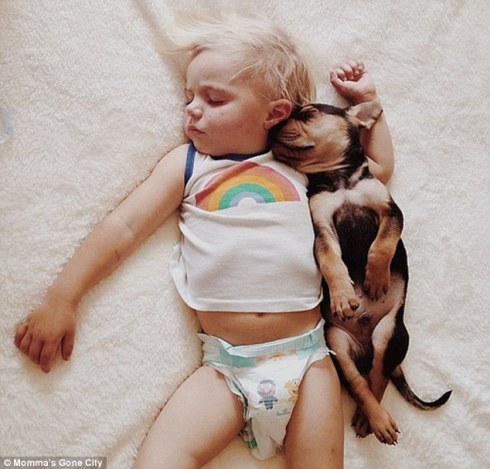
You probably saw these pictures around the internet too. When a boy and his dog started to take naps habitually together, a mom started photographing them and posting on the internet.
That was the missing piece for me. I knew what the story was. It was about a toddler and his dog. When the toddler gets put to bed, the dog and the toddler are separated. When the toddler escapes his crib, the two are on their own adventure. You’ll have to wait to see what the rest of the book is about.
Here’s are a few tips for making a story work:
- START WITH A STRONG FEELING. Think of stories that you love and how they made you feel. Capture this in your first draft of your story.
- SHARE YOUR IDEA with a few trusted experts. Be careful not to overshare. You don’t need too many ideas in your head, especially at this early juncture.
- If your concept isn’t working, THINK HOW YOU CAN SHIFT YOUR STORY to a new setting or new characters. Remember the feelings of the story you want to create. Sets and characters are actors in your world. Anything can change at this early stage.
- STEP AWAY AND GET INSPIRED. Collect references. Make boards, folders.
- PUT IT TOGETHER. If you have enough pieces, you’ll be able to put together a new story. If you’re not quiet there yet, repeat steps 3 and 4.
If you have an idea or strong feeling for a story, don’t give up. OUT took 2 years to piece together. Refining ideas into a core story is the hardest part of developing a book. Remember the feeling you want to capture in your story and get excited. Keep at it and you’ll get there.
Happy Holidays and Happy PiBoMo!

Arree Chung is the author and illustrator of the popular picture book, “Ninja!”, which has received starred reviews from Kirkus and School Library Journal and has been named one of Amazon’s best books for 2014. “Ninja!” was also named one of NPR’s best children’s books of 2014. “Ninja!, Attack of the Clan” the followup to Ninja will be releasing in 2016, along with “How to Pee: Potty Training for Girls” and “Fix-it Man.” Arree has a two-picture-book contract with MacMillan and is also illustrating books from other publishers. Visit him online at Arree.com.
Arree is giving away a signed copy of NINJA!
Leave a comment below to enter. One comment per person, please.
This prize will be given away at the conclusion of PiBoIdMo. You will be eligible for this prize if:
- You have registered for PiBoIdMo.
- You have commented ONCE ONLY on today’s post.
- You have completed the PiBoIdMo challenge.
Good luck, everyone!
 by Paula Yoo
It’s Day 28 of Tara Lazar’s annual Picture Book Idea Month (AKA PiBoIdMo)! Two more days and you’re done. Best of all, you will have 30 ideas to explore for your next picture book draft… and hopefully, one day, a published book!
For today’s blog, I will walk you through the general process of how I write my non-fiction picture book biographies. Here we go…
1. How do I come up with a non-fiction picture book idea? I do the following:
- KEEP CURRENT: Read books. Pay attention to the news (social media, TV news, newspapers/magazines).
- BRAINSTORM: Brainstorm about your own personal life: hobbies, favorite music/TV/books/etc. You never know what ideas might spark!
- FRIENDS: You never know—a friend might mention something that could spark an idea. For example, I have had friends mention an article they read that would inspire me to jot down a picture book idea based on that!
2. Once I come up with my idea, then comes the research:
- DO YOUR HOMEWORK: Read/watch books, articles, documentaries, movies, youtube clips, etc. related to your idea/non-fiction subject.
- TAKE LOTS OF NOTES: Highlight what interests you as a good “story” or character moment.
- INTERVIEW: If possible, interview the subject (if they are alive) or people who worked with the subject or are friends/family.
3. Then comes the first draft:
- OPENING IMAGE: I usually start with an opening image—what opening image or action defines immediately the tone and direction of my story?
- THREE-ACT STRUCTURE: I like to follow the classic “Three Act Structure”—Beginning, Middle, End, where there is an obstacle or conflict that must be overcome along with rising stakes in the action.
- MAIN CONFLICT/OBSTACLE: I focus on the main conflict & struggle for my subject. What is the obstacle my main character faces? How do they overcome it?
- EMOTIONAL JOURNEY: I also think about my main character’s emotional journey—what is their flaw? How do they grow and change by the end of the story?
- THEME: As I write the first draft, a theme usually starts to form. I always ask myself—is the theme universal? Does it appeal to me personally? Can it appeal to everyone with a common universal element?
- NUTS & BOLTS: As I write, I try to be mindful of using strong, active verbs, specific word choices and vivid descriptions. I make sure there are a variety of sentence lengths from short to long to keep the rhythm alive in my text.
- STORY, STORY, STORY: Finally, I always remind myself that I’m telling a story—how do I keep my reader interested enough to keep turning the page?
4. Revisions:
- REVISE, REVISE, REVISE! Once I finish the first draft, I start the revision process. Revisions can range from overall big picture structural notes to smaller nitpicks, fact checking and line edits.
- READ OUT LOUD: I always read my drafts OUT LOUD to check for typos & spelling/grammar mistakes.
- FACT CHECKING: Because this is non-fiction, I will double-check my footnotes and bibliography to make sure every single fact is accounted for by a primary or secondary source. You can even do follow-up interviews with your sources, too.
Now, some of you might cringe at the boring footnote/bibliography process. I don’t blame you. It’s a pain for me, too! But trust me, it is VITAL for non-fiction. Really back up your work properly and make sure you can tell your agent/editor/reader WHERE you got all your facts. It’s a painful process but worth it in the end.
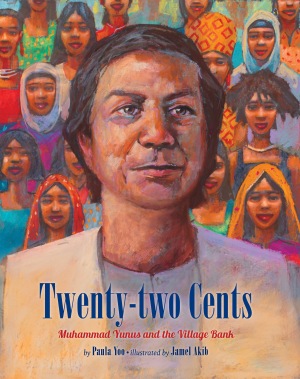
For example, with my latest picture book TWENTY-TWO CENTS: MUHAMMAD YUNUS AND THE VILLAGE BANK (illustrated by Jame Akib, Lee & Low Books 2009), I interviewed three expert historians on the country of Bangladesh to make sure I had the correct historical facts.
I highly encourage everyone to try writing more non-fiction because a) it’s a great genre to write picture books for and b) non-fiction is become more popular and in-demand by schools, teachers, librarians, and students. It’s an area of picture books that will never go out of style. Plus, I love the challenge of discovering and creating a fascinating story and compelling character from a bunch of dry facts. Non-fiction picture books make history come ALIVE.
Happy Writing!
Paula Yoo is a published children’s book author and TV writer/producer. She hosts the annual NATIONAL PICTURE BOOK WRITING WEEK (AKA “NaPiBoWriWee”) every May 1-7. The next event takes place May 1-7, 2016. Go here for more details: http://paulayoo.com/category/napibo/.
Paula’s books include the Young Adult novel GOOD ENOUGH (HarperCollins 2008), which was an Honor Book of the Asian/Pacific American Award for Youth Literature, along with the IRA Notable picture book biographies SIXTEEN YEARS IN SIXTEEN SECONDS: THE SAMMY LEE STORY, SHINING STAR: THE ANNA MAY WONG STORY and TWENTY-TWO CENTS: MUHAMMAD YUNUS AND THE VILLAGE BANK from Lee & Low Books. Her TV credits include NBC’s THE WEST WING, Amazon’s MOZART IN THE JUNGLE, and SyFy’s EUREKA and DEFIANCE. She currently is writing for NETFLIX. Paula is also a professional violinist who has played with everyone from IL DIVO to FUN and NO DOUBT. But most importantly, she has three cats named Oreo, Beethoven & Charlotte. Her website is: PaulaYoo.com. You can follow her on Twitter @paulayoo, Youtube, and Instagram @PaulaYoo.
Paula is giving away a signed copy of TWENTY-TWO CENTS: MUHAMMAD YUNUS AND THE VILLAGE BANK.
Leave a comment below to enter. One comment per person, please.
This prize will be given away at the conclusion of PiBoIdMo. You will be eligible for this prize if:
- You have registered for PiBoIdMo.
- You have commented ONCE ONLY on today’s post.
- You have completed the PiBoIdMo challenge.
Good luck, everyone!

Photo by Sonya Sones
It’s Day 27 of PiBoIdMo and based on all of the incredibly inspiring posts being shared here you must have more ideas than Thanksgiving leftovers. So how do you decide which ideas are keepers? Throw a dinner party!
A few weeks ago with another holiday season looming, I got a sudden and unexpected flash in my mind’s eye of all of my book characters seated together at a long table. I found the image amusing because it’s never occurred to me to put all of them together in the same room. But there they were eating, and drinking, and conversing loudly like they were at a swanky after-Oscar’s party.
Grace Campbell from GRACE FOR PRESIDENT was, of course, talking politics and the upcoming presidential election. Gaston was trying very hard to sip (never slobber!) his French champagne. Alfred Zector was passionately discussing books with Crafty Chloe who was busy rearranging the table center pieces. My beloved zombie, Mortimer, was smiling and secretly holding Mildred’s severed hand under the table. And no surprise, Bacon was seated at the head of the table commanding everyone’s attention with his bad jokes, long-winded stories, and impromptu ukulele solos.

Admittedly, some of my older characters weren’t adding much to the discussions. The dinosaurs from DINOSNORES were rudely asleep at the table, drooling into their salad plates, while the monsters from HOW TO POTTY TRAIN YOUR MONSTER spent the majority of the evening locked in the bathroom unrolling toilet paper and eating soap.
I asked myself if I were to extend my guest list to include other picture book characters, who might I want to invite and why?
 I’d be sure to invite Matt De La Pena’s character CJ and his Nana because I know I could count on Nana to find something kind to say about my cooking. I’d send a telepathic invitation to Tammi Sauer’s little green alien because who wouldn’t want to hear what life is like on his planet? No doubt Ame Dyckman’s spunky Dot with her strong opinions and big appetite would be a lot fun to sit next to at a dinner party. I’d definitely invite Drew Daywalt’s crayons for a splash of color and Pat Zietlow Miller’s sweet Sophie just to see which vegetable she might befriend at the dinner table.
Characters don’t necessarily have to be as lovable as Dan Santat’s adorable Beekle but they should be memorable. Judy Schachner’s Skippyjon Jones would certainly be an unforgettable guest as would Elise Parsley’s Magnolia and her show-and-tell alligator. My Bacon might not be the kind of character you’d want to be seated next to at a dinner party because he’s exceedingly arrogant, but you can bet he’d be the kind of guest people would talk about on their drive home. And isn’t that better than being the guy in the beige sweater with kale in his teeth who’s name you can’t remember?
 When you’re contemplating your new picture book ideas, take a close look at your lead actors. Would they be characters you’d remember meeting the day after a dinner party? What about weeks or years later? Would they be the kind of characters you’d love to have as a friend because they’re thoughtful and kind like Amos McGee or imaginative and smart like Rosie Revere?
The characters we create may be playing out their adventures in two-dimensional worlds on the glossy, flat pages of picture books but something truly magical happens when we create characters that take on a multi-dimensional existence and live on in the hearts and memories of our readers for years to come.
Cheers!
Kelly DiPucchio is the award-winning author of nineteen picture books, including two New York Times bestsellers. Her forthcoming titles include DRAGON WAS TERRIBLE, illustrated by Greg Pizzoli, EVERYONE LOVES CUPCAKE, illustrated by Eric Wight and ONE LITTLE, TWO LITTLE, THREE LITTLE CHILDREN illustrated by Mary Lundquist. Kelly lives in southeastern Michigan with one husband, three children, and two puppies. You can see more of her work at KellyDiPucchio.com and follow her on Twitter @kellydipucchio.
Kelly is giving away a copy of EVERYONE LOVES BACON.
Leave a comment below to enter. One comment per person, please.
This prize will be given away at the conclusion of PiBoIdMo. You will be eligible for this prize if:
- You have registered for PiBoIdMo.
- You have commented ONCE ONLY on today’s post.
- You have completed the PiBoIdMo challenge.
Good luck, everyone!
 by
by This Thanksgiving, what are you thankful for?
Yes, I know. Your health. Your family. Food on the table. The upcoming football game. And, perhaps, some Black Friday shopping.
Those are all good and worthy things. I am thankful for them too.
But, it’s Picture Book Idea Month. And that means I am thankful for ideas. All kinds of them.
As I writer, I get asked, “Where do you get your ideas?”
A lot.
For a while, I didn’t know what to say.
But then, I figured it out. Or, I should say that Wendy Reid Crisp did. She wrote an essay in a book that is the perfect answer. I wish I could repost it for you here. But, you know, copyright issues.
The essay is on Page 26 of her 1997 book DO AS I SAY NOT AS I DID: PERFECT ADVICE FROM AN IMPERFECT MOTHER. It’s called, “There Are No Big Breaks.”
Anyway it’s about an aspiring actress in New York who is riding the subway and notices a lone grape rolling down the center aisle. She can’t figure out where it came from, but appreciates the absurdity of the moment enough to write a letter to the New York Times. Her letter is printed.
Then, the actress (who, remember, is unknown) goes to an audition. The director thinks her name sounds familiar and finally asks, “Are you the woman with the grape?” She acknowledges that she is. He praises her eye for detail and understanding of human behavior. She gets the part.
Reid Crisp concludes her essay by writing, “There are no big breaks. There are only rolling grapes. Some people see them, and some people don’t.”
To me, successful writers are people who notice the grapes in life. The weird, funny moments. The unexplainable occurrences. The odd socks the mail carrier is wearing. The squirrel that you can’t stop watching because it reminds you of your Uncle Esteban—except, you know, smaller. The snippet of conversation you overheard from the next checkout lane that made no sense but won’t get out of your head.
That’s where writers get their ideas.
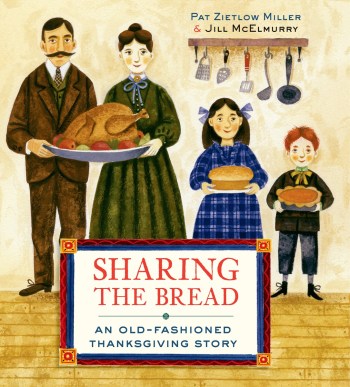
For my Thanksgiving picture book, SHARING THE BREAD: AN OLD-FASHIONED THANKSGIVING STORY (Schwartz & Wade, 2015) I got the idea from some weird words that popped into my brain during one of those boring meetings that make you question every career choice you’ve made to get to this point in your life.
The words were:
Mama, be a cooking pot, cooking pot.
Big and round and black and hot.
Mama, be a pot.
They came out of nowhere and raised logical questions: “Who was Mama?” “And why on earth should she be a pot?”
The words made no sense. I hadn’t been thinking about mothers or pots or cooking. But I liked their very weirdness. I emailed them to myself at home and played around with them that night.
In other words, I noticed the grape and decided to do something with it.
Not that it was easy. First, I thought I might create some kind of play or game where kids could pretend to be different items.
Then, I thought the family might find the items instead of being them. Soon everyone was cooking a meal.
But, the rhyme scheme seemed off. So I revamped, using Dori Chaconas’ ON A WINTRY MORNING as a mentor text. When I told her this at a recent Society of Children’s Book Writers and Illustrators conference, she told me she used a different mentor test to write her book, so I guess we’re all sharing the love.
Then, an editor declined the manuscript but suggested the family make a holiday meal. Enter turkey and cranberries and lots of hair-pulling. (What rhymes with turkey anyway? “Murky?” “Jerky?” “Perky?”)
But, I eventually made the story work, and another editor was interested. Anne Schwartz had me revise again. And again. And then suggested I add a rhyming refrain. Which was incredibly hard to do, but unquestionably added a lot to the book.
Some writers carry notebooks to jot down rolling grapes when they see or hear them. Others keep the grapes corralled in their heads. Do whatever works for you, but notice those grapes. They just might end up in the best fruit salad you ever created.
Oh, and because I do get asked this a lot, here’s what the first stanza of the book eventually became after all the revision:
Mama, fetch the cooking pot.
Fetch our turkey-cooking pot.
Big and old and black and squat.
Mama, fetch the pot.
Have an amazing Thanksgiving!
Pat Zietlow Miller has three picture books in print and seven more on the way. Her debut, SOPHIE’ S SQUASH, won the Golden Kite Award for best picture book text, an Ezra Jack Keats New Writer Honor and a Charlotte Zolotow Honor. It also won the Midwest Region Crystal Kite Award and was a Cybils’ finalist. WHEREVER YOU GO briefly made the Midwest Booksellers bestseller list, and SHARING THE BREAD was, at one point, the No. 1 Amazon.com release for new Thanksgiving books. Pat blogs about the craft of writing picture books at http://www.picturebookbuilders.com. She lives in Madison, Wisconsin, with one wonderful husband, two delightful daughters and two particular cats. Find her on Twitter at @PatZMiller.
Pat is giving away a signed copy of SHARING THE BREAD: AN OLD-FASHIONED THANKSGIVING STORY.
Leave a comment below to enter. One comment per person, please.
This prize will be given away at the conclusion of PiBoIdMo. You will be eligible for this prize if:
- You have registered for PiBoIdMo.
- You have commented ONCE ONLY on today’s post.
- You have completed the PiBoIdMo challenge.
Good luck, everyone!





 Writing for Kids (While Raising Them)