You are currently browsing the category archive for the ‘Picture Books’ category.
 by guest blogger & singer Deborah Underwood
I’ve been a singer for even longer than I’ve been a writer. But when it became too hard to juggle rehearsals and concerts with my writing work, I regretfully resigned from the chamber choir I’d sung with for nearly two decades.
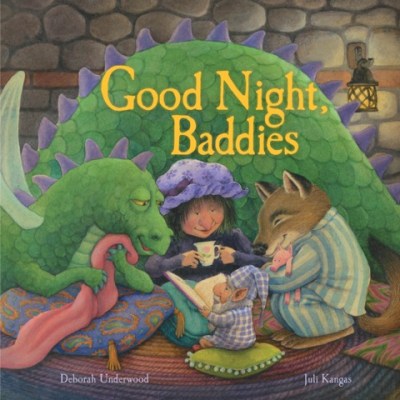
But I really missed making music. So I had an idea: I’d write and record a lullaby to go along with GOOD NIGHT, BADDIES, my new picture book about all the supposedly-bad fairy tale creatures clocking out and going home to spend a lovely evening together.
Easy-peasy, right?
Here’s what I learned about the similarities between writing a picture book and recording a song.
They both seem simple at first, then completely impossible. But if you keep moving forward, they get done.
My first picture books were total messes. One had six main characters. One had nothing resembling a plot. It took a while for me to understand just how difficult it is to write a good picture book, because I didn’t know what I didn’t know!
Recording was the same way. I naively asked a recording artist friend what I needed to do, and learned I’d need a team of professionals, a recording studio, a bunch of knowledge I didn’t have, and a whole lot of money.
I almost threw in the towel, but decided to ask around first. Did anyone know a sound engineer? Did anyone know of a studio? Or a guitarist, since I’d cleverly written a guitar part I was unable to play?
Luckily, one of the folks I asked was Gunnar Madsen, founding member of The Bobs and a former critique group member. It turned out he has a home studio, he could do the engineering, and he knew a guitarist, Jules Leyhe, I could hire.
Ta-da! Most of the obstacles disappeared—after I did a bunch of research and reached out to people who might help. It was still a hefty expense, but not as much as my friend had predicted.
Both are learning experiences.
Every picture book I’ve written has been instructive—especially the ones I wrote in the beginning. (I don’t write books with six main characters anymore.)
Likewise, I learned a lot making this recording. For example: the guitarist and I were recording in the same room, so if either one of us made a mistake, we had to redo both our parts. A recording studio with separate booths for each musician could have made the process speedier.
Nothing’s perfect.
It’s hard not to want to go back and change things in my published books. But I’ve come to realize that with every book, I do the best I can. If my present best is better than my past best, that’s only a good thing: it means I’ve grown.
That was a hard-won lesson for this recovering perfectionist, and I’m happy it transferred to this new venture. The recording isn’t perfect, but neither am I. We could have spent hours in post-production trying to make every note flawless, but Gunnar and I agreed that the result would be less appealing; I wanted to sound like a human being, not a robot. Who wants to be sung to sleep by a robot? (Hmm, I may have a new picture book idea…)
All in all, it was a great experience. I’d dreamed of recording a song for ages, and it was a thrill to combine, rather than need to choose between, my love of singing and my love of writing.
The song is a free download at deborahunderwood.bandcamp.com. Listen here:
I hope you enjoy it! And please look for GOOD NIGHT, BADDIES. Juli Kangas’s art for the book is gorgeous, rich, funny, and heartwarming—I am one lucky writer! You can get a sneak preview of some of the beautiful illustrations in the trailer, which you’ll find at DeborahUnderwoodBooks.com.
Thank you, Deborah, for sharing your beautiful voice and original composition. It’s BAD! (That’s Michael Jackson BAD, not bad BAD.)
GOOD NIGHT, BADDIES releases TOMORROW but you can win a copy TODAY! You have until MIDNIGHT PST tonight to enter by leaving a comment below.
by author Catherine Bailey & illustrator Sarita Rich
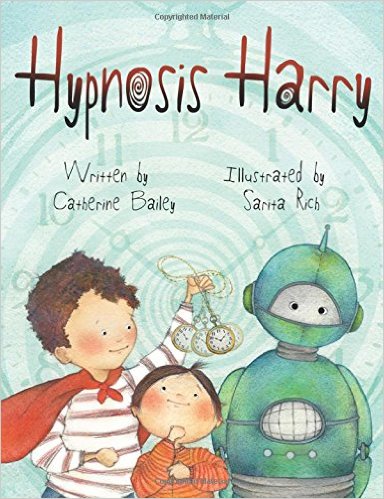
Thank you for hosting us today, Miss Tara. We are excited to be here, and we are excited to celebrate the release of HYPNOSIS HARRY, and we are excited to talk about each other and, well, we are just really excited. So without further ado, here is us interviewing us.
1. Okay, Sarita, Harry’s expressions are some of my favorite moments in the book. Was he, or any of the characters or images, based on your family or home life?
As much fun as Harry was to draw, I really liked having a sister. In an earlier draft, she was older, but I decided maybe a baby/toddler would be funnier, especially on the last page. And I had a (sometimes) cooperative model at home, so that was helpful. I also liked having a cat in the story. I’ve had my share of overweight cats that could squish themselves into tiny cardboard boxes and fall asleep.
2. I love that background info – especially the bits about the sister and the cat. (I have both.) So what was the most challenging aspect of illustrating Harry, and how did you overcome it?
Timing. I received the manuscript late September 2014 and had to submit a sample spread before October 10. I was pregnant with an October 23 due date and thought I had plenty of time to finish the spread. At my 38-week appointment, my doctor said I could go into labor any day, possibly that very night. “But I can’t! I haven’t finished the spread!” I thought. I sent the file on October 9, and Stella was born October 12. Sky Pony offered the contract shortly afterward, and I had to figure out how to be a mom and an illustrator at the same time. I was a little sleep deprived until June, but when an opportunity to work with editors from like Sky Pony, and an author like Catherine comes along, you say YES and sleep later.
3. I had NO CLUE you were birthing babies during all this. You win the amazing illustrator ward of the year for sure! And you have been equally amazing with the promotional / post-publication support. What unique skills/opportunities do you think an illustrator can provide to/for the marketing of a picture book?
Illustrators have a chance to bring a book to life in many different ways. When you invited me to collaborate on launch party ideas, I learned an illustrator can extend the life of the book way beyond the reading. For HYPNOSIS HARRY, I helped create fun extras like coloring pages, drawing activities, and a craft demonstration. Since we both love giveaways, I suggested that since we couldn’t attend the other’s launch party, that we each donate an item to give away at our respective parties. And one thing I love most about illustrators is seeing a preview of process—a drawing demo, for example–because usually all we get to see is the finished product. When I find a book I admire, one of the first things I wonder is, “How did the illustrator do this?!” Seeing what goes into the creation of a book makes you appreciate the work so much more.
4. I do love giveaways. And your genius craft ideas. And Nutella. But I digress. What part of marketing HYPNOSIS HARRY are you most looking forward to doing?
I have some school visits lined up on April 8th, which happens to be during reading week at this particular school. I’m looking forward to reading to kids and drawing with them and giving them free stuff (bookmarks!).
5. Okay one last deep and insightful question. What was one NO from your parents that you wish had been a YES?
I’m from a treeless part of northern Alaska, and therefore my sister and I could never have a tree house. We had to settle for a ground level clubhouse. One summer we devised the perfect set up of old pallets and scrap plywood, complete with a clandestine hole in the ground in which I deposited empty candy wrappers. At one point, I tried to build a fire inside the clubhouse to destroy evidence of said candy consumption. I made sure to put the fire out completely, etc. but Dad found out and said NO to unsupervised backyard fires. He was especially furious because I had overlooked the fact that our clubhouse was built right next to the 50-gallon oil tank that contained our winter fuel…
That’s hilarious. And also dangerous. I am very glad you did not blow yourself up Sarita. And I am very, VERY glad you are my illustrator. Thank you! Okay, my turn in the hot seat.
1. In hindsight, I’m also grateful for parents who tempered the pyromaniac within so that I could live to meet Harry. What made you want to tell his story?
I read some little online blurb somewhere about a hypnosis demonstration gone wrong – the performer couldn’t snap his audience out of their trance. So I added hypnosis to my list of picture book ideas and forgot about it. A few weeks later I was trying to explain to my three-year-old why she couldn’t wear my wedding dress to school and it hit me – what if she were in charge? What if she hypnotized me and her dad? What would she do?! It would be terrifying, but also funny. Also, when I was a kid, I had a book called something like How To Get Your Parents To Give You Everything You Ever Wanted. That book was definitely a big inspiration too.
2. I love this insight into the inspiration behind the book. Speaking of others being in charge, how do you strike the balance between including too many illo notes and trusting the illustrator?
How do I strike the balance? Um, I don’t. I’m awful. LOL! My early drafts include dozens of art notes. I guess it is just part of my writing process to visualize every image and page turn. Fortunately I have great critique partners, and a wonderagent, who save me from myself. They help me to cut most of the art notes, which is a good thing. It is critical to trust the illustrator, art director, and publisher. They know so much more and do a much better job at that side of things. Let’s just say that if you and I both drew a stick figure, your stick figure would be way prettier.

3. I can see my stick figure getting carried away with clothes and eyelashes but the important point is that YOU are a marketing genius whose marketing plans should be SCBWI conference presentations. So what are the 3 most important things you keep in mind when developing a marketing plan for your picture books?
Audience, Budget, and Feasibility.
Defining your Audience makes you focus your efforts, which makes everything you do – calls, emails, school visits, signings, tweets, etc. – more effective. For example, I know my audience likes books, so bookmarks are a good giveaway (thank you Sarita for those!). Hairy poisonous spiders on the other hand, are not.
I hate to say Budget – but books are a business, like it or not, and I can’t spend a lot of money on items that don’t have a healthy return (even if I really, really want to!).
Feasibility means “Will Catherine actually do this thing or will she wimp out because she’s tired / doesn’t understand it / ran out of time?” For example, I would love to drive to every library within 200 miles and show them HYPNOSIS HARRY and convince them to add it to their collection. But unless I win some sort of babysitting and gas lottery, I can’t. So I’ll tone it down and just drive to every one within 30 miles 🙂 And I will do a lot of outreach online.
4. Those tips are sure to help us maintain sanity. Moving on: what major differences do you see in your marketing strategies for this book vs. MIND YOUR MONSTERS?
The biggest difference is that I can market HYPNOSIS HARRY towards schools because it came out during the school year. Also I now have dozens of school visits under my belt from my first book, MIND YOUR MONSTERS, so I can go back to those contacts. Overall marketing the second book is easier because I have at least some clue as to what I’m doing. But there’s always more to learn!
5. And finally, because I have to know, what was one NO from your parents that you wish had been a YES?
My grandparents had a farm, and on that farm was Molly. Molly was a horse and she belonged to my older sister Sarah Helen. Eventually I wanted a horse too (they really should have seen that coming), but my parents responded with a firm No. Instead my sister was instructed to share Molly with me. You can just imagine how that went. I spent a lot of time trying to ride the barn cats.

Thank you for reading. And there’s more! A giveaway (wheee)! Just leave a note in the comments below and you will be entered to win a Skype consult with author Catherine Bailey and illustrator Sarita Rich. Consider it a tag team critique where we will take a look at your picture book manuscript, and then chat about it with you in person. Well, in “digital-person.” You know what we mean.
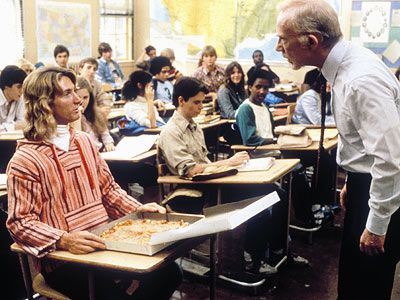
In Fast Times at Ridgemont High, Mike Damone counsels Rat on how to pick up girls with his fool-proof 5-point plan. Part of the plan is to be relaxed and cool at all times. “Wherever you are, that’s the place to be.” Damone leans back casually and shrugs. “Isn’t this GREAT?”
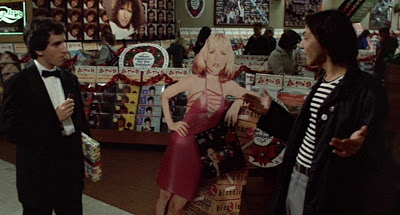
That’s exactly how I feel about NORMAL NORMAN‘s blog tour. Every stop has been the place to be!
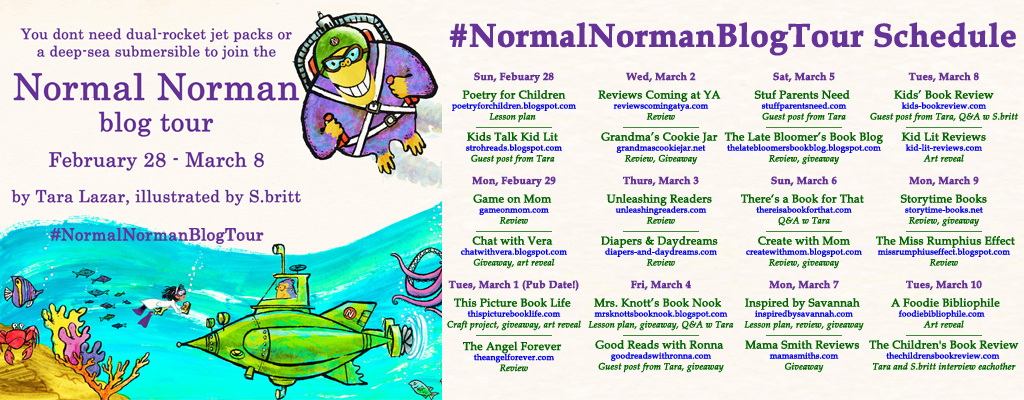
This is my first real blog tour. I say “real” because I never organized an official one before–I just asked blogs I knew if I could do a guest post. I didn’t schedule them, I just did it when I could. Yeah, I’m not much of a planner.
My publisher organized this tour, and I’ve discovered many great new blogs that you might want to check out, too.
 My heart was warmed by Inspired by Savannah when Savannah’s mom realized that Normal Norman would help her daughter feel okay about her shyness.
- Librarian Margie Myers-Culver astounded me with astute observations of the book and its illustrations. Things I didn’t even realize! And ya gotta love that “Quintessential Quirkiness” title!
- The Normal Norman tissue paper craft from This Picture Book Life & Homemade City is so colorful and fun!
- I can’t wait to visit A Foodie Bibliophile because I AM A FOODIE BIBLIOPHILE!
- Then this cool Activity Kit was made especially for the tour. Click below to download it in PDF! There’s a crossword, word search, maze, spot the differences challenge and a coloring page.

There’s so much more that just tickles me purple. I’m extremely thankful to those who are participating in the #NormalNormanBlogTour and to Sterling for putting it all together. Many giveaways are still going on now, so check the blog schedule above and go win a copy of Norman!
If you’re doing a blog tour, I recommend keeping all due dates and posting dates in a spreadsheet, even though I feel dizzy at the sight of all those columns and rows! Think Spicoli in Mr. Hand’s class. Time to order a pizza! (I’m sure Norman will want pepperoni.)
Phew! What a whirlwind this week has been! The weather flip-flopped between winter and summer, the Bat Mitzvah RSVPs flooded in and my fourth book released to critical and commercial acclaim. It was also the week that I got a swift kick in the gut.
The jolt came in the form of an Amazon 1-star review that felt like a personal attack because of its mean-spirited content and because two more 1-star reviews followed for my other books. My first thought—someone out there really hates me. (And really idolizes her cat.)

But then I corrected myself. Someone out there really hates my success. The success that’s come from eight years of hard work, learning about the business of children’s literature, building a respected blog, and writing (and rewriting) picture books. Someone out there is envious and thinks that the best way to feel better is to put me down. And it’s the most impossible thing for me to understand.
I want to say to this person—please, don’t feel threatened—feel buoyed. Why? Because the children’s book market is doing so well. Think about it, picture books could be dead right now. The portent of their demise came…but has now passed, unwarranted. The Newbery Medal was awarded to a picture book! Ebooks didn’t replace a physical book in a parent’s lap. Apps and video games didn’t rob us of story time. Children’s books remain a bright spot in the publishing industry. So be happy for those people who have worked hard to achieve and work hard to achieve, too.
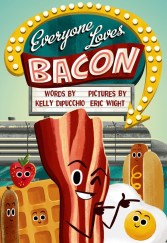
Look, LADY PANCAKE AND SIR FRENCH TOAST released on the same day as EVERYONE LOVES BACON. Did Josh Funk and Kelly DiPucchio go at each other’s throats…or breakfasts? No. Those books help one another sell even better because they are both delicious titles. Right now there are a ton of YETI books being published and it’s making YETIS become all the rage. People are now seeking out abominable snowmen books because they see they’re becoming popular. Our books HELP one another.

Now, this is not to say I’ve never been jealous. Of course I have! It’s a natural human emotion. But I’ve never sought to strike down someone who has enjoyed success. Whether or not I personally like a book, that artist deserves the sales and the accolades. Hopefully, one of my books will reach the same level of success some day. That’s what I keep working toward.
I think this attitude comes down to the fact that I’ve been kicked in the gut before, but by a disease. Being diagnosed with MS was the worst thing to ever happen to me, and after being in a funk for a year, I realized that if this was the worst thing then I had it pretty darn good. Great husband, two beautiful daughters, a comfortable home—that’s all I really need to be happy. Maybe it sounds cliché, but it’s true.
I was warned that speaking out about this review might cause a backlash. After all, maybe the review was legitimate and I’m just a sour puss. Sure, I could be overreacting. But the timing of the review (just minutes after I posed about NORMAL NORMAN’s #1 New Release status on social media) and having two more appear on different books suggests to me otherwise. However, yes, that person had the right to leave those reviews and I accept that.
Thankfully I’ve moved past that initial sting. I have, more than ever, realized that authors and illustrators are in this together—if we’re to keep selling books, we’re to celebrate each other’s successes. Be happy for those who get on the best-seller lists or receive starred reviews from the journals. They are bringing attention to our format and keeping it strong and desired. They have worked hard for the limelight and they should shine. My hope is that we can all shine just as brightly…and yes, even Marie Poppy’s cat.


The creators of PEEP & EGG, author Laura Gehl and illustrator Joyce Wan, are letting us hear a peep from their recent conversation about making this seriously cute new book…which is just in time for Easter! It’s all it’s cracked up to be! (Man, I’m really pushing the puns lately.)
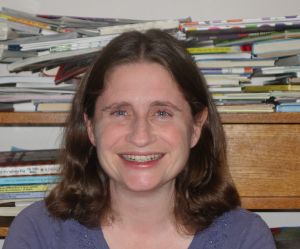

Joyce Asks Laura….
Joyce: How did you first come up with the idea for this book?
Laura: With four kids of my own, I spent many years hearing I’M NOT every day. And by every day, I really mean every minute. But on the rare occasion that I got a full night’s sleep, or a full bar of chocolate, I could recognize that my kids and their peers weren’t actually trying to drive adults crazy (most of the time). A lot of the hesitation and I’M NOT came from nervousness, rather than stubbornness. I hope Peep and Egg will help parents start conversations with their kids about fears—however ridiculous those fears may seem. And I hope Peep and Egg will remind toddlers and preschoolers that they can overcome their fears.
Joyce: You left a lot of room in the text for illustrations, which was great for me! Is that a challenging thing to do as a writer?
Laura: YES!!!!!!!!! It is extremely hard to do! As an author, you have to resist the temptation to write a zillion detailed illustration notes and instead trust the illustrator to make magic happen. I always need to remind myself that if I am doing my job correctly, then my words—without the pictures—should only tell part of the story. If a child could hear only the words and get the full experience of my story, then I’ve totally failed.
Joyce: When you were writing this book, how did you imagine the illustrations?
Laura: I imagined the illustrations like Richard Scarry’s illustrations in I Am A Bunny. Just as you can see every hair on his bunny, I imagined seeing every feather on Peep. It’s hilarious to think about that now, since your style is totally different and yet I LOVE LOVE LOVE your interpretation of my words, and the magic we made together. That’s what I mean about trusting the illustrator—and also trusting the editor to make the perfect partnership between words and pictures. I know Janine, our wonderful editor, had you in mind from the beginning. It was her wisdom that made Peep and Egg the adorable book it is today!
Joyce: Peep and Egg is also written entirely in dialogue. Was that something that evolved as you were writing the story or was that something you decided from the start?
Laura: Over the various versions of Peep and Egg, certain aspects of the story changed—the ending most of all. But the story started in dialogue and stayed that way through every revision.
Joyce: Would you say you are more like Peep or more like Egg? (I’m more like Peep and tend to jump head first into everything!)
Laura: Now I know why we make a great team. I am definitely an Egg. I worry about everything and most days would love to stay inside my safe, cozy shell (as long as I could have chocolate inside, and a good book to read!).

Laura Asks Joyce…
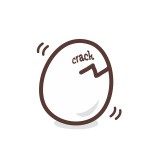
Laura: When you began developing the characters, who was more difficult to draw–Peep or Egg? (In this case, I mean Egg as an egg. I still can’t believe how much personality you bring out for Egg without the benefit of facial expressions!)
Joyce: The voice in the manuscript was so strong I could see the characters in my head right away. They were a joy to draw because they are such opposites personality-wise, and so expressive in their dialogue. Yes, Egg as an egg was hardest as I was unable to show facial expressions or body movements, but it was a fun challenge.
Laura: How did you decide on the color palate that you used? Did you experiment with other colors before narrowing in?
Joyce: I tend to gravitate to a particular color palette in a lot of my work and they’re usually colors that are a little off from the traditional rainbow colors. So instead of straight red, green and blue, I love colors like blush pink, olive, teal, lime, and aqua, which you will see a lot of in Peep and Egg.
Laura: Can you tell us a little about the process of designing the ridiculously adorable cover?
Joyce: What initially started as a two-book project became a four-book project over the course of working on the first two books [side note from Laura: WOO-HOO!] so I felt like this first book cover needed to be branded in a way so that recognizable design elements could be carried over a few books. I even sought feedback from my design-savvy agent on a number of design ideas, which helped me tremendously throughout the cover design process. That is one of the nice things about having an agent who worked on the design side of publishing before becoming an agent. It took a few rounds of different ideas before I reached a final design that the editor loved.

Laura: Which illustration from the book is your favorite? Mine is Egg wearing the football helmet.
Joyce: I like the front endpaper, as I hid a little surprise for readers to discover.
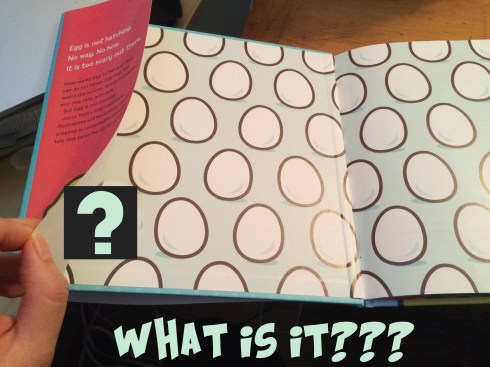
I suppose you’ll have to pick up PEEP AND EGG to find out!
Thanks, ladies. I can see this adorable series easily growing into a dozen books! A DOZEN! GET IT? (Groan, Tara.)
Macmillan is giving away a copy of PEEP & EGG: I’M NOT HATCHING to one lucky blog commenter. U.S. addresses only, please. Just leave a comment below to enter. Giveaway closes March 14th!
Laura Gehl is the author of ONE BIG PAIR OF UNDERWEAR, a Charlotte Zolotow Highly Commended Title, International Literacy Association Honor Book, and Booklist Books for Youth Editors’ Choice for 2014; HARE AND TORTOISE RACE ACROSS ISRAEL and AND THEN ANOTHER SHEEP TURNED UP (both PJ library selections for 2015 and 2016); and the PEEP AND EGG series. A former science and reading teacher, she also writes about science for children and adults. Laura lives in Chevy Chase, Maryland with her husband and four children. Visit her online at lauragehl.com.
Joyce Wan is an award-winning author and illustrator of many best-selling books for children, including YOU ARE MY CUPCAKE, WE BELONG TOGETHER, and THE WHALE IN MY SWIMMING POOL, which was a Junior Library Guild Spring 2015 selection. When she’s not working on books, she teaches courses at The School of Visual Arts in New York City. Joyce is originally from Boston, Massachusetts and currently lives in Ridgewood, New Jersey. Through all her work, she hopes to inspire people to embrace the spirit of childhood and follow their dreams. Visit Joyce online at wanart.com.

Stuffed Norman by dollsforfriends.com!
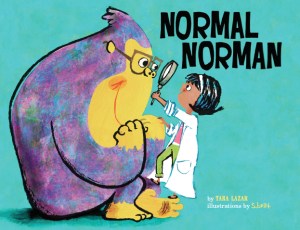
A four-foot-tall stuffed NORMAL NORMAN sits in my house and my 12-year-old forgets he’s here, so she jumps upon spotting him, not unlike Gloria’s reaction to dog-butler Barkley on Modern Family. OH DIOS MIO!
It’s exciting and shocking to see your character come to life. Although, truth be told, Norman is not really MY character. If you were participating in PiBoIdMo this past November, you discovered that I didn’t know what kind of animal Norman was. I left the art note blank in my manuscript. Editor Meredith Mundy asked me what Norman was but I refused to name his species—I thought an illustrator would do a much better job. So Norman, he really belongs to S.britt. Only Stephan could have created a purple orangutan with handsome-nerd glasses and such emotional expressions. But it did take a while to find the real Norman. The first few attempts didn’t feel quite right. But we all knew it when the true Normal Norman revealed himself. On a unicycle.


So if I didn’t imagine Norman, how did he come to life?
I began with his name, the title: Normal Norman. That’s all I had. But I knew there was no way Norman could actually BE normal. No siree. He had to revolt at all I threw at him. By making my character act in unexpected ways, I conveyed a message to readers that I didn’t necessarily intend, but which worked out perfectly: there’s really no such thing as “normal.” We are all different in our own special—sometimes zany—ways. And that’s something that should be celebrated.
I’ll be celebrating the release of Normal Norman in just a few days, on March 1st! Sterling Children’s Books is giving away five copies via GoodReads—please click below to enter and add Norman to your want-to-read list!
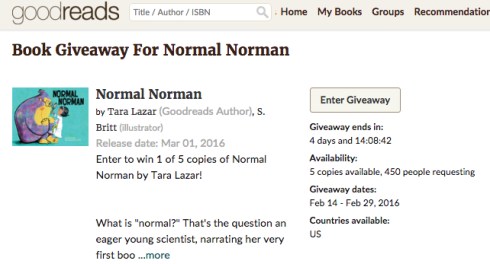
If you’d like to pre-order a signed copy, please call my good friends at The Bookworm in Bernardsville, NJ at 908-766-4599. I’ll dash over there to personalize and sign it.
A couple of places I’m not dashing are London and Bologna for the international book fairs. But guess who is? Yep, you’ve guessed it: Norman. He’s on a world tour! I hope they don’t serve bananas in first class.
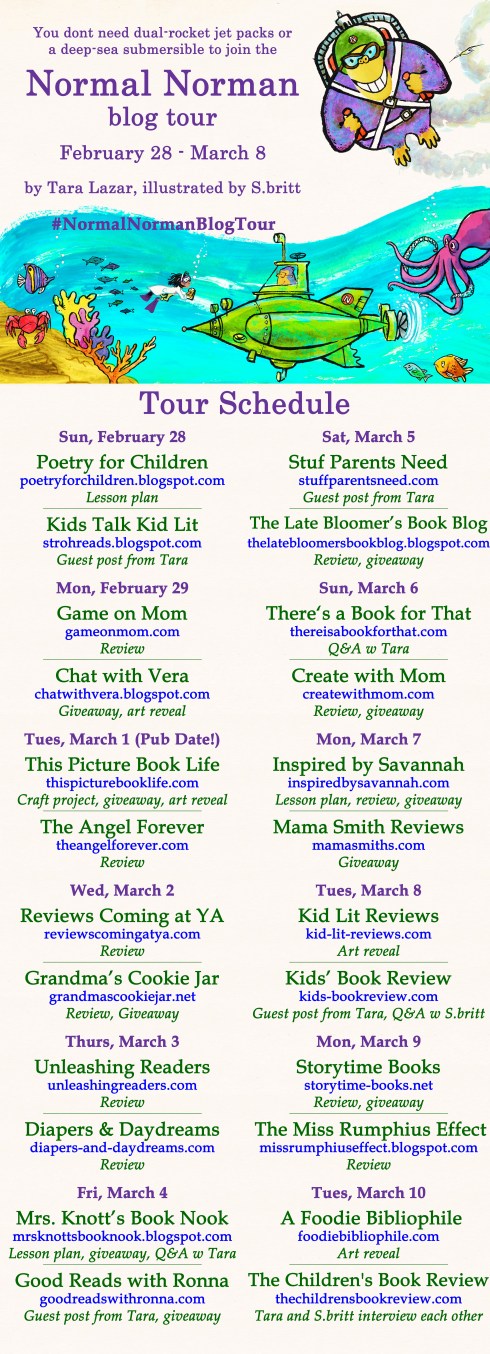
Meanwhile, the author will be on a virtual tour. Be sure to stop by these entertaining blogs for all kinds of uncommon fun and giveaways. But sorry, we’re not giving away stuffed Norman. After all, he’s got a jet-set schedule. Lucky dude!
 by
by I have a confession to make.
But you can’t tell anyone, OK?
I’m not fond of historical fiction.
I’m a huge reader with wide-ranging interests, so it pains me to say there’s a genre I don’t particularly like—especially when I know many writers who are working hard to create very valuable books in it. It also pains me because I’m smart enough to know that there’s probably historical fiction out there I would like if I got past my prejudice that historical fiction is all 800-page tomes full of hoop skirts, archaic language and obscure references.
So knowing that about me, what genre would you guess my latest picture book belongs to?
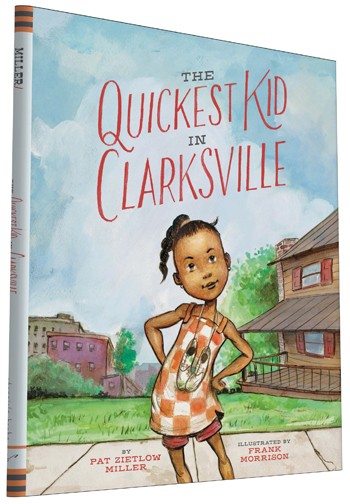
Yup. Historical fiction.
What can I say? Life is funny sometimes.
Interestingly enough, it’s not like I set out to write historical fiction. I kind of stumbled into it. I was initially writing a book called THE FASTEST FEET ON FLEET STREET, set in current times, about two girls competing to see who was the better runner, jumper and double-dutch rope skipper.
But the story needed something more. I wasn’t sure what.
The answer came from a discussion with an editor at a writing conference. She suggested anchoring it in a specific time. That one suggestion set off the proverbial light bulb. I immediately thought of Wilma Rudolph.
I knew the outline of Wilma’s story—overcoming polio and other illnesses as a child to become a three-time Olympic gold medalist and the fastest woman in the world—but not exactly when it had taken place. Research was obviously required.
I used to work as a newspaper reporter, so I know how to conduct research and interview and generally find things out. That part felt familiar as I read books, searched online and emailed experts.
And, as happens anytime I conduct research, l learned things. Things that fit right in with the story I was writing. My research filled in the gaps in my story, strengthened the weak parts and gave it the needed oomph, for want of a more technical term. Soon, the story’s title was THE QUICKEST KID IN CLARKSVILLE, a nod to Wilma’s hometown of Clarksville, Tennessee.
I was able to weave in facts about the poverty Wilma grew up in and how her hometown was segregated during her youth. I also learned that Wilma paved the way for the town’s eventual integration by insisting that her victory parade in 1960 be open to everyone.
I wrote an author’s note. Got the rights to use a photo of the real-life Wilma riding in her parade.
Before I knew it, I had a historical fiction picture book. That I liked. Maybe it was time to rethink my priorities.
So, when my middle-school daughter came home and grumpily said she had to read a historical fiction book and she didn’t want to because all historical fiction was “boring,” I did not agree with her.
Instead, I put out a call to my online friends and soon had a list of more than 50 historical fiction middle-grade titles they recommended. My daughter and I spent an evening at the library looking some up. She left with THE BOY IN THE STRIPED PAJAMAS and TWERP, while I left with TURTLE IN PARADISE and AL CAPONE DOES MY SHIRTS.
While I still wouldn’t say historical fiction is my favorite genre, I now know that I like it more than I used to.
And I’d certainly be open to writing some again.
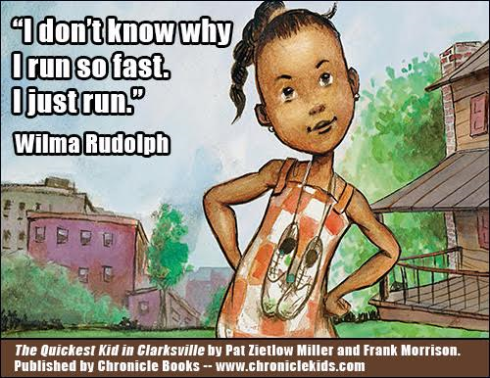
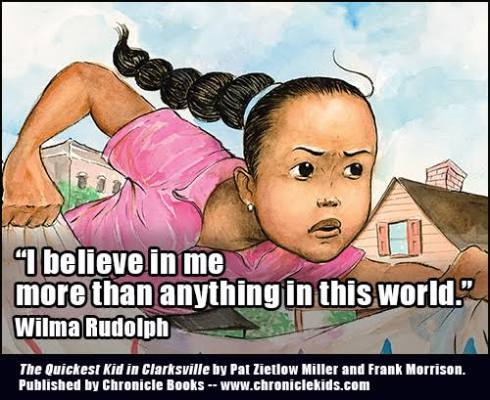
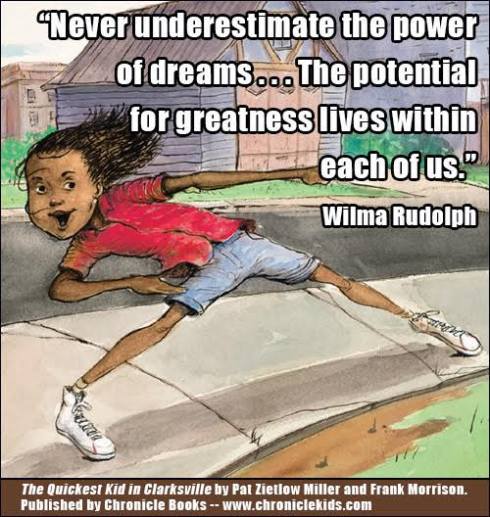
As I researched, I found great quotes by Wilma that apply to any era. Here are a few:
Thank you, Pat! Sometimes agents and editors advise writers, “This story needs another layer.” You found yours in historical fiction!
I’m giving away a copy of this spunky book! Just leave a comment to enter and a winner will be randomly selected in early March!
I find it fascinating when kidlit authors can hop into other genres. My mind is perpetually caught in 2nd grade so I could never envision writing young adult novels. But as my agent reminds me, never say never. Clever, Joan, ever clever.
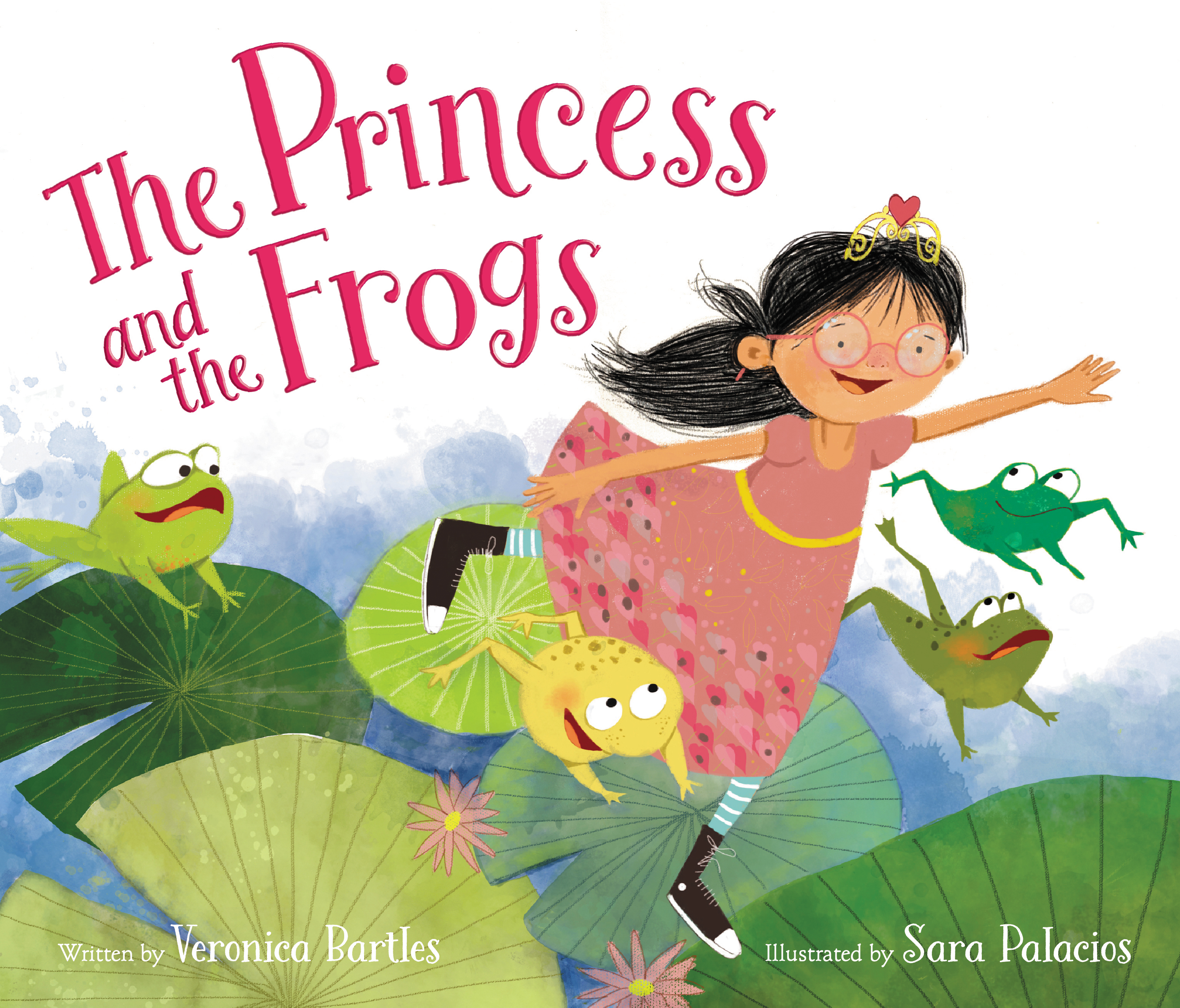
 Veronica Bartles is one of those age-group-jumping frogs. Err, I mean authors. Sorry, I’ve got froggies on the brain because today she’s revealing the cover of her upcoming picture book THE PRINCESS AND THE FROGS (Balzer + Bray), illustrated by Sara Palacios. And GET THIS–the idea for the book came from her participation in PiBoIdMo. It’s another success story!
Veronica, you write YA novels! And now, a picture book! How difficult was it for you to write for a much younger age group?
Well, I’ve been accused of being very young at heart, so luckily it’s not too difficult for me to slip into a younger voice. But there’s definitely a shift between writing YA novels and picture books. I wouldn’t say one is harder to write than the other, but writing a picture book is definitely not easier than writing a full-length novel, just because it’s shorter. You’d think (at least, I used to think) that it would be a lot harder to write a 50,000-word novel than a 500-word picture book, because the novel has 100 times more words. But with a picture book, every single word counts. When you have only 500-700 words (or less!) to tell a story, with fully-developed characters, plenty of conflict, and a plot that keeps an audience’s attention through multiple re-readings, even the smallest word choice questions make a difference.
Although I can usually jot down a picture book first draft in a few days, while it takes a month or more to finish a YA novel’s first draft, I discovered that the revision process is so much more intense for my picture books. When all is said and done, writing and revising a picture book takes as long as it takes to write and revise a full YA novel. (Maybe even longer.) That was definitely something that took some getting used to.
OK, now I’m really going to test your YA loyalty! How is writing a PB “better” than writing a novel?
Tough question!
I think the best part about writing a picture book is that I can be surprised by the final story too. Writing YA is really fun, and I absolutely make friends with my characters by the time we reach the end of the story together. But since I write all the words, there isn’t anything in the final novel to surprise me. With THE PRINCESS AND THE FROGS, my words only tell half of the story. The rest is the work of my fabulous illustrator, Sara Palacios. I love the way her pictures and my words fit together to tell a story better than either of us could do on our own.
What was it like when you first saw Sara’s illustrations?
Way back before Sara was officially signed on as my illustrator, my editor sent me some sample artwork with the most adorable frogs you’ve ever seen, and I was immediately smitten. When I got the word that Sara had agreed to illustrate THE PRINCESS AND THE FROGS, I saved those frog pictures as the background wallpaper on my phone, so I could look at them several times a day. Of course, this made waiting for the official illustrations just a teensy bit harder, because I knew something absolutely fabulous was coming.
So I started following Sara’s Facebook page, watching for any hints of frogs and princesses in her artwork.
One day, she posted a picture of her desk with several sketches for the book she was currently working on, and up in the corner of the picture, there was a pencil sketch of the most adorable little girl I’ve ever seen. I remember thinking, “I want Princess Cassandra to look just like that.” And I’ll admit, I was kind of sad to see this perfect princess in a pile of sketches for someone else’s book. But a couple of days later, my editor, Kristin Rens, emailed me some rough, preliminary sketches of Sara’s concept art for Princess Cassandra … and it was the sketch I had fallen in love with from her Facebook post!!! I sent my daughter outside to do lots of cartwheels for me in celebration. (I’ve never had good enough balance to pull off a proper cartwheel, so I always have to designate a proxy cartwheel performer when celebrations call for one.)
What suggestions do you have for MG or YA authors who want to take on a PB?
Read lots and lots of different kinds of picture books to familiarize yourself with the PB voice. Read them aloud, so you can hear the rhythm of the narrative, even in the books that don’t rhyme. Read them to small children (if you don’t have small children of your own, you can always volunteer to read for story time at your local library), and pay attention to the way they interact with the books. And don’t be afraid to use big words. Kids love creative vocabulary choices!
Also, if possible, make friends with some illustrators. Their critique is invaluable when you’re trying to write a book that’s both fun to read and still leaves enough room for the illustrator to tell her part of the story.
THE PRINCESS AND THE FROGS sounds like an adorable fractured fairy tale, where a princess loves frogs so much, she can’t help kissing them. What was your inspiration for this one?
Well, in November of 2010, I was gearing up for NaNoWriMo (National Novel Writing Month). I’d written my first YA manuscript during NaNoWriMo in 2008, and I’d attempted to write another one (but failed miserably) in 2009, so I felt like I had to “win” again in 2010 to redeem myself. But I was querying that first YA manuscript, knee-deep in revisions on other YA manuscripts, and I didn’t have any great ideas for the next big thing. The thought of subjecting myself to NaNoWriMo made me want to curl up under my desk and sob. So when one of my friends posted a link to something called PiBoIdMo (Picture Book IDEA Month!), I decided I would do that instead. Come up with 30 ideas in 30 days? How hard could it be?
I didn’t actually intend to write picture books, but I wanted an easy way to give myself a writing win, and I told myself that coming up with thirty PB ideas was sure to spark my brain and give me plenty of ideas for YA manuscripts as well. But ideas don’t always come just because you want them to!
Suddenly, it was almost the end of the month, and I still had a nearly-empty PiBoIdMo idea notebook. But I had started collecting query rejections on my YA manuscript, KISSING FROGS, and I desperately needed some kind of validation. I was NOT going to let this challenge beat me, so I started looking everywhere for the slightest glimmer of an idea. And as I thought about my “failed” novel (I had almost TEN whole rejections!!) I started to wonder, “Well, what if the princess didn’t WANT that clichéd Happily Ever After? What if she wasn’t looking for a prince? What if she really just wanted a frog? But what if she loved frogs so much she couldn’t help kissing them goodnight? What if the poor princess had a castle full of princes, all proposing marriage, but really just wanted a pet to love? By the end of the week, my PiBoIdMo idea book was brimming with ideas for fractured fairy tales, including two or three ideas for YA novels.
And I fell in love with a spunky Princess Cassandra, who wanted a frog, not a prince.
So let’s meet Princess Cassandra and her beloved froggies!
You know I’ll be first on line to buy this one. I’m a frog fanatic. (Which I tend not to reveal because everyone starts buying me frog-themed gifts. I’ve got a big box of ugly porcelain frogs, hidden away. Maybe I’ll try smooching them into royalty!)
Thanks, Veronica, for revealing your cover here today. Congratulations!
Princess Cassandra and frogs are coming via Balzer + Bray on November 15, right smack dab in the middle of PiBoIdMo 2016. Be sure to hop back here then to win a copy!
 You’re a lovely person. Simply charming. I mean that, I really do. You read my blog and leave nice comments and buy my books and write like you can’t go wrong. But I have to tell you:
“It’s not you. It’s me.”
In short, that’s what a literary rejection means. It’s not about YOU. Remember, YOU are lovely! It’s about the editor and whether the proposed project fits with her taste and imprint list.
Subjective, it’s all subjective! One editor’s rejection is another editor’s next book!
But editors and agents often provide writers with rejection statements that we want to understand. We feel the need to analyze, to determine what we can do better. But don’t over-analyze. Sometimes a rejection is just a way of saying “no, it’s not for me.”
Here is a list of common rejections heard by picture book writers (and other writers), plus an interpretation of what they mean. (Note that I said “interpretation”! Your mileage may vary.)
“It feels familiar.”
The editor is reminded of another book (or books) while reading your manuscript, but he can’t quite put his finger on it. Maybe it’s the character, the theme or the structure, but it’s impossible to pinpoint. In short, the story doesn’t feel unique enough. The editor doesn’t think it will stand out in the marketplace. There’s too much similar competition. If you wrote about a common theme (new sibling, moving to a new house, first day of school, etc.) without a fresh new twist, this could be the problem.
“It’s too slight.” or “It’s too one-note.”
The editor feels your story doesn’t have enough meat to it. It may be lacking a universal emotional theme (friendship, being yourself, perseverance, etc.) or a clear story arc. The editor may feel there isn’t enough going on to encourage re-readings. The story feels more like a one-line joke than a fully fleshed-out tale. The main character may not have struggled enough before finding the resolution, which is sometimes why an ending can “fall flat”. Also rejected as “needs more layers.”
“It’s not right for our list.”
Every imprint within each publisher has a specific “style”. Some are commercial, some are literary, some are message-driven, some are wacky and humorous. Know which imprint publishes what.
“It’s too similar to…”
Your story competes too closely with a book on the editor’s list or a wildly popular book by another publisher that’s already in the marketplace.
“It’s not right for us at this time.”
See above. They might have projects in the hopper that compete too closely with what you submitted. (You submitted a story about a bowling ball. They just signed a bowling ball book! What are the odds???) They may have recently contracted multiple projects and no longer have room on their list. They may be moving away from “older” picture books into the younger set (ages 2-5 vs. 4-8). Unfortunately, this rejection is also used as a polite catch-all or a form rejection.
“It’s too quiet.”
The imprint you submitted to might not publish literary fiction. The editor feels your manuscript doesn’t have a strong hook, something that will make your book marketable. They don’t feel it will stand out in the marketplace. It cannot be easily summarized into an elevator pitch, which is what their salespeople will use to market the book to stores, schools and libraries. It’s not a commercial or high-concept story.
“It’s too commercial.”
The imprint you submitted to might not publish commercial fiction. Commercial books have a strong marketing hook, are often high-concept (can be boiled down to an immediately understood, succinct statement), have a clear plot struggle and appeal to a wide range of readers. Literary fiction features artistic prose and often contains an internal conflict and more meandering plot.

“It doesn’t resonate with me.”
This is really a case of “It’s not you. It’s me.” The editor may think the story is well-written and even enjoy it, but it isn’t tugging at her heartstrings. Being an editor is like dating, like finding a potential mate—the story has to light something within her to want to devote passion and commitment to it. Remember, the editor has to spend two or more years with your story, bringing it to life. They need to feel sincerely attached to it. You want them to LOVE it, you want them to be EXCITED so they can create the best book possible. Examine your emotional theme—is it strong enough?
“I didn’t quite connect with this in the way I’d hoped.”
See above. The editor may have liked your concept and pitch, but not the execution of the story. Again, the story isn’t tugging at his heartstrings. Examine the POV, voice and the emotional theme (often referred to as a “layer”). A revision might be necessary…or not. Another editor may connect. Also rejected as, “It doesn’t have that WOW factor” or “I’m not getting that YES! feeling.”
“This needs a stronger voice.”
Voice is the unique way an author combines words and strings together sentences. It is your story’s personality, its manner of expression. It’s the difference between “Oh, shucks!” and “Oh, slippery slush!” (Little Red Gliding Hood) It’s the difference between “Charmaine’s showing off” and “Charmaine’s strutting hard enough to shame a rooster.” (The Quickest Kid in Clarksville) It’s the difference between “Pancake raced away” and “Pancake rappelled down a rope of linguini.” (Lady Pancake and Sir French Toast)
Go ahead and play with your words—use stronger verbs, alter the sentence structure, use alliteration, internal rhyme, onomatopoeia and uncommon words. Heck, make up a word every once in a while! Think of voice the way a poet thinks about meter—there’s a certain beat that the reader can dance to.
Pretend YOU are the main character. How would he or she TALK? Does the way you’ve written the story—the cadence of the words—match the character, the setting, the situation?
“There’s no current market for this.”
Your story’s subject matter and/or theme is either too popular or too obscure.
Remember when vampires were all the rage in YA? Same thing with pirates in picture books. There were a slew of well-received books featuring gangplanks that sold gangbusters. (Hey, there’s “voice” again!) But then that ship sailed. The market got soaked with pirates. So guess what? Editors didn’t necessarily buy a lot of pirate titles because there was too much existing, well-established competition. But everything is cyclical. I spot new pirate books on the horizon, captain! Land, ho!
Also, your manuscript might not be a picture book because it’s too long or too descriptive, yet it doesn’t fall neatly into another kidlit category, either.
Form Rejection vs. Personal Rejection
Most will send a form rejection. There’s just not enough time in the universe—or even in the flux capacitor—to personally respond to every manuscript. But if you receive a personal rejection, the editor or agent sees something promising. You haven’t hooked him, but he sees potential. Think of it as encouraging. You’re on the right wave. Just keep swimming; just keep swimming.
On the other hand, getting only form rejections doesn’t mean you DON’T have potential. It just means the editor or agent is crunched for time.
I mean, imagine this is what gets dumped on your desk every day!

One thing you should know: if an agent or editor wants to see more of your work, they will ask. No need for interpretation; it will be there in black and white. If they complimented your story but did not ask for a revision, DO NOT send one anyway thinking they just forgot to ask. If they want it, they WON’T FORGET. And if you send something they didn’t ask for, THEY WILL REMEMBER.
Let’s face it, the fact that you’re even receiving rejections is good. Yes, GOOD! You’re putting your work out there. And the sting of each rejection will lessen with every new one you receive. So let them pile up. Read ‘em. Move on. You WILL get rejections for the rest of your life if you’re a writer. Bottom line: learn to live with them, their brevity and their occasional ambiguity. Ever onward.
And, in case you forgot, you’re a lovely person.
Been snowed in this week and going stir crazy?
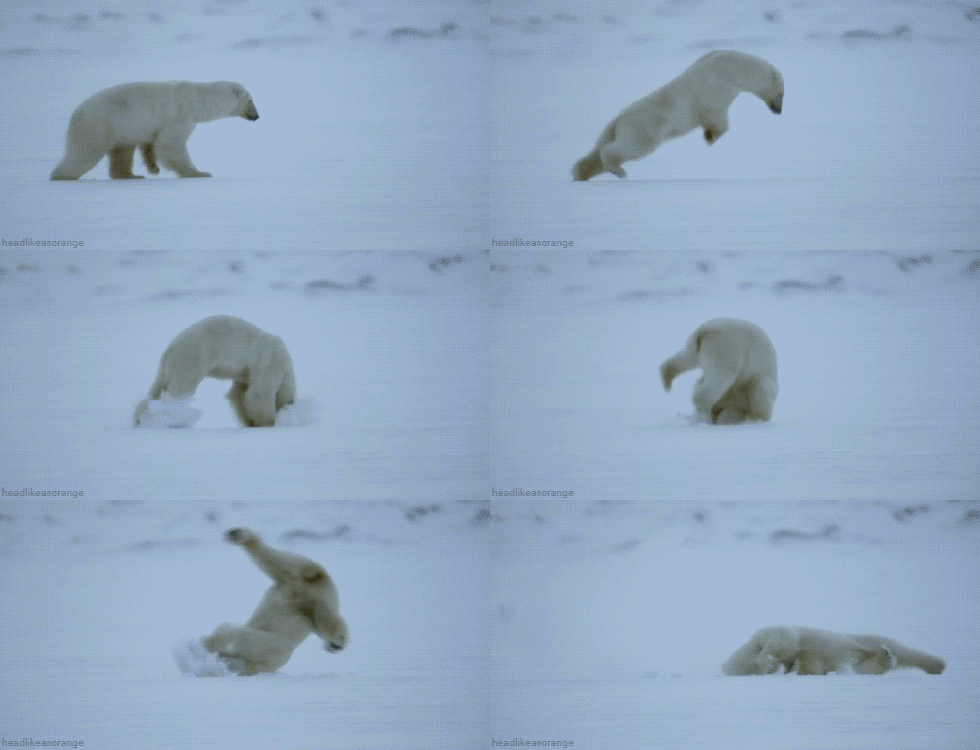
Yowie! I think you may have fractured something there, buddy.
Speaking of fractures, all along I’ve been calling LITTLE RED GLIDING HOOD a fractured fairytale, but I think I’ve been WRONG. Yes, folks, I’m admitting my mistake. Somebody turn up The Biebs!

LITTLE RED is actually a fairytale MASH-UP. (This is probably a sub-segment of a fracture, like a bone chip.)
I didn’t merely retell LITTLE RED, I inserted a flock of fairytale and nursery rhyme characters into a whole new story starring Red and The Big Bad Wolf.
During revisions, editor Heidi Kilgras asked me to create a chain reaction after the boy cried “Wolf!”. I immediately whipped this up, which Troy Cummings illustrated brilliantly:
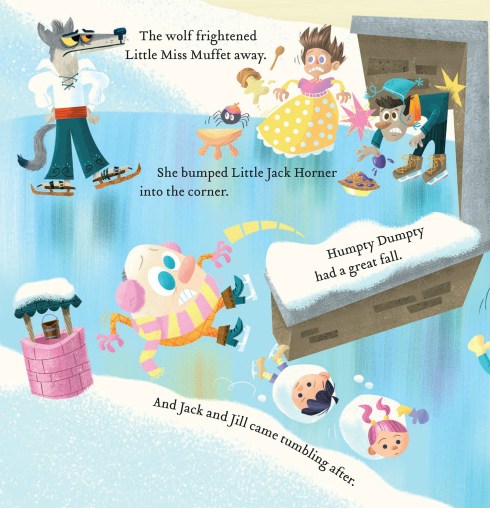
I’m wondering if maybe I haven’t marketed this book correctly. Do people think it’s the same story as the original, just taking place on ice??? No, it’s so much more than that!
Again, self-doubt creeps into the creative’s mind. Self-doubt, which I talked about last week, happens not just when you’re writing, but through every part of the book-making process…even when the process is over! I still think self-doubt is healthy, as long as it’s not overwhelming or paralyzing. Those slices of doubt help you create a better book…and perhaps also help you market the title more effectively!
So now I’m doing the mashed potato.

Oh wait, not THAT mashed potato. I’ll leave that for an alien book.
OK, enough hijinks (which is a FABULOUS word for a picture book text)…onto the final winners of the PiBoIdMo daily prizes. I will be emailing the remaining winners (from this week) later today to arrange delivery!
Day 21: Nancy Tupper Ling Winner
LANE ARNOLD (Double Happiness)
Day 22: Anna Staniszewski Winner
CAROL GWIN NELSON (Power Down, Little Robot)
Day 23: Katy Duffield Winner
SELENA SPAIN (Loud Lula)
Day 24: Jesse Klausmeier Winner
ANNIE CRONIN ROMANO (Open This Little Book)
Day 25: AJ Smith Winner
ROBYN CAMPBELL (Even Monsters)
Day 26: Pat Zietlow Miller Winner
LISA CONNORS (Share the Bread)
Day 27: Kelly DiPucchio Winner
AMY BRADSHAW (Everyone Loves Bacon)
Day 28: Paula Yoo Winner
CHRISTINE RODENBOUR (Twenty-Two Cents…the book, not $0.22!)
Day 29: Arree Chung Winner
SARA WEINGARTNER (Ninja!)
Day 30: Kim Norman Winner
KIM PIDDINGTON (This Old Van)
Congratulations to all the winners…and that includes all those who completed the 30-ideas-in-30-days challenge. Remember you can honor your gumption (ooh, another great word!) with a prize at the PiBoIdMo CafePress Shop! Like this snazzy mug! Every purchase via our link makes $3.00 for RIF (all proceeds).
In 2015, PiBoIdMo donated $230.39 to Reading is Fundamental, helping to put new books into the hands of underprivileged children. A sincere thank you to those who snapped up PiBoIdMo goodies. You did a good thing.

Thanks to everyone for participating! That’s all, it’s OVAH!
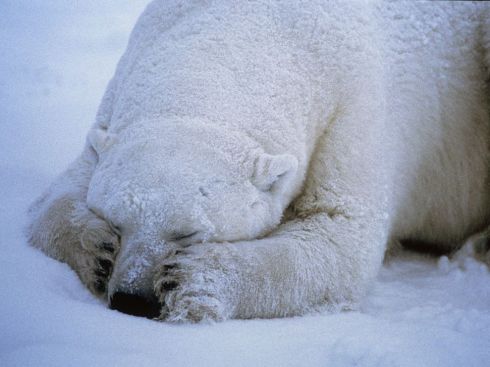
Now I think I’ll go hibernate with this guy!





 Writing for Kids (While Raising Them)