This is the fourth in a series of posts about the 2008 Rutgers University Council on Children’s Literature One-on-One Mentoring Conference. Click on the RUCCL tag above to read them all.
Vivian Grey, accomplished author and founder of the RUCCL conference welcomed attendees to an “extraordinary creative collaboration.” Why did she use those three words? The RUCCL is unlike any writing conference of its kind, matching new and aspiring authors with experienced professionals for an in-depth discussion of children’s literature—on whatever topic the mentee wishes to explore.
“Use this day to move your writing career forward,” Ms. Grey said. “The RUCCL pioneered and developed the one-on-one format and helped launch the careers of many well-known authors: Marcie Aboff, Laurie Halse Anderson, Denise Lang, Pamela Curtis Swallow, Kay Winters, and Rita Williams-Garcia.” (And I’m sure I didn’t catch them all!)
When Vivian Grey approached legendary Rutgers President Mason Gross in 1970, he enthusiastically supported her idea and assured the conference a permanent home at Rutgers through a presidential charter. The RUCCL is the only group in the country to be recognized in this manner. Aspiring authors can be confident knowing that this organization will continue to inspire us year after year.
Ms. Grey left us with words of wisdom based upon our difficult times. “We live in an era of great confusion and agitation,” she said, referring to the upcoming election, our suffering economy, and the wars raging overseas. “Children are vulnerable and powerless. But we can listen to them and be their voice. We can help them understand this increasingly confusing world.”
She continued, “There’s no better time than now to be writing for children. The vision we create for children becomes their future.”
Bravo, Vivian. The vision you created for us will indeed become our future, too.
 Ms. Winters spoke of her journey to becoming an author, which began in childhood with a love of books. She always wanted to be a teacher, however, and that is what she became. But she still wrote for pleasure, penning articles, short stories and poems that never made much money. Writing to make a living didn’t seem possible.

 “You need to write what you want regardless of whether you think anyone else ‘gets it’,” she said. “But writing what you desire is always a risk.” With Fat Kid, she didn’t necessarily cater to the reader. There’s a hunk of bleeding leg and splattering of fat when Troy envisions the results of his own suicide, and some people may put the book down at that point. (In fact, her book was banned in some areas.) But others will stick with it and read on. If the reader’s journey isn’t easy, maybe it will be more redemptive and satisfying by the end.
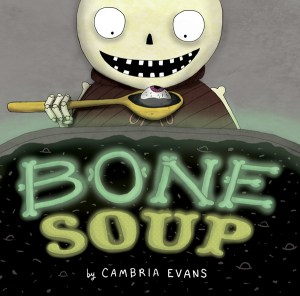 Succulent eyeballs float among tender bat wings, seasoning Cambria Evans’ Bone Soup with gross Halloween humor no five year-old can resist.