You are currently browsing the category archive for the ‘Writing’ category.
It’s Children’s Book Week! So what does that mean? It’s time to celebrate children’s books across all genres.
Read to children. Inspire their creativity. Write a story together. Draw pictures. Enter Carin Berger’s Contest. Do whatever you want to make reading a priority in your family’s life! (Although I’m sure it’s already a priority.)
To help you along on this salute to Silverstein, this festival of Fox, this jubilee of Jeffers, here are some links:
- Read story starters by children’s authors and finish what they started.
- Visit the Write For a Reader blog. Shelly will have author interviews and give-aways all week.
- Check out IlluStory and Create Your Own Pop-up Book, fun ways for your child to publish their own book.
- Review the Top 10 Summer Reading Lists from various organizations and the children’s choice reading list from the Children’s Book Council.
- Share your favorite children’s book with us. Comment below so others can discover great books.
And here are some marvelous picture books being released this week! Enjoy!

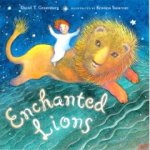

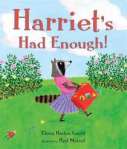


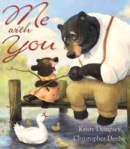


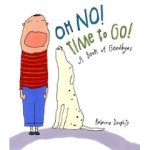

 First there was Mitali Perkins’ list of young adult authors on Twitter. Then came the picture book author and illustrator list.
And now–finally–middle grade authors have a list to call their own.
Below you’ll find authors of published books (or soon-to-be-released titles) for middle grade readers. Chapter book and tween authors have been included as well.
If you know of others who should be on this list, please leave a comment and I’ll update the list periodically.
Enjoy! Discover talented writers; make new connections.
- R.J. Anderson @RJ_Anderson
- Elizabeth Atkinson @tWeenBooks
- Susan Taylor Brown @SusanWrites
- Meg Cabot @MegCabot
- RJ Clarken @LightVerse
- Bonnie Doerr @BonnieDoerr
- Michelle Knudsen @MichelleKnudsen
- Adrienne Kress @AdrienneKress
- Cynthea Liu @Cynthea
- Lauren Baratz Logsted @LaurenBaratzL
- Anne Mazer @AnneMazer
- Kate Messner @KateMessner
- Lauren Myracle @LaurenMyracle
- Nicole O’Dell @Nicole_Odell
- Ellen Potter @EllenPotter
- Sarah Prineas @SPrineas
- Karen Rivers @KarenRivers
- Christine Rose @ChristineRose
- Laurel Snyder @LaurelSnyder
- Cynthia Chapman Willis @CynthiaCWillis
 Children’s book writers were treated to another fun and informative first page session this week in Princeton, hosted by the NJ-SCBWI. Editors Michelle Burke and Allison Wortche of Knopf & Crown Books For Young Readers listened to 30 first pages read aloud as they followed along with each manuscript page. Then they gave their immediate first impressions of the work.
If you’ve never attended a first page critique, it’s a quick way to get a handle on what your peers are writing. A first page session shows you what it’s like for an editor to spend two hours in the slush pile. Common themes emerge. Mistakes reveal themselves. If you listen carefully, you’ll learn how to avoid first page problems and encourage an editor to read on.
So what did the editors say? I encourage you to read on…
Picture Books:
Use varying imagery in picture books. One manuscript conveyed a lot of emotion and the editors didn’t see where the illustrator would take inspiration for art. The same scene through several page turns may lose a child’s attention.
Dialogue needs to match the age of your character. A picture book character shouldn’t sound older than a five- or six-year-old child. Their actions should also match their age.
Cut excess detail in picture books. The first page of the manuscript should reveal a clear story arc. If the manuscript is bogged down with details, it slows the story down. For example, writing that a mother is carrying a napkin to the table and setting it down next to the plate is unecessary (unless that specific action is crucial to the story, and even so, it could probably be illustrated).
Premise and conflict should be apparent on the first page of a picture book manuscript. For example, dialogue between two characters should reveal a story, not just serve as adorable banter.
Every line in a picture book should move the story forward. There’s no room for chatting or extraneous stuff.
Picture books should have a linear approach. Moving back and forth in time can confuse a young child.
With holiday stories, you automatically have to work harder. Stories about specific times of year are a tough sell. There’s a lot of competition and a small sales window.
Some picture book stories are told better without rhyme. If the phrasing is unnatural in rhyme–things you wouldn’t ordinarily say–it can be jarring to the story. One bad line can ruin the manuscript’s chances.
Middle Grade/YA:
The narrator/main character should be the highlight of the first page. One manuscript began by describing a minor character as a way to compare/contrast the narrator. However, when that minor character disappeared from the rest of the page, the editors were confused. Was that comparison necessary to introduce the narrator?
Historial fiction should tell a story. The reader should get a sense of the main character first–how he/she is affected by historial details. Too much fact will bog the story down and lose the character.
Don’t be too reptitive in a novel–get on with the story. If a main character reveals the same thing over and over again on the first page, it feels overdone. Introduce a concept and then move on with the story; don’t circle back paragraph after paragraph.
A first person narrative should have more narrative than dialogue on the first page to take advantage of this device. Plus, the narrative voice and the dialogue voice should match (unless the disconnect is for a specific purpose).
Avoid the stereotypical whiny, displaced, unhappy middle-grade voice. More than one middle-grade manuscript began with a character learning that he/she had to move. The result was a whiny narrator who wasn’t necessarily likeable. Editors warned that they see a lot of the parents-uprooting-child theme, so to rise above the slush, consider a different approach.
Be cautious in stories with several important characters. It’s difficult to write a story with multiple characters because introducing them can sound like a laundry list. Reveal their personalities in a way that’s organic to the story. It also asks a lot of the reader, to keep track of several characters.
Watch tense. The switch from dialogue to narrative in one story felt very abrupt because the dialogue was in past tense and the narrative was in present.
The difference between MG and YA is edgy, gritty. If the main character’s personality feels innocent, the genre might be middle grade, not young adult.
Balance description and dialogue. Dialogue moves a story along fast. Description slows it down. Long stretches of each create a choppy storytelling rhythm.
Make descriptions specific, not generic. One story began with vague details that could be applied to almost any story setting. It wasn’t until further down on the page that the reader learned the unique time and place, something that attracted attention. The editors suggested moving that info higher up.
YA characters should be teenagers. College YA characters and those over the age of 19 can be a tricky sell. That moves the story into adult territory. YA readers need to relate to the characters, and 20+ seems like a lifetime away to a 15 year-old.
Finally, stories should be kid-friendly, not sprinkled with adult sensibilities. One of the editors warned, “this feels like it’s about kids rather than for them.” Don’t let a parental point of view creep into your writing–kids find that creepy.
I’ve pulled together some questions and answers from yesterday’s QueryDay on Twitter. I’ve edited this slightly to make it more readable (there’s more room than 140 characters here). The questions are in no particular order and may not include every response. In fact, I’ve removed answers by writing peers to concentrate on agent advice.
I hope this helps you with your query process. Thanks to all the agents and writers who participated!
Will an agent overlook a title she doesn’t like to request proposal/chapters for a query that otherwise caught her eye?
Rachelle Gardner: It’s all about the writing. The story. Yeah, a title can help or hurt your chances, but not make or break.
What are the rules for resubmitting after lots of revision? (We’re talking years since the original sub.)
Rachelle Gardner: Most important rule on resubmitting after revision: Be honest, say it up front.
Is it best to send a query to a few agents at once or just send them one by one?
Rachelle Gardner: I don’t know of any agents who expect or even want exclusivity on queries. On requested partials, yes.
Scenario: Big publisher has full manuscript. They offer contract. How can one query an agent to represent you in this situation? Is it proper?
Colleen Lindsay: It will depend on the offer. Agents are in it for $$$ too, so if the offer isn’t big enough, we won’t care. It takes as much time to work on a $2000 deal as a $20,000 deal. Not every deal created equally. But you should always have a publishing lawyer look over the contract even if an agent won’t rep you.
Greg Daniel: If I were a writer trying to find the right agent, I’d pay for access to Publishers Marketplace.com.
Regarding requested material: What is it that ultimately kills the YES when you read a partial or full that had potential?
Lauren MacLeod: Actually, it goes the other way. I start with probably no & you can move to yes with great voice & writing.
Rachelle Gardner: TOP reason I say “no” to queries is the story doesn’t sound unique, fresh, exciting. The problem isn’t the query, it’s the book. What kills the YES? That’s where it gets difficult and subjective. Does the story grab me and not let go, or not? What about being told “your writing is good” but still no? Remember–dozens of queries in the pile. Can only say yes to a few.
I’d think it’s better not to compare your book to other books and just let it stand on it’s own, meself.
Rachelle Gardner: Listing comparable books is important, it puts yours in context, shows you know your market, helps agent “get” your book.
Would this put you off – if someone spends years perfecting one novel? Would output be a concern?
Lauren MacLeod: No need to tell me in the first place (nothing to gain), but I expect first novels to have had more polish than 2nd.
Greg Daniel: No, wouldn’t concern me.
Why do publishers/agents even bother with email partials? Why not just take the whole manuscript and stop reading if it’s a dud?
Lauren MacLeod: I ask for email partials to manage expectations. I try and write longer & more involved rejections for fulls.
Having a hard time deciding what genre my novel is, should I leave that part out of query or can you suggest a way to help decide?
Rachelle Gardner: You must include the genre. Publisher, bookstore, consumer all need to know! Find books/websites that discuss genre.
How much of it is really who you know? How much of the process relies on you receiving recommendations?
Rachelle Gardner: Referrals definitely help. That’s why you go to conferences and network like crazy. I appreciate referrals from my current clients, editors I trust, and other friends in the industry.
Elana Roth: Connections help. Half my list is from referral, but the other half is from queries.
Greg Daniel: The only recommendations that make much difference to me are writers who are referred to me by my current clients.
Are most agents from NY or CA? Is it okay to query agents in other places? Are they for real?
Lauren MacLeod: With email and phones agents anywhere can get in contact with editors. First and foremost, pick someone you connect with.
Rachelle Gardner: It’s a good point about agent location. The Internet has made it easier for publishing folks to live anywhere.
Should a fiction writer ever mention their education or academic publications?
Lauren MacLeod: It should be mentioned in your bio, certainly, esp. if you are planning on doing more, but it should be a CV.
I’m worried about being relevant to the market…will the super hero novel I’m writing now still be relevant six months from now?
Lauren MacLeod: A great story with dynamic writing will always be relevant. Write good books, don’t worry about trends.
Do I need an agent to get a great book published?
Lauren MacLeod: Not necessarily, but probably to get it in the hands of the editors at the big houses & to negotiate a fair contract.
What are you looking for when it comes to voice?
Colleen Lindsay: Authenticity.
In my YA query, would you want to know if I’ve been mentored by famous YA author?
Kate Sullivan (editor): YES, I would LOVE to know if you were mentored by a famous, accomplished or great YA author in a query/pitch.
 In early March, several literary agents, organized by Colleen Lindsay and Lauren E. MacLeod, participated in QueryFail on Twitter. They sat at their desks, inboxes open, a pile of envelopes at their side, and then read queries one-by-one, Tweeting examples from undesirable letters: “I know that I have attached a file, but please have a read even though it’s against your policy.”
Lesson #1: follow submission guidelines.
Lesson #2? Even though many writers felt QueryFail was interesting and helpful, there was a considerable backlash from those who felt it was unfair to share query letters meant only for the agents’ eyes. But listen, if you’re an aspiring author, that means you want your words to go into print someday. You have to be ready for the criticism. If you’re not confident about sharing your query letter, perhaps you should try writing another one.
QueryFail2 was all set for yesterday, but it didn’t happen. Instead, we got QueryDay. The guidelines were supposedly the same, but the tone was decidedly different. Agents opened the floor to questions from writers, making QueryDay an interactive event. And because writers became participators, I doubt that anyone who witnessed QueryDay had anything negative to say about it.
Several positive spins emerged. Elana Roth of Caren Johnson Literary Agency announced her first QueryWin of the day early on. She requested “a YA light sci-fi novel. Strong query. Good voice in sample pages.” She was also impressed with a “Smart cookie author/illustrator: did not attach art to email, but pointed me to link of her art online. Win.”
Later on Ms. Roth passed on “a 3,000 word picture book” and a “YA novel set in college. Still on the fence about that. And only 39,000 words.” Writers, you need to know the proper word counts for your genre.
Agents also provided tips. Rachelle Gardner offered, “This may be hard to hear, but I suggest you avoid being in a rush to get published. Take TIME to develop your craft.” Later she confessed, “A query that makes me laugh is a great thing! Whether or not the book is for me, it definitely gets my attention.”
Agent Lauren MacLeod shared information on her preferences: “For the record, I prefer not published to self-published. For me, self-published has to try harder. Others feel differently.” She then explained, “Why my self-pubbed position? 1) I assume it has already been widely rejected by agents, 2) might have already exhausted the market.”
Some themes and suggestions emerged repeatedly, like submitting polished work. Lauren MacLeod announced, “I assume you have edited your work, have a writers group and have shown this to someone who likes it.” Later on, Colleen Lindsay said, “A writer needs to get the manuscript into the best shape possible before querying. An agent’s job is not to handhold or coddle or boost a writer’s self-esteem. An agent’s job is to sell the manuscript.” Editor Kate Sullivan presented this caveat, “Remain open-minded and be ready to revise. You need to be open to changes every step of the way.” Even a polished manuscript can be improved.
The most important thing learned from QueryDay is really quite basic: write a sharp query and follow guidelines.
And just how much time does an agent devote to your query? Lauren MacLeod answered, “A query that is to our guidelines, within normal word count range and my genre? About 5 minutes. These are rare.”
She then summed it up: “More important than anything: WRITE A GOOD BOOK. Good writing, good plot & good voice trump all.” Rachel Gardner agreed, “Fiction writers…it’s ALL about the writing. Nothing’s as important as what’s on the page. If it rocks, nothing else matters.”
Got that? Now if only the word “good” weren’t so subjective…
I collected a number of questions and answers from QueryDay that other writers may find useful. I’ll post separately…coming very soon.
Every SCBWI first-page session I’ve attended has had one thing in common: picture book manuscripts about new babies in the family. At least two or three are submitted each time. Editors and agents respond by warning new writers: “The market is saturated with mom-is-having-a-baby books. If you’re going to write about a new sibling, the idea must be unique to stand out.”
I remember a harsh moment. After reading the first page of a new baby tale, an editor said, “This isn’t special enough to continue.”
Daunting, isn’t it? Makes you want to toss your baby—erm, your manuscript—out the window!
So when they say the idea has to be unique, what do they mean?
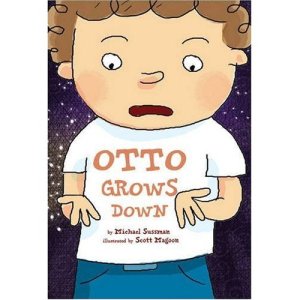 In a perfect world, they’d whip out Michael Sussman’s Otto Grows Down. Illustrated by Scott Magoon, it’s a tale of a boy who wishes his baby sister Anna was never born. “Be careful what you wish for” might be a cliché, but trust me, Otto Grows Down is an uncommon cautionary tale.
Otto makes his Anna-be-gone wish on his 6th birthday as he blows out the candles. Immediately, life begins to travel in reverse. Otto wraps up his gifts and hands them back to his friends. The second hand on his new watch ticks backward.
The next day at school, they start with mess-up time. Otto can’t get used to sliding UP the slide, and he’s so tired at the end of the day, he just wants to eat breakfast and get to bed. And going to the bathroom? Nasty business. (Nasty, hysterical business to my kids.)
Otto’s parents soon return Anna to the hospital and she disappears. Otto rejoices. But strangely, time doesn’t move forward again, it just keeps unraveling. Otto celebrates his fifth birthday, his fourth, his third…and he realizes that he may disappear, too! He’s slowly losing the words he needs to make his new wish come true: OTTO BIG!
Call it a dark comedy for kids. Scott Magoon’s film noir feel strikes the right balance between humor and horror. Dark shadows and warm colors mimic Otto’s flip-flopping emotions. (And hey, did you notice all the character names are palindromes? Another cool touch, huh?)
I won’t tell you where it ends—or where it begins—but let me just say: every editor who sent Mr. Sussman a rejection probably wishes they could make time go in reverse, too.
 Otto Grows Down
Story by Michael Sussman
Illustrated by Scott Magoon
Sterling, February 2009
Want it? Get it!
P.S. Author Heather Ayris Burnell interviewed Michael Sussman on her blog–plus she’s giving away a copy of the book!
Rarely do I stray into my mommy life on this blog, but if I’m writing for kids while raising them, then a little parenting humor has its place. Enjoy, mommies! (P.S. This article may or may not be based on actual events!)
 This is for all the stay-at-home mothers who are exhausted at the end of the day only to be greeted by the words:
“What did you do all day long?”
I realize our husbands work hard so that we may stay home and care for our families, and I appreciate their sacrifices. They sit in traffic jams, discuss process and procedure at redundant meetings, and stress over outsourcing and layoffs. They eat lunches of bland, bark-dry chicken and imagine the blissful hours we spend in the safe, comfortable confines of our own home, children playing happily at our feet while we page through the latest romance novel.
Umm…no.
To dispell the soap-opera-and-bon-bon-eating-couch-dweller myth of stay-at-home mothers I present to you an average day in husband perceived time (herein referred to as HPT, not to be confused with home pregnancy test) versus actual time.*
Task: Wake children and get them bathed
HPT: 30 minutes
Actual Time: 60 minutes
First child wishes to remain in the bed she so desperately tried to avoid the night before. While removing second child’s diaper, she pees all over herself, your pajamas, and the floor. Throw pajamas in the wash, scrub floor with antibacterial yet environmentally-friendly cleanser, and place children in bath. Second child makes poop-ready face, so she immediately must come out of bath water with shampoo still in hair. Wrestle new diaper on, rinse hair, clothe her, bathe first child. Slip on floor, ice sore ankle, let first child run around wet and naked.
Task: Feed children breakfast (and yourself if you have the chance)
HPT: 15 minutes
Actual Time: 45 minutes
First child refuses to eat and throws food on floor. Sit child in time-out. Clean floor. Second child spits food out like a machine gun. Clean floor. First child returns to table, lifts cereal bowl to drink like cat, spills milk. Calm tears. Clean floor. Remove second child from highchair, half the breakfast you thought was eaten falls to the ground. Slip on floor, ice sore ankle, let baby lick crumbs off ceramic tile.
Task: Take preschooler to school
HPT: 10 minutes (even though school is 15 minutes away)
Actual Time: 70 minutes
Spend 15 minutes getting shoes and jackets on children and buckling into Houdini-quality childseats. Drive to school. Wrestle stroller out of car, get baby into stroller, carry backpack, lunchbox, stuffed animal du jour and walk (limp) child to classroom. Get stopped by parent #1 requesting an RSVP to their child’s birthday party. Get stopped by parent #2 requesting a playdate. Get stopped by parent #3 requesting you chair a PTA fundraiser. Preschool director says you did not sign a precious piece of paperwork. File into her office and wait 10 minutes while she finds crucial document: a pledge to provide a peanut-free lunch.
Task: Put baby down to nap
HPT: 5 minutes
Actual time: 30 minutes
Baby fights sleep. A cough appears out of nowhere, causing her to awaken just as she is about to fall asleep. Get in car and drive around neighborhood.
Task: Free time while baby naps
HPT: All day long
Actual time: 37.2 seconds
Chores done in beat to William Tell Overture: sort clothes for laundry, run a wash, put this morning’s soiled jammies in dryer, empty the dishwasher and reload, make yourself a sandwich, go through mail, schedule a doctor’s appointment, return phone calls to your mother-in-law, your babysitter and the YMCA for swim lessons that have been cancelled and rescheduled for a day and time that is most inconvenient for you. Sit and eat lunch. Thirty seconds of bliss. Bite into sandwich as baby wakes from carseat flashnap.
Task: Pick-up preschooler from school
HPT: 0 minutes (you mean she doesn’t take a bus?)
Actual Time: 45 minutes
Preschooler is starving when you arrive. Examine lunchbox. Entire lunch remains. Sit at school while child eats lunch that should have been consumed three hours ago.
Task: Play with kids
HPT: 60 minutes
Actual Time: 60 minutes
Draw with chalk on driveway. Skip. Roll on grass. Blow bubbles. Have tickle contest. Giggle and make goofy faces. Collect acorns; plant them.
Task: Make dinner
HPT: 30 minutes
Actual Time: 60 minutes
“Hey honey, how come Rachael Ray can do it in 30 minutes?” Like Jane Jetson, you press a button on a little silver box and dinner magically appears in a cloud of steam, hot and ready, on a table already set with placemats, forks, knives, spoons, napkins, plates, glasses and everyone’s favorite beverage.
Task: Prepare for tomorrow
HPT: 0 minutes (what, can’t you do that tomorrow?)
Actual Time: 60 minutes
Make lunch and pack it. Check weather report and take out clothes for tomorrow, jackets, gloves, hats, boots, gloves. Throw out junk mail, sort bills, tack invitations on the fridge and check calendar. Make grocery list. Fold laundry. While helping first child go to the potty, baby grabs pile of laundry. Refold laundry. Put laundry away.
I’ll skip bedtime and instead point you to this poignant little ditty on YouTube. This husband’s inner HPT clock is working perfectly.
So, let’s add it all up for the day…drumroll please…
Husband Perceived Time of All Tasks: 1 hour (only playing with the kids counts)
Actual Time of All Tasks (including 30 minutes potty time): 7.7 hours
Hmmm, out of an eight-hour day, that gives us exactly 18 minutes to blog.
*Please note that HPT exists in households where mothers work outside the home as well. In this case, the HPT may be even more distorted.
Today literary agents Lauren E. MacLeod and Colleen Lindsay hosted “QueryFail” on Twitter. Several agents and editors joined in by sharing the worst query lines from their slush piles.
The intention wasn’t to mock writers, but to educate them. “I know writing and querying are hard,” wrote Ms. MacLeod. “So my queryfails have been chosen from people who did not follow submission guidelines.”
Originally I had reposted many of the QueryFail examples here. But after hearing from several writers who were upset by the event, I have removed the specific entries. Instead, I’ll focus on what I learned by following QueryFail.
I apologize to those writers who felt disrespected. My intention in reposting was to share what I thought was good information. I still think it’s good information. But if you know me personally, you know I’m an empathetic soul and I don’t wish to cause another writer distress. Frankly, we’re distressed enough.
So onto what I learned, sans examples…
1. Failure to follow directions is an automatic rejection.
Agents receive hundreds of queries a week. Their submission guidelines help them work efficiently. If you don’t follow those guidelines, it takes more time to read and respond to your query. The easiest solution is therefore not to bother.
2. Don’t include anything in your query other than what is requested. (Typically a one-page letter and first page(s) writing sample.)
What sells a book? The writing. The same goes true for your query. The writing sample’s the thing. Don’t include food, photos, scented paper, stickers, alcohol or anything else. This distracts from your writing, the one thing that will win the agent’s attention.
3. An agent makes a living by selling books. If you don’t have a book available to sell, you shouldn’t be querying.
Do not query until your book is finished, polished and ready for sale. Agents do not write for you, so don’t send ideas you want them to complete. Don’t contact an agent if you have something already published but nothing new to sell.
4. Only include relevant, professional publishing credentials in your query.
If you are writing a middle grade novel, your articles for a food packaging trade magazine aren’t relevant. Neither is adult fiction, unfortunately. And if you don’t have any credentials, don’t apologize. Simply list your membership in a writer’s organization, like SCBWI. Remember, your writing is what matters. Experience is good, but not a requirement.
5. Submit a novel with a unique idea, not a bizarre one.
You may write well, but is your book marketable? Remember, an agent’s job is to sell books.
6. Don’t toot your own horn.
Confidence is an attractive quality. Arrogance is not. Know the difference.
7. Remember correct punctuation and grammar.
If your one-page query contains mistakes, the agent can assume that your manuscript is flawed, too.
8. Use the correct salutation.
Call the agent by their name. They want to know that you know who they are! If they are agent #47 in an email blast, they know you haven’t done your research. Don’t call a female agent “sir.” And don’t address your query “to whom it may concern.”
After all those fails you may be wondering, what is a Query Win?
- First sentence hook
- Wordcount/genre
- One- or two-paragraph blurb
- Relevant writing credits/background
- Polite closing
- Solid writing sample
If you want to read more, search TweetGrid.com for #queryfail.
One last tip from Query Fail: “If you must scream about your rejection, do so into a pillow, not on your blog.”
 Tammi Sauer is the author of Cowboy Camp, a knee-slappin’, whip-snappin’, giddyup of a picture book.
I predict you’re going to be hearing a lot about Tammi soon. With several gotta-read-’em titles on the way–including Chicken Dance, Mostly Monsterly and Princess-in-Training–we can all say we knew her when!
Tammi is moseyin’ over to my blog today to talk about her trail ride from writer to published author.
Tammi, how did Cowboy Camp gallop from your desk to the bookshelves?
Cowboy Camp didn’t start at my desk, it started on my front porch.
One evening, there was an unexpected knock at the door. I opened it and was greeted by a young boy. He was selling newspaper subscriptions in an effort to go to…COWBOY CAMP. I looked at this kid with his everywhere hair and thick glasses and uncowboy-like everything and knew I had a story.
I wrote the manuscript, revised it, and sent it out in under a week—my fastest ever. Early on, Cowboy Camp made its way to three acquisitions meetings. Oh, the joy. But each time the manuscript was returned to me with regret. Oh, the agony. Many personal rejections rolled in as well. Then I discovered a house that was just starting up a picture book line. I thought, “Maybe this is it!”
I sent Cowboy Camp to Sterling Publishing. Within two weeks, I learned the manuscript was going to acquisitions. Shortly thereafter, the editor emailed and told me the acquisitions team loved the manuscript, but the house wanted to find the perfect illustrator before offering me a contract. Yes, more joy. More agony.
Months went by. I decided to send Cowboy Camp to SmartWriter’s first W.I.N.! (Write It Now!) Competition. Cowboy Camp ended up placing second in the picture book division out of more than 400 entries. I shared the news with my editor contact at Sterling. Within weeks, I had an offer. Yee-haw!
You said Cowboy Camp was your “fastest ever.” How many picture book manuscripts did you write before Cowboy Camp? Are any of those slated for publication?
I’m not sure how many picture book manuscripts came before Cowboy Camp. Maybe four or five? I do know that they were collectively awful. I consider them my “practice manuscripts.” And ha! No, none of those early works are slated for publication.
So how long had you been writing for children when you got the contract for Cowboy Camp?
 In 2000, I started toying with the idea of writing children’s books (this meant I would write for a couple of hours one day and not write another word for the next, oh, ten months or so). I didn’t get serious about writing children’s books until the spring of 2003 when an illustrator paid a visit to my daughter’s preschool. Seeing a real live person who was involved in the creation of children’s books was the push I needed to make writing a priority in my life. I received Cowboy Camp’s offer the following year.
You have five books slated for release. Do you have an agent now, or are you continuing to submit on your own?
I have an agent. In August of 2005, after much agent research, I sent Laura Rennert at Andrea Brown Literary Agency a query for a humorous, contemporary teen novel. It wasn’t long before she asked for the manuscript. The next thing I knew, she wanted to call me. Eek! Fortunately, a miracle occurred and the phone call went well…so well in fact that I KNEW I found the right match for me and my work.
Around the time that I signed, my PB writing started to take off. And that teen novel of mine? It was getting revision request after revision request after revision request to infinity. I made the decision to put the novel on hold and focus on what I loved and did best–PBs. Laura fully supported me on my decision.
You obviously have the talent to succeed in novels. How did you come to the realization that you were a PB-writer at heart? Do you think you’ll ever go back to that YA novel?
PBs just felt more right.
I don’t think I will ever go back to that novel. There was a lot that I loved in that manuscript (the characters, the humor, the voice). But one day it occurred to me that if I was going to have a novel Out There, I’d want it to be someone’s favorite. I would want others to feel about my book the same way I had felt when I read A Crooked Kind of Perfect by Linda Urban. My manuscript was nice, but it didn’t have that kind of wow factor.
What do you love most about writing picture books? Is there a particularly satisfying challenge? Are you thrilled to see your words come to life through each illustrator’s interpretation?
I can’t think of the one thing I love most. Coming up with a good idea is awesome. So is finding the perfect word, creating just the right story arc, and discovering new ways to build heart and humor into a manuscript.
As for satisfying challenges? I would have to say getting the “Yeah, baby!” from my critique partner Cynthea Liu is one of the hardest things to come by and therefore one of the most satisfying of challenges. The “Yeah, baby!” is what we give one another when a manuscript is decidedly brilliant and ready to be sent agent-ward. Believe me, getting the coveted “Yeah, baby!” is worthy of fanfare.
 It has been a real thrill to see my words come to life through each illustrator’s interpretation. In Chicken Dance, Dan Santat created an Elvis Poultry that absolutely floored me. I recently received Scott Magoon’s sketches for Mostly Monsterly and I was equally amazed. Scott’s take on the main character and her story was better than I had ever imagined. I feel honored to be working with such talented people.
One way for children’s authors to promote their books is with school visits. You just got back from a school visit in Texas. Can you tell us about that? What is a typical Tammi Sauer visit like for the students?
I absolutely love doing school visits–especially when schools work hard to make the day an event. On my web site, I list some tips for a successful school visit and Holliday Elementary certainly made the most of it. The kids–as well as some of the faculty and staff–gussied up in their best cowboy and cowgirl gear. Cowboy grub was served. Stick horse races took place in the gym. Bandana-wrapped trail mix was passed out. A guess-the-number-of-beans contest was held in the library media center… It was truly a cowboy-themed day.
I always strive to make my school visits fun, engaging, and informative. I offer a lot of opportunities for audience participation, perform a couple of magic tricks and/or an impromptu theater experience, and do what I can to really connect with the kids. Creating a memorable and meaningful experience for students is my top goal.
Yee-haw, honey! That sounds like a rootin’-tootin’ good time!
Once your picture book is accepted, the publisher has to find an illustrator. How much input do you give your editor regarding illustrator choice?
Some houses ask for illustrator input. Some don’t. I was thrilled when my editor at Simon & Schuster asked me for an Illustrator Wish List. So fun! One of the names at the very top of my list was Scott Magoon. I was astounded when Scott signed on for Mostly Monsterly. Total writerly dream come true!
I am happy to say I have formed good email relationships with Dan Santat and Scott Magoon. They are both so funny and brilliant and beyond what I had ever hoped for as partners for my books.
How do you stand the wait until your book is released? Most picture books take 1-2 years to hit the shelves!
 I WISH it only took 1-2 years! Chicken Dance will hit the shelves three years after I received the offer. Mostly Monsterly debuts two and a half years post-offer. The waiting is pretty horrible–especially since I am not a patient person. At all.
But, wow, when little bits of news trickle in—like finding out who will illustrate an upcoming book or receiving preliminary sketches or seeing the final art for the first time–it makes for some really nice moments along the way.
Tammi, thanks for sharing your story. Before you ride off into the sunset, what’s your best piece of advice for aspiring picture book authors?
My best piece of advice for new writers who dream of becoming published picture book authors is to read–and study!–as many picture books as possible. Knowing picture books inside and out–their feel, their rhythm, their language–is the very first step in creating quality picture books of their own.
OK, cowpokes! You heard Tammi! Now get on back on yer saddle! Read and write!
And don’t forget to visit Tammi’s blog! You can order Cowboy Camp or pre-order Chicken Dance via Amazon.
 I met author-illustrator Steve Ouch on Twitter several weeks ago and was immediately impressed by his 5,000 followers. (Which has now topped 10,000.) Just who is this guy? Why had I never heard of his book SteamPotVille?
The easy answer is that Steve wrote, illustrated, and published SteamPotVille himself. And now he’s a one-man marketing juggernaut, making connections with parents, teachers and fellow writers through social media.
Smart? You bet. His book, released in early January, already garnered 19 five-star reviews on Amazon. The word-of-mouth is spreading…and spreading fast.
Fascinated by his approach, I had to learn more about Steve and his creation.
SteamPotVille is a topsy-turvy romp through a fantastical dreamland. The illustrations feature animals in impossible situations–a lion riding a pony, a monkey swinging from a straw–created by photomontage. Steve, one has to wonder, what came first? The pictures or the text?
The text came first. Just as in the development of a movie, I changed some of the script as images came to life. Each page has about 150 hours of illustration time. When you spend that much time on one piece, the characters start their improvisations. Adjusting the text to express this phenomena makes the book a better read. That’s a flexibility that comes with being the author and the illustrator.
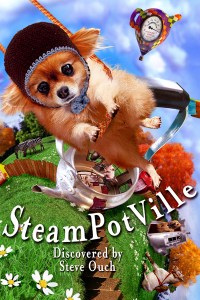 Wow! 150 hours! Truly a labor of love. And that shows not only through your elaborate, whimsical illustrations, but in the way you’re marketing SteamPotVille via social media.
Can you tell us why you decided to release your book as an independent title? Did you have a viral marketing campaign in mind all along?
I did a logic problem and this is what I discovered:
a. I shouldn’t spend all my time looking for an agent and a publisher when I could be trying to make money selling books.
b. By enacting my own campaign and getting the book viewed, I’m doing a service to a publisher by testing how the product will be received on the market.
c. Once SteamPotVille is established then I can meet with publishers for wider/deeper distribution. I like the idea of getting things done. It’s really taxing to forge new paths all the time, but that’s life. As far as a viral campaign: I don’t see it as a campaign but more of an ongoing experiment.
And you’re definitely getting things done. How did you attract so many Twitter followers? What other kind of online promotion have you been involved in?
 Twitter is parallel to human society. All of the general rules of socializing apply to this medium, so I get out there and socialize. The more I do it, the more popular I become.
Online I’m trying to get in the Guinness Book of World Records for the most cousins on FaceBook (add me as a friend and I will make you my cousin). That’s a slow and long term promotion. The other promotions happening at the moment are my inefficiency campaign and sending bottles of the Internet to people who can’t get access.
Ha! And let’s not forget about blog interviews!
Some may call you brilliant and yet others might be cynical about your publisher-come-to-Mohammed approach. What do you have to say to the skeptics?
:chuckle: I wonder if Mohammad had a hard time finding a publisher? That would be a fun story.
I never place judgment on what others choose to do for themselves. Each of us have our own path to go down. I am not saying that mine is the best nor is it right. I am just doing what seems to be right for me for the time. Whether it works to deliver SteamPotVille in the right hands will be like a bad mini-series (to be continued). For now though, I am enjoying the opportunities to chit-chat with people like you and that makes me happy enough.
Thanks, Steve. No wonder you’re so popular!
Can you tell us a little about your photomontage process? How do you start illustrating a spread? Do you make a rough sketch first, or does it all come together on the computer screen?
I spend time breaking apart a scene I have developed in my head, then I rough it out on paper. Next, I take pictures and apply them to the layout on my Mac, over and over, until I feel like the image is strong enough to stand on its own.
Are you working on another book now?
I finished writing my next work. I hope to get started on the montage at the end of the year.
Have you approached traditional booksellers about carrying your title? Will be you making any appearances to promote your book?
I have yet to approach any traditional booksellers, know any buyers? Speaking of, anyone who would like to get my book into any store or chain, I would offer a commission of the sale.
I plan on doing a book tour this summer/fall! If it happens, it will be pretty interactive from a web perspective. 😉
What advice do you have for other authors who are interested in publishing and marketing their own title? Is there anything you know now that you wish you knew when you started?
I would advise anyone who is going to setup their book “indie style” to begin marketing your book before you are done. I wish I knew that one.
I think that’s good advice for any author. Thanks, Steve! Good luck with your books!
Check out SteamPotVille and follow Steve Ouch on Twitter for his book updates.





 Writing for Kids (While Raising Them)