You are currently browsing the category archive for the ‘Uncategorized’ category.
 by
by Creating a digital version of your picture book can be exciting. Or daunting. Or both. The learning curve in creating apps and eBooks was once so steep that most picture book authors and illustrators had no choice but to leave the process of creating apps and eBooks to the publisher. And depending on resources, budget, marketing allocations, and the like, a digital version might not have been an endeavor the publisher was willing—or able—to take on.
In the past few years, however, children’s books have exploded digitally, and new, inexpensive, and intuitive platforms have emerged to allow for easy(ish) creation of enhanced eBooks and apps. The playing field has leveled; it is now possible for authors and illustrators to create digital adaptations of their picture books with only a small initial investment and very little technical know-how. It has also become easier to distribute content on the iPad, Android, Nook, Kindle, and other platforms. So, since a great story deserves to be told and retold, it makes sense for authors and illustrators to consider adapting their picture books to be enjoyed on various devices across all types of media.

Image via purplecarrotbooks.com
But what makes a good digital version? It’s not enough to simply add tappable animal sounds to a picture book about a farm and call it a day. The best interactivity moves the story along; it does not distract the reader, or in any other way detract from it. Taking the reader’s attention out of the moment to play a mindless game isn’t exactly the best way to engage with a story, much less to promote literacy and encourage reluctant readers to get into the habit of reading.
So where should you start? To make the digital experience as satisfying as the physical one, you need to think about how the reader will be engaging with the story on a device. Therefore, the interactivity you choose to include should enhance the world you’ve built and the journeys of your characters. In fact, if done well, the interactivity should be experienced as a natural extension of the story. This means that each key moment, each plot point, should be examined for ways in which the user can participate in the story.
You should also devote some time to thinking about the specific ways in which your readers will relate to the telling of the story itself. If your picture book is plot-oriented, then an app made up of quick, adventure-based activities set at specific story beats might be the way to go. If you have a rhyming story, an eBook with a “read-along” feature might make more sense. Basically, as the content creator, you need to decide the specific what and why of the interactivity to ensure that the experience you’re providing digitally is organic to the world of your book.

Image via designboom.com
Here are some things to keep in mind when creating a digital version of your picture book:
- Look for moments of interactivity that naturally present themselves within the story. Let’s say there is moment in which your protagonist is crossing a river. In this case, it might make sense to invite the user to participate in an activity that helps guide the protagonist to safety.
- Since picture books appeal to both parents and children, consider including activities that resonate with both demographics. The best interactive features are collaborative, with engaging interactivity for adults and kids.
- Think about what types of content would be a true value-add from a digital perspective. It might make sense to include a video, or a tappable resource that allows readers to learn more about your subject than is possible in book form.
We all know that interactive stories are a great way to improve literacy, as children who are reluctant to sit still for traditional books are sometimes drawn into the “gamified” experience of interacting with a picture book on a device. But it’s our responsibility as content creators to ensure that the digital experience provides a rich, fully realized experience rather than just flashy, “keep ‘em busy” activities to allow readers to truly participate in the world you’ve created, and keep them coming back for more.
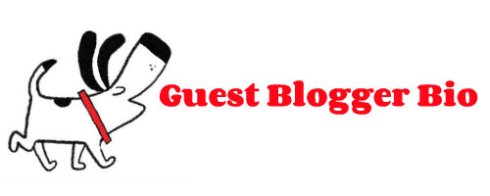
Michele R. Wells is an editor and writer with two decades of experience in multimedia and print publishing. An expert in conceptualizing and developing content, she has edited illustrated books for DK Publishing, lifestyle nonfiction for Penguin, and business self-help for McGraw-Hill, as well as educational content for Pearson, The Princeton Review, and others. She currently manages the digital editorial department at one of the world’s largest entertainment companies, where she has written scripts for award-winning apps and interactive products. The author of several books for children and young adults, she volunteers for literacy organizations, and was the founding chairperson of First Book-Brooklyn. She now lives in Los Angeles. Follow her on Twitter at @michelewells.
 by
by I am the founder of Picture Book Month and it starts tomorrow, November 1. The website, PictureBookMonth.com, features essays from thought leaders in the children’s literature community. Each day in November, a new essay is posted. This year’s Picture Book Month Champions are: Chris Barton, Aaron Becker, Kelly Bingham , Sophie Blackall, Arree Chung, Anna Dewdney, Johnette Downing, Ame Dyckman, Jill Esbaum, Carolyn Flores, Lupe Ruiz-Flores, Robin Preiss Glasser, Deborah Heiligman, Marla Frazee, Stefan Jolet, Kathleen Krull, Rene Colato Lainez, Loreen Leedy, Betsy Lewin, Ted Lewin, Brian Lies, Kelly J. Light, Debbie Ridpath Ohi, Alexis O’Neill, Sandra Markle, Ann Whitford Paul, Aaron Reynolds, Judy Schachner, Linda Joy Singleton, and David Schwartz. Please join the celebration!

As you prepare for PiBoIdMo, think about the titles of your picture books. In a recent interview for California Kids! magazine, Patricia Newman asked me, “How do you come up with titles for your books?” This started me thinking in depth about picture book titles. What’s in a title? How important is a title to a book? Can a book be centered around its title?
As it turns out, titles are vital to a book’s success. Author Scott Westerfield says, “Titles name a book, and names are important. A good name can make or break you.”
Brandi Reissenweber of Gotham Writers “Ask the Writer” column says, “A title is a story’s first impression. People make a first impression with appearance, wardrobe, and body language. Stories do it with a title.”
Eric Ode says, “Dan, the Taxi Man began as nothing more than a title. And one of the books I have coming out next year began as a title.”
PiBoIdMo founder and picture book author Tara Lazar says, “Most of my books begin as titles. It’s just the way my mind works. I want a BAM! concept, something that really hits you, and I find that people get HIT best with a succinct, powerful title.”
Corey Rosen Schwartz says, “I have written several books around titles! Like Tara [Lazar], most of my books begin that way. Goldi Rocks and the Three Bears, for example, was just a title on my PiBoIdMo 2009 list.”
Character-Based Titles
Many picture books have character-driven titles. The character of the book IS the title. Do you have a book character that is so compelling that the character’s name should be the book’s title? Here are some examples:
- Olivia by Ian Falconer
- Splat the Cat by Rob Scotton
- Flat Stanley by Jeff Brown
- Amelia Bedelia by Peggy Parish
- Biscuit by Alyssa Satin Capucilli
- Fancy Nancy by Jane O’Connor

Clever, Punny Titles
I am a big fan of clever, punny titles. In fact, several of my books have punny titles. Here are some examples that are just too clever for words… almost.
- Crankenstein by Samantha Berger
- The Monstore by Tara Lazar
- Little Red Hot by Eric Kimmel
- Pinkalicious by Victoria Kann
- Epossumondas by Colleen Salley

Verbose Titles
I am generally a fan of the “less is more” title for a book but sometimes, a garrulous title is EXACTLY what the book calls for. Can you imagine these books with a short title?
- Alexander and the Terrible, Horrible, No Good, Very Bad Day by Judith Viorst
- Don’t Let the Pigeon Drive the Bus by Mo Willems
- How Do Dinosaurs Say I Love You? by Jane Yolen
- There Was an Old Lady Who Swallowed a Fly by Simms Taback (a folktale retelling)
- The Fantastic Flying Books of Morris Lessmore by William Joyce

Plot-Based Titles
Some titles beckon you to open the book. These titles are based around the book’s plot. Yes, as short as a picture book is, it can still have a plot. In fact, these picture book plots were so inspiring that they were turned into Hollywood blockbuster movies!
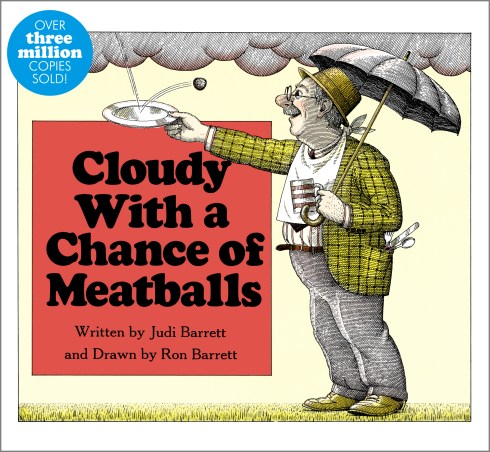
- Cloudy with a Chance of Meatballs by Judi Barrett
- A Night at the Museum by Milan Trenc
- The Story of Ferdinand by Munro Leaf
- We’re Back! A Dinosaur’s Story by Hudson Talbott
- Where the Wild Things Are by Maurice Sendak
Single-Word Titles
A picture book title can also be short and succinct, even one-word. These acclaimed picture books prove that a word is worth a thousand pictures.
- Green by Laura Vaccaro Seeger
- Blackout by John Rocco
- Ninja! by Arree Chung
- Carnivores by Aaron Reynolds
- Hug by Jez Alborough

Aaron Zenz says, “Hiccupotamus started with the title. I really wouldn’t have had any desire to write a book about a bunch of jungle animals chasing around a disruptive hippo if not for the title. In my mind, the pun ‘Hiccupotamus’ is the most important thing about that particular book.”
As you create and engage your imagination this month, think about your picture book’s title. In what way can an engaging title enhance your picture book? How can you use the title to attract readers? Perhaps you can be the Author with the Terrific, Tremendous, Oh-So-Grand, Very Remarkable Title.
As you celebrate PiBoIdMo and Picture Book Month, read LOTS of picture books. Comment below and share with us your favorite picture book titles and why you think they are so splendiferous. Here’s to Picture Books! Read * Share * Celebrate!
Dianne de Las Casas is an award-winning author, storyteller, and founder of Picture Book Month. Her performances, dubbed “revved-up storytelling” are full of energetic audience participation. The author of 24 books, Dianne is the International Reading Association LEADER 2014 Poet Laureate, and the 2014 recipient of the Ann Martin Book Mark award. Her children’s titles include The Cajun Cornbread Boy, There’s a Dragon in the Library, The Little “Read” Hen, The House That Santa Built, and Cinderellaphant. Visit her website at diannedelascasas.com. Visit Picture Book Month at PictureBookMonth.com. Twitter & Instagram: @AuthorDianneDLC Picture Book Month Twitter: @PictureBkMonth Facebook: fanofdianne and PictureBookMonth. Dianne is the proud mom of 14-year-old culinary celebrity, Kid Chef Eliana.
 by Lauri Meyers
I’m totes ready for PiBoIdMo. I’ve got my notebook, my combo pen/highlighter, and a jumbo bag of turbo boost coffee. But has anyone seen my muse?
Perhaps buying her a Cloak of Invisibility for Halloween wasn’t very smart, but I couldn’t resist. (She’s such a Potterhead.) I’m sure she’s doing super important invisible things, like reading subversive picture books or gorging on the trick or treat Snickers or playing Candy Crush in the bathroom.
Luckily, I’ve got a handy flowchart to help me summon my muse.
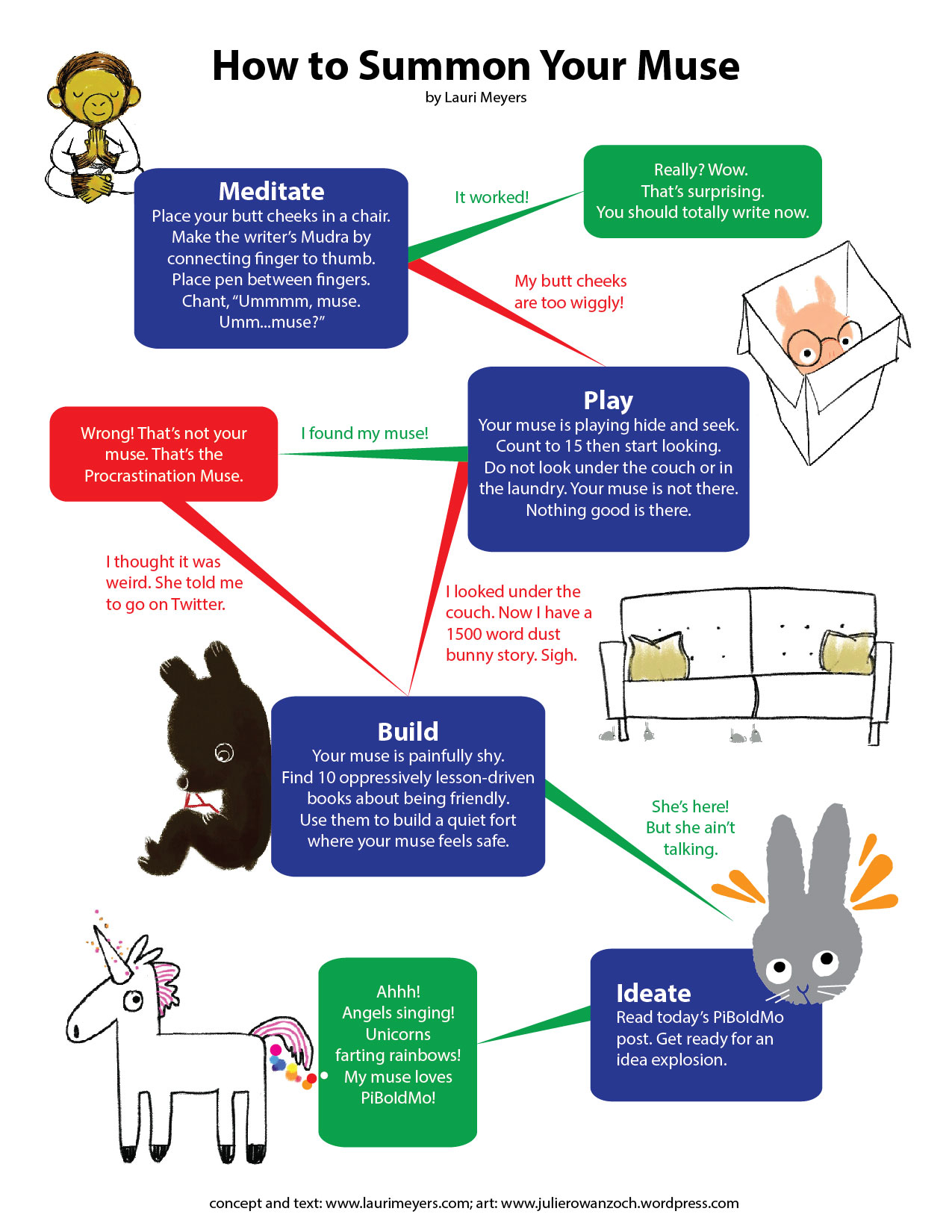
Click to view full size.
Hey! Here’s my muse! If there’s one thing she loves more than a Weasley, it’s rainbow flatulence.
You’ll have no problem finding your muse during PiBovember, but in other months try these tricks (Meditate, Play, Build, Ideate, Pass Gas) which have been highlighted in amazing PiBo posts of the past.
Lauri Meyers is a children’s writer living part-time in New Jersey and part-time in the made-up world in her head. She enjoys making people laugh until milk squirts out of their nose holes. She is hoping an agent will fall in love with her picture book A HOLE IS MORE THAN A HOLE which she dug out from a PiBo 2013 idea. Julie Rowan-Zoch, who illustrated How to Summon Your Muse, is the illustrator of the YOU’RE HERE! board book series.
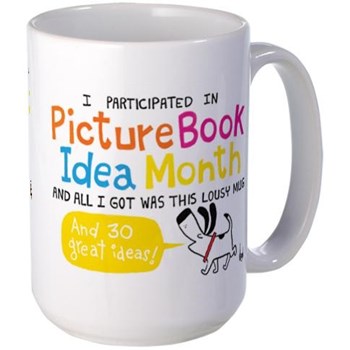
Lauri is giving away a PiBoIdMo Coffee Mug to fill with your own turbo coffee.
Leave one comment to enter. One winner will be randomly selected at the conclusion of Pre-PiBo.
Good luck!
I’m thrilled to welcome Steve Barr today with an idea that will touch the hearts of many…
As a professional cartoonist and the author of 13 “How to Draw” books, I’ve spent my entire life trying to make other people laugh and smile. While this has been an extremely satisfying endeavor over the years, it’s not exactly a get-rich-quick scheme! My path along the way has had many ups and downs, triumphs and failures. But the rewards—those smiles on other people’s faces—have always made me feel like the roller-coaster ride we know as freelancing was worth it.

However, lately I’ve found myself longing to do something with a much more profound, longer-lasting impact. I’ve begun to feel drawn (no pun intended!) to begin working with pediatric patients and their families. Art activities, as well as music therapy, has been shown to substantially reduce stress in young children who are battling really difficult diseases. Drawing and painting has even been proven to have fairly long-lasting effects involving pain reduction.
Find that hard to believe? Check out the results of this study that was released by the National Institute of Health!
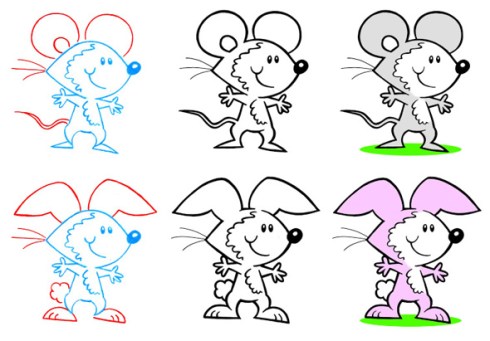
I can’t think of a better type of art therapy than teaching children to draw cartoons! It’s easy to do, entertaining and distracting. When kids are in the hospital, they have very little control over anything in their life. They’re expected to follow orders, and do whatever they are told. But when they’re drawing cartoons, there are NO RULES! Cartooning is one of the only art forms I know of where someone’s art is not expected to look exactly like someone else’s. Every successful cartoonist I know has a very distinct style that is easily recognizable as their own.
That’s why I’ll be teaching the children to experiment, to try different techniques, explore options and just have fun with their creations. Their drawings will begin with simple lines and shapes, and we’ll build on that to come up with characters that they can bring to life! The lessons are so easy to follow, I’ve had five year-olds grasp them immediately and amaze me with their natural talent.

Click image for full page, printable version.
Once the patients and their families feel comfortable with the cartoons they’ve drawn, they’ll be encouraged to experiment by making slight alterations to their creation to change them into other characters. That will let them have hours of fun on their own after I’ve left.
I want to provide these services completely free of charge to the hospitals, patients, their families and the art therapy groups that serve the facilities where they’re being treated. I’m dreaming of also sharing them with the surrounding communities and bringing more attention to the lingering benefits these classes will have.
But I can’t do this alone. I need help. I’ve begun researching grant opportunities and funding possibilities, but those can be very difficult for individuals to qualify for. With that in mind, I decided to set up a “Go Fund Me” page and seek funding from other people who would like to help me make this happen. If you’d like to take a peek at that campaign, here’s a link: http://www.gofundme.com/e9oahg
When children are hospitalized and fighting diseases like cancer, they often have a difficult time expressing how they are feeling. Art therapy can often help them open up and share their emotions. When they’re drawing cartoons, they can do that simply and easily with just a few shapes and lines. This can help both the medical staff and their therapists determine where the kids are in the process, and address any problems they’re having in dealing with their treatments.

I am hoping that this idea will continue to grow. If it really takes off, I would love to involve other cartoonists and illustrators in the effort. It has already become quite a time-consuming process, but I know the rewards will be fantastic.
If you’d like to help, but can’t contribute, please feel free to share the link with your friends: http://www.gofundme.com/e9oahg. Any exposure will be helpful, and together we can put smiles on lots of little faces and laughter in their hearts.

I honestly cannot think of a better way to spend the next few years of my life. And perhaps even longer than that!
Note: Please feel free to use the drawing lessons I’ve included in this blog if you are an Art Therapist, Child Life Specialist, Teacher or Nurse who works with children. Parents and guardians are also welcome to share the lessons with their kids. It’s not to be republished commercially without permission, but I’d be quite happy if it was shared personally with kids who would enjoy it.
 A PiBoIdMo “Kind of” Success Story
by Nancy Tandon
After hearing about PiBoIdMo for several years, I decided to play along last November. Actually, the truth is, what I really decided to do was participate in NaNoWriMo, which runs the same month, and write a full novel. But on November 2nd, I got a little freaked out by what I’d bitten off, and turned to the supportive atmosphere of Tara Lazar’s “Writing for Kids (While Raising Them)”, and PiBoIdMo, for some user-friendly structure and guidance.
I told myself, it’s just one idea a day—you can do this! So every morning, I’d poke around in my brain until an idea popped up that (at the time) seemed good enough to write down. Then, on most days, I worked on the novel as well. But it was the act of writing down a picture book idea that got my butt in the chair. Already, the support was working!
The other part of PiBoIdMo that I had not realized would be so helpful was reading all the juicy guest posts. Tips on character, theme, story arc, rules of three, and much more, make PiBoIdMo a kind of month-long conference for PB writers.
One commonality that I noticed across posts, no matter what the topic, was the idea of the importance of story. (I know, duh, right?) But it can be deceptively hard to get all the necessary story elements to line up, particularly in so few words.
Then one morning, I was having trouble coming up with even a bad idea. So, I looked back at earlier entries to see if that might help spark something.
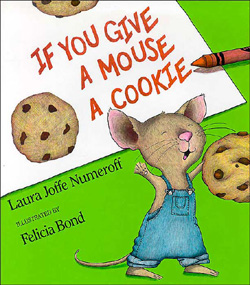 One of these older ideas had been fun to play with, but my sketchy first draft was very episodic. It was missing that narrative arc that makes a story, a story. The premise was a bit like IF YOU GIVE A MOUSE A COOKIE, and was based on the phrase, “which was good…” (Things kept happening, or not happening, which was good because…and on and on).
Then as I was playing with this idea in my mind, and searching for a story framework, the phrase “which was good” flipped in my mind to become “witch was good.” And that’s how the idea for my picture book THE WORST WITCH was born.
The tradition of picture book characters that do not fit the mold society expects of them is as old as Ferdinand himself. I worried this story had been done. But I decided it would be worth it to give this little witch, who just couldn’t help being good, a chance.
 Several months and several revisions later, I submitted the manuscript to the New Voices in Children’s Literature: Tassy Walden Awards Competition, which is run by the Shoreline Arts Alliance. The competition “encourages and nurtures the creation of exceptional quality books for children by unpublished Connecticut writers and illustrators.”
A few months after that, I learned that my manuscript, THE WORST WITCH, was a winner in the Picture Book/Text Only category. What a thrill! Recently, I had the pleasure of reading my text aloud at the awards ceremony. The absolute highlight for me was when I was approached afterwards by a young girl named Lucy, who said, “I liked your story a lot. I like witch stories.” Her praise meant as much to me as the award itself.

I don’t know if THE WORST WITCH will ever reach more kids like Lucy, but I hope so! And if it does, I will have to come back and take the words “kind of” out of my success story.
Thank you, Tara, and all the contributors to this year’s PiBoIdMo. I’ll be back next year, and hope you will, too!
Graphic by Edna Cabcabin Moran
.
Yes, we’ve gotten to a fourth installment! Or maybe I can call this THE FOURTH STALL?
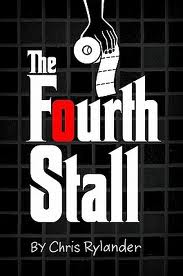
(P.S. I loved this book. It includes one of my favorite things to write—a secret place that adults don’t know about.)
So, there have been three previous Q&A’s…check them out here: Part I, Part II, Part III.
Without further ado…Part IV!
.
berylreichenberg asks:
If you already have several picture books published, what are the best blogs and other sites to use to get the word out and market your books?
So many kidlit authors tend to stick with promoting on writer blogs, which is certainly good, but we can be preaching to the same audience over and over again. I, myself, worry that people are gonna get sick of me.
Instead, look to librarian blogs, parenting blogs, teacher blogs, homeschool blogs, bookseller blogs and other “gatekeeper” sites that target those who buy children’s books.
Technorati.com is a good place to search for top blogs in various categories, like books, education and parenting.
Some blogs have review policies, so read them and reach out. I receive many unsolicited requests every month. I can’t accept them all, but I do what I can. Bloggers are always in search of good content, so you’ve got nothing to lose by asking for coverage. Make sure you appeal to that blog’s readership with your pitch. (I receive pitches that don’t come close to interesting my audience, which tells me the sender is doing a mass mailing rather than targeting me specifically.)
.
Pat Miller asks:
When you have a drawer full of PiBoIdMo drafts that just don’t seem to get off the ground, how do you maintain your motivation to dig back in and make one of them sing?
Another tough question!
I have barrels full of uncompleted manuscripts. Honestly, I tend to think that if I’m not “feeling” them, they’re not worth my time, at least not at the moment. I might feel them later, so that’s why nothing ever gets tossed.
Jerry Spinelli’s EGGS was in a drawer for 20 years when his wife Eileen made him pull it out. He reread the manuscript and felt re-energized. Neil Gaiman got the idea for THE GRAVEYARD BOOK 20 years before he actually wrote it. He wanted to wait to become a better writer because he knew the idea would be challenging to execute.
Other writers will argue that you cannot wait for the muse, you just have to keep pounding on the manuscript. I tend not to do that because I have enough ideas that do sing to me, in key and on beat.
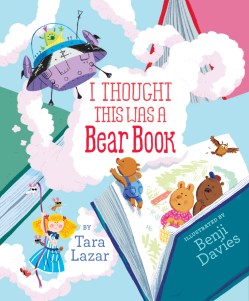
And hence we get to the reason why I do PiBoIdMo—the more ideas in your file, the more potential manuscripts you’ll have. You can ditch one idea and move onto another. In my experience, the best manuscripts have begun when I have stopped working on a manuscript that’s been giving me headaches. It’s like my brain has suddenly been freed from its chains. My upcoming title, I THOUGHT THIS WAS A BEAR BOOK, came about after I ditched a struggling manuscript. The words for BEAR just flew out, whereas I was laboring hard on the previous story and it just wasn’t working.
Sometimes changing the voice or POV in a manuscript is enough to get it revived.
A critique partner pow-wow can also provide a boost. Just sit around with some best buddies (and coffee and coffee cake) to discuss the challenges and concerns you have. Ask for suggestions and solutions. If you can’t do it in person, Google hangouts are fun, especially since you can stay in your jammies. I truly believe critique partners are not just for completed manuscripts, but those in progress, too.
When all else fails, go for a walk or take a shower. Research shows that “thinking on our feet” leads to creativity. And mundane, repetitive tasks give our minds freedom to wander.
.
Amymariesmith asks:
I’m going to my first SCBWI regional conference in June. Any tips on what to bring?
Have fun, Amy! You should bring:
- A list of your PB ideas. I think it’s great to get a professional’s opinion about whether your story ideas are marketable or if they’re too common and need work. You might have an opportunity to sit down with someone to discuss them.
- Your manuscripts. You never know when a critique opportunity will arise.
- A list of industry questions. I know I tend to forget everything once I arrive at a conference. If there’s something you want to know, write it down and keep it handy. There’s often panel discussions where you can pose your questions.
- A notebook and pen to take good notes. (Then when you go home, type up your notes. This will help them soak into your brain.)
- A camera. Take pics and share them.
- Your business cards. Even if you’re unpublished, you’re still officially a “writer”. You want to connect with professionals and potential critique partners. If you’re having meals there, hand them out to those sitting at your table. Everyone else will remember to hand them out, too!
Side note: sometimes at conferences I’ve seen unpublished writers carrying plush likenesses of characters they’ve created. This seems like a smart idea, to attract attention and questions about your work, but some professionals just think this is strange. Great writing is guaranteed to attract positive attention, not gimmicks.
.
Mrs. Ricefield asks:
I would also love to hear more on how to make the best out of conferences you attend. Thank you for the question.
See my suggestions above on what to bring. Also, make friends. See someone standing alone? They’re an introverted writer, but writers love to talk about writing, so go say hello. This is your opportunity to network and gain a support system. Have fun and be yourself.
Don’t go with too many expectations—it’s rare to get a book deal or an agent at a conference. (But be sure to follow-up if someone expresses interest. Things happen AFTER the event.)
Volunteering at a conference is also a great way to get one-on-one time with professionals and to be remembered. Why not volunteer to pick up agents and editors at the train station or airport? You’ll have time to chat and get to know them.
Ask editors about life outside the office. You’ll connect on a more personal level and you’ll be one of the few people who aren’t trying to squeeze a book deal out of them. Editors are people, too. They get tired of being pitched, poked and prodded.

Great friends at the NJ-SCBWI Annual Conference. Authors Ame Dyckman, Sudipta Bardhan-Quallen and Kami Kinard.
.
Angela Turner asks:
I am writing a nonfiction book in narrative form but I want to put notes on the same page that tell a little more with more specific language. What is the proper way to show this in your manuscript?
While I haven’t written this kind of book before, I suggest using a format similar to how we place art notes in a picture book manuscript. Use brackets to denote the sidebars. Like this: [Sidebar text:].
Maybe someone more experienced with these manuscripts can comment below.
.
Joy Moore asks:
How would you describe your writing style?
A quirky, punny word-a-palooza.
.
Brenda Harris asks:
If an author-illustrator is self-publishing, who are the most important people (editors, art directors, etc) I should ask advice(hire?) from about my dummy book. And- where can I search and find these legit helpers?
There are independent editors with decades of publishing experience whom you could try. Just a few:
Read through each consultant’s site to determine the best fit for your writing style.
Also, be aware of current publishing scams and hustles. There are those who prey on writers with dreams of publication. Check out Preditors & Editors.
Before you begin, you should know the distinction between true self-publishing and publishing via a vanity press. Read this blog post.
.
Thiskidreviewsbooks asks:
I’d really like to know what your best time to write is (and the importance of having a set time to write).
Erik, I don’t have a set time to write. I have found that routine tends to stifle my creativity. I know some writers insist upon writing the same time every day, in the same place, with the same materials, claiming that routine means they write whether or not they’re in the mood. And I suppose that does work nicely for a lot of writers. It doesn’t work nicely for me.
I’ve never been a routine person. Something about my personality always eschews routine. I cannot remember to take a daily vitamin. I don’t wake up the same time every day nor go to sleep at a set hour. I have a tough time eating leftovers.
I like changing things up. Sometimes I write in the morning, sometimes late at night. Different times of day can lend varying moods to my writing. Same as with different places—sometimes I write in bed, sometimes in the kitchen. Occasionally I work on my back deck, at the park or at the library.
And I don’t write every day. That may have to change when I start writing novels and I’ll need to get more words down, but for now, I take writing breaks. Two days on, one day off. Three days on, three days off. One day on, four days off. (GASP!) Again, I change it up a lot. And sometimes these breaks are dictated by family or other obligations.
With this non-routine routine, I’ve had no shortage of creativity, no writer’s block. I’ve got four manuscripts under submission right now and four under construction.
The bottom line is that there’s no “right” thing that works for everyone. It’s totally up to you to find your creative groove. Don’t take anyone else’s advice unless it resonates with you.
.
Charlotte asks:
Why does it seem that there are so many women writing for children, attending SCBWI conferences, posting here, etc., and yet by comparison there seem to be so many successful children’s books by men? Ya know what I mean? Certainly there are tons of successful children’s books by women, but the rations have me baffled. At the last SCBWI conference I attended, women outnumbered men 98-2. Even if there are more children’s books by women authors, the ratio is not 98-2, not even close. So what’s going on? Do men feel more free to write wackier stories? Do women censor their own out-of-the-box impulses? Do editors and agents subconsciously give men more leeway to push the boundaries/break the rules? Do women tend to write more lesson-y stories? Are there just as many men writing and they just don’t show up at conferences? Whaddaya think?

Charlotte, you may want to check out the VIDA Count. VIDA has found a distinct imbalance between the amount of literature by women that’s published and awarded versus that of men. See these articles:
From VIDA’s FAQ:
But don’t women read more? Don’t they buy more books? Don’t they edit these journals [and books] and read slush? And therefore—isn’t this largely the fault of women, as well?
First: sexism pervades our culture, and so it is often unconsciously absorbed/internalized by everyone, including women. Feminism is an act, not a bumper sticker. It requires the constant re-evaluation of one’s assumptions, habits, and biases. By being a part of the system, women are often a part of the problem.
Further, as Sarah Seltzer points out,
“In my experience, the reality may even be worse than the numbers. Women who are allowed to be prominent — and this is not to erase those who do it on their own merit, because their numbers are growing — often don’t challenge the worldview of those who hire them. In fact, given all the anti-feminists like Caitlin Flanagan, Katie Roiphe and Christina Hoff Summers taking prime media real estate, it would seem that for women, reinforcing sexism is a good formula for vaulting ahead.”
~ Sarah Seltzer, Jewish Daily Forward, March 2012, “Byline Bias – and What We Can Do About It.”
.
Stacy Couch asks:
I was wondering about the different stages of birthing a PB. PiBoIdMo does a great job re: brainstorming. Maybe posts about craft would help bring those ideas to life.
- Character-driven picture books: What they are, what makes a character sing.
- Plot: How to plot a PB.
- Plot: Why stakes matter.
- Rule of Three
- Plot and the Rule of Three.
- Different Genres within the PB World (Quiet, Noisy, Character-Driven, Interactive, Etc.)
- External vs. Internal Conflict
- Allowing Room for the Illustrator
Then perhaps a series about critique groups (how to find them, how to set up one), conferences (purpost, intensives, tips) and another querying agents, editors (the importance of etiquette, researching them beforehand).
I’d love to see more craft-related posts, though, since any agent or editor would focus on the work itself.
Great suggestions, Stacy! I’ve covered some of these topics already. Check out:
- The Rule of Threes in Picture Books
- The Rule of Threes for Picture Book Writers (with video evidence)
- Every Day I’m Structurin’ (by Tammi Sauer)
I’ll cover all your suggestions in craft posts soon. Thanks for the input!
.
In closing, thanks to everyone who submitted a question. This was a fun series and I hope to make it a recurring blog feature!
You may be wondering–what ever happened to Tara? It’s been almost a month since she blogged. (Or you may not. You may be relieved your inbox has been devoid of my blivel. I made that word up, in case you’re wondering. A portmanteau of blog and drivel.)
Well, I’ve been traveling! I’ve actually changed out of my pajamas several times in the last few weeks!

Not so pristine whiteboard.
At the end of March I drove down to MD/DE/WV SCBWI’s Annual Conference to present my workshop “From Concept to Dummy for Picture Book Writers”. About 70 writers attended–it was a full house in our little room. The attendees got a taste of my imbalance. Yes, my mental imbalance, but also my MS imbalance. Luckily I didn’t topple the whiteboard. I did, however, have one sinking moment when I thought I used a permanent Sharpie on the pristine white surface. It reminded me of NJ-SCBWI 2008 when I volunteered to hang signs on the aging plaster of the Princeton Theological Seminary, only to take chunks of wall with me when I removed the signs. Be forewarned, I cause mayhem and destruction at SCBWI events.
I think many will agree that the best part of the workshop was when we read the beginnings of successful picture books to discern the WHO, WHAT, WHERE, and WHEN in each opening line. Incorporating these details makes your reader ask WHY and eagerly turn the page to find out.
Many new writers mistakenly begin stories with, “My name is Jamie and I’m six years old.” This tells a reader nothing about the story to come. And more importantly, an editor who reads this plain first line will most likely stop there. YIKES. Not what you want. You have to break out of that slush pile with a line that captures the editor immediately.
After reading a dozen picture book openings, with me screaming WHY? WHHHHHYYYYY? and bending over in feigned painful anticipation, shaking my fists at the sky, I challenged the participants to rewrite their opening lines. Everyone was quite thrilled to get their own Tara WHHHHHYYYYY? in response to their improved introductions.
Writer Sarah Maynard summarized my workshop with bullet points, to which I’ve added my thoughts from the event:
- You have 30 seconds to grab their attention. MAKE IT GOOD!
Like a resume to obtain a job, you have limited time to make an impression with an agent or editor. They can have hundreds of manuscripts to read each week, so they give each one only a few moments to grab them. Punch that opening, make them want to continue reading.
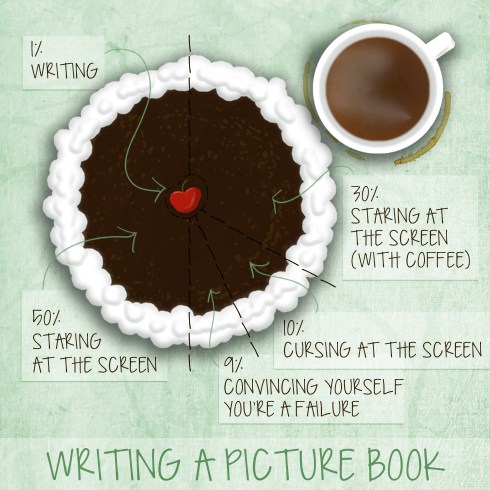
- “Writing a picture book is 99% staring and 1% writing.”
There is A LOT of thinking involved in writing a picture book. Don’t worry if you’re not actually putting words on paper every day. Think about how to resolve problems in your story. Stare at your manuscript. Your subconscious will most likely be working on a solution and it will pop out while you’re doing mundane chores, like emptying the dishwasher, folding laundry, or taking a shower.
- Learn who YOU are as a WRITER.
A lot of authors, including me, espouse advice that may not work for you. Discover how YOU work best and stick with it. For instance, routine doesn’t jive with me, although it works for a lot of other people. I used to force myself into routine only to get frustrated, losing my creative mojo. Only you know how to thrive in your creative mode. It’s very personal. Don’t take advice that doesn’t serve you well. (It may be useful to note here that I’ve shunned routine my entire life.) - If it’s not apparent by words you’ve written, add an art note.
One attendee told me I was the first person to speak positively about art notes. Yeah, I think they get a bad rap. They’re absolutely ESSENTIAL to use if it’s not apparent what’s happening by your words alone. If the text says your character is smiling but you actually want them to frown, you need an art note to convey that. Of course, you should not use them to direct the entire shabang, but to ensure there are no misunderstandings. Which brings me to the last point…
- Don’t make an agent or editor guess!
I find that some new writers like to surprise the reader on the second or third page of a manuscript. This means the beginning is not entirely clear and the reader must guess what is happening. Well, what if your reader guesses wrong? Then they become hopelessly confused at the reveal and probably discard your manuscript. You don’t want an agent or editor to have to guess what is happening in your tale. Make it CRYSTAL either by the text or the addition of art notes. It can be as simple as “[art: the character is a bear]” to make everyone understand.
I thoroughly enjoyed my time in Maryland—the hospitality of the chapter went above and beyond. We had a lovely faculty dinner at the Craftsman-style log cabin home of former RA Edie Hemingway. Is there anything more writerly than that (I mean, c’mon, HEMINGWAY)? Edie has a charming home with a writing hut tucked into the woods.

Far better than my writing space—my unmade bed!

As I crawl back into my pajamas, I’ll be getting another blog post ready. This time, about my trip to Reading is Fundamental and the donation that my publisher and PiBoIdMo participants made possible, enriching the lives of children with BOOKS!
WRITE ON!
Hey, look at that! I finally got Sara Zarr on my blog! Let me introduce us: Tara Lazar, Sara Zarr. Sara Zarr, Tara Lazar. Woo-wee, that’s fun to say!
OK, enough fooling around. Let’s get serious. Well, maybe that’s not the right word. Let’s get mischievous. Because today we’re breaking rules!
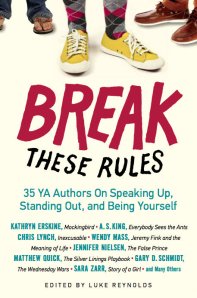 The YA anthology BREAK THESE RULES explores the flip-side of those nit-picky little rules you’re supposed to follow when growing up. What would happen if you didn’t “grow up” and “be serious”? So what if you daydream, skip college or talk about religion? Must you really pick a side between jocks and geeks?
Well, 35 authors tell you to ignore “the rules”, just go ahead and break ’em. Because they did. And it didn’t kill them. Heck, they even came out on top. Check it out. (Even I’m in the book! I can’t believe they asked me. Maybe they knew I’m a scooter-ridin’ rebel.)
To celebrate BREAK THESE RULES, I thought it would be fun to learn what WRITING RULES some of the authors have broken. You know, we hear the rules all the time—rules about content, length and showing-not-telling. And in picture books: no rhyming, no art notes. We’re bombarded by rules at conferences, in craft books and even on this blog! (Yeah, sorry ’bout that.)
So today we’ll hear from Wendy Mass, Josh Berk, and of course, that author with the awesome name, Sara Zarr!
.

When I talk to kids at schools about writing, I always tell them to be sure to keep their eyes and ears open when they’re out in the world and to closely observe what’s going on around them. The thing is, when I am out in the world, say at a busy shopping mall, the people around me may as well have three eyes and two heads for all I notice them. I never study people, I never notice what they wear, how they move, how their voice sounds, all those things you are supposed to do when you are trying to create believable characters. It all just makes me uncomfortable. That said, I do get inspired by things I see in the world, or hear, or read, just not people. So there you have it, my dirty little secret. On the positive side, if we cross paths you’ll never have to worry if you have spinach in your teeth because I’ll never notice .
.

I quite possibly owe my entire writing career to the fact that some years ago I decided to break the first rule of writing: write what you know. I had a crazy idea to write a YA mystery novel about a deaf teen solving a murder. I knew nothing about writing mysteries and less about being deaf. But I was curious. And so I learned.
You can write about anything—or anyone—you care to. Curiosity and empathy are your greatest tools as a writer, not the limited scope of your own experience.
.
The rule I break most often is “write a crappy first draft.” I work much better if I revise as I go. Which isn’t to say that my first drafts aren’t crappy. Because they are. As are my second and third, I’m pretty sure. But what I try to avoid is blindly thrashing through and pushing ahead no matter what, just to get the words in. For one thing, I don’t want to write myself into a corner or dead end and then have to throw out all the pages that got me there. For another thing, I get this unpleasant feeling of anxiety if I write forward knowing there are big problems behind me. If I feel my idea of a character changing as I write, I want to go back and at least patch up the previous version of that character before I get too much further. It’s like knowing I left my wallet at the restaurant or something. I have to go back. There’s always more revision to do, but I try to keep the crappy to a minimum along the way.
.
Thanks, daring edict-evaders!
So get out there and start breaking rules. Be different. But most importantly, be WHO YOU ARE. (I’m Tara Lazar, not Sara Zarr. But maybe we could switch for a day?)
What writing rule have you broken?
Leave a comment to be entered to win a copy of BREAK THESE RULES, available now from Chicago Review Press.
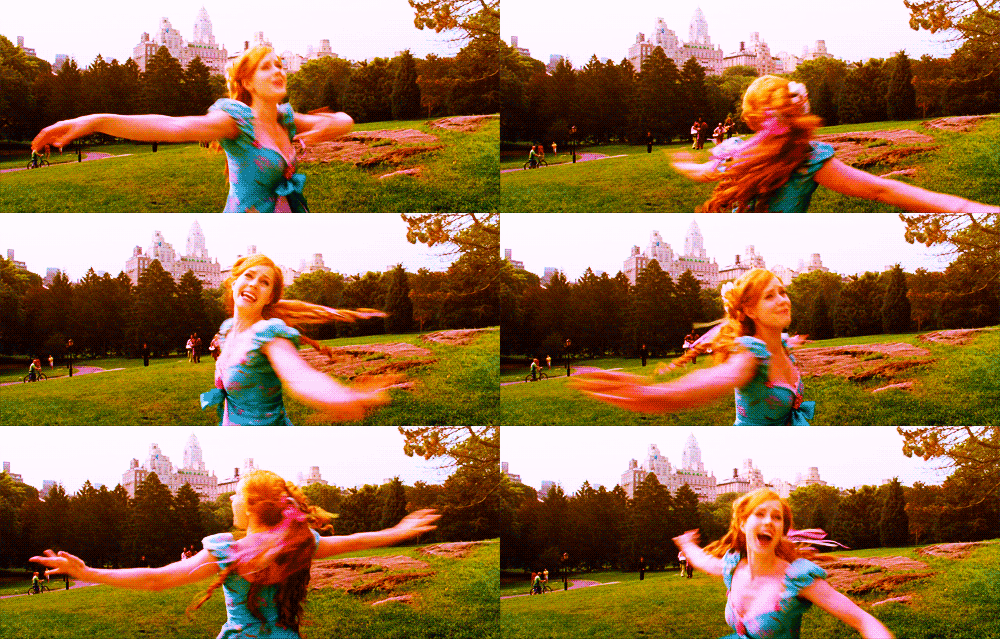
Well, this week has been a whirlwind, a whirlygig and a tilt-a-whirl all-in-one.
Stop, Amy, I’m dizzy!!!
After so many of you nominated this blog for Write to Done’s “Top 10 Blogs for Writers” contest, I learned yesterday that it was selected! It cracked the top 10!

 This blog is a labor of love, it truly is. (I know I’m using a lot of clichés this week, but heck if they aren’t so darn apropos.) I blog because I enjoy it immensely, and hey, even though picture books LOOK simple, we all know they’re complicated. There’s a lot to dish and discuss.
Many of you are visiting for the first time, linking from Write to Done. So now would be a good time for a “Year in Review”, no? Amazingly, the top three posts this year were NOT written this year—they’re oldies but goodies (another cliché, Tara?):
- Picture Book Construction: Know Your Layout (Picture Book Dummy)
- 500+ Things That Kids Like
- Roald Dahl: What Makes a Good Children’s Writer
The top three posts written this year were from PiBoIdMo guest bloggers:
- Tammi Sauer Starts with a Title
- Zachariah OHora Pimps His Characters
- Melissa Guion Bursts the Bubble
And my three favorite posts of 2013?
- A Monstrous Book Launch Story in GIFs
- What’s Wrong with Writing Message-Driven Picture Books?
- Tara Lazar Gets Emotional
- Gifts for Writers (In Other Words, Gifts for YOU!)
(Hey, I thought you said THREE? It’s my blog, they’re my rules. Which can be broken. Just like picture book rules.)
Write to Done called this blog “a hub for picture book writers.” It’s true—we’ve created a supportive community here and in our PiBoIdMo Facebook group. (Please join us there. The group is open year-round and delves into all things picture book.)
While composing this “year in review,” I noted that in 2013 I highlighted more authors and illustrators than ever before—and while that’s a good thing, I’d like to circle back to more craft articles in 2014.
However, it always helps to have your input. What do YOU want to see here in 2014? (Besides PiBoIdMo 2014, of course.) Please leave a comment! Your votes got this blog into the Top 10 (thank you!) and your votes for this blog’s content will ensure it continues to be a useful (and FUN) resource.
Many thanks to Mary Jaksch of Write to Done for the honor, and congratulations to the other winners: Writer Unboxed, KM Weiland, Carol Tice, Chuck Wendig, CS Lakin, James Chartrand, Kristen Lamb, Linda Formichelli and Darcy Pattison. Go check them out! Methinks you’ve got a lotta good reading in your future.
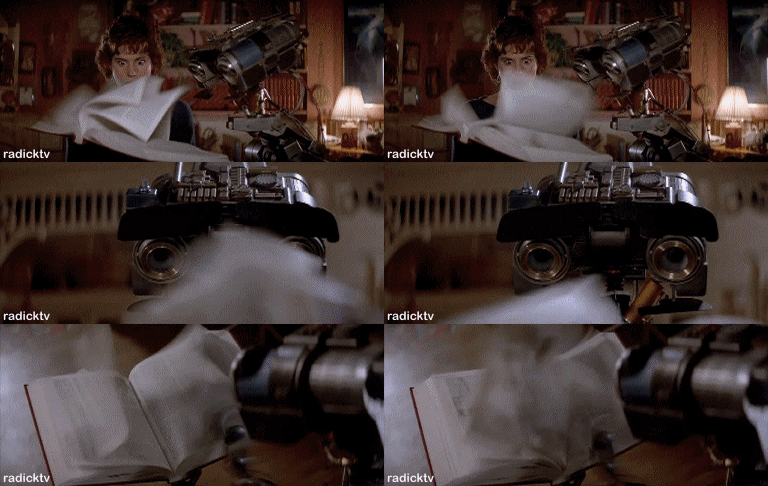
(Hey, you know who that is? Ally Sheedy! I tell this story at school visits: when I was in elementary school I checked “She Was Nice to Mice” out of the library. My librarian, Mrs. Shamus, told me that the author, Alexandra Elizabeth Sheedy, was only 12 years old. I then thought, “If she can do it, then I can, too!” That was my writing epiphany, the first time I recall wanting to become a children’s author.)
So, you have your list of 30 or more ideas. Now what?

First of all, DON’T STOP. Your mind is fertile right now. This is when most of my ideas come… the week after PiBoIdMo.
The pressure is off, but the brain is still in idea-generating mode.
Take advantage of it. Keep your list in a handy place and add, add, add.

Check your list twice. Then check last year’s list. And the one from 2011. What pops? While some ideas may seem too overdone or too dull, there are likely to be two or three that jump out at you.
Tuxedo-saurus: too fancy
Hip-Hop-a-Saurus: too dancy
Ho-Hum-a-Saurus: a bore
Sashay-a-Saurus: too prancy
Piggy-Bank–a-saurus: too finance-y
Snooze-a-saurus: a snore
Poker-a-saurus: too chancy
Trig-a-saurus: too advance-y
Slobberdon: yes, score!!!

Look at your best options. Do some research. Have they been done before?
Explore. Check Amazon to see what competing titles are out there.
One year I had Panda-monium on my list. Done. Another, I had Dino-snores. Also done. Better to find this out BEFORE you begin.
This brings me to my final point…

Once you’ve got a solid manuscript, shop it to editors and/or agents.
Tyrannosaurus Wrecks was one of my favorite ideas from 2011. I wrote a draft, but wasn’t happy with it and put it aside. Turns out, I was too slow. Someone has now beat me to it!
So, if you have a winning idea, get rocking.

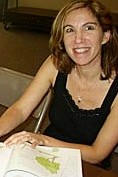 Corey Rosen Schwartz is the author of THE THREE NINJA PIGS and the upcoming GOLDI ROCKS AND THE THREE
BEARS. Her singing is extremely pitchy, but she does hold Family Idol and X Factor events in her living room.
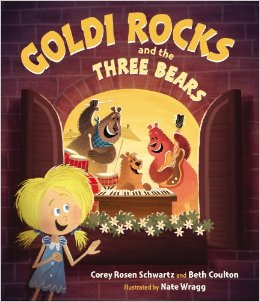
Corey will give away a signed copy of GOLDI ROCKS & THE THREE BEARS (as soon as it releases on Feb 6th).
This prize will be awarded at the conclusion of Post-PiBoIdMo. You are eligible for this prize if:
- You have registered for PiBoIdMo.
- You have commented ONCE ONLY on today’s post.
- You have completed the PiBoIdMo challenge. (You will have to sign the PiBoIdMo Pledge at the end of the event.)
Good luck, everyone!





 Writing for Kids (While Raising Them)