You are currently browsing the category archive for the ‘Picture Books’ category.
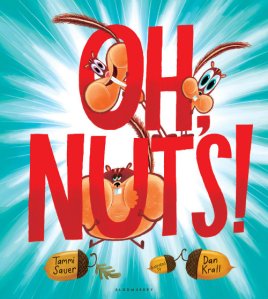
OMG! I’m having a fangirl moment. Somebody fan me and feed me chocolate. (No, not YOU. Get Ryan Gosling.) Because not only is the brilliantly prolific author Tammi Sauer here, but she brought along the stars of her newest picture book, OH NUTS!
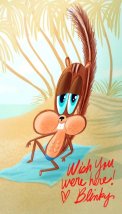
Thankfully I have Billy Bush helping me out (who will do as a Ryan Gosling substitute in a pinch). Billy’s qualified to interview Miss Universe contestants, so he will no doubt pose the tough questions to our guests Cutesy, Blinky and Bob. He caught them on last night’s Emmy’s Red Carpet.
Take it away, Billy.
 Billy: Wow, so great to see you Cutesy, Blinky and Bob, stars of OH NUTS! Thanks for stopping to talk. You look fabulous. Tell us, who are you wearing?
Cutesy: Carolina Herrerra’s “Forest Dwellers” collection.
Blinky: Um, obviously Bob. Will someone please peel him off my back?
Bob: Wait, I was supposed to get DRESSED?
.
Billy: So you guys reached the pinnacle of popularity but then retreated from the limelight. What caused you to give up show business? Was the pressure just too much?
Blinky: Well, dude, we realized we had to be true to our inner chipmunk, you know?
Cutesy: Plus, all those flashing lights kind of wrecked my mascara.
Bob: Huh?
.
Billy: But your fans really want you to get back into the game. We heard that Alvin and his crew rejected an offer to star in “The Hunger Games IV: Acorn Atrocity”. Will you be lobbying for those roles now?
Cutesy: Our agent definitely wants us to consider it.
Blinky: Like whoa. It would be an awesome opportunity to showcase my six-pack.
Bob: I like noodles.
.
Billy: Do you think you’d like to branch out into other forms of entertainment? You know, become a triple-threat with a triple-threat?
Cutesy: We’ll always stick together, but we each have something special to give the world. Soon I’ll be launching my very own line of accessories called Chic Chipmunk.
Blinky: ABC wants me to be the next Bachelor.
Bob: I’m going to…wait…I forget.
.
Billy: How would you like to be remembered and immortalized by your fans?
Cutesy: We just want everyone to remember that chipmunks are people, too.
Blinky: I’d really like a street named after me.
Bob: I’d really like a nap. And a taco.
.
Billy: Oh wow, here comes Brangelina…so…SCRAM!
Cutesy: You know, we have a nickname, too. It’s “Blutesy”.
Blinky: I like it!
Bob: Hey, where’s the “Bob” in that?
.
Well, thanks Billy Bush, Cutesy, Blinky and Bob for the interview. And thanks for leaving behind an autographed copy of OH NUTS!
One lucky US resident will win it, just leave a comment to be entered! A winner will be randomly selected one week from today. Good luck!
And don’t forget to check out the rest of Tammi Sauer’s books. I mean, there must be a million of them now.
My goal on this blog is often to get writers thinking about exciting hooks for picture books.
Robots? YES!
Zombies? ERMMMFFF! (“Yes!” in zombie-talk.)
Frankenstein? AHHHGGGRRROOOOOWWWZZZ! (“You bet your sweet bippy!” in Frankenstein-talk.)
How about all THREE in one book? (Sorry, that one broke my translation tool!)
Well, Annette Simon already beat you to it!
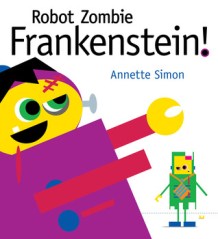 ROBOT ZOMBIE FRANKENSTEIN is the story of two nuts-and-bolts buddies who try to one-up another. So I wanted to see how Anette one-upped a fabulous ROBOT idea to make it a triple-threat.
TL: Annette…umm…HOW?
AS: Robots and zombies may be getting some extra attention now (and for that I’m grateful!), but I think that from a kid’s perspective, they’re pretty standard characters. Like pirates, superheroes, and outer space invaders, they aren’t new subjects, just fun ones, and why not combine? My youngest, who’s now 18 and soon to graduate from high school, came to his fifth birthday party wearing a pirate hat, a tie, and a chef’s apron.
TL: In your book, the robots try desperately to one-up another. This is brilliant, as you’ll often see young children doing this. I remember dance class when I was seven, a girl told the instructor she practiced for an hour every day. Then came shouts of “I practice two hours” until I finally said “well, I practice TEN hours a day”. So funny. At the time I thought I was impressing everyone, but now I realize they knew I was lying. Do you have a childhood one-upmanship experience that gave rise to the ROBOT ZOMBIE FRANKENSTEIN story?
AS: Hmm. Tara, I pinkie-promised my sister I would not divulge details. (Let’s just say I won. All the time.)
I wish I had some fantastic backstory about this book. The truth is not glamorous: Robot and Robot showed up in little snippets as I walked, cleaned my house, grocery-shopped, and waited in car pool. They crept in from the fringes while I was busy querying agents with other stories.
But I do want to share something that may be especially dear to readers of your blog. These two cartoons by Jerry Scott and Jim Borgman have smiled from my fridge for years. (You can tell they’re old by their colors.)


My youngest is about to head off to college, and I’m realizing I will have to find another excuse, er, reason, as to why I’m not more prolific. Or else just get my butt back in chair.
It’s still complicated.
TL: Did you give your robot characters names as you were creating them? What do you think their names really are?
AS: I did kinda play around with names. For awhile, I thought of Robot and Robot as Cy and Borg, then Cy and Henry (Henry = the measuring unit of inductance– sounds smart, huh?) or Hecto (a computer measurement for 100). My fabulous editor, Mary Lee Donovan, sometimes nicknamed them Watson and…Isaac? Asimov? Chip? I can’t remember. In story discussions, we called them Purple and Green. In the end, they each said, “I, Robot.”
I hope one day the robots get a pet; I have a fun long list of pet names.
TL: Is there anything your robots wanted to be, but they didn’t get the chance to transform themselves? Anything cut out of the final version that you wish would have remained?
AS: As far as cutting-room-floor material, here’s a spread that didn’t make it. But, should Robot and Robot one day go trick-or-treating…

Well, folks, you can one-up your friends by not only winning a SIGNED COPY of ROBOT ZOMBIE FRANKENSTEIN (which is a *perfect* Halloween read), but by also winning cool robot chest iron-ons! Impress your friends, neighbors, and local Kindergarten classes!

Just leave a comment to be entered. A winner will be randomly selected one week from today!
 Annette Simon says that when she was in kindergarten, she was named Best Artist in her class. When she was in the third grade, she won her school’s Fire Prevention Week poster contest. After she graduated from the University of Cincinnati’s College of Design, Architecture, Art and Planning, Annette earned awards as an advertising creative director. Now, she writes and draws for young readers. Simon says she could not feel more honored. Learn more about her books at AnnetteSimon.net.
When I teach a picture book writing class or speak to new writers, I tell them I don’t subscribe to the “write every day” philosophy. That just doesn’t work for me as a picture book author. Sorry, wise writing sages.
However, I do give out this suggestion: “stare every day”.
Yes, I spend the bulk of my time staring (a.k.a. thinking) when writing a picture book. In fact, it’s about 50% of my effort. And thanks to my friend Carter Higgins from Design of the Picture Book, I can now share this secret with you in a deliciously accurate chart.
Can I get you a slice?
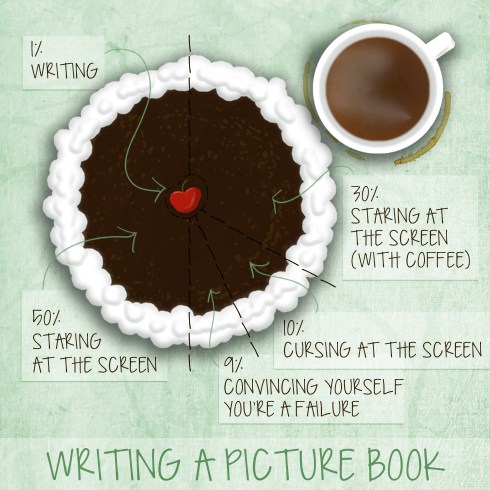
(Please note: “Writing” is the cherry on top!)
The Picture Book Idea Month success stories just keep pouring in!
The latest news is from lucky Penny Klostermann who was named runner-up for the 2012 SCBWI Barbara Karlin grant! This makes THREE YEARS IN A ROW that a PiBoIdMo story either snatched the grant or was named next in line.
Without further ado, I’ll let Penny tell you all about it!
 In the fall of 2011, my wonderful critique group, Picture Bookies, made me aware of Tara’s brilliant concept, PiBoIdMo—30 picture book ideas in 30 days! My very first PiBoIdMo idea was to do a rewrite of THE NIGHT BEFORE CHRISTMAS. I know….holiday stories are hard to sell. I know….rhyme done right is hard to write! But, it was November…and Christmas was just around the corner…and I love the original. By the end of November, I had three different ideas for rewriting THE NIGHT BEFORE CHRISTMAS.
From the time I wrote the first line for my 25th idea, MARS NIGHT BEFORE CHRISTMAS, I knew it was my favorite.
Then, in December, Susanna Leonard Hill hosted a competition on her blog for a rewrite of THE NIGHT BEFORE CHRISTMAS. This brought my idea to the forefront, and I decided to work on it right away. I read every version of the story I could get my hands on. I researched Mars and Space! I got excited as words and phrases from my research enhanced my manuscript.
February 26, 2012, I emailed my manuscript to my critique group. As usual, their comments were incredible. I revised and revised and revised some more. Then on March 12, 2012, I mailed my manuscript to the Barbara Karlin committee…and waited.
I got the call/voicemail at 6:36 p.m. Friday, August 3rd. (Of course I took a picture of my call log!) I didn’t listen to the voicemail until 10:30 p.m. The caller said she was with the Barbara Karlin Grant, and could I give her a call. COULD I GIVE HER A CALL?????? I live in Texas. She was in California. It wasn’t too late! When she told me I was runner up I just couldn’t believe it. Uncontained happiness!!!
I have to say, Tara, that PiBoIdMo is out-of-this-world awesome. As I look through my list of ideas for the next manuscript to tackle, I am amazed. Your organization of the event with inspiring posts and interaction among so many picture book writers took my mind to places it wouldn’t go sitting alone in front of my computer. Thank you.
I just have to brag on my critique group, Picture Bookies. Rebecca Colby was the winner of the 2011 Barbara Karlin Grant. Also, in 2011, Mona Pease received a Letter of Merit. The other members are just as incredible. I am lucky to be a part of this group.
Congratulations, Penny, and thanks so much for sharing your success story! You can visit Penny online at her blog: “A Penny and Her Jots“.
Now folks, you know the old rhyme: “Find a Penny, pick it up, all day long you’ll have good luck!” So let Penny’s story sprinkle some good fortune on you.
PiBoIdMo guest bloggers and badges will be revealed on October 1st, with registration to begin on October 24th right here on this blog. Subscribe via email (← see left column) to make sure you don’t miss PiBoIdMo updates!
If you have suggestions about who you’d like to see guest blogging this year, please leave a name (or two or three) in the comments!
Three is a magic number. Not only because it’s the age when tiny toy parts no longer pose a choking hazard to your toddler, but because the universe is full of threebies.
Three square meals a day.
Three strikes and you’re out.
Three ring circus. And three ring government. (Excellent analogy, Schoolhouse Rock.)
Then there’s the “rule of thirds” design principle for composing visual images with tension and interest.
Ever heard of the FOUR LITTLE PIGS? Of course not. There’s just three, like THREE BLIND MICE and THREE BILLY GOATS GRUFF. Heck, there’s even THREE STOOGES.
In picture books, you’ll often find the protagonist struggling to solve their problem three times before finally succeeding. This technique encourages the reader to become invested in the hero’s journey. If the character were to try once and triumph, what fun is that? There’s no time to root for her!
Likewise, you’ll often see groups of three drawings on one picture book page. Three offers a nice balance because two is too few and four is too many. Like Goldilocks and the THREE Bears know, three is “just right”.
So today I’m going to extend “The Rule of Three” to you, the aspiring author. How so? I encourage you to have THREE polished manuscripts ready before submitting to an agent or editor.
Three manuscripts means that you’ve been writing for a while. Not a month or two, but most likely a year or two…or yes, even three. You’ve taken the time to hone your craft. Three manuscripts also means you’ve got a body of work an agent can review. If they don’t like your first story, but they see potential, they will ask for some more. Wouldn’t it be a missed opportunity if you didn’t have more?
In fact, even if they LOVE your first story, they will ask to see more. Picture books are a difficult sell, so if the first manuscript doesn’t find a home, they’ll want something else to submit. Three stories lets the agent know that your body of work, your style, resonates with them. On the flip side, they may LOVE your first book but not see a market for your other stories, or personally dislike them. Their lack of enthusiasm means they are not the right agent for you. You want to know this BEFORE you sign with someone, not AFTER….’cause breaking up? It’s hard to do.
And listen, if you have three manuscripts ready, I’m going to go a bit further and suggest you get FIVE ready. Because five is shiny, like “five golden rings” or “The Jackson Five”.
Yeah, it’s easy as A B C, 1 2 THREE.
Geesh, you’d think I wouldn’t forget about my own book contest. But I plead summer brain. It’s all mushy with Slurpees and Sno-Cones. Maybe I should plead brainfreeze then, too!

So without further ado, the red guy on the front cover is named DUSTER!
While no one guessed the exact name, Wafa Musitief guessed DUSTERS, so she wins an original signed monster sketch by illustrator James Burks!
But wait! We added a second prize for a random winner. And that winner is Jarm Del Boccio!
Congratulations Wafa and Jarm! I’ll be emailing you shortly.
Once again, thanks for subscribing to my blog. Rest assured there will be a lot more prizes coming soon. You’re bound to win one eventually. And if you don’t, I’ll treat you to a Slurpee. Brainfreeze is an awesome way to float through summer.
I am ridiculously far behind in picking winners. So without further ado, here they are!
WINNER of CRASHING EDEN by Michael Sussman:
MIKE ALLEGRA! (heylookawriterfellow)
WINNER of THE MONSTER WHO LOST HIS MEAN by Tiffany Strelitz Haber:
LESLIE G!
Congratulations, guys! I’ll be emailing you shortly.
I’m sorry if you didn’t win, but everyone’s leaving with a consolation prize. No, not a lifetime supply of Turtle Wax. (Do they even make Turtle Wax anymore? If you ever won a lifetime supply on Let’s Make a Deal you’d be ripped off.) Instead, it’s a piece of picture book writing advice:
Think BIG and carry a SMALL manuscript.
OK, so you know that I love monsters. Can’t get enough of them. Well, my friend Tiffany Strelitz Haber is here today with a monster of a story—her debut picture book, THE MONSTER WHO LOST HIS MEAN!
Some of you may know Tiffany as one of the two rhyming geniuses behind The Meter Maids (with Corey Rosen Schwartz). If you don’t, you have to check out her site, which is all about writing in rhyme. Don’t make me slap you with a citation!
Before we get riffing with Tiffing (yeah I can call her that, it rhymes), you MUST take a look at the extraordinary trailer for her new book. The Danny-Elfman-like original music, the animation—it’s all so monstrous and so much fun!
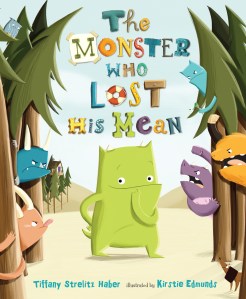 TL: THE MONSTER WHO LOST HIS MEAN is about a monster who loses his ‘M’. You know I host Picture Book Idea Month every November so I’m obsessed with the origin of ideas. Where did this idea come from?
TSH: I have always been a very visual person when it comes to words. Even as a kid, I loved the concept of homonyms, acrostics, acronyms, spelling words backwards, and even looking at them upside down. One day I started thinking about the letters in the word MONSTER, and what they might actually stand for if the word MONSTER was an acronym. From there the concept just grew and evolved, and “The Onster” was born!
TL: We’re also all about characters names on this blog. Did “The Onster” have a name before he lost his M?
TSH: Ya know…that’s a great question. I like to think that he only really found any identity at all after he lost his M. Before that he was just…well… generic, nameless, and not nearly as cool—Monster. Bleh.
TL: The Onster cooks brunch at one point in the book. I’m a foodie like you, so what’s your favorite brunch food?
TSH: Hmm…for me, picking a favorite food is kind of like bending a spoon into a perfect figure eight using just my toes (almost impossible). But in the interest of quasi-decisiveness…I’ll go with a tie. EITHER: Perfectly toasted onion bagels slathered in whipped cream cheese, lox and just a few rounds of raw, red onion…OR…a dim sum extravaganza.
So…What’s YOUR favorite brunch food? Tell us and be entered to win a signed ARC of THE MONSTER WHO LOST HIS MEAN!
You get one entry for commenting and then one entry for every place you share—blog, Facebook, Twitter, Pinterest, etc. Just let us know where you ONSTER’ed!
 Tiffany Strelitz Haber is the author of two rhyming picture books: THE MONSTER WHO LOST HIS MEAN (Henry Holt Books for Young Readers, July 17, 2012) and OLLIE AND CLAIRE (Philomel/Penguin, 2013). She will eat any food she is served, be it fried witchetty grubs on a stick or calf’s brain ravioli, and loves to be high in the air or deep in the sea. Tiffany lives in NJ with her two little monsters, Jack Dalton and Travis Hawk. Like her on Facebook. If you don’t, Tara will sic the monsters on you.

*Photo Credit: WENN.com

“Tara Lazar’s LITTLE RED GLIDING HOOD, with an icy twist on the familiar fairy tale, where Little Red is desperately searching for a partner in the upcoming pairs skating competition, to Heidi Kilgras at Random House Children’s, by Ammi-Joan Paquette at Erin Murphy Literary Agency (World).”
Thanks for making my announcement, Ryan. *blush*
It couldn’t have come on a better day!
This was a deal that required a lot of perseverance. It proved to me that writers should never give up on a story.
And I must say that I am thrilled beyond all beyond (is that even an idiom?) to be working with Heidi Kilgras, who has edited titles of industry legends such as Jane Yolen. WOWZA.
From the very beginning, Heidi had a particular illustrator in mind for this project. I hope to share that news with you soon because it’s pretty darn awesome!
Congratulations to all the writers and illustrators featured in PM today! In picture book news, Marilyn Sadler sold ALICE FROM DALLAS to Abrams Children’s and Susan Reagan sold PINGO AND PUFF to Hyperion Children’s.
And now, it’s time to PAR-TAY!
I just got back from a FABULOUS 1st grade school visit! I was so excited about it that I immediately had to vlog.
While this isn’t my first vlog (that was for EMU’s Debuts), it is the debut vlog for this blog.
If you want to start doing school visits as a pre-published author, I explain the way to go about it. I think. *Warning: DO NOT APPEAR AS CRAZY AS I DO IN THIS VIDEO.*
Apologies for the ethereal lighting. I was sitting in my breakfast nook with the blinds opened. But I rather prefer the Cybill Shepherd “Moonlighting” look, don’t you, dahlings? (What, you don’t know what that means? Oh, you young whipper-snapper, go Google it.)
More apologies for the mirror writing. If I knew how to flip a video, I would. Anyone know? Help?!
And hey, wanna know more about my school visits? I’m going old-school with a CLICK HERE. (Really. Click there.)
And please remember to leave me a comment about what we should name “vlogs” instead of “vvlawwwgz”. It’s an ugly word for an exciting medium.





 Writing for Kids (While Raising Them)