You are currently browsing the category archive for the ‘Picture Books’ category.
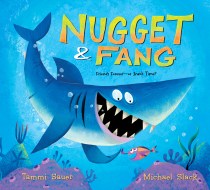 Dudes, it’s new Tammi Sauer! YES!!!! *Jersey fist pump*
Ya know Tammi, right? She’s the most prolific picture book author this side of the Atlantic! (And that side, too.)
An annual contributor to Picture Book Idea Month, Tammi has dispensed invaluable picture book pointers about story structure, celebrating the weird stuff in life, and putting a twist on the familiar. She’s also a regular PiBoIdMo participant, and NUGGET AND FANG is her success story from the November 2009 event!
So the unlikely underwater duo are here today to chomp away! (Don’t worry, Tammi’s here, too. Fang didn’t gobble her up.)
Tammi, what about unlikely friendship stories makes them so fun to write?
If two characters are at odds in some big way, that immediately builds in tension and offers real deal conflict. This can provide great opportunities for humor, too. That’s fun stuff! Some unlikely friendships deal with issues such as neatness versus messiness or quiet versus loud. The quandary that my characters face is clear–sharks and minnows aren’t supposed to be friends because everybody knows sharks EAT minnows.
Sharks are popular characters these days! What makes FANG stand out in the world of storybook selachimorpha? (Yes, that is a real word. I looked it up. Honest.)
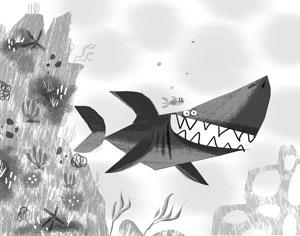
Michael Slack’s first sketch of the carnivorous chums.
I love that I have a contender in storybook selachimorpha. It sounds super sophisticated. As for Fang, he stands out among regular sharks because he has a huge heart. Yes, he’s toothy, but, holy mackerel, my guy is irresistible. If I were a minnow, I’d be honored to be his friend.
What are some of your favorite unlikely friendship stories/books?
My Favorite Unlikely Friendship Story of 2012 was BOY + BOT by Ame Dyckman, illustrated by Dan Yaccarino. That book is brilliant in 2,465 different ways. Plus, Ame has blue hair. (Tara’s note: sometimes it’s pink or purple, or even rainbow leopard.)
A fun and endearing unlikely friendship story that just came out this past February is WOOBY AND PEEP written by my oh-so-fabulous critique partner Cynthea Liu, illustrated by Mary Peterson. (Hey, WOOBY AND PEEP are coming soon to a blog near you. Umm, this one.)
If NUGGET and FANG could endorse their book personally, what do you think they would say?
Nugget: Holy mackerel! Get your fins on this book. It’s FANG-tastic!
Fang: Sink your teeth into our book. It’s a total NUGGET of awesomeness!
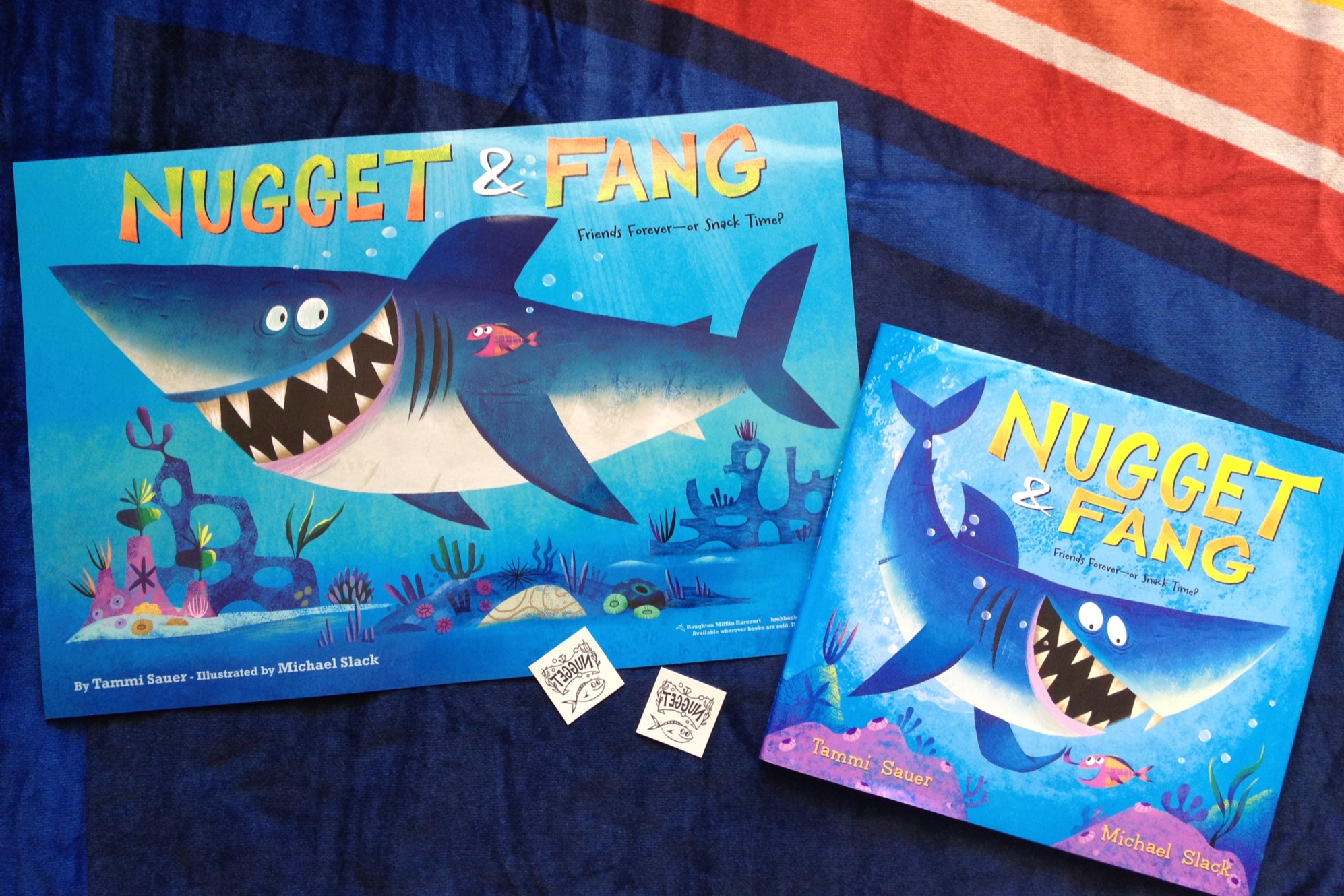
Well, I’ve got a nugget of awesomeness for you, dear blog readers: a “NUGGET AND FAN” (not a typo–you’re a fan already, right?) prize pack, including a signed first edition, a teacher’s poster, and adorable tattoos you can slap on any fin (or bicep). Just leave a comment or question for Tammi to enter and a winner will be chomped up later this month! In the meantime, go visit these seaworthy sidekicks!
Wow, that’s kinda unheard of, isn’t it? A debut deal for TWO picture books?! I’m blown away. I know you are, too. So let’s meet the NOT UNTALENTED Maria Gianferrari!
I met Maria online a couple years ago when she signed up for PiBoIdMo. She’s also purchased my jewelry. And now she’s represented by Ammi-Joan Paquette, which makes us agent-mates. I mean, we’re practically sisters at this point, right?
OK, I will stop asking questions and give answers now. How did Maria land her agent? What is the two-book deal about? (Oh wait, that’s more questions, huh?)

Maria Gianferrari’s debut PENELOPE, UNTALENTED, focusing on a girl who’s having a difficult time deciding on what talent she might have (if any!) to put on display for her school talent show; with a little help from her dog, she tries out various talents with disastrous results — until she realizes that she and her dog have a talent to share that’s unique to them, to Cynthia Platt at Houghton Mifflin Harcourt Children’s, for publication Spring 2014, in a two-book deal, by Ammi-Joan Paquette at Erin Murphy Literary Agency.
Now take it away, Maria!
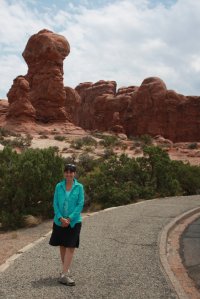
Maria…on the path to publication!
I first met Joan in 2009 at the PEN New England Susan Bloom Discovery Award ceremony. I was lucky to have been chosen as one of the winners for one of my nonfiction picture book manuscripts, and she introduced herself to me. At the time, I only had two submission-ready picture book manuscripts (and several in progress) so the timing wasn’t right, but she told me to keep in touch.
In May 2011, I saw Joan briefly at the New England SCBWI conference and she encouraged me to send her some manuscripts. We were getting ready to drive cross-country and live in San Diego for a year for my husband’s sabbatical, so I told her I’d be in touch at the end of the summer. I sent her a bunch of picture book manuscripts in late August, and then I heard back in October that she liked several of them, and asked me to revise two of them. I did two rounds of revisions for Joan, with the able assistance of my online critique group (Go CP!), and in late August 2012, I became her client. I felt overjoyed, and very lucky again, because Joan took me on based on my picture book manuscripts, knowing it would be more work, because there would be multiple editors involved. Ultimately, she told me that she had to have them on her list, which was a very nice compliment.
Joan began sending out three of my manuscripts almost immediately, and I began to receive some lovely rejections, and even a couple of revision requests. I was coming home from picking up my daughter at school, when I heard a voice on the answering machine. I picked it up and to my great surprise and delight it was Joan telling me we had an offer from Houghton Mifflin for my fiction picture book PENELOPE, UNTALENTED! I must have sounded like a complete and total idiot. All I could say was “Oh My God” about a thousand times.
Meanwhile my 11 year-old-daughter, Anya, was screeching in the background—“Mom—what is it? Who is it?”—so I told her that I sold a book. Then if I’m remembering correctly, I think Joan asked me if I wanted to sit down, so I did, and then she started telling me that I got a two-book deal! I was completely flabbergasted. Most of the conversation was pretty hazy, but I do remember thanking her, and telling her that this was beyond my wildest dreams—it was & is! After we hung up the phone, Anya and I did a happy dance in our living room. Our dog, Becca, thought we were nuts. The hardest part was having to wait to share my news because Joan had a hard time getting in touch with the other two editors to whom it had been sent since both had been out sick—flu season!
The lovely Cynthia Platt is “my” editor at Houghton. I live in the Boston area, so we recently met for lunch, and I was also able to meet Mary Wilcox and Monica Perez. It was so surreal that they knew my MC Penelope, and were excited about the book! I’m really looking forward to working with Cynthia on both of these books, and to finding out who will be chosen as the illustrator!
Thanks for sharing your success story with us, Maria!
Now aspiring picture book authors, what does this teach us? Patience and perseverance is key! Maria first met Joan three years before she became her client. Make those connections and keep in touch! Take advantage of SCBWI events (like the NJ Chapter’s annual conference in June) to improve your craft and network with agents, editors and fellow kidlit professionals. It all pays off!
 OK, silly title. And if anyone under 30 reads this post, they’re not gonna get the reference to Moon River.
But heck, I like it, because your smile will be wider after you visit RhymeWeaver…
Many kidlit writers hear “don’t rhyme” from picture book editors. It’s not that editors hate rhyme (well, maybe SOME do), it’s just that they see badly-executed rhyme so often in the slush, it’s easier to discourage it. Common rhymes like “me, see” and “you, two” and other one-syllable predictability can kill the joy of a story.
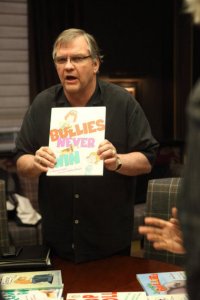 Remember “Celebrity Apprentice” when the men’s team gleefully authored “I know my A, B, C’s and my 1, 2, 3’s” as if it hadn’t been regurgitated in a googolplex of board books? They thought it was a rhyme worthy of victory and publication. Well, they did win the challenge, but the book Trump promised to publish was released by a vanity press, not a traditional publisher. No publisher was gonna touch it, ten foot pole or not.
Editors also see a lot of rhyme with flawed meter. Meter is a tricky thing. There’s stressed and unstressed syllables, plus the lilt of natural speech patterns that can render your meter more choppy than Zoanette Johnson’s drumming. If you read your own rhyme aloud, you might not even hear how off it is, because you are forcing yourself to follow the pattern [you think] you created.
Then there’s the near-rhyme mistake, when the words don’t really rhyme at all, unless you twist your tongue or alter your accent. Like “hat” and “what” or “hat” and “back”. Once or twice and you can maybe get away with it. More than that and the editor may assume you need the WaxVac.
Moreover, writers can find their story dictated by rhyme, getting trapped in nonsensical situations simply because “dishwasher” rhymes with “impostor” (almost). It’s obvious when a plot decision has been forced based upon one word.
For these reasons, editors will advise, “don’t rhyme”.
For these reasons, author Lane Fredrickson created RhymeWeaver.com.
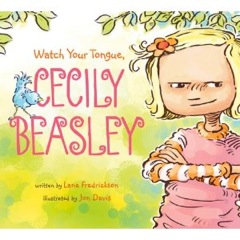 Lane is the author of WATCH YOUR TONGUE, CECILY BEASLEY, a rhyming picture book with a joyfully jaunty rhyme. Remember as a child when you stuck out your tongue and a parent warned, “It will get stuck that way!” Well, Cecily finds herself in that very predicament. Hilarity ensues when a bird takes up residence on Cecily’s perfect pink perch. What’s Cecily to do?
Knowing the difficulty of rhyme for picture book writers, Lane created RhymeWeaver.com to teach the bard-challenged the complexities of rhyming well.
Lane, your rhyme is perfection! How did you get to be so good at it?
Ha. Thank you, Tara.
The short answer would be: a gnawing question and a genetic glitch.
But there is also the long answer. When I first joined SCBWI, everybody seemed to be telling everyone else NOT to write in rhyme, like there was a disease associated with it. You know, literary sarcoma or writer’s blockjaw. You almost didn’t want to admit you were a rhymer lest they sit in some quarantined section and slap a scarlet R on your forehead. The other thing I kept hearing was that a person’s rhyme had to be PERFECT. I wanted to write PERFECT rhyme, but I could never get a really good answer as to what PERFECT rhyme was. This is the kind of scenario that drives a slightly obsessive-compulsive person to behaving obsessively compulsive. So I googled around and studied my Seuss and found a website that offered critiques for $50. The critique, although well-intentioned, was just plain bad advice involving “counting syllables.” And don’t get me wrong, I’ve definitely given bad advice (but I’m pretty sure it was free when I did it). I totally get that sometimes bad advice seems good because it comes from multiple sources, but “counting syllables” is not the way to perfect meter and I had (being slightly obsessive compulsive) already figured that out. So I went back to school thinking I’d take a poetry class and clear up the PERFECT meter issue. But the thing about college is they don’t tell you what you want to know, they tell you whatever they want to tell you. So it took a BA in English and healthy stab at an MA in British Lit to figure it out that meter is a lot of things, but PERFECT is rarely one of them (I only stabbed at the MA, I haven’ t killed it yet).
 What inspired you to put all your rhyming knowledge into a website?
I watched a lot of people go through exactly what I went through: trying to figure out the rules, trying to decide if writing in rhyme was worth the stigma, trying to find complete resources that explained everything. I have a degree in psychology, where I focused on cognition and development (which is the opposite of those people who ask you to talk about your problems). Cognitive and developmental psychologists look at how people think and how they grow, mature, and learn. I knew that I could show meter in a way that’s visual and image-based. I knew that I could break it down into constituent parts in a way that I had never seen done. I knew that I could make it easier to grasp. But I wanted it to be free because I’m trying to improve the status of rhyme in the literary world and the more people who rhyme well, the less it looks like I have a disease.
Lane’s website has already helped this ruined rhymer who can’t hear meter even if I got whacked upside the head with it. So I encourage you to pay RhymeWeaver.com a visit, Pin it, share it, study it, LIVE IT. Children deserve better rhyming picture books like CECILY BEASLEY.
And hey, you can WIN CECILY! Just leave a comment telling me about the most interesting thing you learned at RhymeWeaver.com. A winner will be picked randomly in a week (or knowing me and prize distribution, two weeks).
So don’t hesitate, get out there and rhyme, oh Kate! (Sorry if your name isn’t Kate. I had to end on a rhyme.)
Before you click the back button, thinking you’ve arrived at the wrong blog, let me assure you…I DO NOT hate picture books.
And neither does Timothy Young, author-illustrator of the new picture book I HATE PICTURE BOOKS! It’s his main character with the picture book problemo.
I will let him explain…
 In November I was a guest blogger for PiBoIdMo and I told a brief version of how I had the idea for I HATE PICTURE BOOKS!. I was at the NJSCBWI 2011 summer conference where I was on the faculty. I taught a seminar about creating pop-up books and sat on a panel with some of the other authors in the KidLit Authors Club. I attended a couple of the other seminars while there, including “Finding The Funny Stuff” with Audrey Vernick and Olugbemisola Rhuday-Perkovich. They were talking about parody (I love good parody) in children’s books and Olugbemisola made a very funny comment about Paddington Bear’s immigration status.
That’s where things got rolling. I’ve always loved good parody but I hadn’t really thought of doing a parody book. There have been some really good ones lately like Michael Rex’s THE RUNAWAY MUMMY and GOODNIGHT GOON. So sitting there I started thinking, if I were going to do a parody what would it be? Images of classic books started running through my head and I thought, there are too many to choose from. Could I do something that used a bunch of books instead of just one? Somewhere in my thoughts appeared this kid, this boy who misinterpreted what he was reading. He was angry about it and he yelled “I hate picture books!”.
I have to say I really liked that title. It had a great hook and I thought “there’s a title readers will notice”. It has to be a good story with a title like that. I thought of all of the books this boy would be angry at. I thought of the kind of trouble he would get into based on what he read. I was really enjoying the process.
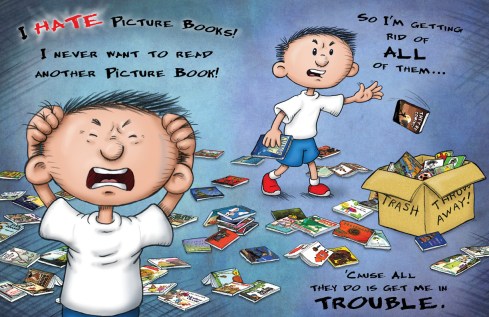
I had the beginning of the book really fleshed out, I was even designing spreads in my head. Having the boy (he was eventually named Max) appear in the books he was talking about, and illustrating him in the style of classic illustrators really excited me.
I then came up with the idea of having lots and lots of books lying on the floor and I couldn’t wait to get home and start drawing some of the scenes I was working out in my head.
So this story pushed it’s way out of my head. Once I got home from the conference I began furiously drawing. I designed my boy and started drawing him onto the scenes I was developing. I went to my local library and checked out dozens of books. (I’ve dedicated this book to my mom and to Rosemary Morris, the children’s librarian at the Talbot County Library). I’ve had an ability to mimic other peoples styles which I’ve developed working in the toy industry with licensed product from Disney, Henson and other famous character brands. I knew I had to go the New York in August for 2 weeks so I gave myself a deadline to have a rough dummy ready for then.
I made my deadline and set up some meetings. I got a very good reaction from a number of people who’s opinion I really respect. I HATE PICTURE BOOKS! was sent out to a number of publishers by my then agent, and was turned down (nicely) by all of them. In November I was introduced to the good people at Schiffer Publishing. I submitted it along with SHADOWS ON MY WALL, THEY’RE COMING! and another book. They came back to me quickly saying they wanted all four. Since SHADOWS ON MY WALL and THEY’RE COMING! were almost ready to go they were put into the schedule right away. I then had 6 months to finish all of the illustrations for I HATE PICTURE BOOKS! and here it is coming out in a couple of weeks!
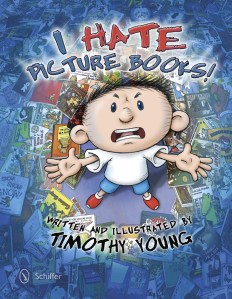
I’m having a book launch event at Books of Wonder in NYC on March 2nd (Dr. Seuss’ Birthday!) from 1 – 3 pm. If you can’t make it and want to get a signed copy, you can order one from my Kickstarter campaign until Sunday, February 17th when the campaign ends. You can see a video there of me reading the first few pages of the book.
I’m also having a contest on my website, www.ihatepicturebooks.com. If you can recognize and name 40 books from the over 250 classic and modern picture books referenced in it you can enter to win over a dozen signed books that appear in my book. They are by authors and illustrators you’ve actually heard of.
Thanks, Timothy!
I definitely cannot wait to get my hands on this one.
How about you?
Wake up, kidlit campers! Rise and shine! It’s time to register for Picture Book Idea Month!

I hope you’re ready to take the 30-picture-book-ideas-in-30-days challenge!
Need to know more before you sign up? Read this.
Those who sign-up for Picture Book Idea Month will be eligible for prizes—like feedback from one of four literary agents and critiques from picture book editors! Plus more to come!
To register for PiBoIdMo 2012, you must do three things:
1. Subscribe to this blog via email. (Click “Follow Tara’s Blog” button in left column.)
2. Leave your full name in the comments of this post. The form will ask for your email address. Please enter it so I can contact you if need be. (Your address won’t be published and I won’t use it for any other purpose.) PLEASE LEAVE ONLY ONE COMMENT. DO NOT REPLY TO COMMENTS.
3. Display the official PiBoIdMo participant badge on your blog, website, or social network. (Right click to save to your computer.) Please include a link back to taralazar.com so folks know where to join the challenge. And if you’re game, mention what an awesome job illustrator Ward Jenkins did on the logos. (If you don’t have anywhere to display the badge, then skip this one.)
Optional Other Stuff:
4. Purchase PiBoIdMo merchandise, like the official journal. [Note: more items to come over the next week.] All proceeds ($3 per item) benefit RIF, helping to put books into the hands of underprivileged children.
4. Add a Twibbon to your Twitter avatar and use the #PiBoIdMo hashtag when tweeting about the event.
5. Join the PiBoIdMo Facebook discussion group. (Note: the name says “2011” but it is the current group.)
6. Repeat after me:
I do solemnly swear
that I will faithfully execute
the PiBoIdMo 30-ideas-in-30-days challenge,
and will, to the best of my ability,
parlay my ideas into
picture book manuscripts
throughout the year.
That’s it. You’re golden!
REGISTRATION REMAINS OPEN THROUGH NOVEMBER 7th. You can still follow along if you’re not registered, but remember, those who register and complete the challenge are eligible for agent and editor prizes like picture book critiques.
PiBoIdMo will kick-off with the first guest post October 25th for Pre-PiBo, a week designed to help you prepare for the event. There will also be a Post-PiBo the first week in December to help you organize all those ideas.
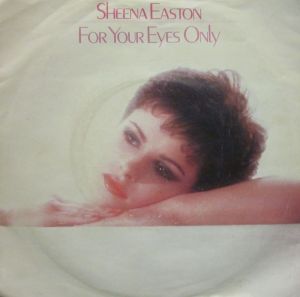
Visit this blog for daily inspiration from the guest bloggers, then keep a journal or computer file of your ideas. There’s no need to post your ideas online or send them to me. KEEP YOUR IDEAS TO YOURSELF! As Sheena Easton croons, they’re “for your eyes only.”
If you’d like, comment on the daily posts. You don’t have to say anything profound, a simple “Keeno Yaccarino!” will do.
At the end of the month, I’ll ask you to sign the PiBo-Pledge confirming you did create 30 ideas, and then I’ll pick prize winners from those who have registered and pledged.
Thanks for joining! I hope you enjoy this year’s PiBoIdMo! As always, if you have any suggestions for this event, please contact me at tarawrites (at) yahoo (dot) com or post on the PiBoIdMo Facebook group.
I will leave you with a quote that serves as PiBoIdMo’s motto…from Roald Dahl’s THE MINPINS…
And above all,
watch with glittering eyes
the whole world around you
because the greatest secrets
are always hidden
in the most unlikely places.
Those who don’t believe in magic
will never find it.

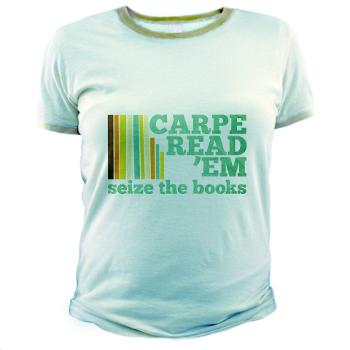
So I love this coffee mug.
Everything about the title and cover design screams that it’s going to have something marvelous inside. (And that it’s HOT.)
Note the retro color scheme and bold lines representing books on a shelf.


I talked to the author of this mug, and she said she wanted to create it so avid readers could profess their love of books. And, oh yeah, to also bring in a few bucks for Reading is Fundamental (RIF), the national non-profit organization that puts books in the hands of underprivileged kids who otherwise wouldn’t have any books of their own.
Well, how did the author pull this off?

That’s right, she bugged her friend Carter Higgins, the writer and designer behind the popular blog Design of the Picture Book. Yes, the same person who designed the Picture Book Writing Pie.
And Carter delivered. Big time.
So head on over to the CafePress PiBoIdMo shop to grab your cuppa. (And there’s a shirta, too.)
All proceeds benefit RIF ($3 per purchase), so there’s a good cause behind a good design!
Supercalifragilisticexpialidocious does not even begin to describe the week I’ve been having! I know, I know, why should YOU care? Frankly, I don’t know. The fact that anyone other than my mother reads this blog blows my mind.
First, on Friday, my agent said she loves the 900-word picture book I just wrote. Who knew that many words was possible? I tend to stick to the 500-is-best rule, but this story was too librarious (made-up word) to fit in such a tiny space. So it’s busting out into the world and I hope it writes home soon. Au revoir, dahlink!
Next, I spoke at the RUCCL One-on-One Plus conference. And people thanked me for my speech! To know that I helped a few mentees feel less nervous that day—whoa! Mission accomplished.
And now, I have an announcement!
Drum roll please….

Oh, you’re an animal, Animal!
I have an illustrator for I THOUGHT THIS WAS A BEAR BOOK (Aladdin/S&S, 2014)!
And he is full of awesome sauce! (Although he’s from the UK, so that might be called “admirable gravy” across the pond, I dunno.)
Without further ado (and I do a lot of ado), it’s…
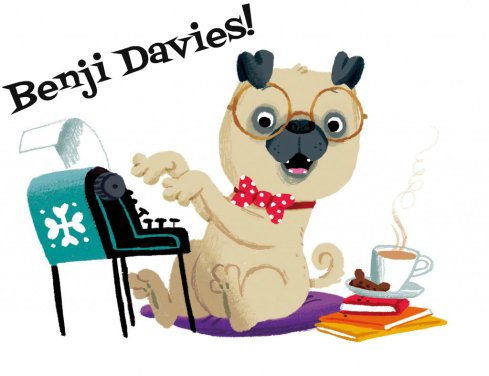
(No, that’s not Benji in the picture. Although I think that may be me on a non-showering day.)
Benji is the admirable gravy behind such books as WINSTON WAS WORRIED, DINO PARADE and HODGE THE HEDGEHOG (which I mistakenly thought was about John Hodgeman), plus the delightful interactive book app series from Nosy Crow, BIZZY BEAR.
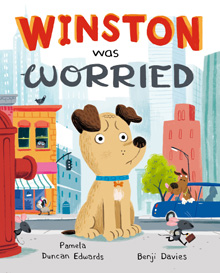
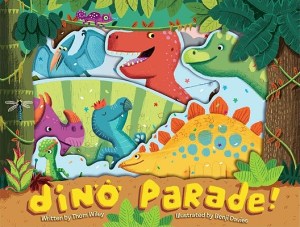


So can you tell I’m absolutely tickled to have him working on my book?
This is one of the most exciting parts of being a picture book author—finding out who your illustrator will be and falling in book love. (Not to be confused with marriage love, as I am already taken by a dashing computer geek. And yes, you can use the words “dashing” and “computer geek” in the same sentence. Although to the computer geek, it may have a programming connotation.)
So check out Benji’s work, congratulate him, and also give him fair warning that he’s working with an absolute nut. He may require counseling after the book launch.
After all, I called him “admirable gravy”!
UPDATE: 2/5/2013 #Bedtimepicks hasn’t caught on, so I’m changing the hashtag to #BedtimeReads, which is more appropriate and easily understandable. Please join in! Just Tweet the hashtag with the titles of the books you’re reading to your children each night.
For two years I’ve been Tweeting the hashtag #bedtimepicks to share the picture books I’m reading to my kids that night. For two years some folks have joined in, yet all have dropped out.
Then I realized: YOU HAVEN’T BLOGGED ABOUT THIS FOR TWO YEARS?
What is wrong with me? (Don’t answer that!)
So I now triumphantly propose we get moving with this hashtag! It’s a simple way to share and discover great picture books for parent-child bonding. (And if you read chapter books or middle grade novels to your kids, of course, those count, too!)
In the evening, tweet something like this:

 Then click on the hashtag to see what other parents and caregivers are reading.
VOILA!
TWO YEARS IN THE MAKING!
If you’re in, let me know in the comments. And please blog about it to spread the word.
Now quick, let’s all play catch-up!
“Don’t use art notes,” is what you may hear as a new writer.
It’s not that editors don’t like art notes. It’s just that many new writers want to dictate illustrations that do not require direction.
 For instance, you shouldn’t pick what your character looks like. Red hair, blue shirt, green sneakers, pigtails, etc. are not for you to decide. The editor of Mary Ann Hoberman’s THE SEVEN SILLY EATERS thought the characters should be animals, like crocodiles. Marla Frazee, the illustrator, thought they should be people, and she was right. She even made the mother a cello player, which was not in the text, but it added a delightful layer to the mother’s personality. The options were wide open—the author never described the characters’ appearance.
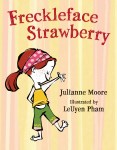 The exception to this rule is when your character’s appearance is crucial to the story, like FRECKLEFACE STRAWBERRY. Although the title pretty much says it all, right?
You must trust that your editor and illustrator have ideas for what your scenes should look like. Better ideas than you. Leave the art direction to them (and the art director). Writing that the house has a front porch, or that the cat is calico, or that the car is yellow is all unnecessary. Again, unless that car needs to be yellow for your story to work.
But you will no doubt read picture books with subversive text—where the character is doing completely opposite what the words say. Or books with text so spare, the action comes thru only in illustration. These are times when your text requires art notes. SCREAMS for them.

But if you have an art-heavy manuscript, where much of the story relies upon the illustrations, how do you submit it? Putting the art notes in [brackets and italics] is typically the way to go. However, too many art notes can interrupt the flow of the story. It gets difficult to read and comprehend.
So what do you do?
Maybe…submit your manuscript in grid format.
What?! But Tara, I’ve NEVER heard of this before.
I know, me neither. But my agent just submitted a manuscript like this. I was skeptical at first, but then I realized the grid was the best no-nonsense way to present the text with the illustrative mayhem. Yes, this book has MAYHEM. And FRACAS and PANDEMONIUM, too.
Here’s what the grid looks like in manuscript format:

The header includes your name, contact details and a word count.
Then the title (in caps) and your byline.
There is a general art note at top which introduces the story idea. Moreover, it states the art notes are “intended as a guideline.” Again, as an author, you cannot rule over all that is picture in picture books.
Next comes the grid. On the left is the story text, on the right appears “rough art direction.” Notice we said “rough” because they are only suggestions for the editor to understand the story. Remember that the illustrator may create something even better, funnier, more poignant. Remember the CELLO.
The grid continues for as long as it takes to tell your story. Typically one or two more manuscript pages.
Please note this isn’t a standard way to submit, it only serves as an example of what one author and her agent did. It’s like the photos on the front of frozen food boxes that say “serving suggestion”.

Now if you’ll excuse me, I suddenly became very hungry.
I know you’ll probably say, “Tara, you had me at Peter Brown…”, but you will no doubt flip at the entire spectacular line-up of authors, illustrators, editors and other kidlit professionals I’ve secured for this November’s Picture Book Idea Month, affectionately known as PiBoIdMo ’round these parts.
PiBoIdMo challenges picture book writers to create 30 new story ideas in 30 days. Read the full scoop here.
Plus, we have an adorable mascot this year: Doodle! She’s the doggie pal of artist-couple Peter Harren and Kayla Skogh (who are equally adorable), and she’ll be making several cameos throughout the month of November!

.
PiBoIdMo will kick-off on October 24th with registration plus a guest post from…
 …YOU?!
That’s right! One lucky former PiBoIdMo participant will win a guest blogging spot to write about how past events have inspired you, what you’ve done to gear up for the event, and how you sort through that fat file of ideas to pick ones to pursue.
To be eligible:
- Blog about PiBoIdMo and what it means to you.
- Link back to this blog post.
- Leave a comment on this blog post telling me you’ve done so.
- Complete all of the above by October 15th.
I will read all your entries and pick the blogger who most exemplifies the spirit of this annual event.
And now, without further ado, here are your PiBoIdMo guest bloggers!
Peter Brown
James Burks
Priscilla Burris
Dianne de Las Casas
Kelly DiPucchio
Amy Dixon
Kate Dopirak
Ame Dyckman
Donna W. Earhardt
Marcus Ewert
Deborah Freedman
Tiffany Strelitz Haber
Peter Harren
Charise Mericle Harper
Julie Hedlund
Leeza Hernandez
Carter Higgins
Ward Jenkins
Mike Jung
Ella Kennen
Diane Kredensor
Emma Ledbetter, Assistant Editor, Atheneum
Kelly Light
Deb Lund
Tracy Marchini
Wendy Martin
Diana Murray
Laura Murray
Debbie Ohi
Carol Rasco, CEO of RIF
Aaron Reynolds
Laura Sassi
Liz Garton Scanlon
Corey Rosen Schwartz
Kayla Skogh
Tammi Sauer
Mr. Schu, School Librarian & Kidlit Book Blogger
Melissa Sweet
Will Terry
Audrey Vernick
Robert Weinstock
Tamson Weston, Editor & Consultant
Timothy Young
 And while you’re waiting for registration to begin on October 24th, why not join our PiBoIdMo Facebook group? Connect with other participants and picture book professionals, chat about the event and other writerly topics.
Stay tuned for more PiBoIdMo announcements in the coming days!





 Writing for Kids (While Raising Them)