You are currently browsing the category archive for the ‘Picture Books’ category.
Graphic by Edna Cabcabin Moran
.
Yes, we’ve gotten to a fourth installment! Or maybe I can call this THE FOURTH STALL?
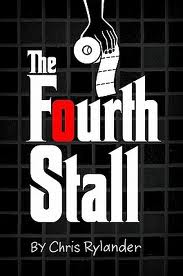
(P.S. I loved this book. It includes one of my favorite things to write—a secret place that adults don’t know about.)
So, there have been three previous Q&A’s…check them out here: Part I, Part II, Part III.
Without further ado…Part IV!
.
berylreichenberg asks:
If you already have several picture books published, what are the best blogs and other sites to use to get the word out and market your books?
So many kidlit authors tend to stick with promoting on writer blogs, which is certainly good, but we can be preaching to the same audience over and over again. I, myself, worry that people are gonna get sick of me.
Instead, look to librarian blogs, parenting blogs, teacher blogs, homeschool blogs, bookseller blogs and other “gatekeeper” sites that target those who buy children’s books.
Technorati.com is a good place to search for top blogs in various categories, like books, education and parenting.
Some blogs have review policies, so read them and reach out. I receive many unsolicited requests every month. I can’t accept them all, but I do what I can. Bloggers are always in search of good content, so you’ve got nothing to lose by asking for coverage. Make sure you appeal to that blog’s readership with your pitch. (I receive pitches that don’t come close to interesting my audience, which tells me the sender is doing a mass mailing rather than targeting me specifically.)
.
Pat Miller asks:
When you have a drawer full of PiBoIdMo drafts that just don’t seem to get off the ground, how do you maintain your motivation to dig back in and make one of them sing?
Another tough question!
I have barrels full of uncompleted manuscripts. Honestly, I tend to think that if I’m not “feeling” them, they’re not worth my time, at least not at the moment. I might feel them later, so that’s why nothing ever gets tossed.
Jerry Spinelli’s EGGS was in a drawer for 20 years when his wife Eileen made him pull it out. He reread the manuscript and felt re-energized. Neil Gaiman got the idea for THE GRAVEYARD BOOK 20 years before he actually wrote it. He wanted to wait to become a better writer because he knew the idea would be challenging to execute.
Other writers will argue that you cannot wait for the muse, you just have to keep pounding on the manuscript. I tend not to do that because I have enough ideas that do sing to me, in key and on beat.
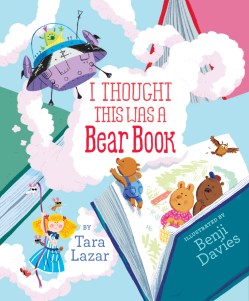
And hence we get to the reason why I do PiBoIdMo—the more ideas in your file, the more potential manuscripts you’ll have. You can ditch one idea and move onto another. In my experience, the best manuscripts have begun when I have stopped working on a manuscript that’s been giving me headaches. It’s like my brain has suddenly been freed from its chains. My upcoming title, I THOUGHT THIS WAS A BEAR BOOK, came about after I ditched a struggling manuscript. The words for BEAR just flew out, whereas I was laboring hard on the previous story and it just wasn’t working.
Sometimes changing the voice or POV in a manuscript is enough to get it revived.
A critique partner pow-wow can also provide a boost. Just sit around with some best buddies (and coffee and coffee cake) to discuss the challenges and concerns you have. Ask for suggestions and solutions. If you can’t do it in person, Google hangouts are fun, especially since you can stay in your jammies. I truly believe critique partners are not just for completed manuscripts, but those in progress, too.
When all else fails, go for a walk or take a shower. Research shows that “thinking on our feet” leads to creativity. And mundane, repetitive tasks give our minds freedom to wander.
.
Amymariesmith asks:
I’m going to my first SCBWI regional conference in June. Any tips on what to bring?
Have fun, Amy! You should bring:
- A list of your PB ideas. I think it’s great to get a professional’s opinion about whether your story ideas are marketable or if they’re too common and need work. You might have an opportunity to sit down with someone to discuss them.
- Your manuscripts. You never know when a critique opportunity will arise.
- A list of industry questions. I know I tend to forget everything once I arrive at a conference. If there’s something you want to know, write it down and keep it handy. There’s often panel discussions where you can pose your questions.
- A notebook and pen to take good notes. (Then when you go home, type up your notes. This will help them soak into your brain.)
- A camera. Take pics and share them.
- Your business cards. Even if you’re unpublished, you’re still officially a “writer”. You want to connect with professionals and potential critique partners. If you’re having meals there, hand them out to those sitting at your table. Everyone else will remember to hand them out, too!
Side note: sometimes at conferences I’ve seen unpublished writers carrying plush likenesses of characters they’ve created. This seems like a smart idea, to attract attention and questions about your work, but some professionals just think this is strange. Great writing is guaranteed to attract positive attention, not gimmicks.
.
Mrs. Ricefield asks:
I would also love to hear more on how to make the best out of conferences you attend. Thank you for the question.
See my suggestions above on what to bring. Also, make friends. See someone standing alone? They’re an introverted writer, but writers love to talk about writing, so go say hello. This is your opportunity to network and gain a support system. Have fun and be yourself.
Don’t go with too many expectations—it’s rare to get a book deal or an agent at a conference. (But be sure to follow-up if someone expresses interest. Things happen AFTER the event.)
Volunteering at a conference is also a great way to get one-on-one time with professionals and to be remembered. Why not volunteer to pick up agents and editors at the train station or airport? You’ll have time to chat and get to know them.
Ask editors about life outside the office. You’ll connect on a more personal level and you’ll be one of the few people who aren’t trying to squeeze a book deal out of them. Editors are people, too. They get tired of being pitched, poked and prodded.

Great friends at the NJ-SCBWI Annual Conference. Authors Ame Dyckman, Sudipta Bardhan-Quallen and Kami Kinard.
.
Angela Turner asks:
I am writing a nonfiction book in narrative form but I want to put notes on the same page that tell a little more with more specific language. What is the proper way to show this in your manuscript?
While I haven’t written this kind of book before, I suggest using a format similar to how we place art notes in a picture book manuscript. Use brackets to denote the sidebars. Like this: [Sidebar text:].
Maybe someone more experienced with these manuscripts can comment below.
.
Joy Moore asks:
How would you describe your writing style?
A quirky, punny word-a-palooza.
.
Brenda Harris asks:
If an author-illustrator is self-publishing, who are the most important people (editors, art directors, etc) I should ask advice(hire?) from about my dummy book. And- where can I search and find these legit helpers?
There are independent editors with decades of publishing experience whom you could try. Just a few:
Read through each consultant’s site to determine the best fit for your writing style.
Also, be aware of current publishing scams and hustles. There are those who prey on writers with dreams of publication. Check out Preditors & Editors.
Before you begin, you should know the distinction between true self-publishing and publishing via a vanity press. Read this blog post.
.
Thiskidreviewsbooks asks:
I’d really like to know what your best time to write is (and the importance of having a set time to write).
Erik, I don’t have a set time to write. I have found that routine tends to stifle my creativity. I know some writers insist upon writing the same time every day, in the same place, with the same materials, claiming that routine means they write whether or not they’re in the mood. And I suppose that does work nicely for a lot of writers. It doesn’t work nicely for me.
I’ve never been a routine person. Something about my personality always eschews routine. I cannot remember to take a daily vitamin. I don’t wake up the same time every day nor go to sleep at a set hour. I have a tough time eating leftovers.
I like changing things up. Sometimes I write in the morning, sometimes late at night. Different times of day can lend varying moods to my writing. Same as with different places—sometimes I write in bed, sometimes in the kitchen. Occasionally I work on my back deck, at the park or at the library.
And I don’t write every day. That may have to change when I start writing novels and I’ll need to get more words down, but for now, I take writing breaks. Two days on, one day off. Three days on, three days off. One day on, four days off. (GASP!) Again, I change it up a lot. And sometimes these breaks are dictated by family or other obligations.
With this non-routine routine, I’ve had no shortage of creativity, no writer’s block. I’ve got four manuscripts under submission right now and four under construction.
The bottom line is that there’s no “right” thing that works for everyone. It’s totally up to you to find your creative groove. Don’t take anyone else’s advice unless it resonates with you.
.
Charlotte asks:
Why does it seem that there are so many women writing for children, attending SCBWI conferences, posting here, etc., and yet by comparison there seem to be so many successful children’s books by men? Ya know what I mean? Certainly there are tons of successful children’s books by women, but the rations have me baffled. At the last SCBWI conference I attended, women outnumbered men 98-2. Even if there are more children’s books by women authors, the ratio is not 98-2, not even close. So what’s going on? Do men feel more free to write wackier stories? Do women censor their own out-of-the-box impulses? Do editors and agents subconsciously give men more leeway to push the boundaries/break the rules? Do women tend to write more lesson-y stories? Are there just as many men writing and they just don’t show up at conferences? Whaddaya think?

Charlotte, you may want to check out the VIDA Count. VIDA has found a distinct imbalance between the amount of literature by women that’s published and awarded versus that of men. See these articles:
From VIDA’s FAQ:
But don’t women read more? Don’t they buy more books? Don’t they edit these journals [and books] and read slush? And therefore—isn’t this largely the fault of women, as well?
First: sexism pervades our culture, and so it is often unconsciously absorbed/internalized by everyone, including women. Feminism is an act, not a bumper sticker. It requires the constant re-evaluation of one’s assumptions, habits, and biases. By being a part of the system, women are often a part of the problem.
Further, as Sarah Seltzer points out,
“In my experience, the reality may even be worse than the numbers. Women who are allowed to be prominent — and this is not to erase those who do it on their own merit, because their numbers are growing — often don’t challenge the worldview of those who hire them. In fact, given all the anti-feminists like Caitlin Flanagan, Katie Roiphe and Christina Hoff Summers taking prime media real estate, it would seem that for women, reinforcing sexism is a good formula for vaulting ahead.”
~ Sarah Seltzer, Jewish Daily Forward, March 2012, “Byline Bias – and What We Can Do About It.”
.
Stacy Couch asks:
I was wondering about the different stages of birthing a PB. PiBoIdMo does a great job re: brainstorming. Maybe posts about craft would help bring those ideas to life.
- Character-driven picture books: What they are, what makes a character sing.
- Plot: How to plot a PB.
- Plot: Why stakes matter.
- Rule of Three
- Plot and the Rule of Three.
- Different Genres within the PB World (Quiet, Noisy, Character-Driven, Interactive, Etc.)
- External vs. Internal Conflict
- Allowing Room for the Illustrator
Then perhaps a series about critique groups (how to find them, how to set up one), conferences (purpost, intensives, tips) and another querying agents, editors (the importance of etiquette, researching them beforehand).
I’d love to see more craft-related posts, though, since any agent or editor would focus on the work itself.
Great suggestions, Stacy! I’ve covered some of these topics already. Check out:
- The Rule of Threes in Picture Books
- The Rule of Threes for Picture Book Writers (with video evidence)
- Every Day I’m Structurin’ (by Tammi Sauer)
I’ll cover all your suggestions in craft posts soon. Thanks for the input!
.
In closing, thanks to everyone who submitted a question. This was a fun series and I hope to make it a recurring blog feature!
Graphic by Edna Cabcabin Moran
In case you missed it:
Grab your PiBoIdMo mugga joe and let’s get to it, shall we?

mvanhierden asks:
When submitting query letters for picture books, is it standard practice to include a manuscript?
Always follow an individual’s submission guidelines. Some agents/editors don’t ask for a query first because a picture book is a short read. They’ll ask for a cover letter and the manuscript instead. And even though some want the full manuscript, they’ll still ask for a query letter with it. Why? They want to hear how you SELL the story.
Not sure what goes into a query letter? See yesterday’s post.
But everyone is different; pay attention to their guidelines. Guidelines are in place to help an agent/editor work most efficiently, according to their preferences. Therefore, not following guidelines is subject to an immediate, automatic rejection. They just can’t afford the time to read submissions that don’t follow directions.
.
 Anne Bromley asks:
I heard recently that one needs at least 3 polished, ready-to-submit picture book stories in order for an agent to take serious interest. Has this been your experience as well?
Yes, this is what I recommend—have at least 3 to 5 picture book manuscripts polished and ready for submission.
An agent will rarely take a writer based upon one picture book manuscript alone. Yes, it happens, but your odds are so much better if you have several ready. Why? If the agent likes your work, they will almost always ask for MORE WORK. An agent wants to ensure that they are a good fit for you, so they want to connect with a body of work, not just one piece. If they like your submission and want to see more but you don’t have anything else, you’ve wasted an opportunity.
More books ready means more books to sell, which is preferable for the agent. If they can’t sell one manuscript, they have another to sub immediately.
But what about an editor? The same holds true. They could like your manuscript but not have the ability to publish it for whatever reason. They may ask for something else. You want to have that something else ready!
And honestly, you become a better writer with each manuscript you complete. So although you might have one ready to submit, wait until you have more because the next manuscript might be the better sell.
.
Patricia Tilton asks:
When do you set aside a MS after many rejections, even though it’s polished, been through editors and you’ve done the revisions and more revisions? Or do you just keep submitting?
Tough question, Patricia! I feel like this is dictated by a gut feeling more than anything else.
I have an agent, so my rejections always include a reason. If I receive compliments and suggestions, then the manuscript is on the right track and we keep submitting. If I receive a lot of similar suggestions for improvement, I take it back and revise.
For those without an agent, if you receive only form rejections without any personal rejections, it’s a signal that perhaps the manuscript needs more work.
It’s not uncommon to hear of manuscripts rejected 20 or more times, so sometimes it’s about just connecting with the right editor at the right time.
If you’ve submitted widely without a bite, I’d recommend putting the manuscript aside and coming back in a few months to see if you can make improvements. Then try another round. Again, some rejections are about timing rather than quality, so a new round of submissions can yield new results.
.
Carrie Brown asks:
We know, as writers, to revise until our very best work is present. Then, we know to send it out to our critique groups and revise some more. Repeat. Repeat again. Etc. Once our work is “the best it can be,” do you think there is a secret numbers formula as to how many subs a manuscript should go through before being shelved? What if, for example, a manuscript goes through a period of requests mixed with personal feedback from agents, and then said changes are made and it goes back out to be met with chirping crickets? Then what? Just like everything in the writing world, I know these questions will be met with subjectivity, as well. But this inquiring mind values your opinion!
Yes, as you’ll see by my answer above, it really is subjective, a gut feeling. I’ve known writers who have submitted 27 times with rejections and the 28th time was the charm. I’ve known writers who have revised a manuscript on and off for nearly 10 years before it was bought.
I suppose my suggestion is to keep plugging away as long as you feel passion and confidence in your work. Again, sometimes it’s about timing more than anything else.
Let’s go to the scenario you proposed—if you’ve made changes that were requested but have only heard crickets in response, I would probably go back to the previous version. When you revise based upon suggestions from one individual, it’s purely being done to meet their specific taste. And if they don’t like it after the changes have been made, it probably wasn’t the right move.
.
Jo Dearden asks:
In your query letter, when it comes to describing your Picture Book, should you include a short paragraph in the style of a jacket blurb, or should it be a straighter description (like a mini, paragraph-long synopsis)? This is assuming you’re sending the whole text to the agent/publisher.
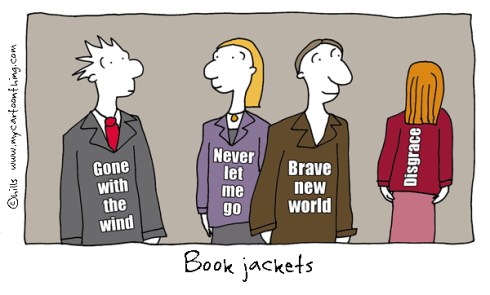
Yes! It’s an excellent idea to write your synopsis in the style of jacket flap material. This kind of paragraph whets the appetite and makes the reader want to dive in. Pick up a bunch of picture books at your library and study the book jackets. Try to emulate them.
Guess what? There’s one final installment coming tomorrow!
And remember, follow-up questions are welcomed.
Graphic by Edna Cabcabin Moran
Jennifer Kirkeby asks:
What do you do to keep yourself motivated? Especially after rejections?
You know how “location, location, location” is real estate’s most important criteria? Well, “new work, new work, new work” is how I keep myself motivated. A new story is always so exciting, isn’t it?

I’ve seen writers try to sell the same manuscript year after year. On one hand, it’s good to be persistent, but on the other hand, you should know when it’s time to move on. Once you’ve finished a manuscript and started submitting, work on something new. Always have your list of ideas ready. Review them. Grab onto whatever resonates and start writing. An editor might not like what you’ve just submitted, but they might like your NEXT project. The more projects you have, the better your odds of becoming published.
Don’t let rejections get you down. Everyone gets them. It’s the nature of our business. I’ve gotten so many now that they’ve lost their sting. I read the rejection, absorb the comments, decide if I agree or disagree, and move on.
Not every manuscript is for every editor—and a rejection doesn’t mean your story’s terrible and it will never find a home. Editors can reject a manuscript because it competes too closely with one of their existing or upcoming books, or because it doesn’t fit with their imprint’s personality and goals. An editor with a bug phobia may stay away from beetle books. An editor might even love your story, but their team isn’t as enthused.
Remember a rejection is not a personal attack. They are rejecting the work you submitted, NOT YOU. YOU are marvelous. YOU are creative. YOU just need to write another story.
.
Yangmommy asks:
Hi! I thoroughly enjoyed your presentation at the MD/DE SCBWI in Maryland last month. It was the highlight of my day (and I still find myself saying, “whhyyy?”)! But I left wondering more about how and when to insert the art notes. In the margins? Within the text (but doesn’t that break up the flow?)? Do you have an example you can showcase on your blog?
An art note can be written in the body of your text, right after the words the art will accompany. I typically put the art note in brackets and italicize the text, like this: [Art: bear tickles alien.]
I’ve also written manuscripts with so many necessary art notes that my agent has submitted them in graph format. This is because the art notes broke up the flow of the story too much, making it difficult to read. The graph format allows an editor to scan through the story easily while still being able to comprehend the illustrations. I explained this in a post here.
.
Tim asks:
I attended a picture book writing conference recently, and the presenter asked for a show of hands of all those who at least occasionally wrote manuscript in rhyme. Nearly every hand in the room went up. And many new rhyming picture books are published each year. Yet aspiring PB writers are told frequently that rhyme is a very tough sell. So I’d love to see a post or two on how to sell rhyming PBs. Not tips on how to write in rhyme–there are lots of resources for that–but on how to SELL it, including the no-nos either in queries or in manuscripts that will stop an editor or agent cold.
Tim, there are no tricks to selling a rhyming manuscript other than making that rhyming manuscript GREAT. (There’s nothing you can say or do to sell a sub-par manuscript.)
Editors see a lot of bad rhyme, which is why they often tell new writers to avoid it. Rhyming manuscripts that don’t sell:
- use common and predictable rhymes,
- feature wonky meter,
- veer off in an unbelievable direction to meet the rhyme scheme,
- use awkward sentence structure to make a rhyme work,
- feature too many near-rhymes, or
- explore an overdone theme.

What’s a GREAT rhyming story? A manuscript whose rhyme scheme is original and whose meter is consistent. A manuscript that features an appealing, marketable hook.
For a picture book, some agents and editors zip right past the cover letter to get to the meat of the manuscript, so I don’t think anything is going stop them cold, unless you’re wildly unprofessional and stuff your envelope full of glitter.
Your query/cover should:
- address the agent/editor by name,
- explain why you are submitting/targeting that editor/agent/imprint,
- compare/contrast your book to existing titles,
- include a brief synopsis,
- offer a short bio (only with information relevant to writing for children), and
- have a polite closing.
It should be one page only.
The manuscript should be double-spaced in a 12 pt serif font, like Times New Roman.
Again, don’t use gimmicks. Good writing and a professional presentation are all you need to attract an agent/editor’s attention.
.
Ginger asks:
What does a picture book look like in written form and do you add picture ideas?
I mentioned the standard format above. Here’s a pic of what the first page of a PB manuscript might look like:
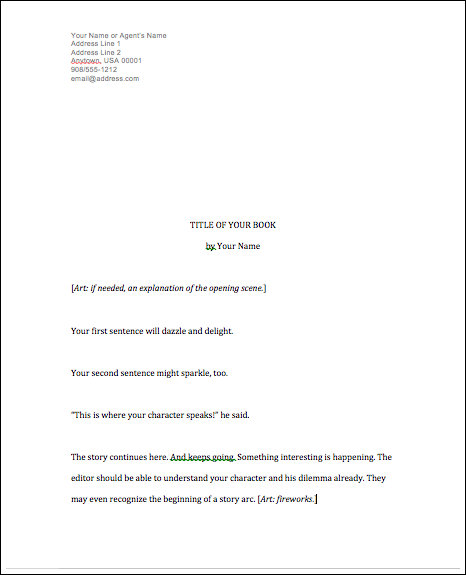
The second and each subsequent page header will include “Name/TITLE” on the left and numerical page number on the right.
Regarding art notes, that really requires its own post! See these previous posts:
The bottom line is that you only include art notes if it’s not clear what’s happening from the text alone. For instance, if your text says “Felix was happy” but he’s really upset, you need an art note so the illustrator doesn’t make him smile.
Write something like: “Felix was happy. [Art: Felix isn’t happy.]” You should not write “Felix was happy. [Art: Felix is stomping his feet, wearing red, waving his arms and sticking his tongue out.]” That’s far too specific and doesn’t leave the illustrator room to interpret Felix and his feelings.
.
You asked for it, you got it, Toyota.
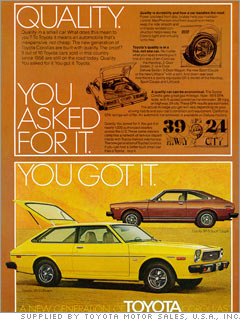
Sorry, no car giveaway here. Not sure you’d want a ’77 yellow hatchback anyway.
What you’ve got are your burning kidlit questions with my answers. Please remember that these are my opinions and not necessarily gospel. (I can’t sing, anyway. Except, apparently, for 70’s car commercial jingles.)
If you have follow-up questions, please leave them in the comments!
Graphic by Edna Cabcabin Moran
Writenit asks:
Is there a better place than Amazon to search to see if the fabulous (at least in my head LOL) idea you came up with has already been done a million times?
Besides Amazon, try searching WorldCat.org, the world’s largest database of library holdings. A simple Google search is also a good idea. Try the various types of Google searches, including images and news.
But just remember, even if your title is taken or your idea has been published, there might be room for your manuscript, too. General ideas can be similar, but the execution can result in wildly differing stories. Of course, if there’s an extremely popular book with your idea, odds are that a publisher won’t take a chance on a directly competing book. In other words, if your dragons love tacos or your crayons are going on strike, you probably want to look elsewhere for ideas.
.
Patricianesbitt asks:
Do you have any inside tips as to what themes or topics publishers are looking for?
This information is always changing. Right now, I hear that character-driven picture books are all the rage.
“Looking for” details can often be found at SCBWI conferences and on blogs when a particular agent or editor has been interviewed. You might want to search for conference bios, where professionals often divulge their wish lists.
You’ll also want to visit the bookstore at least once or twice a month. See what’s being displayed face-out (publishers have paid for this promotional opportunity). Are there are a lot of books on one particular subject, like trucks? Well then, the truck ship has probably sailed. (Whoa, that was a mixed metaphor, huh?) Once you see an abundance of one kind of book in the stores, the end of that craze is probably upon us. Remember pirate books during the Johnny Depp “Pirates of the Caribbean” movies? I went to a conference around that time and the editors practically screamed, “No more pirate books!” Sometimes they know more about what they DON’T want than what they DO.
Bottom line: everyone wants a good story. You don’t have to write to the marketplace’s demands. In fact, I suggest that you don’t. Whatever idea stirs up the most passion in you is the manuscript you should be writing. Your enthusiasm will be evident on the page—and that is always appealing.
And always remember Karma Wilson’s example. McElderry’s sub guidelines said “no rhyme and no talking animals” when she sent them BEAR SNORES ON, which turned out to be a huge hit, launching her successful career. It was a great manuscript, so the DON’T guidelines became moot.

.
Maria Matthews asks:
Is it better to aim at writing a current popular topic or to write a quirky unusual book?
As I noted above, “currently popular” isn’t your best bet, simply because the books released today got purchased as manuscripts two to four years ago, on average. So you can’t necessarily catch up to what’s hot. And what’s hot is always changing. You never know what the next “big thing” will be.
That’s why I suggest writing from your heart. If quirky and unusual is what you enjoy, then by all means, write quirky and unusual!
.
Josh Funk asks:
How do you get awesome illustrators to do “head shots” for you? (like AJ Smith did in your previous post)
When I first began my blog seven years ago, I paid illustrators to do graphics for my site, like this watermelon-themed banner by the talented Val Webb.
Now that my blog has become well-read, I often ask on Facebook or Twitter for a particular graphic and someone volunteers their services, in exchange for a mention and link. I’m usually blown away by the response, and so grateful!
.
Jdewdropsofink asks:
So after reading your previous post, I want to know the super secret story techniques you learned from Sudipta?
I’ve learned a ton from Sudipta. If ever you get a chance to hear her speak or teach a class, grab the opportunity. I’m going to send you to her very pink site instead of spilling her secrets here…
.
Nicole Snitselaar asks:
I would like to know, how much details you must write down when you are planning a PB without words…?
Only as much detail as you need to get the idea across. Be as succinct in your word choices as you are while writing a regular picture book. Paint the overall picture but don’t go into minutiae. You still must leave some things for the illustrator to fill in.
Author Linda Ashman has posted her manuscript for NO DOGS ALLOWED, which is nearly wordless. Check it out here. It’s an excellent example.
.
Tune in for Part II tomorrow, kidlit fans!
On the Facebook PiBoIdMo group, I’ve been asking picture book writers which topics they want to see on my blog. Then it finally dawned on me (and Dawn is my middle name, so this should have occurred far sooner)—I should ask on the blog. DUH.
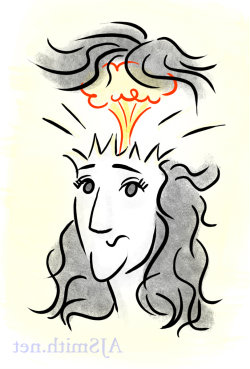
Tara-ra-BOOM-dee-ay by AJ Smith
See that? It’s my head exploding from the geniusity. (Yes, I made that word up. I’m allowed. I write picture books!)
So here I am, asking you, dear blog readers, what is your most burning, brain-blasting kidlit question?
Leave it below in the comments and later this month, I’ll strive to answer them all.
But just remember, you’ll be getting an answer from someone with half a head.
Today there’s not one guest post, but TWO. On the radio, this would be called a TWO-FER TUESDAY. But it’s Thursday. Yeah, this is why I’m not on the radio.

My Favorite Parts of Writing for Kids by Sudipta Bardhan-Quallen
So far, 2014 has been a really big year for me. I’ve had four picture books come out in the first four months of the year—DUCK DUCK MOOSE, ORANGUTANGLED, TYRANNOSAURUS WRECKS, and SNORING BEAUTY. I’ve had books selected for the Junior Library Guild, chosen as Amazon Big Spring Picks, and reviewed in the Wall Street Journal. I also joined the faculty of the Children’s Book Academy and began teaching writing.
Almost 12 years ago, I made the decision to leave graduate school in biology and begin writing books for children. In that time, there have been many highs and lows, though right now is certainly one of those highs. In light of the good fortune I’m experiencing right now, I wanted to share my three favorite parts of being a children’s author.
- Nobody tells me what to write about.
Every project I take up, I do so because it is something that interests me. I get to decide what to write about, and if that means spending one day on a concept book about the bond between a mother and a son, the next day on a picture book biography of Jackie Robinson, and the next on a story of some ducks whose best friend always MOOSES everything up, I can certainly do so (and I have!). It is a wonderful thing to have complete control over what I have to work on. - I can work barefoot in my bed in my pajamas.
In the spirit of no one telling me what to do, I don’t even have a boss who makes me get dressed before I go to work! Some of my finest writing has come out of the left side of my bed, under the covers with my feet poking out. - I get to create something out of nothing.
This one’s the key. In so many jobs, people follow instructions, push paper from one end of their desk to the other, execute against a task list. I’m not knocking those jobs at all—without them, our world doesn’t work. I’m just saying that it’s very rare to be able to start with nothing—just me and my imagination (and my laptop!)—and end up with something that is real and good, that didn’t exist before, that is entirely the product of my willing it into existence. Artists are driven to create. To be able to follow that imperative and still be able to support my family—well, that’s what I’m most grateful for. That’s my favorite part.
Happy Writing!
.

My Favorite Parts of Teaching and Agenting by Mira Reisberg
That part is easy–helping!! This helping boils down to helping make dreams come true, helping people improve their skills, helping to create a more level playing field with Children’s Book Academy scholarships, helping get great books and art out into the world created by great people, and finally helping bring more happiness and joy in the world (oh and having fun playing with people, words, and images).
Being a creative is hard. We live in a culture that generally undervalues and underpays us though this seems to be shifting a bit with new technologies where there is more of an emphasis on storytelling and image-driven messages.
But the payoff, and it’s big, even if it does take a long time for the money to come, is having a meaningful, heart-filled, and very fun life. I was talking with another agent this morning where we were helping each other out and it was just so lovely. That’s what we do in community-oriented organizations like PiBoIdMo, Rate Your Story, the Society of Children’s Book Writers and Illustrators, and the Children’s Book Academy, and this is another thing that I love about what I do.
In the old days, being a writer or illustrator meant slaving away in isolation. Now we have all these fantastic resources that not only help us with our craft, but also with our hearts providing support, resources, companionship, and practical assistance. So if you are feeling isolated or stuck, just reach out and ask for help. How amazing that we can do this. I certainly couldn’t be doing what I do at any other time in history. In some ways I love what I do a little too much and having a slightly addictive personality, tend to do too much. But this is a small price for all the joy and happiness that I get from being creative and helping others. So I guess this is another thing that I love about what I do, getting to live a wildly creative life and do good at the same time.
.
Tara’s Favorite Part of This TWO-FER
Years ago, I attended NJ-SCBWI events to learn about the business and craft of writing for kids. That’s where I met Sudipta. She has taught numerous picture book courses. She’s the most savvy and knowledgable instructor I know. She has taught me story techniques that no one else has ever divulged!
And now everyone has the chance to gain writerly wisdom from Sudipta. Along with Mira, she’s teaching the outrageously interactive online course: “From Storyteller to Exquisite Writer: The Pleasures and Craft of Poetic Techniques” starting May 19th. Mira and Suipta have nicknamed this course “The Missing Link” because it really is what most writers are missing in foundational knowledge. CLICK HERE for details and top secret discounts. This is the only time that Sudipta and Mira will be co-teaching this course together with the wonderful Mandy Yates assisting.
Thanks, Sudipta & Mira!
So now it’s your turn. What are your favorite parts of what you do?
Happy Mother’s Day to my mama-writer friends. What you do every day is amazing! You created kids…and now you create stories!
And what I just did is amazing, too. I gave birth to a new book cover!
(Well, really, Benji Davies did.)
I THOUGHT THIS WAS A BEAR BOOK releases in August 2015 from Aladdin/Simon & Schuster. But you can catch a glimpse of the alien-bear mayhem right here, right now:

Many thanks to my very cool editor, Alyson Heller, and art director, Karin Paprocki, at Aladdin. And of course, none of this would be possible without über-agent Ammi-Joan Paquette.
More sneak peeks to come soon. I promise you a cute bear tushy.
Have a great day, Mama Bears!
You may be wondering–what ever happened to Tara? It’s been almost a month since she blogged. (Or you may not. You may be relieved your inbox has been devoid of my blivel. I made that word up, in case you’re wondering. A portmanteau of blog and drivel.)
Well, I’ve been traveling! I’ve actually changed out of my pajamas several times in the last few weeks!

Not so pristine whiteboard.
At the end of March I drove down to MD/DE/WV SCBWI’s Annual Conference to present my workshop “From Concept to Dummy for Picture Book Writers”. About 70 writers attended–it was a full house in our little room. The attendees got a taste of my imbalance. Yes, my mental imbalance, but also my MS imbalance. Luckily I didn’t topple the whiteboard. I did, however, have one sinking moment when I thought I used a permanent Sharpie on the pristine white surface. It reminded me of NJ-SCBWI 2008 when I volunteered to hang signs on the aging plaster of the Princeton Theological Seminary, only to take chunks of wall with me when I removed the signs. Be forewarned, I cause mayhem and destruction at SCBWI events.
I think many will agree that the best part of the workshop was when we read the beginnings of successful picture books to discern the WHO, WHAT, WHERE, and WHEN in each opening line. Incorporating these details makes your reader ask WHY and eagerly turn the page to find out.
Many new writers mistakenly begin stories with, “My name is Jamie and I’m six years old.” This tells a reader nothing about the story to come. And more importantly, an editor who reads this plain first line will most likely stop there. YIKES. Not what you want. You have to break out of that slush pile with a line that captures the editor immediately.
After reading a dozen picture book openings, with me screaming WHY? WHHHHHYYYYY? and bending over in feigned painful anticipation, shaking my fists at the sky, I challenged the participants to rewrite their opening lines. Everyone was quite thrilled to get their own Tara WHHHHHYYYYY? in response to their improved introductions.
Writer Sarah Maynard summarized my workshop with bullet points, to which I’ve added my thoughts from the event:
- You have 30 seconds to grab their attention. MAKE IT GOOD!
Like a resume to obtain a job, you have limited time to make an impression with an agent or editor. They can have hundreds of manuscripts to read each week, so they give each one only a few moments to grab them. Punch that opening, make them want to continue reading.
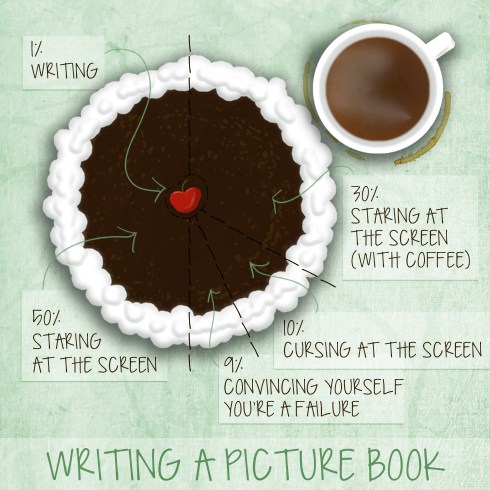
- “Writing a picture book is 99% staring and 1% writing.”
There is A LOT of thinking involved in writing a picture book. Don’t worry if you’re not actually putting words on paper every day. Think about how to resolve problems in your story. Stare at your manuscript. Your subconscious will most likely be working on a solution and it will pop out while you’re doing mundane chores, like emptying the dishwasher, folding laundry, or taking a shower.
- Learn who YOU are as a WRITER.
A lot of authors, including me, espouse advice that may not work for you. Discover how YOU work best and stick with it. For instance, routine doesn’t jive with me, although it works for a lot of other people. I used to force myself into routine only to get frustrated, losing my creative mojo. Only you know how to thrive in your creative mode. It’s very personal. Don’t take advice that doesn’t serve you well. (It may be useful to note here that I’ve shunned routine my entire life.) - If it’s not apparent by words you’ve written, add an art note.
One attendee told me I was the first person to speak positively about art notes. Yeah, I think they get a bad rap. They’re absolutely ESSENTIAL to use if it’s not apparent what’s happening by your words alone. If the text says your character is smiling but you actually want them to frown, you need an art note to convey that. Of course, you should not use them to direct the entire shabang, but to ensure there are no misunderstandings. Which brings me to the last point…
- Don’t make an agent or editor guess!
I find that some new writers like to surprise the reader on the second or third page of a manuscript. This means the beginning is not entirely clear and the reader must guess what is happening. Well, what if your reader guesses wrong? Then they become hopelessly confused at the reveal and probably discard your manuscript. You don’t want an agent or editor to have to guess what is happening in your tale. Make it CRYSTAL either by the text or the addition of art notes. It can be as simple as “[art: the character is a bear]” to make everyone understand.
I thoroughly enjoyed my time in Maryland—the hospitality of the chapter went above and beyond. We had a lovely faculty dinner at the Craftsman-style log cabin home of former RA Edie Hemingway. Is there anything more writerly than that (I mean, c’mon, HEMINGWAY)? Edie has a charming home with a writing hut tucked into the woods.

Far better than my writing space—my unmade bed!

As I crawl back into my pajamas, I’ll be getting another blog post ready. This time, about my trip to Reading is Fundamental and the donation that my publisher and PiBoIdMo participants made possible, enriching the lives of children with BOOKS!
WRITE ON!
 by
by As an author, I look forward to my next book release the way parents look forward to the birth of their child. After all, the release date is a birthday of sorts—the day my creation is real to everyone, not just me! If you’ve ever known someone expecting twins, the excitement is even higher—though, the fear associated with the event is also heightened.
This year, I’m having the publishing equivalent of quadruplets:
- DUCK, DUCK, MOOSE in January,
- ORANGUTANGLED in February.
- SNORING BEAUTY in March.
- Then, TYRANNOSAURUS WRECKS in April!

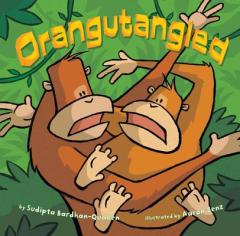

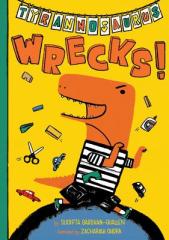
Like I said, I’ve got 99 problems, but a book ain’t one.
I get it. To have her problems, you might be thinking. After all, too many things publishing is a far better problem than too few. Or none at all. But there are problems created by my multiple birthing. Here are a few things you might not consider when praying for a year like this:
- The whirlwind of marketing becomes a tornado.
Since January, I’ve done three blog giveaways (the first was a DUCK, DUCK, MOOSE package of a book, a book, and a package of magic erasers, the second was a piece of Aaron Zenz’s original art, and the third is the autographed book we will give away here on this blog) with a fourth one coming up. I’ve done 42 Skype classroom visits—not including the 14 I have scheduled for the TYRANNOSAURUS WRECKS launch. I’ve flown to a conference in California and done a bunch of signings. I’ve revamped my website, I’ve had educator guides created, I’ve read the books so many times I have them memorized. And on the 7th day I rested…except, not really. Remember, all these marketing things are in addition to my regular job of writing, revising, preparing workshops, creating professional development. Oh, and raising all my kids.  Too much of anything is good for nothing.
As much as we want to see our books in print, publishing is about more than just personal accomplishment—t’s about sales. While my ego might be excited by multiple books out at the same time, the market is another story. Have you ever heard of market saturation? Economic theory says in a given market, only so much growth can be supported. For authors, that means there are only so many new books a consumer will buy at a given time. Having too many books at once can actually reduce the probability that a fan will buy all of them, just because he may not want to buy more than a certain number of books within a short time period. This principle also extends to recognition. It’s highly unlikely that you’d have multiple books nominated for a given award in the same year. So you’ve increased your overcall competition by competing with yourself.- The “what have you done for me lately?” problem.
Let’s face it—people are basically raccoons, distracted by whatever is new and shiny. And if you have a bunch of books come out at once, chances are, that will be followed by a long gap until your next release. But a book only keeps it’s “new car smell” for a finite amount of time. When something else new and shiny comes along, you won’t be able to compete and the raccoons will move on.
So, who still wants to have lots of books published at once? And who doesn’t?
Well, let me tell you a secret—it’s not up to you.
For the most part, publishers work on their schedule. And their concerns aren’t your concerns. So books may come out slowly at regular intervals, or they might appear all at once. As authors, we don’t have much say in this.
So how do you deal with this? How can you turn all these negatives into something positive for you?
I’ve given you the problems, so let me propose some solutions:
- Find your overarching narrative.
Whenever I have a book release, I take the details of its inspiration and craft a storyline that matches to a theme. For example, every night at bedtime in my house, my kids go nuts. My son, especially, when he was younger, he refused to sleep—no naps, no bedtime, no nothing. He was absolutely convinced I was going to do something awesome. This became the backstory for CHICKS RUN WILD, and I’ve introduced the book to hundreds if not thousands of readers by telling this story. With each of your books, you should be creating a narrative as well—but when you have multiple books at once, think of an umbrella narrative that talks about all the books. For example, DUCK, DUCK, MOOSE and ORANGUTANGLED are both about having bad days (though they resolve that issue differently). When I talk about them together, I tell my audience about taking bad days, mistakes, blunders and turning them into inspiration. They’re also both about friendship, and the different ways your friends can help you get through a rough patch. When you have one narrative, that message starts to represent you as a brand instead of the individual products/books. And at the end of the day, you want fans of your brand, not just your book. - Coordinate efforts.
When you start marketing one book, leave yourself openings to market the others. For example, when I was booking release day virtual visits for SNORING BEAUTY and I had too many requests, I offered the folks I couldn’t schedule in March a spot on the TYRANNOSAURUS WRECKS release day. So instead of having to start from scratch for the next release, I’ve got some legwork done already.
 Use this principle in your marketing materials, too. Having bookmarks printed? Think about designing something that works for all your new releases. Making postcards? Create a “New for 2014” card instead of individual designs.
Just breathe. As I said before, in the grand scheme of things, having too many things published at once is the better dilemma to have. Because if you’ve got to have 99 problems, at least a book ain’t one.
.
Thank you, Sudipta! This is all good to know since I will be having two books released in 2015! Yikes! TWINS! Somebody boil some water!
Do you have any questions or comments for Sudipta? Leave a comment below and you’ll be entered to win a signed copy of one of her 2014 books, YOUR CHOICE! (And a tough choice it is!)
Also be sure to visit Sudipta’s awesomely nerdy blog, Nerdy Chicks Rule.
Today we’re lucky to have Peggy Robbins Janousky visiting to share highlights from SCBWI FL’s Picture Book Intensive. Take it away, Peggy!
 I have attended many picture book intensives over the years, but this one topped them all. Participants were treated to an all-star panel that included: agent Deborah Warren of East West Literary, editor Laura Whitaker of Bloomsbury, author and editor Andrea Davis Pinkney and author Toni Buzzeo.
The presentations were practical, but powerful:
- Always bring your “A” game.
- Rhyme is not taboo, but bad rhyme is.
- Picture books are getting shorter and are being targeted for younger audiences.
- Show, don’t tell.
- Hook me and keep me hooked.
- Be passionate about your book and be able to pitch in just a few sentences.
One of the best things that was presented was the HOT list. These are the topics that editors and Barnes and Noble want now:
- Moments of the day
- School stories
- Learning concepts
- Holidays (MLK, Valentine’s Day, 4th of July, St. Patrick’s Day)
- Friends and family
- Biographies
- Character-driven stories
- Original stories that every kid will love
- Interactive picture books
- Finding the new in the old
If you haven’t taken an intensive before, I strongly urge you to consider it. Intensives are exactly that, intense. They give you the opportunity to delve in deeper and they also give you the opportunity to get to know the presenters on a more intimate level. I came away from this intensive with a new sense of purpose and drive. I also came away with a few good friends. All in all, it was money worth spending.
I have to admit, I almost did not attend the Miami conference. I was having a pity party and I wasn’t really up for the company. I had broken my leg in three places. Needless to say, getting around was a wee bit difficult. I was ready to bail. I am glad I didn’t. The first page of my manuscript was read during “first page reads”. Much to my surprise, the panel loved it. One editor wanted to know who wrote it, an agent wanted to read more, and another editor wanted to acquire it. I have to admit, I was in shock. By the end of the weekend, thanks to the help of a good friend, I had signed with that agent. Just one month later… My bio and picture are up on the East West Literary website. The editor that I mentioned is considering three of my manuscripts. And I am still pinching myself.
I will tell you that this was not an overnight success. I have attended many conferences and taken copious notes. I have revised, cut, and revised some more. I have also had moments where I was so rejected that I thought I would never put myself through another critique again. So what’s the moral of the story? Never give up. Never let pity or self-doubt get the upper hand. Believe with all your heart that your day will come. Then get off your butt and get to that conference. Your happily ever after is waiting for you to show up!
Peggy Robbins Janousky uses her offbeat sense of humor to write offbeat picture books. When she is not writing, Peggy uses her time to rescue stray animals. Much to her family’s dismay, she keeps them all.
 And thanks to Kristen Fulton for adding this summary of Andrea Pinkney’s workshop: The Write Stuff.
- Writers write every day, whether it be a holiday or vacation.
- Find your “twinkle”—what makes you sparkle around others?
- Establish immediacy—using voice, characterization, mystery and drama.
- Ask yourself, “Why does the reader want to come on this journey and what makes the reader stay on this journey?”
- Writing is fun—and hard work.
- Writing is re-writing at least 10 times.
- Just get started and keep going.
- Read every day, whether it be a holiday or vacation.
Kristen Fulton writes non-fiction picture books and is running an amazing non-fiction picture book retreat with loads of agents, editors, and authors on July 7-12. Check out her website for details!





 Writing for Kids (While Raising Them)