You are currently browsing the category archive for the ‘KidLit’ category.
…let it be Jarrett Krosoczka’s hilarious writer’s block adventure.
Starring Tomie dePaola, Jeanne Birdsall, Mo Willems, Jane Yolen, Grace Lin, John Scieszka, Adam Rex, and many others!
BOOK BY BOOK: the making of a monkey man from Jarrett Krosoczka on Vimeo.

You might already know that Charlie and the Chocolate Factory is my favorite children’s book. So I went in search of The Golden Ticket today.
But does anyone see something wrong with this Golden Ticket?
While you ponder that question, let me kick off Love a Kidlit Author Month with a few golden words from Dutton Executive Managing Editor Steve Meltzer.
Mr. Meltzer penned an article in the latest edition of Sprouts, the magazine of the NJ-SCBWI. The title says it all: “Market Your Book Without the Book.”
Common sense tells us not to market a book until you actually have a book to publish. I say that is no longer true. When you are selling a book these days you have to sell yourself as well. It is up to you to do the job. Publishers like people who know how to market…
…Web video technology and social networking are the author’s friend. There is so much you can do these days for so very little. So get out and market yourself.
If you don’t subscribe to Sprouts, I highly suggest it! Each issue contains useful industry tips from editors and agents.
Figured out the mistake on the Golden Ticket yet?
Remember, every comment you make this month counts towards an entry for the gift certificate (but only one comment per blog post). If you blog or Twitter about Love a KidLit Author month and link here, it counts as an extra entry, just let me know about it!
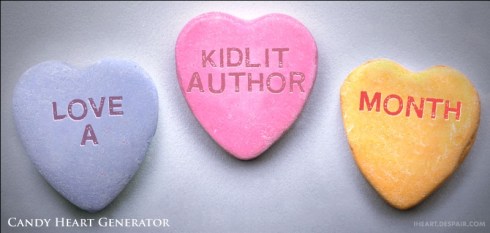
Yeah, I changed the name of my February blogfest. Mostly because “Children’s” didn’t fit on the candy heart generator. Oh, the sacrifices we make for our art.
Here’s a sneak peek at the upcoming author interviews…
Jessica Burkart, author of the brand new tween series Canterwood Crest, billed as “The Clique” meets “The Saddle Club.”
Toni De Palma, author of Under the Banyan Tree, an Association of Booksellers for Children Best New Voices pick.
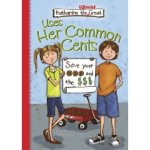 Lisa Mullarkey, author of the new Katharine the Almost Great chapter book series from Magic Wagon.
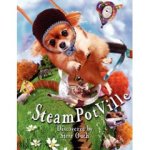 Steve Ouch, author/illustrator of SteamPotVille, a little independent title making big Tweets.
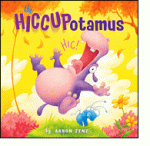
Aaron Zenz, author/illustrator of HICCUPotamus and the groovy dad behind Bookie Woogie book reviews.
Plus authors Jennifer Brown, Brenda Reeves Sturgis, Mary Ann Scott, Corey Rosen Schwartz…and I’m working on a few more.
And now the prize announcements!
Each comment you leave in February counts as an entry to win a $25 gift certificate to the bookstore of your choice. (Be sure I can reach you via your comment link. Comment as many times as you wish, but only one comment will count per blog post.) If your choice is your local independent bookseller like The Bookworm in Bernardsville, NJ, you’ll win a $35 gift certificate. 
The winner will be chosen out of a hat, which may or may not be an actual hat. Probably a melamine mixing bowl like one of these:
Plus, some of our featured authors will be giving away autographed copies of their books! Woo-hoo!
I’m having a blast putting this together, learning a lot from these new authors and getting inspired. I hope you will be, too!
Have you tried the Typealyzer? Just plug in your blog address and the typealyzer will tell you just what kind of blogger you really are.
 Who am I? The independent and problem-solving type.
They are especially attuned to the demands of the moment are masters of responding to challenges that arise spontaneously. They generally prefer to think things out for themselves and often avoid inter-personal conflicts.
The Mechanics enjoy working together with other independent and highly skilled people and often like seek fun and action both in their work and personal life. They enjoy adventure and risk such as in driving race cars or working as policemen and firefighters.
That was all pretty accurate until the risk part. I’m not interested in jumping out of airplanes. I prefer both feet on terra firma, thankyouverymuch.
So what blog type are you?
And now that I have your attention, don’t forget that “Love Children’s Authors” month begins on February 1st. So if you’re not whoopin’ it up at a SuperBowl party, come on over and enjoy the author interviews, book reviews and giveaways! (Who am I kidding? Not busy with the SuperBowl? I’ll see you February 2nd.)
 Ah, February. The month of love.
I love that December’s bills have been paid off. I love that I don’t have to worry about fitting into a bathing suit quite yet. I love dreaming of ways to spend my tax refund (which has already been spent). And I love gettin’ cozy in front of the fire with my daughters and a good book.
So this February I’m hosting a celebration of children’s authors, new and old. (Well, maybe not old. Established.) It will be 28 days of author interviews, book reviews and giveaways beginning on February 1st.
And what would February be without chocolates? Besides the quintessential heart-shaped box, February 1st was the day Willy Wonka invited five kids to tour his chocolate factory for the very first time…
Do you have a new book coming out? Recently snagged your dream agent? I’m still looking for writers to feature, so please get in touch by leaving a comment!
 I first heard the phrase “TwitLit” from writing friend Christopher Cocca. I’ll give him coining credit. We both write flash fiction, so he had suggested using the 140-character Twitter format to tell uber-short stories. His first submission: “His probation stopped on a dime-bag.” Mine? “The gourmand often ate too much, but she was living life to the fullest.”
So how else can writers use Twitter? You might want to refuse answering the assumed question, “What are you doing?” Come on, that’s boring. We’ve got Facebook status for that. Twitter is nimble, Twitter is quick, Twitter has the power to change the world. (OK, a bit of hyperbole there.)
Agent Nadia Cornier used Twitter to update authors on Firebrand Agency’s “query holiday.” From December 15 to January 15, Firebrand invited submissions without a query letter. At final count, she had over 3500 submissions with 387 read and 30 requested. Useful, clever Tweeting. Thanks, Nadia.
Of course, agent Nathan Bransford already covered authorly Tweeting with a guest post by Tracy Marchini two months ago. Marchini suggests 21 ways an author can use Twitter. Yep, she’s got TwitLit covered.
But I’m going further with this.
You may be aware of the cell phone novel phenomenom in Japan. Authors deliver stories a few lines at a time directly to mobile devices and welcome reader feedback regarding the tale’s direction. Once the novel is completed, readers rush to buy the paper copy because they feel invested in the story. After all, they had a hand (or a thumb) in its creation.
Some critics consider mobile novels an omen of a literary doomsday. Others think the platform can’t be ignored, especially with five of the top 10 novels in Japan having originated on cell phones.
So why not tell an entire tale in Twitter a few lines at a time? OK, perhaps there’s a certain level of literary integrity you want to maintain and this ain’t the way. But it’s a fun and interesting new venue for fiction, and one that could elicit reader feedback. Applications like TweetDeck help you to organize Tweets by subject and keep track of responses to others (using the “@” symbol). But be careful not to use Twitter for conversations that will lose other readers.
What about a Twitter account for your fictional characters? Don’t they have something to say beyond the confines of your book? A Tweet or two and they’re brought to life in real-time. Or maybe you can create a new character who only exists in Tweets.
The format is experimental. Who knows if it will catch on for story telling. But with Amazon’s Kindle gaining popularity and cell phones evolving into integrated entertainment devices for music, web browsing, pictures and videos, surely books and zines can’t be far behind. Can you imagine your phone’s screen folding out like a newspaper and delivering any story you want anytime you want it? Will Twitter help push things in that direction? Perhaps with a million authors using it, it just might.
 So how are you using Twitter to enhance your writing career? Are you marketing yourself or using it creatively? Please share your ideas!
Writers are entertainers. We immerse readers in a magical world, letting them escape with our words as a guide. If a reader enjoys your ride, chances are they’ll seek you out again. And again.
This week I read a lot about branding yourself as a writer, thanks to writing friend Jill Corcoran. The subject isn’t foreign to me, having worked in marketing for a decade. But just what is branding for writers? Developing a consistent style in your stories, offering readers a place that’s as comfortable to return to as their favorite chair. It’s not about writing books so similar that no one finds value in buying more than one. It’s about finding your niche in the publishing world and working within it.
Let’s compare this idea to chain restaurants in the US. Why are they popular? Diners know the menu, they know exactly what to expect. Olive Garden promises that the chicken parmigiana in Spokane will taste the same as the one in Cleveland. They don’t just sell unlimited salad and breadsticks, they serve predictability and comfort. Repeat diners know they’ll enjoy their meal.
People often buy the same laundry detergent, the same rice and the same cheese year after year. How many of you use the same brands your mother bought? Consumers will buy an item simply because they know it and they don’t know the competitors.
Brands also have unique qualities that make them more attractive than similar products. I prefer Barilla Plus pasta because it has added protein without a significant change in flavor. While it’s just pasta, it’s very different from the other noodles on the grocery shelves.
As a new writer in an increasingly difficult book market, developing a brand may give you an edge over the competition. When I think of Grace Lin, I think of whimsical illustrations with colorful patterns like origami paper. John Scieszka? Fairytale spoofs. Roald Dahl writes humorous, fantastical tales. Think about some of your favorite authors and what kind of feelings their name brings to mind. You want to elicit that same kind of recognition when readers think of you.
On the flip side, author K.L. Going admitted that her interest in multiple genres makes it difficult for readers to get a handle on her. At the Rutgers One-on-One Mentoring conference last October she said, “You never know what you’re going to get with a K.L. Going book.” She suggested not doing this as a new author, although she also encouraged us to write what we love.
But what if we love crossing genres? What if writing a supernatural YA mystery comes as naturally as a quiet non-fiction picture book? Perhaps you can be predictable in your unpredictability? Isn’t that a brand as well? Sure it is. But is it one you want as someone who’s trying to break into a tough, competitive business? Agents and editors tout “high concept” in novels, so why not come up with a “high concept” for yourself?
I realize that branding yourself as a writer is a complex task, especially for someone new who is still experimenting with style, genre, voice and subject matter. Stories are more complex than shampoo. You can’t guarantee thicker, fuller hair and a fresh lavender scent with each turn of the page. So what do you guarantee your readers?
Ask your critique partners what your brand might be. What perceptions do they have about your stories? What qualities in your writing are consistent? What do they look forward to when you hand them a new tale? Where does your work really shine?
You might have a very good idea about what your brand is. But remember that branding is all about someone else’s perception, not yours. You can have an image or a message you wish to relate to your readers, but are you sending it? Start asking around. Get to know your own brand so readers can get to know you.
What are you thoughts on branding for writers?
Who doesn’t love first page sessions? Where else can you get two non-stop hours of professional, editorial feedback? They pack quite a picture book pow. (And a middle grade wallop. And a YA smack.)
But how do you get the most out of these sessions? Take care in what you submit and how you submit it. Let the editors focus on your story rather than procedure.
These suggestions are based upon the November 19 NJ-SCBWI first page session with Kendra Levin of Viking and Lauren Hodge of Little, Brown.
1. Format properly. Some submissions didn’t use standard paragraph breaks and indents. While the editors understood that these writers were eager to submit as much story as possible, the manuscripts were confusing to read. Everything ran together. Format your first page just as you would a professional submission. Honestly, you will get more out of less.
2. Use Times New Roman font. A serif font reads well. Courier, the traditional typewriter font, is a monospaced font, meaning each letter is the same width. This wastes space. If you submit with Courier, you’ll have 50% less story on your first page.
3. Research your genre. Some manuscripts felt inappropriate for the genre the author indicated. The topic, word choice and level of sophistication need to match your audience’s age. If you submit with the correct genre, the editors will spend more time assessing your writing than genre counseling.
4. Don’t limit yourself to one gender. One manuscript indicated it was for girls. If you write this on a submission, an editor will immediately think your work doesn’t have broad appeal. Let the editor decide if both boys and girls will love your story.
5. Skip the prologue. Go right to the story. Submit page one of the first chapter, not the backstory.
6. Don’t include an explanation. One picture book began with an intro about why the author had written the story, based upon an experience with her children. And here is where editor Kendra Levin was gracious and tactful. She thought the children in this author’s life were incredibly lucky to have such a playful, creative parent. But stating how children you know enjoy your work doesn’t help sell it. The story does. The intro only left room for five lines of the tale, so the editors could not comment fully. They also emphasized that if the story is written well enough, an explanation becomes unneccesary.
7. Take notes. Don’t just wait for what the editors/agents have to say about your manuscript. Listen to the comments about every page. There’s something to learn from everyone’s manuscript.
There’s more to come from this dynamic first page session. Watch for another post this weekend. And please add your own first page tips!
A few weeks ago, the hot topic here was Five Rules for Picture Books. Follow those guidelines and you might just have a winning manuscript. Or you might just have Hop! Plop! by Corey Rosen Schwartz, Tali Klein and Olivier Dunrea.
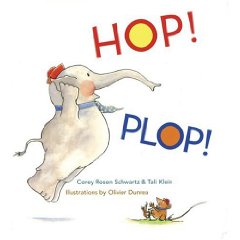 Let’s take a closer look at this story and how it fits beautifully with “the rules.”
Rule #1: Audience Age is 2-6 years old
A picture book should include situations and characters to which children this age can relate. Hop! Plop! is set at a playground. Familiar? Check. Adorable, friendly animals? Check.
Rule #2: 500 Words is the Magic Number
Hop! Plop! comes in at about 300. Check.
Rule #3: Make it Really Sweet or Really Funny
In this case, it’s really sweet and really funny. Elephant and Mouse navigate the playground together and hilarity ensues. Elephant is too heavy on the seesaw and he pushes Mouse a little too hard on the swing. In the end, the two friends discover that their favorite playground diversion is each other. Awwwww.
Rule #4: Use Playful, Unique Language
Elephant and Mouse’s foibles are expressed through onomatopoeia and rhyme. “Skip! Tip! Zoom! Zip! Mouse did a backward flip.” and “Plop! Drop! Crash! Whop! The swings were a total flop.” Totally fun to read aloud. And not too tongue-twisty.
Rule #5: Create Situations that Inspire Cool Illustrations
Picture an elephant and a mouse on a seesaw. And a mouse sliding down an elephant’s trunk. Funny situations, cute pictures. Final check.
Hop! Plop! is a delightful romp. While this book happens to follow “the rules,” that doesn’t mean other manuscripts which color outside the lines are doomed for the rejection pile. Not at all. Remember, “the rules” are merely guidelines for new writers, to help them understand what editors generally seek in a manuscript. (I should really add to the rules: there must be a story.) I can name plenty of picture books that break at least one of these guidelines, with length being the most common one. But Hop! Plop! fits all the criteria–and it’s darn cute to boot. Check it out.
Please share in the discussion by naming your favorite rule-followin’ title! Or maybe you want to point out a rule breaker, a rebel title that deserves praise!





 Writing for Kids (While Raising Them)