You are currently browsing the category archive for the ‘Flash Fiction’ category.
Can you believe I’m still fighting off infections? Yeah, and I also had my latest immune-suppressant infusion. So it’s beat it back, let it in, beat it back, let it in again over here.
Whilst you still await Storystorm prize distribution, here’s another Flash Fiction piece that my mentee and soon-to-be-debut-author Arlene Shenker requested. Remember, this is for adults, not children. Please enjoy!
The Puppet
©2020-2025 by Tara Lazar
Rory and Jane met on the set of a cough syrup commercial, performing as cold germ puppets. Ironically, Jane got sick immediately after the wrap. Rory brought her homemade chicken and dumplings, his grandma’s recipe. Of course, Jane couldn’t let a man who could cook and skillfully wield a rhinovirus marionette slip past.
Their common circle of friends, a small, insular puppetry group, marveled at how they had somehow missed meeting for years. Rory exited an off-Broadway production right before Jane landed the lead role. Jane apprenticed in Los Angeles at the same time Rory worked in Studio City. When Jane zigged, Rory had zagged. Finally, they smacked into each other and stuck like Velcro.
After moving into their new apartment, though, Rory panicked.
“Have you seen Mr. Fuhgeddaboudit?” he asked, rummaging through boxes and bubble wrap.
Rory loved that puppet and performed with it at every opportunity. He brought it to Jane’s nephew’s birthday party. He wrote an autobiographical one-man show featuring Mr. Fuhgeddaboudit. Rory even proposed to Jane with the help of his signature character.
“He wasn’t with the others?” Jane pointed to the collective of puppets sitting upon the couch.
“No, I kept him separate! His own box. And I marked it up like crazy!” Rory had moved past upset to frantic, his voice rising an octave.
“Okay, Honey, calm down. I’m sure he’s here.”
“Don’t tell me to calm down! He’s the first puppet I ever made. I was nine!”
“I know, I know. We’ll find him.”
“He’s the entire reason I became a puppeteer. He’s the entire reason we met!”
Jane had never seen this side of Rory, manic and unhinged. Normally he acted as a steady presence in stressful situations, defusing irate directors. He could reassure a cast before opening curtain, calming stage fright. Demanding producers took a step back to reevaluate after hearing Rory’s logical solutions.
But now he was tearing the apartment apart, slamming cupboards, ripping boxes open in eruptions of packing peanuts. Every soothing word Jane offered was met with contempt and rage.
“Why aren’t you looking?” Rory yelled. “Don’t sit there! Look! Help me look!”
“Honey, there’s only two rooms. We’ve gone through it all.”
Suddenly Rory stopped and turned to her in slow motion, red-faced.
“I knew it!” he said, pointing at Jane.
“You knew what?”
“It was you!”
“Me? What are you talking about?”
“You never liked Mr. Fuhgeddaboudit!” Rory exclaimed. “So you took him. You stole him from me. Where did you put him? Where, Jane? Tell me where!”
Jane stood up, ramrod straight, blindsided by Rory’s accusation.
“Honey!” she said. “You’re upset. You’re not thinking straight.”
“Or you sold him! Oh my God, you sold him to that hack Jimmy MacEnery!”
“Jimmy who?”
“Or a pawn shop! That seedy little performer’s pawnshop off The Strip.”
“Las Vegas?”
“Do you know another ‘Strip’?”
“No, but Honey, I haven’t been to Vegas in years.”
“Aha!” Rory yelled. “So you know the pawnshop I’m talking about!”
Jane sunk to the floor. This is why people live together before getting married. This sh*t, right here. Except it hadn’t even been 24 hours.
Rory marched to the contingent on the couch, lifted each puppet, looked underneath, peered inside, then tossed them into a pile. But these weren’t a toddler’s playthings, these were custom, professional puppets, worth thousands of dollars each.
“Honey, don’t be so flip with the puppets!” Jane gathered each one and propped them back into sitting position. They stared at her with wide eyes, as if they, too, couldn’t believe the unraveling of Rory.
He grabbed his coat and shoved his arms in.
“Where are you going?”
“I have to get out of here!”
“I’ll come with you,” Jane said.
Rory pulled on a wool beanie, thrust his hands into his jeans, closed his eyes and sighed. His rough face softened ever so slightly, enough for Jane to feel assured pulling on her jacket and following him out.
By the time they reached the street, down five flights of stairs, Rory had cooled and Jane was able to slip her arm around his waist. They turned west and walked in silence for several blocks, matching each other’s rhythm.
“I don’t know what happened up there,” Rory confessed. It was true. He felt driven by some imaginary force, a sudden and gripping fear that robbed him of all control.
“It’s okay, Honey.” Jane looked at him but Rory stared straight ahead. “I know how much that puppet means to you.”
“I know you do,” he said. “But you mean more.”
That was all they said. Rory and Jane maintained a companionable silence back to their new building. Although the apartment was a fifth-floor walkup, it was halfway between the theatre district and the television studios where they did the bulk of their work. They loved the large windows, the recently remodeled stainless steel and concrete kitchen, and Jane was in awe of the garbage chute and incinerator. First thing that morning she had shoved Mr. Fuhgeddaboudit down, relieved she’d never have to see that stupid f***ing puppet ever again.
So as typically happens this time of year, I’ve been sick. So I’m just going to chalk February up to a loss and get to your Storystorm prizes in March. I am still recruiting agents for your Storystorm Grand Prizes, where you’ll receive feedback on your 5 best story ideas, to help you determine which to pursue as manuscripts and submissions.
Speaking of submissions, I am sharing a Flash Fiction story I wrote during the pandemic that I cannot seem to place anywhere, so I am publishing it here instead. This is an original story and I hope you enjoy! (Be forewarned, it’s for adults, not kiddos.)
The Neighbors
©2020-2025 by Tara Lazar
We were forced to write the neighbors about the beast.
Louise and I had promised it refuge in our basement in exchange for sparing our family. It assured us that if we kept supplying it with deer and possum, it would remain sated. There would be no need to torment the town. However, it has spent the last week digging passageways to the other homes.
Our son warned us that a beast cannot be believed, and we should have listened. But you don’t heed the kid with straight-Ds who wears t-shirts emblazoned with “Whoof Arted”. Meanwhile, our daughter, the good child, was devoured a month ago. Once again, our fault for the misplaced trust.
“What shall the letter say?” my wife asked.
“How about this,” I replied, pen in hand. “Dear neighbors, it has come to our attention that—”
“No, no, you can’t begin that way. They’ll think we’re telling them to power wash their vinyl siding again. They won’t read past the first line.”
“Then it’s really their fault if they can’t read a simple letter,” I said.
“Use powerful language, Chester. Write it like your clean-up-after-your-pet notice.”
“I won’t swear again, Louise.”
“Of course not, dear. Just be direct. Like your lawn-mowing letter.”
“I’ve got it,” I said, clearing my throat. “Dear neighbors, a beast has infiltrated our neighborhood.”
“Oh, excellent, darling. But shouldn’t you make it clear that you don’t mean Mrs. Stubbs?”
“Good point. Dear neighbors, an inhuman beast has infiltrated our neighborhood.”
“Wonderful! That’s a fine start,” Louise said. “Shall I make us some tea?”
“Spot on. Writing makes me thirsty.”
We composed a letter both urgent and actionable, without being too alarming. We agreed that Mr. Rasmussen, our eldest neighbor, was too fragile to read such a missive, given that his wife had recently passed, so we invited him to dinner instead. We could deliver the news with hearty helpings of Louise’s pot roast and Dutch apple pie, softening the blow.
*****
“We’ve been meaning to have you over for a while,” Louise said, leading Mr. Rasmussen to the dining room. “We were sorry to hear about Mrs. Rasmussen. What a special soul, volunteering at the hospital all those years.”
“Much obliged, Mr. and Mrs. Smythe. Awful kind of you.”
“Please, call us Chester and Louise. And you remember our son, Devin.”
“Goodness gracious. He’s sure grown! Bigger than his father now.”
An intense growl emerged from deep beneath the house, rumbling through the floor in magnificent waves. We held our collective breath, waiting for Mr. Rasmussen’s reaction. He just blinked and asked to use the restroom.
“Do you think he’s going deaf?” Louise asked. “Does he have nerve damage in his feet?”
“I don’t think he’s diabetic,” I replied.
“Well, if he heard or felt that, he didn’t flinch!”
“Good. Maybe this won’t be so difficult after all.”
We worked through the meal with light conversation and waited until we were warm and satisfied to broach the subject. Some things are better discussed on a full stomach.
*****
“I don’t believe you,” Mr. Rasmussen replied.
“I know this is a shock, but it’s living in our basement and it has carved underground routes to every house on King Drive,” I said. “It will pluck you one-by-one from your beds and devour you complete.”
Mr. Rasmussen crossed his arms. “How come you haven’t been devoured?”
“It got to Penelope, the poor dear.” Louise dabbed a napkin under her eye.
“I see,” said Mr. Rasmussen, leaning back. “I still don’t believe you.”
“My God, man! This is no time to be a contrarian!”
“Chester,” Louise said, placing a hand upon my forearm, “we said we were going to be calm and gentle with our guest.”
“Right. My apologies,” I said in a soft tone. “Please understand. This beast is a serious threat.”
“Let’s go see it, then,” said Mr. Rasmussen.
“Pardon me?”
“You’ve got a beast in your basement. Let’s take a look.” He pushed his chair back and stood up.
“I don’t think you comprehend the gravity of this. Going down there is dangerous. I wouldn’t advise it.”
“Hell, I’ve got a lawyer. He advises me, not you.” Mr. Rasmussen started toward the cellar door. “Let me see this thing. I’ll decide for myself if we should run for the hills.”
I blocked his path. “Mr. Rasmussen, I strongly urge you not to open that door.”
He reached for the doorknob and I reacted on a primal level, pushing both hands against his chest, sending him flying backward.
“Chester!” Louise screamed.
Mr. Rasmussen landed with a thwack, slamming his head against the tile floor.
The clamor of the disturbed beast rattled beneath us and the floor seemed to breathe.
The beast galloped up the stairs, thrashing against the walls, snarling and spitting, emitting a brutal heat. Twisting and heaving, it screeched with a sickening sharp note that sounded as if all eternity’s nightmares had joined forces. Then in a flash it dissolved into a tar-like puddle of infinite depth. The liquid bubbled and boiled and from within its abyss emerged a plump, grandmotherly figure with yellow-white hair.
“Mrs. Rasmussen?!”
“You remember my wife, Gertie,” Mr. Rasmussen said, rising, his bashed-in head dripping blood. “Surprising, given you never had us over for supper.”
“Oh, Gerald,” Mrs. Rasmussen slapped at her husband playfully. “Be nice. The Smythes were kind enough to let me stay in their roomy basement.”
“I hope they kept you comfortable, sweetheart.”
“Yes, quite! But I must apologize for the teenage girl. I’m afraid I got carried away that day.”
Mr. Rasmussen proffered his arm and the elderly couple strolled across the living room to the front door, trailing tar and blood.
“Now then,” he said, turning to us, “maybe next time you’ll think twice before sending us another rude letter. We’ll power wash when we damn want to power wash and not a moment sooner.”
The End
©2020-2025 by Tara Lazar
“How did you get your start writing?”
“Just like Roald Dahl.” (Yes, I take advantage of any opportunity to compare myself to my favorite writer.)
But, I’m not kidding. When I began this whole crazy ride, I did so by writing short stories for adults, just like Dahl. Except my stories weren’t short stories. They were short, short, extra short stories—flash fiction.
I had found an online magazine called “Six Sentences” that published one flash fiction piece per day. The name of the site said it all—every story was only six sentences long (or six sentences short, chortle chuckle).
To some writers, this presents an enormous challenge, to examine character and emotion and conflict between six periods. Sure, you could exploit the semi-colon and em-dash and maybe stretch it to resemble eight-and-a-half sentences, but still. That’s not much space.
The uber-short format, however, is like prose-poetry. And it’s most definitely like a picture book because some things must be left unsaid, yet the silence remains part of the story’s experience.
Paper Cuts
by Tara Lazar
Her daughter was achingly beautiful, a delicate loveliness like a paper lantern, illuminated from within. The girl’s long hair separated into fine ringlets, cascading like curled Christmas ribbon down her back. She was the kind of child who made strangers smile and take pause—the kind of child who made other mothers envious. The mother was not so much shunned as politely excluded; excuses were made, apologies provided, but invitations were never extended. She exaggerated her own ordinary features—forgoing makeup, leaving her hair unwashed for days, wearing mismatched clothing—but none of her efforts to elicit pity served to lessen the jealousy; her daughter’s radiance only shone brighter, her extraordinary hair the source of more disdain. The mother closed her eyes, grasped the scissors, and cut.
I’ve long held the belief that aspiring picture book writers would benefit from writing flash fiction, as it’s good writing practice in another format. No pictures are necessary, but a mind for visuals is. Can you imagine the scene above?
Writing these stories is fun as well as a challenge, so I was mighty intrigued when I saw Logitech announce their Very Short Story contest on Twitter.

So here’s your chance to strut your storytelling skills outside the usual medium. Logitech is giving away their new K380 Multi-Device Bluetooth Keyboard and a Blurb giftcard for the best short story written in 8 tweets or less. Just use #LogiVSS to tell your tiny tale. Get all the details here—http://blog.logitech.com/2016/02/18/k380veryshortstorychallenge—but hurry! The contest ends at the close of this week.
And guess what? Logitech is also giving away one of their new keyboards to one of my blog readers! If you hate typing on a phone or tablet’s screen, worry no longer. This keyboard is happy to help you out.
Just leave a comment below about short story writing and you’re entered to win. One lucky commenter will be picked randomly in two weeks!
So go ahead and write on! (But don’t write on and on and on!)

Flash on over to Flash Fiction Chronicles today and I’ll tell you all about writing micro fiction for children! It’s how I got my start.
http://www.everydayfiction.com/flashfictionblog/flash-fiction-for-ya-y-not
 [UPDATE: The winner is Sheryl Tilley! Congratulations and enjoy!]
My story “The Juggler Triplets” will appear in the November issue of Abe’s Peanut, a micro-magazine for kids ages 6-10. Delivered in four postcard installments, the story appears on one side with full-color illustration by Lichen Frank on the other.
Independently published by editors Anna and Tess Knoebel, Abe’s Peanut launched this year after the success of Abe’s Penny, a micro-magazine for adults: “Off-set printed on double thick matte card stock, each issue dispenses art and literature while becoming a collectible, temporal object.” (In kidspeak: “They look cool tacked to your bedroom door.”)
Recent Abe’s Peanut contributors include Audrey Vernick, author of Is Your Buffalo Ready for Kindergarten?, and Lisa Tharpe, author of P is for Please: A Bestiary of Manners.
Kids love receiving their own mail, so here’s a chance to receive four postcards with your child’s name on the label.
Leave a comment naming your child’s favorite picture book for one contest entry. Mention the giveaway elsewhere for two additional entries. A winner will be chosen on Friday, October 22nd.
And stay-tuned for PiBoIdMo in November, when there will be several itty-bitty (plus some hugantic) giveaways!
Besides writing for kids, I’m raising them, too. (You may have already figured this out by the blog title. I’m not that full of surprises.)
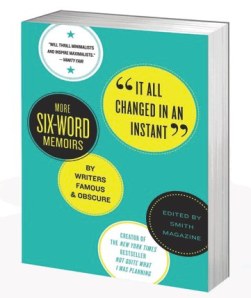 Two years ago I won a Six-Word Momoir contest from Smith Magazine, and now another one of my Momoirs is featured in their new book It All Changed in an Instant: Six Word Memoirs by Writers Famous and Obscure:
Wanted independence but had two dependents.
Probably would have sounded better if I went all Duggar and said nineteen dependents, but I digress…
Sometimes we need a break from our current manuscript, but we still want to write. Well, what better way to be succinctly witty and wittily succinct than by writing six-word memoirs? Picture book writers are expected to write short, so here’s the ultimate exercise. In my case, I’m sticking to momoirs. Here’s a few to get your creative sixes flowing:
Woman with awesome body becomes homebody.
Two words bring joy: “She pooped!”
You really do become your mother.
How many years until Kindergarten begins?!
Naptime: my favorite time of day.
Wake me up when they’re grown.
Stuffed animals must breed at night.
Motherhood should require an entrance exam.
Hug tight. The years move fast.
Say “yes” as often as possible.
Except when muddy nightcrawlers are involved.
Grant wishes. Encourage dreams. Inspire hope.
Give birth. Give lessons. Give freedom.
OK, I apologize for the poop. I have no reason to sink that low. But I do have something to tell new mothers in six words: “Stay far away from rice cereal.”
So, give it a shot. If you’re a parent or not, try a six-word memoir. I expect to see at least six below in the comments!
 I first heard the phrase “TwitLit” from writing friend Christopher Cocca. I’ll give him coining credit. We both write flash fiction, so he had suggested using the 140-character Twitter format to tell uber-short stories. His first submission: “His probation stopped on a dime-bag.” Mine? “The gourmand often ate too much, but she was living life to the fullest.”
So how else can writers use Twitter? You might want to refuse answering the assumed question, “What are you doing?” Come on, that’s boring. We’ve got Facebook status for that. Twitter is nimble, Twitter is quick, Twitter has the power to change the world. (OK, a bit of hyperbole there.)
Agent Nadia Cornier used Twitter to update authors on Firebrand Agency’s “query holiday.” From December 15 to January 15, Firebrand invited submissions without a query letter. At final count, she had over 3500 submissions with 387 read and 30 requested. Useful, clever Tweeting. Thanks, Nadia.
Of course, agent Nathan Bransford already covered authorly Tweeting with a guest post by Tracy Marchini two months ago. Marchini suggests 21 ways an author can use Twitter. Yep, she’s got TwitLit covered.
But I’m going further with this.
You may be aware of the cell phone novel phenomenom in Japan. Authors deliver stories a few lines at a time directly to mobile devices and welcome reader feedback regarding the tale’s direction. Once the novel is completed, readers rush to buy the paper copy because they feel invested in the story. After all, they had a hand (or a thumb) in its creation.
Some critics consider mobile novels an omen of a literary doomsday. Others think the platform can’t be ignored, especially with five of the top 10 novels in Japan having originated on cell phones.
So why not tell an entire tale in Twitter a few lines at a time? OK, perhaps there’s a certain level of literary integrity you want to maintain and this ain’t the way. But it’s a fun and interesting new venue for fiction, and one that could elicit reader feedback. Applications like TweetDeck help you to organize Tweets by subject and keep track of responses to others (using the “@” symbol). But be careful not to use Twitter for conversations that will lose other readers.
What about a Twitter account for your fictional characters? Don’t they have something to say beyond the confines of your book? A Tweet or two and they’re brought to life in real-time. Or maybe you can create a new character who only exists in Tweets.
The format is experimental. Who knows if it will catch on for story telling. But with Amazon’s Kindle gaining popularity and cell phones evolving into integrated entertainment devices for music, web browsing, pictures and videos, surely books and zines can’t be far behind. Can you imagine your phone’s screen folding out like a newspaper and delivering any story you want anytime you want it? Will Twitter help push things in that direction? Perhaps with a million authors using it, it just might.
 So how are you using Twitter to enhance your writing career? Are you marketing yourself or using it creatively? Please share your ideas!
History Lessons
Juliet Dupree snuck into Mr. Forman’s classroom before the morning bell and wrote Mr. Snoreman on the blackboard. When Tristan sat next to her, she’d nudge his arm, nod toward the front of the room, and take credit.
Everyone knew that Mr. Forman’s monotone lectures came straight from the textbook, word for dreary word. He cradled the teacher’s guide with his left arm while he pointed to the ceiling with his right, appearing only slightly more animated than the Statue of Liberty.
The huddled masses of 1st period American History yearned to be free of boredom, so Tristan organized daily pranks. Yesterday the entire class dropped their textbooks on the floor at precisely 8:10am…and received empty detention threats at 8:11am.
When Juliet reached for her book, she had noticed it was published the year she was born. That was odd; she was pretty certain that something historically meaningful had happened in the past 13 years. After all, Tristan had kissed her. That might not make it into the next edition of An American Account Volume II, but it would launch an unpredictable new chapter in her own history, threatening full-out war as soon as Tristan’s girlfriend found out.
This flash fiction piece is in response to the Imagine Monday writing prompt posted last Friday. Join us every week for a new writing exercise.
When I came up with this week’s prompt, I immediately drifted back to my 9th grade American History class. The tale above isn’t far from what occurred in the classroom. My friend arranged pranks on a near-daily basis. One day a classmate discovered that he owned the same digital Casio watch as our teacher, so he set the alarm to go off in class. Our teacher fumbled at his wrist, wondering why he couldn’t get the beeping to stop. Such adolescent nonsense has a way of escalating into legend, and in the hyperbole of memory, I recall this little trick baffling our teacher for months.





 Writing for Kids (While Raising Them)