You are currently browsing the category archive for the ‘Children’s Books’ category.
…let it be Jarrett Krosoczka’s hilarious writer’s block adventure.
Starring Tomie dePaola, Jeanne Birdsall, Mo Willems, Jane Yolen, Grace Lin, John Scieszka, Adam Rex, and many others!
BOOK BY BOOK: the making of a monkey man from Jarrett Krosoczka on Vimeo.

You might already know that Charlie and the Chocolate Factory is my favorite children’s book. So I went in search of The Golden Ticket today.
But does anyone see something wrong with this Golden Ticket?
While you ponder that question, let me kick off Love a Kidlit Author Month with a few golden words from Dutton Executive Managing Editor Steve Meltzer.
Mr. Meltzer penned an article in the latest edition of Sprouts, the magazine of the NJ-SCBWI. The title says it all: “Market Your Book Without the Book.”
Common sense tells us not to market a book until you actually have a book to publish. I say that is no longer true. When you are selling a book these days you have to sell yourself as well. It is up to you to do the job. Publishers like people who know how to market…
…Web video technology and social networking are the author’s friend. There is so much you can do these days for so very little. So get out and market yourself.
If you don’t subscribe to Sprouts, I highly suggest it! Each issue contains useful industry tips from editors and agents.
Figured out the mistake on the Golden Ticket yet?
Remember, every comment you make this month counts towards an entry for the gift certificate (but only one comment per blog post). If you blog or Twitter about Love a KidLit Author month and link here, it counts as an extra entry, just let me know about it!
Yeah, I changed the name of my February blogfest. Mostly because “Children’s” didn’t fit on the candy heart generator. Oh, the sacrifices we make for our art.
Here’s a sneak peek at the upcoming author interviews…
Jessica Burkart, author of the brand new tween series Canterwood Crest, billed as “The Clique” meets “The Saddle Club.”
Toni De Palma, author of Under the Banyan Tree, an Association of Booksellers for Children Best New Voices pick.
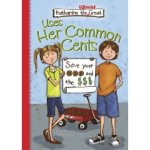 Lisa Mullarkey, author of the new Katharine the Almost Great chapter book series from Magic Wagon.
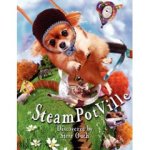 Steve Ouch, author/illustrator of SteamPotVille, a little independent title making big Tweets.
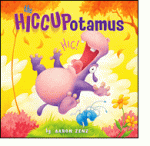
Aaron Zenz, author/illustrator of HICCUPotamus and the groovy dad behind Bookie Woogie book reviews.
Plus authors Jennifer Brown, Brenda Reeves Sturgis, Mary Ann Scott, Corey Rosen Schwartz…and I’m working on a few more.
And now the prize announcements!
Each comment you leave in February counts as an entry to win a $25 gift certificate to the bookstore of your choice. (Be sure I can reach you via your comment link. Comment as many times as you wish, but only one comment will count per blog post.) If your choice is your local independent bookseller like The Bookworm in Bernardsville, NJ, you’ll win a $35 gift certificate. 
The winner will be chosen out of a hat, which may or may not be an actual hat. Probably a melamine mixing bowl like one of these:
Plus, some of our featured authors will be giving away autographed copies of their books! Woo-hoo!
I’m having a blast putting this together, learning a lot from these new authors and getting inspired. I hope you will be, too!
 Ah, February. The month of love.
I love that December’s bills have been paid off. I love that I don’t have to worry about fitting into a bathing suit quite yet. I love dreaming of ways to spend my tax refund (which has already been spent). And I love gettin’ cozy in front of the fire with my daughters and a good book.
So this February I’m hosting a celebration of children’s authors, new and old. (Well, maybe not old. Established.) It will be 28 days of author interviews, book reviews and giveaways beginning on February 1st.
And what would February be without chocolates? Besides the quintessential heart-shaped box, February 1st was the day Willy Wonka invited five kids to tour his chocolate factory for the very first time…
Do you have a new book coming out? Recently snagged your dream agent? I’m still looking for writers to feature, so please get in touch by leaving a comment!
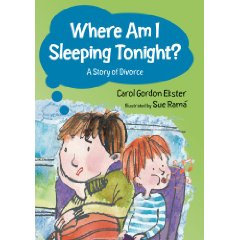 You’ve probably heard this advice: never write a children’s story with the intent of teaching a lesson. They typically come out preachy. Kids are clever; you can’t fool them into reading a lecture.
But what about writing a story with the intent of easing a child’s pain? Letting them know they’re not alone in their troubles? Carol Ekster does this beautifully in Where Am I Sleeping Tonight?, a humorous and realistic look at life as a child of divorce.
I was a child of divorce. The only books available to me in the early 1980’s were ones written by shrinks, telling kids that we weren’t responsible for the split. Well, DUH! I knew it wasn’t my fault! Whenever I got upset, people told me I wasn’t to blame, something I knew from day one. Nobody understood how I felt, knowing that the two people I loved the most no longer loved each other.
My life changed immediately and dramatically. My stay-at-home mother got a job and I became a latch-key kid, responsible for taking care of my younger brother every day after school. My father moved in with my Nana and we spent every weekend at her house, sleeping in the same room in which our Great Uncle had died. (Creepy!)
Life got frustrating. My belongings were strewn between two houses more than 30 minutes from one another. My dad didn’t know how to cook. My mom didn’t have time for us, between work, the house, and dating. (Creepier!)
Debut author Carol Ekster has filled a need in children’s books: a story for kids adjusting to divorced life, showing real situations and emotions. I wish Where Am I Sleeping Tonight? was around back then to let me know I wasn’t alone in my back-and-forth shuffle.
A niche title like this can be a great way to break into the publishing business. I talked to Carol about her journey to publication…
How long have you been writing?
About 6 years. It just came over me like an outer body experience on a July day at the beach. I went to get a pen and post-its (the only writing material I had) from my car, and started to write my first picture book.
[Lesson learned: always carry a notebook with you!]
Is this the first book you wrote?
This was actually the 20th book I wrote, but the first to sell.
[Lesson learned: you get better with every story. Don’t expect the first thing you write to sell.]
Where did you get the idea for the story?
It is loosely based on a former student who had the same schedule as the boys in the story. He touched my heart. I’ve been teaching 35 years and always had compassion for the children whose parents were divorced. I could feel their pain.
[Lesson learned: look for stories in everyday life. They’re all around.]
How many revisions did it go through?
Too many to count!
[Lesson learned: revision is your friend.]
How did you research where to submit it?
I use the “Children’s Writer’s & Illustrator’s Market,” but for this story, there was a call for submissions in the SCBWI Bulletin. Boulden Publishing was looking for books on divorce and a few other topics. I sent it out and heard back six weeks later that they were interested in it.
[Lesson learned: wow, that was quick! But Carol had exactly what they wanted! It’s all about finding a perfect match.]
How has your life changed since becoming published?
I’ve had to do book signings and promotion…none of which I ever thought about when I began writing. I was surprised how nervous I was for my first book signing. It takes a lot of time and effort, so I’m not getting as much writing done.
[Lesson learned: marketing and promotion is just as important as writing. Yes, it takes time, but it pays rewards in book sales and a solid platform from which to launch your next title. Check out agent Nadia Cornier’s recent post about her floundering novel and how she’s reinvesting herself in book promotion.]
Thanks to Carol for answering my questions and best wishes with the book. If you have questions for debut author Carol Ekster, please leave a comment!
 I first heard the phrase “TwitLit” from writing friend Christopher Cocca. I’ll give him coining credit. We both write flash fiction, so he had suggested using the 140-character Twitter format to tell uber-short stories. His first submission: “His probation stopped on a dime-bag.” Mine? “The gourmand often ate too much, but she was living life to the fullest.”
So how else can writers use Twitter? You might want to refuse answering the assumed question, “What are you doing?” Come on, that’s boring. We’ve got Facebook status for that. Twitter is nimble, Twitter is quick, Twitter has the power to change the world. (OK, a bit of hyperbole there.)
Agent Nadia Cornier used Twitter to update authors on Firebrand Agency’s “query holiday.” From December 15 to January 15, Firebrand invited submissions without a query letter. At final count, she had over 3500 submissions with 387 read and 30 requested. Useful, clever Tweeting. Thanks, Nadia.
Of course, agent Nathan Bransford already covered authorly Tweeting with a guest post by Tracy Marchini two months ago. Marchini suggests 21 ways an author can use Twitter. Yep, she’s got TwitLit covered.
But I’m going further with this.
You may be aware of the cell phone novel phenomenom in Japan. Authors deliver stories a few lines at a time directly to mobile devices and welcome reader feedback regarding the tale’s direction. Once the novel is completed, readers rush to buy the paper copy because they feel invested in the story. After all, they had a hand (or a thumb) in its creation.
Some critics consider mobile novels an omen of a literary doomsday. Others think the platform can’t be ignored, especially with five of the top 10 novels in Japan having originated on cell phones.
So why not tell an entire tale in Twitter a few lines at a time? OK, perhaps there’s a certain level of literary integrity you want to maintain and this ain’t the way. But it’s a fun and interesting new venue for fiction, and one that could elicit reader feedback. Applications like TweetDeck help you to organize Tweets by subject and keep track of responses to others (using the “@” symbol). But be careful not to use Twitter for conversations that will lose other readers.
What about a Twitter account for your fictional characters? Don’t they have something to say beyond the confines of your book? A Tweet or two and they’re brought to life in real-time. Or maybe you can create a new character who only exists in Tweets.
The format is experimental. Who knows if it will catch on for story telling. But with Amazon’s Kindle gaining popularity and cell phones evolving into integrated entertainment devices for music, web browsing, pictures and videos, surely books and zines can’t be far behind. Can you imagine your phone’s screen folding out like a newspaper and delivering any story you want anytime you want it? Will Twitter help push things in that direction? Perhaps with a million authors using it, it just might.
 So how are you using Twitter to enhance your writing career? Are you marketing yourself or using it creatively? Please share your ideas!
Writers are entertainers. We immerse readers in a magical world, letting them escape with our words as a guide. If a reader enjoys your ride, chances are they’ll seek you out again. And again.
This week I read a lot about branding yourself as a writer, thanks to writing friend Jill Corcoran. The subject isn’t foreign to me, having worked in marketing for a decade. But just what is branding for writers? Developing a consistent style in your stories, offering readers a place that’s as comfortable to return to as their favorite chair. It’s not about writing books so similar that no one finds value in buying more than one. It’s about finding your niche in the publishing world and working within it.
Let’s compare this idea to chain restaurants in the US. Why are they popular? Diners know the menu, they know exactly what to expect. Olive Garden promises that the chicken parmigiana in Spokane will taste the same as the one in Cleveland. They don’t just sell unlimited salad and breadsticks, they serve predictability and comfort. Repeat diners know they’ll enjoy their meal.
People often buy the same laundry detergent, the same rice and the same cheese year after year. How many of you use the same brands your mother bought? Consumers will buy an item simply because they know it and they don’t know the competitors.
Brands also have unique qualities that make them more attractive than similar products. I prefer Barilla Plus pasta because it has added protein without a significant change in flavor. While it’s just pasta, it’s very different from the other noodles on the grocery shelves.
As a new writer in an increasingly difficult book market, developing a brand may give you an edge over the competition. When I think of Grace Lin, I think of whimsical illustrations with colorful patterns like origami paper. John Scieszka? Fairytale spoofs. Roald Dahl writes humorous, fantastical tales. Think about some of your favorite authors and what kind of feelings their name brings to mind. You want to elicit that same kind of recognition when readers think of you.
On the flip side, author K.L. Going admitted that her interest in multiple genres makes it difficult for readers to get a handle on her. At the Rutgers One-on-One Mentoring conference last October she said, “You never know what you’re going to get with a K.L. Going book.” She suggested not doing this as a new author, although she also encouraged us to write what we love.
But what if we love crossing genres? What if writing a supernatural YA mystery comes as naturally as a quiet non-fiction picture book? Perhaps you can be predictable in your unpredictability? Isn’t that a brand as well? Sure it is. But is it one you want as someone who’s trying to break into a tough, competitive business? Agents and editors tout “high concept” in novels, so why not come up with a “high concept” for yourself?
I realize that branding yourself as a writer is a complex task, especially for someone new who is still experimenting with style, genre, voice and subject matter. Stories are more complex than shampoo. You can’t guarantee thicker, fuller hair and a fresh lavender scent with each turn of the page. So what do you guarantee your readers?
Ask your critique partners what your brand might be. What perceptions do they have about your stories? What qualities in your writing are consistent? What do they look forward to when you hand them a new tale? Where does your work really shine?
You might have a very good idea about what your brand is. But remember that branding is all about someone else’s perception, not yours. You can have an image or a message you wish to relate to your readers, but are you sending it? Start asking around. Get to know your own brand so readers can get to know you.
What are you thoughts on branding for writers?
Slumpy and dumpy, I’m feeling grumpy. The end of December twinkled its lights and blinded me. Images of sugarplums not only danced in my head, they had an all-night party and crashed on my couch for two weeks.
I took a break from writing, interrupting one of the most prolific writing periods I’ve ever had. Call it a creativity smackdown. And now, well, I can’t seem to jumpy back into it.
What to do?
I need to chug-chug along here. I’ve got a mentoring session to attend in February and the NJ-SCBWI annual conference is in early June. (Five months is a mere blip in the writing world, like the short amount of time humans have been on Earth in comparison to the age of the Universe.)
How can I snap myself back into shape? I need a hard wallop upside my head. Didn’t I just write about making this year a revisolution? Ha! What a crock! I’m soft and lumpy.
So give me your ideas. How do you get out of a writing slump?
A big storm’s a-comin’, says the weatherman, pointing to a white map.
Here in New Jersey, we’re expecting at least six inches of the fluffy stuff by tomorrow. My eleven-year-old neighbor began dancing in front of my fridge and told me about her snow day superstitions: silly but important steps she must take to ensure a snow day tomorrow.
She wears her pajamas inside-out.
Sleeps with a big spoon under her pillow.
Flushes one ice cube down the toilet for each inch of snow she wants.
Eats ice cream.
And dances beside the Frigidaire.
She swears “everyone” does this. At first I wasn’t sure if “everyone” referred to her sixth-grade friends or the rest of the school-age country. Have these snow day superstitions made their way across America, much like the Mikey-of-Life-Cereal Pop Rocks and Diet Coke rumor of my youth?
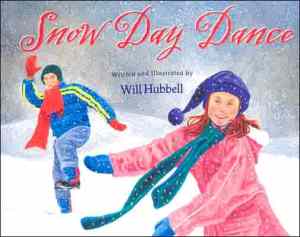 Yes, they have! Darn it, because I thought this was a charming idea for a picture book. Alas, it’s already been written. Check out “Snow Day Dance” by author/illustrator Will Hubbell.
According to my young friend, the final snow day superstition is to say a prayer before bed, so I wrote one for her…and for the rest of the kids in America who are wishing hard for a day off.
Now I lay me down to sleep,
I pray for snow twelve inches deep.
Should it melt before I wake,
I pray school’s canceled by mistake!





 Writing for Kids (While Raising Them)