 by
by Back in 2014, a picture book idea popped into my head. Luckily I jotted it down in my handy, dandy PiBoIdMo notebook. Gradually, the idea grew into a story about a girl named Chana who was miffed that everyone was mangling her name (“Shayna-China-Shawna-Kahana”). “I’m changing my name to Sue!” Chana cried to her grandmother.
“Sue’s a nice name,” said Grandma. “But did you know there was another Chana who came before you?” Grandma proceeded to tell her granddaughter all about Great Grandma Chana, her voyage to America, and her amazing qualities. Guess which name Chana chooses in the end? I titled the book THAT’S NOT MY NAME, and sent a draft to my critique group.

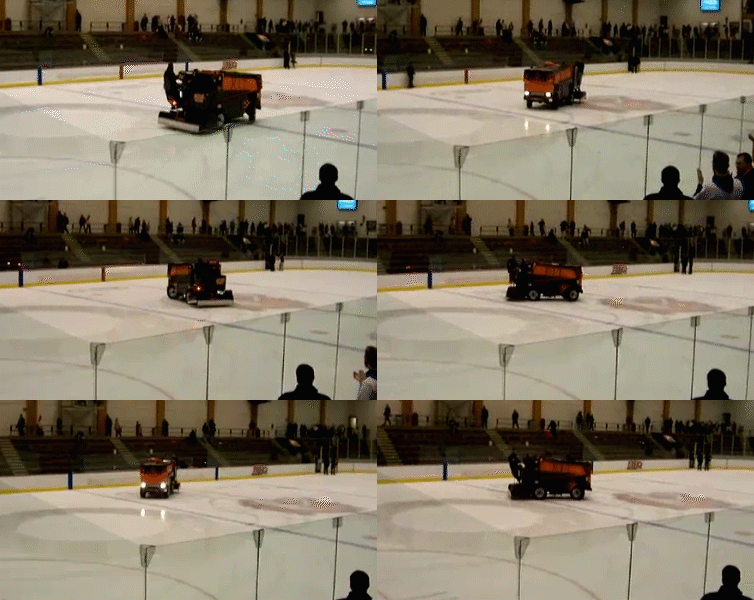
The critiques I received were lukewarm. My writing partners liked that the book drew on my personal experience. (Not a day goes by without someone bungling my name. The “Ch” is a throat clearing kh sound, like Challah bread or Chanukah, + Ah +Nah.) I had a feeling that all the Sibhoans, Seans, Xaviers, and Chiaras, of the world could relate. The book also emphasized the meanings of names and the importance of maintaining family traditions. Some of my critique partners found the story relatable, BUT . . . they didn’t like that Grandma solved Chana’s problem for her, which made the story fall flat as a pancake run over by a Zamboni.
How could Chana solve her own problem? I made about 10 different attempts at revision. In one draft, Chana scrutinized old photographs. In another she studied a family quilt. She even tried on Grandma Chana’s name necklace. But all of these ideas were BORING! I was stuck.
Then, in the summer of 2015, I read a guest post by my agent, John Cusick, on the Kidlit Summer School blog. John offered “Three Ways to Jumpstart Your Draft When the Plot Starts to Sag.” Tip #1 was a field trip. “In life, if you’re in a funk, you might need a change of scenery,” John wrote. “Chances are your characters feel the same way. Try switching up the setting.”
I love field trips. (Anything to get away from my desk.) Around that time, I went hiking on vacation with my husband in the Canadian Rockies. We were trudging two miles up a mountain in the rain to get to the Lake Agnes Tea House when BAM! It hit me.

What if I drop my character into a whole new setting and a whole new era? Inspired by the rocks around me I thought: What if Chana is a cave girl named…
WAKAWAKALOCH!
(See how I kept the Ch?) And what if she’s really steamed that her friends Oog, Boog, and Goog keep bungling her name? And what if she can’t find a T-shirt with her name on it? And what if she’s inspired to solve her own problem after looking at cave paintings of her great, great, great grandmother, the Mighty Wakawakaloch?
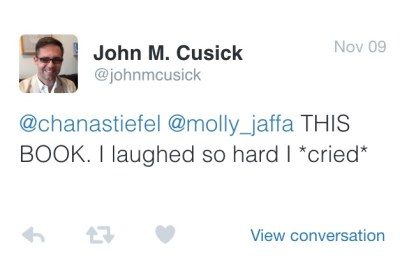
By placing my character in a whole new time and place, I had a fresh, new story with more action, more layers, and lots of humor. My critique partners gave it a thumbs up. I shared it at last year’s NJ-SCBWI Fall Craft Weekend and got rave reviews. When John read it, he tweeted:
Making your agent cry is a good thing (sometimes). We submitted the book to publishers at the start of 2016 and got the obligatory pile of rejections. And then, sometime during Round 2, the wonderful Kate O’Sullivan at Houghton Mifflin Harcourt said yes! She signed with the hilarious illustrator Mary Sullivan (author/illustrator of BALL, TREAT, and more!).
I’m forever grateful to Tara Lazar & the soon-to-be-renamed PiBoIdMo for giving me the spark to get this story started. Without my handy, dandy PiBoIdMo notebook—and the lessons I’ve learned over the years about freely jotting down ideas & then fine-tuning them—none of this would ever have happened. Stay tuned for WAKAWAKALOCH’s debut in 2019!
Chana Stiefel (back of the throat Ch-ah-nah STEE-ful) is the author of more than 20 non-fiction books for kids on topics like exploding volcanoes and stinky castles. Her debut picture book, DADDY DEPOT, will be published by Feiwel & Friends in May 2017. WAKAWAKALOCH will be published by Houghton Mifflin Harcourt in 2019. Chana is represented by John M. Cusick at Folio Literary. Check out Chana’s work at chanastiefel.com and on her authors’ blog, which she co-writes with her writing partner Donna Cangelosi, at kidlittakeaways.com.
 by
by 
 “Is there any better medium for bringing together such varied artists and writers and stories and styles? The book has not died after 500 years and the picture book continues to be the most accessible of media. It’s not a fad. It’s not obsolete technology. It is an intimate tactile entity for making ideas come alive. As long as there is paper, what better way to use it?”
 “A lot of American mothers today have become what the Japanese call “Education Mamas.” They want their offspring to start college at 12 and retire at 30, and book merchants are hell-bent on accommodating them. They have forgotten the Alice who asked for all children: “What is the use of a book without pictures or conversation?” Thanks to the conversation of Lewis Carroll and pictures by Sir John Tenniel, Alice is very much alive today. Would anybody remember Alice without Sir John?”
 “The demise of picture books is connected to other mistaken predictions like the death of the print book when e-books came on the scene years ago. There is a general backlash against electronic books because of the amount of time people are spending on their phones, online, and binge-watching TV. People need a break from screen time. Also, the e-book experience, when compared to the tactile experience of a print picture book is not significantly better. The time spent reading an actual book is still a great past time that relies on the power of imagination, and the close relationship of words and pictures.”
 “I never believed in the demise of the picture book! Picture books will always remain a vibrant art form. They are constantly evolving, constantly being reinvented as new authors and illustrator enter the field. Styles change; a new style surprises and delights, then there are imitators, and eventually something different will turn it all around again. I’ve seen a style dismissed as outdated, then a few years go by and it is fashionable again, maybe even considered classic.
 by
by 







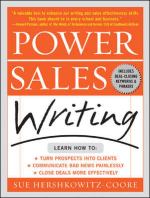 Back when I wrote marketing copy, sales letters and press releases for a living, I bought POWER SALES WRITING by Sue Hershkowitz-Coore, an eye-opening guide and the most useful business book I’ve ever read. Good business requires sharp writing.















 Writing for Kids (While Raising Them)