Want to be a fly on the wall in an agent’s office? If you were at the NJ-SCBWI conference last week, you got that kind of insider buzz. Some top agents in children’s publishing revealed what’s been sitting on their desks, and more importantly, what hasn’t been submitted.
The agent panel featured:
- Jill Corcoran, Herman Agency Inc.
- Jenni Ferrari-Adler, Brick House Literary Agents
- Rachel Orr, Prospect Agency
- Scott Treimel, S©ott Treimel NY
- Emily van Beek, Pippin Properties
- Marietta Zacker, Nancy Gallt Literary Agency
After brief introductions, the agents welcomed questions. The first attendee (OK, me) wanted to know: “What trends are you seeing in your submissions? Specifically, what are you seeing too often? And what aren’t you seeing?”
The agents were quick to say that vampires were overdone. They’re seeing a lot of fantasy, especially with werewolves and zombies–on their own but also vampire/werewolf/zombie hybrids.
Jill Corcoran added, “I’m seeing a lot of plot-driven manuscripts, but where the character isn’t fully developed.”
The agents thought that paranormal hadn’t yet peaked, while historicals were down. That’s not to say a fantastic historical couldn’t come along and raise the whole genre, but as of now, they weren’t selling well.
They also added, “please don’t send anything about bullies. We’re sick of bullies.” Seems there was a bully article in a prominent parenting magazine (or perhaps it was an Oprah episode?) which began an unwelcomed trend.
Turning their attention to what wasn’t being submitted, Marietta Zacker said, “We’re not seeing a true depiction and representation of our diverse population. Kids aren’t seeing themselves in books and that’s a problem.”
Rachel Orr said, “And please realize there should be other Chinese stories than those about Chinese New Year. And stories featuring African-Americans that are about something other than slavery.”
Scott Treimel added, “Don’t send a story about three characters from three different races that have adventures.” He said such stories tended to be stereotypical and poorly conceived.
Ms. Zacker emphasized, “Certainly, be true to your voice. But write outside of yourself. Look beyond yourself to the world around you.”
Rachel Orr commented that she sees stories about a kid who moves to a new house far too often.
Scott Treimel wondered, “Where are the stories about the boys who feel weird about their sexuality? What if the girl is aggressive for a change?”
The agents agreed that in regards to sex in YA novels, the sky’s the limit, but it must be organic to the story. Don’t be shocking just for shock’s sake.
An attendee asked if she had been rejected by an agent, but spent several months polishing the manuscript, is it acceptable to submit again?
The agents said that the writer should first look to the agent for a response. Typically, they’ll note if they want to see a revision. And a writer must put the work in before coming back a second time. Marietta Zacker said, “This sounds like common sense, but don’t forget that we remember you. We really do read submissions. Don’t make us feel like we don’t know you. Please say, ‘I sent this to you six months ago but I’ve revised it…'”
Emily van Beek chimed in with: “Remember that the world owes you nothing. You owe the world your best work.”
In regards to working with an agent, the agents said that their business is all about relationships and trust. “We’re partners in your career. We’re architects for your career. We have a design for you.”
Also remember that an agent has their favorite editors so they’re tuned to the tastes of a few dozen editors, but not all of them. It pays to shop your work around to find the best match.
And one of the agents commented that if something isn’t selling, move on. “I wonder about those people who try to sell the same story year after year. You’re a writer! Write something else.”
When the agents were asked what they’re currently working on, books they’re excited about, Marietta Zacker said they are asked this question frequently, “but we always shoot ourselves in the foot when we answer. We don’t want to pigeonhole ourselves. You shouldn’t necessarily send to us just because we liked something in particular. And we don’t want you to write to that preference, either.” Agents have a wide range of tastes. “We don’t know we want it until we read it.”
Emily van Beek talked about the importance of falling in love with a manuscript in order to represent it because they do all work on spec. “We don’t get paid until we sell it.” So her mantra tends to be, “If you can resist it, do. I know that sounds [harsh], but it’s true.” She finds projects she can’t live without. Then she has the passion to sell it.
Interestingly, she told us that Kathi Appelt’s Newbery honor The Underneath took two years and underwent eight major revisions.
Scott Treimel added, “Writing and revising are equally important skills.”
Some agents will help edit your manuscript for submission, others may not be that involved. It depends upon the agent. But remember that your agent is not a critique group. Be sure that you have reliable crit partners and that your manuscript is “polished to within an inch of its life” prior to submission.
So when does an agent know that the manuscript is ready to be submitted to editors? When do they let go? Jill Corcoran said, “When I think it’s phenomenal.”
And to end the panel, Jill Corcoran talked about endings. “I love endings that are expected, but unexpected; surprising but logical.”
And I suppose this is a logical place to end this post. Be sure to check back for more from the conference throughout this week!
 “For all those who thought E.B. White was coming. Sorry, I’m the black one. As you can see, I’m not white and I’m not dead.”
 He gave us some background on his childhood. “When I visit schools, I tell the kids that I failed 3rd grade. It levels the playing field. ‘Wow, E.B. Lewis failed!’ the kids say.” The children immediately understand that if Mr. Lewis was able to become an artist, they, too, can reach their goals.
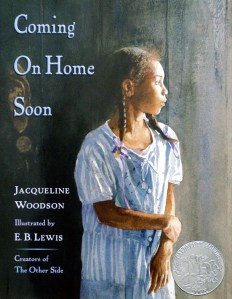
 Over the past 14 years, Mr. Lewis has illustrated 47 books at the rate of about 3/4 books a year. He has won the Coretta Scott King illustrator award four times. He won a Caldecott honor for Coming on Home Soon. He works with 14 different publishers and is currently booked through 2014. (That’s right, five years in advance. But I’m taking special note of the lucky number 14.)
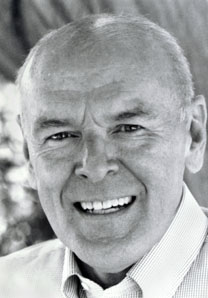 The first keynote presentation by Richard Peck, Newbery award-winning author of The Year Down Yonder, set a serious yet exciting tone for the conference. His unique voice extends beyond his books–when he speaks, he feels as big as a Shakesperean actor, filling the room, enunciating, using his entire body. (It was no surprise to learn that he belongs to a group of authors known as the “
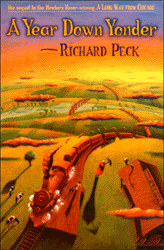 “A lot of fiction is about remembering better days.” The elder characters in Mr. Peck’s books are often patterned after the old men who frequented his father’s filling station in the 1930’s and 40’s. He recalls their conversations and makes “rough music out of real speech.” You can write in the voice of a young character, but have that young person know old people. Children want adults to be strong, but they often can’t find them.
 If you love children’s books, please participate in a new weekly blog meme:
 Jonathan Woodward’s an artist, a nomad and a soon-to-be father. The man behind