OK, so you know that I love monsters. Can’t get enough of them. Well, my friend Tiffany Strelitz Haber is here today with a monster of a story—her debut picture book, THE MONSTER WHO LOST HIS MEAN!

Some of you may know Tiffany as one of the two rhyming geniuses behind The Meter Maids (with Corey Rosen Schwartz). If you don’t, you have to check out her site, which is all about writing in rhyme. Don’t make me slap you with a citation!

Before we get riffing with Tiffing (yeah I can call her that, it rhymes), you MUST take a look at the extraordinary trailer for her new book. The Danny-Elfman-like original music, the animation—it’s all so monstrous and so much fun!
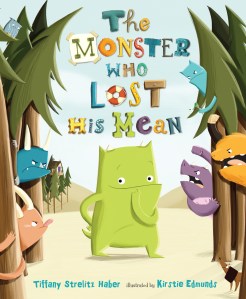


TL: THE MONSTER WHO LOST HIS MEAN is about a monster who loses his ‘M’. You know I host Picture Book Idea Month every November so I’m obsessed with the origin of ideas. Where did this idea come from?

TSH: I have always been a very visual person when it comes to words. Even as a kid, I loved the concept of homonyms, acrostics, acronyms, spelling words backwards, and even looking at them upside down. One day I started thinking about the letters in the word MONSTER, and what they might actually stand for if the word MONSTER was an acronym. From there the concept just grew and evolved, and “The Onster” was born!

TL: We’re also all about characters names on this blog. Did “The Onster” have a name before he lost his M?

TSH: Ya know…that’s a great question. I like to think that he only really found any identity at all after he lost his M. Before that he was just…well… generic, nameless, and not nearly as cool—Monster. Bleh.

TL: The Onster cooks brunch at one point in the book. I’m a foodie like you, so what’s your favorite brunch food?

TSH: Hmm…for me, picking a favorite food is kind of like bending a spoon into a perfect figure eight using just my toes (almost impossible). But in the interest of quasi-decisiveness…I’ll go with a tie. EITHER: Perfectly toasted onion bagels slathered in whipped cream cheese, lox and just a few rounds of raw, red onion…OR…a dim sum extravaganza.

So…What’s YOUR favorite brunch food? Tell us and be entered to win a signed ARC of THE MONSTER WHO LOST HIS MEAN!

You get one entry for commenting and then one entry for every place you share—blog, Facebook, Twitter, Pinterest, etc. Just let us know where you ONSTER’ed!
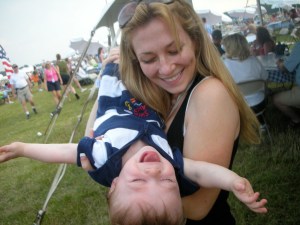
Tiffany Strelitz Haber is the author of two rhyming picture books:  THE MONSTER WHO LOST HIS MEAN (Henry Holt Books for Young Readers, July 17, 2012) and OLLIE AND CLAIRE (Philomel/Penguin, 2013).  She will eat any food she is served, be it fried witchetty grubs on a stick or calf’s brain ravioli, and loves to be high in the air or deep in the sea.  Tiffany lives in NJ with her two little monsters, Jack Dalton and Travis Hawk. Like her on Facebook. If you don’t, Tara will sic the monsters on you.

STORYTELLER: The Authorized Biography of Roald Dahl by Donald Sturrock cannot be missed, yet for two years I missed it. What is wrong with me? (Eh-hem, this is a rhetorical question, thankyouverymuch.)

Roald Dahl remains one of the most iconic children’s authors of all time, yet he began his career writing macabre short stories based upon his experience in the Royal Air Force during World War II. Just how did he evolve into the fantastical children’s author we all love?

Sheila St. Lawrence, Dahl’s literary agent at the Watkins Agency, is to thank. She realized “the ease in which Dahl could enter a child’s mind,” clearly apparent in his short story “The Wish”. In the tale, a young boy dares to walk across a carpet by stepping only on its yellow portions. Should his foot slip onto another color, he thought he would “disappear into a black void or be killed by venomous snakes.” This story was the only adult Dahl piece to feature a child protagonist to date, and it could not escape St. Lawrence’s attention.

After a disastrous two-year foray into playwriting, St. Lawrence implored Dahl to turn his literary aspirations elsewhere. Yet he ignored her kidlit suggestion, wrote stories that got turned down by The New Yorker, and instead got placed in the far less desirable (but still paying) Playboy.

Dahl’s publisher Alfred Knopf expressed interest in a children’s book, but then dropped a collection of adult stories called “Kiss Kiss” from Knopf’s 1959 list. Dahl spouted some choice words in response, threatening that Knopf would never squeeze a children’s book out of him.

Dahl once again became focused on writing for actors, as he wished to develop vehicles for his wife at the time, screen star Patricia Neal. After all, if Neal was working steadily, her income afforded him more time to write what he wanted to write. There were shows for Hitchcock and a drama series for TV based upon classic ghost stories, produced by Alfred Knopf’s half brother. But when the pilot episode encountered a controversy, the series got permanently shelved and Dahl was forced to return to the idea that evolved into JAMES AND THE GIANT PEACH.

I will say “and the rest is history” here, although STORYTELLER is only halfway through Dahl’s life story at this point. So like Sheila St. Lawrence, I implore you to turn your literary aspirations toward it.

But before I go, it would be a shame not to share with you Dahl’s advice to children’s writers, as told to Helen Edwards in an interview for Bedtime Stories exactly 42 years ago:

What makes a good children’s writer? The writer must have a genuine and powerful wish not only to entertain children, but to teach them the habit of reading…[He or she] must be a jokey sort of fellow…[and] must like simple tricks and jokes and riddles and other childish things. He must be unconventional and inventive. He must have a really first-class plot. He must know what enthralls children and what bores them. They love being spooked. They love ghosts. They love the finding of treasure. The love chocolates and toys and money. They love magic. They love being made to giggle. They love seeing the villain meet a grisly death. They love a hero and they love the hero to be a winner. But they hate descriptive passages and flowery prose. They hate long descriptions of any sort. Many of them are sensitive to good writing and can spot a clumsy sentence. They like stories that contain a threat. “D’you know what I feel like?” said the big crocodile to the smaller one. “I feel like having a nice plump juicy child for my lunch.” They love that sort of thing. What else do they love? New inventions. Unorthodox methods. Eccentricity. Secret information. The list is long. But above all, when you write a story for them, bear in mind that they do not possess the same power of concentration as an adult, and they become very easily bored or diverted. Your story, therefore, must tantalize and titillate them on every page and all the time that you are writing you must be saying to yourself, “Is this too slow? Is it too dull? Will they stop reading?” To those questions, you must answer yes more often than you answer no. [If not] you must cross it out and start again.

For me, these are words to write by. Funny that he should utter them within days of my birth! (Wait a second, did I just reveal my age?! Eh-hem, this is a rhetorical question, thankyouverymuch.)

UPDATE: Whoopsie. I looked at the wrong footnote. The quote above is from a letter Dahl wrote to “The Writer” Magazine in October, 1975: “A Note on Writing Books for Children”.

Allow me to reveal the cover of THE MONSTORE, my June 2013 picture book illustrated by James Burks!

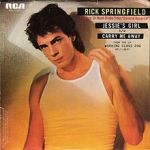
It’s so fabulous I spend hours staring at it as if I’m a 7th grade dork in love with a 1981 poster of Rick Springfield.

Forget about wishing to be Jessie’s girl, I’d rather be James’s girl, ’cause the dude seriously knows how to whiz-bang-kaPOW a picture book cover. ( Oh, Rick, please don’t take it personally.)

That’s main character Zack front-and-center with his pesky little sister Gracie popping into the frame. The hulking orange guy is Manfred, the flying monster is Mookie, and that’s Mojo with the striped, wiggling arms and crooked horns. Peeper is the little eyeball perched on the Monstore sign, although he isn’t named in the book. He’s James’s invention!

That leaves the red broom guy. And guess what? He doesn’t have a name. Well, he does because James names all the character he draws, but this monster never gets mentioned in the story.

So here’s a monster of a contest for ya: try to guess the name James gave him! If you do, you’ll win an original, autographed monster sketch by the talented Mr. Burks. If no one guesses his correct name, or if there’s more than one correct answer, the ultimate winner will be decided by Random.org UPDATE: We’re now giving away TWO sketches because y’all have come up with such great names. One to the person who guesses the name and one random winner chosen from the rest of the entries.

You get one entry for commenting and then one additional entry for each place you share THE MONSTORE cover—blog, Facebook, Twitter, Pinterest, etc. Just leave a comment letting us know! The contest closes one week from today, so get those monsterly names in!

Hope you love the cover.

And if Rick Springfield is out there, how about playing my book launch party?

Have your people call my monsters.

Last week I said if someone invented another social media site my head might explode.

Well…KA-BLOOIE!!!!

Yes, we bibliophiles have a new social domain: !

Named after the sound book pages make when thumbed, Riffle has been dubbed “the Pinterest of book discovery” by Publisher’s Weekly. Could it potentially change the way we learn about great new reads? Absolutely! Could your head also detonate? Let’s put it this way—if you ever wanted to sport a mushroom cloud, you’re in luck.

The Publisher’s Weekly article didn’t reveal much, featuring jargon-heavy quotes by Riffle founder Neil Baptista, like this beaut: “We’re going to focus on bringing the audience to the table and curating the information. There’s a ton of online expertise, and we want people to push their content through Riffle.”

So what the heck does this all mean? How will Riffle work?

Well, yours truly worked in high-tech market research for a decade (from 1993 to 2003), so I called upon one of my smartest digerati buddies to give it to us straight.

Chris Rechtsteiner is the founder and chief strategist of blueloop concepts, a boutique research and advisory firm focused on the mobile and digital media market. Chris has worked on many publishing projects, so he’s very knowledgeable about the intersection of books and digital applications.

Here’s what Riffle may be:

  • The idea is to build a truly Facebook-connected social reading group/platform. How this isn’t GoodReads is a mystery, but apparently the need to build a GoodReads 2.0 is there.
  • The company behind Riffle, Odyl, already has templated/socially-integrated foundations for bringing content about books to consumers, so they have a fast and easy starting point.
  • The core objective is to really bring forward the content being created/discussed about a book (that’s what the curation reference hits). When Tweets, Facebook posts, blog posts, etc. are posted about a title, they’ll all be “magically” brought together to give you a complete look at the “conversation” and “group” around a book. (Again, GoodReads, but with MORE noise.)
  • Odyl isn’t a novice at this stuff as they’ve been able to do a really good job of building publisher relationships, so they’ll have the “blessing” of the publishers to do this right out of the gate. (Translation: they’ll have books featured with deep, rich content day one and it will grow from there.)

And here’s how they may do it:

  • Supposedly the “curated” information (e.g. people scanning blogs, reviews, Twitter, etc.) is going to be done by experts, so there won’t be “noise” (per se) but only the best information on a particular title.
  • This means you’re going to have to have HUNDREDS of “experts” there to sift through everything in order to have any volume of books at all… which means scale is a serious issue because the books that get the Riffle treatment will be “selected” … and likely tied to the publisher relationships (read: publisher financed through marketing budgets/author marketing dollars). While that last part might not be true, it wouldn’t be surprising, as no one has yet deeply tapped the publishers’ book marketing dollars online like the brick-and-mortar booksellers and traditional media have.

(I applied for more information on Odyl, and I was asked, as an author, how much money I planned to spend on book marketing this year, so Rechtsteiner’s ideas sound spot on.)

If you had to bet your money, right now, on what Riffle ultimately does or becomes, you’re going to see a GoodReads that is a series of lists or collections of books that have a narrative by an expert. This is how the expert would really play. The question is how many people they employ (or allow?) to be experts as to how rapidly these narratives and book lists are created. And who will these “experts” be? How will they be vetted? Will they be Riffle employees, contractors (like About.com guides), or volunteers (like Wikipedia writers/editors)? All this remains to be seen.

So is anyone on Riffle now? Yes. What did we hear about it? “Pinterest for books sounds really interesting, until you realize that people don’t repin books on Pinterest today.” (True dat. The most repins I get are for recipes, home decor and fashion. Did I just say true dat?!)

So…only time will tell. But as Chris Rechtsteiner told me, Riffle is needed and welcomed. “While there are no shortage of book discovery tools and platforms coming to market today (Riffle, Jellybooks, etc.), it’s hard to argue with anyone’s efforts to make reading more prominent. I have some doubts regarding how social book reading really is (in the web’s definition of social), but one thing will remain constant and true for a while: there are simply too many titles to choose from and finding the next, best one to read [online] will remain a challenge for a long time.”

If you’d like a Riffle invitation, this link is your ticket.

Many thanks to Andy J. Smith, illustrator extraordinaire, and Chris Rechsteiner of blueloop concepts for helping me pull this blog post together while I tried to stuff gray matter back into my skull.

*Photo Credit: WENN.com

“Tara Lazar’s LITTLE RED GLIDING HOOD, with an icy twist on the familiar fairy tale, where Little Red is desperately searching for a partner in the upcoming pairs skating competition, to Heidi Kilgras at Random House Children’s, by Ammi-Joan Paquette at Erin Murphy Literary Agency (World).”

Thanks for making my announcement, Ryan. *blush*

It couldn’t have come on a better day!

This was a deal that required a lot of perseverance. It proved to me that writers should never give up on a story.

And I must say that I am thrilled beyond all beyond (is that even an idiom?) to be working with Heidi Kilgras, who has edited titles of industry legends such as Jane Yolen. WOWZA.

From the very beginning, Heidi had a particular illustrator in mind for this project. I hope to share that news with you soon because it’s pretty darn awesome!

Congratulations to all the writers and illustrators featured in PM today! In picture book news, Marilyn Sadler sold ALICE FROM DALLAS to Abrams Children’s and Susan Reagan sold PINGO AND PUFF to Hyperion Children’s.

And now, it’s time to PAR-TAY!

Photo Credit: Martha Payne

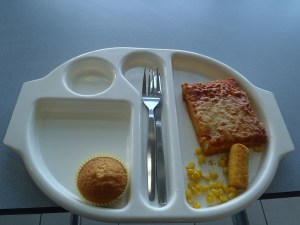
Thanks to new fan and friend John Evans, I just learned about NeverSeconds, a blog written by a nine-year-old Scottish schoolgirl named Martha Payne (a.k.a. “VEG”) who was tired of her awful school dinners. So Martha decided to photograph her meals, rate them (she counts the number of hairs included at no extra cost), and share them with the world.

A clever kid! But this story gets even better.

Once VEG’s school council got word of the blog, they banned her from taking photographs of her meals. But Jamie Oliver, the celebrity chef who has been campaigning for healthier school meals worldwide, launched a social media support crusade via Twitter. After millions of blog hits and public outcry, Roddy McCuish, the leader of the Argyll and Bute Council in West Scotland, lifted the blog ban. McCuish claimed preventing the photos from being posted was a form of censorship. So VEG is online once again.

Not only is she still posting her meals, she’s receiving photos from children and educators around the world. Plus, Martha is raising money for Mary’s Meals, headquartered in Scotland and right here in New Jersey! This non-profit organization’s mission is to feed children in the most impoverished nations.
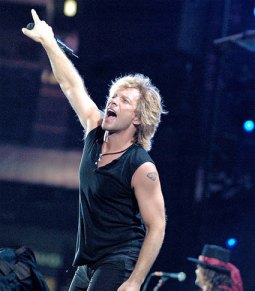
I have a passion for healthy eating, so I just had to blog about this young girl’s chutzpah! I hope you’ll support her over at NeverSeconds and maybe submit your own school lunch! If she posts your picture, VEG will even tell you how long she took to find your location on the globe. It’s a good food and geography lesson all at once!

So…just for fun…I wrote a song parody for Martha/VEG. Sung to the tune of Bon Jovi’s “You Give Love a Bad Name”, this is “School Gives LUNCH a Bad Name”. Enjoy and mangia!

School Gives Lunch a Bad Name

Your meal’s a la carte
But it’s still lame.
Martha,
School gives lunch a bad name. (Bad name.)

A “balanced” meal is what they sell
They promise you chicken but give you dry spelt.
A plain white tray with no mashies,
And globs of brown stuff that stink like bad cheese.

Oh, it’s a load of yuck!
Oh, they told you don’t blog
But Jamie told Twitter,
“You’re righteous, photog!”

Your meal’s a la carte
But it’s still lame.
Martha,
School gives lunch a bad name. (Bad name.)
We read your grade; it’s a four you claim.
Martha,
School gives lunch a bad name. (Bad name.)
School gives lunch, oh!

Bring the fork to your lips,
Pull out hair with your fingertips.
Your school cooks bad, we don’t know why.
It’s not too hard to make fresh veggie stir-fry.

Oh, it’s a load of yuck!
Oh, they told you don’t blog
But Jamie told Twitter,
“You’re righteous, photog!”

Your meal’s a la carte
But it’s still lame.
Martha,
School gives lunch a bad name. (Bad name.)
We read your grade; it’s a four you claim.
Martha,
School gives lunch a bad name. (Bad name.)
School gives lunch, oh!

I just got back from a FABULOUS 1st grade school visit! I was so excited about it that I immediately had to vlog.

While this isn’t my first vlog (that was for EMU’s Debuts), it is the debut vlog for this blog.

If you want to start doing school visits as a pre-published author, I explain the way to go about it. I think. *Warning: DO NOT APPEAR AS CRAZY AS I DO IN THIS VIDEO.*

Apologies for the ethereal lighting. I was sitting in my breakfast nook with the blinds opened. But I rather prefer the Cybill Shepherd “Moonlighting” look, don’t you, dahlings? (What, you don’t know what that means? Oh, you young whipper-snapper, go Google it.)

More apologies for the mirror writing. If I knew how to flip a video, I would. Anyone know? Help?!

And hey, wanna know more about my school visits? I’m going old-school with a CLICK HERE. (Really. Click there.)

And please remember to leave me a comment about what we should name “vlogs” instead of “vvlawwwgz”. It’s an ugly word for an exciting medium.

The title of this blog post is a misnomer because no one has a crystal iPhone to see into the future. All I can report upon is what I heard at the NJ-SCBWI conference this past weekend. But I can say with certainty there is good news, not portents of doomsday.

In fact, according to Steven Meltzer, Associate Publisher/ Executive Managing Editor at Penguin Group USA, with every new technology, from the gramophone to the radio to the TV, came a prediction of the book’s demise. But the book continued to thrive and grow despite innovative forms of electronic entertainment. And today, Americans purchase 8 million physical books daily. In the 4th quarter of 2011, Amazon’s sales of physical books rose by double digits. It surprised them, too. But you cannot give an ebook as a holiday gift. Well, you can, but there’s nothing to wrap—and more importantly—unwrap. So physical books won out in the season of giving. Plus e-book sales remain a relatively small percentage of book purchases: 26% of adult fiction and 11% of children’s books.
Moreover, 74% of today’s readers have never even read an e-book, and 14% of those who own an e-reader have never read a book on it. The digital book market, despite what seems to be the e-reader’s ubiquity, is in a nascent stage.

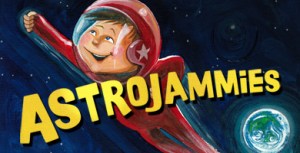
Stacey Williams-Ng, author of the digital book ASTROJAMMIES and founder of Little Bahalia, a book app developer, also demonstrated how poorly imagined some digital books currently are. A swipe of the finger on an iPad screen blew the wind in one book, but the same motion also turned the page. This meant a child playing with the app could be easily frustrated with the next page when they really wanted to manipulate a tornado.

Also problematic, the vertical orientation of most e-readers creates double the page turns of traditional picture books, throwing off the timing of a story. Creating digital horizontal spreads is preferred, but then you’re also dealing with a much smaller version of the original. Sometimes the solution is to make digital books (that do not have a hardcopy counterpart) shorter than the traditional 32-page picture book.

But Williams-Ng learned the hard way it’s difficult to do traditional promotion with a digital book. She has a great relationship with her local bookseller, but when it came time to do an ASTROJAMMIES appearance, she realized she had no physical book for the store to sell. Moreover, there was nothing to sign. Williams-Ng warned, “You need a hardcopy book to sell the digital book.” She self-published the hardcopy version of her digital creation so she didn’t have to wait years to find a traditional publisher.

Right now there are three main forms of e-books: e-pubs, which are similar to PDF files and have re-flowing text (which means you can change text format and size); enhanced e-books, which are e-pub with embedded features like audio and video; and book apps, which can be anything that can be programmed, from a movie to a game and beyond. “The sky’s the limit with book apps,” said Williams-Ng.

However, the Big 6 are picking and choosing which picture books to digitize; one publisher is no longer making e-pubs of their entire list because most e-books do not sell. The ones that are popular now are the classics like Dr. Seuss—books everyone knows. A new picture book has to lend itself to interactivity for a publisher to consider the book app investment, which can run approximately $25,000, according to Williams-Ng. So if you, as an author, WANT to have a digital book, you should think about interactivity at the very start of your creative process.

Digital publishing is about five years behind the music business in terms of figuring out new distribution and pricing models. In 2011, digital music sales surpassed physical music sales for the first time. Album sales were up for the first time since 2004. The industry is adapting. Publishing will adapt as well.

Steven Meltzer believes picture book sales will escalate because parents will buy a hardcopy book for the home, and if their child enjoys it, they’ll purchase the digital version for their mobile device. “Bundling is coming, too,” he said, referring to the practice of selling a hardcopy and digital book together at a discounted price. “It’s good news for picture book authors.” (Insert Snoopy dance.)

So what’s next for digital books? The future could be digital readers with foldable layers, multi-screened with high definition graphics. The future might even be Xenotext: “encoding textual information into genetic nucleotides, thereby creating ‘messages’ made from DNA—messages that we can then implant, like genes, inside cells, where such messages persist, undamaged and unaltered, through myriad cycles of mitosis, all the while preserved for later recovery and decoding.”

“Remember M.T. Anderson’s FEED?” Meltzer asked. “Wouldn’t it be ironic to be fed FEED?”

No matter what the future holds, “people are still writing and reading…ain’t nothing ever going to change that.”

Thanks, Mr. Meltzer, I needed that reassurance.

The contents of this post have been removed.


The contents of this post have been removed.

Like this site? Please order one of my books! It supports me & my work.

FLAT CAT is the winner of multiple state book awards, selected by kids!

Enter your address to receive this blog via email.

Join 14.3K other subscribers

My Books

Blog Topics

Archives