You are currently browsing the category archive for the ‘Picture Books’ category.
 You’ve probably heard this advice: never write a children’s story with the intent of teaching a lesson. They typically come out preachy. Kids are clever; you can’t fool them into reading a lecture.
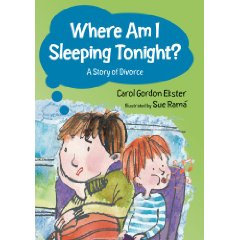
But what about writing a story with the intent of easing a child’s pain? Letting them know they’re not alone in their troubles? Carol Ekster does this beautifully in Where Am I Sleeping Tonight?, a humorous and realistic look at life as a child of divorce.
I was a child of divorce. The only books available to me in the early 1980’s were ones written by shrinks, telling kids that we weren’t responsible for the split. Well, DUH! I knew it wasn’t my fault! Whenever I got upset, people told me I wasn’t to blame, something I knew from day one. Nobody understood how I felt, knowing that the two people I loved the most no longer loved each other.
My life changed immediately and dramatically. My stay-at-home mother got a job and I became a latch-key kid, responsible for taking care of my younger brother every day after school. My father moved in with my Nana and we spent every weekend at her house, sleeping in the same room in which our Great Uncle had died. (Creepy!)
Life got frustrating. My belongings were strewn between two houses more than 30 minutes from one another. My dad didn’t know how to cook. My mom didn’t have time for us, between work, the house, and dating. (Creepier!)
Debut author Carol Ekster has filled a need in children’s books: a story for kids adjusting to divorced life, showing real situations and emotions. I wish Where Am I Sleeping Tonight? was around back then to let me know I wasn’t alone in my back-and-forth shuffle.
A niche title like this can be a great way to break into the publishing business. I talked to Carol about her journey to publication…
How long have you been writing?
About 6 years. It just came over me like an outer body experience on a July day at the beach. I went to get a pen and post-its (the only writing material I had) from my car, and started to write my first picture book.
[Lesson learned: always carry a notebook with you!]
Is this the first book you wrote?
This was actually the 20th book I wrote, but the first to sell.
[Lesson learned: you get better with every story. Don’t expect the first thing you write to sell.]
Where did you get the idea for the story?
It is loosely based on a former student who had the same schedule as the boys in the story. He touched my heart. I’ve been teaching 35 years and always had compassion for the children whose parents were divorced. I could feel their pain.
[Lesson learned: look for stories in everyday life. They’re all around.]
How many revisions did it go through?
Too many to count!
[Lesson learned: revision is your friend.]
How did you research where to submit it?
I use the “Children’s Writer’s & Illustrator’s Market,” but for this story, there was a call for submissions in the SCBWI Bulletin. Boulden Publishing was looking for books on divorce and a few other topics. I sent it out and heard back six weeks later that they were interested in it.
[Lesson learned: wow, that was quick! But Carol had exactly what they wanted! It’s all about finding a perfect match.]
How has your life changed since becoming published?
I’ve had to do book signings and promotion…none of which I ever thought about when I began writing. I was surprised how nervous I was for my first book signing. It takes a lot of time and effort, so I’m not getting as much writing done.
[Lesson learned: marketing and promotion is just as important as writing. Yes, it takes time, but it pays rewards in book sales and a solid platform from which to launch your next title. Check out agent Nadia Cornier’s recent post about her floundering novel and how she’s reinvesting herself in book promotion.]
Thanks to Carol for answering my questions and best wishes with the book. If you have questions for debut author Carol Ekster, please leave a comment!
Writers are entertainers. We immerse readers in a magical world, letting them escape with our words as a guide. If a reader enjoys your ride, chances are they’ll seek you out again. And again.
This week I read a lot about branding yourself as a writer, thanks to writing friend Jill Corcoran. The subject isn’t foreign to me, having worked in marketing for a decade. But just what is branding for writers? Developing a consistent style in your stories, offering readers a place that’s as comfortable to return to as their favorite chair. It’s not about writing books so similar that no one finds value in buying more than one. It’s about finding your niche in the publishing world and working within it.
Let’s compare this idea to chain restaurants in the US. Why are they popular? Diners know the menu, they know exactly what to expect. Olive Garden promises that the chicken parmigiana in Spokane will taste the same as the one in Cleveland. They don’t just sell unlimited salad and breadsticks, they serve predictability and comfort. Repeat diners know they’ll enjoy their meal.
People often buy the same laundry detergent, the same rice and the same cheese year after year. How many of you use the same brands your mother bought? Consumers will buy an item simply because they know it and they don’t know the competitors.
Brands also have unique qualities that make them more attractive than similar products. I prefer Barilla Plus pasta because it has added protein without a significant change in flavor. While it’s just pasta, it’s very different from the other noodles on the grocery shelves.
As a new writer in an increasingly difficult book market, developing a brand may give you an edge over the competition. When I think of Grace Lin, I think of whimsical illustrations with colorful patterns like origami paper. John Scieszka? Fairytale spoofs. Roald Dahl writes humorous, fantastical tales. Think about some of your favorite authors and what kind of feelings their name brings to mind. You want to elicit that same kind of recognition when readers think of you.
On the flip side, author K.L. Going admitted that her interest in multiple genres makes it difficult for readers to get a handle on her. At the Rutgers One-on-One Mentoring conference last October she said, “You never know what you’re going to get with a K.L. Going book.” She suggested not doing this as a new author, although she also encouraged us to write what we love.
But what if we love crossing genres? What if writing a supernatural YA mystery comes as naturally as a quiet non-fiction picture book? Perhaps you can be predictable in your unpredictability? Isn’t that a brand as well? Sure it is. But is it one you want as someone who’s trying to break into a tough, competitive business? Agents and editors tout “high concept” in novels, so why not come up with a “high concept” for yourself?
I realize that branding yourself as a writer is a complex task, especially for someone new who is still experimenting with style, genre, voice and subject matter. Stories are more complex than shampoo. You can’t guarantee thicker, fuller hair and a fresh lavender scent with each turn of the page. So what do you guarantee your readers?
Ask your critique partners what your brand might be. What perceptions do they have about your stories? What qualities in your writing are consistent? What do they look forward to when you hand them a new tale? Where does your work really shine?
You might have a very good idea about what your brand is. But remember that branding is all about someone else’s perception, not yours. You can have an image or a message you wish to relate to your readers, but are you sending it? Start asking around. Get to know your own brand so readers can get to know you.
What are you thoughts on branding for writers?
A big storm’s a-comin’, says the weatherman, pointing to a white map.
Here in New Jersey, we’re expecting at least six inches of the fluffy stuff by tomorrow. My eleven-year-old neighbor began dancing in front of my fridge and told me about her snow day superstitions: silly but important steps she must take to ensure a snow day tomorrow.
She wears her pajamas inside-out.
Sleeps with a big spoon under her pillow.
Flushes one ice cube down the toilet for each inch of snow she wants.
Eats ice cream.
And dances beside the Frigidaire.
She swears “everyone” does this. At first I wasn’t sure if “everyone” referred to her sixth-grade friends or the rest of the school-age country. Have these snow day superstitions made their way across America, much like the Mikey-of-Life-Cereal Pop Rocks and Diet Coke rumor of my youth?
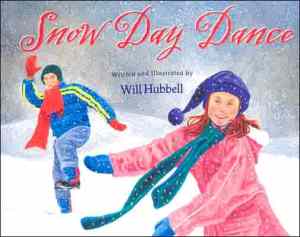 Yes, they have! Darn it, because I thought this was a charming idea for a picture book. Alas, it’s already been written. Check out “Snow Day Dance” by author/illustrator Will Hubbell.
According to my young friend, the final snow day superstition is to say a prayer before bed, so I wrote one for her…and for the rest of the kids in America who are wishing hard for a day off.
Now I lay me down to sleep,
I pray for snow twelve inches deep.
Should it melt before I wake,
I pray school’s canceled by mistake!
Tonight I attended a chat with Sean McCarthy, assistant agent with the Sheldon Fogelman Agency. Sean talked to aspiring authors about the children’s book market and how to find the right agent for your work.
It’s late and I’m tired, but you all know my obsession with taking notes! Here are just a few of the major points Mr. McCarthy touched upon during this informative session:
What’s the ideal picture book length?
Sean suggested that 500-word manuscripts tend to be a bit slim. They’re seeing the most success with stories above 500 but under 800. The 900 to 1000-word length is a difficult sell right now and he doesn’t see that changing anytime soon.
How many PB manuscripts should a new author have before querying?
His agency prefers to see at least two completed PB manuscripts. The ideal number would be five viable manuscripts. Sean said the market is difficult and there are so many variables for new authors–editor preferences vary and timing is another crucial element that’s out of an author’s hands. The one thing you can control is how many projects you have ready to go—so the more, the better. (Jack be nimble!) In other words, if you only have one completed PB manuscript, keep writing. Don’t submit yet. Sean urged “prolific-ness” as an ideal author quality.
What’s a hot niche in children’s publishing?
Sean thinks that middle grade is wide-open, with fewer and fewer boundaries, making this area particularly exciting. Sci-fi and dystopian books are a blossoming market, and he’d personally like to see more boy-friendly middle grade novels and hybrid prose/graphic projects. There’s room for mixing genres in middle grade. The biggest development in picture books is the character-driven movement. He wants to see clever and funny stories that have a clear beginning, middle and end, wherein the central conflict is resolved by the main character.
What’s cooling off?
YA has been hot for the past several years, so with the exception of Stephenie Meyer, he sees this area slowing down, since the industry tends to be cyclical.
Is it better for YA novelists to query with a series or just one book?
Mr. McCarthy said that series are tricky for a first-time author. Nine times out of ten, the 1st book in a trilogy will be the most successful. A series is not necessarily more attractive than a stand-alone novel.
Should new authors secure magazine credits before querying an agent?
Only if they are applicable to the genre you’re writing for. Publishing a literary adult short story won’t be helpful if you’re writing a juvenile novel. But he does like to see that you have been actively writing and publishing recently, even if it’s in small places.
Should new authors wait until they have an offer in hand before querying an agent?
While an offer is great and it can grab an agent’s attention, it can unfortunately lead to a “knocked up” scenario, where the author-agent relationship is borne out of convenience and necessity, not because it’s a great match. So he tends to be wary of these situations.
How is the economy affecting the children’s book market?
In the short term, it will be more difficult to place projects, since there are fewer editors. But the good news is that for the most part, children’s books have been one of the few bright spots for many publishers. He definitely thinks things will improve, although the time frame for that is uncertain–6 weeks, 6 months or 6 years…?
One last thought: Mr. McCarthy mentioned that the #1 method of obtaining new clients is by referral–either by meeting someone at a conference or by receiving a recommendation from a current client.
Writing may seem like a solitary occupation, spending hours on your own with a pen or keyboard, but like any other business, making contacts is vital to your success.
So get out there! Attend conferences. Meet editors, agents and other writers. It’s a small world…and, to borrow a phrase from the NY Lottery…”you’ve got to be in it to win it!”
I’m the Library Mom! Yes, that’s me behind the desk, collecting the picture books. You forgot yours, Jacob? That’s okay. You can still check out another. (Oh the joy on his face!)
I’m the Library Mom! I’m not allowed to kiss or hug my own daughter, so we sign “I Love You” across the room. I suggested tugging on my ear like Carol Burnett, but my five year-old didn’t appreciate the nostalgia.
I’m the Library Mom! It’s taking me twice as long to put the books back on the shelves because I’m busy reading them. Ooh, I love Bark, George! And I never saw this Mo Willems before!
I’m the Library Mom! “You’re good for a rookie,” the library aide says. “Have you done this before?” No, ma’am. I just know my alphabet.
I’m the Library Mom! It feels like 10 minutes ago I was skipping into Mount Pleasant’s library, excited to see my mother behind the desk. Aren’t I the coolest kid in Kindergarten, having Mom in charge of so many books? You can’t take one home until she stamps it. That’s my mom, you know.
In another two weeks, I’ll be there again, Miss G’s class. And I’ll be skipping through the doors just like I did 30 years ago, but this time…I’m the Library Mom!
Who doesn’t love first page sessions? Where else can you get two non-stop hours of professional, editorial feedback? They pack quite a picture book pow. (And a middle grade wallop. And a YA smack.)
But how do you get the most out of these sessions? Take care in what you submit and how you submit it. Let the editors focus on your story rather than procedure.
These suggestions are based upon the November 19 NJ-SCBWI first page session with Kendra Levin of Viking and Lauren Hodge of Little, Brown.
1. Format properly. Some submissions didn’t use standard paragraph breaks and indents. While the editors understood that these writers were eager to submit as much story as possible, the manuscripts were confusing to read. Everything ran together. Format your first page just as you would a professional submission. Honestly, you will get more out of less.
2. Use Times New Roman font. A serif font reads well. Courier, the traditional typewriter font, is a monospaced font, meaning each letter is the same width. This wastes space. If you submit with Courier, you’ll have 50% less story on your first page.
3. Research your genre. Some manuscripts felt inappropriate for the genre the author indicated. The topic, word choice and level of sophistication need to match your audience’s age. If you submit with the correct genre, the editors will spend more time assessing your writing than genre counseling.
4. Don’t limit yourself to one gender. One manuscript indicated it was for girls. If you write this on a submission, an editor will immediately think your work doesn’t have broad appeal. Let the editor decide if both boys and girls will love your story.
5. Skip the prologue. Go right to the story. Submit page one of the first chapter, not the backstory.
6. Don’t include an explanation. One picture book began with an intro about why the author had written the story, based upon an experience with her children. And here is where editor Kendra Levin was gracious and tactful. She thought the children in this author’s life were incredibly lucky to have such a playful, creative parent. But stating how children you know enjoy your work doesn’t help sell it. The story does. The intro only left room for five lines of the tale, so the editors could not comment fully. They also emphasized that if the story is written well enough, an explanation becomes unneccesary.
7. Take notes. Don’t just wait for what the editors/agents have to say about your manuscript. Listen to the comments about every page. There’s something to learn from everyone’s manuscript.
There’s more to come from this dynamic first page session. Watch for another post this weekend. And please add your own first page tips!
A few weeks ago, the hot topic here was Five Rules for Picture Books. Follow those guidelines and you might just have a winning manuscript. Or you might just have Hop! Plop! by Corey Rosen Schwartz, Tali Klein and Olivier Dunrea.
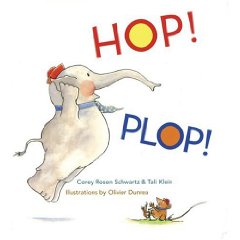 Let’s take a closer look at this story and how it fits beautifully with “the rules.”
Rule #1: Audience Age is 2-6 years old
A picture book should include situations and characters to which children this age can relate. Hop! Plop! is set at a playground. Familiar? Check. Adorable, friendly animals? Check.
Rule #2: 500 Words is the Magic Number
Hop! Plop! comes in at about 300. Check.
Rule #3: Make it Really Sweet or Really Funny
In this case, it’s really sweet and really funny. Elephant and Mouse navigate the playground together and hilarity ensues. Elephant is too heavy on the seesaw and he pushes Mouse a little too hard on the swing. In the end, the two friends discover that their favorite playground diversion is each other. Awwwww.
Rule #4: Use Playful, Unique Language
Elephant and Mouse’s foibles are expressed through onomatopoeia and rhyme. “Skip! Tip! Zoom! Zip! Mouse did a backward flip.” and “Plop! Drop! Crash! Whop! The swings were a total flop.” Totally fun to read aloud. And not too tongue-twisty.
Rule #5: Create Situations that Inspire Cool Illustrations
Picture an elephant and a mouse on a seesaw. And a mouse sliding down an elephant’s trunk. Funny situations, cute pictures. Final check.
Hop! Plop! is a delightful romp. While this book happens to follow “the rules,” that doesn’t mean other manuscripts which color outside the lines are doomed for the rejection pile. Not at all. Remember, “the rules” are merely guidelines for new writers, to help them understand what editors generally seek in a manuscript. (I should really add to the rules: there must be a story.) I can name plenty of picture books that break at least one of these guidelines, with length being the most common one. But Hop! Plop! fits all the criteria–and it’s darn cute to boot. Check it out.
Please share in the discussion by naming your favorite rule-followin’ title! Or maybe you want to point out a rule breaker, a rebel title that deserves praise!
The KidLit Comment Challenge helped me discover some boss new blogs and websites this weekend.
Everyone is talking about Wordle by Jonathan Feinberg. Input text and Wordle creates a word cloud, your very own piece of literary art, which I’m calling “literarti.” The more frequently a word appears in the text, the larger its relative size.
I had fun pasting my picture books into Wordle. Here is The Prince of Pizza:

You can change the font, color palate, direction of the words, and maximum word count. You can even link phrases with the tilde symbol (~) so they appear together. Keep in mind that Wordle’s gallery is uncensored, so it might not be appropriate for lil’ ones.
A site you will want to share with your young readers is author/illustrator Aaron Zenz’s Bookie Woogie: book reviews by kids, for kids (and their parents). Aaron and his three children, Isaac (10), Gracie (8), and Lily (5), review their favorite books from their impressive 2800-book home library. And when the discussion is finished, they share artwork inspired by the story. Aaron’s artistic talent has definitely rubbed off on his brood! Join them every Monday for a new book.
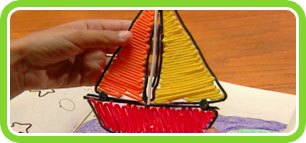 And then there’s Bendaroos. If you have a child with an insatiable artistic soul, then these colorful, bendable wax sticks promise to keep them busy for hours. You can even make your favorite picture book characters come to life by using the illustrations as a template. Your Bendaroo sculpture will lift right off the page when you’re done. As soon as ours arrive, I’ll post our creations.
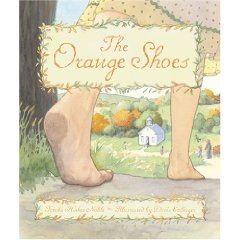 Trinka Hakes Noble once described the joy of being a children’s writer: she can relive her childhood. And not just the fun times, but the difficult ones, too. And why would that be a good thing? As an author, she has the opportunity to rewrite her own history—to take an unfortunate situation from her past and finally make it right.
She does just that in the poignant story The Orange Shoes.
Ms. Noble grew up in rural Michigan as the fifth of seven children. The hand-me-downs that defined her childhood became the inspiration for this tale.
Each child in her family received just one sturdy pair of shoes per year, and since they were to be passed down between boys and girls, they were plain loafers. At school she was teased for her boyish Buster Browns. One afternoon while browsing the sole department store in town, she set her eyes upon a pair of lovely orange Mary Janes and instantly fell in love. She does not know how they afforded it, but the next day her parents presented her with that special pair of shoes.
As a young innocent, she showed them off to the children at school so they would finally admire and compliment her shoes. Instead, the children kicked dirt on her shoes, stomped on her feet and destroyed them, leaving her heartbroken.
In The Orange Shoes, marvelously illustrated by Doris Ettlinger, the main character Delly comes from a poor, rural family who cannot afford shoes until October, when the weather demands them. And yet, Delly’s character does not feel sorry for herself without shoes. Instead, she relishes the feel of the cool earth beneath her bare feet.
Like Ms. Noble, Delly is a talented artist. The inside of unfolded, used envelopes are her canvases. Her teacher, Miss Violet, encourages her students to decorate boxes for a “Shoebox Social” which will raise money for art supplies. When Delly sees a pair of orange Mary Janes in town, she immediately wants them to wear to her school’s social, but she knows they will never be hers.
To Delly’s surprise, her father buys the shoes she so admires. The delighted young girl wears her shoes to school and her jealous classmates ruin them.
This is where Ms. Noble fixes the situation from her childhood. Delly becomes a resourceful artist, painting each crack and crease with vines, transforming bigger scuffs into flowers. She decorates her Shoebox Social box to match perfectly. At the event, her box draws the highest bid, but it comes from an unexpected source.
The Orange Shoes was easily my favorite picture book of 2007 and it deserves a place on your shelf. The illustrations and story marry beautifully, and the message is uplifting and powerful. This being said, it is a more complex tale meant for older children, making it a great snuggle-up-together tale which elicits discussion between parent and child. And those are some of my favorite moments with my kids, when we can talk about books that we love.





 Writing for Kids (While Raising Them)