You are currently browsing the category archive for the ‘Picture Books’ category.
 “I think what this fella Psy is tapping into…is the fact that people don’t want any meaning right now. The most popular music apparently is that without intelligible words…not reality, not feeling, not meaning.”
 Darn straight, readers want a good beat. What they don’t want is to be beat over the head with a lesson you think they need to learn, sly Mr. Fox.
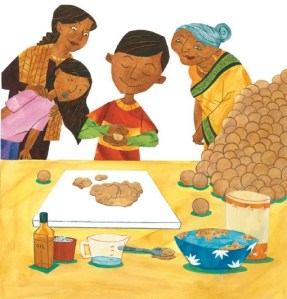
 Oh boy, do I love Indian food. Sometimes I think I oughta start a foodie blog. Samosas, tandoori, palak paneer—I can’t get enough of the spicy stuff. So when I heard about HOT HOT ROTI FOR DADA-JI, I knew I had to devour it. My nephew is half-Indian and the boy on the cover reminded me of him. But inside HOT HOT ROTI is a story about any grandfather and grandson, for the sentiments transcend culture and ethnicity. Inside is a story about memories, imagination, and the power of sharing family traditions.
I asked the author, Farhana Zia, to join us today. And stick around, because after the interview I have a copy of the book for you and Farhana’s personal recipe for HOT HOT ROTI!
What inspired you to write HOT HOT ROTI FOR DADA-JI?
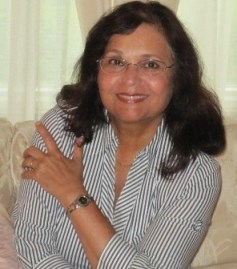 The motivation for writing HHRFDJ was a desire to do something enduring for my three grandchildren. They are pre-readers now but one day they’ll read the book to themselves and also, not far down the road, to others important in their lives and I hope that when this happens, they’ll sense the love that’s packed inside. I wrote the book to create some good memories for them. We all need warm, lasting memories. Good memories can be so comforting at unexpected times.
The inspiration for the story came from a host of such memories of childhood…memories of sights, smells, sounds, tastes and emotions that linger on and on and are comforting. Foremost among these is the memory of snuggling up to my own grandmother for her wonderful stories.
In the book, Dada-Ji gets his power from the hot, hot roti. What food is your own personal power source?
First of all, I’ll take the liberty to use the word “food” metaphorically and say that each new day, when things generally go right, is the ultimate power source for me as well as a reason to give thanks. In addition to that, as an elementary school teacher, I can truthfully say I derive plenty of power from the energy and vibrancy of my students. They keep me on my toes and competing with their exuberance every single day! A classroom is definitely an exhilarating place to be. As far as real food, I have lots of favorite power sources. At the risk of surprising you I’m going to put a steaming, tongue burning, pepperoni, mushroom, anchovy pizza at the top of the list. This is an occasional weekend treat when I’m absolutely not in the mood to cook. My husband runs down to the local pizza place and I keep the oven nice and hot! A medium rare filet that cuts like butter is a close second in my personal favorites and falls under the, “I don’t want to cook, let’s go out to eat” category. I could go on but….a fluffy, piping hot bature (deep fried leavened bread), puffed up to the size of a volley ball, with a spicy potato can hit the spot when one is very, very hungry. Trust me!
It’s refreshing to see the South Asian/Indian culture in a picture book–that’s rare in the market. How can children from different cultures relate to this story?
 I wrote the book for all children, regardless of nationality and ethnicity. While the book definitely has cultural elements, the underlying themes and attributes are universal. I like to think that the story is a testimony to the unfailing creativity and initiative present in all children.
When kids read about Aneel making roti for his grandfather, they’ll recognize their own innate inventiveness. I witness it every day in my classroom. Kids also love to take charge. They can surprise you with their cleverness and their ability to offer creative solutions. They can also be so helpful and they especially love to feel responsible. I think all young readers will recognize and revel in these traits. Besides, Hot, Hot Roti for Dadaji is a fun story mixed with a bit of fantasy and tall tale and what child doesn’t like that? The book is also very strongly a story about inter generational relationships which happen to be universal. All children know about grandparents who love to spend time with them, play with them and spoil them. Whether it’s Dadaji or Grandpa, Gramps, or Pop-Pop the relationship is the same… special and immediately recognizable. Lastly, the book is about food and kids love food, in one form, or another.
My niece me once that when she read the book in her daughter’s kindergarten, she had all kids crying out, “Wah!” Now that’s music to my ears!

Do you have a recipe for hot, hot roti to share with us?
Certainly!
Ingredients:
Whole Wheat Flour (Chapati Flour, available in Indian grocery stores) – 2 cups. Reserve 2 Tablespoons for rolling and dusting.
Salt – 1/2 tsp
Warm Water – 3/4 cup
 Method:
1. In a large mixing bowl, mix flour and salt.
2. Gradually add warm water to form a medium soft dough ball. The dough should not be too stiff, nor too sticky. Knead the dough about fifty times. Cover the bowl and set it aside for 15 minutes
3. Heat a skillet on medium heat until a water droplet sizzles and evaporates immediately.
4. Divide the dough into 8 golf ball size balls.
5. Coat one ball in the reserved four and roll it out into a thin disc (the thickness of a penny), approximately 6 inches in diameter. Sprinkle more flour on the rolling board to keep the dough from sticking to the rolling surface.
6. Shake or rub off excess flour from the roti and place it onto the hot skillet for about 10-15 seconds.
7. Flip to the other side and allow the roti to cook for 10-15 seconds until you see bubbles appear. Use a paper towel to move the roti around on the skillet for even heat distribution.
8. Flip the roti one last time. You should see scattered golden brown spots. Gently press down on various places using the paper towel. This will make the roti puff up with the built up steam. Be careful that escaping steam does not scald you!
9. Remove the roti from heat and keep it covered with a towel. Repeat the process for the remaining dough.
Hot, hot roti is ready!
Thanks, Farhana! It looks delicious!
And now HOT HOT ROTI is ready for you, too! Please leave a comment for a chance to win the book! I’ll randomly select a winner in one week. Good luck and happy eating (and reading)!
 I’ve bumped into Susan Hawk a few times lately, which is easy for me, since I walk with a cane and my balance stinks! *rimshot*
Knowing I have blog followers who are eager to snag a picture book agent, I sat down with Susan (after we bumped—yes—right there on the floor) and asked her some questions about picture books, agenting, and the surreal softness of the carpet. Was it Turkish cotton? Or do they only use that for robes and towels? (Um, scratch those last couple questions.)
Susan, what led to your decision to become a kidlit agent? Can you tell us about your professional background?
I’m lucky to have worn a number of hats within the children’s book world. I’ve been a bookseller; I have a degree in Library Science and have worked in an elementary school library as well as the Brooklyn Public Library; I acquired a few book projects for Dutton Children’s Books. But most of my background is in Children’s Book Marketing, gathered at Penguin, Henry Holt and North-South Books. All of that led to my decision to make the jump to agenting three years ago, which feels like the perfect way to put these experiences to work. But, really, I think it all began with this: I’m a reader. I love reading books, I love meeting new characters and going new places in the pages of a book, and that’s always been true for me.
 What are some of your all-time favorite picture books?
Ah, a great question. It’s hard to stop!
- ME, JANE by Patrick McDonnell
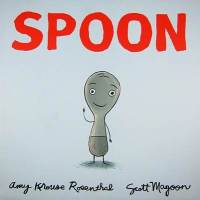
- SPOON by Amy Krouse Rosenthal and Scott Magoon
- I’M NOT by Pam Smallcomb and Robert Weinstock
- THE HELLO, GOODBYE WINDOW by Norton Juster and Chris Raschka
- SO YOU WANT TO BE PRESIDENT by Judith St George and David Small
- OFFICER BUCKLE AND GLORIA by Peggy Rathmann
- “MORE, MORE, MORE,” SAID THE BABY by Vera B Williams
 BLUEBERRIES FOR SAL by Robert McCloskey
- GEORGE AND MARTHA, or anything by James Marshall
- SYLVESTER AND THE MAGIC PEBBLE by William Steig
- MISS RUMPHIUS by Barbara Cooney
- LILLY’S PURPLE PLASTIC PURSE by Kevin Henkes
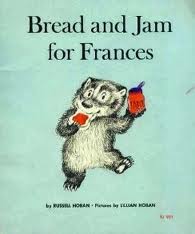
- BREAD AND JAME FOR FRANCES by Russell Hoban
- FREDERICK by Leo Lionni
What about those books make them special?
Three things: character, humor, and each of these is a very satisfying book.
In most of them, the main character is someone I love. Like, obsessively love. ME, JANE—I already think Jane Goodall is amazing, but in the pages of this book, we’re introduced to a real little girl who’s so true to her own interests, that you can’t help but be entirely charmed. Spoon features the most adorable spoon you’d ever want to meet, not to mention his smart, reassuring parents. And it goes on—every one of these books holds a real, textured person, brought to life in just a few words and pages.
Almost all of them are funny. Some of them are more broadly so, in some of them the humor lies more in a clever twist, but with all of them, I find myself smiling. A lot.
You know the feeling when you close a book and think, I can’t wait to read that again? That happens when the author and artist, together, create a perfect symphony of voice, character and plot. When everything works in concert, you finish the story feeling somehow more whole, and will want to come back to that story again. Obviously, which books do this will be different for different people, but for me, these books all give me that sense.
What do you look for in a picture book submission?
Pretty much what I described above!
Also, shorter text (about 500-600 words), and I’m not usually a fan of rhyming text.
What makes you stop reading a submission?
Predictably, longer texts, rhyming texts—I usually stop reading those. There are also quite a few “evergreen” stories, themes or subjects out there—making a new friend is one. (Here’s a list of a few others.) These can be tricky because in the right hands, they can feel fresh and new, so I’d never say that I’d automatically stop reading a story like this. Still, these texts will be competing with quite a few others out there, so I’m cautious with these.
 Is there anything you see too much of in your submission pile?
I see quite a few projects that want to teach kids a lesson. I’m not particularly interested in this, though there are quite a few picture books that want kids to understand some values—fairness, for instance—and do this quite skillfully. I guess that, in terms of message books, I want to see this emerge from the character’s journey, rather than leading the story.
What is the word from picture book editors these days? What are they seeking in picture books?
The main thing editors ask me for is strong, original characters with a compelling, meaty story. If that character has the potential to build a series, all the better. Length should be shorter (see word count above). Most editors will find something funny very appealing and are often looking for something quirky. This is harder to quantify—one gal’s quirky is another gal’s odd—but in general, I think this is about looking for something that feels new and different.
What factors go into your decision to offer a picture book author representation? (Do you offer representation based on only one picture book, or do you prefer that the author have a few ready to submit?)
Two things—I need to love the work, and I need to feel that I can sell it. Easy to explain, hard to find! Mainly that’s because it’s ultimately personal and what I may love is so different than what someone else may love. It’s best if the writer has a few books in the bag, so to speak, but not 100% necessary.
Do your rep author-illustrators? Is it best for them to query with a full dummy, or just a story and a portfolio?
I do! In fact, I’m very eager to take more author-illustrators on. I love seeing a full dummy, but querying either way is fine. My submissions information is here: http://www.thebentagency.com/submission.php.
Could you describe your ideal client?
Someone who loves their work. Writing and illustrating is amazing work, and I feel super lucky to work with children’s book creators, but it requires dedication, patience, flexibility, and some grit. You’re probably going to hear no a few times before you hear yes. Being able to balance all that against a deep love for your work, and a real pleasure in doing it, is key.
Are you open to submissions? How can writers reach you?
Very much so. Please visit The Bent Agency website to learn more about being in touch.
Thank you, Susan! I hope to bump into you again soon! Without dumping us both onto the floor. Although, it sparked a lovely, informative conversation, didn’t it?

I saw author Jean Reidy’s post this morning about donating a picture book critique to benefit One Fund Boston and thought it was such a wonderful thing, I offered to join in. (And now Tammi Sauer joined us! That’s AMAZING!)
Please visit Jean’s blog and bid! The top three bidders win!
Or, if you don’t wish to win a critique, click the flag to donate directly. As Audrey Vernick said, “You’ll win a good feeling.”
 SORRY FOR THE DELAY!
Geesh, I am full of apologies lately. I’m so far behind in everything, which might not surprise you if you read my Emu’s Debuts post about “balance” being overrated. Being a mother, an author, managing my book launch and Multiple Sclerosis…phew. Wanna be an intern? Inquire within. Better terms and conditions than Kramerica Industries!
First I’d like to THANK YOU for backing my friend Ryan Hipp’s Kickstarter project, LITTLE STEPS. Ryan has exceeded his goal with more than a week to go. HIPP HIPP HOORAY!
Next, here are the winners from the past two giveaways! (Selected with the help of Random.org.)
WATCH YOUR TONGUE, CECILY BEASLEY by Lane Fredrickson:
Tina M. Cho!
NUGGET AND FANG PRIZE PACK from Tammi Sauer:
Laura Dineen!
CONGRATULATIONS! Watch for an email from me.
And that’s all folks. But stay tuned—lots of book reviews coming soon, including a rare “poisonous” foray into YA fiction! I’ll also be walking you through what it takes to plan a book launch, which today includes getting quotes for COOKIES. Sweet!

 Got a great creative project? Kickstart it! Author-illustrator Ryan Hipp did!
Kickstarter.com is a website that enables artists to pitch a project, collect pledges in exchange for incentives, and finance their creative endeavors.
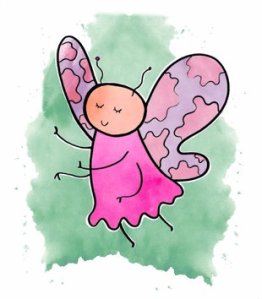
My friend Ryan Hipp recently went through a personal crisis and emerged triumphant on the other side. He translated that experience into a delightfully charming story, LITTLE STEPS: “Thru the short life-cycle of a caterpillar, we learn life is difficult, yet precious.” In order to bring this project to life, Ryan turned to Kickstarter, and he’s here today to explain the genesis of LITTLE STEPS and his Kickstarter experience.
He’s only a few hundred dollars short of his goal, so I hope you’ll consider backing LITTLE STEPS, too! (I did!)
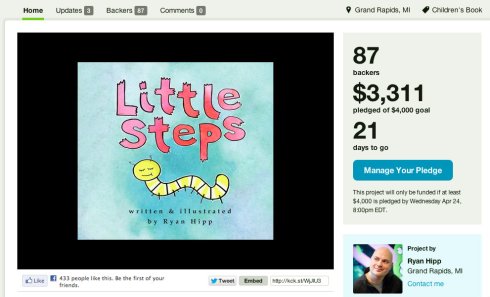
Ryan, what inspired you to create LITTLE STEPS?
Great Question. Normally, I struggle and struggle to come up with an idea for a good story. But when the idea for LITTLE STEPS came to me, it came to me when I needed it the most, and came to me quite clearly. LITTLE STEPS wasn’t part of my plan, but, in a way, that is exactly why it was a perfectly-timed inspiration for me. It was at a point in my life where my plans all fell apart. I’ve had a pretty carefree life up to a point. I guess I had been living my life thinking I was in a protective bubble, and couldn’t see that it was about to pop. Then my life really changed abruptly without warning, and I was a mess after. During the time trying to pick up the pieces and rediscover myself, it dawned on me there was a way to universally sharewhat I learned on my journey through the power of words and pictures—what I know best.
 How did LITTLE STEPS become a Kickstarter project?
I knew this project I needed to keep pretty close to my chest. Being much more of a personal expression of myself than any other work I have done, I just didn’t want to expose it to the familiar channels of traditional publishing like my other books. I had to do this one on my own. So that was when I thought of Kickstarter. Kickstarter is allowing me to create the book the way that I need to and 100% on my own terms.
Beyond the Kickstarter seed fund, what are your goals for LITTLE STEPS?
My goals for LITTLE STEPS is to help people. Especially families. If I did my job right, the book will resonate just as much with adults as children. I think LITTLE STEPS carries so many strong themes that anyone can relate to. Life can be really hard, and I tried to make the symbols in the book be applicable to all the myriad struggles, fears, roadblocks, and hardships that we all face. I want LITTLE STEPS to inspire those that read it to overcome anything that is thrown at them. To overcome adversity stoically and be better people when they get to the other side. Life is short, and precious, and we should not waste a single day.
 What are some do’s and don’ts you learned about Kickstarter projects?
I have learned a lot about Kickstarter. I meticulously scrutinized before pressing the “start” button, but after dotting my I’s and crossing my T’s for the Nth time, I just decided to roll with it. The best advice I can give is use your network. Start with your social media, your friends and family—and then watch the chain reaction. Word-of-mouth is all you really have with a project like this. The biggest “don’t” I learned is don’t assume your audience understands how Kickstarter works. I try to make it really clear to all that if I don’t hit my goal by the deadline, I lose all the pledges. I try to let them know that it is not a donation, but a pledge—a trade for cool incentives. I also try to let people know that a pledge today only gets charged if the project is a success. Anything you can do to ease people into a pledge helps. A lot of people have intentions to pledge, but the secret is getting them to take the action. Everything rides on the supporters.
Is this a great time to be a creative, or what?!
I think in our modern world, it’s becoming much more obtainable for those who want to shine their light on the world to do so. Technology is a gift of opportunity for those brave enough to take their hopes, dreams, and ambitions into their own hands. I say, be creative first. If you make something truly great, the rest will work itself out.
Thanks, Ryan, for letting us know about your worthwhile project and giving us a behind-the-scenes glimpse at Kickstarter.
You can learn more about Ryan at his website HippHop.com or pledge your support for LITTLE STEPS at Kickstarter.com!
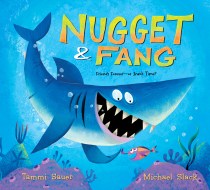 Dudes, it’s new Tammi Sauer! YES!!!! *Jersey fist pump*
Ya know Tammi, right? She’s the most prolific picture book author this side of the Atlantic! (And that side, too.)
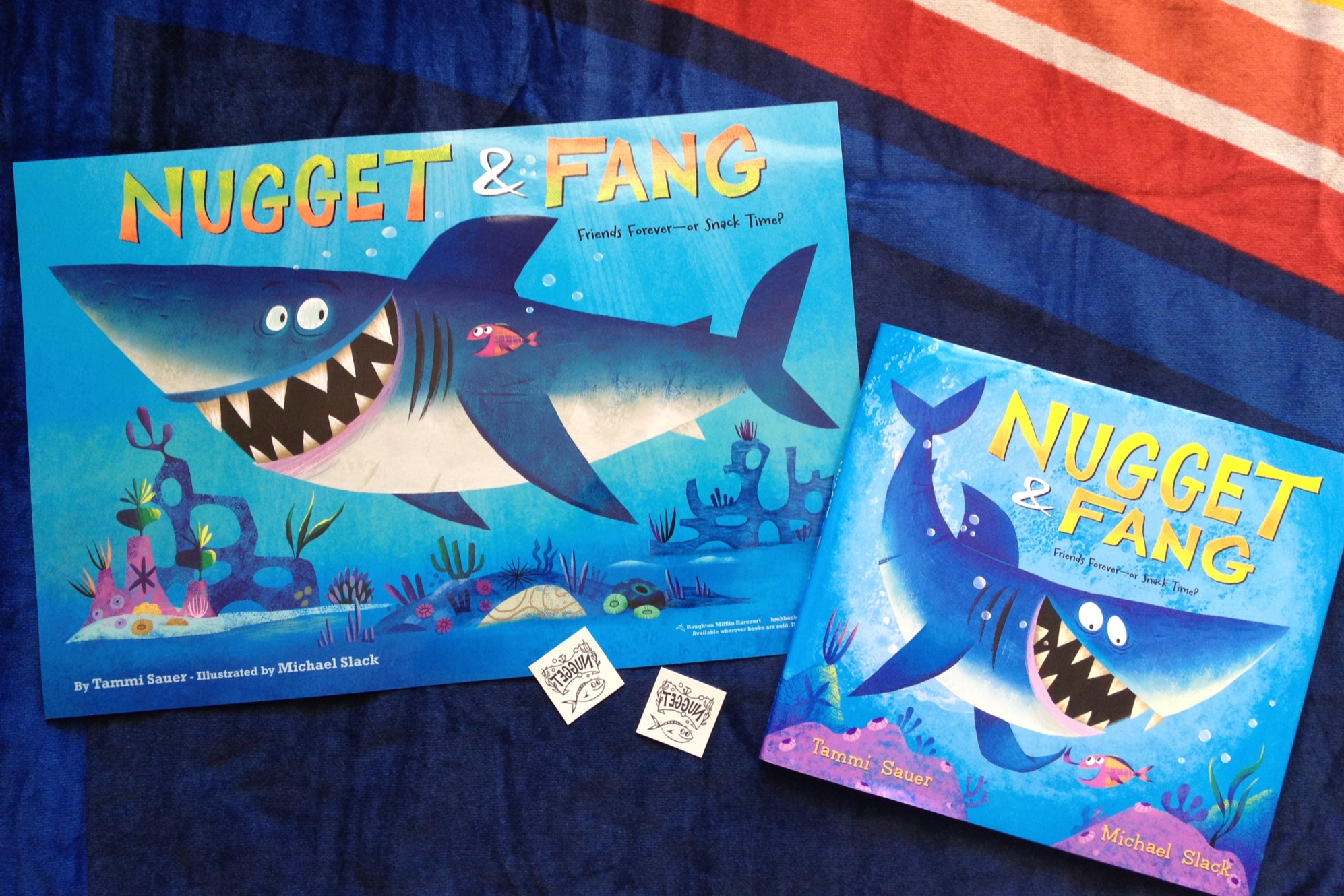
An annual contributor to Picture Book Idea Month, Tammi has dispensed invaluable picture book pointers about story structure, celebrating the weird stuff in life, and putting a twist on the familiar. She’s also a regular PiBoIdMo participant, and NUGGET AND FANG is her success story from the November 2009 event!
So the unlikely underwater duo are here today to chomp away! (Don’t worry, Tammi’s here, too. Fang didn’t gobble her up.)
Tammi, what about unlikely friendship stories makes them so fun to write?
If two characters are at odds in some big way, that immediately builds in tension and offers real deal conflict. This can provide great opportunities for humor, too. That’s fun stuff! Some unlikely friendships deal with issues such as neatness versus messiness or quiet versus loud. The quandary that my characters face is clear–sharks and minnows aren’t supposed to be friends because everybody knows sharks EAT minnows.
Sharks are popular characters these days! What makes FANG stand out in the world of storybook selachimorpha? (Yes, that is a real word. I looked it up. Honest.)
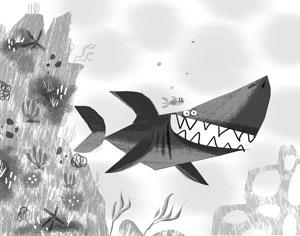
Michael Slack’s first sketch of the carnivorous chums.
I love that I have a contender in storybook selachimorpha. It sounds super sophisticated. As for Fang, he stands out among regular sharks because he has a huge heart. Yes, he’s toothy, but, holy mackerel, my guy is irresistible. If I were a minnow, I’d be honored to be his friend.
What are some of your favorite unlikely friendship stories/books?
My Favorite Unlikely Friendship Story of 2012 was BOY + BOT by Ame Dyckman, illustrated by Dan Yaccarino. That book is brilliant in 2,465 different ways. Plus, Ame has blue hair. (Tara’s note: sometimes it’s pink or purple, or even rainbow leopard.)
A fun and endearing unlikely friendship story that just came out this past February is WOOBY AND PEEP written by my oh-so-fabulous critique partner Cynthea Liu, illustrated by Mary Peterson. (Hey, WOOBY AND PEEP are coming soon to a blog near you. Umm, this one.)
If NUGGET and FANG could endorse their book personally, what do you think they would say?
Nugget: Holy mackerel! Get your fins on this book. It’s FANG-tastic!
Fang: Sink your teeth into our book. It’s a total NUGGET of awesomeness!
Well, I’ve got a nugget of awesomeness for you, dear blog readers: a “NUGGET AND FAN” (not a typo–you’re a fan already, right?) prize pack, including a signed first edition, a teacher’s poster, and adorable tattoos you can slap on any fin (or bicep). Just leave a comment or question for Tammi to enter and a winner will be chomped up later this month! In the meantime, go visit these seaworthy sidekicks!
Wow, that’s kinda unheard of, isn’t it? A debut deal for TWO picture books?! I’m blown away. I know you are, too. So let’s meet the NOT UNTALENTED Maria Gianferrari!
I met Maria online a couple years ago when she signed up for PiBoIdMo. She’s also purchased my jewelry. And now she’s represented by Ammi-Joan Paquette, which makes us agent-mates. I mean, we’re practically sisters at this point, right?
OK, I will stop asking questions and give answers now. How did Maria land her agent? What is the two-book deal about? (Oh wait, that’s more questions, huh?)

Maria Gianferrari’s debut PENELOPE, UNTALENTED, focusing on a girl who’s having a difficult time deciding on what talent she might have (if any!) to put on display for her school talent show; with a little help from her dog, she tries out various talents with disastrous results — until she realizes that she and her dog have a talent to share that’s unique to them, to Cynthia Platt at Houghton Mifflin Harcourt Children’s, for publication Spring 2014, in a two-book deal, by Ammi-Joan Paquette at Erin Murphy Literary Agency.
Now take it away, Maria!

Maria…on the path to publication!
I first met Joan in 2009 at the PEN New England Susan Bloom Discovery Award ceremony. I was lucky to have been chosen as one of the winners for one of my nonfiction picture book manuscripts, and she introduced herself to me. At the time, I only had two submission-ready picture book manuscripts (and several in progress) so the timing wasn’t right, but she told me to keep in touch.
In May 2011, I saw Joan briefly at the New England SCBWI conference and she encouraged me to send her some manuscripts. We were getting ready to drive cross-country and live in San Diego for a year for my husband’s sabbatical, so I told her I’d be in touch at the end of the summer. I sent her a bunch of picture book manuscripts in late August, and then I heard back in October that she liked several of them, and asked me to revise two of them. I did two rounds of revisions for Joan, with the able assistance of my online critique group (Go CP!), and in late August 2012, I became her client. I felt overjoyed, and very lucky again, because Joan took me on based on my picture book manuscripts, knowing it would be more work, because there would be multiple editors involved. Ultimately, she told me that she had to have them on her list, which was a very nice compliment.
Joan began sending out three of my manuscripts almost immediately, and I began to receive some lovely rejections, and even a couple of revision requests. I was coming home from picking up my daughter at school, when I heard a voice on the answering machine. I picked it up and to my great surprise and delight it was Joan telling me we had an offer from Houghton Mifflin for my fiction picture book PENELOPE, UNTALENTED! I must have sounded like a complete and total idiot. All I could say was “Oh My God” about a thousand times.
Meanwhile my 11 year-old-daughter, Anya, was screeching in the background—“Mom—what is it? Who is it?”—so I told her that I sold a book. Then if I’m remembering correctly, I think Joan asked me if I wanted to sit down, so I did, and then she started telling me that I got a two-book deal! I was completely flabbergasted. Most of the conversation was pretty hazy, but I do remember thanking her, and telling her that this was beyond my wildest dreams—it was & is! After we hung up the phone, Anya and I did a happy dance in our living room. Our dog, Becca, thought we were nuts. The hardest part was having to wait to share my news because Joan had a hard time getting in touch with the other two editors to whom it had been sent since both had been out sick—flu season!
The lovely Cynthia Platt is “my” editor at Houghton. I live in the Boston area, so we recently met for lunch, and I was also able to meet Mary Wilcox and Monica Perez. It was so surreal that they knew my MC Penelope, and were excited about the book! I’m really looking forward to working with Cynthia on both of these books, and to finding out who will be chosen as the illustrator!
Thanks for sharing your success story with us, Maria!
Now aspiring picture book authors, what does this teach us? Patience and perseverance is key! Maria first met Joan three years before she became her client. Make those connections and keep in touch! Take advantage of SCBWI events (like the NJ Chapter’s annual conference in June) to improve your craft and network with agents, editors and fellow kidlit professionals. It all pays off!
 OK, silly title. And if anyone under 30 reads this post, they’re not gonna get the reference to Moon River.
But heck, I like it, because your smile will be wider after you visit RhymeWeaver…
Many kidlit writers hear “don’t rhyme” from picture book editors. It’s not that editors hate rhyme (well, maybe SOME do), it’s just that they see badly-executed rhyme so often in the slush, it’s easier to discourage it. Common rhymes like “me, see” and “you, two” and other one-syllable predictability can kill the joy of a story.
 Remember “Celebrity Apprentice” when the men’s team gleefully authored “I know my A, B, C’s and my 1, 2, 3’s” as if it hadn’t been regurgitated in a googolplex of board books? They thought it was a rhyme worthy of victory and publication. Well, they did win the challenge, but the book Trump promised to publish was released by a vanity press, not a traditional publisher. No publisher was gonna touch it, ten foot pole or not.
Editors also see a lot of rhyme with flawed meter. Meter is a tricky thing. There’s stressed and unstressed syllables, plus the lilt of natural speech patterns that can render your meter more choppy than Zoanette Johnson’s drumming. If you read your own rhyme aloud, you might not even hear how off it is, because you are forcing yourself to follow the pattern [you think] you created.
Then there’s the near-rhyme mistake, when the words don’t really rhyme at all, unless you twist your tongue or alter your accent. Like “hat” and “what” or “hat” and “back”. Once or twice and you can maybe get away with it. More than that and the editor may assume you need the WaxVac.
Moreover, writers can find their story dictated by rhyme, getting trapped in nonsensical situations simply because “dishwasher” rhymes with “impostor” (almost). It’s obvious when a plot decision has been forced based upon one word.
For these reasons, editors will advise, “don’t rhyme”.
For these reasons, author Lane Fredrickson created RhymeWeaver.com.
 Lane is the author of WATCH YOUR TONGUE, CECILY BEASLEY, a rhyming picture book with a joyfully jaunty rhyme. Remember as a child when you stuck out your tongue and a parent warned, “It will get stuck that way!” Well, Cecily finds herself in that very predicament. Hilarity ensues when a bird takes up residence on Cecily’s perfect pink perch. What’s Cecily to do?
Knowing the difficulty of rhyme for picture book writers, Lane created RhymeWeaver.com to teach the bard-challenged the complexities of rhyming well.
Lane, your rhyme is perfection! How did you get to be so good at it?
Ha. Thank you, Tara.
The short answer would be: a gnawing question and a genetic glitch.
But there is also the long answer. When I first joined SCBWI, everybody seemed to be telling everyone else NOT to write in rhyme, like there was a disease associated with it. You know, literary sarcoma or writer’s blockjaw. You almost didn’t want to admit you were a rhymer lest they sit in some quarantined section and slap a scarlet R on your forehead. The other thing I kept hearing was that a person’s rhyme had to be PERFECT. I wanted to write PERFECT rhyme, but I could never get a really good answer as to what PERFECT rhyme was. This is the kind of scenario that drives a slightly obsessive-compulsive person to behaving obsessively compulsive. So I googled around and studied my Seuss and found a website that offered critiques for $50. The critique, although well-intentioned, was just plain bad advice involving “counting syllables.” And don’t get me wrong, I’ve definitely given bad advice (but I’m pretty sure it was free when I did it). I totally get that sometimes bad advice seems good because it comes from multiple sources, but “counting syllables” is not the way to perfect meter and I had (being slightly obsessive compulsive) already figured that out. So I went back to school thinking I’d take a poetry class and clear up the PERFECT meter issue. But the thing about college is they don’t tell you what you want to know, they tell you whatever they want to tell you. So it took a BA in English and healthy stab at an MA in British Lit to figure it out that meter is a lot of things, but PERFECT is rarely one of them (I only stabbed at the MA, I haven’ t killed it yet).
 What inspired you to put all your rhyming knowledge into a website?
I watched a lot of people go through exactly what I went through: trying to figure out the rules, trying to decide if writing in rhyme was worth the stigma, trying to find complete resources that explained everything. I have a degree in psychology, where I focused on cognition and development (which is the opposite of those people who ask you to talk about your problems). Cognitive and developmental psychologists look at how people think and how they grow, mature, and learn. I knew that I could show meter in a way that’s visual and image-based. I knew that I could break it down into constituent parts in a way that I had never seen done. I knew that I could make it easier to grasp. But I wanted it to be free because I’m trying to improve the status of rhyme in the literary world and the more people who rhyme well, the less it looks like I have a disease.
Lane’s website has already helped this ruined rhymer who can’t hear meter even if I got whacked upside the head with it. So I encourage you to pay RhymeWeaver.com a visit, Pin it, share it, study it, LIVE IT. Children deserve better rhyming picture books like CECILY BEASLEY.
And hey, you can WIN CECILY! Just leave a comment telling me about the most interesting thing you learned at RhymeWeaver.com. A winner will be picked randomly in a week (or knowing me and prize distribution, two weeks).
So don’t hesitate, get out there and rhyme, oh Kate! (Sorry if your name isn’t Kate. I had to end on a rhyme.)
Before you click the back button, thinking you’ve arrived at the wrong blog, let me assure you…I DO NOT hate picture books.
And neither does Timothy Young, author-illustrator of the new picture book I HATE PICTURE BOOKS! It’s his main character with the picture book problemo.
I will let him explain…
 In November I was a guest blogger for PiBoIdMo and I told a brief version of how I had the idea for I HATE PICTURE BOOKS!. I was at the NJSCBWI 2011 summer conference where I was on the faculty. I taught a seminar about creating pop-up books and sat on a panel with some of the other authors in the KidLit Authors Club. I attended a couple of the other seminars while there, including “Finding The Funny Stuff” with Audrey Vernick and Olugbemisola Rhuday-Perkovich. They were talking about parody (I love good parody) in children’s books and Olugbemisola made a very funny comment about Paddington Bear’s immigration status.
That’s where things got rolling. I’ve always loved good parody but I hadn’t really thought of doing a parody book. There have been some really good ones lately like Michael Rex’s THE RUNAWAY MUMMY and GOODNIGHT GOON. So sitting there I started thinking, if I were going to do a parody what would it be? Images of classic books started running through my head and I thought, there are too many to choose from. Could I do something that used a bunch of books instead of just one? Somewhere in my thoughts appeared this kid, this boy who misinterpreted what he was reading. He was angry about it and he yelled “I hate picture books!”.
I have to say I really liked that title. It had a great hook and I thought “there’s a title readers will notice”. It has to be a good story with a title like that. I thought of all of the books this boy would be angry at. I thought of the kind of trouble he would get into based on what he read. I was really enjoying the process.
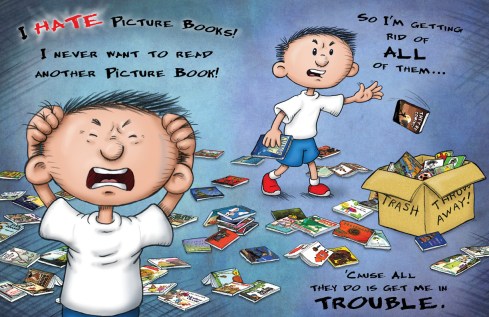
I had the beginning of the book really fleshed out, I was even designing spreads in my head. Having the boy (he was eventually named Max) appear in the books he was talking about, and illustrating him in the style of classic illustrators really excited me.
I then came up with the idea of having lots and lots of books lying on the floor and I couldn’t wait to get home and start drawing some of the scenes I was working out in my head.
So this story pushed it’s way out of my head. Once I got home from the conference I began furiously drawing. I designed my boy and started drawing him onto the scenes I was developing. I went to my local library and checked out dozens of books. (I’ve dedicated this book to my mom and to Rosemary Morris, the children’s librarian at the Talbot County Library). I’ve had an ability to mimic other peoples styles which I’ve developed working in the toy industry with licensed product from Disney, Henson and other famous character brands. I knew I had to go the New York in August for 2 weeks so I gave myself a deadline to have a rough dummy ready for then.
I made my deadline and set up some meetings. I got a very good reaction from a number of people who’s opinion I really respect. I HATE PICTURE BOOKS! was sent out to a number of publishers by my then agent, and was turned down (nicely) by all of them. In November I was introduced to the good people at Schiffer Publishing. I submitted it along with SHADOWS ON MY WALL, THEY’RE COMING! and another book. They came back to me quickly saying they wanted all four. Since SHADOWS ON MY WALL and THEY’RE COMING! were almost ready to go they were put into the schedule right away. I then had 6 months to finish all of the illustrations for I HATE PICTURE BOOKS! and here it is coming out in a couple of weeks!
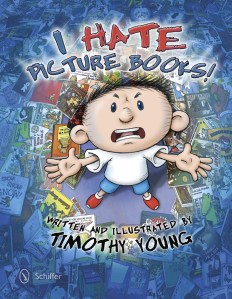
I’m having a book launch event at Books of Wonder in NYC on March 2nd (Dr. Seuss’ Birthday!) from 1 – 3 pm. If you can’t make it and want to get a signed copy, you can order one from my Kickstarter campaign until Sunday, February 17th when the campaign ends. You can see a video there of me reading the first few pages of the book.
I’m also having a contest on my website, www.ihatepicturebooks.com. If you can recognize and name 40 books from the over 250 classic and modern picture books referenced in it you can enter to win over a dozen signed books that appear in my book. They are by authors and illustrators you’ve actually heard of.
Thanks, Timothy!
I definitely cannot wait to get my hands on this one.
How about you?








 Writing for Kids (While Raising Them)