You are currently browsing the category archive for the ‘Picture Books’ category.

 A few years ago, my sister in agent-hood Pat Zietlow Miller asked if I would take a peek at her manuscript. That manuscript turned out to be the newly-released WHEREVER YOU GO. I immediately knew it would be a beloved hit because of its lyrical text and universal theme, but once Eliza Wheeler signed on to illustrate, I became certain her art would exponentially elevate WHEREVER YOU GO into the stratosphere. (Don’t you wish we had flying cars to take on that trip?)
Since this blog loves to talk about how ideas originate, I asked Pat and Eliza a few questions about the path to this book’s publication. (Get it? THE PATH???)
Pat, what was the genesis of WHEREVER YOU GO?
This book started when I was at work and a few lines of random poetry popped into my head:
Over a hill, under a bridge, deep in a dale, high on a ridge …
I liked the way the words sounded, so I emailed them to myself at home and started working with them to see where they could go. (Ha! See what I did there?) I realized that the words described places roads could go, which got me thinking about other places roads could go, which led to a first draft of the book.
But, I felt it needed something more. Some heart. So, I set it aside and proceeded to do something I do really well. Worry about my children. This time, it was my oldest daughter. She was growing up so fast! In a few years she wouldn’t even be living with us! Was she ready to be on her own? Would she make good choices?
After some time, I realized that could be the heart my book needed. All the places roads could go also could represent life and its many choices. So I revised my draft keeping all the things I wanted my oldest daughter to know in mind, and that became the book that sold.
And it came out this spring, right before her high school graduation. I could not have planned that, but it was perfect timing.

Eliza, as the illustrator, how were you approached for this project and what attracted you to it?
Connie Hsu, the book’s editor at Little Brown at the time, sent the manuscript to my agent with the loveliest email introducing the project. When I read it, I could see the pictures flowing in my imagination. This is a dream text for an illustrator; no frivolous details or lengthy descriptions—a blank canvas for the art to tell its own part of the story. But I didn’t say ‘yes’ right away, because I could see two directions this story could take: 1) The story of life’s roads, or 2) A cars and trucks book. I wanted to make sure that my vision of it as the first direction was also what the publishing team envisioned, and I was happy to hear that we were all on the same page about staying true to the deeper meaning under Pat’s text. I found out later from Pat that this was a deciding factor for her in choosing Little Brown as the publisher, so it seems it was all meant to be!
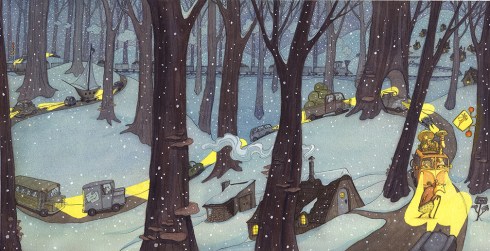
Any creature could be the lead character traveling these roads. What made you select a bunny on a bike?
I did try a few different animal choices while doing character development, and it came down to a cat, owl, and bunny. These animals in particular are all pretty cute, but in the end the bunny felt the most age-less and gender neutral. The editor and art director also loved the idea of the bunny’s ears flying behind him/her to help emphasize the motion of the bike. That’s how we landed on the bunny!
Oh, so it really had nothing to do with your last name being WHEELER?
Hahaha! Maybe that was the whole subconscious reason! You can change my answer to that. 😉
Pat, what do you hope the child (and adult) reading this book will take away?
The message I’d like people to take away is this:
Life isn’t a straight line.
It’s good to have goals in life. It’s good to pursue them and to celebrate when you reach them. But, there will be unexpected detours along the way. Those detours may take you somewhere greater than you ever expected, or they may lead you somewhere you never wanted to be. But, either way, you can chose how to react to where you end up and to take a different path if you’re not happy with your current location.
A long time ago, I read that the most mentally healthy people are the people who see the most options in their life because they can get unstuck from the nasty places more easily than people who can’t envision a different future. So I hope readers will internalize the message that they’re in charge of their own lives and that they always have choices about where they want to be.
*SNIFF* *SNIFF* *BLOW*
That’s a beautiful message, Pat. And it’s one that’s true for writing as well as life. No career is a straight line. It’s rather bumpy. But hold on and you will indeed get the ride of your life!
Thank you, Pat and Eliza, for sharing your journey (GET IT AGAIN???) and for offering the book and an art print from Eliza as prizes to our blog readers!
To win a copy of WHEREVER YOU GO, just leave a comment below. One comment per person and a random winner will be chosen at the end of June.
To win Eliza’s print, take a photo of you with WHEREVER YOU GO and post it on Twitter with the hashtag #whereveryougo. A random winner will be selected at the end of June.
Good luck!
 by Tammi Sauer
Psst. Hey, you there. Yes, you. Do you want to wow an editor with your next picture book manuscript? Great!
It only takes one thing. Come up with the next Fancy Nancy, Olivia, or Skippyjon Jones. Editors are wading through their slush and/or agented submissions in the hopes of finding an irresistible, can’t-put-down, character-driven manuscript. They want manuscripts that make them feel something and a great character can do just that.
Examples of strong characters in picture books:
OLIVIA by Ian Falconer
Olivia is a feisty little piglet who has too much energy for her own good.
FANCY NANCY by Jane O’Connor
Nancy is very into fanciness whereas her family is not.
SKIPPYJON JONES by Judy Schachner
Skippyjon Jones is a little kitty with a big imagination.
A PET FOR PETUNIA by Paul Schmid
An exuberant Petunia wants, wants, wants a pet she really shouldn’t have.
DINOSAUR VS. BEDTIME by Bob Shea
The seemingly unstoppable Dinosaur is very much into his own bad self.
CLARK THE SHARK by Bruce Hale
Clark has super-sized enthusiasm which leads to all kinds of mayhem.
Developing a unique and engaging character like the ones listed above, however, is a huge challenge.
When I’m working on a new picture book manuscript, I remind myself that if people don’t care about my main character, they won’t care about my story.
I always keep A.R.F. in mind.
A stands for Active.
I want my main character to be doing something. No one wants to read about a kid who just sits on the couch all day with a bag of Doritos.
R stands for Relatable.
I want my main character to connect with readers. I want readers to think, “Yeah, I know what that feels like.”
F stands for Flawed.
I want my main character to have some sort of flaw. Nobody longs to read about little miss perfect. Yawn. Perfect is boring. A flawed character is much more interesting. A bonus? A flaw often increases the story’s tension and makes the character more endearing and root-worthy to readers.
In my latest book, GINNY LOUISE AND THE SCHOOL SHOWDOWN (Disney*Hyperion), illustrated by Lynn Munsinger(!!!), Ginny Louise is the new kid at school.
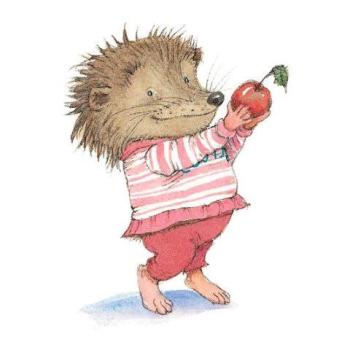
But Truman Elementary is no ordinary school. This is made clear at the very beginning of the book:
The Truman Elementary Troublemakers were a bad bunch.
Especially these three: Cap’n Catastrophe, Destructo Dude, and Make-My-Day May.
Day after day, these scoundrels made waves.
They dodged danger.
And in the classroom?
You don’t even want to know what went on.
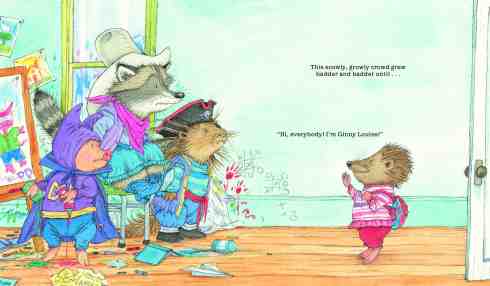
Ginny Louise is Active. She happily goes about her school day. She paints, she sings, she learns things. All the while, she is oblivious to the fact that everything she does drives the Truman Elementary Troublemakers bonkers.
Ginny Louise is Relatable. She doesn’t fit in with her classmates in the classroom or out on the playground. (Readers can empathize with her because everyone has experienced the feeling of not fitting in at one time or another.)
Ginny Louise is Flawed. She only hears what she wants to hear. This results in all kinds of miscommunication.
By the book’s end, this active, relatable, flawed character turns things around at Truman Elementary. Well. For the most part. 🙂
GINNY LOUISE AND THE SCHOOL SHOWDOWN debuts TODAY! Next summer, Ginny Louise and the rest of the gang return for more mayhem in GINNY LOUISE AND THE SCHOOL FIELD DAY.
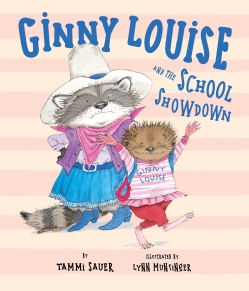
And now it’s a great giveaway for GINNY LOUISE!
Leave a comment naming your favorite PB character and you will be entered to win a signed, first-edition copy of GINNY LOUISE AND THE SCHOOL SHOWDOWN!
One comment per person, please.
A random winner will be selected in two weeks.
Good luck!
Tammi Sauer is a former teacher and library media specialist. She has sold 23 picture books to major publishing houses. In addition to winning awards, her books have gone on to do great things. Mostly Monsterly was selected for the 2012 Cheerios Spoonfuls of Stories program. Me Want Pet! was recently released in French which makes her feel extra fancy. And Nugget and Fang, along with Tammi herself, appeared on the Spring 2015 Scholastic Book Fair DVD which was seen by millions of kids across the nation. Tammi’s books Ginny Louise and the School Showdown (Disney*Hyperion), Your Alien (Sterling), and Roar! (Simon & Schuster/Paula Wiseman) debut in 2015.
You can visit Tammi online at tammisauer.com and at picturebookbuilders.com.
This morning I thought I was still at the NJ-SCBWI Summer Conference because I stumbled downstairs expecting to find fresh-baked coffee cake and a fruit platter. Instead, I found a slumbering adolescent who never got up for middle school and missed the bus. Hence, I was rudely thrust back into the life of a mom. Sigh. So I decided to ignore my life for a while and write this post. Relive the glory days!
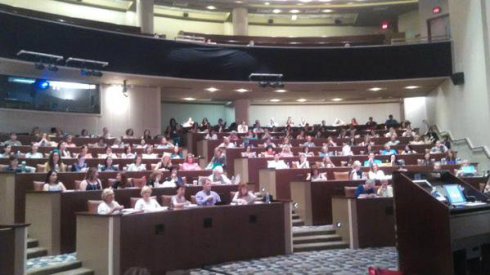
This would make a great WHERE’S WALDO? spread.
The weekend was chock full of good friends, like author extraordinaire Tammi Sauer, whom I’ve known for SEVEN YEARS but had never met in person. I wanted to make a good impression upon her, so I picked her up from the airport…and then proceeded to get hopelessly lost in Newark. We did spy a ’57 Chevy during one of our dozen-or-so U-turns, so perhaps all was not lost.
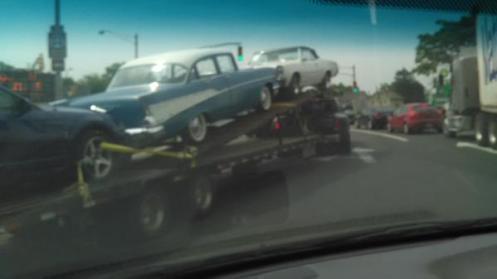
’57 Chevy! Yes, I snapped this while we were stopped.
And then, we got cut off by a rumbling, muffler-roaring Racini. RACINI, PEOPLE! Only in Jersey.

Racini! (Not the full license plate.)
Of course, there were also the usual suspects present: Sudipta Bardhan-Quallen, Kami Kinard, Marcie Colleen, Ame Dyckman, Adam Lehrhaupt, our fearless RA Leeza Hernandez, and newly-signed talents like Jason Kirschner, Colleen Rowan Kosinski and Kelly Calabrese. (For those of you with bets in the pool, Ame’s hair shone bright blue this year, bordering on periwinkle, stylishly accented with a coral red bow.)
Sudipta, Marcie & Kelly. Yes, they can go by first names only.
Katya Szewczuk from KidlitTV let us know that her last name is pronounced “Shove Chuck.” Sadly, Chuck Palahniuk was not in attendance. What a fight club that would have been! (P.S. Isn’t Katya adorable? I call her Ame Dyckman Jr.)
Carrie Charley Brown, Kirsti Call, Lori Degman and Robin Newman were there, too…but the Witherspoon Grill couldn’t get us a table for 10. For shame! But they did get us a bottle of Prosecco. Next time, it should be on the house.
Me, Kelly, Marcie, Kami, Sudipta and Tammi
My editor from Sterling, the smart and lovely Meredith Mundy, made an appearance with a stack of NORMAL NORMAN cover designs from which to choose. Tammi, an author of eight Sterling titles, offered her expert opinion, too. And guess what? We all agreed on two favorites. (Now do we eeny-meeny-miney-mo?)

NORMAN!
I only saw critique partners Corey Rosen-Schwartz and Mike Allegra briefly. I waved to Mike from my post at the registration table. Then he promptly dissolved into the crowd. This became a new picture book idea. Thanks, Mike!
So I bet you’re like ENOUGH ALREADY, TARA. GET TO THE NUGGETS.
Opening Keynote by Denise Fleming
 Denise encouraged us to find out what age we really are. No, this isn’t a plug for how-old.net. Go back to your childhood and discover the age of your true voice. Denise never aged past Kindergarten. Me, I’m perpetually 8.
So that’s what you write. Dig down to emerge as a child, forever locked in a state of wonder.
Denise told us an impromptu paper-making class inspired her to choose this art form as her picture book medium. She evolved from precise watercolor paintings to a more loose, bold, colorful style. HER STYLE. Her illustrations set her apart. She asked us to ponder what makes us each unique. You’ve got to offer something different and not be like everyone else. Stand out, don’t blend in.
Oh, by the way, Denise thinks you’re pretty.
 Workshop One:
Writing Picture Books that Sell! by Tammi Sauer
With 23 contracts in 10 years, you’ve got to listen to and respect Tammi’s advice. She presented her top 12 tips for picture books, citing from her titles as examples. The quirkiest thing I found out is that she loves to use the name “Louise.”
Tammi recommends reading A LOT of picture books. You will begin to absorb information about their structure and format without even realizing! This knowledge will then seep into your manuscripts.
Tammi also wants us to write titles that POP. Up the tension in your stories and use words that SING.
Me? My name sings. I shall hereforthto be known as Tra-la-la Lazar.

Workshop Two:
Writing Mainstream (BUT COOL!) Picture Books by Ame Dyckman and Adam Lehrhaupt
This dynamic duo demonstrated a lot of energy, pizzazz and “special sauce.” No, we’re not talking about McD’s. Their “cream of creativity” is a mixture of unique elements that add up to writing a hook-y, mainstream winner. Slather on your own writing style, stir in heart and humor, and you will concoct a winning picture book recipe.
But remember, that’s just the sauce—an accent. Your picture book still needs meat! Pick popular subjects, relatable situations and age-appropriate “big picture” messages to make your story its most delish.
 Workshop Three:
Thinking Outside the Box to Market Your Book with Jen Malone
I call this presentation “How to Sell Your Book Without Being Creepy.” As natural introverts, we writers don’t like going outside to deal with “people and weather.” We abhor the uncomfortable, used-car-like sales pitch. We don’t want to plaster the interwebs with “BUY MY BOOK!” Ick.
So what’s an author to do? Jen presented unique, creative ways to market by simply being you. Look outside your own book community to find opportunities for connections. Offer others what they want and they might just offer what YOU WANT—an introduction to a new audience. Jen has been doing work with the Girl Scouts and a famous bakery to reach her target audience, tween girls. (And, there are CUPCAKES involved. Win, win, stuff yer face.)
Workshop Four:
7 Revision Tips to Take your PB from WAAH to WOW! by Sudipta Bardhan-Quallen and Marcie Colleen
Don’t let the high-heels distract you. These two PB experts offer furlongs of fabulous advice. (Furlongs? I gotta stop the alliteration.)
They emphasized reviewing your picture book to ensure visual variety. This refers to textual elements as well as compositional ones. Think story AND layout. Think page turns. Think scene changes. Dump anything that’s repetitive or passive without purpose.

Workshop Five:
Is Your PB Worthy? by Marie Lamba
 Oh, how I regret not getting a photo of Marie hugging her presentation easel. Adorbs.
Marie, an author and agent, bubbles with enthusiasm for picture books. She brought some of her all-time favorites to share and exclaimed, “Isn’t that HILARIOUS?” while doubled over in laughter.
We all want that—a reader who loves our book five, ten, even 20 years after first reading it. So how do we get that?
Be different. Don’t just write the first idea that comes to mind. Write five ideas. Then another five. Use the tenth one. Applying this tip from Donald Maass means you’ll arrive upon something no one has done.
Marie also shared the top 10 mistakes she sees in picture book submissions. For example, she doesn’t want to see “just a schtick.” (Don’t you LOVE Yiddish words?)
Your picture book can be ridiculous, but quirky humor isn’t enough. She cited her own manuscript about a girl who wears gloves on her feet and pretends she’s a monkey. It’s cute and funny, but it’s not enough. Marie didn’t have a story, she had a schtick. Your manuscript needs a plot to matter.
Other common errors include rhyming NO MATTER WHAT and writing a slice-of-life vignette—a set-up instead of a story.
 Sunday Morning Keynote:
Top 10 Things You Need to Know About the Children’s/YA Market by Harold Underdown
Harold! You have to love him. (You have to follow his Purple Crayon website!) He’s bursting with kidlit experience and wisdom.
First, he told us some great news: the children’s publishing market rose 20% last year!
Hard copy books are not disappearing and ebooks are not replacing them. In fact, the ebook market has hit a plateau and represents only 15% of the children’s market, but that number leans heavily toward YA. Picture books are preffered in hard copy by a wide margin.
Bookstores (both online and brick-and-mortar) are now the biggest sales channel (40%), as opposed to schools and libraries in years past.
Know that diverse books are hot and that writers and publishers are taking this issue seriously.
YA remains a boom area, MG is very healthy and PBs are experiencing renewed interest. Some are even calling this time “the golden age of picture books.”
However, Howard emphasized that you should always do your best work and not focus on what’s hot. This is what will get you published.
Workshop Six:
Marrying the Right Manuscript with the Right Publisher by Steve Meltzer
 Steve is a welcomed, popular mainstay at NJ-SCBWI. He emphasized doing your research when searching for a publisher. It’s important to seek out comparable titles published within the last three years, those that are of a similar subject and format, but not famous or mega-selling. No one’s gonna believe your series is the next Harry Potter. Query with a reasonable comp, not an outrageous claim.
Workshop Seven:
The Changing Face of Humor in Picture Books by Steve Meltzer
Do I even have to talk about this? Steve and I disagree. I respect his opinion immensely, but I think a popular recent title missed the mark and had opportunity for so much more humor than it presented. He nudged me on the lunch line, “It’s a great book.” I topped my salad with bleu cheese and thought about it.
 Closing Keynote:
How to Be a Writer Without Losing Your Mind by John Cusick
John Cusick said much about life as a writer and agent, how he uses an Iron Man figurine on his desk to distinguish agent-time from writer-time, and how to balance our life roles.
He reminded us that our job is to “sit down and start.” Don’t worry about writing the whole book. Write a little bit for now. (This resonated with me. I tend to panic about writing AN ENTIRE NOVEL when I should really just put one word in front of the other.)
Also, no one cares if you stop writing. YOU MUST be the motivator.
Have a writing friend you can complain to…and let them know that this is their purpose. (Not their sole purpose, of course. We all need to kvetch and we need a kvetch catcher.)
Bottom line, it’s irrational and childish to make things up for a living. It’s crazy-making. So embrace it. Be crazy. It’s crazy that anything can be this good!
“Don’t worry about being normal because what you do is extraordinary,” John said.
I couldn’t agree more. How about you?
DRESS ME!
No, not me. I’m quite capable of dressing myself, thankyouverymuch. Although I often remain in my pajamas. It’s a comfortable life!
I’m talking about the new book by author-illustrator Sarah Frances Hardy, and it’s a dress-up delight for little readers. What child doesn’t love pretend play, imagining themselves as anything they long to be?
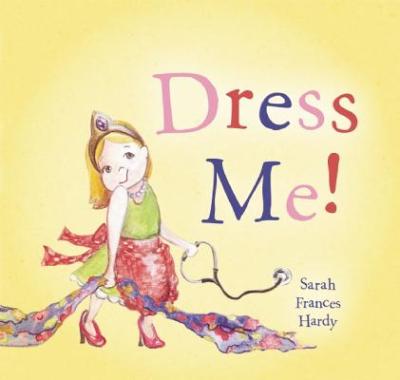
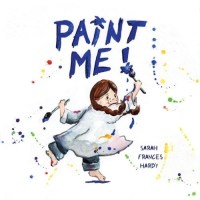 Sarah Frances, how did DRESS ME! come to be?
I knew I wanted to do a companion book for PAINT ME! which released last year from Sky Pony Press, and I had written a manuscript for a dress up book a few years ago that never quite worked. My agent and I talked through it, and she suggested I take the dress-up idea and do another “me!” book with that.
So did you play dress up as a child? What was your favorite thing to be? Were any of your childhood choices reflected in the book?
Did I ever!
The best Christmas gift I ever received was from my grandmother when I was about eight-years-old. She gave me an antique trunk full of the most fabulous dress up clothes ever—shoes, gloves, funky hats, bridal veil, aprons. Over the years, I added to the collection with anything I could find. My dad was a doctor and he gave me a real stethoscope as well as a set of his scrubs …so those definitely found their way into my book.
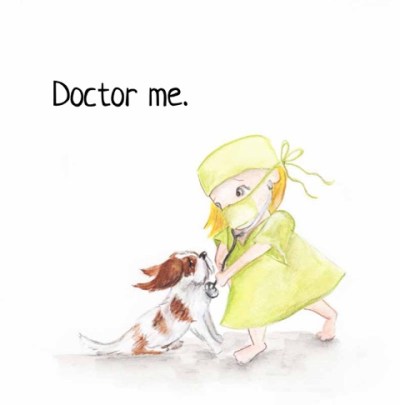
I don’t remember what my favorite thing to be was, but there are lots of pictures of me wearing a mish-mash of gloves, sparkly dress, high heels and a bridal veil with a hat over it. I can only describe the look as “eccentric hippie bag lady”. And no, that look didn’t make it into the book. 🙂
The little girl in the book is having a fabulous time. What do you think her favorite dress up costume was? (Besides the last one, of course, which we can’t give away!)
Since the book was inspired by (and dedicated to) my middle daughter Sallie who’s a dancer, I’m going to have to say the tutu. Who wouldn’t love getting to do lots of fun twirlies?

When did you know you wanted to be an author-illustrator? When did you go from “dressing up” as one to being one?
One of my favorite props to bring to school visits is my paint smock which is one of my husband’s old button-downs that’s now covered in paint. So I still dress the part!
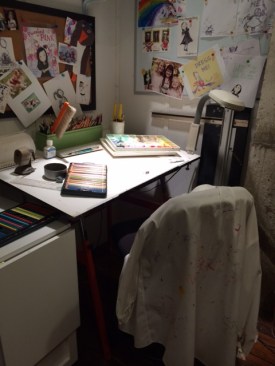
But to answer your question, my background was in fine art, and I spent years showing in galleries and art shows.
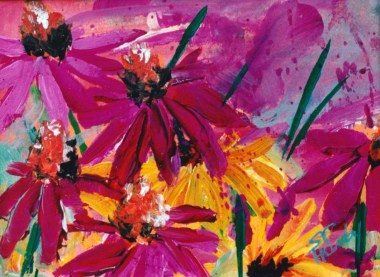
But I had always had a secret dream of writing and illustrating children’s books, and over the years, I submitted manuscripts and illustrations to a handful of publishers without any luck. When my youngest daughter was a baby (she’s eleven now), I decided to shift gears and really commit to being a published author/illustrator. I started going to SCBWI conferences and learning everything that I could about the entire process. I sent out manuscripts and got rejected. I revised, revised, revised—both the writing and my illustrations. I sold my first book PUZZLED BY PINK in 2010 (it released in 2012).
The story would not be the same without the cute little doggie sidekick. Is he fashioned after anyone you know?
All of my books feature a pet following the main character throughout the story and getting in on the action. In PAINT ME!, a gray Schnauzer follows the little girl around as she paints everything around her. He is based on the dog I had when I was a little girl. In DRESS ME!, I chose a King Charles Spaniel for no other reason except that I think they are the cutest little dogs (we have one in our neighborhood). The dog we have now is a giant Black Lab named Jake, and while I’d love to feature him in a book, I was afraid he’d overwhelm the little girl in the story–both in size and energy level! Also, after painting a black cat in every spread in my first book PUZZLED BY PINK, I vowed to never feature another solid black animal. It was so hard!
Besides having fun, what’s the message at the heart of “Dress Me!”?
The message at the heart of the story is “be yourself.”
But I also wanted to throw in a (not so subtle) message to young girls that it’s doesn’t always have to be about dressing up in sparkles and high heels. Girls can be anything they want to be whether it’s a monster or a doctor or a teacher, and it has more to do with what you can do than what you look like.
 Amen to that!
Thanks, Sarah Frances, for introducing us to your new book. And thank you for offering blog readers a signed copy!
Leave a comment below and tell us your favorite dress-up memory. (One comment per person, please.) A random winner will be selected in a couple weeks. (Which sometimes means more than a couple, LOL.)
You can also learn more about Sarah Frances Hardy, her books and her fine art at www.sfhardy.com.
Quick, think of a picture book with a long title!
DUH, I KNOW.

Of course, Judith Viorst and Ray Cruz’s classic sports a long title for hyperbole purposes. The author wants you to know that Alexander’s day was straight-up disastrous…and that Alexander is perhaps a tad overdramatic. The title sets up the plot and character perfectly.
However, you don’t see long picture book titles like this one too often. Why?
Picture books tend to sell on concept. That concept must be communicated succinctly in order to capture a young child’s (and a parent’s) imagination. Yes, people really do judge a book by its cover.
If your picture book manuscript has an overly long title, it may suggest your concept is either too vague or too complicated for the format. You want to nail down your concept and make it snappy, catchy. BAM! SELL THAT BOOK!
Even though character name titles are short, I personally tend to shy away from them. The title ERIN & JOAN doesn’t tell my audience enough about who the characters are. Here’s an interesting case study: the talented Ame Dyckman’s WOLFIE THE BUNNY was originally called WOLFIE & DOT. The final title WOLFIE THE BUNNY practically sells itself (with Zacharia OHora’s bold artwork), whereas the original title doesn’t necessarily relay enough clues about the tale.

But there are exceptions when two names work. GEORGE & MARTHA, one of the most popular picture books of all time, totally blows a hole in my theory.
So does Josh Funk and Brendan Kearney’s upcoming LADY PANCAKE & SIR FRENCH TOAST. But here the names give you a lot to go on.

Now let’s examine SLJ/Fuse #8’s Top 100 Picture Books. The majority of titles are between one and four words. The longest title? THE LITTLE MOUSE, THE RED RIPE STRAWBERRY AND THE BIG HUNGRY BEAR, published in 1984. But let’s take a look at the cover…

…interestingly, THE BIG HUNGRY BEAR is emphasized in larger letters, juxtaposed against the image of the delicious strawberry and an anxious-looking mouse. I’m going to predict that in today’s market, an editor might have cut that title down to just the BEAR part. (But alas, the world will never know. Just like we still don’t know how many licks it takes to get to the Tootsie Roll center of a Tootsie Pop!)

Now here’s a title for ya:
POPPY THE PONY PICKS A PERFECTLY PATIENT PLAYMATE
This isn’t a real title, but notice how long it is and how it fell into an alliteration trap! Ahhhhh! I tend to see this often with new writers’ manuscripts.

THE STINKY CHEESE MAN AND OTHER FAIRLY STUPID TALES
This is a real title. It’s long but it’s allowed to be. It features “stinky” and “stupid,” two words especially beloved by the target audience. (Plus it’s Jon Scieszka! You gonna argue with JON SCIESZKA?)
So take a close look at your picture book manuscript’s title. If you haven’t found a clever moniker, it may be that your story isn’t focused enough yet. If the title is long and complicated, maybe your story is, too. The title is going to be one of your most important selling points, so spend some time on it and get it right!
Bottom line: long titles can work, but be sure to know when they don’t.
Now it’s your turn:
What are some of your favorite picture book titles?
I typically don’t like to upload JUST a winner announcement…I like to shove something else in there to ensure the post is entertaining and informative as well.
So, here.
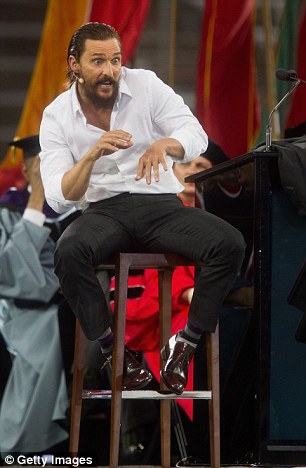
OK, so that’s neither entertaining nor informative. But it is hilarious.
What do you think he was saying at that moment? (Guess in the comments.)
Personally, I think he was scatting.
Or casting a groovy employment spell upon the graduating masses.
Or perhaps asking for a sammich.
Performing “The Eensy-Weensy Spider”? (Deb Lund’s guess.)
Now that we’ve had a little fun, let’s get onto the winnahs.
The winnah of OWL BOY by Brian Schatell is:
JIM CHAIZE
The THREE winnahs of framed BE A FRIEND art from the incomparable Salina Yoon are:
SANDI LAWSON
DANIELLE DUFAYET
SHERI RAD
Whooppeee-do-dooo-beeee! (Hmm, this may be what McConaughey was saying.)
Congratulations to the winners and please be on the lookout for an email from me!
I’ve been wanting to do a book with Ryan Sias because his illustrations are so cartoony, bubbly and fun. Ryan’s free weekly Sias Studios emails feature creative worksheets with new characters I always want to call my own. But I can’t. They’re his. But they can be YOURS, too, because anyone can receive his free doodle and story pages by signing up at SiasStudios.com.
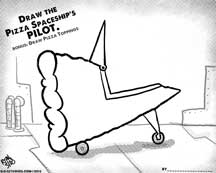
(A PIZZA SPACESHIP! Why didn’t I think of that??? ANCHOVY ALIENS! PEPPERONI FROM PLUTO!)
Ryan’s new book SNIFF! SNIFF! just landed on my front porch and I could not resist this cuddly little doggie with the huge honker. How adorable! The bold, sketchy outlines and bright colors will attract the youngest readers with this tale of true friendship and love.
The curious star of the story gets into all kinds of mischief with “SNIFF, SNIFF” being a recurring theme. Repetitive phrases help new readers recognize words…and also practice their onomatopoeia out loud. The story is told through action and play while also showing kids all about having a pet. (Not easy, but rewarding!) A really fun read-aloud with lots to look at!

Hey, do you want to learn how to draw this cute fella? Well, do you, boy? Yes, you do! YES, YOU DO!!!

Ryan, what were your thoughts behind the design of your dog and how did you accomplish them?
For my Dog I wanted the design to be animated, super cute with a BIG NOSE (but not a gross nose). Originally he was more normal dog proportions, but the more I drew him, the bigger his head and nose got. When I create characters I draw them again and again and quicker each time, to get a loose and fluid design. Then “Ta da!” I end up with the final design!
I wanted him to look like pure energy and love. To have tons of expression and while he was being bad, not look mean but full of curiosity and wonder.
The dog doesn’t have a name in the book, but does he have a name in your head?
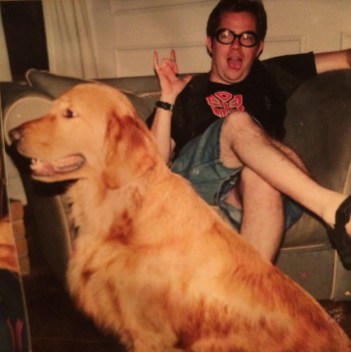
In my head his name is Simon, which is the dog I dedicated the book to. He was my BFF and a golden retriever. He has the attitude of the dog in my book. Full of joy and love plus a destructive side. Here is a photo from ’95 of me and Simon.
You offer fun weekly drawing lessons and creativity activities for kids, delivered via email. We all know art education is shrinking in some school districts. Why do you think art education is so important?
To me art education is THE most important because it teaches abstract problem solving, and that is the key to a kid’s success in life. I am not saying every kid needs to be a painter, but learning how to think “outside” the box will grant success in any field. Steve Jobs and Albert Einstein were amazing abstract problem solvers.
So since arts are getting cut, I have developed Sias Studios free weekly emails. They’re designed to promote creative thinking and foster children’s imaginations. Our original art projects encourage kids to invent their own stories and make art without boundaries. We provide a springboard for children to dive into artistic discovery!
Well, the springboard is strong enough for adults, too! I know I enjoy jumping in every week! SPLASH! SPLASH!
Ryan, you happen to be dyslexic, which I find amazing considering your profession. How do you overcome the difficulties of Dyslexia as an author?
Short answer: A lot of people go over my work to make sure it’s all spelled and punctuated correctly.
Long answer: My mom is a teacher and had me tested in first grade, so i’ve known my whole life and I’ve grown to see Dyslexia as an advantage—as a creative my brain works differently than a lot of people. A lot of huge creatives are dyslexic: Thomas Edison, Albert Einstein, Picasso, Jim Carrey and John Lennon to name a few. It didn’t get in their way. I can always find people to spell check, but not everyone knows how to use their creativity.
For books, I am lucky that I write and Illustrate, so I let my artwork do most of the talking. Then I use words to fill in what I can’t show. In my new book SNIFF! SNIFF! it’s mostly visual with just 12 words.
But that is not to say it’s easy for me. My problem comes through in emails, which have errors, which is a REAL problem at first, because I’m emailing editors who are spelling kings! So I have to have those emails gone over also. As my relationships progress, they quickly learn that I am dyslexic (also I tell them pretty early on) so they understand. I also have a great agent who helps fill in the holes.
So while it is more work for me, I just know I can’t send anything out with out a group of people checking it and rechecking it.
I think what you accomplish is incredible considering this disability! Thank you for sharing your creativity with us.
Ryan’s also sharing a copy of SNIFF! SNIFF! with a lucky winner.
Leave a comment below to enter. In the comment, tell us what you think the doggie’s name is. I’ll call him Mr. Scruffles. (One comment per person, please. No taking “Mr. Scruffles,” either.)
A random winner will be selected in two weeks! Good luck!
Releasing on January 5, 2016 is Salina Yoon’s 158th book, BE A FRIEND. (Yes, it really is her 158th book. Salina is the most prolific author-illustrator on the planet!)
The delightful cover is being revealed by Bloomsbury exclusively here today!
Isn’t it sweet?

Salina, I know with my books the cover has come at the end of the book-making process…but I recently spoke with Matthew Cordell and his latest book’s cover idea came to him early on. When did you create this cover and what about the story did you want to convey through the images?
The cover was the first thing I designed and illustrated when I conceived of the idea to prepare it for submission. But since then, the cover’s changed a few times, even its title, and only recently was everything finalized. The book itself was completed much earlier.
Conveying the story with just one image and one title is so challenging with any book. In BE A FRIEND, it was important to show the two main characters having a deep connection to one another. It’s a unique kind of friendship because one child is silent, and he lives in a world of his own imagination. But here, we see the girl looking straight into his eyes, accepting the gift he dreamed up in his mind. She accepts him, just the way he is, and that’s a strong theme in the book. Like a mother who blows a kiss across a room and the child snatching it up, even gifts of the imagination are felt if the heart is in them.
Could you tell us a little more about the book?
BE A FRIEND is about a boy named Dennis who expresses himself through the silent art of mime, which alienates him from the other kids. No one seems to notice him, except one girl. Her name is Joy. Even without words, they can laugh and play. And most importantly, they can be friends. Joy shows Dennis that he can still be himself while including others—that his world needn’t be solitary.
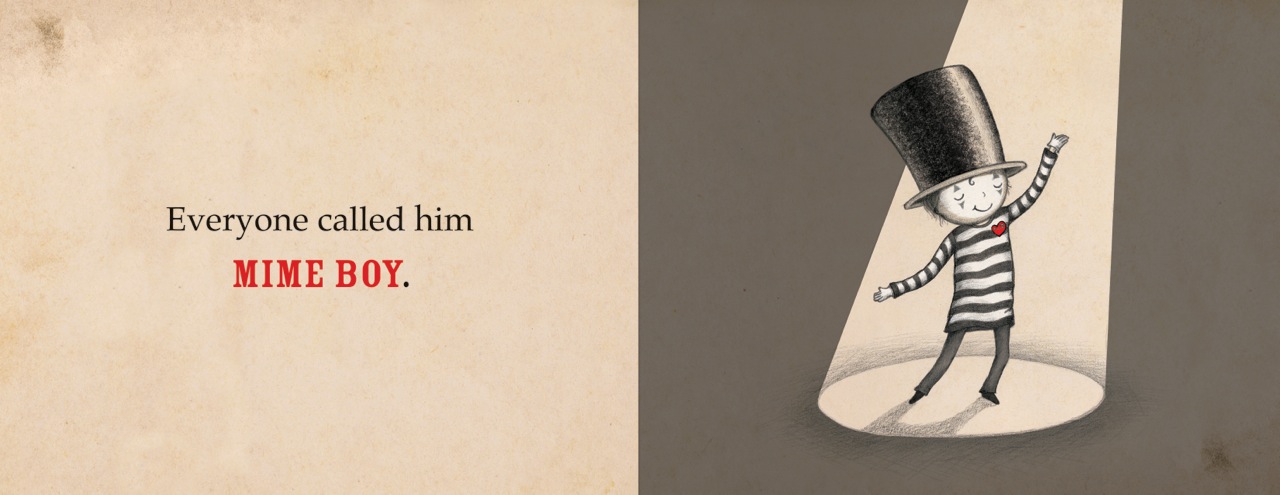
This book is for any child (or adult) who has ever felt different that made them feel alone, and the importance of reaching out and making connections.
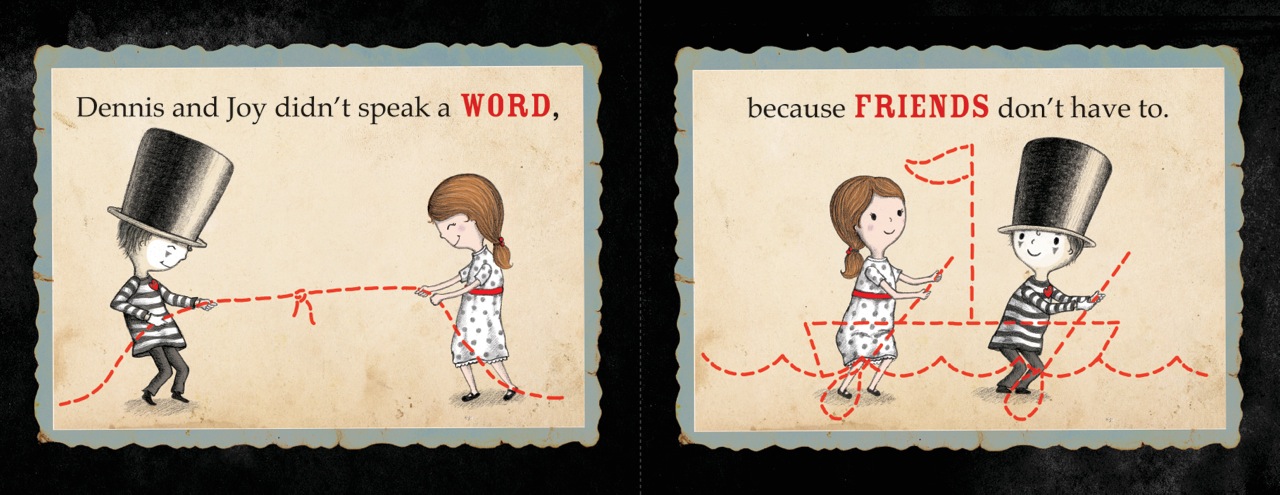
BE A FRIEND is a heartwarming celebration of individuality, imagination, and the power of friendship. (Bloomsbury/January 2016)
Salina is giving away three signed, framed art prints from BE A FRIEND just for visiting her cover reveal today.
Leave a comment below; one comment per person, please. Three random winners will be drawn on May 18th. Good luck!
Oh boy, it’s a new picture book by Brian Schatell, OWL BOY!
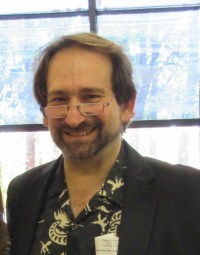 For those of you who don’t know Brian, he co-chairs the Rutgers University Council on Children’s Literature One-on-One conference…and has been doing so for YEARS. You will not find anyone more giving of his time and talents to help aspiring kidlit authors and illustrators reach the next level in their careers. What he pulls together—over 80 publishing mentors in a jam-packed day of learning, networking and professional growth—for YOUR benefit is mind-boggling!
(What’s that? You don’t know about RUCCL? Well then GO HERE. The 2015 application is live now!)
So when I saw Brian’s new book and its pure adorableness, I had to talk to him about it. He’s OWLWAYS got some fantastic pieces of wisdom.
Brian, when I first heard you talking about OWL BOY, you said it was autobiographical, “except for the owls.” What did you mean?

This is a book about an obsessed, hyper-focused child; the sort of kid who when he’s interested in something, he’s interested all the way! That’s the sort of child I was, and that’s the sort of person I am today, still. Owls were not my own particular childhood focus. But one of my daughter’s elementary school classmates was a boy who knew every owl fact you could ever want to know, as well as every NY Yankee baseball statistic, among other things. That boy was certainly an inspiration for the owl part, but as I told his parents, the book is really about me!
As an author-illustrator, which part comes first for you, the owl or the egg? Er, I mean, the story or the pictures?

Owl Boy character sketch
Well, the concept comes first, and stews around in my brain for some time. Often this concept will include certain visual elements—a key spread, a visual joke. Picture books are a visual storytelling medium, after all. I carry a note book with me and when I get an idea pertaining to a particular book concept, I jot down the idea, but it may be a sketch or it may be a snippet of text, or often both together. I stuff these notebook pages into a folder, and when they start to accumulate, they begin to coalesce into a coherent book with a beginning, middle and end. Years ago, I used to type up the manuscript, sans pictures, as a first step, and then move to thumbnails, and then a dummy. More recently, the first time I commit something to paper, I’m sketching words and pictures together from the get-go, using my earlier notebook pages as reference. For OWL BOY, there was never a separately typed manuscript until after contract, when my editor and I were finessing it. The initial version of OWL BOY was a collection of sketches done on index cards.
Your last book was a few years ago. What changes in picture books have you noted from then to now and did that influence OWL BOY in any way?
That’s a really interesting question!
First of all, a lot of illustrators are doing their art on computers these days. For other illustration work I do, for the children’s apparel industry, I work nearly exclusively in Adobe Illustrator/photoshop, yet for my books I stubbornly cling to pen and watercolor. Nevertheless, the digital age has wrought some changes in my process. Specific to OWL BOY there are pages where I combined separate elements in digital layers, as opposed to actual overlays as done in the old days, or as opposed to cutting out and pasting down elements. There’s a spread in the book—the owl extravaganza spread—where the background sky and foreground objects are two different paintings which I separately scanned and combined digitally. Makes life much easier! It’s not as if I’m against full digital illustration in my books, but to try to recreate my hand-painted look on a computer wouldn’t save me any time, not the way I work, not for OWL BOY. However, I have a couple of book ideas in mind that I do specifically see as appropriate for all-digital art.
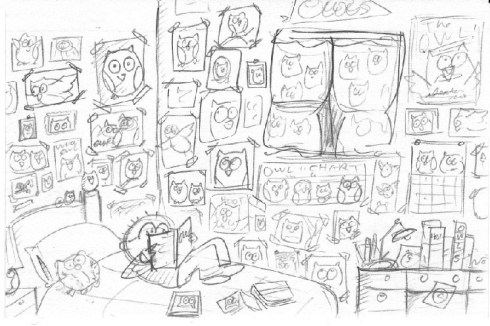
OWL BOY bedroom sketch
Another change these days is that pretty much all picture books are simultaneously released as e-books. This did have a pretty big impact on OWL BOY. In the book I employ speech balloons for certain dialogue elements, and my intention was to hand-letter the text in these balloons, as opposed to using a font for the regular text. But as my editor told me, the age of hand-lettered type is over! Because in an ebook the text pops up in size when the cursor hits it, I was required to use set type for the speech balloons, which I was not happy about. It took us a while to arrive upon an available font that approximated my concept of hand lettering, but I’m happy now. But it was a big adjustment!
As for changes in the picture book genre these past few years, I’ll just say that I write the stories that I have to write. Trends do evolve, there are good books and bad, there are always “hot” books, but to my mind, the attributes of a successful picture book remain the same: genuine voice, strong characters, warmth, empathy and emotion, a plot with an organic beginning, middle and denouement, words and pictures that complement each other to create a whole that is more than the sum of the parts, among other things.
Good to know some things will never change!
Winding the clock back a bit further, how did you first get involved in picture books and why is RUCCL so important to you?
As someone who drew my entire life, I had no particular interest in picture books until college. While attending Parsons School of Design, I discovered a new comic strip in New York City’s weekly alternative paper, The Village Voice, by a guy named Mark Alan Stamaty. It was called “MacDoodle Street” and something about its humor and aesthetic and crammed-with-detail drawings spoke to me immediately, and began to influence my own illustration style.
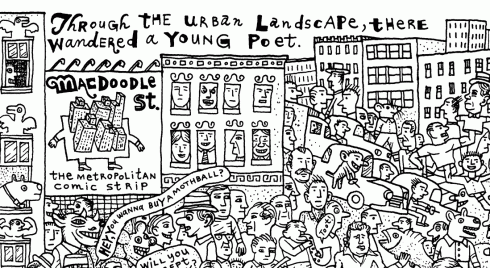
A year or so later, I saw that Stamaty was teaching a class at Parsons: a children’s book illustration and writing class. As I said, I hadn’t previously had the slightest interest in children’s books, but I enrolled anyway just to meet this guy. He could have been teaching a class in taxidermy—I still would have signed up! But as it happened, he had done some interesting books and was a very good teacher. The big semester project involved writing and illustrating an original picture book dummy. There and in other college classes I began creating freestanding illustrations with the juvenile market in mind, though in retrospect I was not very sophisticated about it.
After graduation, I visited the Children’s Book Council, which compiled lists of publishers and their submission/portfolio requirements. Things were a bit simpler then. This was prior to the big wave of conglomeration in publishing, so there were dozens of major independent houses to submit to. As an illustrator, most publishers had a weekly portfolio appointment day—actual appointments, not drop off! One such appointment eventually resulted in an offer to illustrate a nonfiction picture book, this only a few months after graduation. Once I completed that, I dug out the old picture book dummy I had made in Mark Stamaty’s class and submitted it to the people I had been working with, and they actually took it!
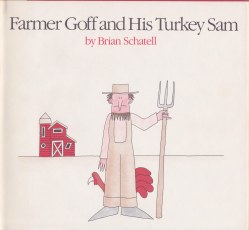 That book was Farmer Goff and His Turkey Sam, which ended up being named an SLJ Best Book when it came out. One might suppose it was all smooth sailing from that point, but of course that’s not how the industry works.
The next book I submitted to my editor was rejected. The one after that they took. There were long periods when I wasn’t working on anything at all, and times when I worked on one idea for years. I’m not the most prolific author, and sometimes I just waited for an illustration assignment to come along. OWL BOY, which just came out, was begun five years ago! I do feel fortunate that following my first book, I’ve always been able to submit ideas to people I already know.
 Early in my career I was invited to teach a children’s book illustration and writing course at Parsons School of Design, more or less the same type of class I had taken with Mark Stamaty. Naturally I called him for advice. I ended up teaching this class for 12 years. One of the most gratifying aspects of teaching was the ability to help people make creative breakthroughs, to help them raise their work to the next level. Some of my students eventually published!
A few years after I started teaching, I was invited to be a mentor at the Rutgers One-on-One Conference. And some years after that I joined the Rutgers University Council on Children’s Literature, which organizes the conference.
 My feelings about the conference are similar to my feelings about teaching. Juvenile publishing is not the most glamorous nor remunerative branch of publishing —JK Rowling and her ilk aside—so most of us do it out of a true love for the genre. But it is a small industry, and can be difficult to break into, so many of those fortunate enough to be working in it are very grateful to be able to do so, and want to “pay it forward,” as the saying goes. At the Rutgers conference, as in teaching, I want people to get published! I want them to make creative breakthroughs, I want to connect them to professionals who might be able to help their careers. And at Rutgers, I and my colleagues on the Council have been able to do just that.
 The One-on-One Plus Conference, as it is now called, is unique in that we have a faculty of over 80 editors, agents, art directors, well-published authors and illustrators, and that every aspiring author or illustrator who attends is guaranteed a forty-five minute one-on-one session with one of these professional mentors, to discuss the work that they have submitted. As I’ve personally benefited from mentors like Mark Alan Stamaty, and the editor who took on my first book, I’m only too happy to see others go on to success from this conference that I help organize.
A few years ago I found myself doing an author/illustrator presentation at an elementary school on the same day that Mark Stamaty was making an appearance. He actually sat in the audience during my presentation, all those years after I had taken his class, and speaking in front of him, I felt like the kid who had hit a home run in the big game in front of all his friends and relatives! I’m very lucky to be able to do picture books, but I owe my career to the generosity of mentors. Rutgers is a great mentoring conference, and that’s why it is so important to me.
Thank you, Brian, for the hundreds of hours you’ve put into RUCCL. I’m sure everyone who has ever attended is full of gratitude, too. Many kudos to you on OWL BOY.
And OH BOY, you can win OWL BOY from Holiday House!
Just leave a comment to be entered. One comment per person, please. A winner will be announced in two weeks.
Good luck!
I grew up with a funny guy.

(No, Walter Matthau isn’t my dad, but I don’t have a digital photo of my father and he looks just like Mr. Wilson from “Dennis the Menace.” So this will have to do.)
Anyway, he’s the one who passed along his sharp, dry humor to me. He was actually a Chemical Patent Attorney for a large petroleum company and used to speak about opening a law firm together when I grew up. Only being a Chemical Patent Attorney is quite possibly the career of my nightmares. I suppose his job is why he’s so funny—it didn’t provide gas for humor so he had to create his own laughs. (It did provide gas, though.)
A simple man, he has means but always preferred to live in a small apartment or condo. When I asked him why he didn’t buy something larger, he quipped, “Why? You can only be in one room at a time.”

Smart, Pops.
So I began thinking about this concept recently…as it applies to picture books, of course. You know I suffer from PBOTB (Picture Books on the Brain, not Picture Book Off-Track Betting). Here’s what I came up with:
“You can only be on one spread at a time.”
Aha!!!
So what does this mean?
When you’re finished with your tale, cut it in pieces.
You may already be aware of my layout templates:
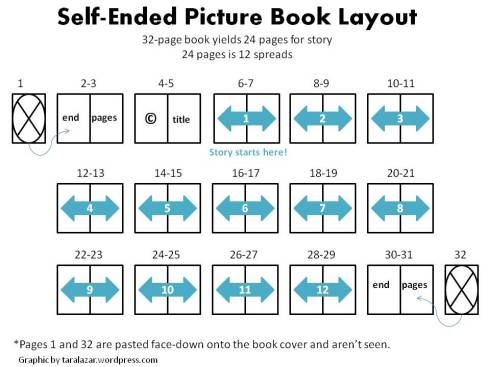
Look at each spread of your story individually and ask yourself some questions:
- Does it move the story forward?
- Does it provide a page-turn surprise?
- Does it provide ample opportunity for illustrative interpretation or an illustrative subtext?
- Is it interesting and entertaining? Does the reader want to linger?
- Is it active?
- Does it have too much text?
- Does the scene change from the previous page?
Remember, you can only be on one spread at a time. Make each one MATTER.
Maybe you’d like to comment with your interpretation of this witty Pops-inspired picture book phrase…? Please do!
And now, the winner of my March giveaway–Philip C. Stead and Matthew Cordell’s SPECIAL DELIVERY!
DIANA DELOSH!
Congratulations, Diana, I’ll be emailing you!
Now I usually end with something witty, so I called my dad for comment. He says being a children’s book author is quite possibly the career of his nightmares. And with that, he’s ready for a nap…albeit a scary one.





 Writing for Kids (While Raising Them)