You are currently browsing the category archive for the ‘KidLit’ category.
If you want to publish a book for children, the first thing you must do is ask yourself why.
Is your motivation to publish a kid’s book one of the following?
- Your kids/grandkids/nieces/nephews/neighbors/students love a story you’ve written.
- It would be fun to see your name in print.
- You want to sign autographs.
- You want to make money, quickly.
- You want your artist cousin/sister/friend to illustrate it.
If you answered “yes” to any of the above, please read this post. I write this to save you a lot of time and frustration. Because it’s not an easy business. NOT. EASY. AT. ALL.
New writers often believe they can pen one story in an hour or two, never revise it, yet somehow land an agent and a publishing deal—-as if the simple act of writing begets publication.
 Hitting one baseball does not mean the Yankees will draft you. Likewise, writing one story does not mean Random House will offer you a contract. Although, keep hitting that ball, make it go higher and farther…learn about fielding and sliding, too…and play seriously for years, and you just might make it.
Everyone believes the first thing they write will be golden and they’ll never receive a single rejection. We are all HOPEFUL. But, everyone is wrong. (Including me!) Trust me, this will NOT happen. It has NOT happened to ANYONE. (Except for Kevin Henkes.)
The motivation to write a children’s book should be:
- You love to write. You were born to write. You can’t NOT write.
- The child inside you is begging to get out and explore.
- You love children’s literature and want to contribute worthy stories to the genre.
- You want to inspire children to read, write, create, imagine and dream.
- You enjoy learning from children. (Yes, your primary goal should not be to teach them. Teachers, parents and guardians teach. Books are meant to be fun.)
- You want to work hard to establish a career as a kidlit author. You’re in it for the long haul.
 Notice fame and fortune have nothing to do with it. That’s something a small percentage of authors achieve. (Yes, authors can have dozens of books in print yet they cannot support themselves through writing alone. Moreover, advance checks can take a long time to arrive, and royalties trail about about 6-9 months behind book sales.)
And even if you become a famous author, most people won’t recognize you by sight or name. It will never get you the window table at The Four Seasons on a busy Saturday night. You’re better off making a reservation as “Doctor Lazar”.
It takes most children’s writers years to land their first book deal. And selling one book does not guarantee future book sales. Selling each subsequent book can get MORE difficult, especially if one (or more) of your titles do not sell as well as the publisher expected.
I don’t mean to be discouraging. I want to be REALISTIC. Children’s literature is a BUSINESS. And this business is like any other—it takes hard work, commitment, talent and a little luck, too. If you’re writing a children’s book on a whim, you might end up being very disappointed when you realize how tough it really is.
In short, I’ve made more money and worked fewer hours in EVERY OTHER JOB I’VE EVER HAD.
BUT…
There’s no job I’VE LOVED MORE. (Besides being a mom, of course.)
Just because you’re writing for children doesn’t mean it’s easy. In fact, it is more difficult to become a published kidlit author than it is to become any other kind of author. (That’s because there’s a tremendous amount of competition. Everyone believes writing for kids is easy because they’re kids. Not so.)
So do it because you LOVE it. You LOVE it like you CAN’T LIVE WITHOUT IT. Because children don’t deserve anything less than YOUR VERY BEST WORK.

Steps you should take:
- Earn a degree in English and/or Creative Writing.
- Read hundreds of books in your chosen kidlit genre (picture books, non-fiction, middle grade novels, graphic novels, YA).
- Write. Write. And write some more.
- Join a critique group specific to the genre in which you wish to publish. YA novelists don’t necessarily know a lot about picture books and vice-versa.
- Join SCBWI.
- Attend professional kidlit conferences, book fairs and other literary events.
- Revise. Revise. And revise some more.
- Research agents and editors online.
- Establish a social media presence. Make writing friends. Gain a support system.
- Consider investing in professional writing books, magazines and services like Publisher’s Marketplace (which will show you what books are selling, which agents are selling them, and to whom), The Horn Book, Publisher’s Weekly and The Children’s Writer’s and Illustrator’s Market Guide.
- After at least two years of writing, try submitting. Don’t send your work out in huge batches. Research who likes the kind of work you produce and target a few. If only rejections come back, try another small set of subs, revise again or write something else.
- Never give up. Keep writing new stories. Those who make it in this business are those who persevere!
Excellent online resources for aspiring children’s authors:
- SCBWI
- The Purple Crayon
- Writing for Children and Teens
- Twitter Chats for Writers
- SCBWI (formerly Verla Kay’s) Blueboards
- Myths and Truths of Writing for Children
- Preditors & Editors
- Literary Rambles: Spotlighting Children’s Book Authors, Agents and Publishing
- Author April Pulley Sayre’s How to Become A Children’s Book Author
EMU’s Debuts is not a flock of oversized flightless birds opening on Broadway. It’s a bunch of new authors represented by the Erin Murphy Literary Agency chatting about their experiences from deal to debut. It’s everything you ever wanted to know about the process of publishing a book from the author’s perspective.

Today on EMU’s I talk about getting “the call”. So pop on over for a quick read and show the debut authors some love by following along. It promises to be a wild ride, not unlike jumping on an emu.
 If you’re a bibliophile, do something grand for a favorite kidlit book today. Write an online review!
It need not be of professional magazine quality—just show your love with some stars on an online book site!
According to a study from Stanford University, when x-star ratings increase in number, it’s more likely for the next review to be of that same star. So if you show your love for a particular book with 4 or 5 stars, other people will, too. It’s contagious!
Some tips when writing reviews:
 If your rating is really 3 1/2 or 4 1/2, round off to the next higher number. The author will thank you for it.
- Emphasize the child-pleasing qualities of the book. Parents want to know their kids will like it. An adult liking it may not hold weight for them.
- Talk about both the text and the illustrations.
Erm, that’s about it. I want this to be an achievable goal for you today.
Happy Valentine’s Day!
Love a book!




Following up on last week’s Ryan Gosling meme, I’ve got a green fellow with a few special messages for you.

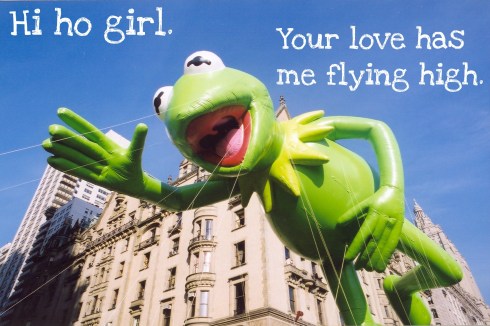
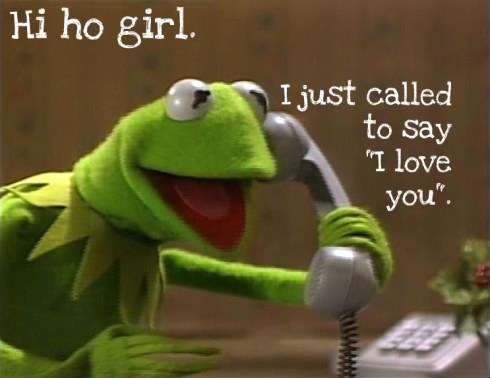

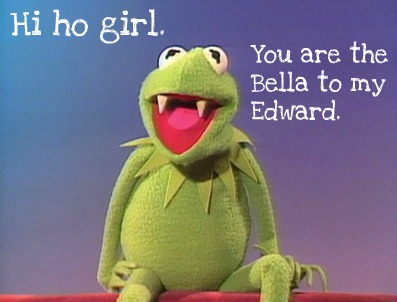
So ladies, I know you love Kermit…but you should really watch out for someone…

Happy Valentine’s Day!
I bumped into Peter Harren on Etsy where I discovered his adorable illustrations. We had a few convos and I encouraged him to join SCBWI. Peter and I got in touch again a couple weeks ago as he was gearing up for the SCBWI mid-winter conference. So I asked him to blog about it as a first-timer. Take it away, Peter!
 The co-founder of SCBWI Lin Oliver is hilarious. Part of her first day welcome address (at 7:30 am or some ridiculous turd hour like that) was this quote from the famous body builder Ronnie Coleman:
“Everybody wants to be a bodybuilder, but nobody wants to lift no heavy-ass weights.”
Of course the conference was going to be awesome, but Lin knew that it had a shadow for some people. The days were packed with activity starting at the wee hours and there was going to be a serious amount of information whipping past our heads. As Lin said, it was going to be work. And for people like me and my fiance Kayla Skogh (kick-ass children’s book writer and illustrator), one other shadow, one big shadow, was the socializing.
We’re introverts, and peppered throughout the info package for the conference and people’s advice for us was some scary stuff— “you gotta network”, “introduce yourself”, “mingle” and “talk to people”. We spent 5 years of our lives in New York City squashed up against people and still, the mention of a Saturday night Gala for networking and “fun” made our mouths dry.
The good news for us was children’s book people are really sweet. There were so many warm smiles and rosy cheeks. I think there were over 1000 people, and something like 70% of them were ladies. With 700 children’s book ladies in there you could really feel the nurturing energy. There were lots of hugs. When I remember the Ballroom I see a peach colored glow coming from the room. And as for the structure of the weekend, it went beautifully. It was really well organized and there were some nice breaks and awesome lemon poppy seed bread.
Now, on to the juice. I’ll share the words of wisdom from all the children’s book world royalty that I deemed worthy of note taking. I guess that’s called ‘noteworthy’. And before I start I should mention that everyone felt the children’s book industry is strong and steady. One guy even said it was robust!
Unfortunately, I didn’t write down who said what, but it’s safe to assume they’re a serious-ass children’s book professional of some sort. Also, all these quotes are in reference to picture books. So, here’s some quotes:
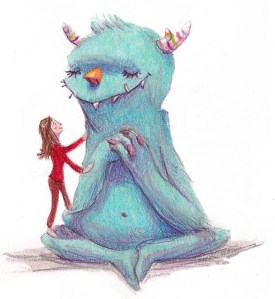 “The keys to a good picture book are: character driven, brief, witty, light on text, and very young.”
- “Great children’s books have clear ideas, an emotional arc, simplicity, and compositional variety.”
- “Keep the story moving, don’t waste pages.”
- “Illustrations need to be narrative on their own.”
- “Make sure the left to right action is strong and promotes page turns.”
- “Character Driven!”
After writing those quotes I’m realizing that they don’t feel as huge as they did when I first wrote them down. I guess that’s evidence of a real benefit to the conference; being there. The conference was hugely inspiring and motivating. And the main reason I went was the portfolio review. My portfolio and book dummy were viewed by over a hundred editors, agents, art directors and book professionals.

If you want an in depth view of the conference you can go to scbwiconference.blogspot.com and find tons of information and videos of the conference. They had a whole team of people blogging the crap out of it.
And just for the fun of it, I added one of my pages of notes.
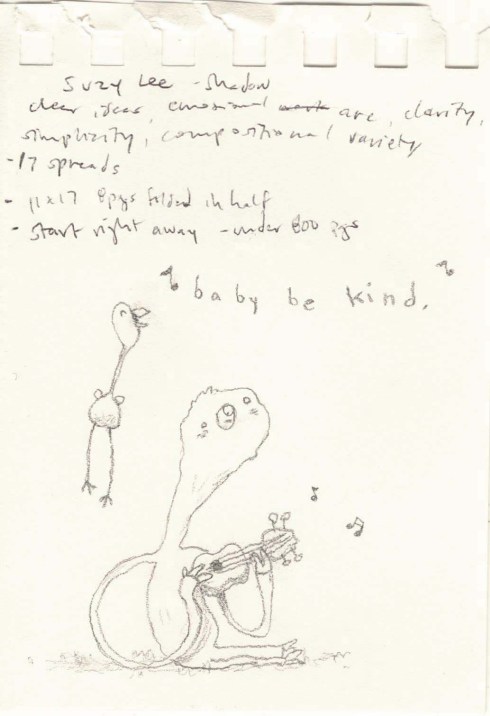
The bird’s lyrics are from Devendra Banhart’s song “Be Kind” which was in my head all weekend. In stressful situations I try to remember to be nice to myself and avoid judging myself for being anxious. This song shows up a lot when I need it.
Peter Harren is an aspiring author/illustrator. Track his progress at PeterHarren.com.
 Say what you will about Wikipedia—that it’s unreliable, that it’s unaccountable, that it’s run by a bunch of idealistic zealots—the fact remains that it is one of the most heavily accessed web resources in the world.
And so, one day as I was researching some of my favorite contemporary kidlit authors and illustrators, I found they were not mentioned in the online encyclopedia. Scott Magoon? Not there. Kate Messner? Nope. Tammi Sauer? Dagnabbit.
I think it’s time we rectified that situation. These folks deserve to go on record, especially those who have won awards for their work.
If you’re a frequent reader of this blog, I’d like to ask you a favor. Pick a favorite contemporary kidlit author or illustrator. Check to see if they’re in Wikipedia.
- List of Wikipedia Children’s Literature Authors
- List of Wikipedia Children’s Literature Illustrators
And if your favorite person is not there, pledge to create an article for that kidlitter by the end of March. Show your love for children’s literature and the people who create it!
Remember that Wikipedia wants you to source references when writing your article. There is a handy-dandy article creation wizard for those of you unfamiliar with the Wikipedia process.
If you are interested in participating, just leave your name and the name of your chosen kidlit personality below. I’ll check in at the end of this month with a master list of potential pages we’re creating.
C’mon, who’s with me?
 Contests for kidlit writers are big draws because they’re an opportunity to break into the business, but I must say to publishers—please stop with the public vote-to-win process.
Publishers may think that open voting ensures that the public’s favorite—and thus, the best book for their audience—will win, but how is that going to happen when the writers are campaigning for votes via social media?
Sure, votes demonstrate the author’s reach and may indicate how well they’ll market a published book, plus it gets more eyeballs on a publisher’s site. But the thing that will really sell a book? A GOOD story.
Writing contests should be chosen by an experienced editorial team, not by Aunt Sue in Schenectady. Because it’s one thing to ask for a writer’s friends and family to click a button and yet another to ask them for cash once the title is released. Just because someone spends two seconds to vote does not mean they’ll spend hard-earned money on the completed book.
Contests that require people to vote once a day for a prolonged period are even more exhausting to the writer and the people who are repeatedly asked to vote. And vote again. Just one more click. Another? Pretty please? It may even cause that writer’s social network to shrink.
And think of the disappointment when the diligent voters learn their time was for naught. Think of the writer’s disappointment having to tell their audience that it was for naught. Will people spend the time voting for that person again? Maybe. But maybe not.
Yep, social media isn’t always so social. And it shouldn’t be exploited.
As a kidlit enthusiast, I want to see good stories published for children to love. The public voting process does not ensure that. Like a Student Council election, it ensures that the most popular person wins. But the most popular isn’t always the most qualified or the most deserving.
In the end, these contests are more about marketing for the publisher than about discovering real talent. And if you have real talent, you should avoid them. Spend your time polishing your manuscript for submission, not campaigning for votes.
I’m sure this post will cause a stir. So please, debate away in the comments. I’m eager to hear your thoughts.
 You probably know the talented illustrator Ryan Hipp—he’s the guy who designed the first PiBoIdMo logo. Well, now he’s got a cool sketch service to check out. You want something drawn? A robot eating a cupcake? A cupcake eating a robot? Or, even more awesomer—a cupcake robot? He’s your man! Check out his very cool site www.SketchRequest.com!
Ryan told me he’s a world-class procrastinator and we battled a little over who was better at putting off things. I think I won. I said I’d continue the argument tomorrow.
But I did ask Ryan to guest blog about his New Year’s resolutions and how to turn procrastination into pro-magination. Take it away, Ryan!
 by Ryan Hipp
The New Year is upon us all, and along with all the diets and promises to give up vices, many of us set resolutions and battle with the evils of procrastination in our professional lives. This is no different in the business of children’s literature. Take it from me—someone that really knows the sinking, overwhelming feeling deep in the pit of the stomach—someone that often doesn’t even know where or how to begin.
People ask me all the time, “So when’s your next book out?”. Wow, its, the worst question to get. Lately I say, “Oh yeah, I’m totally working on this awesome thing that I totally can’t talk about because its like on the verge of blowing up big time and I don’t want to unveil it too soon and stuff, you know?” But in secret, I haven’t sat down to work on it in weeks in some cases.
For me, the irony is that the rigors of being a kidlit professional means I spend a ton of time trying to secure school visits or sending out mailings, and not doing the very thing that all of that work stems from—the writing and the drawing. I am often feeling underwater with all the business that goes along with making books, that I have trouble concentrating on…well…making books!
And then there’s just normal life getting in the way. We all can relate to that, excuse or no excuse.
But here’s an indefensible excuse—the other embarrassing reality is that when I do actually have time to be creative and productive, I still sometimes don’t . I’ll get easily swayed by a call from friends to go out to a movie, or whatever. I’ll have full intentions of turning a free 24 hour Saturday into a work day, then find a way to completely blow it on fun and frivolity.
I’ll say, “I can just do it on Sunday”. But do I? Nope. Encore performance.
I find myself making every excuse in the world to keep away from my desk. Its as if I have a subconscious mental barrier that won’t allow me to begin writing or drawing if my office is cluttered or if I have other things on my mind. And then when I do sit down, sometimes it is a battle to stop goofing around watching cat videos on YouTube.
So here is what I have been doing to combat this of late:
Slow & Steady for the Win
Every little bit helps. 15 minutes a day for a week is still better than failing your intention to sit down for 2 hours on the weekend and then not doing it.
Get Out of the House to Get Work Done
A quiet coffee shop or restaurant away from distractions at home. (Tara: I spend at least one day a week at the library. Otherwise the fridge calls me too often.)
Turn off Phone/Computer
The battle for me is my computer is a tool for research and design—but also a distracting temptation. So I draw my thumbnails away from my desk, and I scribble my notes away from my computer. Then I bring that stuff back home when the momentum will keep me on-task.
Ask Someone Else to Keep Accountability
When you are your own boss, nobody will get on your case if you didn’t write today. So schedule someone to critique your work on a set schedule so you have regular benchmarks to shoot for.
But, when I do get an urge to goof around on YouTube, I cut myself some slack, and remind myself to watch the one thing that usually puts me in the right mood to get productive immediately afterwards. It’s an episode of the Babar animated series titled “To Duet or Not Duet” and it’s a wonderful lesson in procrastination and setting realistic goals. So the next time you are distracted or frazzled, I give you permission to take a break to watch it here:
So what are my resolutions for 2012? I am going to defeat another battle I have—submitting. I am TERRIBLE about sending my work out. But it is really the most important part. I am going to make a better effort at sending out my queries and samples—because all that diligence and hard work means nothing unless it gets discovered.
Be Good and Work Hard!
What are some of your tricks for getting the BIC—butt in chair?
 Before I got my first publishing contract, I dreamed of the day I could call myself a bonafide “author”. I thought my life would be transformed. Transformed how, I wasn’t sure, but I’d walk down the street with a dignified air.
Of course, I got my first contract and I was like Samantha Baker on her 16th birthday. I looked in the mirror and nothing had changed. (And, I will note that the cream they say diminishes dark under-eye circles doesn’t work.) Sure, I was happy—thrilled—but the Tara remained the same. For instance, nowadays:
- I don’t wear tweed jackets with elbow patches.
- I don’t sit in Queen Anne chairs, sipping Darjeeling.
- My toilet doesn’t magically scrub under its rim.
- I haven’t taken up pipe smoking.
- I still don’t use words like “forthright” and “verisimilitude”.
- Joyce Carol Oates has not invited me to dinner. (But I’m only 45 minutes away, Ms. Oates!)
Nope. In fact, I still:
- Remain in my jammies for 2-3 days at a time.
- Drown my eggs in ketchup.
- Do a spot-on impression of Kermit, Miss Piggy, Elmo and Fozzie Bear—while I’m buying groceries.
- Have zero confidence in my writing at times.
- Fall into creative slumps.
- Wear my hair in pigtails.
- Question my significance after viewing Hubble images.
So, I’m here to say…if you haven’t gotten a publishing contract yet, don’t sweat it. You’re still an artist. You’re still a writer. Heck, you’re even an “author”. Life doesn’t really change when you sign on the dotted line. But…
…maybe it changes after the book is released?!
 This list of literary agents on Twitter is mostly comprised of kidlit agents, and it isn’t comprehensive, and some are no longer agents…but all are worthy of a follow. They are in no particular order.
Know other literary agents on Twitter? Please post a comment and I’ll periodically add to the list.
You can also find this list here: http://twitter.com/#!/taralazar/literary-agents/
 LovethePippins
Pippin Properties
We are a boutique literary agency dedicated to the management and representation of the finest authors and artists working today.

KSonnack
Kelly Sonnack
Children’s agent for the Andrea Brown Literary Agency.

Jamie Weiss Chilton
Agent, Andrea Brown Literary Agency, shameless caffeine addict, farmer for Marbles, my gray and white rescue bunny.

Jen Rofe
Children’s lit agent with Andrea Brown who dreams about being a bakery-owning cowgirl. Nevermind that I don’t bake much or have a horse.

Steven Malk
Literary agent with Writers House musing on publishing, music, and sports–not necessarily in that order.

The McVeigh Agency (Mark McVeigh)
A boutique literary agency representing authors, illustrators, graphic novelists and photographers.

Donald Maass
President of Donald Maass Literary Agency in New York, author of Writing the Breakout Novel, The Fire in Fiction and other craft books for fiction writers.


Michelle Wolfson
I’m a literary agent. Check out my site and if you think we’re a fit, let me know. Otherwise just support my authors and buy their books!

The Knight Agency
Our talented agents include Deidre Knight, president, Pamela Harty, Lucienne Diver, Nephele Tempest, Elaine Spencer and Melissa Jeglinski.


DeidreKnight
Literary Agent and New York Times bestselling author of romance/women’s fiction who loves to travel to far away places, mentally and geographically.


TracyMarchini
Editorial Consultant, former Literary Agent Assistant, freelance copywriter.

Suzie Townsend
book lover, former HS teacher, literary agent, sci-fi/fantasy nerd, and owner of an unused $6000 wedding dress. love my life.


Nathan Bransford
Author of JACOB WONDERBAR AND THE COSMIC SPACE KAPOW (coming in May)

Colleen Lindsay
Publishing browncoat. Cat herder. Queer human. Professional nerd. TARDIS fan. Athlete’s foot survivor. Part of Penguin Group (USA) Business Development team.


Kim Lionetti
Literary Agent representing women’s fiction, romance, mystery, true crime, pop culture and pop science.

Ginger Clark
I am a literary agent. I work at Curtis Brown. I respond only to queries I’m interested in. This twitter account will be boring.


Lauren E. MacLeod
A literary agent @strothmanagency with an emphasis in YA and MG fiction and nonfiction. Opinions are my own.

jennifer laughran
literary agent at andrea brown lit, children’s bookseller, reader, raconteur, eccentric multi-millionaire and patron of the arts… and some of those are lies

Jill Corcoran
Literary Agent with Herman Agency representing primarily MG and YA authors.

Rachelle Gardner
Literary agent, firefighter’s wife, mom of two awesome girls, Starbucks freak.

ElanaRoth
Elana Roth
Brooklynite, children’s book agent, Squarespace support specialist, semi-pro Jew, bourbon drinker. I work for lots of people. None of these tweets are theirs.

MarieSuzetteYA
Marie Suzette
At work, I’m a literary agent focusing on the YA genre, and I have to bite my tongue. On Twitter, I’m the anonymous Marie Suzette, who says whatever she wants.

EpsteinLiterary
Kate Epstein
Literary agent representing nonfiction for adults and nonfiction and fiction for YA and MG readers I tweet mainly advice for writers and updates on my books.

AlannaLitAgent
Alanna Ramirez
Alanna Ramirez is a literary agent with Trident Media Group.

mikalroy
Michael Stearns
Michael Stearns
Literary agent. A bit obsessive compulsive about words and writing, books and pop culture.

edwardnecarsulm
Edward Necarsulmer
Director and Principal Agent, Children’s Department, McIntosh & Otis, Inc.

Janet_Reid
Janet Reid
Janet Reid
Writer wrangler. President of the Fabulosity Fan Club. Reader. Easily annoyed, often amused, devoted NYer. I love my job more than makes any kind of sense.

barrygoldblatt
Barry Goldblatt

JuliaChurchill
Julia Churchill
We’re the Greenhouse Literary Agency, a transatlantic agency specialising in children’s fiction.

adamsLiterary
Adams Literary
Adams Literary
A full-service, boutique literary agency exclusively representing children’s and young adult authors and artists.

SarahGreenhouse
Sarah Davies
Founder and agent of children’s/YA at Greenhouse Literary Agency, based in DC and London. Dachsund-slave, photographer, lover of history and wild places.

MandyHubbard
Mandy Hubbard
Agent with D4EO Lit and multi-pubbed author writing as Mandy Hubbard and Amanda Grace. I like words. And pasta. Not necessarily in that order.

sarahlapolla
Sarah LaPolla
Sarah LaPolla
Associate Literary Agent at Curtis Brown, Ltd., pop culture junkie, writing enthusiast, all around book nerd.

seekendall
Sara Kendall
Literary assistant and junior associate at Nancy Coffey Lit. Lover of books and food. And cupcakes.

RebeccAgent
Rebecca Sherman
Rebecca Sherman
Literary Agent at Writers House. Midwesterner transplanted to NYC. Musical theater loving, pop culture addict vegetarian.
 KatRushall
Kathleen Rushall
There’s more to life than books, you know, but not much more. Children’s Literary Agent at Waterside Productions, Inc.

Literary Agent with the Sandra Dijkstra Literary Agency Proudly representing YA, children’s picture books, and some adult projects!





 Writing for Kids (While Raising Them)