You are currently browsing the category archive for the ‘Creative Writing’ category.
 This week, leading-edge technologists, social media gurus and publishers discussed the future of publishing at the O’Reilly Tools for Change for Publishing conference.
I just read a wrap-up from Publishing Trends that blew my mind. Chris Brogan, President of New Marketing Labs, suggested that publishers put their slush piles online, as a way to determine if the public would want to read it before it gets published (or rejected)!
Brogan also said that “Twitter is THE social media tool publishers should learn how to use…it’s a better marketing tool than MySpace or Facebook.” Why? It encourages discussion and allows users to develop genuine relationships.
The publishing industry has to be very careful that books don’t go the way of music before they’re ready for it. Can you imagine a Napster for literature? The Kindle 2 was just released–and its sleeker, magazine-slim design is appealing (there’s a waiting list). Publishers must embrace technology now, before clever programmers enable the public to make their own decisions about how they’ll purchase books.
I’m eager for your thoughts. What do you think about social media and publishing? How will it change the game?
Have you tried the Typealyzer? Just plug in your blog address and the typealyzer will tell you just what kind of blogger you really are.
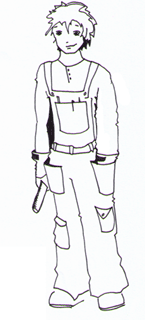 Who am I? The independent and problem-solving type.
They are especially attuned to the demands of the moment are masters of responding to challenges that arise spontaneously. They generally prefer to think things out for themselves and often avoid inter-personal conflicts.
The Mechanics enjoy working together with other independent and highly skilled people and often like seek fun and action both in their work and personal life. They enjoy adventure and risk such as in driving race cars or working as policemen and firefighters.
That was all pretty accurate until the risk part. I’m not interested in jumping out of airplanes. I prefer both feet on terra firma, thankyouverymuch.
So what blog type are you?
And now that I have your attention, don’t forget that “Love Children’s Authors” month begins on February 1st. So if you’re not whoopin’ it up at a SuperBowl party, come on over and enjoy the author interviews, book reviews and giveaways! (Who am I kidding? Not busy with the SuperBowl? I’ll see you February 2nd.)
 I first heard the phrase “TwitLit” from writing friend Christopher Cocca. I’ll give him coining credit. We both write flash fiction, so he had suggested using the 140-character Twitter format to tell uber-short stories. His first submission: “His probation stopped on a dime-bag.” Mine? “The gourmand often ate too much, but she was living life to the fullest.”
So how else can writers use Twitter? You might want to refuse answering the assumed question, “What are you doing?” Come on, that’s boring. We’ve got Facebook status for that. Twitter is nimble, Twitter is quick, Twitter has the power to change the world. (OK, a bit of hyperbole there.)
Agent Nadia Cornier used Twitter to update authors on Firebrand Agency’s “query holiday.” From December 15 to January 15, Firebrand invited submissions without a query letter. At final count, she had over 3500 submissions with 387 read and 30 requested. Useful, clever Tweeting. Thanks, Nadia.
Of course, agent Nathan Bransford already covered authorly Tweeting with a guest post by Tracy Marchini two months ago. Marchini suggests 21 ways an author can use Twitter. Yep, she’s got TwitLit covered.
But I’m going further with this.
You may be aware of the cell phone novel phenomenom in Japan. Authors deliver stories a few lines at a time directly to mobile devices and welcome reader feedback regarding the tale’s direction. Once the novel is completed, readers rush to buy the paper copy because they feel invested in the story. After all, they had a hand (or a thumb) in its creation.
Some critics consider mobile novels an omen of a literary doomsday. Others think the platform can’t be ignored, especially with five of the top 10 novels in Japan having originated on cell phones.
So why not tell an entire tale in Twitter a few lines at a time? OK, perhaps there’s a certain level of literary integrity you want to maintain and this ain’t the way. But it’s a fun and interesting new venue for fiction, and one that could elicit reader feedback. Applications like TweetDeck help you to organize Tweets by subject and keep track of responses to others (using the “@” symbol). But be careful not to use Twitter for conversations that will lose other readers.
What about a Twitter account for your fictional characters? Don’t they have something to say beyond the confines of your book? A Tweet or two and they’re brought to life in real-time. Or maybe you can create a new character who only exists in Tweets.
The format is experimental. Who knows if it will catch on for story telling. But with Amazon’s Kindle gaining popularity and cell phones evolving into integrated entertainment devices for music, web browsing, pictures and videos, surely books and zines can’t be far behind. Can you imagine your phone’s screen folding out like a newspaper and delivering any story you want anytime you want it? Will Twitter help push things in that direction? Perhaps with a million authors using it, it just might.
 So how are you using Twitter to enhance your writing career? Are you marketing yourself or using it creatively? Please share your ideas!
Writers are entertainers. We immerse readers in a magical world, letting them escape with our words as a guide. If a reader enjoys your ride, chances are they’ll seek you out again. And again.
This week I read a lot about branding yourself as a writer, thanks to writing friend Jill Corcoran. The subject isn’t foreign to me, having worked in marketing for a decade. But just what is branding for writers? Developing a consistent style in your stories, offering readers a place that’s as comfortable to return to as their favorite chair. It’s not about writing books so similar that no one finds value in buying more than one. It’s about finding your niche in the publishing world and working within it.
Let’s compare this idea to chain restaurants in the US. Why are they popular? Diners know the menu, they know exactly what to expect. Olive Garden promises that the chicken parmigiana in Spokane will taste the same as the one in Cleveland. They don’t just sell unlimited salad and breadsticks, they serve predictability and comfort. Repeat diners know they’ll enjoy their meal.
People often buy the same laundry detergent, the same rice and the same cheese year after year. How many of you use the same brands your mother bought? Consumers will buy an item simply because they know it and they don’t know the competitors.
Brands also have unique qualities that make them more attractive than similar products. I prefer Barilla Plus pasta because it has added protein without a significant change in flavor. While it’s just pasta, it’s very different from the other noodles on the grocery shelves.
As a new writer in an increasingly difficult book market, developing a brand may give you an edge over the competition. When I think of Grace Lin, I think of whimsical illustrations with colorful patterns like origami paper. John Scieszka? Fairytale spoofs. Roald Dahl writes humorous, fantastical tales. Think about some of your favorite authors and what kind of feelings their name brings to mind. You want to elicit that same kind of recognition when readers think of you.
On the flip side, author K.L. Going admitted that her interest in multiple genres makes it difficult for readers to get a handle on her. At the Rutgers One-on-One Mentoring conference last October she said, “You never know what you’re going to get with a K.L. Going book.” She suggested not doing this as a new author, although she also encouraged us to write what we love.
But what if we love crossing genres? What if writing a supernatural YA mystery comes as naturally as a quiet non-fiction picture book? Perhaps you can be predictable in your unpredictability? Isn’t that a brand as well? Sure it is. But is it one you want as someone who’s trying to break into a tough, competitive business? Agents and editors tout “high concept” in novels, so why not come up with a “high concept” for yourself?
I realize that branding yourself as a writer is a complex task, especially for someone new who is still experimenting with style, genre, voice and subject matter. Stories are more complex than shampoo. You can’t guarantee thicker, fuller hair and a fresh lavender scent with each turn of the page. So what do you guarantee your readers?
Ask your critique partners what your brand might be. What perceptions do they have about your stories? What qualities in your writing are consistent? What do they look forward to when you hand them a new tale? Where does your work really shine?
You might have a very good idea about what your brand is. But remember that branding is all about someone else’s perception, not yours. You can have an image or a message you wish to relate to your readers, but are you sending it? Start asking around. Get to know your own brand so readers can get to know you.
What are you thoughts on branding for writers?
Slumpy and dumpy, I’m feeling grumpy. The end of December twinkled its lights and blinded me. Images of sugarplums not only danced in my head, they had an all-night party and crashed on my couch for two weeks.
I took a break from writing, interrupting one of the most prolific writing periods I’ve ever had. Call it a creativity smackdown. And now, well, I can’t seem to jumpy back into it.
What to do?
I need to chug-chug along here. I’ve got a mentoring session to attend in February and the NJ-SCBWI annual conference is in early June. (Five months is a mere blip in the writing world, like the short amount of time humans have been on Earth in comparison to the age of the Universe.)
How can I snap myself back into shape? I need a hard wallop upside my head. Didn’t I just write about making this year a revisolution? Ha! What a crock! I’m soft and lumpy.
So give me your ideas. How do you get out of a writing slump?
Christy Evers of Christy’s Creative Space nominated me for an Honest Scrap award. This meme requires me to reveal 10 honest things about myself and then tag 7 friends.
I want to stick to this blog’s theme, so I’ll list 10 honest things about me that have to do with writing:
1) I never finished a story in college, but I still earned a Creative Writing degree.
2) I thought there was some magic formula for story endings that no one ever taught me.
3) I was surprised when my professors didn’t share this literary secret.
4) I learned how to end a story by ending it. Amazing how that worked.
5) I lied to my great-grandparents by telling them I had published a book. Poor folks left their house for the first time in 20 years to buy my title at the bookstore. (In my defense, I was only 7 years old. I have no defense for them, believing a second-grader.)
6) I illustrate, too. But I think someone else could illustrate my stories better.
7) I cannot work on adult short stories and my children’s stories during the same day or even the same week. My brain has to completely shift its way of thinking.
8 ) I write most of my stories in my dining room.
9) I like writing long-hand because it frees me from my internal editor, but I rarely do it.
10) I only tagged one friend for this meme. Corey, you’re it.
Tonight I attended a chat with Sean McCarthy, assistant agent with the Sheldon Fogelman Agency. Sean talked to aspiring authors about the children’s book market and how to find the right agent for your work.
It’s late and I’m tired, but you all know my obsession with taking notes! Here are just a few of the major points Mr. McCarthy touched upon during this informative session:
What’s the ideal picture book length?
Sean suggested that 500-word manuscripts tend to be a bit slim. They’re seeing the most success with stories above 500 but under 800. The 900 to 1000-word length is a difficult sell right now and he doesn’t see that changing anytime soon.
How many PB manuscripts should a new author have before querying?
His agency prefers to see at least two completed PB manuscripts. The ideal number would be five viable manuscripts. Sean said the market is difficult and there are so many variables for new authors–editor preferences vary and timing is another crucial element that’s out of an author’s hands. The one thing you can control is how many projects you have ready to go—so the more, the better. (Jack be nimble!) In other words, if you only have one completed PB manuscript, keep writing. Don’t submit yet. Sean urged “prolific-ness” as an ideal author quality.
What’s a hot niche in children’s publishing?
Sean thinks that middle grade is wide-open, with fewer and fewer boundaries, making this area particularly exciting. Sci-fi and dystopian books are a blossoming market, and he’d personally like to see more boy-friendly middle grade novels and hybrid prose/graphic projects. There’s room for mixing genres in middle grade. The biggest development in picture books is the character-driven movement. He wants to see clever and funny stories that have a clear beginning, middle and end, wherein the central conflict is resolved by the main character.
What’s cooling off?
YA has been hot for the past several years, so with the exception of Stephenie Meyer, he sees this area slowing down, since the industry tends to be cyclical.
Is it better for YA novelists to query with a series or just one book?
Mr. McCarthy said that series are tricky for a first-time author. Nine times out of ten, the 1st book in a trilogy will be the most successful. A series is not necessarily more attractive than a stand-alone novel.
Should new authors secure magazine credits before querying an agent?
Only if they are applicable to the genre you’re writing for. Publishing a literary adult short story won’t be helpful if you’re writing a juvenile novel. But he does like to see that you have been actively writing and publishing recently, even if it’s in small places.
Should new authors wait until they have an offer in hand before querying an agent?
While an offer is great and it can grab an agent’s attention, it can unfortunately lead to a “knocked up” scenario, where the author-agent relationship is borne out of convenience and necessity, not because it’s a great match. So he tends to be wary of these situations.
How is the economy affecting the children’s book market?
In the short term, it will be more difficult to place projects, since there are fewer editors. But the good news is that for the most part, children’s books have been one of the few bright spots for many publishers. He definitely thinks things will improve, although the time frame for that is uncertain–6 weeks, 6 months or 6 years…?
One last thought: Mr. McCarthy mentioned that the #1 method of obtaining new clients is by referral–either by meeting someone at a conference or by receiving a recommendation from a current client.
Writing may seem like a solitary occupation, spending hours on your own with a pen or keyboard, but like any other business, making contacts is vital to your success.
So get out there! Attend conferences. Meet editors, agents and other writers. It’s a small world…and, to borrow a phrase from the NY Lottery…”you’ve got to be in it to win it!”
How many of you know your grandparents? I mean, really know their stories? Their favorite childhood friend, how they met their spouse, the hardships they endured in their marriages, the passions they pursued, the loves they left behind, the joys that comprised their lives?
I don’t know my grandmother beyond the surface. She collects owl and cardinal knick-knacks. Her eyesight is fading. She enjoys making hooked rugs and solving word puzzles. She sleeps beneath a golden crucifix.
I know she married a man 10 years her senior at just 17 years old and had two children before she turned 20. I know she was a young girl during the Depression. I know her brother lived with her almost his entire life. I know she watched her husband die of Lou Gehrig’s disease. But I don’t know any of the stories associated with these things. I know one sentence each, and I’ve told you all I know.
I’m eager for more about her life. I want to understand what she went through to ensure I could have the happy, secure life I have today. She is a part of me, but it is all mystery.
As I fell asleep last night, I thought about this blog and how it may remain online for many years into the future. Ten, twenty, maybe even 100 years or more. Then there’s my Shutterfly albums. And YouTube. A permanent record of my life in words, photographs and movies exists out there. Future archeologists need no shovels.
So if you are my grandchild reading this after I have passed, I don’t know you, but I love you. I would like to tell you all my stories. Please sit in a comfortable chair and read about how I wanted to be an author. I hope I inspire you.
Tell me, was I successful? Do you have my books at your bedside?
Please don’t forget to comment. Who knows, maybe in 100 years they’ll figure out a way for me to read it. I’m sure the spammers will lead the way with that technology.





 Writing for Kids (While Raising Them)