You are currently browsing the category archive for the ‘Children’s Books’ category.
Not every book is meant for every reader, but try telling that to an author. We cringe at bad customer reviews of our titles. After years of hard work, it’s difficult to hear that someone dislikes your story. It’s even harder to swallow when your book gets a one-star review for glacier-speed delivery and schmutz on the cover. Yep, these days the old adage is truer than ever: “Everyone’s a critic.”
No one’s immune to the anonymous online rant. Not even Pappi’s Pizza Parlor.
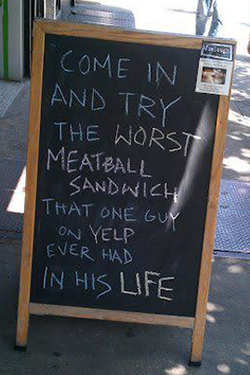
(They had no problem swallowing that review.)
If you’ve spied Jimmy Kimmel’s “Mean Tweets”, where celebrities read devastating Twitter exchanges about them, you know that these criticisms can be hilarious and even, I dare say, cathartic to read aloud.
.
So in the same spirit of poking fun at ourselves and our detractors, author Marc Tyler Nobleman collected videos of children’s authors reading bad reviews of their books. The first installment included three deliciously derogatory episodes. And now the next three episodes have been released, with a mightily attractive screen shot of yours truly gracing the “cover” of Episode 5.
.
Enjoy, and feel free to share your worst review below!
It’s as healthy for ya as a meatball sandwich.
Let me take you back to the first year of PiBoIdMo—2009. (For those unindoctrinated, that’s Picture Book Idea Month. Wait, can a picture book writer even use a highfalutin word like unindoctrinated? Or highfalutin?)
Well, it’s 2009 and my good friend Corey Rosen Schwartz is having trouble meeting the 30-ideas-in-30-days challenge. She despises her ideas. Corey takes her frustration out on Facebook, where all passive-aggressive complaints go to get their wings. She shares several titles on her idea list which feature the precocious blondie:
- Goldifox and the Three Hares
- Tawnylocks, Goldi’s Little Known Twin
- Goldi-Rocks and The Three Bear Band
She posts these same titles on her blog under the caption “Goldi on the Brain” (a serious affliction for fractured fairytale writers). And you know what? Everyone on Facebook and the blog LOVES the third idea. (Remember the Rule of Threes?) One person, Beth Coulton, even offers to collaborate. They write it together and it gets bought by Putnam in 2010.
And so, a book is born. Isn’t it adorable? Don’t you just wanna pinch its cheeks?
 ‘
‘
The concept is clever—the Three Bears form a band but they can’t find a lead singer who can hit the high notes.
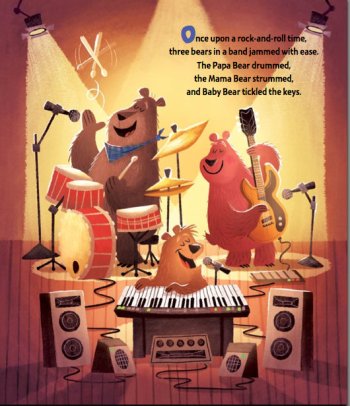
They hold Idol-like auditions and the fairytale characters just don’t cut it. Sorry, Little Red, you’re not going to Hollywood. No golden ticket for you.

(I wonder if Papa Bear is supposed to be Simon? But Simon wouldn’t dare don a bandana, right? V-neck tees are much more his style. Maybe Papa is Keith Urban.)
Meanwhile, Goldi wreaks havoc in their studio.

She even drools on their keyboard!
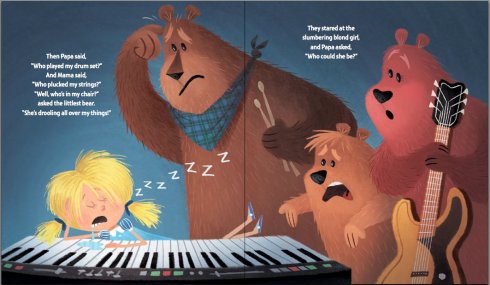
What are the Bears to do? They have to get rid of the golden-haired menace!
Or do they?
Well, you can find out right here. Because I’m giving away a signed copy of GOLDI ROCKS AND THE THREE BEARS to one lucky winner! Just leave a comment below and a winner will be randomly selected in one week. Good luck, music fans!
And congratulations to Corey, Beth and Nate on the release of their new book!
You know, picture book authors and teachers have oodles in common. We all love kids, we’re often underpaid, and we deal with constant parent criticism. Really, we could be twins. Except teachers must get groomed and dressed every morning while we authors get to lounge around in jammies all day. (Sorry, it’s one of the professional perks.)
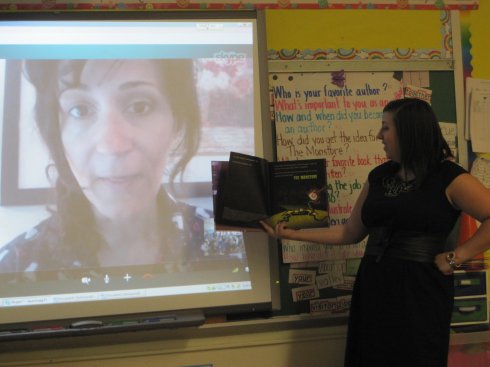
I do Skype visits in my jammies–whichever kind the kids pick. This time it was ice skate jammies!
.
That’s why I was surprised when I spoke to a group of 50 teachers last week and not a single one had ever used Skype in the classroom. We’re not so twinsy after all?
I connect with a lot of teachers online, so I mistakenly assumed that a majority already took advantage of this technology. But I learned that lack of time and resources—plus occasional lack of the internet—means Skype doesn’t get utilized. Some schools even have privacy concerns and other rules preventing its use.
But that’s too bad! Why should it be? If schools can’t afford to bring an author in to speak, Skype provides a free next-best-thing alternative. Author Kate Messner maintains a list of authors who offer free 15-minute Skypes, and a searchable database of Skype-able authors is available at skypeanauthor.wikifoundry.com. With World Read Aloud Day approaching on March 5, think of how excited students will be to hear an author read their own book. It’s magical. Kids consider authors the “rock stars” of the written word.
 Just ask Shannon McClintock Miller’s students. She’s District Teacher Librarian at Van Meter Community School in Van Meter, Iowa and has invited authors/illustrators into her library via Skype for the last six years!
I asked Shannon a few questions to help other teachers get started with their own Skype program…
Shannon, what can a teacher do if their administration is skeptical about Skype?
If the administration is resistant, teachers need to show examples, show the importance, show the impact it can have on the students. They also need to reassure them that the kids are safe, that they know what they are doing…that they understand the “digital citizenship” impact.
When we started out, we practiced Skyping into each others’ rooms. I would read from my library office to the kids down the hall over Skype. We were then able to teach them about Skype, how to behave, that it was just an “extension” of their classroom. All those silly behaviors that we see at first when kids are put in front of a camera can be talked about and addressed. Make sure your administraion knows this.
The impact of bringing in not just authors, but other experts and professionals, takes the library or classroom outside of the four walls and into the world. It brings the children experiences that they might not have otherwise.
 What is your Skype set-up like?
We have a computer with a camera and that is what I use. I have it connected to a projector so the kids can see the author or visitor. You don’t have to have a fancy set up to make this work. It can be simple. And kids can also gather around the laptop on the table, which is what we usually do because they like to be close to the author. Also, it’s very important to have speakers set up. Have the kids be able to come up easily and ask questions, too.
I love how mobile my set-up makes me. I can go anywhere with my laptop…and make connections happen naturally. I also use my phone and iPad with Skype, too. Last year took my phone to our pasture for a class of Kindergarteners to see our horse. It works—the connection, the relationships are what is important.
Also, it’s important to have the author’s book available. We have even read the book along on our iPad if the book is an eBook, too. Or I have printed off papers from the Skype visitors to have for the kids.
We are renovating our library and this is a very important part of the new design. But I want people to know—you can have it be very simple, too.
What have been some of your most memorable Skype author/illustrator experiences?
We have had so many wonderful Skype visits.
- Mercer Mayer was very special because being one of the favorite of all kids (and teachers)… And my cousin (with whom I teach) asked me for her kindergarteners.
- Michael Buckley led an hour-long discussion as a culminating event with our 5th graders and also had fun with us on the last day of school last year.
- Tom Angelberger has Skyped with us several times to create Origami Yodas.
- Robert Forbes and Mrs. P read poetry together for our Poetry Summit with five other schools around the world.
- Peter Reynolds Skyped from his home studio. Being an artist and friend of Peter’s, this was very special.
- Loren Long Skyped for Read Across America Day
- This fall we have been Skyping with Capstone Publishing Art Studio. And LOVED this one…
- I know I am leaving out so many of my favorite friends and visits…I could go on and on.
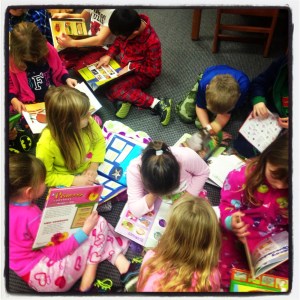 How do you feel these visits have impacted your students?
I feel that these visits bring great experiences and connections to our students. By Skyping with authors, they can discuss writing, publishing, reading, brainstorming, etc. By Skyping with illustrators, they can discuss being an artist for books, for authors, how they got involved and the process.
A lot of times the authors talk about writing when they were younger—how they went to school, where they trained and how they got better at writing.
We have Skyped with publishers to understand the process of writing and publishing a book.
We get to bring the world to our children through these virtual visits.
Thank you, Shannon! It’s interesting to hear from a school system that has been utilizing Skype to its full advantage!
So, how about YOU?
Are you a teacher, educator or librarian eager to try Skype? I’m offering free 15-minute Skype sessions for World Read Aloud Day on March 5th!

I will read my book THE MONSTORE, tell students a SECRET about the book and then answer their questions. (I also perform a magic trick made possible only by this amazing technology and the warping of the space-time continuum.)
Just email me at tarawrites (at) yahoo (dot you-know-what-else) and we can set up a time slot!
Happy Skyping to all!
You know the Piña Colada song, right? Getting caught in the rain?
Well, imagine that song in a picture book for kids (without the dunes of the cape, of course). Two besties have great times together, but they get stuck in a rut and go off to seek other adventures…only to rediscover each other.
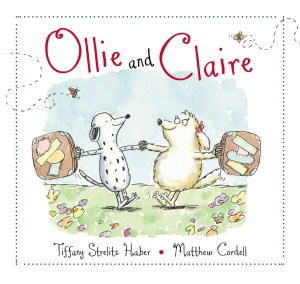 That’s the premise of Tiffany Strelitz Haber‘s charming OLLIE AND CLAIRE. The light and cheery watercolors by Matthew Cordell feature sketchy lines that suggest fun and frolic. A delight to read aloud, your voice just skips along like the two friends do. Tiffany’s a master of rhyme and one of the two ladies behind The Meter Maids.
Besides having two successful picture books to her credit (the other is THE MONSTER WHO LOST HIS MEAN), Tiffany has branched out into ebooks. She recently released HUNGRY HARRY with StoryPanda and MORE CHEESE, PLEASE with KiteReaders. I interviewed her to find out about the ebook process and this emerging opportunity for children’s book writers.
Tiffany, what attracted you to ebooks?
To me, ebooks are just another way for kids to experience reading. In some cases there are interactive aspects to the ebook that can really help them learn, and in other cases it might just be a nice opportunity for a more reluctant reader to enjoy stories and story time in general.

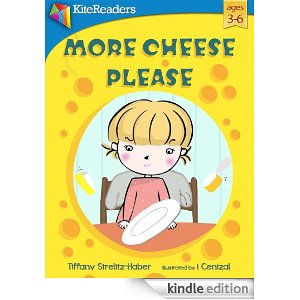 Did you write HARRY and CHEESE specifically for an ebook format, or were these traditional picture book manuscripts first?
I have this sort of arsenal of completed picture books. Some have been subbed out widely. Others to just a couple places, and others have never actually seen the light of day! I picked two stories that I liked a lot and just rolled with those. Not sure CHEESE was ever subbed out anywhere and HARRY went to one place, actually got to editorial, but didn’t make it through. Wait. Does that even answer your question? Kind of, right?!
How did you go about researching ebook publishers and in what format did you submit?
Oh, I googled the bejesus out of ebook publishers and chose to submit to ones that I felt the most comfortable with. There’s a lot of communication available with the actual publishers and marketing directors etc., so you can really get a feel for who you would be working with before you actually work with them.
I hired illustrators (after exhaustive searches on freelance websites) and submitted completed manuscripts (text and art) to the ebook publishers. The illustrators I chose were those willing to accept a flat fee for the work, and OK with the fact that I would retain the rights to the images as well. Hopefully it is some good publicity for them, and also additional work to add to their portfolio when searching for agents, etc. There are so many wonderful artists out there!

How was the ebook editorial process different from a traditional picture book process?
Um…it’s different in that it’s ALL YOU. Period.
Care to expand upon that?
It’s basically self-publishing your picture book online. You need to edit it, and make all the art decisions, and check the spelling and punctuation, etc. There isn’t an editor or an art director to do that with you—although with HARRY I did work with someone at StoryPanda to create the interactive elements of the story.
The sounds all the crazy stuff HARRY eats sure are fun!
What recommendations and cautions do you have for other picture book writers about delving into the world of ebooks?
I think it’s too soon for me to make any cautionary statements OR recommendations about ebooks yet. It’s something I am experimenting with, and really enjoying so far…but definitely too soon to say much more than that!
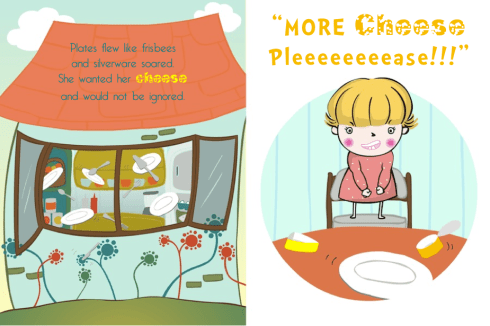
How have you gone about marketing your ebooks?
Well, again—this is all very new to me, but I’ve started sending them out for reviews and of course there’s social media. And on a larger scale, I am trying to work with schools to get the books on their computers, etc. Definitely a very entrepreneurial endeavor; but I think if you’re up for the challenge, it’s also lots of fun with somewhat limitless possibilities!
So you’ve now published two traditional picture books and two ebooks. What’s next for you?
Hmmm…I’m working on a middle grade novel right now, which is taking up most of my writing time—but still juggling a bunch of picture book works in “progress”, although I use the term “progress” loosely, as they seem to be at a dead stop for the time being!
Well, jump back into it because you’re a perfect rhymer and the world needs more great rhyming books!
Thanks for stopping by to let us in on the ebook process!
Blog readers, don’t go yet. Tiffany has a copy of HUNGRY HARRY and MORE CHEESE, PLEASE to give away. Just leave a comment below to enter the giveaway. Two winners will be chosen one week from today. Good luck!
Hippity, hoppity…

Come meet some new kidlit authors with the Children’s Author Blog Hop!
I was invited to participate by Darlene Beck-Jacobson, an author I know from NJ-SCBWI whose historical middle grade novel WHEELS OF CHANGE releases next year. It’s set in 1909 Washington D.C. and follows a young girl who attempts to save the family carriage business during the proliferation of the automobile. (Really cool premise I cannot wait to read!)
To participate in this hop, you don a pair of your fluffiest Hello Kitty socks and…wait a minute! This isn’t the Children’s Author SOCK HOP? Oh darn. And I was itching to do the mashed potato, too.
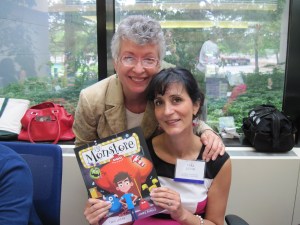
Darlene and me at a NJ-SCBWI book signing
To participate in the BLOG hop, you answer four questions, then pass the torch onto three other authors. One of the great privileges of writing this blog is to promote other talented kidlit professionals. I’m so pleased to introduce you to PiBoIdMo participants and authors you may not know yet—Elaine, Angie & Jacque—but you will!
And now the four questions…
Why is this night different from all other nights?
Whoops. Sorry. That’s the first of the Passover four questions. Maybe my Jewish friends had a chuckle. The rest of you are going HUH?!
1. What are you currently working on?
As you may know, I host Picture Book Idea Month (PiBoIdMo) every November. It’s the picture book writer’s alternative to NaNoWriMo. The challenge is to create one new picture book idea daily.
I caution PiBoIdMo participants NOT to post their ideas anywhere online. Concept is primarily what sells a picture book, and you don’t want someone to snatch your hook-y concept.
So I’m going to follow my own advice and be a little cryptic about what I’m working on. It’s a magical story about someone who’s not happy with magic.
My usual M.O. is to begin with a title, and that’s what I’m doing yet again. It’s got a snazzy, catchy title, something that will make people wanna snag it right off the shelf. The bad news is that I’ve already written this story once before—and revised it at least a dozen times. But it just didn’t work. In fact, I set aside this story for an entire year before I re-read my final draft again just last week.
WHOA! WHAT A STINK! WHAT DIED IN THERE?
In my zealous quest to perfect the manuscript, I darted further and further away from my original intentions. The story didn’t resemble anything I’d like to call my work. And so, it got filed in the circular file.
This week I began again with nothing but the title. I’ve got the opening down and I can already see it’s going far better than it did last year, but I’ve still got a long way to go.
I’m also putting final edits on LITTLE RED GLIDING HOOD, a punny skating adventure coming from Penguin Random House Children’s in October 2015. All your favorite fairytale characters will be along for the glide—Humpty Dumpty, Old MacDonald, even Jack Sprat and his wife.
2. How does it differ from other works in the genre?
The magical story will feature an adult. In fact, it opens with an adult. I know this is typically a no-no, but the adult is not an ordinary grown-up. You’ll see. Know the rules, but know when to break them, too.
3. Why do you write what you do?
I have always had a love affair with the short story. I prefer the brilliance in their brevity. And with picture books, I adore the juxtaposition of words and images. It’s like playing for a living.
4. What is the hardest part about writing?
Not letting the words get away from you. Sometimes the words have a way of writing themselves, pulling you in a direction you didn’t want to go. You have to learn to tame your words, and that’s no easy feat.
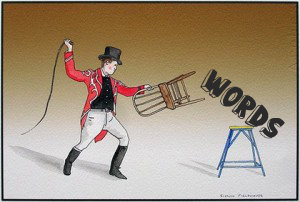
And now, ladies and gentleman and children of all ages, I’m pleased to present the three authors I’ve chosen to hop to: Elaine Kiely Kearns, Angie Karcher and Jacque Duffy!
E. Kiely Kearns is an elementary school teacher and a member of the SCBWI. She earned her Masters in Education from Fordham University. She dreams up wild and wonderful stories in New York State where she lives with her husband, two children, and menagerie of animals. She lives on coffee, chocolate and humor. Mostly humor. Get your “Book Smarts” fix at EKielyKearns.com.
Angie Karcher’s first book, WHERE THE RIVER GRINS: THE HISTORY OF EVANSVILLE, ILLINOIS came out in November 2012. It was part of the city’s Bicentennial celebration and is a resource book for local history in all third grade classrooms in Evansville. Her current project, THE LEGENDARY COWBOY JONES, about a 70-year-old jockey who’s still racing, comes out after the first of the year. She is a former Kindergarten teacher and professional storyteller. Read more of her story at AngieKarcher.wordpress.com.
Born in Brisbane, Australia, Jacque Duffy has always been creative and entrepreneurial. She has written, illustrated and self-published seven children’s books in a series. These books were sought and purchased by the Queensland State Government and placed into schools and libraries. In 2014 her first picture book THE BEAR SAID PLEASE will be released by Wombat books. Follow her down under at JacquesArtandBooks.com.
Happy hopping!
So my debut picture book has been out for three and a half weeks (not that I’m counting). People are excited for me. It’s finally real! They ask me how the book is doing.
Ya got me!
I’ve received two positive quasi-reviews from School Library Journal and Publisher’s Weekly—I call them “quasi” because they were more like synopses than reviews. No thumbs up or thumbs down, just thumbs sideways. I watch my Amazon rank bounce up and down. Up to 12,000, then down to 134,000, then back up again. I held book signings where a few complete strangers did show up, looked at my book, then put it back again. My township’s mayor bought two copies as gifts. Reviews on GoodReads and Amazon have been 96% positive. And bloggers have beamed over the book. Still, I have no idea if sales are brisk, average or slow. There’s no way to know.
So, three and a half weeks post-release and I’m kinda stuck.
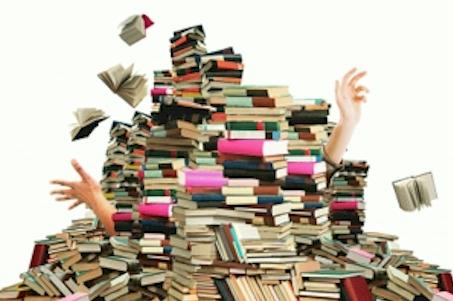
I call it “Post Book-Launch Stress Disorder”.
I don’t know what to do next to help promote my book. And frankly, I’m exhausted. I’m lounging with my laptop, glancing at Amazon and GoodReads, checking my inbox for messages. I know I have blog interviews to complete, but it’s tough to answer repetitive questions in new and interesting ways. And it doesn’t help that I have three books under serious consideration right now and it feels like they’re taking forever to work their way through the system. I feel very much in limbo, without direction. Maybe I need to consult with North West.
I suppose this is why so many writers have a schedule, a set routine. I am not one of those people. I have never been good with routines, tap dance or otherwise. But I see the advantage of the same-old, same-old. If I were a scheduled, disciplined person I’d be writing every day, no matter what, Post Book-Launch Stress Disorder be damned. Like Roald Dahl, I’d stroll to my writing hut, plop down in my comfy chair and grasp my Number 2 Ticonderoga, watching it fly across the legal pad. But no. I sit here. And wonder what comes next.
I never had an actual book launch party. I don’t like planning parties and it seemed like a frivolous expense. Friends assured me you only release a book once—celebrate! Plus, my husband said the party is to thank everyone who has helped me over the years, not necessarily to toot my own horn. But it felt like tooting, and frankly, I’m tired of tooting. (P.S. To the seven-year-olds reading this, NOT THOSE KINDS OF TOOTS.)
It’s hard not to toot when someone blogs beautifully about your book, or when it winds up in a major newspaper. But I fear I may be getting overexposed. Maybe I need to consult with North West.
All this is to say I have no plan. Wednesday was the last day of school for my children and I’ve realized the summer is here and I NEED A PLAN. They’re going to camp, but it’s only half days, which leaves me little time to write. Did I say I need a plan?
Anyone got a plan for beating Post Book-Launch Stress Disorder?

Hope. Dream. (See attached necklaces.)
When people find out I’m a children’s author, I typically get this response:
“Oh, wow! You know, my sister/cousin/neighbor/son’s teacher wrote a children’s book a while back. You could probably help her/him to get it published.”
This is so common. You know the saying “everyone has a book in them”? That’s incorrect. “Everyone has a children’s book in them” is far more accurate!
In the early days, I was naive. I said, “Of course!” I gave the person my contact info, then I spent hours with their acquaintance critiquing their manuscript, teaching them about picture book structure, and ultimately causing this person great disappointment when they realized the tale they whipped out on a rainy afternoon wasn’t publishable exactly as they had written it.
It made them feel awful. It made me feel awful. It was not worth it.
Then I realized—these casual writers think having a published book would be “neat”. And it’s not neat. It’s hard work.
So now, I take a very honest approach. Instead of offering my assistance right away, I say this instead: “If they have a passion for children’s books, by all means, send them my way and I’ll do all I can to help. But if this person wrote a story on impulse and they don’t have any desire to have a career in children’s literature, they’ll find it extremely difficult to get published and end up being very frustrated and disappointed.”
This is usually followed by an “Oh. Gotcha.”
They understand. (I hope.)
I don’t know why being a children’s author is perceived as such a simple skill as opposed to something like playing in the NHL or becoming a doctor or lawyer. You never hear someone say, “You know, my sister/cousin/neighbor/son’s teacher wrapped an ace bandage around a kid’s ankle a while back. You could probably help him/her to become a pediatrician.” OK, I realize you don’t need a degree to become an author, but you do need several years of concentrated study and practice. You need to be dedicated. Passion for your craft is essential.
So now I let people know this. Publishing is not something to enter into partway. The industry is full of criticism, rejection and waiting…more waiting than the DMV times a thousand. It’s frustrating. It’s challenging. If you don’t love it, you won’t live through it.
So hope and dream. And work hard.
The kids deserve it.
 “I think what this fella Psy is tapping into…is the fact that people don’t want any meaning right now. The most popular music apparently is that without intelligible words…not reality, not feeling, not meaning.”
 Darn straight, readers want a good beat. What they don’t want is to be beat over the head with a lesson you think they need to learn, sly Mr. Fox.
 OK, silly title. And if anyone under 30 reads this post, they’re not gonna get the reference to Moon River.
But heck, I like it, because your smile will be wider after you visit RhymeWeaver…
Many kidlit writers hear “don’t rhyme” from picture book editors. It’s not that editors hate rhyme (well, maybe SOME do), it’s just that they see badly-executed rhyme so often in the slush, it’s easier to discourage it. Common rhymes like “me, see” and “you, two” and other one-syllable predictability can kill the joy of a story.
 Remember “Celebrity Apprentice” when the men’s team gleefully authored “I know my A, B, C’s and my 1, 2, 3’s” as if it hadn’t been regurgitated in a googolplex of board books? They thought it was a rhyme worthy of victory and publication. Well, they did win the challenge, but the book Trump promised to publish was released by a vanity press, not a traditional publisher. No publisher was gonna touch it, ten foot pole or not.
Editors also see a lot of rhyme with flawed meter. Meter is a tricky thing. There’s stressed and unstressed syllables, plus the lilt of natural speech patterns that can render your meter more choppy than Zoanette Johnson’s drumming. If you read your own rhyme aloud, you might not even hear how off it is, because you are forcing yourself to follow the pattern [you think] you created.
Then there’s the near-rhyme mistake, when the words don’t really rhyme at all, unless you twist your tongue or alter your accent. Like “hat” and “what” or “hat” and “back”. Once or twice and you can maybe get away with it. More than that and the editor may assume you need the WaxVac.
Moreover, writers can find their story dictated by rhyme, getting trapped in nonsensical situations simply because “dishwasher” rhymes with “impostor” (almost). It’s obvious when a plot decision has been forced based upon one word.
For these reasons, editors will advise, “don’t rhyme”.
For these reasons, author Lane Fredrickson created RhymeWeaver.com.
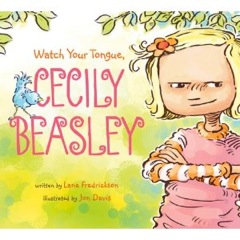 Lane is the author of WATCH YOUR TONGUE, CECILY BEASLEY, a rhyming picture book with a joyfully jaunty rhyme. Remember as a child when you stuck out your tongue and a parent warned, “It will get stuck that way!” Well, Cecily finds herself in that very predicament. Hilarity ensues when a bird takes up residence on Cecily’s perfect pink perch. What’s Cecily to do?
Knowing the difficulty of rhyme for picture book writers, Lane created RhymeWeaver.com to teach the bard-challenged the complexities of rhyming well.
Lane, your rhyme is perfection! How did you get to be so good at it?
Ha. Thank you, Tara.
The short answer would be: a gnawing question and a genetic glitch.
But there is also the long answer. When I first joined SCBWI, everybody seemed to be telling everyone else NOT to write in rhyme, like there was a disease associated with it. You know, literary sarcoma or writer’s blockjaw. You almost didn’t want to admit you were a rhymer lest they sit in some quarantined section and slap a scarlet R on your forehead. The other thing I kept hearing was that a person’s rhyme had to be PERFECT. I wanted to write PERFECT rhyme, but I could never get a really good answer as to what PERFECT rhyme was. This is the kind of scenario that drives a slightly obsessive-compulsive person to behaving obsessively compulsive. So I googled around and studied my Seuss and found a website that offered critiques for $50. The critique, although well-intentioned, was just plain bad advice involving “counting syllables.” And don’t get me wrong, I’ve definitely given bad advice (but I’m pretty sure it was free when I did it). I totally get that sometimes bad advice seems good because it comes from multiple sources, but “counting syllables” is not the way to perfect meter and I had (being slightly obsessive compulsive) already figured that out. So I went back to school thinking I’d take a poetry class and clear up the PERFECT meter issue. But the thing about college is they don’t tell you what you want to know, they tell you whatever they want to tell you. So it took a BA in English and healthy stab at an MA in British Lit to figure it out that meter is a lot of things, but PERFECT is rarely one of them (I only stabbed at the MA, I haven’ t killed it yet).
 What inspired you to put all your rhyming knowledge into a website?
I watched a lot of people go through exactly what I went through: trying to figure out the rules, trying to decide if writing in rhyme was worth the stigma, trying to find complete resources that explained everything. I have a degree in psychology, where I focused on cognition and development (which is the opposite of those people who ask you to talk about your problems). Cognitive and developmental psychologists look at how people think and how they grow, mature, and learn. I knew that I could show meter in a way that’s visual and image-based. I knew that I could break it down into constituent parts in a way that I had never seen done. I knew that I could make it easier to grasp. But I wanted it to be free because I’m trying to improve the status of rhyme in the literary world and the more people who rhyme well, the less it looks like I have a disease.
Lane’s website has already helped this ruined rhymer who can’t hear meter even if I got whacked upside the head with it. So I encourage you to pay RhymeWeaver.com a visit, Pin it, share it, study it, LIVE IT. Children deserve better rhyming picture books like CECILY BEASLEY.
And hey, you can WIN CECILY! Just leave a comment telling me about the most interesting thing you learned at RhymeWeaver.com. A winner will be picked randomly in a week (or knowing me and prize distribution, two weeks).
So don’t hesitate, get out there and rhyme, oh Kate! (Sorry if your name isn’t Kate. I had to end on a rhyme.)
Sorry if I tricked you.
This is not a post about breaking picture-book-writing rules. (Although I will DEFINITELY get on that idea lickety-split!)
This post’s about the book BREAK THESE RULES!
Due from Chicago Review Press in September, yours truly plus 34 kidlit authors YOU’VE ACTUALLY HEARD OF (unlike me), take on typical life rules adults love to preach (like “Grow Up and Be Serious!”) and offer our experience of why it’s probably a BETTER idea to BREAK those rules.
The subtitle says it all: “35 YA Authors on Speaking Up, Standing Out, and Being Yourself”—and so do the yellow canvas sneakers clashing with the argyle socks.
Behold the brand-spanking-new cover!

My husband asked why my name wasn’t on the cover. Isn’t he adorable? (Seriously, I just wanna pinch his cheeks like a plump polyester-pant-suit-wearing Auntie.) Um, there’s no way anyone’s gonna pick up this book because it says “Tara Lazar”. But look—it says “Matthew Quick” and “The Silver Linings Playbook”. HOLY OSCAR-WORTHY GUACAMOLE, PEOPLE!
So be on the lookout for this extraordinary compilation come September because all proceeds benefit The Children’s Defense Fund. And it’s sure to be a POWERFUL read for adolescents and teens (and the occasional pusillanimous adult).


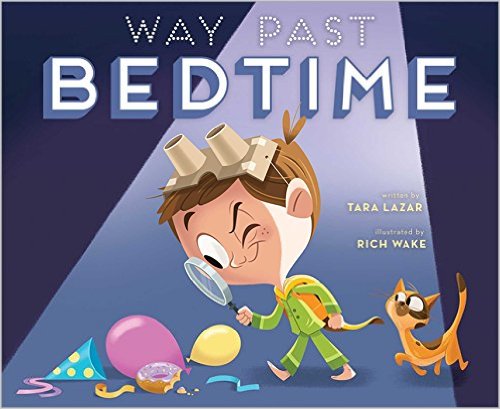



 Writing for Kids (While Raising Them)