
Joyce Wan, talented author/illustrator of “Greetings from Kiwi and Pear,” stops by the blog today to recap the recent NJ-SCBWI annual conference. I couldn’t attend this year so Joyce offered to share the juicy details. (Get it? Kiwi and pear…juicy? Ugh, stick to humor in picture books, Tara.)

Take it away, Joyce!

It was my first time attending the New Jersey SCBWI Annual Conference and it was such a blast! There were intensives, workshops, lunches with editors/agents/art directors, a book fair, a juried art show, a raffle, auctions, one-on-one critiques, agent pitch sessions and portfolio reviews galore. A whopping 22 publishing houses/agents were represented. A round of applause to Kathy Temean (NJ-SCBWI RA), Laurie Wallmark (Assistant RA) and all the volunteers for coordinating such an amazing and well-organized event. The conference was informational yet inspiring and I left Princeton feeling excited and energized!

Highlights from two of the workshops I attended which stood out in my mind:

Sure it’s Cute, But Will it Sell?
Steve Meltzer
Associate Publisher/Executive Managing Editor
Dial, Dutton, & Celebra

He provided us with information on the business side of the industry and a snapshot of the current picture book market. The market is made up of four types of buyers:

  1. Independent Retailers
  2. Mass Market Retailers
  3. Institutional (Libraries and Schools)
  4. Book Clubs/Fairs

You want to write a book that hits ALL markets. Examples of current books that are hitting all markets:

  • Skippyjon Jones
  • Fancy Nancy
  • Ladybug Girl
  • Llama Llama Red Pajama

As mentioned in the recent #pblitchat on Twitter, Meltzer is looking for character-driven stories: stories with quirky characters that are unusual and original but realistic. Character stories invite sequels, branding, and licensing opportunities.

Finally, he suggested that writers should be able to pitch their story in one sentence. Compare it to something successful but then tell him how it’s different (ex. Like Skippyjon Jones but with whales).

Picture Books – What Works
Sudipta Bardhan-Quallen
Author of 13 picture books and seven non-fiction books

Picture books should be 650 words or less. Story should consist of a character that has a conflict and makes three failed attempts to solve the problem and then has a successful attempt on the fourth try. The end of the book must surprise the reader (a twist), extending the story beyond the story, which makes the book re-readable. Although she did mention that there are no hard and fast rules to picture book writing–and that these are just what, in her experience, has worked for her–I do think it’s a handy little formula to follow for those of us beginning our journey in the world of picture books! Another little trick that can help add tension to any story is to add a ticking clock of some sort: the character has to reach the goal by a certain time (ex. by bedtime, by sundown, etc.).

In addition to the workshops, there were two really inspiring keynote presentations at the lunches given on the first day by David L. Harrison, author of 80 children’s books, and on the second day by Catherine Gilbert Murdock, author of Dairy Queen and other books. David Harrison reminded us all why we do what we do, which is to create literature for young people. Catherine Gilbert Murdock charmed us all with her self-deprecating humor and shared with us how her journey to becoming a successful author started in a not-so-successful career in screenwriting.

There was also a juried art show organized by Leeza Hernandez, which was a first for the NJ SCBWI conference. You can read about the winners of the art show and view some of their beautiful artwork on Kathy Temean’s blog.

I submitted this piece for the art show which is a scene from my picture book that came out last year called Greetings from Kiwi and Pear.

I had fun being part of such a visual part of the conference and even had a fellow attendee email me after the show saying how much she loved my work and what a bummer it was that we didn’t get to chat during the conference.

One of the best parts of the conference was the one-on-one critique with the editor/agent. I thought the one-on-ones alone were worth the price of the conference. The editor I had my critique with gave me very insightful feedback and ideas. I showed her the picture book dummy that went with the manuscript I submitted for the critique along with my picture book that came out last year and even my Wanart catalog so that she could get a better sense of my illustration style. She liked my picture book dummy so much she actually asked to keep it along with my catalog–how exciting!

One fun side note is that there was a High School prom at the hotel the first night of the conference. I got quite nostalgic at dinner watching all the kids in their tuxedos and glittering gowns make their grand appearances in the hotel lobby–it was quite a spectacle and felt like dinner theater!

Overall, the conference was fantastic in every way from the top notch venue (there were koi ponds in the atrium!) to the high calibur faculty. I’m already looking forward to next year!
I was taken aback this week when a girl posted a comment on my blog in regards to the 365+ Things Kids Like post:

what the hell im i kid i dont like most the things on that list [sic]

OK, so we’ve got one unusual and outspoken kid out there. I mean, nearly 365 things is a lot NOT to like. Although I assume that this kid does like #21 Being Independent, #175 Ignoring Adults and #201: Knowing More than Everyone Else. And this kid may not be of picture-book age (less than 8 years old), given the language.

I add to this list periodically, to keep track of subjects that may work in a future picture book manuscript. But one thing I forgot is that kids like to be unique individuals. Not every child loves riding skateboards and roller coasters. Some are scared of clowns or think they’re stupid. And licorice? Blech. I know I hate it.

This leads me to ask–how do you know the subject of your story will appeal to a broad range of children?

Because at its heart, a picture book isn’t about a dragon or a robot. It’s about an emotional truth–friendship, family, fitting in. Carving out your place in the world. Accomplishing your goals.

So I have to add two things to the list of 365+ Things That Kids Like:

  1. Being loved and appreciated.
  2. Having their voice heard.

Every Monday at 10pm EST children’s writers and illustrators jump on Twitter to chat about picture books. The brainchild of Aussie authors Karen Collum and Kat Apel, #pblitchat churns away for an hour, with topic schedules and transcripts posted on the Picture Books Only blog. Below are highlights from this week’s chat on writing for the very young–children from birth to age 3.

  • Unless you’re an author/illustrator, board books are a difficult sell. The word count is low and the stories are less complicated than picture books for 4-8 year-olds, so illustrations become even more crucial to bring life to the story. For example, the visual cues in Sandra Boynton’s Blue Hat, Green Hat allow non-readers to “read” the story themselves. As a new writer, you want to write a story with the broadest possible appeal to maximize your chances of being published, so writing specific to the board book format may limit you.
  • A trend in board books is to republish books that have been popular sellers in hardcover/paperback. Board books are expensive to produce, and at the same time, parents want to pay less for them, so publishers may prefer to go with a proven story rather than a new one. Great example: Snowmen at Night by Caralyn and Mark Buehner was first a successful hardcover title, released in 2002. A few years later, the publisher created board books and sold them with a stuffed snowman during the winter holidays. A jigsaw puzzle board book and a pop-up version (a new story) were also created.
    • Average word counts for young books are typically less than 500 words and could be fewer than 100 words.
    • The market is saturated with ABC concept books, but books with a completely fresh take can be successful, like Shiver Me Letters, A Pirate ABC by June Sobel and Henry Cole.
    • Repetition helps young children understand story and recognize words, plus it encourages participation in reading aloud.
    • Lift-the-flap books offer peek-a-boo surprises and drive the story forward, but again, they’re a tough sell unless you’re an established author and illustrator.
    • Novelty books (pop-ups, foldout pages, liftable flaps, or hidden sound chips) are often published by mass-market publishers and not trade publishers. What does this mean to you? In-house talent or work-for-hires create these books.
    • The jury is split on interactive titles for the very young. Do parents want their toddlers drooling on an $800 iPad? Do electronic titles lose the “cuddle factor”? Or does the new interactive medium offer an unprecedented opportunity to unknown author/illustrators? A recent article cited a new 3D book as one of the top 20 ebook apps for the iPad, right up there with Dr. Seuss and Disney titles.

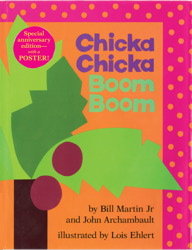
    My favorite #pblitchat moment? Board books get gnawed and chewed by babies, so how about an edible board book? (As suggested by @RedStepChild a.k.a. illustrator Lynn Alpert.) I think this is an idea whose time has come, especially if they’re made out of freeze-dried astronaut ice cream. Mama may want to chow down on tasty kidlit, too! (I can see it now–Chicka Chicka Yum Yum.)

    What else is important to know about writing and illustrating for the very young?

    Don’t worry, I haven’t slid off the children’s book wagon to blog about the policies of Franklin Delano Roosevelt. No, “the new deal” to which I refer is my first picture book deal.

    Did you hear what I said? FIRST PICTURE BOOK DEAL!

    Tara Lazar’s debut THE MONSTORE, about a shop which sells only the most useful monsters, and has only one rule: no refunds, no exchanges, to Emily Lawrence at Aladdin, for publication in summer 2012, by Ammi-Joan Paquette at Erin Murphy Literary Agency (NA).

    I’m thrilled to be working with Emily, who not only loves tacos as much I as do, but also made an appearance on this blog two years ago (unbeknownst to her). Joining Emily in the monsterly hijinx is assistant editor Alyson Heller, who shares my passion for figure skating.

    (Note: Please don’t send these editors stories about TACO HARDING AND JEFF GUACAMOLE. Mexican food and figure skating don’t mix! Not even with some good queso!)

    Next up, an illustrator will be chosen and then we’ll work on revisions.

    And hey, what the heck, I’ll drag you along on the journey. I’ll share as much as I can about the behind-the-scenes process–from getting a book signed to signing books!

    The journey thus far:

    1. I was born.
    2. I wrote my first picture book with my 2nd-grade BFF and told my great-grandparents it would be published soon.
    3. I apologized to my 80-something great-grandparents for making them drive an hour to the bookstore.
    4. I went to college and wrote awful short stories and lousy poetry.
    5. I worked in high-tech and wrote awful press releases, shouldering some of the blame for “irrational exuberance.”
    6. I got married and had two kids.
    7. I decided to take up my 2nd-grade passion again (without BFF).
    8. I wrote.
    9. I revised.
    10. I conferenced.
    11. I rinsed and repeated.
    12. I submitted.
    13. I wrote this post. (And you commented!)

    Want a great piece of writing advice? As a new writer, surround  yourself with more experienced professionals. You’ll grow and learn far more quickly than if you remain in a critique group comprised of writers on your level.

    Unfortunately, it’s not always easy to find an experienced critique group. However, paid critiques are one way to gain access to knowledgeable professionals and speed-up your learning curve. You can receive paid critiques at SCBWI conferences and through independent editors, and once in a while critiques go up for auction to benefit good causes. But these critiques, while thorough and worth every penny, can sometimes cost a lot of pennies.

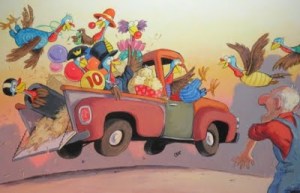
    I met award-winning author Brenda Reeves Sturgis at the 2008 Rutgers One-on-One Plus Conference and we had instant chemistry. Easy-going, lovely, and full of fun, Brenda possesses a great personality and a penchant for picture books. Her debut TEN TURKEYS IN THE ROAD releases fall 2011 with Marshall Cavendish, and her poetry appears in the SWEET DREAMS anthology later this year from Blooming Tree Press. And guess what? OK, you’ve guessed it, she has begun a new critique service for picture book writers (and for not that many pennies).

    Hey–did you notice–critique service, Reeves Sturgis. That rhymes! Well, kind of. Maybe just a little? Huh?

    But believe me, her critiques are far better than my rhymes.

    Check out her testimonials!

    Dust cobwebs off the fake plants!

    [Check email.]

    Play online Bingo Luau!

    [Jump when the phone rings.]

    Give away old clothes circa 1994!

    [Check email. For the 27th time this hour.]

    Refill the bird feeders!

    [Check answering machine.]

    Clear unidentifiable aluminum-foiled bricks out of the freezer!

    Yes, such is the glamorous life of a newly-agented writer who hopes to someday soon be a bonafide author.

    What’s that you say?

    I should be doing something else while I wait for an editor response?

    Something like…writing???

    Bahhh! What a crazy idea.

    Well, what would YOU do?

    One winter morning in 1976, my father was reading the Sunday paper when he stumbled across an ad for ice-skating lessons. He snapped the paper in front of me and asked, “It says you have to be able to skate across the length of the ice to sign up. Can you skate across the ice?”
    “Of course I can skate across the ice,” I said, and then gulped a spoonful of oatmeal.

    A minute later he was on the phone, registering me. What on earth made  him believe a five year-old who had never put on a pair of skates could cross a slippery arena, I’ll never know. But I was excited to begin lessons and I imagined zooming around in circles, faster than everyone at South Mountain.

    The next week I proudly stepped onto the ice in my new skates.

    And promptly fell.

    And fell again.

    And again.

    Then I learned to hold onto the side. And then I learned what it’s like to hit the boards AND the ice. And this was in the days before helmets.

    A guard helped me off the ice. She told my father I could not be in group lessons. I thought I might cry. Then she suggested I spend a private lesson with her, learning to skate. My father agreed and by the end of the lesson, I was indeed moving across the ice.

    I took group lessons every winter for a few years, earning my USFSA patches faster than everyone else. And when I had completed those patches, they told me I was ready for a coach and private lessons–lessons my family could barely afford.

    I went for one private lesson and waited for my coach in the corner, practicing simple figures. The older skaters yelled at me because, unbeknown to me, I was hogging the JUMP corner. I was trying to stay out of the way, but I was totally screwing up their double lutzes.

    And then when my father heard what time the coach wanted me at the arena–5:30am twice a week–that was the end of private lessons.

    Over the years, I skated recreationally instead, going to the arena once a week and trying to teach myself. I was able to do a scratch spin and a waltz jump, crossovers in every direction, and a few fancy turns. But my real desire was to compete. I always thought…some day.

    That day came as an adult. As soon as I had my own money, I took lessons. And like I had done as a child, I quickly moved up through the ranks. I hired a coach. I competed. And I won. In 2002, I competed at Adult Nationals in Ann Arbor, Michigan, after winning Gold at Eastern Sectionals and two other Golds, a Silver and a Bronze in other competitions that year. It was a dream come true.

    I thought–if I can do this, I can do anything.

    And now, here I am today, accepting an offer of literary representation. Skating gave me the confidence to pursue another dream, that of becoming a published children’s author. And now I’m one step closer to that dream.

    I’m here to tell you–work hard, believe in yourself and your talents, find a great critique group and writer friends who support you, and go for it!

    You will stumble. You will fall. But brush yourself off and soon you’ll hit your stride–or in my case–glide!

    Besides writing for kids, I’m raising them, too. (You may have already figured this out by the blog title. I’m not that full of surprises.)

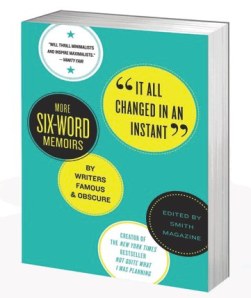
    Two years ago I won a Six-Word Momoir contest from Smith Magazine, and now another one of my Momoirs is featured in their new book It All Changed in an Instant: Six Word Memoirs by Writers Famous and Obscure:

    Wanted independence but had two dependents.

    Probably would have sounded better if I went all Duggar and said nineteen dependents, but I digress…

    Sometimes we need a break from our current manuscript, but we still want to write. Well, what better way to be succinctly witty and wittily succinct than by writing six-word memoirs? Picture book writers are expected to write short, so here’s the ultimate exercise. In my case, I’m sticking to momoirs. Here’s a few to get your creative sixes flowing:

    Woman with awesome body becomes homebody.

    Two words bring joy: “She pooped!”

    You really do become your mother.

    How many years until Kindergarten begins?!

    Naptime: my favorite time of day.

    Wake me up when they’re grown.

    Stuffed animals must breed at night.

    Motherhood should require an entrance exam.

    Hug tight. The years move fast.

    Say “yes” as often as possible.

    Except when muddy nightcrawlers are involved.

    Grant wishes. Encourage dreams. Inspire hope.

    Give birth. Give lessons. Give freedom.

    OK, I apologize for the poop. I have no reason to sink that low. But I do have something to tell new mothers in six words: “Stay far away from rice cereal.”

    So, give it a shot. If you’re a parent or not, try a six-word memoir. I expect to see at least six below in the comments!

    Photo credit DOCUMERICA by Patricia D. Duncan

    Something strange happens to women once they reach 50, and I’m not talking about hot flashes and sagging skin. I am referring to those female family members who have an overabundance of stuff and feel the sudden need to unload it on me.

    I do not need wooden napkin rings circa 1974 nor a pilly afghan in the trendy avocado green of that decade. A framed print seems like a generous offering, until I learn that it sits beneath cracked glass. Sweaters and velvet jackets thick with dust and the odor of mothballs? No thanks. Old dented tins, used shopping bags, vinyl placemats, and assorted ceramic chachkas—does my home look like a flea market?

    I have relatives who want to get rid of things. I understand that. But they assume the items are too good to throw away. Yet I suspect they also realize their knick-knacks aren’t desirable enough to sell, not even to the eBay-obsessed, so I’m the solution to their clutter.

    So what do I do? Refuse the third PBS tote bag I’ve been offered?

    No, I graciously accept it with a “thank you” and watch their eyes light up with pleasure, knowing their treasure has found another home within the family. And then I tuck it away into a dark basement closet, awaiting my 50th birthday when I can hopefully dump the stuff on my nieces.

    But a few months ago for Picture Book Idea Month, Susan Taylor Brown told us how she finds inspiration: collecting “junk” in an idea box, and then imagining the story behind the brooch, feather or piece of iridescent ribbon she’s found.

    So perhaps collecting chachkas isn’t such a bad experience for a writer. In fact, maybe I’ll start asking neighbors to unload their trash–I mean treasure–on me.

    A few days ago in Think Before You Write, I mentioned that although a picture book is short, it doesn’t take a short time to write:

    You whittle down the length so every word packs a punch, while still presenting a compelling page-turner, full of illustrative potential. (Which means you have to leave some things unsaid.)

    So what does that mean? Leaving some things unsaid? Well, I’ve found perfect examples from Kathi Appelt. (Yes, Newbery Honoree Kathi Appelt. She knows her stuff.)

    Today my daughter asked me to read Appelt’s Bubba and Beau Meet the Relatives, one of our favorite picture books.

    Appelt says a lot with a little, meaning she uses a few words to describe a situation, leaving illustrator Arthur Howard to fill in the blanks.

    Bubba and Beau Meet the Relatives is about a baby boy, his bloodhound puppy and the Texan family relatives who come to visit one afternoon. Bubba’s Mama Pearl quickly prepares for the relatives’ arrival.

    Appelt says: “First Mama Pearl went on a home improvement spree.”
    Howard draws: Mama Pearl shoving clothes into a drawer, pushing an overstuffed closet closed, and sweeping Bubba’s toys underneath the bed.

    Notice it took 19 words to describe the illustrations, but Appelt only used 9 words to set the scene.

    Appelt says: “Then she handed out orders.”
    Howard draws: Mama Pearl pointing to a cobweb which Big Bubba swats with a broom, Mama Pearl holding a bag for the bloodhound to put away his bones and balls, Big Bubba vacuuming with Beau riding the cleaner.

    And there it took 36 words to describe the illustrations, but Appelt only used 5. (OK, I could have described the art in a tighter fashion, but I think you see my point.)

    Later in the story, Appelt introduces “…Cousin Arlene and her dog, Bitsy.”

    Appelt says: “Honey, it was froufrou city.”
    Howard draws: Cousin Arlene in a frilly pink dress, with a pink bow to match the one atop Bitsy’s fluffy head.

    Once again, Appelt’s petite word count packs a humorous punch, with Howard’s illustrations telling half the story.

    In our favorite scene of the story, Bubba, Beau, Arlene and Bitsy have just been discovered in the mud hole. “Only one thing to do,” says Big Bubba.

    Page turn. (Which means a surprise is coming!)

    Appelt says: “Yeehaw, honey! It was a picture-perfect day in Bubbaville.”
    Howard draws: The entire family sitting in the back of Big Bubba’s truck, which has been filled with a hose so it’s a southern-style pick-up truck pool.

    At kidlit conferences and events I’ve repeatedly heard that picture book writers must leave room for illustrations. Bubba and Beau provides a superior example of how to write a successful tale that inspires brilliant pictures. The words and images work beautifully together like Bogey & Bacall, Astair & Rogers, and Lady Gaga & Elton John. (OK, maybe that last analogy wasn’t so good. But I needed something current.)

    If you have a recommendation of a picture book that says a lot with a little, let’s hear it!

    Like this site? Please order one of my books! It supports me & my work.

    FLAT CAT is the winner of multiple state book awards, selected by kids!

    Enter your address to receive this blog via email.

    Join 14.3K other subscribers

    My Books

    Blog Topics

    Archives