You are currently browsing the category archive for the ‘Writing for Children’ category.
The Picture Book Idea Month success stories just keep pouring in!
The latest news is from lucky Penny Klostermann who was named runner-up for the 2012 SCBWI Barbara Karlin grant! This makes THREE YEARS IN A ROW that a PiBoIdMo story either snatched the grant or was named next in line.
Without further ado, I’ll let Penny tell you all about it!
 In the fall of 2011, my wonderful critique group, Picture Bookies, made me aware of Tara’s brilliant concept, PiBoIdMo—30 picture book ideas in 30 days! My very first PiBoIdMo idea was to do a rewrite of THE NIGHT BEFORE CHRISTMAS. I know….holiday stories are hard to sell. I know….rhyme done right is hard to write! But, it was November…and Christmas was just around the corner…and I love the original. By the end of November, I had three different ideas for rewriting THE NIGHT BEFORE CHRISTMAS.
From the time I wrote the first line for my 25th idea, MARS NIGHT BEFORE CHRISTMAS, I knew it was my favorite.
Then, in December, Susanna Leonard Hill hosted a competition on her blog for a rewrite of THE NIGHT BEFORE CHRISTMAS. This brought my idea to the forefront, and I decided to work on it right away. I read every version of the story I could get my hands on. I researched Mars and Space! I got excited as words and phrases from my research enhanced my manuscript.
February 26, 2012, I emailed my manuscript to my critique group. As usual, their comments were incredible. I revised and revised and revised some more. Then on March 12, 2012, I mailed my manuscript to the Barbara Karlin committee…and waited.
I got the call/voicemail at 6:36 p.m. Friday, August 3rd. (Of course I took a picture of my call log!) I didn’t listen to the voicemail until 10:30 p.m. The caller said she was with the Barbara Karlin Grant, and could I give her a call. COULD I GIVE HER A CALL?????? I live in Texas. She was in California. It wasn’t too late! When she told me I was runner up I just couldn’t believe it. Uncontained happiness!!!
I have to say, Tara, that PiBoIdMo is out-of-this-world awesome. As I look through my list of ideas for the next manuscript to tackle, I am amazed. Your organization of the event with inspiring posts and interaction among so many picture book writers took my mind to places it wouldn’t go sitting alone in front of my computer. Thank you.
I just have to brag on my critique group, Picture Bookies. Rebecca Colby was the winner of the 2011 Barbara Karlin Grant. Also, in 2011, Mona Pease received a Letter of Merit. The other members are just as incredible. I am lucky to be a part of this group.
Congratulations, Penny, and thanks so much for sharing your success story! You can visit Penny online at her blog: “A Penny and Her Jots“.
Now folks, you know the old rhyme: “Find a Penny, pick it up, all day long you’ll have good luck!” So let Penny’s story sprinkle some good fortune on you.
PiBoIdMo guest bloggers and badges will be revealed on October 1st, with registration to begin on October 24th right here on this blog. Subscribe via email (← see left column) to make sure you don’t miss PiBoIdMo updates!
If you have suggestions about who you’d like to see guest blogging this year, please leave a name (or two or three) in the comments!
Three is a magic number. Not only because it’s the age when tiny toy parts no longer pose a choking hazard to your toddler, but because the universe is full of threebies.
Three square meals a day.
Three strikes and you’re out.
Three ring circus. And three ring government. (Excellent analogy, Schoolhouse Rock.)
Then there’s the “rule of thirds” design principle for composing visual images with tension and interest.
Ever heard of the FOUR LITTLE PIGS? Of course not. There’s just three, like THREE BLIND MICE and THREE BILLY GOATS GRUFF. Heck, there’s even THREE STOOGES.
In picture books, you’ll often find the protagonist struggling to solve their problem three times before finally succeeding. This technique encourages the reader to become invested in the hero’s journey. If the character were to try once and triumph, what fun is that? There’s no time to root for her!
Likewise, you’ll often see groups of three drawings on one picture book page. Three offers a nice balance because two is too few and four is too many. Like Goldilocks and the THREE Bears know, three is “just right”.
So today I’m going to extend “The Rule of Three” to you, the aspiring author. How so? I encourage you to have THREE polished manuscripts ready before submitting to an agent or editor.
Three manuscripts means that you’ve been writing for a while. Not a month or two, but most likely a year or two…or yes, even three. You’ve taken the time to hone your craft. Three manuscripts also means you’ve got a body of work an agent can review. If they don’t like your first story, but they see potential, they will ask for some more. Wouldn’t it be a missed opportunity if you didn’t have more?
In fact, even if they LOVE your first story, they will ask to see more. Picture books are a difficult sell, so if the first manuscript doesn’t find a home, they’ll want something else to submit. Three stories lets the agent know that your body of work, your style, resonates with them. On the flip side, they may LOVE your first book but not see a market for your other stories, or personally dislike them. Their lack of enthusiasm means they are not the right agent for you. You want to know this BEFORE you sign with someone, not AFTER….’cause breaking up? It’s hard to do.
And listen, if you have three manuscripts ready, I’m going to go a bit further and suggest you get FIVE ready. Because five is shiny, like “five golden rings” or “The Jackson Five”.
Yeah, it’s easy as A B C, 1 2 THREE.
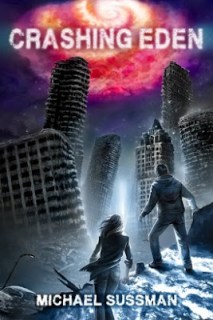 One of my favorite quirky picture books is OTTO GROWS DOWN by Michael Sussman, so you can imagine how thrilled I was to learn that Michael has a new YA novel, CRASHING EDEN. Well, Michael is crashing my blog today and he’s leaving behind a paperback copy just for you.
“Dr. Suss” (as I like to call him) is a prolific, versatile writer who has published books in diverse genres. So I asked him how he shifts gears to different formats and what obstacles he faces in doing so.
TL: Michael, you’ve written medical books, picture books, and now a young adult novel. How did you adjust from writing one genre to another?
MS: The toughest shift was from writing nonfiction professional books on psychotherapy to writing fiction. About 20 years ago I first tried my hand at a novel. Looking back at that manuscript, I cringe at how stiff and wooden my writing was—especially the dialogue. Thanks to practice and critiques from writer’s groups, my next novel was considerably better, although it too went unpublished.
After reading hundreds of picture books to my son, I decided to start writing for children. That transition was a breeze. Writing for kids totally freed my imagination and allowed me to be much more playful and fantasy-based. The result was OTTO GROWS DOWN, a story about a boy who becomes trapped in backwards time.
 In writing for young adults, I benefited from having already spent years honing my novel-writing skills. There were, however, two major differences. It was a stretch to write with the voice of a teenager, and that took a great deal of revising to get right. Secondly, I had to revisit my own adolescence, and that was no picnic!
TL: Which genre is your comfort zone?
MS: When it comes to writing, I’m such a perfectionist that I’m not sure I have a comfort zone.
Writing picture books is probably easiest for me, since the sky’s the limit when it comes to letting your imagination run wild. In terms of novels, I think I feel most comfortable writing thillers and mysteries, especially with a comic edge.
TL: How did you get the idea for CRASHING EDEN? What made you decide to tackle the YA genre?
I started trying my hand at fiction about twenty years ago. I wrote a psychological thriller and a comic mystery novel, neither of which were published. I developed severe writer’s block, which was immediately relieved when I began writing for young children. Looking back, I think I was working out unresolved issues from my own childhood. Next I turned to writing for young adults. Consciously, I chose YA because the market was hot! But unconsciously, I believe I realized that it would give me the chance to work on issues from my mostly miserable adolescence.
The genesis of CRASHING EDEN began with the title, which had floated around in my mind for nearly a decade. I’d been interested in world mythology for many years, and especially intrigued by the widespread myths suggesting that humans have degenerated from an ancient state of grace, symbolized by Paradise or the Golden Age.
I began to wonder what might happen if we were somehow able to recapture the state of mind supposedly experienced by people before the Fall. What if a device could be built that altered our brains in such a way that we felt like we were back in the Garden of Eden?
This led to speculating about how the God of the Old Testament might react to trespassers in his Garden. That’s where the story takes a controversial turn.
TL: What an intriguing premise! So, what YA reads have really stuck with you? To which books would you compare your style?
 MS: My favorite YA novels are Phillip Pullman’s trilogy, FEED by M.T. Anderson, UNWIND by Neal Shusterman, and MARCELO IN THE REAL WORLD by Francis X. Stork.
I’d like to think my style is unique, although I’d say it’s strongly influenced by two of my favorite novelists: Tom Robbins and Christopher Moore.
TL: How do you hope readers will react to your book?
MS: My ideal reader loved OTTO and is curious about the title of my novel. She’s intrigued by the notion that the widespread myths of a Golden Age were based on something real, and by the idea of returning to Edenic consciousness. She feels empathy for my troubled protagonist and gets caught up in his many dilemmas. She enjoys the humor and suspense of the story and finishes the book in one sitting. Then she recommends the novel to all her friends, posts glowing reviews on Amazon and Goodreads, and sends a copy of the book to her uncle, the filmmaker!
TL: Ha, ha! Don’t we all wish! So, with all those genres floating around in your head, do you ever experience writer’s block? If so, how do you overcome it?
Yes, I’ve definitely had periods when I couldn’t write a thing and couldn’t come up with a single idea. It feels awful. With other types of work you can just phone it in, but not with writing.
With mild writer’s block, I can overcome it by exercising, being in nature, taking a hot bath, meditating, or simply taking a break from writing. With more serious cases, it takes some psychological/emotional exploration. The blockage may be due to depression. It may stem from avoiding something that you need to write about. In one case, my writer’s block evaporated when I shifted from writing for adults to writing for children!
TL: I love that. Writing for children definitely frees the imagination and lets you go places adult fiction doesn’t.
Thanks to Dr. Suss for offering a paperback copy for me to give away! Just leave a comment to enter. You get one entry for your comment plus an extra entry for each share on social media, just let me know in a separate comment! A winner will be selected in one week. Good luck!
Want it now? Crashing Eden is available at Amazon, Barnes & Noble and Smashwords.
And visit “Dr. Suss” online because he’s hilarious and talented (and a good friend)!


OK, so you know that I love monsters. Can’t get enough of them. Well, my friend Tiffany Strelitz Haber is here today with a monster of a story—her debut picture book, THE MONSTER WHO LOST HIS MEAN!
Some of you may know Tiffany as one of the two rhyming geniuses behind The Meter Maids (with Corey Rosen Schwartz). If you don’t, you have to check out her site, which is all about writing in rhyme. Don’t make me slap you with a citation!
Before we get riffing with Tiffing (yeah I can call her that, it rhymes), you MUST take a look at the extraordinary trailer for her new book. The Danny-Elfman-like original music, the animation—it’s all so monstrous and so much fun!
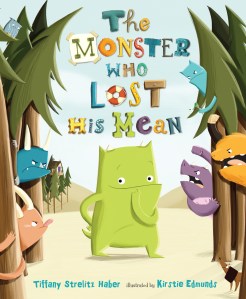 TL: THE MONSTER WHO LOST HIS MEAN is about a monster who loses his ‘M’. You know I host Picture Book Idea Month every November so I’m obsessed with the origin of ideas. Where did this idea come from?
TSH: I have always been a very visual person when it comes to words. Even as a kid, I loved the concept of homonyms, acrostics, acronyms, spelling words backwards, and even looking at them upside down. One day I started thinking about the letters in the word MONSTER, and what they might actually stand for if the word MONSTER was an acronym. From there the concept just grew and evolved, and “The Onster” was born!
TL: We’re also all about characters names on this blog. Did “The Onster” have a name before he lost his M?
TSH: Ya know…that’s a great question. I like to think that he only really found any identity at all after he lost his M. Before that he was just…well… generic, nameless, and not nearly as cool—Monster. Bleh.
TL: The Onster cooks brunch at one point in the book. I’m a foodie like you, so what’s your favorite brunch food?
TSH: Hmm…for me, picking a favorite food is kind of like bending a spoon into a perfect figure eight using just my toes (almost impossible). But in the interest of quasi-decisiveness…I’ll go with a tie. EITHER: Perfectly toasted onion bagels slathered in whipped cream cheese, lox and just a few rounds of raw, red onion…OR…a dim sum extravaganza.
So…What’s YOUR favorite brunch food? Tell us and be entered to win a signed ARC of THE MONSTER WHO LOST HIS MEAN!
You get one entry for commenting and then one entry for every place you share—blog, Facebook, Twitter, Pinterest, etc. Just let us know where you ONSTER’ed!
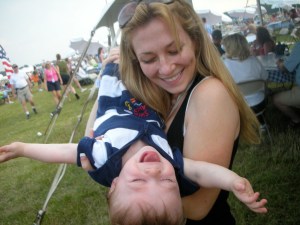 Tiffany Strelitz Haber is the author of two rhyming picture books: THE MONSTER WHO LOST HIS MEAN (Henry Holt Books for Young Readers, July 17, 2012) and OLLIE AND CLAIRE (Philomel/Penguin, 2013). She will eat any food she is served, be it fried witchetty grubs on a stick or calf’s brain ravioli, and loves to be high in the air or deep in the sea. Tiffany lives in NJ with her two little monsters, Jack Dalton and Travis Hawk. Like her on Facebook. If you don’t, Tara will sic the monsters on you.
 STORYTELLER: The Authorized Biography of Roald Dahl by Donald Sturrock cannot be missed, yet for two years I missed it. What is wrong with me? (Eh-hem, this is a rhetorical question, thankyouverymuch.)
Roald Dahl remains one of the most iconic children’s authors of all time, yet he began his career writing macabre short stories based upon his experience in the Royal Air Force during World War II. Just how did he evolve into the fantastical children’s author we all love?
Sheila St. Lawrence, Dahl’s literary agent at the Watkins Agency, is to thank. She realized “the ease in which Dahl could enter a child’s mind,” clearly apparent in his short story “The Wish”. In the tale, a young boy dares to walk across a carpet by stepping only on its yellow portions. Should his foot slip onto another color, he thought he would “disappear into a black void or be killed by venomous snakes.” This story was the only adult Dahl piece to feature a child protagonist to date, and it could not escape St. Lawrence’s attention.
After a disastrous two-year foray into playwriting, St. Lawrence implored Dahl to turn his literary aspirations elsewhere. Yet he ignored her kidlit suggestion, wrote stories that got turned down by The New Yorker, and instead got placed in the far less desirable (but still paying) Playboy.
Dahl’s publisher Alfred Knopf expressed interest in a children’s book, but then dropped a collection of adult stories called “Kiss Kiss” from Knopf’s 1959 list. Dahl spouted some choice words in response, threatening that Knopf would never squeeze a children’s book out of him.
Dahl once again became focused on writing for actors, as he wished to develop vehicles for his wife at the time, screen star Patricia Neal. After all, if Neal was working steadily, her income afforded him more time to write what he wanted to write. There were shows for Hitchcock and a drama series for TV based upon classic ghost stories, produced by Alfred Knopf’s half brother. But when the pilot episode encountered a controversy, the series got permanently shelved and Dahl was forced to return to the idea that evolved into JAMES AND THE GIANT PEACH.
I will say “and the rest is history” here, although STORYTELLER is only halfway through Dahl’s life story at this point. So like Sheila St. Lawrence, I implore you to turn your literary aspirations toward it.
But before I go, it would be a shame not to share with you Dahl’s advice to children’s writers, as told to Helen Edwards in an interview for Bedtime Stories exactly 42 years ago:
What makes a good children’s writer? The writer must have a genuine and powerful wish not only to entertain children, but to teach them the habit of reading…[He or she] must be a jokey sort of fellow…[and] must like simple tricks and jokes and riddles and other childish things. He must be unconventional and inventive. He must have a really first-class plot. He must know what enthralls children and what bores them. They love being spooked. They love ghosts. They love the finding of treasure. The love chocolates and toys and money. They love magic. They love being made to giggle. They love seeing the villain meet a grisly death. They love a hero and they love the hero to be a winner. But they hate descriptive passages and flowery prose. They hate long descriptions of any sort. Many of them are sensitive to good writing and can spot a clumsy sentence. They like stories that contain a threat. “D’you know what I feel like?” said the big crocodile to the smaller one. “I feel like having a nice plump juicy child for my lunch.” They love that sort of thing. What else do they love? New inventions. Unorthodox methods. Eccentricity. Secret information. The list is long. But above all, when you write a story for them, bear in mind that they do not possess the same power of concentration as an adult, and they become very easily bored or diverted. Your story, therefore, must tantalize and titillate them on every page and all the time that you are writing you must be saying to yourself, “Is this too slow? Is it too dull? Will they stop reading?” To those questions, you must answer yes more often than you answer no. [If not] you must cross it out and start again.
For me, these are words to write by. Funny that he should utter them within days of my birth! (Wait a second, did I just reveal my age?! Eh-hem, this is a rhetorical question, thankyouverymuch.)
UPDATE: Whoopsie. I looked at the wrong footnote. The quote above is from a letter Dahl wrote to “The Writer” Magazine in October, 1975: “A Note on Writing Books for Children”.
I just got back from a FABULOUS 1st grade school visit! I was so excited about it that I immediately had to vlog.
While this isn’t my first vlog (that was for EMU’s Debuts), it is the debut vlog for this blog.
If you want to start doing school visits as a pre-published author, I explain the way to go about it. I think. *Warning: DO NOT APPEAR AS CRAZY AS I DO IN THIS VIDEO.*
Apologies for the ethereal lighting. I was sitting in my breakfast nook with the blinds opened. But I rather prefer the Cybill Shepherd “Moonlighting” look, don’t you, dahlings? (What, you don’t know what that means? Oh, you young whipper-snapper, go Google it.)
More apologies for the mirror writing. If I knew how to flip a video, I would. Anyone know? Help?!
And hey, wanna know more about my school visits? I’m going old-school with a CLICK HERE. (Really. Click there.)
And please remember to leave me a comment about what we should name “vlogs” instead of “vvlawwwgz”. It’s an ugly word for an exciting medium.
The contents of this post have been removed.
The contents of this post have been removed.
The contents of this post have been removed.
The contents of this post have been removed.


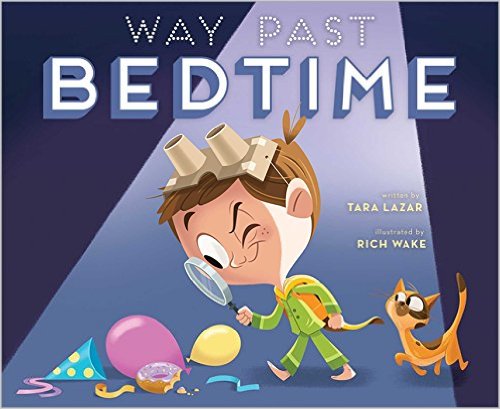


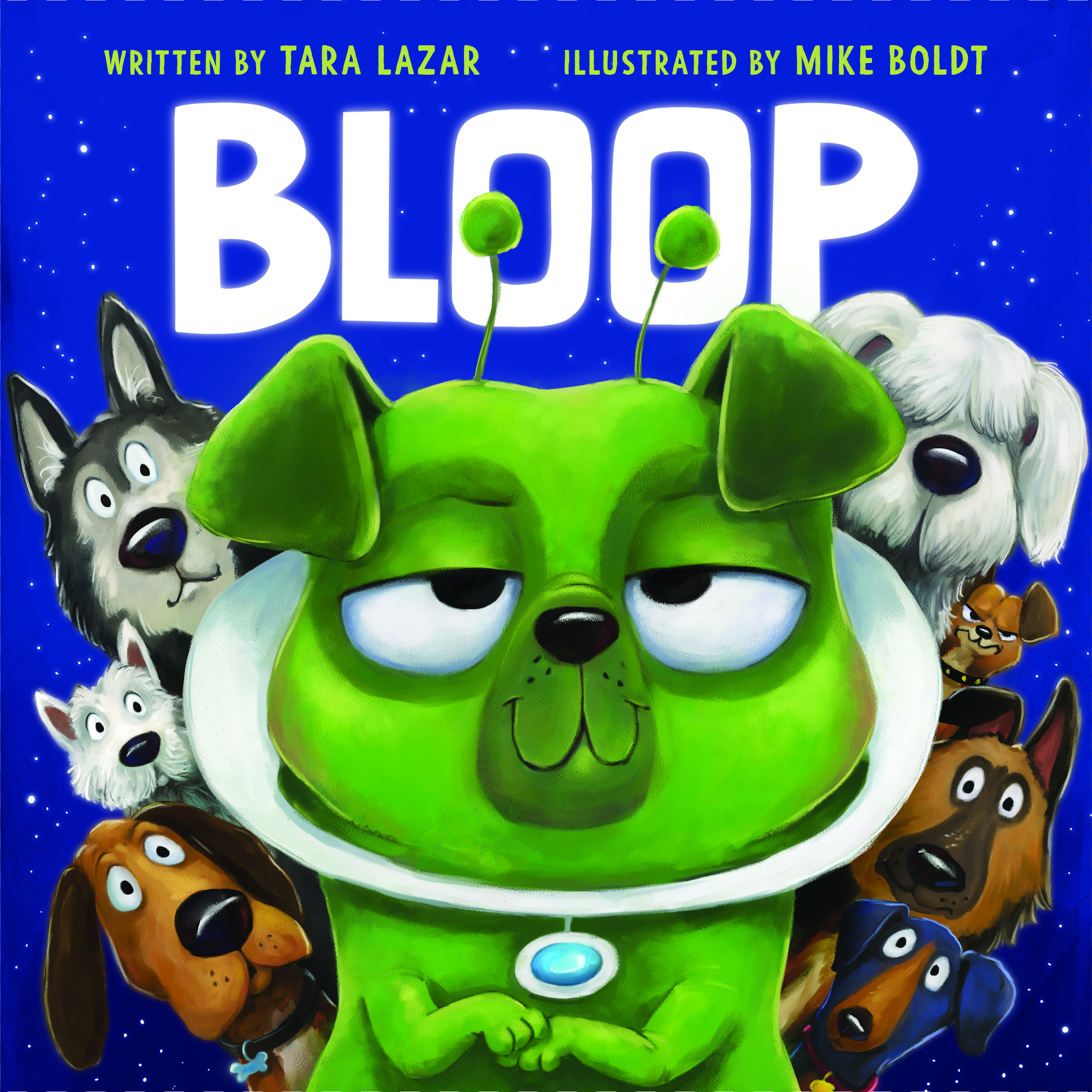

 Writing for Kids (While Raising Them)