You are currently browsing the category archive for the ‘Writing for Children’ category.
I’m back from vacation.
We unlocked the door and dumped our bags, adding to the stray belongings flung about during our packing tornado. Then big sighs on the couch, surveying our natural disaster.
This stinks. Or maybe I should say the house stinks, being closed up for two weeks with a cucumber rotting in the fridge, mossy and shriveled like a dead pickle.
We’re home and I’m in a funk. There’s no sugar-coating the post-vacation blues. (And since the cupboard is bare, I have no sugar anyway.)
 There was no fiction writing on vacation. I barely even thought about writing. I snapped a photo of the charming Beach Haven Public Library to serve as inspiration for a new story, but that was it. The needle is pointing to “E” on my inspiration gauge.
So how do I jump back in the saddle again, I wonder? From where does the motivation arise? I sent nothing out on submission recently, and my middle grade work in progress has been frozen in mid-chapter ever since I received conflicting feedback at the NJ-SCBWI conference.
I used to be in a hurry to get my work published. I had a timeline for getting stories done and accepted. I’m not making that deadline, and what’s worse, I feel guilty that I’ve let this self-imposed schedule slip. I have friends with new agents, friends with new book deals, exciting happenings that should shove me into gear.
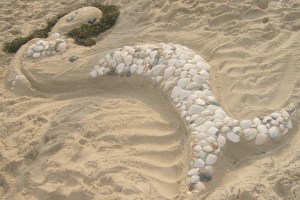
But, no. I’m still sculpting sand mermaids on the beach.
 Perhaps that’s as it should be. I hear you saying, “Everyone needs a break, even writers!” But for the past few years, I didn’t believe this to be true. I write because I must write. I possess a DNA code that compells me to be creative. Shouldn’t I be writing every free moment of the day? And if I’m not, can I still call myself a writer?
An epiphany came yesterday while out to brunch. An elderly woman stopped by our table. With her fingertips brushing the tablecloth she said, “You look like a happy family. That’s so nice to see.”
I nearly teared up at her kindness…and at the realization that my publication woes are stupid, silly. I have a healthy family. A good life. I am a writer. I will write. The stories will come. Someday, they will be published. I will keep working until they’re good enough.
So for now, I’ll ride Western side-saddle. No need to gallop when I can mosey back in.
How about you? Do you have the late-summer blahs? How do you get motivated again after a break? After a rejection?
Agents and editors have told me they occasionally receive calls from writers who are brand new to children’s books. These aspiring authors ask, “How do I get my book published?”
Kindly folks that they are, these agents and editors don’t slam the phone down. They’ll sometimes spend a few moments providing basic details. But this information can be easily found online. That’s what makes being a new writer so exciting these days: there’s professional advice available via websites and blogs, you just have to search for it. It’s not all so mysterious anymore.
So if you’re looking to launch a kidlit career, please don’t call an agent or editor to learn the basics. Let them read manuscripts, sell books and do their jobs. Come here instead…
A New Children’s Writer’s To-Do List:
- Write.
I knew you’d like that one. - Read children’s books.
Become familiar with the genre in which you write. Understand appropriate length and content for specific age groups. See what’s being published. Don’t follow trends, but know the competition. When pitching editors and agents, it’s often helpful to compare your book to another title. You can’t compare if you aren’t well read. - Join SCBWI.
Take advantage of their resources—local chapter events, national conferences, online discussion boards and publications. - Join a critique group.
Find fellow writers who work in the same genre as you. They provide support, motivation, and helpful feedback. (And if you can, find a group with writers who are more experienced than you.) P.S. Your mother, daughter, spouse, and neighbor’s 2nd grade class are not a critique group. - Attend workshops, conferences and events.
Seek out opportunities to learn and network with authors, agents, editors and writing peers. - Read books on the craft.
Writer’s Guide to Crafting Stories for Children by Nancy Lamb
Writing Picture Books by Ann Whitford Paul
Writing for Children and Teens by Cynthea Liu
Writing with Pictures by Uri Shulevitz - Revise and rewrite.
It’s not going to be right the first time (or maybe even the second or the fifteenth). It’s just not. Resist the temptation to submit an early draft to a publisher. - Take time to develop your skill.
Your writing will improve with practice. Most professional authors need at least two years of serious writing to hone their craft, and it’s not unheard of to work for ten to fifteen years before becoming published. - Submit when you have more than one project polished.
Finished your first manuscript? Keep writing. If an editor or agent likes your manuscript, but not enough to make an offer, they may request other material. Have a few manuscripts at the ready. - Learn to have patience.
It can take many years to write publishable material, sell your first project, and develop a career. Even after you become published, the business is still full of waiting—waiting to hear from your agent and/or editor, waiting for a book to be released, waiting to earn out. You will never NOT be waiting. Patience and perseverance are key. - Call yourself a writer.
Because you are one!
If you have some newbie suggestions, let’s hear them. Please leave a comment.
 Ever have one of those light-bulb moments when your manuscript finally gels? Your plot falls into place and you wonder why you didn’t think of something so simple and perfect before.
Sitting in on Sudipta Bardhan Quallen’s picture book workshop last month, I had a dozen lightbulb moments. She dissected picture book structure like a biology teacher dissecting a frog–she split it wide open and showed us its heart. (OK, maybe that analogy wasn’t good for the squeamish, but she has a science background, so I think it works.)
For example, she suggested inserting a “ticking clock” into our manuscript. A deadline makes the story urgent and exciting. (Eureka!) If you’ve never heard her speak, you’re missing out on one of the finest picture book tutorials anywhere.
Besides being wicked sharp, Sudipta has a nervous energy that’s endearing. Get her engaged in conversation, and she’ll talk non-stop about her love of children’s literature. (And high heels and shopping on Bluefly. Yes, she’s a girly-girl like me.)
Surprisingly, she never dreamed of becoming a kidlit writer. She’d thought of being a doctor (but she’s afraid of blood), a model (but she likes to eat), and the President (but she had a dissolute youth). So much for childhood dreams.
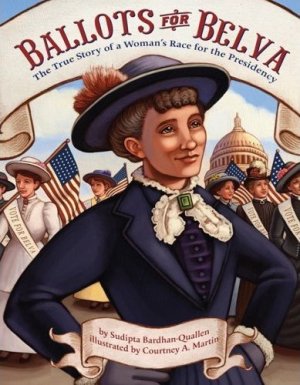 But now she’s the author of 11 picture books and 16 non-fiction books for children including The Hog Prince (Dutton), Ballots for Belva (Abrams) and Tightrope Poppy the High-Wire Pig (Sterling).
So Sudipta, if you didn’t want to be a writer, how did you get into the kidlit business?
I got pregnant twice in the span of 15 months and had to move from California (where I’d been going to grad school) to New Jersey (where a little piece of me dies every day). Like every other new mom in the world, I decided I had stories that I just had to tell my kids and so I started writing. I also had this idea that writing was totally a job I could do with two babies in the house, which was just stupid because you can’t do anything with two babies in the house.
Amen to that! I can’t do anything with two babies out of the house, either. (And by the way, I’ll let that NJ crack slide.)
When I started writing, everything was really bad. Some day, when I am super-famous, I will pull out my Alphabet book, and my going-to-the-zoo book, and all the other requisite bad stories we all write when we start. But eventually, I figured out to go to conferences and read up on the craft of writing, and I started to get things published.
How did you get your first big break?
About two months after I started writing, I wrote up a short story for Highlights. It was something that had actually happened to a friend of mine, with a bit of fictional dramatization. Highlights bought it and it was the first $200 I made writing.
 I also randomly got a foot in the door of children’s publishing by mentioning my science background in a cover letter. I’d sent a picture book manuscript to Sterling, which they rejected, but in the rejection the editor asked if I’d consider writing a science experiment book for them. That became Championship Science Fair Projects, which still sells really well for me, and a few years later, my first picture book, Tightrope Poppy, was published by the same editor.
New writers are often told not to mention irrelevant information in queries, but your science background landed you a contract. What exactly is your science background?
I graduated Caltech in 1998 with a BS in Biology (by the way, with the passage of years and my gradual failure to remember even the most basic biology concepts, BS is becoming more and more appropriate). I spent a year at Harvard, but it really wasn’t for me, and then headed back to Caltech as a PhD candidate in developmental neurobiology. But those plans went off the rails when I had two babies. I had this crazy idea that I could write with two kids in the house—which you totally cannot do—but that’s how I got into the writing-for-kids business.
Normally, I recommend that you don’t mention anything other than kidlit in your cover/query letters, but if you keep it short and sweet, you can throw some things in there. I think the line I wrote was something like: “I have a Master’s degree in Biology from the California Institute of Technology and have published several scientific articles.” That doesn’t take up so much space that it is annoying.
What has surprised you most about being a published author?
So many things have surprised me about being a published author. Hard to pick just one. So I wrote a Top Ten list. I love Top Ten Lists. Except after I start writing and realize that I only have six interesting things to say. But who’s ever heard of a Top Six list?
Top Ten surprising things about being a published author:
- That the advances are so small that after everyone has had their cut and you’ve paid all your expenses (whether it’s permissions, or research costs, or just the cost of babysitting that allowed you to write the book) you have just enough money left over to take your family out to dinner. But only if they agree to go Dutch.
- That you can’t just show up at a book store and expect them to have your book. Or believe that you are a real author.
- That there’s a 50-50 chance that the number of kids that are biologically related to you who show up for a book signing will outnumber the number of kids that are NOT biologically related to you.
- That no matter how much market research you’ve done, there’s a good possibility that there is a really similar book out there that no one has ever heard of – except the person writing the review.
- That even though the publisher picks up the tab for producing the book, all of the marketing responsibility is on you. So if you want anyone beyond your mother and your best friend to know about it, you need to get your butt in gear.
- That you know no more about writing or publishing after the contract than you did before. Even though everyone expects that you do.
- That the more successful you get and the more books you publish, the less of your writing time will actually be devoted to writing.
- That when you and a group of writing colleagues meet certain editors (who may now be agents…), no matter how many books you’ve done, the first comment he will make is, “So… you all are *moms*, huh?”
- That it is a long time before you move “real author” into the list of things you consider yourself. I still haven’t really gotten there.
- That going to a school for an author visit is as close to being Angelina Jolie as you will ever get. And it’s a pretty cool feeling.
How did you begin to bill yourself as a speaker?
I started to volunteer to speak at conferences because I wanted to teach what I had learned about the craft of writing picture books to other aspiring writers. I got a lot out of SCBWI events in New Jersey, and I wanted to give back. Also, teaching helps you learn in ways that doing does not. For example, at this year’s NJ-SCBWI annual conference, I gave a workshop about rhythm, rhyme, and repetition. I talked about using a refrain in your picture book manuscript to give it narrative structure—and it was the first time I had consciously realized that that was something I do a lot in my own writing. Having to teach it, however, was what made me conscious of it.
 Some authors say they learn something about themselves with each new book. What did writing The Hog Prince teach you?
In my workshops, I emphasize the importance of the market over and over again. I’m constantly saying that I only write what I know I can sell. But as I review my own body of work, which has finally grown large enough that I feel comfortable calling it a body of work, I notice that, within the confines of what I feel the market can bear, there are themes that I subconsciously explore time and again. And these are the themes that resonate most strongly for me.
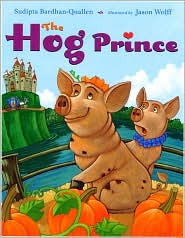
In The Hog Prince, Eldon dreams of being something he is not. He believes that if he were to change by magic, his life would be better, that everything would be shiny and pretty and luxurious and grand. And while I run the risk of coming off as having no self-esteem at all (which is not true, I have an itty-bitty bit), I can say that there have been plenty of times in my life that I have felt this way. In fact, I don’t think it is just a childhood thing–I’m not sure that we ever completely grow out of feeling like everything about our lives would be improved if only we could change ONE little thing. Except that it is never a little thing, nor is it one thing, nor will your life actually get better.
What’s nice about the story is that Eldon figures out that he is worthy and precious just the way he is, and that the folks who really matter (in his case, Petunia) don’t want him to change one muddy little thing. I struggle with this lesson, and I think a lot of kids do, too. Hopefully, that’s what makes the story timeless.
So, here is what I learned about myself:
- I sometimes wish I could change into royalty;
- I use my books to sort out emotional issues;
- I think that every story is better is you replace the main character with a pig.
You may be right there. Who doesn’t love pigs? I mean pigs in literature. Real pigs, not so much.
Thanks for the interview, Sudipta! I think I know what the blog market can bear, and although I’d love to talk to you for another thousand words, something’s telling me to wrap it up here.
More of Sudipta’s serious-yet-sassy picture book philosophies can be found on her new blog, including a picture book writer’s Ten Commandments. Thou shalt not submit a manuscript before its time…

Check ya later, kidlit fans. There’s sand castles, seafood and South Carolina in my forecast.
I’ll be posting again in July. Y’all come back now, ya hear? ‘Cause you won’t want to miss an interview with the stupendous Sudipta Bardhan-Quallen. Or the artistic antics of up-and-coming author/illustrator Ryan Hipp (who contributed the robot fish above). Or the courageous story of YA debut author Albert Borris. Illustrator Kristi Valiant will talk about her latest book, Cora Cooks Pancit. I’ll also share some tips for making your own book trailer before you sell the book. And perhaps my talented friend Michael Sussman will make an appearance…
It’s all coming next month. And August. It may be summer, but I don’t plan on slowing down.
Well, maybe just a little bit, for now.
 Before I take off, let me remind you to Take the Dare at Cynthea Liu’s website. There’s fabulous critiques up for auction from kidlit agents, editors and authors. All proceeds benefit Tulakes Elementary, a Title I school in Cynthea’s home state of Oklahoma. So show you care, take the dare!
This week also marks the YA Book Carnival, hosted by Shooting Stars Mag. Nearly 100 giveaways are listed, so go enter and grab a great read!
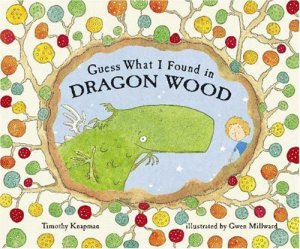 Benjamin wanders too far from home one day and stumbles into Dragon Wood. In this tale of boy meets dragon, the unexpected happens–dragon meets boy.
The cover art by Gwen Millward drew me into Timothy Knapman’s quirky little tale. Her forest reminded me of the Truffula Trees in The Lorax, albeit on a smaller scale (and perhaps not as poofy). They frame Benjamin and the Dragon on a clever, die-cut cover.
I admit that I goofed while reading the story for the first time. I got confused. I had to flip back to the beginning to understand Knapman’s brilliant twist on a familiar theme. When editors tell aspiring authors they want to see fresh ideas in picture books, Guess What I Found serves as a perfect example.
“What kind of review is this?” I hear you asking. “She’s not telling me anything about the book!” Oh yeah, sorry ’bout that. If I tell you too much about the Benjamin’s quest, I’ll ruin the surprise.
“Wait a second, did she just call him ‘the Benjamin?’ Must be a typo. What a sorry excuse for a blogger.” Um, I must inform you, that was no typo.
So okay, calm down. I’ll tell you that I loved the striped boots, the whirly wee-woo boxes and the soccer goalposts. And I can’t forget the volcano-sitting lessons! If you want to know more than that, you’ll have to stumble into Dragon Wood yourself.
Don’t get lost!
 Guess What I Found in Dragon Wood
Story by Timothy Knapman
Illustrations by Gwen Millward
Bloomsbury USA Children’s Books, December 2007
Got a favorite children’s book? Write a review! Today is “Write a Review Wednesday.” Help support kidlit!
Remember #QueryFail? If you want to land a book contract, don’t send a letter like this to an editor or agent. Sung to the tune of “Paperback Writer” by The Beatles, here’s a pop parody with a cautionary theme.
♫ Picture book writer (picture book writer) ♫
To whom it concerns, will you buy my tale?
I’m a stay-home Mom with degrees from Yale.
It’s an alphabet book based on Mother Goose,
And I’ve much to teach so I want to be a picture book writer,
Picture book writer.
It’s a didactic yarn of a wise old sow
Chased by vampire ducks and a zombie cow.
I’ll outsell Mo Willems and Dr. Seuss,
I was in movies but I want to be a picture book writer,
Picture book writer.
♫ Picture book writer (picture book writer) ♫
It’s six thousand words, give or take a few,
My cousin’s friend can illustrate it, too.
I have a twelve-book series that’s told in rhyme,
My three kids love it and I want to be a picture book writer,
Picture book writer.
If you sign me right now, you can be the first,
It’s been e-mailed to hundreds, including Hearst.
If you must reject it, please don’t send a form,
I need your critique and I want to be a picture book writer,
Picture book writer.
 Ruth Spiro is my hero. She’s the only children’s book author I know who invented her own holiday. And what could be more fun than Bubble Gum Day? Celebrations are “popping up” all over the place!
Bubble Gum Day participants raise money to support schools by blowing bubbles. And, of course, they read Ruth’s hilarious picture book Lester Fizz, Bubble-Gum Artist.
Never heard of a bubble gum artist? Lester comes from a long line of artsy ancestors, but he hasn’t inherited traditional talent. One day Lester visits his Uncle Edgar, whose inspiration has waned. When Lester’s bubble bursts, Edgar’s statue gets covered in pink, donning her with a lovely tutu. Hmmm, where have I seen that ballerina before? Sure, Lester helps his uncle out, but he still hasn’t found his fine art calling.
Lester might create drab doodles and pitiful paintings, but he soon discovers his unique talent for blowing beautiful bubble art. Spiro’s clever tale offers tons of fun for kids, but it also winks at parents with spoofs of Picasso, Seurat and other masters sprinkled on its pages. Lester‘s theme is about finding your place in the world, despite what others think. In fact, it serves as a wonderful lesson for aspiring authors.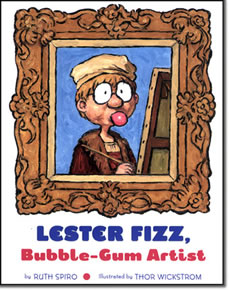 Write from the heart. Find your voice. Keep writing no matter what anyone else says.
Ruth Spiro’s journey to publication was a pretty sweet ride. Lester was her first picture book manuscript and her first sale. The story was also a winner in the 72nd Annual Writer’s Digest competition. But how did she start writing?
Ahh, glad you asked. I knew I liked Ruth’s work for a reason. In 2000, she took a class from one of my favorite picture book authors, Carolyn Crimi (The Louds Move In, Henry and the Buccaneer Bunnies). She gained a firm writing foundation and then found inspiration from her family.
One day her daughter said, “What if I could blow bubbles like that guy at the birthday party who made animals out of balloons? Wouldn’t it be cool if I could blow a bubble shaped like a dog?” With that, Lester’s story was born. And Ruth’s career took another turn.
“Once I sold my book and started selling articles to magazines, I also started receiving calls and emails from ‘friends of friends’ who were looking for advice on breaking into print. It seemed everyone had a drawer full of poems or a children’s book manuscript, but they didn’t know what steps to take next.
“I realized I was spending a lot of time putting together resources and reading other peoples’ work, so why not make it official and get paid for it?”
Ruth created the Writing for Moms program to help other women develop their craft and sell their work. Several of her students are now published authors, too.
And now the burning question: what kind of bubble gum does Ruth prefer?
“I was actually a Bazooka gal until Bubble Yum came out–so soft and sweet! While I don’t like to state a preference for a particular brand, I find Dubble Bubble is a good all-around bubblegum, and I usually have a big pink bowl filled with it at my events and signings!”
As if I needed another reason to attend her signing! Oh Ruth, you had me at “Bazooka.”
 Lester Fizz, Bubble-gum Artist
Story by Ruth Spiro
Illustrations by Thor Wickstrom
Dutton Juvenile, August 2008
Want to be a fly on the wall in an agent’s office? If you were at the NJ-SCBWI conference last week, you got that kind of insider buzz. Some top agents in children’s publishing revealed what’s been sitting on their desks, and more importantly, what hasn’t been submitted.
The agent panel featured:
- Jill Corcoran, Herman Agency Inc.
- Jenni Ferrari-Adler, Brick House Literary Agents
- Rachel Orr, Prospect Agency
- Scott Treimel, S©ott Treimel NY
- Emily van Beek, Pippin Properties
- Marietta Zacker, Nancy Gallt Literary Agency
After brief introductions, the agents welcomed questions. The first attendee (OK, me) wanted to know: “What trends are you seeing in your submissions? Specifically, what are you seeing too often? And what aren’t you seeing?”
The agents were quick to say that vampires were overdone. They’re seeing a lot of fantasy, especially with werewolves and zombies–on their own but also vampire/werewolf/zombie hybrids.
Jill Corcoran added, “I’m seeing a lot of plot-driven manuscripts, but where the character isn’t fully developed.”
The agents thought that paranormal hadn’t yet peaked, while historicals were down. That’s not to say a fantastic historical couldn’t come along and raise the whole genre, but as of now, they weren’t selling well.
They also added, “please don’t send anything about bullies. We’re sick of bullies.” Seems there was a bully article in a prominent parenting magazine (or perhaps it was an Oprah episode?) which began an unwelcomed trend.
Turning their attention to what wasn’t being submitted, Marietta Zacker said, “We’re not seeing a true depiction and representation of our diverse population. Kids aren’t seeing themselves in books and that’s a problem.”
Rachel Orr said, “And please realize there should be other Chinese stories than those about Chinese New Year. And stories featuring African-Americans that are about something other than slavery.”
Scott Treimel added, “Don’t send a story about three characters from three different races that have adventures.” He said such stories tended to be stereotypical and poorly conceived.
Ms. Zacker emphasized, “Certainly, be true to your voice. But write outside of yourself. Look beyond yourself to the world around you.”
Rachel Orr commented that she sees stories about a kid who moves to a new house far too often.
Scott Treimel wondered, “Where are the stories about the boys who feel weird about their sexuality? What if the girl is aggressive for a change?”
The agents agreed that in regards to sex in YA novels, the sky’s the limit, but it must be organic to the story. Don’t be shocking just for shock’s sake.
An attendee asked if she had been rejected by an agent, but spent several months polishing the manuscript, is it acceptable to submit again?
The agents said that the writer should first look to the agent for a response. Typically, they’ll note if they want to see a revision. And a writer must put the work in before coming back a second time. Marietta Zacker said, “This sounds like common sense, but don’t forget that we remember you. We really do read submissions. Don’t make us feel like we don’t know you. Please say, ‘I sent this to you six months ago but I’ve revised it…'”
Emily van Beek chimed in with: “Remember that the world owes you nothing. You owe the world your best work.”
In regards to working with an agent, the agents said that their business is all about relationships and trust. “We’re partners in your career. We’re architects for your career. We have a design for you.”
Also remember that an agent has their favorite editors so they’re tuned to the tastes of a few dozen editors, but not all of them. It pays to shop your work around to find the best match.
And one of the agents commented that if something isn’t selling, move on. “I wonder about those people who try to sell the same story year after year. You’re a writer! Write something else.”
When the agents were asked what they’re currently working on, books they’re excited about, Marietta Zacker said they are asked this question frequently, “but we always shoot ourselves in the foot when we answer. We don’t want to pigeonhole ourselves. You shouldn’t necessarily send to us just because we liked something in particular. And we don’t want you to write to that preference, either.” Agents have a wide range of tastes. “We don’t know we want it until we read it.”
Emily van Beek talked about the importance of falling in love with a manuscript in order to represent it because they do all work on spec. “We don’t get paid until we sell it.” So her mantra tends to be, “If you can resist it, do. I know that sounds [harsh], but it’s true.” She finds projects she can’t live without. Then she has the passion to sell it.
Interestingly, she told us that Kathi Appelt’s Newbery honor The Underneath took two years and underwent eight major revisions.
Scott Treimel added, “Writing and revising are equally important skills.”
Some agents will help edit your manuscript for submission, others may not be that involved. It depends upon the agent. But remember that your agent is not a critique group. Be sure that you have reliable crit partners and that your manuscript is “polished to within an inch of its life” prior to submission.
So when does an agent know that the manuscript is ready to be submitted to editors? When do they let go? Jill Corcoran said, “When I think it’s phenomenal.”
And to end the panel, Jill Corcoran talked about endings. “I love endings that are expected, but unexpected; surprising but logical.”
And I suppose this is a logical place to end this post. Be sure to check back for more from the conference throughout this week!
 “For all those who thought E.B. White was coming. Sorry, I’m the black one. As you can see, I’m not white and I’m not dead.”
Talented artist and illustrator E.B. Lewis discussed process versus product for his NJ-SCBWI keynote. He opened with some humor but then got to serious business.
He has a strong work ethic and told the audience that a person was only an artist if they spent each day producing art. It takes no less than 10,000 hours to become an expert in your craft. If you’re counting, that’s nearly 5 years straight of 40-hour work weeks, no breaks, no vacation.
Work is just that–work. It shouldn’t be easy. But you should love the work. If you don’t, then maybe you’re just fooling yourself into believing you’re something you’re not. Some people say they don’t have the inspiration. “I don’t understand that. I can’t step out of my bed without falling over a juicy piece of inspiration.” (Note to Mr. Lewis: I’m the one who tripped over your portfolio case. How’s that for falling over juicy inspiration?)
Mr. Lewis claims that once he finishes a painting, he admires it. He loves it–for about two hours. Then he hates it. For him, it’s all about the process of creating. He isn’t happy until he is creating once again, improving upon his last accomplishment, trying something new. “As soon as an artist knows their style, they’re dead in the water,” he said. Because your style is something that should be evolving. You’ve got to work hard, you’ve got to better yourself. If you’re satisfied, perhaps you aren’t a true artist.
 He gave us some background on his childhood. “When I visit schools, I tell the kids that I failed 3rd grade. It levels the playing field. ‘Wow, E.B. Lewis failed!’ the kids say.” The children immediately understand that if Mr. Lewis was able to become an artist, they, too, can reach their goals.
Mr. Lewis attended a small, old school with fireplaces in every classroom. One day during math class, he crawled up the fireplace. Remember how the girl in A Christmas Story pointed shyly toward Flick, outside, tongue frozen to the flagpole? Well, the whole class pointed shyly up the fireplace when the teacher asked where Earl had gone.
Then on career day, a classmate said he wanted to become a doctor. That boy received a lot of attention. E.B. wanted that same kind of attention, so he raised his hand. His teacher pushed it down. He raised it again. Finally, he was able to answer. “I want to be a lawyer,” he said, not because he really wanted to, but because he thought everyone would admire his aspirations. Instead, they all laughed, including the teachers. No one thought E.B. Lewis would amount to anything.
So E.B.’s uncle decided to take a special interest in his nephew. Every Saturday afternoon for years, his uncle drove him to art class because he knew E.B. loved to draw. His uncle told him that artists were the critical thinkers of society, and very well read, so he gave E.B. a new book to read every week. This man connected E.B. Lewis to his passion.
E.B. began his career as a fine artist. He would take photographs of his subjects, but from far away, hidden, with a telephoto lens, because as soon as someone knows their picture is being taken, they no longer act naturally. They’re no longer in the moment.
His work appeared on the cover of a magazine and a few days later he got a call from someone in the children’s book industry, asking if he’d like to illustrate a book. He said no. Why not? “Because I’m a fine artist, not an illustrator.”
What’s the difference? A fine artist solves their own philosophical problem. An illustrator solves someone else’s problem.
However, that art director was persistent and encouraged E.B. to go to the children’s section of the library. Mr. Lewis soon realized that some of the most ground-breaking artistic work was being published in children’s books. He called back and agreed to illustrate.
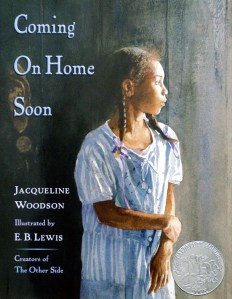
 Over the past 14 years, Mr. Lewis has illustrated 47 books at the rate of about 3/4 books a year. He has won the Coretta Scott King illustrator award four times. He won a Caldecott honor for Coming on Home Soon. He works with 14 different publishers and is currently booked through 2014. (That’s right, five years in advance. But I’m taking special note of the lucky number 14.)
He is one of the few illustrators who travels to meet with his editor and art department to discuss a book at the early stages. He likes to create a brain trust in the beginning. He starts with thumbnail sketches and this begins the dialogue. Then he enlarges the sketches to a dummy and adds the words. He researches photos in the library and uses a model, often combining both photographic guides to create the end result.
“I have a love of the process, the doing. For me, that’s all there is.”
How lucky for us. We get to enjoy the fruits of his labor.
Thirty-eight agents, editors, art directors and acclaimed authors. Two days. Twenty workshop sessions. The NJ-SCBWI is one little conference that packs a writing wallop.
Over the next few days, I’ll share notes from the event, from my own journal and that of writer Natisha LaPierre. So even if you weren’t there, it will feel like you were. (Just surround yourself with friendly folks passionate about children’s books while you read.)
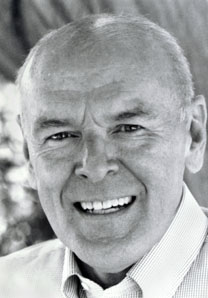 The first keynote presentation by Richard Peck, Newbery award-winning author of The Year Down Yonder, set a serious yet exciting tone for the conference. His unique voice extends beyond his books–when he speaks, he feels as big as a Shakesperean actor, filling the room, enunciating, using his entire body. (It was no surprise to learn that he belongs to a group of authors known as the “Authors Readers Theatre” who travel the country performing each other’s works.) Charming, witty, it is impossible not to be drawn in by Mr. Peck’s dynamic presence.
“I am a writer because of two boys on a raft,” he began, noting his love of Mark Twain. “Writers are readers first. Nobody but a reader ever became a writer. Read 1,000 books before you can write one.”
Mr. Peck encouraged attendees to look at other voices in order to find their own. And what does he think about “write what you know?” Rubbish. “A story is something that never happened to the author,” he said. “I assure you that J.K. Rowling never attended Hogwarts. Beatrix Potter was never a rabbit.”
A writer’s job is to add hope to reality. A story is always about change, and change is animated by epiphany. In his master class on Saturday, Mr. Peck explained epiphany further. When he asked middle school students to define ephiphany, an 8th grade boy said, “Epiphany is when everything changes and you can’t go back.” Mr. Peck thought that was the finest definition he had ever heard. The teacher informed Mr. Peck that the boy had lost his father, and his mother before that. That boy has been overdosed on reality. Now he needs hope.
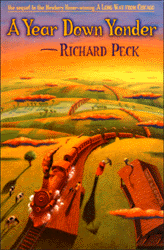 “A lot of fiction is about remembering better days.” The elder characters in Mr. Peck’s books are often patterned after the old men who frequented his father’s filling station in the 1930’s and 40’s. He recalls their conversations and makes “rough music out of real speech.” You can write in the voice of a young character, but have that young person know old people. Children want adults to be strong, but they often can’t find them.
Years ago, the books in his school library were kept under glass and you had to find the teacher for a key. “Consider that metaphor,” he said. “The teacher has the key.” Book are still as precious, but it is up to the writer to make them so. “You can teach children or fear the parent, but you can’t do both. We are the last literature teachers left because we can’t be fired. We’re unemployed!”
Every week Mr. Peck visits the book store and spends an hour perusing first lines. “We live in the age of the sound byte, so you have to ‘byte’ them out front.” He recited the first line of Charlotte’s Web to remind us of its power: “Where’s Papa going with that axe?” Six words on one line ignite the imagination. And then he gave a fine example of voice with M.T. Anderson’s Feed: “We went to the moon to have fun but the moon turned out to completely suck.”
He always travels with a book from the past and a new book. The book from the past reminds him that we’re all links in a chain, while the new title keeps him tuned to what’s coming next. “If we don’t know what publishers are releasing this year, how will we get on next year’s list?” He’s reading Laurie Halse Anderson’s Wintergirls, “the greatest argument for writing in first person. It skates too near to the truth.”
Mr. Peck concluded by reminding us that “a story is always a question, never an answer. We can ask the questions that no one else will ask.” Story is the most important gift we can give our youth. Think about that 8th grade boy. “Story might be the companion that a child needs.”





 Writing for Kids (While Raising Them)