You are currently browsing the category archive for the ‘Publishing’ category.
 Say what you will about Wikipedia—that it’s unreliable, that it’s unaccountable, that it’s run by a bunch of idealistic zealots—the fact remains that it is one of the most heavily accessed web resources in the world.
And so, one day as I was researching some of my favorite contemporary kidlit authors and illustrators, I found they were not mentioned in the online encyclopedia. Scott Magoon? Not there. Kate Messner? Nope. Tammi Sauer? Dagnabbit.
I think it’s time we rectified that situation. These folks deserve to go on record, especially those who have won awards for their work.
If you’re a frequent reader of this blog, I’d like to ask you a favor. Pick a favorite contemporary kidlit author or illustrator. Check to see if they’re in Wikipedia.
- List of Wikipedia Children’s Literature Authors
- List of Wikipedia Children’s Literature Illustrators
And if your favorite person is not there, pledge to create an article for that kidlitter by the end of March. Show your love for children’s literature and the people who create it!
Remember that Wikipedia wants you to source references when writing your article. There is a handy-dandy article creation wizard for those of you unfamiliar with the Wikipedia process.
If you are interested in participating, just leave your name and the name of your chosen kidlit personality below. I’ll check in at the end of this month with a master list of potential pages we’re creating.
C’mon, who’s with me?
 There are all kinds of scenarios in which a manuscript becomes a book. Sometimes it’s a series planned well ahead of time, sometimes the author is well-known and the project is signed on the basis of a proposal, sometimes the agent knows that the idea in itself is a winner and he/she sends it out to vast range of different editors, generating a lot of buzz in the process.
As an acquiring editor, however, my favorite way to come across a manuscript is much more quiet than any of these scenarios. It’s when I stumble across something in a pile of submissions that strikes my fancy. The reason it’s fun to discover things in this way, is that I am not reacting to a trend, but to something that particularly suits my taste. And this means I’m going to remain excited about it right up until the release date and beyond.
I’ve had quite a few books like this on my list. It’s hard to pick just one. But I think there is one that is particularly illustrative of this kind of scenario. It’s Bow-Wow Bugs a Bug by Mark Newgarden and Megan Cash.
 I got a completely different submission from Mark and Megan in the slush pile—unagented. Mark and Megan decided to send it to me because they had come across another project of mine that made them think I might be interested in their work. Their submission was beautifully packaged, in a folder, with lots of visuals and a pitch sheet. I won’t mention that project, because I still love it and hope that it will come out eventually in some form. For various reasons I wasn’t able to pursue it. Anyway, alongside the mystery project was a proposed series of board books based on a intrepid little terrier. Bow Wow Bugs A Bug was created later, as an anchor to this series.
There are a couple of inspiring things about this story. First, the project came through slush. I know we hear about things being discovered this way. But these stories are told for a reason—they are remarkable because they don’t happen very often. The reason Mark and Megan’s work stood out was that it was impeccably presented and it was exactly the kind of thing that I like to read. They had built an entire pitch package of the quality that we might mock up for a marketing meeting, and they thought very carefully about to whom they were sending it. It was funny, clever and visually stunning with selling points and a target audience outlined. The other important point to note is that, despite the appeal of this package, we ended up having them do a different project all together. They were willing to work with us (and did to an absolutely heroic extent) in order to build a good publishing strategy. And I was willing to work with them, because I could see very clearly that they had more than one project in them.
There is one point I would like to make clear. Mark and Megan are not push-overs. A willingness to work on something doesn’t mean a willingness to surrender your vision to someone else. It simply means that you are willing to hear feedback and try to incorporate it in a way that suits the project. Mark and Megan have a strong aesthetic perspective and I had long email exchanges with them over what to keep and what to leave out. It’s important to work with your editor, but it’s also important to maintain your point of view. Do not compromise to the extent that you don’t want to be associated with the finished book. Every change should be considered carefully. And that doesn’t necessarily mean “Do I take it or leave it.” Quite often it means, “What is it that this change will accomplish, and how can I find a way to accommodate it and still make this something that I love.” You have to live with your name on the cover.
I chose this particular example to write about because I think it exemplifies what authors should be looking for from their editorial relationships (and vice versa, really). I still maintain contact with Mark and Megan. We share taste and inspiration. There should be a certain amount of base understanding and sympathy between an creator and editor. You should share a vision for the project. And when you diverge, you should be able to discuss it reasonably and come to some compromise that you can live with. That’s how good books are made.
Tamson Weston is a published children’s book author and editor with over 15 years experience at several prestigious publishing houses including HarperCollins, Houghton Mifflin Harcourt and Disney Hyperion. She has edited many acclaimed and award-winning books for children of all ages. Tamson loves to collaborate with people and help authors, illustrators, agents and publishers bring projects to their full potential.
Among the authors Tamson has worked with with are Adam Rex, Mac Barnett, Robert Weinstock, Adam Gopnik, Jane Leslie Conly, Anne Rockwell, Deborah Hopkinson, Jen Violi, Alexander Stadler, Dan Santat, Florence Parry Heide, Dandi Daley Mackall, Brian Biggs, Marilyn Singer, Megan Cash and Mark Newgarden.
Tamson has an MFA in Writing and Literature. You can visit her website at www.tamsonweston.com.
 Contests for kidlit writers are big draws because they’re an opportunity to break into the business, but I must say to publishers—please stop with the public vote-to-win process.
Publishers may think that open voting ensures that the public’s favorite—and thus, the best book for their audience—will win, but how is that going to happen when the writers are campaigning for votes via social media?
Sure, votes demonstrate the author’s reach and may indicate how well they’ll market a published book, plus it gets more eyeballs on a publisher’s site. But the thing that will really sell a book? A GOOD story.
Writing contests should be chosen by an experienced editorial team, not by Aunt Sue in Schenectady. Because it’s one thing to ask for a writer’s friends and family to click a button and yet another to ask them for cash once the title is released. Just because someone spends two seconds to vote does not mean they’ll spend hard-earned money on the completed book.
Contests that require people to vote once a day for a prolonged period are even more exhausting to the writer and the people who are repeatedly asked to vote. And vote again. Just one more click. Another? Pretty please? It may even cause that writer’s social network to shrink.
And think of the disappointment when the diligent voters learn their time was for naught. Think of the writer’s disappointment having to tell their audience that it was for naught. Will people spend the time voting for that person again? Maybe. But maybe not.
Yep, social media isn’t always so social. And it shouldn’t be exploited.
As a kidlit enthusiast, I want to see good stories published for children to love. The public voting process does not ensure that. Like a Student Council election, it ensures that the most popular person wins. But the most popular isn’t always the most qualified or the most deserving.
In the end, these contests are more about marketing for the publisher than about discovering real talent. And if you have real talent, you should avoid them. Spend your time polishing your manuscript for submission, not campaigning for votes.
I’m sure this post will cause a stir. So please, debate away in the comments. I’m eager to hear your thoughts.
There are many things I wish I had known about writing picture books when I began pursuing my dream of becoming a published author. Word count. Page turns. Linear storytelling. Building tension. The “twist” ending. Instead, I had to learn these things through trial and error, attending industry conferences, reading books and blogs, and networking with professionals.
On November 6 in Madison, NJ, I’ll be sharing all I’ve learned to those who also have a dream of becoming a picture book author. Are you in the area? I’d love to see you!
So You Want To Be a Picture Book Author
November 6, 2011, 2-4pm
Sages Pages, Madison, NJ
Many people believe writing for the young is easy. After all, “they’re just kids!” But writing for children is one of the most difficult genres in publishing to break into.
Picture book author Tara Lazar (“The Monstore”, Aladdin/Simon & Schuster 2013) will teach you all the things she wished she knew when she began her career, from story length to page turns, how to leave room for illustrations and create irresistible, age-appropriate, relatable characters.
You’ll learn the little-known “rules” of kidlit (and that rules are made to be broken!), plus how to fine-tune your ideas into sellable manuscripts. Participants can even submit a first page of their children’s picture book or novel for an anonymous critique. Tara will answer your questions and help you form an action plan for breaking into the kidlit business armed with knowledge, inspiration and encouragement.
Visit The Writer’s Circle to sign up. Only $25 for 2 hours chock full of what took me years to learn!
Ah, how I love spending a warm, sunny Saturday afternoon in suburban mecca: Best Buy. We went in for a digital camera, but stopped at every department, drooling over the latest gas ranges with dual ovens and french-door refrigerators (a thrill you’ll only understand once you’re married with kids).
We were also oogling over the QR codes. Yes, we were two geeks in paradise.
What are QR codes? You’ve probably seen them—pixelated bar-code-like squares that link your smart phone or iWhatever to additional information about a product. Want to see a video of the range in action? Learn about the warranty? View an extended list of features? Call the manufacturer’s customer service? Just scan the QR code and it will lead you to a website, video or other crucial piece of marketing magic that doesn’t fit on the price tag.
So what does the QR code mean for authors?
Glad you asked. Author/illustrator Katie Davis recently explored the possibilities. Just click on the graphic below to read her post:
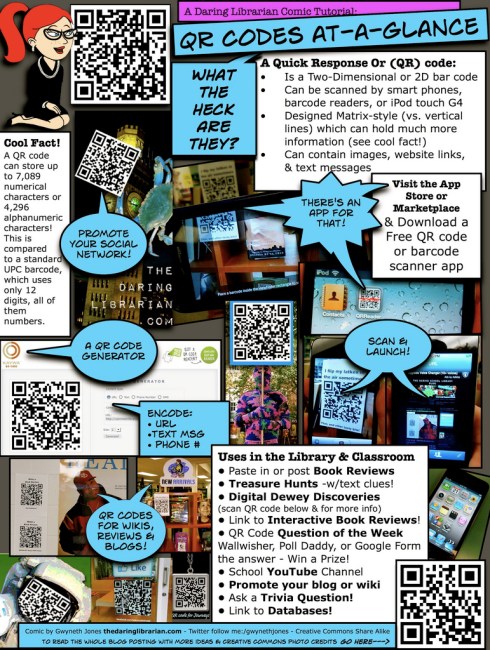
Wouldn’t it be great if publishers started putting them on book jackets? Link to the book trailer! The author’s own book club! Her Formspring fan page! (Gee, the customer could even call you at home. But I digress.) The QR code delivers more whiz-pow-bang to help sell the buyer on the book.
Are QR codes the next big thing? Maybe. They’ve been used in Japan for about 10 years now and I’ve personally seen them more and more over the past few months.
Read Katie’s post about how to generate your own QR code and start examining the possibilities!
Thanks to The Daring Librarian for the graphic.
 One winter morning in 1976, my father was reading the Sunday paper when he stumbled across an ad for ice-skating lessons. He snapped the paper in front of me and asked, “It says you have to be able to skate across the length of the ice to sign up. Can you skate across the ice?”
“Of course I can skate across the ice,” I said, and then gulped a spoonful of oatmeal.
A minute later he was on the phone, registering me. What on earth made him believe a five year-old who had never put on a pair of skates could cross a slippery arena, I’ll never know. But I was excited to begin lessons and I imagined zooming around in circles, faster than everyone at South Mountain.
The next week I proudly stepped onto the ice in my new skates.
And promptly fell.
And fell again.
And again.
Then I learned to hold onto the side. And then I learned what it’s like to hit the boards AND the ice. And this was in the days before helmets.
A guard helped me off the ice. She told my father I could not be in group lessons. I thought I might cry. Then she suggested I spend a private lesson with her, learning to skate. My father agreed and by the end of the lesson, I was indeed moving across the ice.
I took group lessons every winter for a few years, earning my USFSA patches faster than everyone else. And when I had completed those patches, they told me I was ready for a coach and private lessons–lessons my family could barely afford.
I went for one private lesson and waited for my coach in the corner, practicing simple figures. The older skaters yelled at me because, unbeknown to me, I was hogging the JUMP corner. I was trying to stay out of the way, but I was totally screwing up their double lutzes.
And then when my father heard what time the coach wanted me at the arena–5:30am twice a week–that was the end of private lessons.
Over the years, I skated recreationally instead, going to the arena once a week and trying to teach myself. I was able to do a scratch spin and a waltz jump, crossovers in every direction, and a few fancy turns. But my real desire was to compete. I always thought…some day.
That day came as an adult. As soon as I had my own money, I took lessons. And like I had done as a child, I quickly moved up through the ranks. I hired a coach. I competed. And I won. In 2002, I competed at Adult Nationals in Ann Arbor, Michigan, after winning Gold at Eastern Sectionals and two other Golds, a Silver and a Bronze in other competitions that year. It was a dream come true.
I thought–if I can do this, I can do anything.
And now, here I am today, accepting an offer of literary representation. Skating gave me the confidence to pursue another dream, that of becoming a published children’s author. And now I’m one step closer to that dream.
I’m here to tell you–work hard, believe in yourself and your talents, find a great critique group and writer friends who support you, and go for it!
You will stumble. You will fall. But brush yourself off and soon you’ll hit your stride–or in my case–glide!
 A typical day as a newbie writer: sit down at the computer, start writing.
At least, that’s what I did two years ago. I got an idea and I didn’t stop to think: is this a good idea? Is it marketable? Has anyone written something like this before? Nope. I just wrote, motivated by my muse.
And perhaps this was good back then. I was honing my skills, finding the right words, crafting sentences, building stories.
But they were looooong stories. At an average 1,500 words my tales were neither picture books nor chapter books. I insisted I was writing picture storybooks, and I used Patricia Polacco’s body of work as an example of how my stories could be published, not realizing, c’mon, she’s PATRICIA POLACCO.
It took me a while to learn to THINK before I write.
An idea begins. I ponder it. I write down the initial concept. What is my topic—what is this story about on its surface? Bulldozers or ballet dancers or dragons? What is at its heart? Is it about friendship or fitting in or family? Who is my character and what does he want? What is my hook? Can I boil the concept down to one line?
Then I research. Is there anything similar already published? If so, I’ve got to change it up a bit. Or let it go.
I ask myself these important questions:
- Is this picture book marketable?
- Will someone pay $16 to buy it?
Granted, these are difficult questions to answer objectively. Of course you want to believe that everyone will buy your book! But as a mother of two picture book age kids, I know this isn’t the case. If we don’t love reading the book over and over again, I won’t buy it. I try to use my motherly instinct to answer these questions and I think of my other parent friends. (And then I stalk parents in the bookstore and ask them what they think. No, just kidding. But I’m tempted.)
If I can’t answer “yes,” the idea gets filed away for the future, when I can perhaps transform it into something more extraordinary.
If I do answer “yes,” (or even “maybe”) then I create a brief outline or I just write. And I keep the proper length in mind: 500 to 700 words.
Some writers may call this process stifling. But I call it smart. Because if you want to be published, you have to examine these elements before you write. Because although picture books are short, they don’t take a short time to write.
Sure, you may pump out a first draft in a few days, or even less, but picture book revisions could go on for weeks, months, even years until you get it right. You whittle down the length so every word packs a punch, while still presenting a compelling page-turner, full of illustrative potential. (Which means you have to leave some things unsaid.) With all that time invested in a product you want to sell, you’re playing Russian roulette if you haven’t researched the story’s potential first.
It took me a while to learn this, to realize this, so I’m just paying it forward. Many of you are probably nodding your head in agreement. And maybe some of you are waving a finger at me for being a creativity killer.
In any case, I’m eager to hear from both sides! Think or write? Or a hybrid of both?
Whoa, that’s a long title. But it’s accurate! I asked some of my favorite authors and illustrators to pick three stand-out picture books of 2009. It wasn’t an easy task. I know because I couldn’t decide myself! So I dumped the job on them, just like New Jersey got dumped with snow this weekend. Except they’re a lot warmer than I am, cuddled up with good books instead of buried beneath a foot of the white stuff.
Check out their amazing selections and add a new book to your holiday wish list!
Boni Ashburn
Author of Hush, Little Dragon and Over at the Castle
 Rhyming Dust Bunnies
by Jan Thomas
Beach Lane Books
January 2009
A simple, hilarious introduction to rhyming that is not only adorable to look at, but also invites audience participation and is a perfect read-aloud. That’s right, perfect.
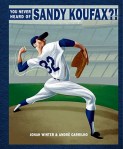 You Never Heard Of Sandy Koufax?!
by Jonah Winter and Andre Carrilho
Schwartz & Wade
February 2009
Striking illustrations coupled with a fantastic voice–this book makes you FEEL baseball. Jonah Winter is a picture-book biography genius–I had a hard time choosing between this one and Gertrude Is Gertrude Is Gertrude Is Gertrude (which has an equally excellent voice!).
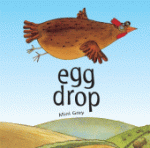 Egg Drop
by Mini Grey
Knopf Books for Young Readers
July 2009
Excellent humor of the dark, dry and deadpan sort, coupled with Grey’s gorgeous art.
This was impossibly hard! Three is too just too few. My “honor books” would be A Penguin Story by Antoinette Portis, Monkey With A Toolbelt And The Noisy Problem by Chris Monroe and Thunder Boomer! by Shutta Crum and Carol Thompson.
Jannie Ho
Illustrator of The Great Reindeer Rebellion and Light the Menorah
 Around the World with Mouk
by Marc Boutavant
Chronicle Books
November 2009
Last year when I was in France, all I could think about was getting my hands on this book (which was originally published in French), but only to find out later that Chronicle books were publishing it in the US this year. Marc Boutavant is one of my favorite illustrators; I’ve read his style described as “the modern day of Richard Scarry,” and I agree! With so many little details to look over, there is always something new to discover each time I open it.
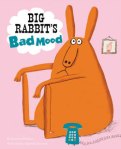 Big Rabbit’s Bad Mood
by Ramona Badescu and Delphine Durand
Chronicle Books
March 2009
Another one from Chronicle! I can’t resist Delphine Durand’s illustrations–so many funny little details to look at. I own many of her books, and am obviously a fan…(even wrote her a fan email!) Even though this story is about a grumpy rabbit, one can’t help but smile when looking at her silly characters.
 The Great Paper Caper
by Oliver Jeffers
HarperCollins Children’s Books
April 2009
I’m a great admirer of those who write AND illustrate their books. Oliver Jeffers’ illustrations are super cozy and serene, I want to live in that forest with the animals! Thumbs up to this quirky, winter mystery story.
Jacqui Robbins
Author of The New Girl…and Me
 A Book
by Mordecai Gerstein
Roaring Brook Press
April 2009
Kirkus called it “Metafiction for the picture-book set.” A young girl who lives in the book with her family struggles to find her story, trying on different genres and marveling at the giant mushy faces (that’s us) looking in on her. It’s funny, it’s smart, and it is truly unique. Plus, we read it five hundred times in the first month we had it and I never tired of it.
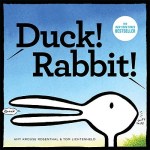 Duck! Rabbit!
by Amy Krouse Rosenthal and Tom Lichtenheld
Chronicle
March 2009
I was smitten with this book from the start. The concept is simple: is it a duck or a rabbit? Two voices argue. Giggling ensues. As I blogged in July, we get extra giggling in our house because my preschool son does not have the cognitive ability to see it both ways and so he thinks the point of the book is that some poor dope thinks that bunny’s a duck.
 Okay, I would be lying if I didn’t pick Two of a Kind, by, um, me (and Matt Phelan).
Atheneum
July 2009
I’d like to be cool enough to pretend I didn’t dance like a four year-old fairy girl whenever I turn to the page with my name on it. But I’m not. And I do. More than that, though, I still love the story and the way it makes kids nod in recognition.
Patricia Storms
Author/Illustrator of The Pirate and the Penguin
It’s really hard to pick just three books! Being a Canadian, you might wonder if my choices are Canuck books. Yup, they are…and they are all very unique and engaging.
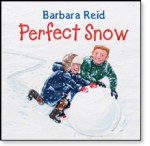 The Perfect Snow
by Barbara Reid
Scholastic
October 2009
Barbara Reid is a treasured Canadian talent who once again creates a visual delight with her plasticine illustrations. Reid creates a delightful story about the joys of creating snowmen and snow forts in the perfect snow of a winter day.
 The Imaginary Garden
by Andrew Larsen and Irene Luxbacher
Kids Can Press
March 2009
Andrew Larsen’s The Imaginary Garden is a beautiful story about the special bond between a grandchild and grandparent, and the power of the creative imagination. Luxbacher’s illustrations are magical and bursting with colour.
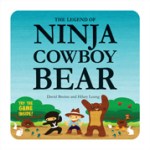 The Legend of Ninja Cowboy Bear
by David Bruins and Hilary Leung
Kids Can Press
September 2009
And finally, The Legend of Ninja Cowboy Bear is charming and fun story about friendship, and celebrating the differences in others. Hilary Leung’s illustrations are bright and utterly adorable!
Michael Sussman
Author of Otto Grows Down
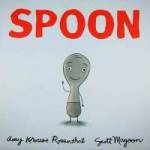 Spoon
Spoon
by Amy Krouse Rosenthal and Scott Magoon
Hyperion
April 2009
Modesty prevents me from mentioning Otto Grows Down (darn, I mentioned it!) But I also loved Spoon, which—like Otto—was illustrated by the supremely talented and charming Scott Magoon. I’m always amazed at Scott’s versatility, and once again he has employed the perfect style for this sweet and quirky story. I also admire Amy, since I’ve tried unsuccessfully for years to come up with a picture book about an inanimate object. Not an easy task, and she makes it look simple.
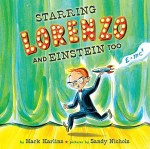 Starring Lorenzo, and Einstein Too
by Mark Karlin and Sandy Nichols
Dial
April 2009
Mark, who is the author/illustrator of many fine picture books, including Mendel’s Ladder and Music Over Manhattan, has produced an endearing story which celebrates the importance of family and the power of the imagination. The cool, retro illustrations are superb.
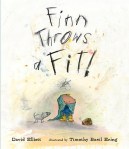 Finn Throws a Fit!
by David Eliot and Timothy Basil Ering
Candlewick
August 2009
Finally, I’m wild about David Eliot’s Finn Throws a Fit! This book is hilarious, and it’s a model for writers striving to tell a compelling story in the fewest words possible. Timothy Basil Ering’s artwork is astounding. I don’t know of a more creative illustrator working today.
So what were your favorite picture books of 2009?
Please leave a comment!
 Remember those embarrassing dance moves your Aunt Myrna unveiled at Cousin Frannie’s wedding? She flapped her arms, wiggled her tush and tumbled onto the parquet floor?
Well, that’s not this chicken dance.
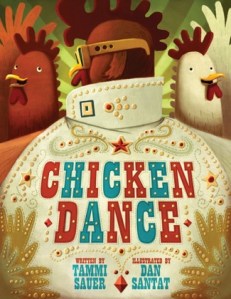
No siree, this Chicken Dance is a brilliant barnyard romp featuring two hilarious hens and their idol Elvis Poultry, thank you. (Thankyouverymuch.)
Author Tammi Sauer grew up on a Kansas farm, tending cows at dawn. Those daybreak chores paid off, ’cause this little lady sure knows how to milk the humor.
According to henhouse pals Marge and Lola, Elvis Poultry is a hunk of bawking love. When the barnyard talent show is announced, the pair discover the grand prize is two tickets to Elvis’ Final Doodle Doo concert tour. They must win!
But the ducks waddle by and wave a wing at the hopeful hens. “Don’t bother, drumsticks.” Seems ducks are top dog at this farm.
Marge and Lola test out their talents but the ducks quack at every failed attempt. When Marge and Lola finally hit the stage–following solid goat, pig and cow acts–they stammer and gulp. A duck heckles, “What’s the matter? Are you chicken?” so they begin to flap, shake and bawk. Just regular chicken stuff, nothin’ fancy. But the crowd loves it and crows for more.
The next spread features Marge and Lola performing dance moves that would make Aunt Myrna shake in her boots. They vogue, point like John Travolta, domo arigato misuta robotto, and walk like an Egyptian. Illustrator Dan Santat makes chickens boogie better than So You Think You Can Dance finalists.
I can’t reveal the contest results, as that would spoil all the feathery fun. But I will tell you that Elvis is in the building. Err, I mean barn.
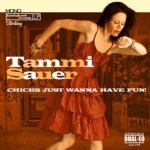 The jokes even extend beyond the story, with end pages that demo step-by-step “Disco Chicken” and “Chattanooga Choo Choo” dance moves. Funky album covers replace the typical staid author and illustrator photos.
Yes, just one look at the blinged-out, white-caped Elvis Poultry on the front cover, and you know this ain’t your Aunt Myrna’s paltry poultry impersonation.
Can’t get enough of the silliness?
Publisher Sterling Kids is holding a video contest now through October 31. Just shake your tail feathers along to the official music and post your hoe-down on YouTube.
And tell them Elvis Poultry sent ya.
 Chicken Dance
Written by Tammi Sauer
Illustrated by Dan Santat
Sterling Kids, August 2009
Want it? Sure you do!
Kidlit Book Trailers
Bookselling is changing rapidly with advances in technology and the belt-tightening economy. Publishers and authors are having an ongoing discussion of electronic rights, trying to anticipate the future of digital books.
But the forces of technology aren’t all daunting. Heck, authors are having a blast creating book trailers to promote their titles. What better way to capture the attention of an increasingly online, plugged-in audience?
Award-winning storyteller Dianne de Las Casas has created a Ning community for sharing and discussing kidlit book trailers. Authors are invited to post their trailers and other videos (like a school visit). Bibliophiles can browse the selections to discover great reads.
http://kidlitbooktrailers.ning.com
Haven’t seen a book trailer? Here’s a gorgeous one from the site: Where the Mountain Meets the Moon by author/illustrator Grace Lin.
The Unread
Here’s where you cover your ears because I’m gonna toot my own horn. Picture book author Heather Ayris Burnell (Bedtime Monster, Raven Tree Press 2010) interviewed me for her Unread series of aspiring authors. As you may have guessed, there’s almost as much talk about food as there is about books.
Besides Unread, Heather’s blog is dedicated to author interviews, book reviews and being a writer and librarian. So there’s lots of reasons to visit regularly.
http://frolickingthroughcyberspace.blogspot.com/2009/08/unread-interview-with-tara-lazar.html
Mitali Perkins’ Fire Escape
I am in awe of this woman. Not only is Mitali Perkins an amazing novelist, she shares the most compelling kidlit news and information via Twitter and her blog, with special emphasis on multi-cultural issues. If you haven’t visited, you really need to.
http://www.mitaliblog.com
http://twitter.com/mitaliperkins
Meet Eric Carle
August 23, 2009 marks Eric Carle’s 80th birthday and there’s a big bash at The Eric Carle Museum of Picture Book Art in Amherst, MA. Crayola will unveil “The Very Hungry Caterpillar Green” crayon as part of the celebration. Wow, getting a crayon named after your work. Now that’s iconic.
http://www.carlemuseum.org/Programs_Events/Upcoming/Meet_Eric_Carle/
Sudipta Bardhan-Quallen’s Picture Book Intensive
On November 15, picture book author Sudipta (yes, she has earned one-name status) will lead a four-hour picture book intensive workshop in Princeton, NJ for the NJ-SCBWI.
Some topics she’ll cover:
- Choosing Timeless Themes
- Ebb & Flow of Tension
- Creating Emotional Attachment to the Main Character
- Finding Ways to Make Your Book Re-Readable
- Humor and Heart
- Query Letters
- Marketing
I know I’ll be there!
For more info:
http://sudiptabq.wordpress.com/2009/08/10/picture-book-writing-intensive-workshop/
To Register:
http://www.newjerseyscbwi.com/events/091115-pbintensive.shtml
Do you have any can’t-miss kidlit links to share?





 Writing for Kids (While Raising Them)