You are currently browsing the category archive for the ‘Picture Books’ category.
 by Karen Collum
We creative types often talk about that moment when inspiration strikes. We get an idea, a phrase, an image, a scent, a sound that somehow switches something on in our brains and before we know it words are churning out faster than electric shocks on a trampoline. The concept of inspiration ‘striking’, however, is misleading. It sounds so passive, so unpredictable, so out of our control.
I’d like you to think about another sort of strike for a moment; a lightning strike. It’s true, lightning can strike people almost anywhere and at anytime, and we often hear amazing tales of the same person being struck more than once, but there are well-known factors that can increase or decrease the likelihood of being struck by lightning. I believe the same applies to the strike of inspiration. Here are a few ways you can increase the likelihood of being struck by inspiration (but please don’t use this advice in a storm as you are quite likely to get struck by lightning and although that might make a great story, it would in fact be terrible!):
1. Stand tall and in the open
Everyone knows that lightning strikes tall objects and the wisest thing to do in a storm is lie low. The opposite is true when waiting for inspiration to strike. Stand out in the open field of life, arms outstretched and reaching for the sky. Stand tall, lift your gaze above what is immediately in front of you and look around. Don’t be afraid to be different. Look at a picture, a scene, a group of people from a different perspective. Ask ‘what if?’ questions. Dare to look beyond what you first see. For me that often means taking a mental step back from the scene and surveying it as an observer. Why is that person frowning? Why is the lady in the car crying? Where is that person in a hurry to get to? Do this often enough and inspiration will surely strike.
2. Have your umbrella up
Umbrellas in a lightning storm are a no-no, especially if yours has a metal tip on the end, but for a writer, having your umbrella up means you are ready and waiting to be struck by inspiration. You are aware of what’s going on around you and that there may just be one tiny thing that will spark your creativity in amongst the mundane. I try to have my umbrella up all the time, consciously searching for things that might be useful. I listen carefully to the conversations that my children have and try to absorb their pattern of speech. I also have a notebook handy at all times so I can capture the strike when it happens. When I’m outside playing with my kids I watch for interesting things in my environment. Just the other day I saw a slow and steady march of butterflies heading to some important but unknown place, one at a time. Inspiration can strike on even the gentlest of wings.
3. Get on the phone
During a lightning storm it’s advisable to stay off the phone as lightning can travel down the phone line and end up quite painfully in your ear. As a writer, however, it’s essential that you connect and network with other creative people. Have conversations about interesting things, bounce ideas off one another, share with trusted creative friends what you’re working on. I don’t believe inspiration happens in a vacuum and by connecting with one another we can create surges of inspiration for all of us.
Don’t just wait for inspiration to strike. Stand tall, have your umbrella up and get on the phone. You might just find those thirty PiBoIdMo ideas flowing faster than you ever thought possible.
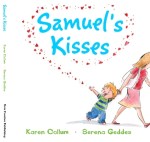 Karen Collum lives in Brisbane, Australia and is a stay-at-home mum to three pre-school boys. She is about to welcome a baby girl to the family in December. She is also a picture book author and co-convenor of the international online picture book chat group, #pblitchat. (You can find details about #pblitchat at http://picturebooksonly.wordpress.com.) Karen’s debut picture book SAMUEL’S KISSES is due for release in late November by New Frontier Publishing. You can follow Karen on Twitter (@KarenCollum) or find more about her and her books on her website http://www.karencollum.com.au.
Venerable LA Times rock critic Robert Hilburn recently penned Corn Flakes with John Lennon and Other Tales from a Rock n’ Roll Life, a revealing memoir-style series of vignettes featuring the great rock icons of the last 50 years.
In the book, Hilburn recounts his seven-piece Times series on the most influential and prolific songwriters of the rock era, which was published earlier this decade. He chose Bob Dylan as his first subject. Hilburn wanted to learn about a songwriter’s creative process: what inspires them, how they begin to lay down the music and lyrics, if success or failure of past work influenced future songs. The interview with Dylan earned Hilburn his third Pulitzer Prize nomination. And, Dylan’s words may give other writers—perhaps even picture book writers—inspiration for their own work:
 “Some things just come to me in dreams,” Dylan told Hilburn. “But I can write a bunch of stuff down after you leave…about say, the way you are dressed. I look at people as ideas. I don’t look at them as people. I’m talking about general observation. Whoever I see, I look at them as an idea…what this person represents. That’s the way I see life. I see life as a utilitarian thing. Then you strip things away until you get to the core of what’s important.”
And picture books are indeed about what’s important; every picture book features an emotional truth, whether it be about family, friendship or fitting in. If you strip away what’s on the surface—the pirates or the penguins or the princesses—what remains is a story about the human experience.
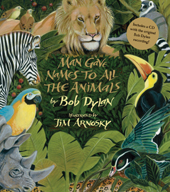
Noted illustrator Jim Arnosky found inspiration in Dylan’s music. “From the first time I heard [Man Gave Names to All the Animals], the lyrics created pictures in my mind of a land of primeval beauty,” said Arnosky. Dylan gave his permission to create a picture book, and the work was released by Sterling in September.
So that’s your inspirational thought for the day. Well, two inspirational thoughts! People and songs.
What do other people’s actions say to you? How do those actions translate to story? What music boosts your creativity?
And don’t forget, there’s much more inspiration to come when PiBoIdMo begins in November. Consider this a warm up, or as Dylan might say, a sound check.
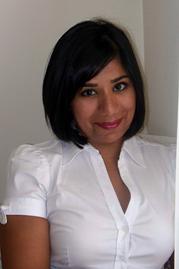
Authors always say that we write what we know, and it is completely true—you cannot tell an authentic story if it doesn’t come from a place of truth. The trouble, though, is when you write picture books for kids, how do you define what it is that you know?
I write books about talking pigs and lonely ducks, and I can assure you I am neither a pig (verbose or otherwise) nor a duck nor any other kind of animal featured in any of my books. And yet I feel very strongly that I only write about the things that I know and that almost every one of my picture books draws heavily from my own life.
Take QUACKENSTEIN HATCHES A FAMILY, for example, my newest book published by Abrams. In this story, poor, lonely Quackenstein looks on in envy as all the other animals in the zoo settle in with their families. So he hatches a plan to solve his problem—upon spying a sign for “orphaned eggs,” Quackenstein decides to adopt an egg to start a family of his own.
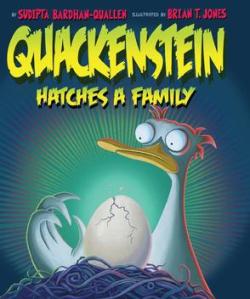 The previously cantankerous duck becomes a devoted father-to-be, even cooing to his “ducky-poo” that he will never be neglected. But when the egg finally does hatch, it is more than the eggshell that cracks—Quackenstein takes one look at his hatchling and runs off in terror.
Without giving away the whole book, suffice it to say that the hatchling eventually catches up to his father and a few choice words serve to melt Quackenstein’s heart and open his eyes to the fact that families can be different or strange but always find a way to work. Despite his fears, Quackenstein learns to be the father he wanted to be—and that his son deserves.
I wrote this story when I was pregnant with my son, Sawyer, who is my third child. I’d already had two girls, Isabella and Brooklyn, and I was convinced that baby number three was going to be daughter number three. So when the doctor told me that I was having a boy, my first response was, “No, I’m not, and you can’t make me.”
Turns out, I really was going to have a boy and nothing was going to change that.
I will freely admit being terrified at the prospect of having a son. After all, I knew lots and lots about how to be a good mother to girls, but knew absolutely nothing about mothering a boy. (Since then, I’ve learned that boys and girls truly are as similar as, well, ducks and platypi—they might as well be two different species.)
I honestly didn’t sit down to write a book about a parent who was both excited and terrified about having a baby. But looking back, I realize I did exactly that.
Had I written QUACKENSTEIN five years earlier, I am convinced it would have been a different story, because there were different things important in my life then. If I’d never written the book and started fresh on it now, it would definitely be a different story (and probably far scarier!).
As much as authors write what they know, the real test of a good story is whether the author has not only found his or her own truth, but also illuminated some truth for the readers. So I’ll leave you with this hope: that you can find a little Quackenstein in your own heart.
Thanks for giving us a warm-up for PiBoIdMo, Sudipta!
Want a sneak peek of QUACKENSTEIN? Look no further–the trailer is here! With every view, a donation will be made to the Association of Zoos and Aquariums!
Last week, the NY Times published an article on the decline of picture books, claiming that parents are pushing chapter books on younger children because they want to advance their child’s learning. (Although a parent’s quote was taken out of context.)
Is this truly a trend? Are parents feeling pressure to keep up with the Joneses, literally?
I hate to say it, but the answer is yes. (But stay tuned, we’ll circle back to picture books.)
The pressure to raise intellectually superior kids starts even before a child is born. The Mozart Effect suggested that playing classical music for your fetus boosted intelligence. Pregnancy Today says exposure to music in utero may instill your child with a sense of confidence after they’re born.
Remember Baby Einstein? The name alone gets parents thinking about academic achievement in the early years.
You’ve probably heard of Your Baby Can Read. They boast that “a baby’s brain develops at a phenomenal pace…nearly 90% during the first five years of life!” They urge parents to “seize this small window of opportunity,” as if your child will never have the capacity to learn again.
A local preschool is cleverly named “Ivy Leaf.” Are they suggesting enrollment will guarantee your child admission to Yale or Harvard? Hmm…
Kindergarten used to be a half-day of painting, building with blocks and playing music. But now children are given summer tutoring in math and reading to prep for Kindergarten.
Look at the rise of tutoring companies like Kumon and Sylvan.
Rigorous school standards push parents to raise children who are smarter, faster. No one wants their child to be left behind.
But should we give chapter books to young children? If they want to read them, sure! Education.com says “choice is vital to reading engagement. As children learn to self-select their reading materials, they become discriminating and independent readers.” That’s a fancy way of saying children who select their own books are more likely to become life-long readers—and learners.
That brings us back to picture books. They are intellectually stimulating:
- Reading with your child early and often helps develop the parent-child bond. (It’s a nice tradition, folks.)
- Illustrations help children comprehend the story when they don’t understand the language. They learn context.
- Picture books expose children to art. Some of the finest illustrative work in the world can be found in picture books.
- The repetitive phrasing common to picture books helps children recognize words.
- Rhyming picture books help children recognize word patterns.
- Children learn story and narrative structure in a concise format. They get a beginning, middle and end in less than 1000 words.
And, come on! PICTURE BOOKS ARE FUN!
I bet the Joneses read them, too.
For those of you who are hungry for PiBoIdMo to begin on November 1, here’s something to satisfy your craving: a delicious PiBoIdMo 2010 badge for your blog, Twitter or Facebook page. Nom, nom, nom!
Just right-click on the image and save it to your computer. Then upload wherever you’d like! I ask that you link the badge back to this blog. I said “ask” because it’s most appreciated, but entirely optional.
Thanks to the talented James Burks for designing this year’s PiBoIdMo logo and badges. (Yes, there’s a “PiBoIdMo Winner” badge, too, but you don’t get to have that one yet!)
If you’re a Twitterholic, you can also add the PiBoIdMo Twibbon to your avatar.
Watch for the PiBoIdMo 2010 kick-off post to appear on Halloween!
Lately many writers have wondered, “Are you hosting Picture Book Idea Month again in November?”
Since this is a children’s lit blog, I have to tone down the language of my reply:
HECK, YEAH!
We’re gonna make NaNoWriMo novelists wish they were PiBoIdMo writers this year!
We’ve lined up great guest bloggers.
And three picture book agents to provide feedback to three winners.
And prizes! Oh, the prizes!
Just remember, you’ll have to complete 30 ideas in 30 days to qualify for the prizes. And you’ll have to officially sign up, too.
Watch for the kick-off post and sign-in on Halloween! You’ll have from then through the first week in November to sign-up.
And for now, I’m signing out!
What happens after a manuscript is bought by a publisher? Well, you pop a cork of bubbly and break the glass shade on your kitchen chandelier. But don’t worry, your advance will cover the repair. (That’s what I told my husband.)
I received an offer for my first picture book, THE MONSTORE, from Aladdin/Simon & Schuster in early May and accepted, after brief negotiations, shortly thereafter. By the end of June, my editor sent me the first round of edits, with the first revision due August 1st.
I opened the Word document and couldn’t believe all the RED.
Stuff was slashed. Crimson comment boxes asked me to change words…and entire passages. And most baffling of all, I thought my editor didn’t like my ending. I felt overwhelmed.
That’s when a good agent swoops in and saves you from having a toddler-like meltdown. A conference call was what I needed to understand the reasoning behind the red. The following week, my editor, editorial assistant and agent called and we ran through every detail. And, guess what? I didn’t feel so overwhelmed anymore. That’s what. (Sorry, there’s a little Junie B. Jones creeping in.) My editor had a great vision, and I agreed with every change she suggested. Big sigh of relief.
Then I had a month to make the changes.
I tried procrastinating. I played a lot of online Boggle. (My high score is 174.)
Honestly, I didn’t know how to tackle the revision—how I would solve the little problems that, at the time, seemed HUGE.
Then I remembered Anne LaMott’s BIRD BY BIRD. So that’s what I did. I took it bird by bird.
The first day I changed the manuscript from 1st person to 3rd. Send over the red button from Staples because that was easy.
The next day, I thought visually. My editor said some of the objects and actions in the manuscript, like a bag of moldy bread, and a monster slithering, wouldn’t come across well in illustrations. She asked me to think of details that were more visually interesting—things that would be humorous to draw, but also fun to read aloud. And, one of those things had to tie into the denouement.
My editor had paginated the manuscript, and she asked me to think of each page turn as a mini-cliffhanger. She did such a bang-up job on the pages, I didn’t need to do much there.
Then came the ending. Remember how I thought my editor didn’t like it? Well, she loved it. She just wanted me to stretch out the denouement. But how? I spent days staring at the screen. I’d come up with an idea, then erase it. And another. Delete. Then save. Then trash. This went on for a fortnight, until, by George, I think she’s got it! (I’ve always wanted to feel like Audrey Hepburn. That was my moment.)
I finished the first revision on June 27th, with enough time to email it to my agent for review before sending it to my editor just under the August 1st buzzer. My agent was thrilled, I was thrilled that my agent was thrilled, and let’s just say the word THRILLED ping-ponged between us that week.
My manuscript had gone from 522 words up to 730 to fit in the changes, but I thought that would be OK.
I was wrong.
The second round of edits arrived in early September. MORE RED. Cut, cut, cut! My editor liked the new denouement, but it was too wordy, bogging down the pace of the story. “This can be shown in illustration,” she said several times. I agreed. (And added those devilish art notes.) I slashed and burned, taking the manuscript down to 589 words.
So now it’s ready to ship out once again, way ahead of my November 1st deadline for the final manuscript.
But guess what? I think there will a lot more changes from now until then, but they’ll make the story even better. That’s what.
Last November this blog hosted “Picture Book Idea Month,” a daily exercise for picture book writers. The object was to create one new picture book idea a day. (As an added benefit, it kept us from having NaNoWriMo envy.)
When I tried PiBoIdMo on my own the year prior, I came up with the concept for THE MONSTORE, which became my first book to be purchased. It’s set for release with Simon & Schuster in 2012. And, this week, my editor is meeting with the art director to talk about illustrators. Oh yeah, it’s a fun time.
Then this week I got word that Diana Murray won the 2010 SCBWI Barbara Karlin grant with one of her PiBoIdMo 2009 ideas! Wow! So I asked her to tell the story…take it away, Diana!
 When Tara announced PiBoIdMo on the blueboards, I was thrilled. One idea per day was something I could handle time-wise and I was looking forward to an excuse to ramp up my picture book writing. It was more challenging than I expected, but the best part was, it helped me figure out my main problem: I’m a compulsive writer. As soon as I think of an idea, I run for my laptop and I can’t stop writing until I get the whole story out of me. I literally find myself waking in the middle of the night to jot things down. In other words, I’m completely nuts. In many ways, this can be a good thing. Motivation has never been an issue for me. But participating in Piboidmo forced me to delay my compulsion to write about anything that popped into my head, and for me, that ended up being more efficient.
I came up with most of my ideas during little “holes” in time throughout the day, like while pushing the stroller or putting my kids to sleep. Some of these ideas were pretty awful, like: “Tabby Moves to Dogtown” and “Mabel’s Amazing Hat,” about a do-everything hat with a remote control. Ha! That one still cracks me up. Some of the ideas were worth investigating and I kept getting tempted to drop everything and start writing. But I held back in the interest of coming up with at least one new idea each day. I knew that if I started writing, I wouldn’t be able to stop and move on to thinking of other ideas. I held off as long as I could.
Finally, on idea #23, I couldn’t take it anymore. The idea of a stubborn, messy witch who keeps losing things resonated with me (Gee, I wonder why?). It’s a very personal experience, of course. An idea that works for one person may not appeal to somebody else. But for me, it just clicked. For a few days, I thought about it and planned it out in my head. Actually, idea #23 had been brewing since idea #1 (to borrow a metaphor from my MC, Grimelda). That’s the good thing about ideas: even the bad ones can ultimately lead to something that inspires you. By the time I started writing, I was overflowing with creative juices and the whole manuscript just poured out.
So, long story short, I’m a PiBoIdMo loser! My compulsion got the best of me, and I didn’t get past idea #23. But the good news is, I won the 2010 SCBWI Barbara Karlin Grant and learned something in the process.
For the record, I announced my participation on the blueboards but not on Tara’s blog. Let’s just say I was a little new to the concept of blogs at the time. Luckily, I was able to read all the inspiring posts after the event.
Congraulations, Diana! I hope you’ll let us know when your manuscript gets purchased!
Do you have a PiBoIdMo success story to share?
Editor and author Ken Geist recently spoke at the New England Children’s Booksellers Advisory Council, asking independent booksellers to get behind picture books, as reported by Publishers Weekly.
Why the impassioned plea? While picture books aren’t disappearing from the market, they have been a tough sell lately. Jacketed picture books are $16.99–not an inexpensive purchase–and customers seem unwilling to buy unjacketed titles. Lower-cost paperbacks aren’t usually produced until the hardcover has proven sales. And big retailer Barnes & Noble is removing its picture book wall and instead showcasing higher-margin activity books. (Say it isn’t so!)
The most interesting tidbit from the article–one that contradicts the word count guidelines heard lately (500 to 700 words, the less, the better)–is that “many [consumers] don’t know what a picture book is, and those who do are looking for more text.”
More text?
Can it be that picture book consumers feel slighted by the $16.99 price tag when they only get 400 words? Does this mean picture book word counts might be on the rise? This is difficult to tell, considering the article also mentioned that 4- and 5-year-olds are being pushed toward chapter books. Lower word counts serve the younger audience this suggests. But do we believe that 4-, 5- and even 6-year-olds are going to give up on picture books completely? Are teachers going to stop using them in their Kindergarten, 1st and 2nd grade classrooms?
And could picture book series be turning off some parents? Once there’s a hit book, publishers release new titles with the same character. Is this strategy a sure money maker, or are parents getting tired of the same premise repeated a half dozen times?
On one hand, familiarity is a strong selling point. Think of the popularity of chain restaurants–customers know the menu is the same in Boston or Boise, so they are assured an enjoyable meal. So a picture book with a character they and their children already know is appetizing, but when do they get full? Editors have been asking for character-driven manuscripts to take advantage of sequel potential, but will this trend level off?
I’m curious to see if publishers will change their acquisitions strategies in light of bookseller changes. What do you think?
One of the booksellers at the event suggested a grass-roots effort to make 2011 “The Year of the Picture Book.” I’m all for that! Who’s with me? What can we do to help a sagging picture book market? (Besides the obvious–write awesome books!)
 Joyce Wan, talented author/illustrator of “Greetings from Kiwi and Pear,” stops by the blog today to recap the recent NJ-SCBWI annual conference. I couldn’t attend this year so Joyce offered to share the juicy details. (Get it? Kiwi and pear…juicy? Ugh, stick to humor in picture books, Tara.)
Take it away, Joyce!
It was my first time attending the New Jersey SCBWI Annual Conference and it was such a blast! There were intensives, workshops, lunches with editors/agents/art directors, a book fair, a juried art show, a raffle, auctions, one-on-one critiques, agent pitch sessions and portfolio reviews galore. A whopping 22 publishing houses/agents were represented. A round of applause to Kathy Temean (NJ-SCBWI RA), Laurie Wallmark (Assistant RA) and all the volunteers for coordinating such an amazing and well-organized event. The conference was informational yet inspiring and I left Princeton feeling excited and energized!
Highlights from two of the workshops I attended which stood out in my mind:
Sure it’s Cute, But Will it Sell?
Steve Meltzer
Associate Publisher/Executive Managing Editor
Dial, Dutton, & Celebra
He provided us with information on the business side of the industry and a snapshot of the current picture book market. The market is made up of four types of buyers:
- Independent Retailers
- Mass Market Retailers
- Institutional (Libraries and Schools)
- Book Clubs/Fairs
You want to write a book that hits ALL markets. Examples of current books that are hitting all markets:
- Skippyjon Jones
- Fancy Nancy
- Ladybug Girl
- Llama Llama Red Pajama
As mentioned in the recent #pblitchat on Twitter, Meltzer is looking for character-driven stories: stories with quirky characters that are unusual and original but realistic. Character stories invite sequels, branding, and licensing opportunities.
Finally, he suggested that writers should be able to pitch their story in one sentence. Compare it to something successful but then tell him how it’s different (ex. Like Skippyjon Jones but with whales).
Picture Books – What Works
Sudipta Bardhan-Quallen
Author of 13 picture books and seven non-fiction books
Picture books should be 650 words or less. Story should consist of a character that has a conflict and makes three failed attempts to solve the problem and then has a successful attempt on the fourth try. The end of the book must surprise the reader (a twist), extending the story beyond the story, which makes the book re-readable. Although she did mention that there are no hard and fast rules to picture book writing–and that these are just what, in her experience, has worked for her–I do think it’s a handy little formula to follow for those of us beginning our journey in the world of picture books! Another little trick that can help add tension to any story is to add a ticking clock of some sort: the character has to reach the goal by a certain time (ex. by bedtime, by sundown, etc.).
In addition to the workshops, there were two really inspiring keynote presentations at the lunches given on the first day by David L. Harrison, author of 80 children’s books, and on the second day by Catherine Gilbert Murdock, author of Dairy Queen and other books. David Harrison reminded us all why we do what we do, which is to create literature for young people. Catherine Gilbert Murdock charmed us all with her self-deprecating humor and shared with us how her journey to becoming a successful author started in a not-so-successful career in screenwriting.
There was also a juried art show organized by Leeza Hernandez, which was a first for the NJ SCBWI conference. You can read about the winners of the art show and view some of their beautiful artwork on Kathy Temean’s blog.
 I submitted this piece for the art show which is a scene from my picture book that came out last year called Greetings from Kiwi and Pear.
I had fun being part of such a visual part of the conference and even had a fellow attendee email me after the show saying how much she loved my work and what a bummer it was that we didn’t get to chat during the conference.
One of the best parts of the conference was the one-on-one critique with the editor/agent. I thought the one-on-ones alone were worth the price of the conference. The editor I had my critique with gave me very insightful feedback and ideas. I showed her the picture book dummy that went with the manuscript I submitted for the critique along with my picture book that came out last year and even my Wanart catalog so that she could get a better sense of my illustration style. She liked my picture book dummy so much she actually asked to keep it along with my catalog–how exciting!
One fun side note is that there was a High School prom at the hotel the first night of the conference. I got quite nostalgic at dinner watching all the kids in their tuxedos and glittering gowns make their grand appearances in the hotel lobby–it was quite a spectacle and felt like dinner theater!
Overall, the conference was fantastic in every way from the top notch venue (there were koi ponds in the atrium!) to the high calibur faculty. I’m already looking forward to next year!








 Writing for Kids (While Raising Them)