You are currently browsing the category archive for the ‘Picture Books’ category.
One of the most frequently asked questions by new kidlit writers is “why do editors say not to write in rhyme?” There’s plenty of picture books written in rhyme, right? They get published somehow!
Well, the answer is a bit complicated. It’s not that editors don’t necessarily LIKE rhyme. It’s just that it is very difficult to do well. Here’s why:
- Rhyme scheme can dictate story–but shouldn’t. Tales should unfold organically, not be forced into the confines of the rhyme. Often it’s suggested to write in prose first—so you don’t get locked into a plot that doesn’t work—then translate it to rhyme.
- Common rhyme schemes can be stale. Editors see them again and again. Avoid overly simple, one-syllable rhyme schemes like go/show/know, to/you, me/be/she/he/see, run/fun/sun, day/may/way/say. If your reader can guess the word at the end of the line before they get there, your rhyme scheme may be too common. Editors want to read rhyme that surprises them.
- Forced rhyme or near-rhyme can ruin a story. This is when words don’t exactly rhyme unless you mispronounce them. Once in a while this is acceptable, but more than a few times in a manuscript and it distracts.
- The meter (or beat) must be spot-on. That doesn’t just mean the number of syllables in each line, but the emphasis on those syllables. Meter shouldn’t be so sing-songy and constant that it lulls the reader to sleep (unless maybe it’s a bedtime book) or so rough that it tongue-ties the reader and forces them to speak unnaturally. Some good rhyming books offer a break in the rhyme scheme for variety—not unlike a bridge in a song.
- Rhyming books are difficult to translate into other languages. An editor may not want to lose out on foreign book sales, so they’ll pass on a rhyming project.
However, if your heart is set on rhyme and if you have a talent for it, you should go for it. At first, Karma Wilson listened to the “don’t rhyme” advice.
“When I first started submitting some 15 years ago all the guidelines said, ‘No rhyme and no talking animals!’ For THREE years I avoided rhyme and talking animals. But guess what my first book sale was? BEAR SNORES ON! And guess what the guidelines said for McElderry books? NO RHYME AND NO TALKING ANIMALS! My passion is rhyme, and talking animals are great as long as they have something interesting to say.”
Yes, you can break the rules like Karma. But get your rhyme critiqued and know whether or not you can nail it.
Me, I’m terrible at rhyme and I know it. I cannot “hear” meter. I’ve tried and failed. My friends have coached me, but I still don’t get the right beat. I can’t dance to it. (I can’t dance anyway. Think Elaine from Seinfeld. Sweet fancy Moses!)
So what is successful rhyme? I’m glad you asked! I’ve got a few examples for you.
In HUSH, LITTLE DRAGON, Boni Ashburn spoofs the lullaby “Hush, Little Baby”. Instead of buying her baby a mockingbird, the mama dragon in the story brings her darling son various villagers to eat. It’s delightfully tongue-in-cheek. Some of the best lines:

Here she comes with a fresh magician.
Don’t mind the taste—he’s good nutrition.
…and later on…
If Mama finds a mean old queen,
Honey, you are lucky—that’s good cuisine!
Notice how these rhymes are out of the ordinary. They’re surprising and fun, plus the words have multiple syllables. She also rhymes “flee” with “fiery” and “bolt” with “revolt”. I challenge you to find these rhymes in another book! You won’t—and that is what makes this story so special.
Jean Reidy’s LIGHT UP THE NIGHT is an example of rhyme that elicits glorious illustrations. Remember that in picture books the art tells half the tale, and these lines create an expansive view of our world (click on image for larger version)…
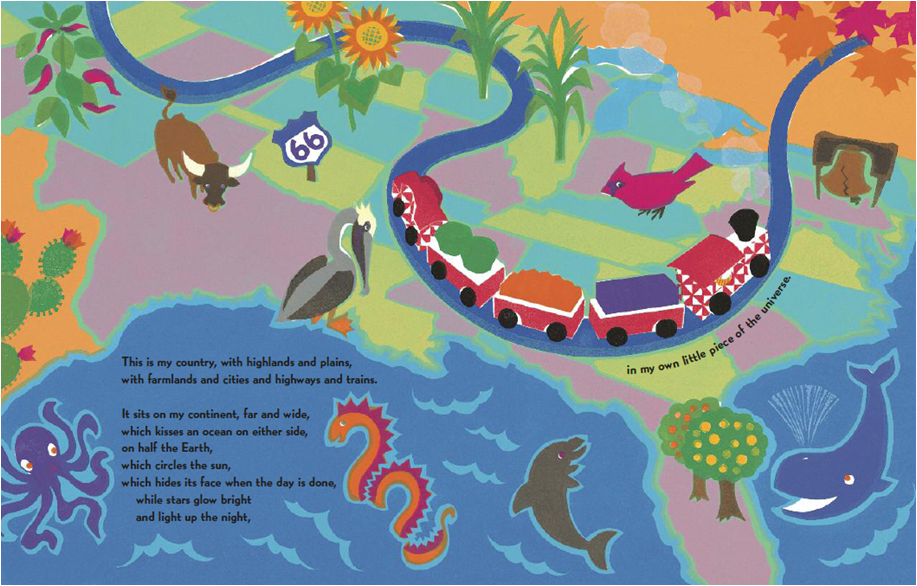
This is my country, with highlands and plains,
with farmlands and cities and highways and trains…
Notice how there is a break in the rhyme scheme at the end of the stanza—and that line is set apart in the illustration for emphasis. Coincidentally, Jean blogged today about her decision to write in rhyme. Go check it out!
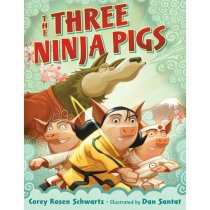 In Corey Rosen Schwartz’s THE THREE NINJA PIGS, the rhyme is infused with porcine puns. Kids and adults alike will appreciate the humor:
She then gave a swift demonstration
With backflips and butterfly kicks
The wolf looked quite shaken
but hollered, “Yo, Bacon!
I’m not at all scared of your tricks.”
There’s more great piggish laughs (like my favorite “pork-chop” line) but you’ll just have to wait until it’s released in September!
So I hope I’ve provided you with some background on why rhyming picture book manuscripts are a hard sell…but that if they’re done well, they can be spectacular.
What are some of your favorite rhyming picture books? Please share in the comments!
 Before Michelle Kwan, before the whole Tonya Harding-Nancy Kerrigan scandal, there was a figure skater who exhibited that perfect balance of power and grace: Kristi Yamaguchi. She had the high jumps and fast spins, but she also had a style and effortless elegance no one else could match.
OK, so why am I gushing? I used to be a competitive figure skater, but no where near the level of Kristi Yamaguchi. She was a role model to me. So today I’m very pleased to share with you her new picture book, IT’S A BIG WORLD, LITTLE PIG! And yes, it’s about figure skating!
 First, let me introduce the main character, Poppy. Isn’t she cute? In her first book, she had the courage to DREAM BIG and chase after her goals.
Now, in the sequel, Poppy receives an invitation to Paris to compete in the International Games. She musters up her porcine prowess to travel far from home–with encouragement from her friends and family, of course.
When Poppy arrives in Paris, she’s overwhelmed. She doesn’t know anyone and doesn’t know where to go. But Poppy is great at making friends. She bumps into Li, a panda snowboarder. And Poppy finds out that even though they are from different countries, they “both smile in the same language.”
 According to John Sellers, children’s reviews editor for Publishers Weekly, “There’s certainly a need for books that portray, mirror and show the value in all kinds of families: same-sex families, mixed-race families, stepfamilies, families with grandparents as guardians.” I also believe that books should reflect the diversity in the world around children. In my own neighborhood, there are families from Brazil, India, the Czech Republic, Spain, Portugal, China, Taiwan, Denmark, and Mexico. So I was pleased to see that Yamaguchi’s book introduces readers to animal competitors from all over the world.
Tim Bowers illustrates with such adorableness (is that a word???), bright colors and a jovial quality. You can’t help but smile at the wonderful world he’s created.
IT’S A BIG WORLD, LITTLE PIG brings together many cool themes (besides ice): following your dreams, making friends, diversity, independence, and doing your best. And it’s all rolled up in a figure-skating package! What could be more perfect?
Well, I’ll tell you! One hundred percent of Kristi’s profits from IT’S A BIG WORLD, LITTLE PIG will benefit early childhood literacy programs supported by her Always Dream Foundation.
 Ooga!
Ooga!
Know Tammi Sauer? She write new book. She write good book. Bob Shea draw picture. It ME WANT PET!
(Me read to five-year-old class. They giggle. They snort. They LOVE!)
Cave Boy star. Cave Boy want pet.
He find pet. Mama say no. Gah!
He find new pet. Papa say no. Gah, ug!
He get new new pet. Gran say no.
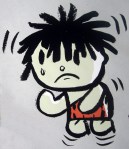 Cave Boy sad. Me sad. You sad!
What Cave Boy do?
Me no tell.
You read book. Ooga!
So…
Daughters want draw. I ask, “What pet you want Cave Boy have?”
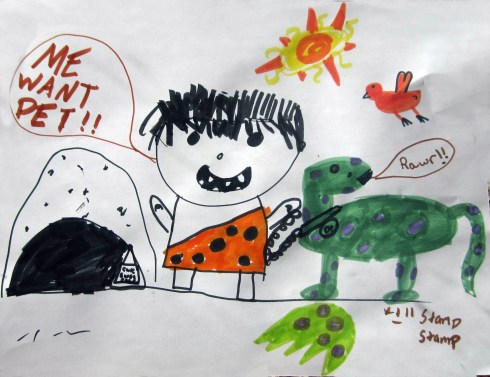
Daughter Eight draw dinosaur. Me say no. Too stompy.
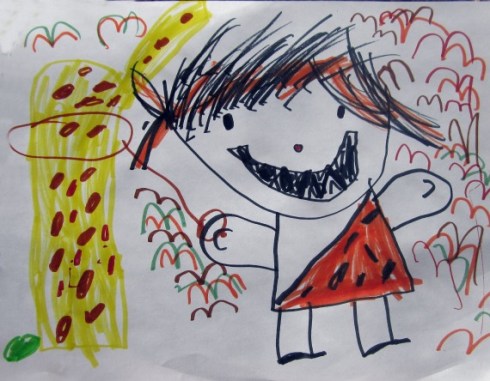
Daughter Five draw giraffe. Me say no. Too tall. No fit cave.
You have kid? Kid draw Cave Boy and new pet. Send to tarawrites (at) yahoo (dot) com by March 13. Me post here. Me pick pet. Kid win book.
OOGA!
Tammi Sauer author. She write many, many kid book. Book like CHICKEN DANCE and MOSTLY MONSTERLY and MR. DUCK MEANS BUSINESS. You visit her: TammiSauer.com. OOGA! (Ooga not book. Me like say OOGA!)
If you want to publish a book for children, the first thing you must do is ask yourself why.
Is your motivation to publish a kid’s book one of the following?
- Your kids/grandkids/nieces/nephews/neighbors/students love a story you’ve written.
- It would be fun to see your name in print.
- You want to sign autographs.
- You want to make money, quickly.
- You want your artist cousin/sister/friend to illustrate it.
If you answered “yes” to any of the above, please read this post. I write this to save you a lot of time and frustration. Because it’s not an easy business. NOT. EASY. AT. ALL.
New writers often believe they can pen one story in an hour or two, never revise it, yet somehow land an agent and a publishing deal—-as if the simple act of writing begets publication.
 Hitting one baseball does not mean the Yankees will draft you. Likewise, writing one story does not mean Random House will offer you a contract. Although, keep hitting that ball, make it go higher and farther…learn about fielding and sliding, too…and play seriously for years, and you just might make it.
Everyone believes the first thing they write will be golden and they’ll never receive a single rejection. We are all HOPEFUL. But, everyone is wrong. (Including me!) Trust me, this will NOT happen. It has NOT happened to ANYONE. (Except for Kevin Henkes.)
The motivation to write a children’s book should be:
- You love to write. You were born to write. You can’t NOT write.
- The child inside you is begging to get out and explore.
- You love children’s literature and want to contribute worthy stories to the genre.
- You want to inspire children to read, write, create, imagine and dream.
- You enjoy learning from children. (Yes, your primary goal should not be to teach them. Teachers, parents and guardians teach. Books are meant to be fun.)
- You want to work hard to establish a career as a kidlit author. You’re in it for the long haul.
 Notice fame and fortune have nothing to do with it. That’s something a small percentage of authors achieve. (Yes, authors can have dozens of books in print yet they cannot support themselves through writing alone. Moreover, advance checks can take a long time to arrive, and royalties trail about about 6-9 months behind book sales.)
And even if you become a famous author, most people won’t recognize you by sight or name. It will never get you the window table at The Four Seasons on a busy Saturday night. You’re better off making a reservation as “Doctor Lazar”.
It takes most children’s writers years to land their first book deal. And selling one book does not guarantee future book sales. Selling each subsequent book can get MORE difficult, especially if one (or more) of your titles do not sell as well as the publisher expected.
I don’t mean to be discouraging. I want to be REALISTIC. Children’s literature is a BUSINESS. And this business is like any other—it takes hard work, commitment, talent and a little luck, too. If you’re writing a children’s book on a whim, you might end up being very disappointed when you realize how tough it really is.
In short, I’ve made more money and worked fewer hours in EVERY OTHER JOB I’VE EVER HAD.
BUT…
There’s no job I’VE LOVED MORE. (Besides being a mom, of course.)
Just because you’re writing for children doesn’t mean it’s easy. In fact, it is more difficult to become a published kidlit author than it is to become any other kind of author. (That’s because there’s a tremendous amount of competition. Everyone believes writing for kids is easy because they’re kids. Not so.)
So do it because you LOVE it. You LOVE it like you CAN’T LIVE WITHOUT IT. Because children don’t deserve anything less than YOUR VERY BEST WORK.

Steps you should take:
- Earn a degree in English and/or Creative Writing.
- Read hundreds of books in your chosen kidlit genre (picture books, non-fiction, middle grade novels, graphic novels, YA).
- Write. Write. And write some more.
- Join a critique group specific to the genre in which you wish to publish. YA novelists don’t necessarily know a lot about picture books and vice-versa.
- Join SCBWI.
- Attend professional kidlit conferences, book fairs and other literary events.
- Revise. Revise. And revise some more.
- Research agents and editors online.
- Establish a social media presence. Make writing friends. Gain a support system.
- Consider investing in professional writing books, magazines and services like Publisher’s Marketplace (which will show you what books are selling, which agents are selling them, and to whom), The Horn Book, Publisher’s Weekly and The Children’s Writer’s and Illustrator’s Market Guide.
- After at least two years of writing, try submitting. Don’t send your work out in huge batches. Research who likes the kind of work you produce and target a few. If only rejections come back, try another small set of subs, revise again or write something else.
- Never give up. Keep writing new stories. Those who make it in this business are those who persevere!
Excellent online resources for aspiring children’s authors:
- SCBWI
- The Purple Crayon
- Writing for Children and Teens
- Twitter Chats for Writers
- SCBWI (formerly Verla Kay’s) Blueboards
- Myths and Truths of Writing for Children
- Preditors & Editors
- Literary Rambles: Spotlighting Children’s Book Authors, Agents and Publishing
- Author April Pulley Sayre’s How to Become A Children’s Book Author
I bumped into Peter Harren on Etsy where I discovered his adorable illustrations. We had a few convos and I encouraged him to join SCBWI. Peter and I got in touch again a couple weeks ago as he was gearing up for the SCBWI mid-winter conference. So I asked him to blog about it as a first-timer. Take it away, Peter!
 The co-founder of SCBWI Lin Oliver is hilarious. Part of her first day welcome address (at 7:30 am or some ridiculous turd hour like that) was this quote from the famous body builder Ronnie Coleman:
“Everybody wants to be a bodybuilder, but nobody wants to lift no heavy-ass weights.”
Of course the conference was going to be awesome, but Lin knew that it had a shadow for some people. The days were packed with activity starting at the wee hours and there was going to be a serious amount of information whipping past our heads. As Lin said, it was going to be work. And for people like me and my fiance Kayla Skogh (kick-ass children’s book writer and illustrator), one other shadow, one big shadow, was the socializing.
We’re introverts, and peppered throughout the info package for the conference and people’s advice for us was some scary stuff— “you gotta network”, “introduce yourself”, “mingle” and “talk to people”. We spent 5 years of our lives in New York City squashed up against people and still, the mention of a Saturday night Gala for networking and “fun” made our mouths dry.
The good news for us was children’s book people are really sweet. There were so many warm smiles and rosy cheeks. I think there were over 1000 people, and something like 70% of them were ladies. With 700 children’s book ladies in there you could really feel the nurturing energy. There were lots of hugs. When I remember the Ballroom I see a peach colored glow coming from the room. And as for the structure of the weekend, it went beautifully. It was really well organized and there were some nice breaks and awesome lemon poppy seed bread.
Now, on to the juice. I’ll share the words of wisdom from all the children’s book world royalty that I deemed worthy of note taking. I guess that’s called ‘noteworthy’. And before I start I should mention that everyone felt the children’s book industry is strong and steady. One guy even said it was robust!
Unfortunately, I didn’t write down who said what, but it’s safe to assume they’re a serious-ass children’s book professional of some sort. Also, all these quotes are in reference to picture books. So, here’s some quotes:
 “The keys to a good picture book are: character driven, brief, witty, light on text, and very young.”
- “Great children’s books have clear ideas, an emotional arc, simplicity, and compositional variety.”
- “Keep the story moving, don’t waste pages.”
- “Illustrations need to be narrative on their own.”
- “Make sure the left to right action is strong and promotes page turns.”
- “Character Driven!”
After writing those quotes I’m realizing that they don’t feel as huge as they did when I first wrote them down. I guess that’s evidence of a real benefit to the conference; being there. The conference was hugely inspiring and motivating. And the main reason I went was the portfolio review. My portfolio and book dummy were viewed by over a hundred editors, agents, art directors and book professionals.

If you want an in depth view of the conference you can go to scbwiconference.blogspot.com and find tons of information and videos of the conference. They had a whole team of people blogging the crap out of it.
And just for the fun of it, I added one of my pages of notes.
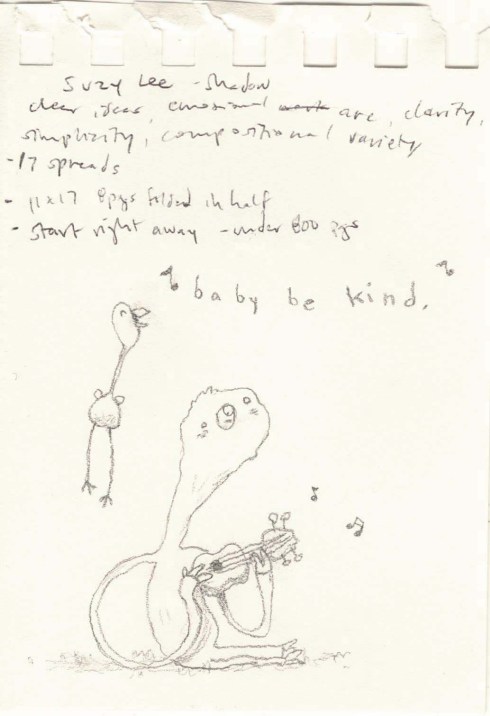
The bird’s lyrics are from Devendra Banhart’s song “Be Kind” which was in my head all weekend. In stressful situations I try to remember to be nice to myself and avoid judging myself for being anxious. This song shows up a lot when I need it.
Peter Harren is an aspiring author/illustrator. Track his progress at PeterHarren.com.
 Say what you will about Wikipedia—that it’s unreliable, that it’s unaccountable, that it’s run by a bunch of idealistic zealots—the fact remains that it is one of the most heavily accessed web resources in the world.
And so, one day as I was researching some of my favorite contemporary kidlit authors and illustrators, I found they were not mentioned in the online encyclopedia. Scott Magoon? Not there. Kate Messner? Nope. Tammi Sauer? Dagnabbit.
I think it’s time we rectified that situation. These folks deserve to go on record, especially those who have won awards for their work.
If you’re a frequent reader of this blog, I’d like to ask you a favor. Pick a favorite contemporary kidlit author or illustrator. Check to see if they’re in Wikipedia.
- List of Wikipedia Children’s Literature Authors
- List of Wikipedia Children’s Literature Illustrators
And if your favorite person is not there, pledge to create an article for that kidlitter by the end of March. Show your love for children’s literature and the people who create it!
Remember that Wikipedia wants you to source references when writing your article. There is a handy-dandy article creation wizard for those of you unfamiliar with the Wikipedia process.
If you are interested in participating, just leave your name and the name of your chosen kidlit personality below. I’ll check in at the end of this month with a master list of potential pages we’re creating.
C’mon, who’s with me?
The internet has been abuzz with Ryan Gosling memes—there’s the feminist Ryan Gosling, Silicon Valley Ryan Gosling, and even a Ryan Gosling who reads young adult literature. Just like NaNoWriMo, I’m feeling like picture book writers are being left out of the fun. So, I’m jumping into the fray with these:
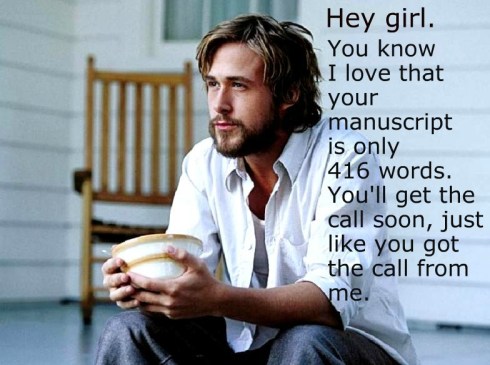
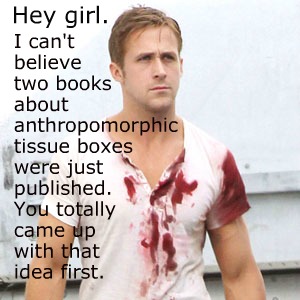
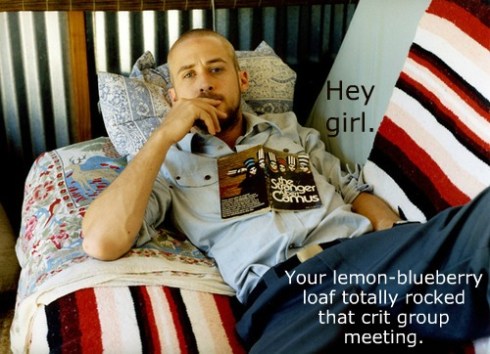
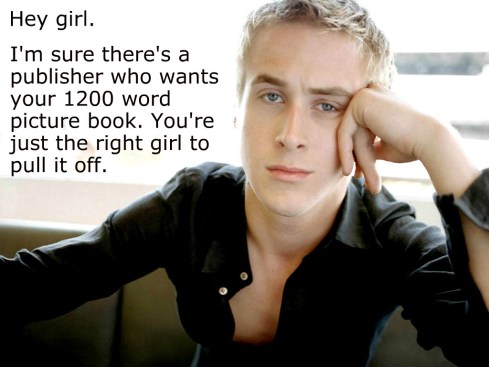

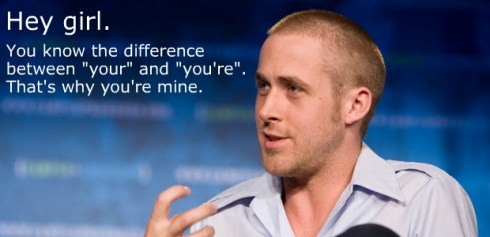
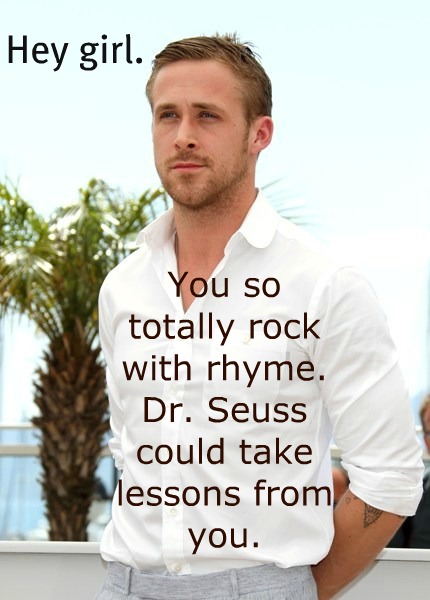

(Special shout-out to Julie Falatko who inspired some of these.)
But you know, Ryan is a little young for me. I need an older, more experienced man for my picture book meme. So I’m thinking about him instead:
 There are all kinds of scenarios in which a manuscript becomes a book. Sometimes it’s a series planned well ahead of time, sometimes the author is well-known and the project is signed on the basis of a proposal, sometimes the agent knows that the idea in itself is a winner and he/she sends it out to vast range of different editors, generating a lot of buzz in the process.
As an acquiring editor, however, my favorite way to come across a manuscript is much more quiet than any of these scenarios. It’s when I stumble across something in a pile of submissions that strikes my fancy. The reason it’s fun to discover things in this way, is that I am not reacting to a trend, but to something that particularly suits my taste. And this means I’m going to remain excited about it right up until the release date and beyond.
I’ve had quite a few books like this on my list. It’s hard to pick just one. But I think there is one that is particularly illustrative of this kind of scenario. It’s Bow-Wow Bugs a Bug by Mark Newgarden and Megan Cash.
 I got a completely different submission from Mark and Megan in the slush pile—unagented. Mark and Megan decided to send it to me because they had come across another project of mine that made them think I might be interested in their work. Their submission was beautifully packaged, in a folder, with lots of visuals and a pitch sheet. I won’t mention that project, because I still love it and hope that it will come out eventually in some form. For various reasons I wasn’t able to pursue it. Anyway, alongside the mystery project was a proposed series of board books based on a intrepid little terrier. Bow Wow Bugs A Bug was created later, as an anchor to this series.
There are a couple of inspiring things about this story. First, the project came through slush. I know we hear about things being discovered this way. But these stories are told for a reason—they are remarkable because they don’t happen very often. The reason Mark and Megan’s work stood out was that it was impeccably presented and it was exactly the kind of thing that I like to read. They had built an entire pitch package of the quality that we might mock up for a marketing meeting, and they thought very carefully about to whom they were sending it. It was funny, clever and visually stunning with selling points and a target audience outlined. The other important point to note is that, despite the appeal of this package, we ended up having them do a different project all together. They were willing to work with us (and did to an absolutely heroic extent) in order to build a good publishing strategy. And I was willing to work with them, because I could see very clearly that they had more than one project in them.
There is one point I would like to make clear. Mark and Megan are not push-overs. A willingness to work on something doesn’t mean a willingness to surrender your vision to someone else. It simply means that you are willing to hear feedback and try to incorporate it in a way that suits the project. Mark and Megan have a strong aesthetic perspective and I had long email exchanges with them over what to keep and what to leave out. It’s important to work with your editor, but it’s also important to maintain your point of view. Do not compromise to the extent that you don’t want to be associated with the finished book. Every change should be considered carefully. And that doesn’t necessarily mean “Do I take it or leave it.” Quite often it means, “What is it that this change will accomplish, and how can I find a way to accommodate it and still make this something that I love.” You have to live with your name on the cover.
I chose this particular example to write about because I think it exemplifies what authors should be looking for from their editorial relationships (and vice versa, really). I still maintain contact with Mark and Megan. We share taste and inspiration. There should be a certain amount of base understanding and sympathy between an creator and editor. You should share a vision for the project. And when you diverge, you should be able to discuss it reasonably and come to some compromise that you can live with. That’s how good books are made.
Tamson Weston is a published children’s book author and editor with over 15 years experience at several prestigious publishing houses including HarperCollins, Houghton Mifflin Harcourt and Disney Hyperion. She has edited many acclaimed and award-winning books for children of all ages. Tamson loves to collaborate with people and help authors, illustrators, agents and publishers bring projects to their full potential.
Among the authors Tamson has worked with with are Adam Rex, Mac Barnett, Robert Weinstock, Adam Gopnik, Jane Leslie Conly, Anne Rockwell, Deborah Hopkinson, Jen Violi, Alexander Stadler, Dan Santat, Florence Parry Heide, Dandi Daley Mackall, Brian Biggs, Marilyn Singer, Megan Cash and Mark Newgarden.
Tamson has an MFA in Writing and Literature. You can visit her website at www.tamsonweston.com.
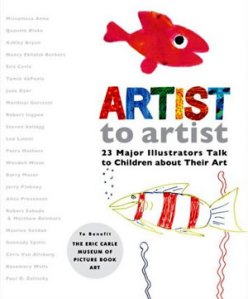 Today is my first official day at work for 2012. Both kids are in school and I’m sitting in the library’s teen section, where it’s typically quiet all day. The seniors stay out of here and the children’s library (with the occasional screaming toddler)–is tucked away downstairs.
But I need a little help getting motivated again. And it’s not just because they moved my favorite table away from the window. I’ve been hanging out in my jammies for two weeks! It’s tough to get moving again when you’ve gotten used to being stuffed in rainbow flannel.
Maybe you need motivation, too. Well, you’re in luck. I roamed the stacks when I first got here and found the lovely “Artist to Artist”, a collection of children’s illustrators talking to children about their art. And here are some get-up-and-go gems I found inside:
“When people look at my work, they often say, ‘Your picture is so good. I can’t even draw a straight line.’ I think everyone can learn to draw. The important thing is to keep trying, keep drawing.” ~ Alice Provensen
“If I have an unusual gift, it’s not that I draw particularly better than other people—I’ve never fooled myself about that. Rather it’s that I remember things other people don’t recall: the sounds and feelings and images—the emotional quality—of particular moments in childhood. Happily an essential part of myself—my dreaming life—still lives in the light of childhood.” ~ Maurice Sendak
“The most important thing in the whole of life is to love what you do. If you want to be an artist, don’t draw from movies and television. That’s something someone else has already imagined. Draw from your life. Draw all the time. Expect to be different from other kids, because if you are an artist, you are different. Sometimes it’s hard to be different. Sometimes it hurts when people don’t understand you or laugh at you for not being cool enough, but stay the course. Believe in yourself. Believe in the paintings and drawings that come out of your mind and your hand.” ~ Rosemary Wells
“Your ability to see and respond sensitively to the beauty of the world around you will, in turn, be transformed into the ability to create art that other people will find to be beautiful. As long as you have this visual sensitivity, you will discover that the actual techniques you need for drawing good pictures are very easy to find. They are within you.” ~ Mitsumasa Anno
“Making pictures is how I express my truest feelings, my truest self.” ~Eric Carle
“In our earliest years there’s no how? to our plunge into art. The doing gives the answer. There is no one way. Your work is original and there is no end to the adventure…HURRAH!” ~Ashley Bryan
So get moving, friends. Keep doing what you’re doing. There’s joy for you and joy for the children who read and view your work. Joy to the world!





 Writing for Kids (While Raising Them)