You are currently browsing the category archive for the ‘Picture Books’ category.
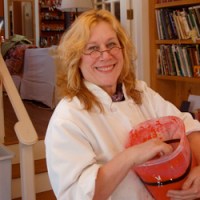 Author-illustrator Denise Fleming gave the keynote at the NJ-SCBWI conference a few years ago and she said something that has stuck with me: “My internal age is five. So I make books for five-year-olds like me.”
I had an ah-ha moment, complete with a hovering lightbulb. I’m eight, I thought. No wonder I write what I do.
Denise’s newest book was recently released, and if you’re familiar with her work, it looks a little different. I learned that Denise has changed up her style. So, of course, I wanted to chat about it.
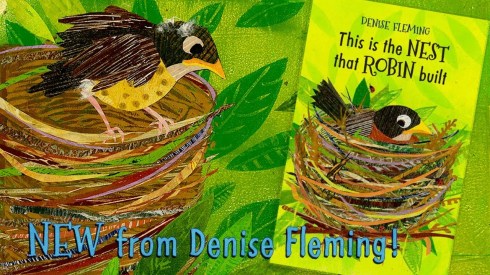
Denise, you are well known for your innovative illustrations created with paper pulp. THIS IS THE NEST THAT ROBIN BUILT looks a little different—still gorgeous and unique—but I understand you decided to reinvent your style with this book. Why did you feel the need to change up your technique?
I have been illustrating my books with pulp painting for over 25 years. While I love paper making, I felt it was time for a change for several reasons. The small company where I bought my pulp had changed hands and the new pulp was causing me problems. The board I used for stencils was no longer available. I had tried substitutes but none worked as well for detail and some were difficult to cut. Then, there were the hours of standing bent over the paper vat which was affecting my health. These were all a part of my decision to experiment with new techniques.
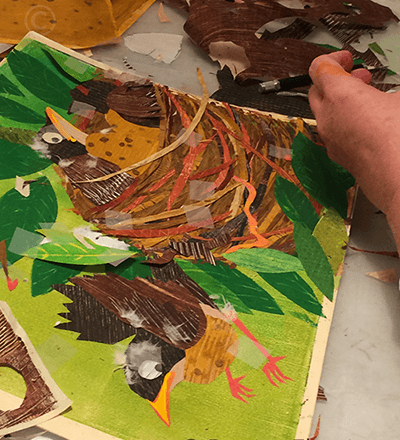
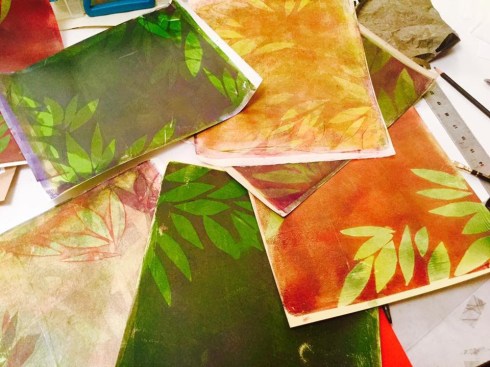
Gelatin printing and foam printing along with collage were the techniques that really interested me. These provided more freedom and the ability to create more detail, which is difficult with paper making. I also felt I needed a bit of reinvention. I have been around for a long time, I wanted readers to take a second look at my art. I am fascinated with printmaking. Before I created books I studied printmaking, mostly etching, lithos and mono-prints. I am excited to try new styles and techniques in upcoming books.

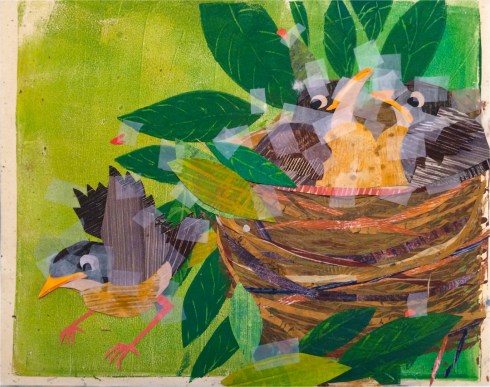
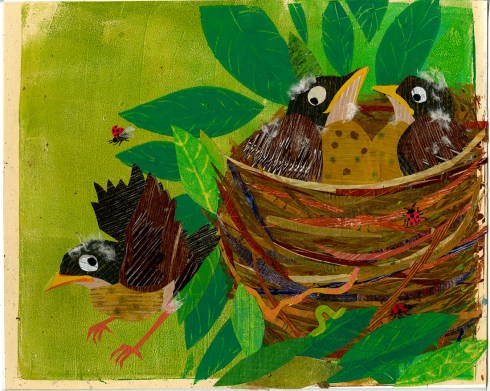
How does this new style contribute to and enhance this story?
With the new style I am able to create more detail in the illustrations. Printing the background and collaging the foreground gives the feeling of more depth. I also am able to make papers with the textures of feathers and grasses which enhances the art and adds a feel of realism.
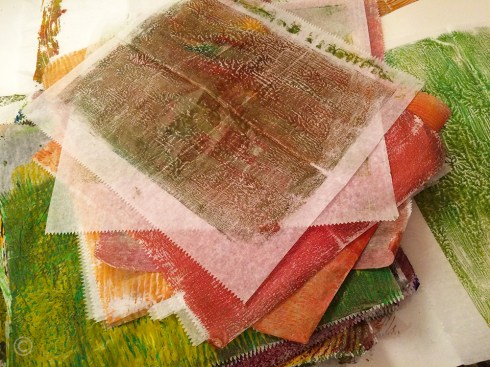
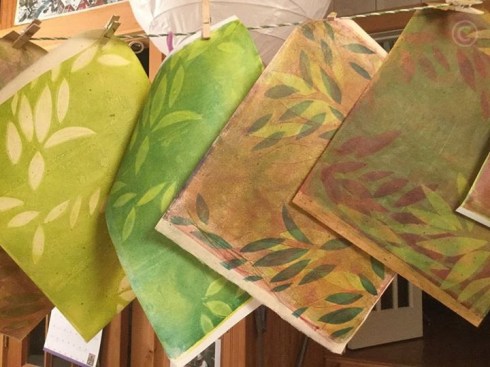
Has your new style given rise to ideas for books you would have never thought of before?
Actually, I will be experimenting with several new styles in upcoming books. And yes, these new styles will allow me to more ably illustrate several manuscripts I had put in the back of my file due to the fact that I couldn’t figure out how to illustrate them in my pulp painting technique. People are difficult to do in pulp painting. Up until this point I have illustrated people as large graphic shapes. Hands and fingers were stressful as the pulp would fill in spaces between figures. Ugh. So maybe more figures and details in upcoming books. And maybe even white space.
Can you tell us about any upcoming projects?
As to future books, I have been on a sort of sabbatical. Working out how I want books to look. Manuscripts have not been submitted, so I would rather not reveal any of the books until they are under contract. But, I will let you know about them as soon as I send them out and am offered contracts. I agent myself, so I have to give myself a push. Unfortunately, I love experimenting, so I am slow to get back to the business of books.
If I were to edit your reply, I would delete “unfortunately”. Readers are lucky that you keep innovating and creating even more beautiful art!
THIS IS THE NEST THAT ROBIN BUILT is available now from Beach Lane Books.
You can win a copy here by leaving a comment below. A winner will be randomly selected in a couple weeks.
Good luck!
by Nancy Viau
Hey there, readers of this wonderful blog!
Betcha can’t wait for hot, hot summer days, right? I know I’m looking forward to lots of sunshine and NO SNOW!
WAIT.
A.
MINUTE!
I canNOT say that because I am all about snow these days. The reason? In September, my fourth picture book makes its way into the world, and it’s called FIRST SNOW (Albert Whitman & Co.). So, put on your clunky boots and funky hats, think chilly thoughts … instead of OMG, it’s summer and it’s ridiculously hot, and please check out:

What does this cover reveal about the book? Simple. Snow. Is. Fun! If you’re an adult, do you remember the hours spent building igloos, having snowball fights, sledding, and that feeling of cozy warmth from a cup of hot chocolate? (Yeah, I know, dear grown-ups, you’ve gotta put aside the snow shoveling, buried cars, bad roads, etc. for a minute. I haven’t forgotten about you. When the book comes out, look at my funny dedication!)
As with my other picture books, this story is written in rhyme. Before I even thought about being a writer, I loved to read rhyming books. The words seemed to roll off my tongue, yet I never really understood why until I tried my hand at rhyme. It was much harder than I ever imagined! With rhyme, there is so much to consider—the rhyming words, internal rhyme, meter, length of phrases, length of stanzas, vocabulary, and more. Still, I love it. I love that every single word counts. It often takes me weeks to find that perfect word—the one that fits for all the right reasons. When that happens, it’s magical, trust me. If you write in rhyme, you know exactly what I’m talking about!
As far as finding a topic for a rhyming picture book, nature has always been my inspiration. I enjoy every season and the weather that comes with each one—warm, breezy, rainy, super-hot and humid, or freezing cold. While some may grumble, growl, and complain about a pending snowstorm, I’m a little kid again. There is something about the crunch of snow under my feet; its clean smell; that blanket of white; the cheery voices of children playing; and at night, the quiet peacefulness it brings.
Puffy jackets. Scarves in place.
Extra mittens, just in case.

In FIRST SNOW, you’ll see the kids scramble to see those first snowflakes, then head outside for adventure. Illustrator Talitha Shipman has done an amazing job of showing how beautiful snow is. (It’s not easy to paint white snow on white paper, right?) The colors she has chosen are varied and bright, and the expressions on the kids’ faces are priceless. Seeing how an illustrator works with my words is one of my favorite things about writing picture books.
So, next winter when meteorologists predict a big winter storm, I hope you’ll curl up with a copy of FIRST SNOW and think back to a time when snow meant serious, crazy fun. Then bundle up and go out and play!
Nancy Viau is the author of five picture books: PRUETT AND SOO (Two Lions, TBA), FIRST SNOW (Albert Whitman), CITY STREET BEAT (Albert Whitman), LOOK WHAT I CAN DO! (Abrams Books), and STORM SONG (Two Lions). She also writes middle grade and has several published with more forthcoming. Look for her latest, BEAUTY AND BERNICE, at the end of August! During the summer Nancy works as a librarian assistant at a public library and is the first to check out the travel books, searching for adventures out-of-state and out of the country. It’s in nature where she finds inspiration and whether it’s navigating mountain trails or riding her bike, she’s always writing stories in her head. Visit her at NancyViau.com.
Nancy is giving away a signed copy of FIRST SNOW in September. Comment now to be entered into the random drawing. A winner will be selected…on the first day of summer…? (Oh, the irony.)
Good luck!
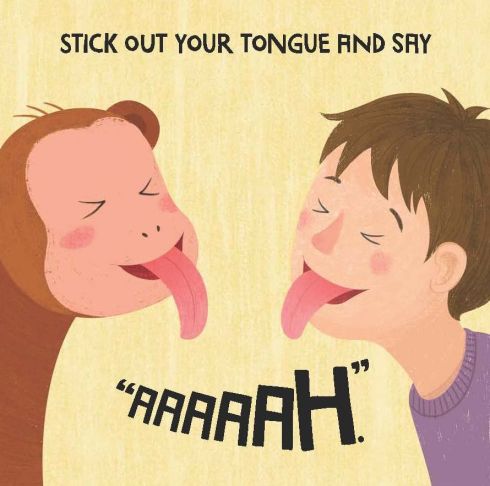
Cat got your tongue? I hope not! It’s time to stick out your tongue and celebrate all things tongue with a TERRIFIC TONGUES book giveaway, and a trip off the tongue thanks to Tara for helping feature it here!
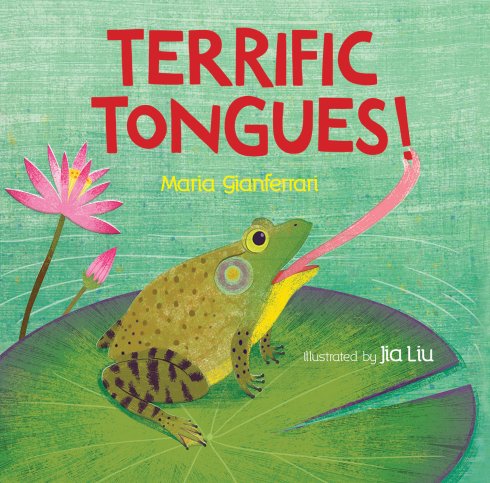
Tongues rule!! So does Jia Liu’s fun and vibrant art!

How cool are tongues? Take this quiz and find out!
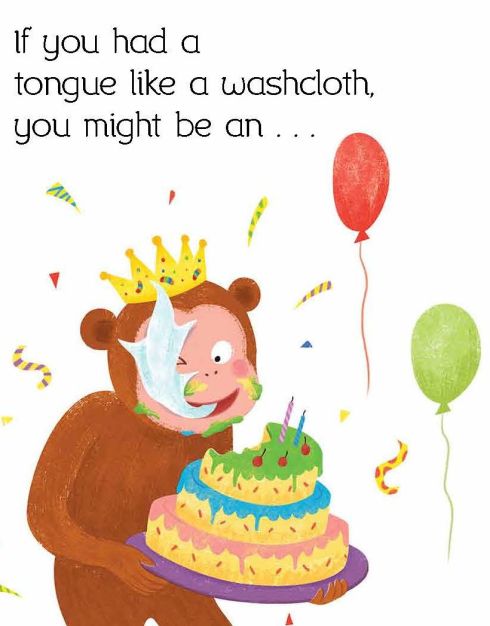
Whose tongue is like a washcloth?
A) Giraffe
B) Okapi
C) Tiger
If you had a tongue like a whip, you might be a …..
A) Snake
B) Dog
C) Anteater

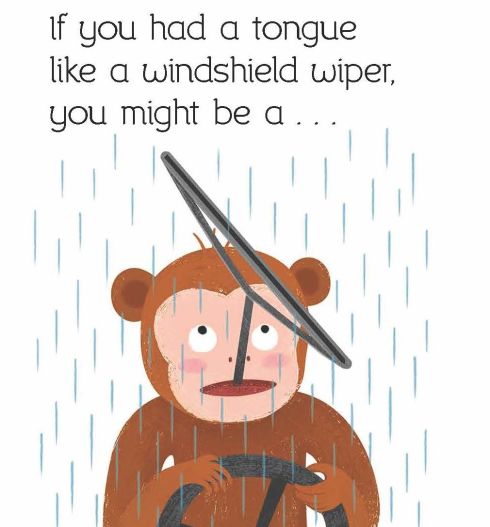
Your tongue cleans your eyes like a windshield wiper. Who are you?
A) A gecko
B) A snail
C) A sea turtle
Answer in the comments and you’ll be eligible to win a copy of the book (for US residents only—sorry!).
To check your answers, read TERRIFIC TONGUES!
Thanks again, Tara & hearty thanks to publisher Boyds Mills Press for generously donating copies!
 by
by I’ve worn a number of hats in my career—and for the most part I have always had at least two hats on at once.
Now, I’m a children’s author who is celebrating her picture book debut, CHICKEN WANTS NAP, and a Literary Agent at BookEnds Literary representing fiction, non-fiction and illustration for children and teens.
But I’ve also been a newspaper correspondent, a children’s book reviewer, a freelance copywriter, a literary agents assistant, a freelance editor and a communications manager. (Well, and a pharmacy tech—which has nothing to do with this post—and very, very briefly an assistant at a wedding dress preservationist’s—which is the only job I’ve ever been let go from. I was relieved.)
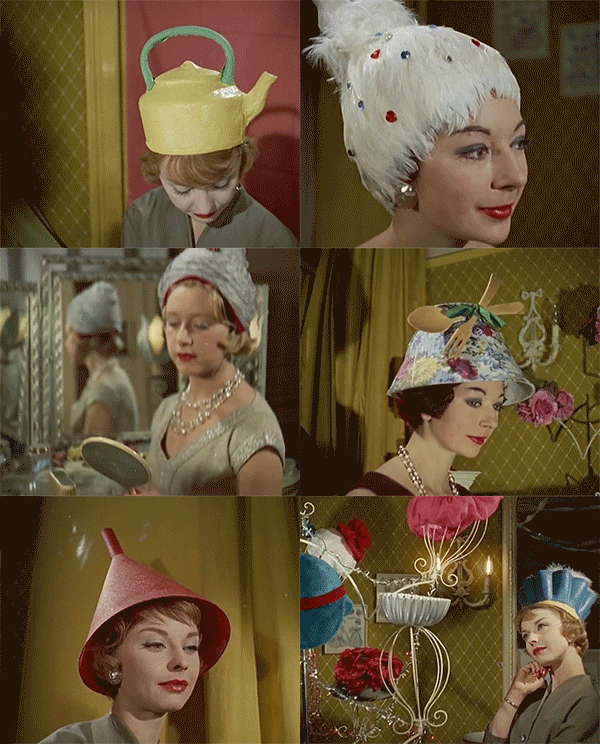
Anyway, so many of these hats forced me to learn to write in a different way. Feature pieces vs. event wrap ups, editorial letters vs. pitch letters, book reviews vs. press releases—everything had a different format or tone, but there was also a lot of overlap. Ultimately, I think all of the above experience helped me with my writing and agenting career, and I hope that some of the below helps you too!
Character
I would get my newspaper assignments on Friday, do interviews and write the story over the weekend, and submit on Sunday so it’d be in my editor’s inbox by the Monday deadline. (Monday I’d be commuting to work as a literary assistant.)
My favorite pieces to write were feature pieces that honored another person’s life. People were generally so happy to talk about this person that they loved or admired, even though we’re all flawed, and I usually left the interviews feeling pretty inspired. I also felt like there was a little more room for creativity in a feature piece. A good features makes the reader feel like they’ve met the person, too.
Looking back on feature writing makes me think about a character exercise that I was once assigned in undergrad. The exercise says to pick a person you know and write about them as they would write about themselves. Then write about them through the eyes of someone that hated them. Then again through the eyes of someone that loved them. You have three different people on the page—or four, right? Because the primary subject is actually probably closer to a culmination of those three pieces than any one particular view—and I think that’s why the exercise can be so helpful when you’re struggling with rounding out your characters. Remember, even antagonists think they’re the hero of the story.
Hook
 Book reviews, newspaper pieces, pitch letters, press releases, copywriting—all of it relied on being able to find a hook that was going to grab a reader and make them want to read more, attend the event, buy the book, click a link, etc.
As an author, particularly as a picture book author, you have to be thinking about what is going to make your story stand out on the shelves or in the submissions pile.
That said, your hook is not the plot summary. For example, I’ve pitched CHICKEN WANTS A NAP as “Remy Charlip’s Fortunately set in the barnyard,” but that’s not the summary.
One exercise I’ve done with friends when they’re having trouble with finding a strong concept for their own WIPs is to go through the bookstore or their own shelves, pull out and read a picture book, then find a hook. For example, DUCKS’S VACATION is THERE’S A MONSTER AT THE END OF THIS BOOK set on the beach. NUT JOB is “Ocean’s 11” with squirrels. Or, if I were to pitch a book without a comparison, I might say something like HOORAY FOR FISH is a fun and heartwarming celebration of a fish’s love for their mom.
Once you’ve had practice with some books on the shelves, tell your friend the hook for your WIP. If it’s a plot summary, your friend should make you try again. And if you can’t find the hook for your WIP—that thing that’s going to make it stand out from all the other queries/manuscripts in an agent or editor’s inbox—then perhaps it’s time to take another look at your WIP’s concept.
In truth, you might not use this hook in your query letter at all, but if you find that a common theme in your rejection letters is “not sure it can compete in the marketplace,” this is an excellent exercise to help punch up your concept!
Word Choice
 Almost everything I wrote had a standard structure and/or expected word count, be it a press release, feature story, book review, pitch letter or pieces for a social media campaign. Just like in a picture book text, EVERY WORD COUNTED. I had to be concise—looking for that one perfect word instead of two to four less precise words.
So take out your picture book WIP. Are you in the sweet spot (300 – 500 words for fiction*)? Does every word convey the exact meaning you intend? If you’re using repetition, is it done in a way that builds tension, humor or otherwise adds to the story? If you’re not sure about a word or line, delete it and then read the story aloud (or bring it to somebody else). Does the story lose anything? If not, then permanently delete that line, phrase or word.
*CHICKEN WANTS A NAP is 165 words, and my current WIP is 600. CHICKEN is a read-aloud for younger picture book readers and the story just did not need another 140 words. My WIP is for older picture book readers who are starting to read by themselves. So I guess I’m saying to use the words you need and not one word more!
Speaking of one word more, I had started a different draft of this post where I went through each job individually and it quickly became a novel. And as I’m hitting that point again, I think it’s best to close here. I hope that these tricks help you in your own writing, and if you have the time or opportunity to do some freelance writing in another format—I say, why not! You’ll exercise a different writing muscle, and I’ll bet it’ll improve your current children’s writing as well!
 Tracy Marchini is a Literary Agent at BookEnds Literary, where she represents fiction, non-fiction and illustration for children and teens. She’s thrilled to represent a list of debut and award-winning authors and illustrators, and is currently open to submissions. To get a sense of what she’s looking for, you can follow her Twitter #MSWL, see her announced client books, and read her submission guidelines.
As an author, her debut picture book, CHICKEN WANTS A NAP, was called “A surprising gem” in a starred review from Kirkus. She’s been accepted for publication in Highlights Magazine and has won grants from the Highlights Foundation, the Puffin Foundation and La Muse Writer’s Retreat in Southern France. She holds an M.F.A. in Writing for Children and a B.A. in English, concentration in Rhetoric.
Tracey is giving away a signed copy of CHICKEN WANTS A NAP.
Leave one comment below to enter and a winner will be chosen next week.
Good luck!
Designing a picture book cover is like housetraining a puppy: it requires lots of patience, there are papers spread all over the house, and it’ll inevitably lead to fits of howling in the middle of the night.
But if you can sniff out the good ideas and clean up your happy accidents, you’ll hopefully wind up with something you’re proud to cuddle up with on the couch.
When I wrangle my picture book covers, I try to explore as many different ideas as possible. I start by sketching a few pages crazy loose brainstormy concepts, and then distill those into half a dozen thumbnail sketches.
I draw my thumbnail sketches at about 1.5″ tall. It forces me to work quickly, make big, bold shapes, and to _not_ get fussy with details. I think it’s best to work in b/w at this point; we can save the color decisions for later.
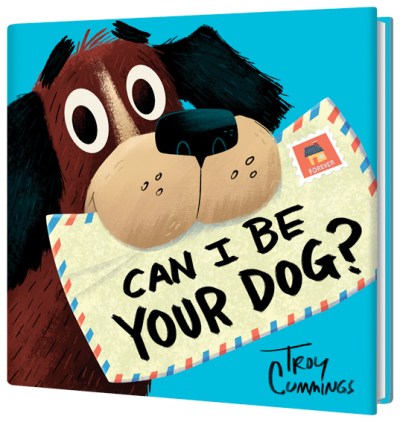
Here are the cover sketches I submitted to my editor/art director for CAN I BE YOUR DOG? It’s a story about a dog who writes letters to every house on Butternut street, in search of a home–so I knew I’d want the cover to involve DOG + MAIL.
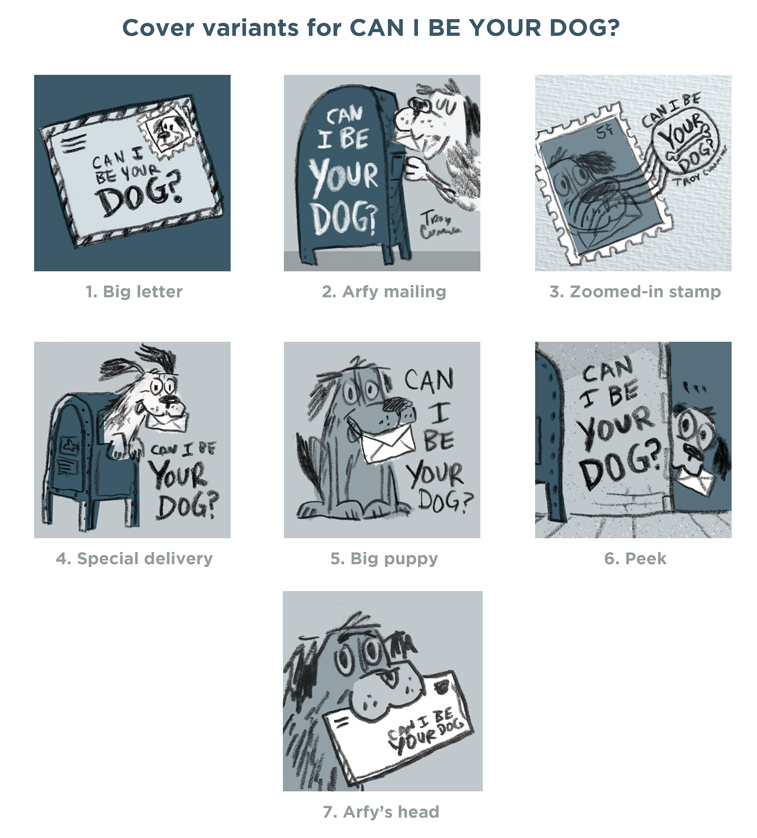
DVD COMMENTARY TRACK ON THE ABOVE IMAGES:
1. Big letter: This would have been a pretty static/boring cover; the puppy is too small! But I kept it here in case it gave us more ideas for another direction to follow.
2. Arfy mailing: I like how this one shows us the dog actually sending a letter. It’s sort of already getting the story started—like a bonus page zero of the book!
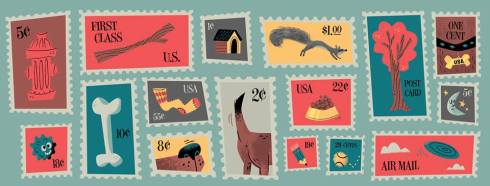
3. Zoomed-in stamp: I was trying to show the title in a cancellation stamp, but it’s too hard to read. (I ended up stealing this idea for my ABOUT THE AUTHOR photo on the flap. (With my portrait on a 3RD CLASS STAMP.)
4. Special delivery: I liked this one, especially Arfy’s floppy ears.
5. Big puppy: We ended up using this one as flap art, too.
6. Peek: I liked the timidness of the puppy peeking around the corner; we ended up using a variant of this on the back cover.
7. Arfy’s head: This was everyone’s favorite. The scruffy mutt is prominently featured, and it was nice to work the title into the illustration.
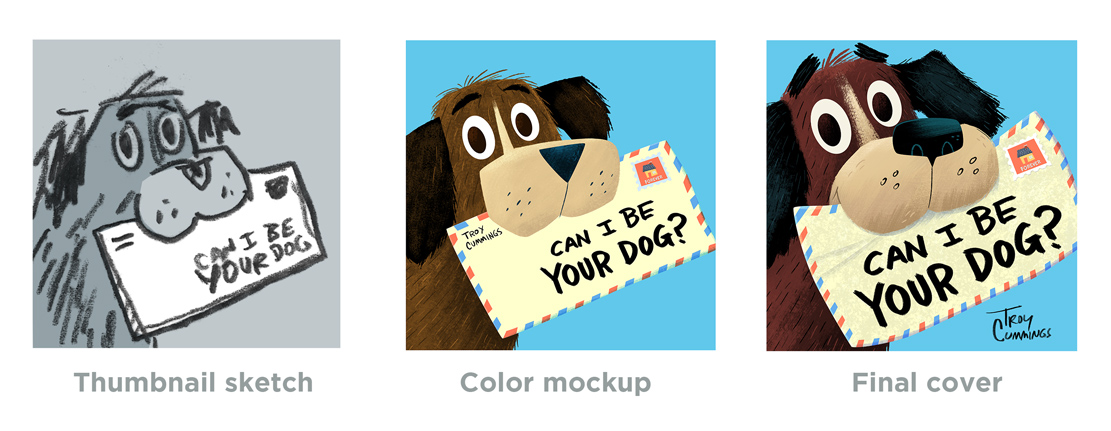
Once we’d agreed on a direction, my art director Liz (who rocks!) was able to take my sketch and improve it like crazy. Liz zoomed in on the image, made the title bolder, suggested to bend the letter, and moved my byline out to the background space. I loved all of her suggestions, and we ended up with a jacket that reads pretty well across the room or as a tiny thumbnail image on the web.
The best part about sketching multiple ideas is that none of that work was wasted. I was able to reuse some of my sketches on the flaps/interiors of the book, or for promotional materials.
Troy Cummings is the author/illustrator of more than 30 books, including CAN I BE YOUR DOG?, THE NOTEBOOK OF DOOM, and LITTLE RED GLIDING HOOD (written by the indefatigable Tara Lazar!) You can follow him on Twitter @troycummings, follow him on Instagram @troxcummings, or follow him to the new ice cream shop that opened next door to his studio. (Shrewd move on their part!)
Troy is giving away a signed copy of CAN I BE YOUR DOG?
Leave one comment below to enter. A winner will be selected next week.
 by Tara Luebbe
Today I’d like to jump into a time machine and beam forward to February 1. You have followed the brilliant advice of my fellow authors and have some great new ideas. Now let’s talk about that next vital step…
Last fall, Tara (Lazar) and I discussed how we often see writers spending too much time polishing, revising, and perfecting a manuscript that, frankly, is not a good idea to begin with. It doesn’t matter how beautiful your prose is or how much you polish every word. If it is not a marketable or unique idea, it won’t sell. So how do you take your Storystorm ideas and assess them for marketability and selling potential?
I’ve been given a gift like the kid in The Sixth Sense, but instead of dead people, I see marketability. My gift was honed through working retail; from the sales floor to the buying offices of big retailers, to wholesale distribution, and finally to owning a book and toy boutique. Buying and selling picture books gave me an astute understanding of what works…and what doesn’t.
In your eyes, your book is your baby, your masterpiece, your blood, sweat and tears, your soul. And yes, it IS all of those. But to the retail world, your book is a product, a SKU—inventory to be turned. Is your idea strong enough to be crafted into a sellable product? I don’t draft an idea into a manuscript unless I can envision the sales pitch. Not everything I write sells, of course—far from it. But I start with an idea that I am confident has marketability, and that is half the battle.
Not every published book falls into the parameters I suggest below. But, when I was trying so hard to break into the industry, writing marketable picture books was my golden ticket. If it is an approach you’d like to try, here are my recommendations to evaluate your ideas for marketability:
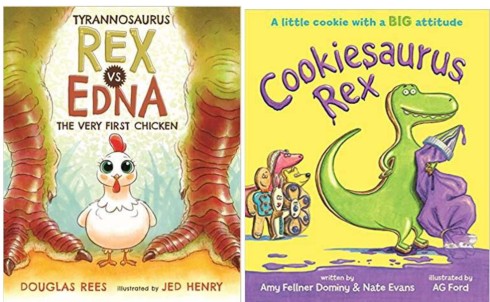
- One obvious place to start is your topic. Does your book have a topic that kids actually like? You would not design any other product that doesn’t appeal to the target market, and books are no different. Can you imagine Pottery Barn trying to sell plastic lawn ornaments or Chia Pets? But yet, a lot of people write about topics that aren’t very interesting to the target market—kids. Kids like trucks, dinos, outer space, ninjas, princesses, pirates, cupcakes, art, monsters, animals, fairy tales, tutus, dance, etc. Popular topics make a book more marketable. BUT, this also means you need to research to make sure your story is DIFFERENT than existing books on your topic, or this won’t matter at all. (Tara Lazar has a brilliant list of 500+ things kids like in case you need help.
These books were recent favorites and are perfect examples of popular subject matters handled in fresh, new ways.
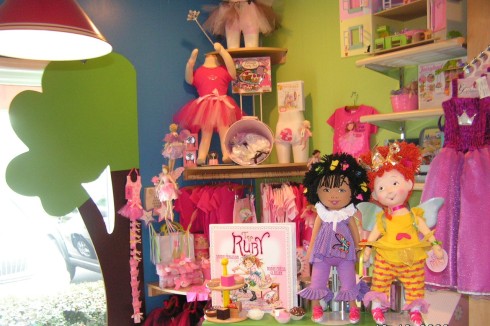
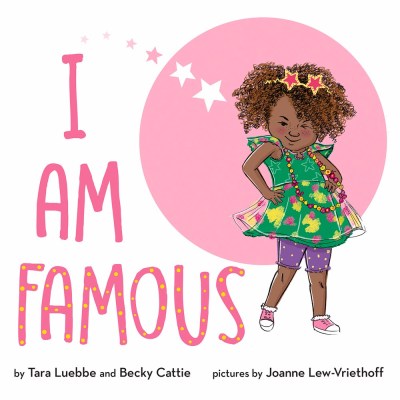
- Walk into a children’s toy store or boutique with your manuscript. Look around. If you had to merchandise your product (book) in this store (not on a bookshelf, but with toys and merchandise), where would you put it? Does it have an obvious place? This is a picture from my former store. There were lots of books that I could merchandise in my “pink, fairy, tea party, ballerina” section. My upcoming book, I AM FAMOUS, would have fit in here, right next to Nancy and Bree. If you can’t see an obvious place for Grandma’s Childhood Tales of Eating Vegetables, you might want to rethink it.
- Think of the changing front table displays at any gift retailer. Does your idea fit one of the themes that rotate throughout the year? The major holidays? The minor holidays? Back to school? Fall? Winter? Spring? Summer? Graduation season? Beach season? Snow season? Your book does not have to be a “holiday book” to be included here. Bunnies and chicks are associated with Easter; monsters, bats, or zombies can fit in with Halloween; love stories for Valentine’s Day, etc. When a retailer needs to create a themed front window or table display, can your “product” be included? Make a list of the holidays and themes that might work.
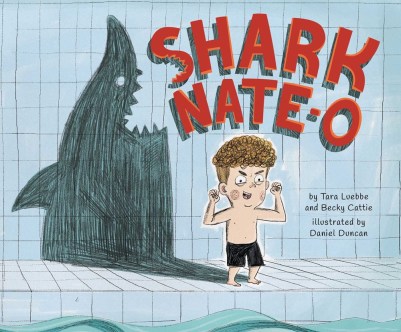
- Are there any specialty retail stores you can envision your book fitting into? Does it belong in a zoo gift shop? An aquarium? The National Park gift stores? Pet boutiques? Pregnancy boutiques? Hobby stores? Museum gift shops? Educational or teacher stores? Craft stores? Cat stores? Specialty catalogs? Besides a bookstore, where else would your book fit seamlessly on the shelf? My book SHARK NATE-O is perfect for aquarium gift shops, and, in fact, we added non-fiction backmatter to make it even more attractive to this group. Bookstores are our bread and butter, but adding specialty retailers to your marketability factor is extremely helpful for sales. Make a list and see what you get.
- Are there any special interest groups that would love this book? Scientists? Bilingual households? Families expecting a sibling? Military families? Pet adoption advocates? Marine biologists? Cryptozoologists? Potty trainers? Sloth aficionados? Flat earthers? Cosplayers? Teachers and librarians? Slot car racers? Grandparents? Yarn bombers? These subsets all are a part of the book’s marketability. I believe my forthcoming book, CONAN THE LIBRARIAN, may really resonate with teachers and librarians because of the literary message. Any marketing plan for your book should include these special interest groups.
- Are there any special occasions or events that would tie in with your idea? Consider major events like the Olympics, Shark Week, a presidential election and Earth Day. Also think of regional events, like the Indianapolis 500, the Kentucky Derby, the Moose Poop Drop, the Polar Bear Plunge, etc. What about anniversaries of historical events? Black History Month? School celebrations like Poem in Your Pocket Day? The 100th day of School? The first day of school? Make a list. SHARK NATE-O is ready for Shark Week!
- And the last great piece of marketability: a high-concept title. A high-concept title is one that tells a buyer what the book is about by title alone. A great title allows a book to be placed on a pallet in the middle of Costco, with no pretty merchandising and no sales help, and sell itself. As a retail buyer, I immediately get a sense of a book just by looking at the title and cover in a sales rep’s catalog. Can you give your manuscript a high-concept title?
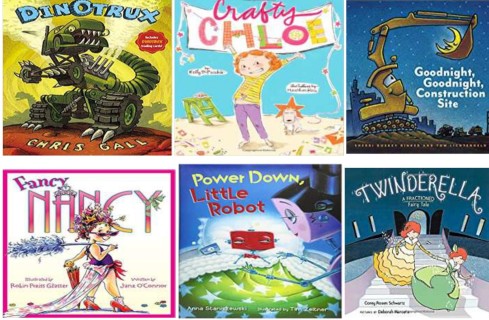
I hope you find something in this post helpful as you sit down with your list of shiny new Storystorm ideas. While reviewing them, run each through the above checklist. Maybe one idea will jump off the page as an obvious place to start. Or maybe two ideas can be combined into something more marketable for an editor or agent. Oh, and watch Shark Tank if you don’t already—it’s brilliant for understanding marketability.
Tara Luebbe is an ex-retailer turned picture book author. She co-writes with her sister Becky Cattie. They are the authors of the forthcoming I AM FAMOUS, illustrated by Joanne Lew Vreithoff, (Albert Whitman March 1, 2018); SHARK NATE-O, illustrated by Daniel Duncan, (little bee books April 3, 2018); I USED TO BE FAMOUS, illustrated by Joanne Lew Vreithoff (Albert Whitman Spring 2019); and CONAN THE LIBRARIAN (Roaring Brook Press Spring 2019). She is also the founder of Writing with the Stars, a free mentorship program for aspiring picture book writers. You can learn more at beckytarabooks.com and you can find her on Twitter @t_luebbe.

To keep it all about retail, Tara (Luebbe) is donating a $20.00 gift certificate to Chapters, an Indie bookstore in Seward, Nebraska, for one lucky winner to buy whatever they like. The winner will also receive a signed copy of I AM FAMOUS upon release on March 1.
Leave ONE COMMENT on this blog post to enter. You are eligible to win if you are a registered Storystorm participant and you have commented once below. Prizes will be given away at the conclusion of the event.
Good luck!
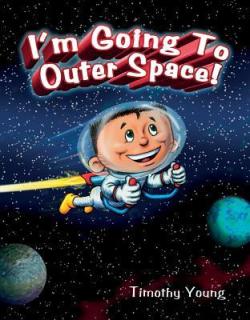
In my new book I’M GOING TO OUTER SPACE! I tell the story of a boy named Luis who tells us all about the exciting things he wants to do and see when he gets to outer space. I was inspired to write this book as an homage to all of the science fiction I’ve loved since I was young. I remember watching old B&W films like “This Island Earth” and “Invaders From Mars” on television and cartoons like “The Jetsons”. As I got older I would read books by Isaac Asimov, Ray Bradbury and Robert Heinlein and watch “Lost In Space” and “Star Trek”. I was already an avid sci-fi fan when “Star Wars” came out and my love for Science Fiction only grew further and continues to this day.
When I started to flesh out the illustrations for my story I decided to pay homage to the entire genre. I have a spread with spaceships from the 1930’s to now. I have a page of robots that I challenge any sci-fi fan to name them all. They are from movies, television, comics and even other picture books.
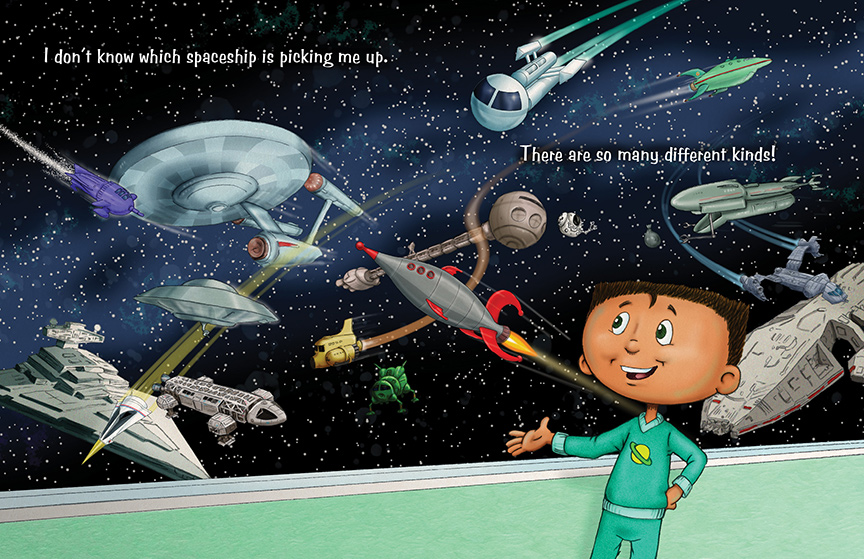
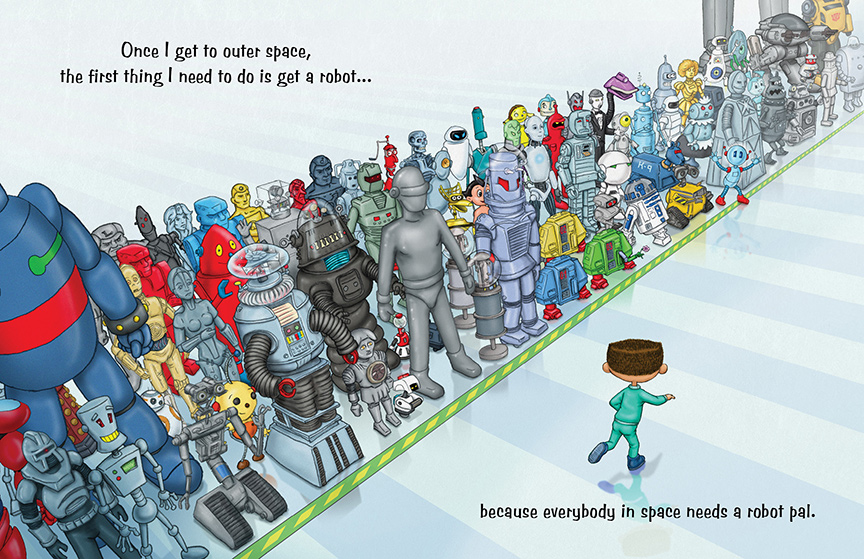
When it came time to draw aliens, I realized I had a problem. I love designing aliens, it’s one of my favorite things to draw. But I also wanted to have some classic aliens as I had done with the spaceships and robots. I decided to have one spread with recognizable aliens that kids and parents will have fun figuring out who they all are. For the rest of the book I put my own original creations designed just for this book…all except one.
Back when I was just out of college I was hired by a friend who was an art director at Doubleday Books. They needed an illustration of an alien artist. At the time I was creating sculptural illustrations, 3D models that were photographed for print.
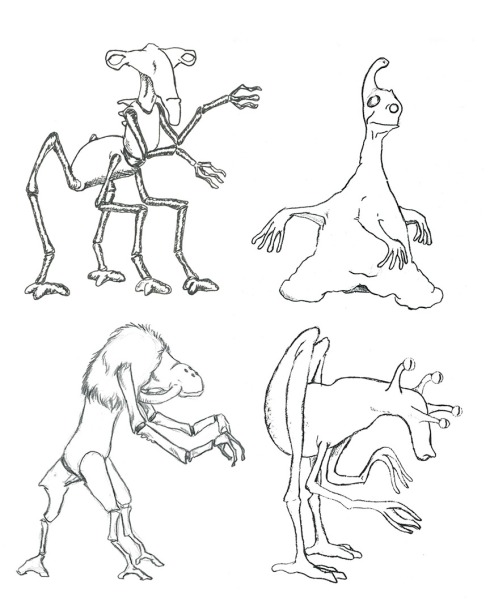
I created a number of sketches for the alien and when one was picked I sketched the final scene. I then sculpted the character and built his props; the easel, canvas and box of paints he uses. Another artist built the landscape and a sky backdrop was rented.
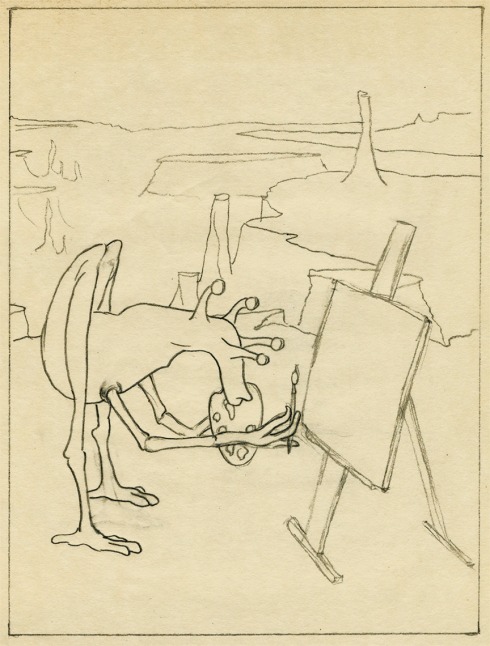
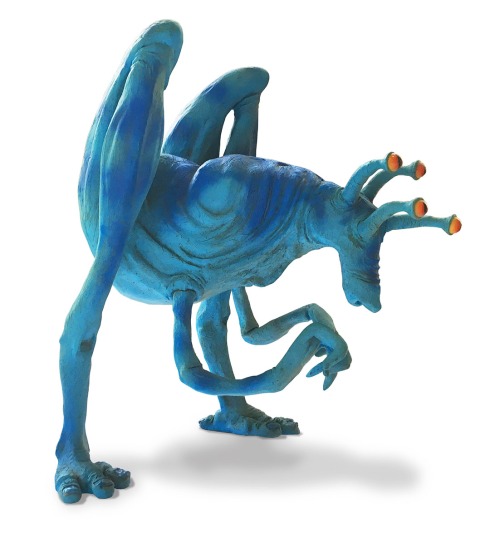
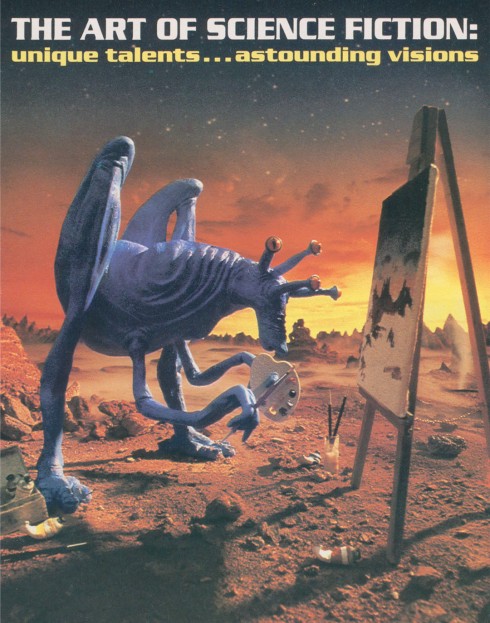
Everything was brought together at a photographers studio in lower Manhattan and the photograph was then used as the cover of a catalog of Science Fiction Art Books.
So when I started drawing aliens for I’M GOING TO OUTER SPACE! I decided to include my first alien from one of my first professional illustration jobs. He appears a few times in the book including this spread with a bunch of his friends.
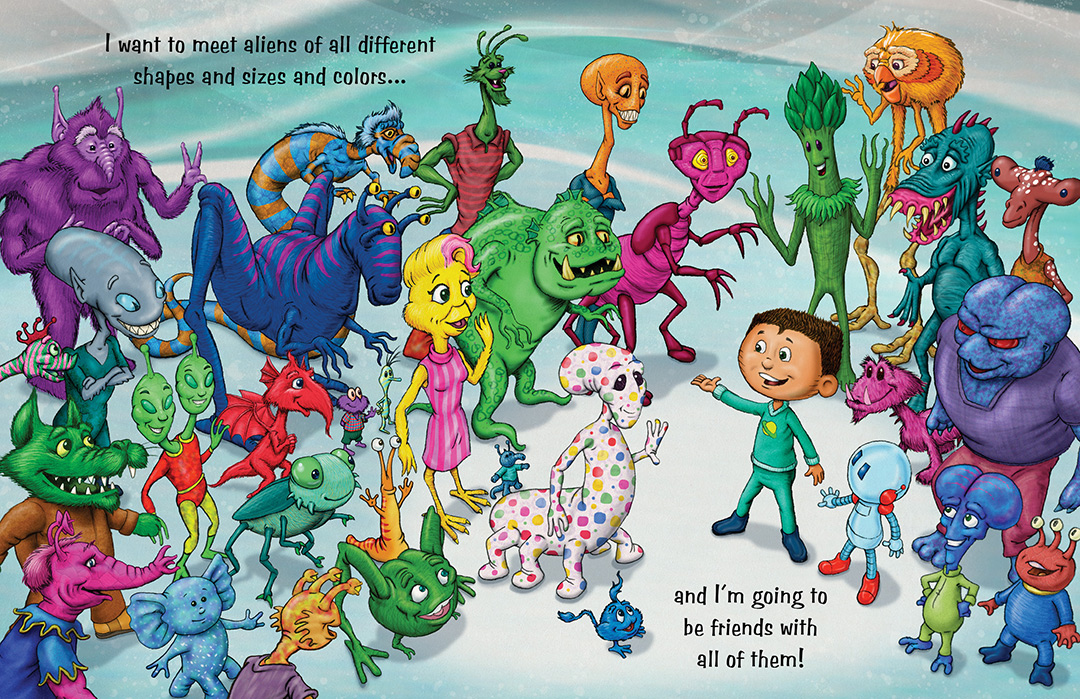
I’M GOING TO OUTER SPACE! released just a few days ago…on December 15, 2017 from Schiffer Publishing.
Thanks, Tim! This was like time-traveling through outer space!
You can go to outer space, too, because Tim is giving away a signed copy of I’M GOING TO OUTER SPACE…THIS WEEK.
Leave one comment below to enter! And good luck!

Boy, I am buried in prizes to give away! I’ve opened Random.org to help me select them all, so let’s get started…
Winner of an original sketch by IF MY LOVE WERE A FIRE TRUCK’s Jeff Mack:
Katie Giorgio
Winner of BONAPARTE FALLS APART by Margery Cuyler:
Tracy Abell
Winner of FORT BUILDING TIME by Megan Wagner Lloyd:
Tiffany Dickinson
Winner of Lori Alexander’s FAMOUSLY PHOEBE Prize Pack:
Ashley Bankhead
Winner of A COOKED UP FAIRYTALE by Penny Parker Klostermann:
Sandi Lawson
Winner of TRUCK, TRUCK, GOOSE by Tammi Sauer:
Sharon Coffey
Winner of MASTERPIECE MIX by Roxie Munro:
Julie Lacombe
Winner of HELLO GOODBYE DOG by Maria Gianferrari:
Sheri Dillard
Winner of SHARK LADY by Jess Keating:
Lauren Kerstein
Winner of RACE! by Sue Fliess:
Alicia Minor
Congratulations to all the winners…and be on the lookout for an email from me.
Next up, I’m busy planning the STORYSTORM idea challenge for January.
Registration will go live the last week in December right here on this blog…and remain open through the first week in January.
I’ve already confirmed the following guest bloggers for January:
- Doreen Cronin
- Heidi Stemple
- Alicia Padron
- Jarrett Lerner
- Annie Silvestro
- Robin Newman
- Corey Rosen Schwartz
- Kate Dopirak & Mary Peterson
- Miranda & Baptiste Paul
Many more to come. I’m putting on my big girl pants and getting organized…which is not easy for me…I think messes are bestest for my creativity. (Didn’t mean to rhyme, but hey, let’s go with it.)

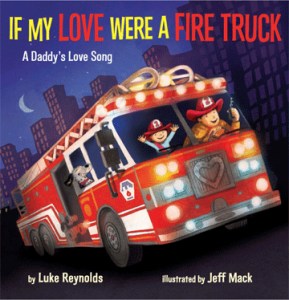
Today IF MY LOVE WERE A FIRE TRUCK illustrator Jeff Mack takes us on a whirlwind ride through his creation process.
Jeff, when you first read a manuscript, how do you begin generating the style and vision of what the art will look like?
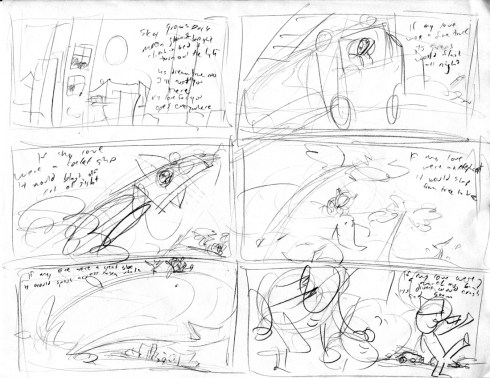
I start by making some really rough scribbles on the paper. I don’t think too hard about it. I just sketch whatever first comes to my mind. The sketches suggest the general shapes of the things in the picture because, at that point, I have only a vague idea of what the picture might look like. Some of the scribbly marks may serendipitously give me ideas for details that I didn’t think of at first. So I stay open to those possibilities as I redraw the picture over and over. Then I start adding a range of values in black and white.


For FIRE TRUCK, I used a combination of watercolor, cut paper, and digital to get the style I wanted. So my next step was to create the characters in watercolor and cut paper. Then using my computer, I added the background colors. On some of the pages, such as the lion image, the cut paper really stands out. On other pages, like the dragon image, I used the computer to blur the edges a bit.
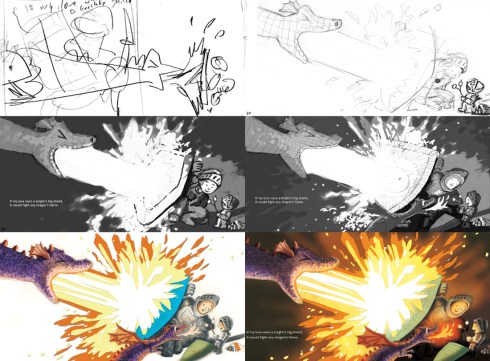
FIRE TRUCK went through many versions in the sketch stage. For instance, I considered animating each of the vehicles that the characters rode on. I also created a version that included lots of different fathers with both sons and daughters. But, in the end, I decided that one father and one son was the best way to lead the reader through the story.
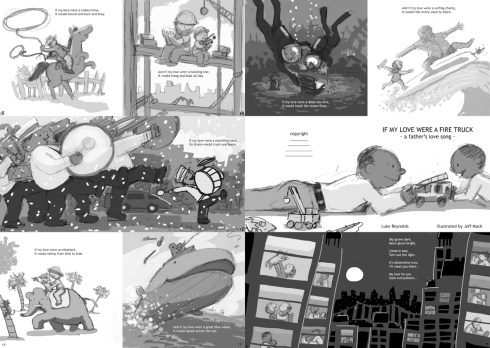
For IF MY LOVE WERE A FIRE TRUCK, you insert surprising moments of humor, such as the scene where the small dragon’s fire enables the young boy to toast his marshmallow. How do you arrive at funny additions like this?
One of the things that drew me to the story was how Luke Reynolds’ text leaves plenty of room for visual interpretation. In the best picture books, where the text and images support each other, leaving this kind of space for the illustrations this is the mark of a highly skilled and clever author. Overall, FIRE TRUCK has a perfect little story arc. At the same time, each of Luke’s rhymes suggests a story of its own. So when I was thinking about each image, I wondered what else could be going on in the scene. What details could I add to make the scene spin off into its own story? What will give the readers something extra fun to talk about? On the dragon page, it’s the marshmallows. On the elephant page, the monkey has swiped the dad’s watch and hat. On the whale page, they’ve hooked a giant blue whale from their tiny fishing boat.
How do you decide what projects to work on, and how long does it take for you to craft the art for an entire book?
I take on few stories by other authors because most of the time I’m working on projects I have written myself. So I have to really love a story to illustrate it. When I’m considering a manuscript, I ask myself “What job does this story do?” or “What important thing will this book add to a young reader’s life?” I ask the same questions of my own stories.
Here’s what I wrote to my editor at Doubleday, Frances Gilbert, about the FIRE TRUCK manuscript:
“Have I mentioned how much I love this book? When I took on the project, it was Luke’s clever, lyrical, emotionally rich poetry that sold me on it. I love that this is about fathers and sons expressing their feelings for each other. Too many guys grow up in our culture with pressure to be tough and to hide their emotions. Luke’s story encourages them to communicate their feelings starting at an early age. He’s given kids and parents something they can really share and connect over. And the wild range of vehicles and animals make it so much fun! I imagine some parents will get a little teary over the ending too.”
It takes me about a month to make the dummy. That’s the process of drawing and redrawing and re-redrawing the sketches. The finished color pictures usually take me between two to three months depending on the style and the amount of detail.
What do you hope readers remember from your artwork in FIRE TRUCK?
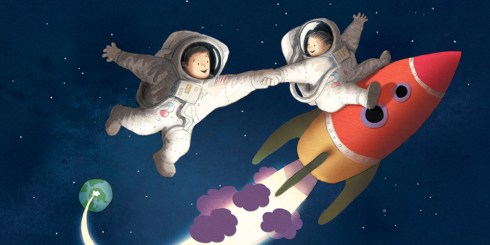
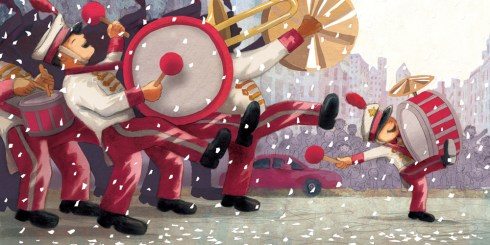
 When I was young, there were often odd little details that stuck with me about certain illustrations. For example, I loved the way H. A. Rey drew donuts in one of the Curious George books. Do I know why I became fixated on his donuts? I do nut. But I do know that I tried to draw donuts the same way. It got me practicing and working on my own drawing skills. So I guess I hope readers notice and remember some of the little details in the illustrations and that those might inspire them to make their own drawings. By the way, my three favorite images in FIRE TRUCK are the rocket page, the parade page, and the dragon page. But I’m sure readers will have their own favorites different from mine.

What’s your favorite snack while you work?
Coffee, Mint Chocolate Brownie Cliff Bars, more coffee, Skinny Pop popcorn, and then a lot more coffee.
Thanks for the fascinating inside look at your illustration process, Jeff!
Blog readers, leave one comment below for a chance to win an original sketch by Jeff Mack.
I’m overdue selecting winners for many giveaways, so I will announce them all next MONDAY, just in time to give as holiday gifts!
 Jeff Mack studied art at SUNY Oswego, Syracuse University, and Scuola Lorenzo De Medici in Florence, Italy.
In 2000, he moved to NYC to try to sell his stories to publishing companies. He didn’t have much luck at first. After a few more years of practice and persistence, he became a published author in 2008.
Since then, he’s written and illustrated a long list of picture books, chapter books, and early readers. And his book GOOD NEWS BAD NEWS, which has only four words in it, has been published in twelve different languages!
Learn more about Jeff at JeffMack.com.
Today I’m posting as part of Tracy Marchini’s #Thankful4forPBs, interviewing picture book author Shelley Kinder about her debut book, NOT SO SCARY JERRY.
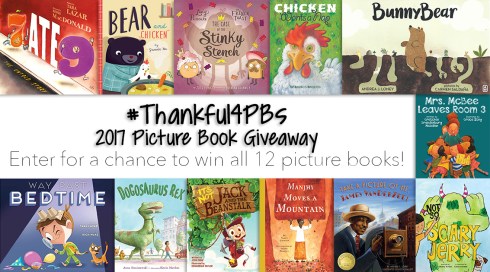
You can enter to win JERRY and all twelve participating books by visiting #Thankful4PBs at Tracy’s blog!
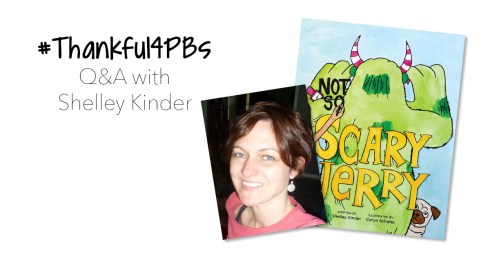
Shelley, tells us a bit about your participating book…
NOT SO SCARY JERRY is a quirky monster story about friendship, individuality, and accepting people as they are. The twists and turns will keep readers on their toes (and giggling too).
What are three things your protagonist is grateful for, and why?
- Jerry is grateful for hugs because they make him feel all warm and gushy inside.
- He’s also grateful for lasagna because it’s the perfect middle-of-the-night snack.
- And Jerry loves his pink watch because it glows in the dark, making nighttime not so scary. Plus, it’s quite a fashion statement!
 As the author, what picture book(s) are you thankful for, and why?
There are so many wonderful books, but I do love NO DAVID! by David Shannon for its simplicity and wonderful illustrations. And because my kids love it too.
Please share one person that’s made a big impact on your picture book career, and how?
I can’t narrow it down to just one person. I’d have to say that my mom and also my husband have played big roles in my career as a writer. My mom always believed in me and pushed me to follow my dreams. I always knew I could do what I put my mind to because of her affirming words in my life. My husband has always been supportive, as well, and he’s so good at reading my first drafts and sharing his thoughts on what could make them better.
What are you hopeful for (or looking forward to) in 2018?
I’m looking forward to my second picture book, THE MASTERPIECE, being published in the spring. It’s a faith-based book about God painting the sunrise. My mom is illustrating the book, and the process of working with her on this project has been amazing. It’s going to be beautiful! She doesn’t even realize how talented she is.
Thanks, Shelley…I am thankful you shared your story with us!
 Shelley lives in Indiana with her not-so-scary husband and their four little monsters. Some of Shelley’s favorite things are family, photography, music, and sushi. NOT SO SCARY JERRY is her first picture book.
Learn more at ShelleyKinder.com.
Click the image below for the #Thankful4forPBs giveaway entry page!








 Writing for Kids (While Raising Them)