You are currently browsing the category archive for the ‘Parenting’ category.
Last week, the NY Times published an article on the decline of picture books, claiming that parents are pushing chapter books on younger children because they want to advance their child’s learning. (Although a parent’s quote was taken out of context.)
Is this truly a trend? Are parents feeling pressure to keep up with the Joneses, literally?
I hate to say it, but the answer is yes. (But stay tuned, we’ll circle back to picture books.)
The pressure to raise intellectually superior kids starts even before a child is born. The Mozart Effect suggested that playing classical music for your fetus boosted intelligence. Pregnancy Today says exposure to music in utero may instill your child with a sense of confidence after they’re born.
Remember Baby Einstein? The name alone gets parents thinking about academic achievement in the early years.
You’ve probably heard of Your Baby Can Read. They boast that “a baby’s brain develops at a phenomenal pace…nearly 90% during the first five years of life!” They urge parents to “seize this small window of opportunity,” as if your child will never have the capacity to learn again.
A local preschool is cleverly named “Ivy Leaf.” Are they suggesting enrollment will guarantee your child admission to Yale or Harvard? Hmm…
Kindergarten used to be a half-day of painting, building with blocks and playing music. But now children are given summer tutoring in math and reading to prep for Kindergarten.
Look at the rise of tutoring companies like Kumon and Sylvan.
Rigorous school standards push parents to raise children who are smarter, faster. No one wants their child to be left behind.
But should we give chapter books to young children? If they want to read them, sure! Education.com says “choice is vital to reading engagement. As children learn to self-select their reading materials, they become discriminating and independent readers.” That’s a fancy way of saying children who select their own books are more likely to become life-long readers—and learners.
That brings us back to picture books. They are intellectually stimulating:
- Reading with your child early and often helps develop the parent-child bond. (It’s a nice tradition, folks.)
- Illustrations help children comprehend the story when they don’t understand the language. They learn context.
- Picture books expose children to art. Some of the finest illustrative work in the world can be found in picture books.
- The repetitive phrasing common to picture books helps children recognize words.
- Rhyming picture books help children recognize word patterns.
- Children learn story and narrative structure in a concise format. They get a beginning, middle and end in less than 1000 words.
And, come on! PICTURE BOOKS ARE FUN!
I bet the Joneses read them, too.
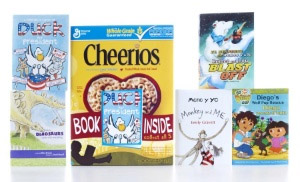
Who doesn’t love Cheerios? Little circles of oat goodness! The TV show “Glee” pays homage to Cheerios by naming their cheerleading squad after the superior cereal. And since we’re already cheering, let’s whoop it up for the Spoonfuls of Stories program! Cheerios distributes 6 million children’s stories in its specially-marked bookish boxes. Bravo!
Well, I do love Cheerios.
When I’m not hating them.
You see, my love/hate relationship with the ubiquitous toddler treat runs deep—deep in my carpeting, that is.
So for the new parents out there, take heed. Sure, run out and buy What to Expect When You’re Expecting. But then, expect Cheerios to be on your grocery list for a lifetime, so pay attention to these lessons:
- Do not purchase carpeting that is the same color as Cheerios. My sand-colored shag disguises stray O’s. We’re endlessly grounding whole grain cereal into the fibers and getting little circles stuck to the bottom of our feet.
- Do not enter the ceramic tile of your kitchen with said Cheerios attached to your heels. You will go flying. It won’t be pretty. (Hey Mom, is that a new dance?)
- Do not buy Cheerios at Costco. The enormous box won’t fit into any cabinet. You will be forced to let it live on the kitchen floor, within easy reach of a newly-walking toddler. You will soon have 5,392 Cheerios dumped onto your floor…with 5,391 rolling under the refrigerator. All the money saved by buying in bulk will be beneath your icebox.
- Do not buy fruity Cheerios in rainbow colors to solve the carpeting dilemma. They will not be eaten, these strange, colorful cereal mutations. Instead, necklaces will be made. Bracelets. They look so beautiful glued to construction paper. If you lick them and press them against the wall, look—they stick!
- Murphy’s Law of Cheerio Consumption: if you place one Cheerio at a time on the baby’s tray to avoid cereal being thrown on the floor, she will eat each quickly and cry for more. If you put more than one on the tray, they will be immediately swiped onto the ground. (Corollary: number of Cheerios provided to your child is inversely proportionate to their hunger.)
I’m sure you other parents have your own Cheerio life lessons. Please share them! (The lessons, not the Cheerios. I have enough all over my floor to make a meal, thankyouverymuch.)
P.S. While I have your attention, please vote for the books to be included in the 2010 Spoonfuls of Stories program. Me, I like Bear’s New Friend by Karma Wilson and The Hair of Zoe Fleefenbacher Goes to School by Laurie Halse Anderson.
Corollary
 When one arrives at their summer rental home, the sandy carpets, wood paneling and fishnet curtains can be largely ignored. You’re there for the beach, not for the house.
But when a foodie arrives in their temporary accommodations, the heart sinks upon discovering a less-than-accommodating kitchen.
Preparing for our annual excursion to the Jersey shore, I packed the extra virgin olive oil, garlic, ginger and jars of spices. I collected basil, chives, parsley, cilantro and mint from my garden. Yet I didn’t bring my trusted chopping knife, so I’m forced to mince and julienne with a butter knife. What I wouldn’t give for a serrated edge.
The hutch stores silverware for 50 people and wine glasses for 75, but not a single can opener that works. I must remind myself to buy dried beans next year.
Paper-thin pans burn their sizzling contents even on the lowest heat, so I’ve adapted a cooking method of removing them from the stove every few seconds. On, off. On, off. The scrambled eggs cannot brown, or else the kids will deem them “dirty.”
The first few days were filled with frustration. I cursed the dull peelers, all seven of them. I laughed at the bevy of bottle openers. If two dozen people wanted to open their Coronas in unison, no problem. There’s an entire shelf of serving platters, but not a single baking dish.
But now I’ve settled into the groove of my poorly stocked summer kitchen. Forced into a culinary simplicity, I plan our meals accordingly. Grilled chicken with roasted tomatoes. Pasta with grated cheese and torn herbs. Sole with browned butter sauce (I knew those pans were good for something). Cutting shortening into flour for biscuits works just as well with two forks as a pastry blender.
When I’m forced to do without, doing with seems complicated. For instance, my cupboard at home features the fruits of a ridiculous Nordicware Bundt pan fixation. But the shape has nothing to do with taste. Baking on an island with inferior cookware feels like a greater accomplishment than serving a cake that resembles a castle. Those pans allow me to cheat. What epicurean expertise can I claim if I own every tool of convenience?
So I’m learning to love my summer kitchen and the skills of culinary compromise it’s teaching me. Now if I could just rip that fishnet off the window, this house might be perfect.
Yes, I’m on vacation and this blog is quiet. Can you guess today is rainy? I will return to kidlit upon returning home. I hope you’re having a fun and relaxing summer!
Thank you to everyone who celebrated the release of Carin Berger’s newest picture book OK Go! by participating in her green-themed collage contest.
Carin thought the entries were so fabulous, she has posted all of them on her website!
We selected three winners at random.
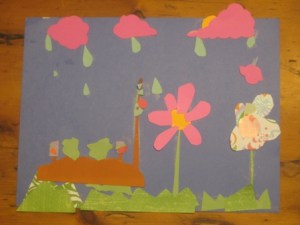
Verity, age 7, wins the signed copy of OK, Go!
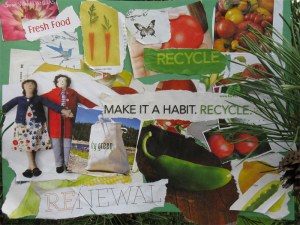
Ellie, age 4, wins a signed bookplate and an All Mixed Up mini-book.
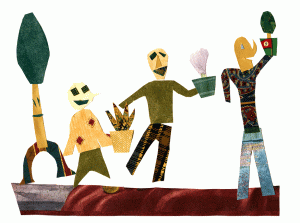
Isaac, age 10, wins a signed bookplate and an All Mixed Up mini-book.
The rest of our artists receive an All Mixed Up mini-book. Everyone wins!
Visit Carin Berger’s website to see all the terrific collages and read the children’s inspiration for their art!
Thank you, green parents and kids! 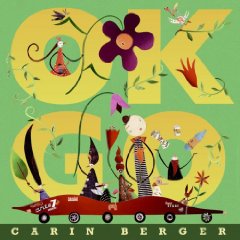
<– And don’t forget to pick up a copy of OK, GO!
OK?
Go!
It’s Children’s Book Week! So what does that mean? It’s time to celebrate children’s books across all genres.
Read to children. Inspire their creativity. Write a story together. Draw pictures. Enter Carin Berger’s Contest. Do whatever you want to make reading a priority in your family’s life! (Although I’m sure it’s already a priority.)
To help you along on this salute to Silverstein, this festival of Fox, this jubilee of Jeffers, here are some links:
- Read story starters by children’s authors and finish what they started.
- Visit the Write For a Reader blog. Shelly will have author interviews and give-aways all week.
- Check out IlluStory and Create Your Own Pop-up Book, fun ways for your child to publish their own book.
- Review the Top 10 Summer Reading Lists from various organizations and the children’s choice reading list from the Children’s Book Council.
- Share your favorite children’s book with us. Comment below so others can discover great books.
And here are some marvelous picture books being released this week! Enjoy!





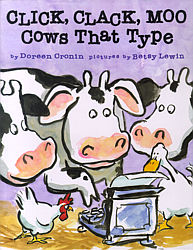 What a lucky duck–I got to meet the moovelous Betsy Lewin this week. The whimsical illustrator of Click, Clack, Moo: Cows that Type and countless other barnyard books visited our local elementary school and entertained the kids with a mix of slide show, drawing lesson and Q&A.
Two Kindergarten classes filed into the library with clipboards and crayons, eager to learn from a master cartooner.
But first, Mrs. Lewin showed photos of her 120 year-old Brooklyn brownstone. Her living room is filled with souvenirs from her world travels–Africa, Australia, the Galapagos–places where she has observed animals and gained inspiration. When she showed her husband’s studio on the fourth floor, she pointed out that it was far bigger than hers, not because he was more important, but because it also housed a photography studio. Ted Lewin paints his realistic watercolors by studying photographs. He pays neighborhood kids to model for him. “Anybody want to move to Brooklyn?” she asked. (My hand went up!)
Mrs. Lewin brought along her cartoon friend, Weirdly, to show the children how to draw expressions: mad, sad, excited, laid back and cool, mischievious, shy. “Weirdly helps me draw ‘sound’ words like BOOM and CRASH because sometimes I can’t imagine what they look like,” she explained.
She also showed her first draft cover for Doreen Cronin’s Duck for President. The original cover depicted a national political convention. The point of view is Duck’s, looking out over the crowd (we see his back and tail, wings outstretched). In the front row there’s Farmer Brown, some cows and chickens, Doreen Cronin and Betsy Lewin. Red, white and blue balloons are falling from the ceiling as the crowd holds signs with slogan spoofs like “The Duck Stops Here,” “I like Duck,” and “A Veggie in Every Pot.”
Then her publisher decided they didn’t want political sayings on the cover, so they asked her to write signs with all 50 states. She soon realized that wouldn’t work. “Which states should go on the front cover? Which states should go on the back? It wouldn’t be fair. What about M-I-S-S-I-S-S-I-P-P-I? That’s too long!”
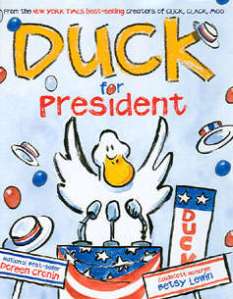 Ultimately they decided to put Duck on the podium with just three signs: DUCK, Doreen Cronin and Betsy Lewin. PERFECT!
The hilarious moment came when Mrs. Lewis showed a photo of someone in a cow costume, typing away. She said the photo was sent to her in an unmarked package. Then she asked, “Does anyone know what Doreen Cronin was before she became a children’s author?” One kid had an answer. “A cow?”
Much to his disappointment, no. Ms. Cronin was a lawyer, just like Mrs. Lewin’s brother, a judge, who had sent the funny cow costume photo. (Yep, lawyers are some of the funniest people I know. My own father included.)
Next, Mrs. Lewin showed the children how to draw a lion with a few easy steps. She broke it down into wiggly lines, circles and half circles and then had the kids decide how they wanted to draw the eyes–happy, sad or angry–with just a slant of the eybrows. She had the first row stand up to show the rest of the audience how different each lion was, as different as they were. “And that’s what makes you so special,” she said. “You’re the only you in the whole world.”
After some questions and answers–her favorite books as a child were Winnie the Pooh and Call of the Wild–she asked the children for suggestions of what to draw. An animal lover and observer all her life, Mrs. Lewin grew up in rural Pennsylvania surrounded by farms. She would watch the animals intently so she could remember how to draw them. She doesn’t need to look at an example as she creates. She can draw anything!
Mrs. Lewin draws with quick strokes, and it’s amazing to watch how these simple lines and squiggles magically come together to form monkeys, elephants, rocket ships and knights in shining armor. Two lucky ducks, I mean kids, even got their portraits drawn.
The most interesting part of the presentation was when Mrs. Lewin showed the difference between her original black and white drawings for her debut 1979 book, Cat Count, and the new full-color edition. In the new release, she gave two dancing felines a blue room lit with the shimmering, sparkling light of a disco ball. The way the dots played on the page gave the scene a magical feel, as if it could lift right out of the book and tango around the room.
I’ll use the saying “lucky duck” one last time: how fortunate children are to have such marvelous books illustrated by a true genius. Thank you, Betsy Lewin!
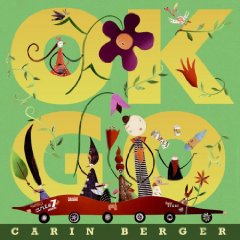 Carin Berger never deliberately set out to become an author/illustrator, but she found her true calling in picture books. She was awarded the Society of Illustrators Founder’s Award in 2006, the NY Times named The Little Yellow Leaf one of the top ten picture books of 2008, and Publishers Weekly called her “one to watch.”
And now’s a great time to watch.
Her latest title OK Go, a playful book about making greener choices, releases in bookstores today.
I had the opportunity to talk with Carin about her journey to publication (somewhat serendipitous) and her plans for the future (deliberately delightful). I shall follow PW’s lead and not only watch her, but predict the Caldecott will soon be calling.
Carin, how did you start on the path to becoming a children’s book illustrator?
I’ve always loved reading, writing, old paper stuff, children’s books, type and making things. I studied graphic design and spent almost 20 years working in the field. I worked my way down the (pay) food chain towards what I really loved: from very high-end annual reports and brochures to eventually designing book jackets for all the major publishers. I did jackets for poetry, fiction and non-fiction. I still do this and love it. I get to read manuscripts and can often use my own illustration or photography.
Anyhow, I had a daughter, and it turned out she was a sleepless wonder. (When she was little. Now she sleeps like a baby!) I spent much of most evenings hanging with her, waiting for her to fall asleep. I wrote the poems for Not So True Stories and Unreasonable Rhymes in those long hours, mostly to amuse myself.
 How did you first get involved in collage?
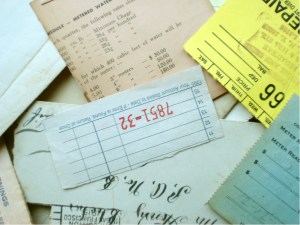
As for collage, that was kind of serendipity. I thought I would do paintings and was experimenting with different painting styles, some which included collage, and then my friend gave me a magic box full of old letters and documents and ephemera that she picked up at a flea market, knowing I had a thing for that kind of stuff. And that was the beginning.
Once I had pulled together some sample illustrations and manuscript, a friend-of-a-friend agreed to rep it; and she, amazingly, ushered it into the world.
And was Not So True Stories and Unreasonable Rhymes your first manuscript?
Yes, it was my first manuscript, though I’d written a bit, for myself, before.
 Wow. That’s a rare accomplishment and speaks volumes about your talent. Where did you go from that first success?
Not So True Stories was a quirky little book that got good reviews but sold…well, like a quirky little book. Chronicle Books graciously published my second book, All Mixed Up, another quirky and very little book. (It can fit in your pocket.)
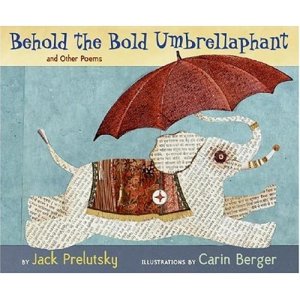
I was then called by Greenwillow Books and asked to illustrate Jack Prelutsky’s book. A real honor. And, because it was the amazing Master Jack’s book, it received lots of nice attention. He was named the first ever Children’s Poet Laureate right when the book came out which meant that there was a shiny golden sticker that went on the front of the book, too. I’ve been working with Greenwillow Books for the last couple of projects.
How has your illustration style evolved from one book to the next?
As for the collage style, it has sort of evolved in a few directions.
 All Mixed Up, a mix and match book where the heads, middles and legs (as well as the alliterative poems) combine in various ways to make new characters, was born out of the idea of collaging the collaged illustration. I had originally conceived it as a game, but Chronicle preferred to do it as a book. The illustrations are similar, yet somewhat simpler than Not so True Stories, so that the mixing worked.
For Behold the Bold Umbrellaphant, I wanted to do a slightly different style than the books that I had authored, and also, because the poems are about a conglomeration of animals and objects (such as Ballpoint Penguins), I thought it would be fun to play that up and make it really obvious.
I collect old dictionaries and army/navy catalogues that have engraved images, and so I used those images and integrated them into the collage. To do this I actually scanned engravings from the book, played with them in Photoshop, printed out pieces and used them to cut and paste with.
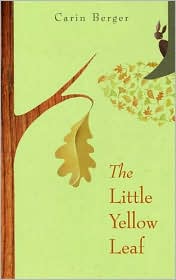 The Little Yellow Leaf felt like a really simple, nostalgic story and I ended up introducing a bit of paint (stenciling) to the collage to add another layer and also, at times, to age the paper.
Ok Go has a zillion funny little characters carousing throughout the book and feels much more like the art in the end papers of Not so True Stories and also in All Mixed Up. It was fun to change things up a bit and to do such playful art.
My next book, due out late next winter, is called Forever Friends and the art is much more similar to the art in The Little Yellow Leaf. I see it as a companion book to The Little Yellow Leaf because the bunny on the front cover and the bird on the back cover of Leaf are the characters in Forever Friends.
Your newest picture book OK Go is a playful book for the wee set, all about making greener choices. How did the concept for this book come together?
As best I can recall, it all sort of came as a whole piece. I liked the idea of introducing taking care of the environment to really young kids. I remember growing up in the 70s when “Give a Hoot, Don’t Pollute” was around and feeling very empowered to help make the world a better place. Here are some early sketches:
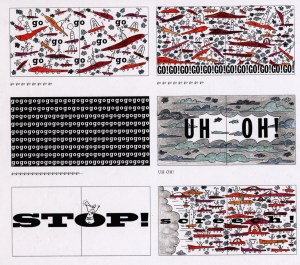
One of the biggest things I needed to figure out was how to emphasize the message in a powerful yet playful way. The gatefold came about because I wanted it to feel like a huge gathering or movement.
How do you choose which paper to cut for certain images? Does the paper speak to you?
 I have files of papers sorted by color—yellows/oranges, reds/pinks, blues/purples—and I also have files for some of my passions: polka dots, plaids, wood grain, buttons…
 I actually cut a vellum stencil of the shape I need and hold it over the paper to find a good section. Something with good gradations for example, that help the piece, say a car, look more dimensional. Clothing catalogs are great for plaids and buttons. And then I use a variety of old stuff, both really old ephemera like letters and receipts with great calligraphy on them and also bits and pieces that I find around: ticket stubs, laundry tags, etc.
Do the words on the paper hold any significance?
I do think about the paper I use, where it comes from and what it says. Not in a huge way, but in a quiet, just-to-amuse-myself sort of way. And in almost every book I make sure to include, somewhere, my daughter’s name, Thea. In The Little Yellow Leaf it appears on the page with the giant sun, and in OK Go I use her name and the names and initials of lots of friends to decorate the cars.
Speaking of the glorious sun in The Little Yellow Leaf, do you have any idea how many pieces of paper you used? Or how long it took to create that page?

I always knew what I wanted to do with that illustration, but it took a little longer (well, w-a-y longer) than I thought it would. I spent probably close to a week on it. Actually, part of the reason it took so long is that I started from the outside and was working my way towards the center and I got pretty far before I realized that, because the sun is asymmetrical, it wasn’t going to work. I had to add another layer working from the center out. Ugh!
I have absolutely no idea how many pieces there are, and I can’t imagine anyone who would be nuts enough to count (though I’d be curious to know that)!
Circling back to your newest book, what kind of impact do you hope OK Go will have on green thinking among parents and young children?
There are some very simple things that kids can do to be more green and they are listed in the back of the book.
I think if you plant the idea early, children will live more careful, aware lives, and remind their parents to do so as well. Plus, what is more motivating than our kids to get us to take care of this planet and the environment?
But mostly I want kids to have fun with the book, and to be introduced these ideas in a playful, engaging way.
One last thought: all of my art is made with found and recycled materials, so maybe this will prove inspiring and enabling, too.
Indeed it is, Carin! So let’s use that inspiration for a contest!
Kids age 10 and under, create a collage with a green theme–reduce, reuse, recycle or whatever you can dream up! Email your illustration to tarawrites at yahoo (you know the rest, dot com) and include child’s first name and age.
With the help of Random.org, we’ll randomly select three winners.
The grand prize winner gets an autographed copy of OK Go. The second and third winners will receive an All Mixed Up promotional mini-book. And all three illustrations will be featured on Carin Berger’s website and/or blog.
In your email, be sure to grant your permission for sharing the illustration and the child’s first name/age online.
One illustration per child. Enter now through midnight E.S.T., Tuesday, May 12.
Carin, thank you for giving us a glimpse into your beautiful world! I bet everyone is going to GO! GO! GO! get your book today!

Take a peek inside OK Go or
Find OK Go at your local bookstore!
OK Go by Carin Berger
April 2009
Greenwillow Books
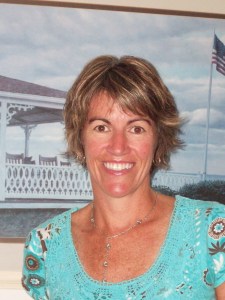
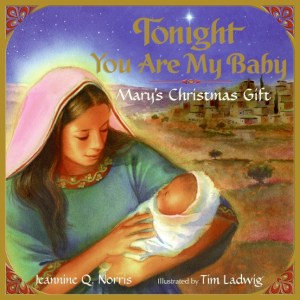 I had the pleasure of meeting author Jeannine Norris at a recent NJ-SCBWI mentoring workshop. One of the organizers, Kathy Temean, held up a copy of Tonight You Are My Baby and pointed to Jeannine, the author, sitting right behind me. Kathy told us that Jeannine had met her editor at a previous NJ-SCBWI event. Amazing! I immediately knew I had to talk to Jeannine about her path to publication.
Jeannine, how long have you been writing?
I have been writing for about four years. I dabbled in writing when our children were babies, as I missed the creative stimulation of my former job. I really started to write when our youngest went to pre-K.
Where did the inspiration for Tonight You Are My Baby come from?
The inspiration came when our daughter, Quinn, who was four years old at the time, was diagnosed with a brain tumor. As a mother, I needed the strength to help our daughter get through this difficult journey. I started to think about Mary, as the mother of Jesus, and her incredible strength. I decided to write about the Nativity, from a mother’s perspective, and, if the book was published, donate part of the proceeds to helping kids with brain tumors. Quinn’s tumor was benign, and next year will be her five-year celebration! We started a foundation, At Least Kids, that contributes to pediatric brain tumor research at Children’s Hospital of Philadelphia and supports families struggling financially. A portion of each book sold is donated directly to At Least Kids.
What a scary time for you as a parent, but what a blessed outcome—a healthy child, a beautiful book and a charitable foundation.
You met your editor at a writer’s event here in New Jersey. Can you tell us how the deal transpired?
I met my lovely editor, Catherine Onder, at a NJ-SCBWI mentoring workshop. Catherine heard Tonight You Are My Baby during the first page session. Another editor asked to see the rest of the manuscript, but it was eventually declined. Several months later, I met Catherine at another NJ-SCBWI workshop (with another manuscript) and she remembered the first page of Tonight You Are My Baby. She asked to see the rest of the manuscript and several months later it was acquired. I couldn’t have been happier! The right time, the right place, a great editor. I’m a huge cheerleader for SCBWI events. Opportunities abound!
I love NJ-SCBWI, too!
After your book was acquired, what was the editing process like?
The editing process was fascinating! I needed to add a few stanzas, when Tim Ladwig, the illustrator, started working on the book. Catherine helped me with the revisions as well. I have to say, I love revising, as my book became so much better! Revisions and rhyme are always a challenge—often it means changing the entire line, instead of just a word. Catherine pointed out that I had used the word “quiet” several times in my manuscript. Not a good idea when you are only dealing with 400-500 words! I hadn’t even noticed. When I do my school visits, I always tell the students about my revisions. A good editor is like a good teacher—encouraging, has a vision, and wants your work to be its best. Kids are always surprised that even authors make many revisions.
Interesting–how many times had you repeated “quiet”?
I think I had repeated “quiet” three times!
I suspect that many writers have a “crutch” word or phrase in a manuscript that we just don’t notice. Yours was “quiet.” Mine is “just.” (See?) It takes a good editor to point that out!
Why the need to add the stanzas? Was it because of the illustration spread count? Or did Tim add a drawing you hadn’t envisioned?
We added three stanzas because when Tim started to draw the story arc, we wanted Mary first traveling to Bethlehem and meeting Jesus several pages in. Naturally, the book is about a mother and her baby, but we needed additional stanzas to add other images: the angels trumpeting, the sheep/cows/donkey in the stable, the wise men bringing gifts. All those stanzas were added during revisions. As it happens, the angels trumpeting is my favorite illustration! It’s not what I imagined, and I love it! Tim was so creative. The rest of the illustrations are what I saw in my mind’s eye when I was writing. Tim really “got it”—Mary is very young, completely accessible and a joyous mother.
What has surprised you most about being a published author?
 My big surprise was—I didn’t really have any big suprises! The tremendous benefit of using the SCBWI and Verla Kay discussion boards is using the experiences of other authors to make the path easier. I am hugely indebted to those who have traveled this literary path before me! Through the discussion boards and workshops, I felt really well-prepared. Any of my questions were answered: simple questions such as “How do I make postcards?” to more complicated questions dealing with contracts. One pleasant surprise was that all of my school visits were wonderful. Each one was gracious, organized, prepared AND I sold a lot of books! Again, I learned how to prepare pre-order forms, write school contracts and even develop a PowerPoint presentation through the experiences of others. There is much to be learned, but a wealth of information is readily available.
What other advice do you have for aspiring children’s authors?
I would urge writers to join a critique group—or start one of their own! I belong to an online group and a local group. I met both of these groups through SCBWI conferences. Critique groups have so much to add! My groups provide me with valuable, honest comments and help prepare my manuscript for an editor’s eyes. I would also suggest aspiring authors gain writing credits through magazine articles, local publications and online sites. The extra income is nice, too! Attend every SCBWI workshop/conference you can afford. I’ve had an SCBWI workshop on my birthday list for the past several years! If your manuscript is acquired, be prepared to market yourself–heavily. The debut author MUST knock on doors, visit schools, call the bookstores, have a website, ask for interviews. This is your opportunity! Finally, have fun. Write what will bring you to your desk each day with a smile on your face.
That’s excellent advice, thank you, Jeannine.
Although Tonight You Are My Baby is about the birth of baby Jesus, a celebration of Christmas, what makes it a relevant read throughout the entire year?
Tonight You Are My Baby is really a celebration of a mother’s love. It’s about the boundless joy that every new mom experiences. The knowledge that a baby’s birth is truly a miracle—a gift unto itself. Tonight You Are My Baby is a celebration of Christmas, but it’s also a celebration of a mother’s heart. The book is certainly most popular at Christmas, but I find many people buying it for other occasions: new baby presents, baby showers, birthdays, etc. Mothers and little ones snuggle as they read of the love story that took place long ago.
Extra cuddle time: a wonderful reason for everyone to pick up this glorious book. Congratulations and thank you for sharing your journey to publication with us!
 Tonight You Are My Baby
Story by Jeannine Norris
Illustrations by Tim Ladwig
HarperCollins, September 2008
Check it out!
 A few weeks ago, YA author Mitali Perkins put together a list of young adult authors on Twitter.
In the same spirit of connecting children’s authors with fans and other publishing professionals, here’s a list of published picture book authors and illustrators who maintain a Twitter presence. Also included are debut authors with books due for release in the coming year or two.
UPDATE AUGUST 2013: It’s been eons since I’ve updated this list, but I see it’s been referenced online in several places and has become a popular resource. Unfortunately, I can no longer take the time to update this list–there are just too many changes to keep up with. But if you want to be included, simply add a comment with your Twitter handle and you’ll be seen there. Thank you!
Enjoy! Make new connections; discover talented people!
- Bonnie Adamson @BonnieAdamson
- Laurie Halse Anderson @HalseAnderson
- Boni Ashburn @BoniAshburn
- Carin Berger @CarinBerger
- Phil Bildner @PhilBildner
- Deborah Blumenthal @DeborahBlu
- Susan Taylor Brown @Susanwrites
- James Burks @JamesBurksArt
- Heather Ayris Burnell @HeatherAyris
- Clay Carmichael @ClayCarmichael
- Tara Larsen Chang @TLCillustration
- Susan Chodakiewitz @SusanChodak
- Rob Christianson @RobChristianson
- Peggy Collins @PeggysBooks
- Susan Crites @SusanCrites
- Kristy Dempsey @KristyDempsey
- Sarah Dillard @SWDillard
- Brandi Dougherty @BrandiDougherty
- Elizabeth Dulemba @Dulemba
- Ame Dyckman @AmeDyckman
- Wendy Edelson @WendyEdelson
- Carol Gordon Ekster @CEkster
- Claudia Golden @Claudiamm37 (Account deleted)
- Gus Gordon @IllustratorGus
- Jean Fischer @JeanFischer1
- Kakie Fitzsimmons @KakieF
- Alison Ashley Formento @AFormento
- Roz Fulcher @Rozzieland
- Neil Gaiman @NeilHimself
- K.L. Going @KLGoing
- Lorie Ann Grover @LorieAnnGrover
- Diane Dawson Hearn @DDHearn
- Anette Heiberg @AnetteHeiberg
- Leeza Hernandez @leezaworks
- Ryan Hipp @HippHop
- Lisa Horstman @LisaHorstman
- Oliver Jeffers @OliverJeffers
- Ward Jenkins @wardomatic
- Dani Jones @danidraws
- Cathy June @CathyJuneArt
- Michelle Knudsen @MichelleKnudsen
- Kara LaReau @KaraLaReau
- Tara Lazar (me!) @taralazar
- John Lechner @JohnLechner
- Kelly Light @KellyLight
- Grace Lin @pacylin
- Wendy Martin @wendymartinart
- Anne Mazer @AnneMazer
- Rich McCoy @McCoyDigital
- Kate Messner @KateMessner
- Jennifer L. Meyer @JenniferLMeyer
- Jamie Michalak @JamieMichalak
- Amy Moreno @EarthenVessel
- Cyn Narsisi @CynDraws
- Jeannine Norris @JeannineNorris
- Neil Numberman @NeilNumberman
- Dianne Ochiltree @WriterDi
- Eric Orchard @EricOrchard
- Alicia Padrón @AliciaPadrón
- Todd Parr @ToddParr
- The Pigeon @The_Pigeon
- Jamie Pogue @JamiePogue
- Jean Reidy @JeanReidy
- Peter H. Reynolds @PeterHReynolds
- Jacqui Robbins @JacquiRobbins
- Shelly L. Rogers @KidsIllustrator
- Candace Ryan @CandaceRyan
- Tammi Sauer @SauerTammi
- Niki Schoenfeldt @NikiofWare
- Corey Rosen Schwartz @CoreyPBNinja
- Jon Scieszka @GuysRead
- Diana Scimone @DianaScimone
- Cynthia Leitich Smith @CynLeitichSmith
- Kim Sponaugle @PictureKitchen
- Laurel Snyder @LaurelSnyder
- Ruth Spiro @RuthSpiro
- Patricia Storms @stormsy
- Susan Marie Swanson @Susan_Marie
- Don Tate @Devas_T
- Nikki Tate @WriterGrrrl
- Jennifer Therms @JenThermes
- Holly Thompson @HatBooks
- Renee Ting @ReneeAtShens
- Joyce Wan @wanart
- Kathy Weller @wellerwishes
- Leah Wiedemer @RoamingArtist
- Karma Wilson @KarmaWilson
- Paula Yoo @PaulaYoo
- Laura Zarrin @CreativeGirl
- Paul O. Zelinsky @PaulOZelinsky
Every SCBWI first-page session I’ve attended has had one thing in common: picture book manuscripts about new babies in the family. At least two or three are submitted each time. Editors and agents respond by warning new writers: “The market is saturated with mom-is-having-a-baby books. If you’re going to write about a new sibling, the idea must be unique to stand out.”
I remember a harsh moment. After reading the first page of a new baby tale, an editor said, “This isn’t special enough to continue.”
Daunting, isn’t it? Makes you want to toss your baby—erm, your manuscript—out the window!
So when they say the idea has to be unique, what do they mean?
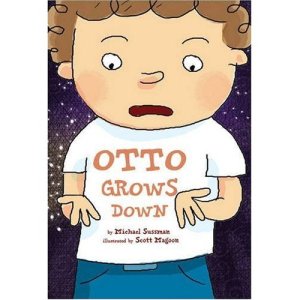 In a perfect world, they’d whip out Michael Sussman’s Otto Grows Down. Illustrated by Scott Magoon, it’s a tale of a boy who wishes his baby sister Anna was never born. “Be careful what you wish for” might be a cliché, but trust me, Otto Grows Down is an uncommon cautionary tale.
Otto makes his Anna-be-gone wish on his 6th birthday as he blows out the candles. Immediately, life begins to travel in reverse. Otto wraps up his gifts and hands them back to his friends. The second hand on his new watch ticks backward.
The next day at school, they start with mess-up time. Otto can’t get used to sliding UP the slide, and he’s so tired at the end of the day, he just wants to eat breakfast and get to bed. And going to the bathroom? Nasty business. (Nasty, hysterical business to my kids.)
Otto’s parents soon return Anna to the hospital and she disappears. Otto rejoices. But strangely, time doesn’t move forward again, it just keeps unraveling. Otto celebrates his fifth birthday, his fourth, his third…and he realizes that he may disappear, too! He’s slowly losing the words he needs to make his new wish come true: OTTO BIG!
Call it a dark comedy for kids. Scott Magoon’s film noir feel strikes the right balance between humor and horror. Dark shadows and warm colors mimic Otto’s flip-flopping emotions. (And hey, did you notice all the character names are palindromes? Another cool touch, huh?)
I won’t tell you where it ends—or where it begins—but let me just say: every editor who sent Mr. Sussman a rejection probably wishes they could make time go in reverse, too.
 Otto Grows Down
Story by Michael Sussman
Illustrated by Scott Magoon
Sterling, February 2009
Want it? Get it!
P.S. Author Heather Ayris Burnell interviewed Michael Sussman on her blog–plus she’s giving away a copy of the book!





 Writing for Kids (While Raising Them)