You are currently browsing the category archive for the ‘Middle Grade Fiction’ category.
When writing a story, the setting plays a role as important as any character–exuding its own personality and affecting its inhabitants.
Put simply, the setting offers sights and objects to discuss, to throw, or to ignore. The manner in which your characters use these objects can reveal each person’s emotions, purpose, and their personality.
Before writing a scene, I like to do visual research. I want to grasp hold of the objects surrounding my characters before I hand things over to them. I’m currently building a fictitious southern town and I have a general idea of what it should look like, but having never lived south of the Mason-Dixon, I need a little nudge. I punch some select words into the search engines to see what images pop up.
An embellished oil pump courtesy of Roadside America:
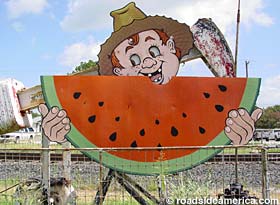
A rolling crop field courtesy of the Randall County Agriculture Department:
A lonely little house courtesy of Homes.com:

An old service station courtesy of the Fayetteville, TX Chamber of Commerce:

Endless inspiration, y’all!
Soon I’ll be touring a circa 1785 historic house as visual research for another project. A local township’s historical society removed layers of paint during the restoration and revealed a mysterious drawing of a woman. Legend has it that a disgruntled worker drew the image with a spoon in 1837, after an argument with the owner of the home.
Since one of my projects features an 18th-century home undergoing renovations, I thought this would be a worthwhile trip in the name of research. And the woman on the wall may provide additional inspiration. They say everyone sees something different in her face, and perhaps my characters will, too.
How do I choose which manuscript to submit to the next first page session? I’ve been going back and forth, trying to decide which one showcases my best work. And yet, the two manuscripts I am considering are so very different.
One is a clever tale of a boy with an unusual name–a name that creates a lot of confusion. This picture book is in the boy’s voice, told from his point of view. Yet the illustrations will show something very different happening around him. I have repeatedly heard editors say that a PB must leave enough unsaid for the pictures to comprise half the story, and I think this tale accomplishes that.
Then I have a fractured fairy tale. With pizzas. Glorious, cheesy pies! What kid doesn’t like pizza? A familiar story with a unique new twist might take the cake. Err, I mean, pie.
I admit, I’m getting a little too hopped up for a first page session. I shouldn’t expect anything to come from it other than a lot of good advice. I listen carefully to each page and then when the editor or agent gives his thoughts, I take a lot of notes, hoping to learn from all the manuscripts, not just mine.
Unfortunately, I don’t think everyone has this attitude. Last time a woman in front of me drew doodles on her paper throughout the two-hour session. And when it was over, she complained that the professionals didn’t like her story because they didn’t understand or appreciate rhyme. That may be true, as the editors worked in middle-grade and not picture books, but I had an entire page of notes on her story, while she went home with a lot of squiggles and stick figures.
There’s two ways to approach a first-page session: as a way to grab the attention of an editor or agent, or as an opportunity to receive professional feedback. It’s important to remember that if your work doesn’t impress the editors, all is not lost. Be inspired to work harder. Editors and agents volunteer their time to these events, and we should all be grateful. They don’t owe us anything. But we owe them our very best work.
How do you know when your manuscript is ready for submission? For some, it’s a gut feeling. But just how do you learn to trust your writer’s intuition?
The support and encouragement of my writing group has helped. I run a picture book manuscript by them three or four times until there’s not much more to be gussied up. And then I tuck that story in my back pocket and wait, creating distance. Weeks later, I iron out the creases.
Months pass. I flip sentences around. And then I flip over in bed all night, over-analyzing the story. I consult the thesaurus and exhaust the synonyms. I belt out the story in my best character voice and listen to how it flows (and someone please tell me why I always slip into a southern accent?). I love reading aloud. That’s the best way for me to check the authenticity of the kid voice, y’all (there I go again). And then, when all that’s left to edit is interrobangs, just when I think I can play endlessly with it for lack of anything better to do, I think it’s time to let it fly.
Or is it?
I understand when experienced authors suggest new writers to take an apprenticeship of two years. Writing improves with practice, and the children’s market has its own set of rules. Moreover, it’s an extremely competitive field with many successful, established authors. To break in these days, not only does your writing have to be crisp, the idea has to be unique. So much has already been done—and done well.
Now, you may believe you have extraordinary talent (don’t we all), but don’t skimp on those two years. Immerse yourself in writing. Read books on the craft, attend conferences, join a critique group, take classes, read best-sellers in your genre. That will always be time well spent, creating a solid foundation from which to launch a career. Think of it as a sling shot: the further you pull yourself into the craft, the further you’ll fling yourself forward.
I subbed four manuscripts out this summer and the rejections are trickling in. Did I submit too early? I admit, I didn’t complete the full two-year apprenticeship before letting go of my stories. Thankfully, I didn’t submit far and wee (little nod to e.e. cummings since it’s so puddle-wonderful outside). I kept the list very small so I could gauge response. And the response tells me I have to improve my gut.
I’m working on it.
I’ve already revised two PBs with a new critique partner, one who really pushes me. I believe in her talent, and she believes in mine. Maybe two guts are better than one.
As an aspiring author and mother of two young children, the time spent pursuing my career comes mostly at night, when the kids are asleep. I don’t have a lot of time, so I need to prioritize. Should I revise tonight? Or read? Blog? Research? Submit? I have to decide quickly; I only have thirty-three minutes until midnight. That’s when the baby wakes up. She loves ushering the new day in with a solid wail.
I suppose my choice tonight is to blog. I won’t have time for anything else.
I wonder if blogging is doing me any good. The majority of hits on my blog derive from “tattoo” searches, so who really reads this thing? (Which reminds me to tell you: if you want to pump up your site statistics, definitely slip in a word or two about body ink. Personally, I’ve got an inexplicable thing for Ami James, but I digress.)
Then I tell myself, it doesn’t matter if anyone reads this blog. It’s good writing practice. Even if the writing stinks (and it usually does), at least I’m meeting my daily word count quota.
But for the next few weeks, I’ll have my writing time spoken for. I’ll be busy preparing for the Rutgers University Council on Children’s Literature One-on-One Mentoring Conference (phew, that’s a mouthful, huh?). I have writing samples to polish and questions to prepare for my mentor, whomever that may be. I have my eye on a particular editor, but I doubt I’ll be lucky enough to get paired with that person.
And I feel panic bubbling up inside of me. I don’t know enough about the authors working in my genre, I don’t know enough about the mentors, I don’t know enough about the marketplace. I don’t know enough about comma splices. I need to know more so I can mix and mingle without sounding like a total noob.
But hey–maybe I should mingle with you.
Are you going to the RUCCL One-on-One Mentoring event in October? If so, drop me a note and let’s chat. I’ve got exactly twelve minutes left before the baby alarm goes off.
When a character stops talking to me, I have no choice but to ask another to come forward. Like a radio station that goes static across state lines, I must dial the tuner until I find another song worth listening to. And it’s gotta be catchy.
I could force myself to work on a project I’m not feeling, or jump on the current groove. I choose to go where inspiration takes me.
I understand that successful, published authors must learn to multitask. There may be times in the future when several projects will be coming to deadline and I’ll have to channel a myriad of characters. However, being still unpublished, I can follow my fickle desires.
So one middle grade novel that received interest from professionals gets shelved…and a new one begins.
In the meantime, my picture books have been submitted. All three are out looking for homes. Write home soon, won’t you, boys?
For my submissions, I researched publishers to target those with books similar to mine (but not in direct competition) already on their list. Amazon’s “advanced search” function is helpful here, enabling you to search by publisher and age range. If you find a book similar to yours, you may be able to read it on Lookybook immediately instead of running to the library.
If I haven’t blogged recently, you can’t blame a girl who has been writing and submitting her work. Now I must dive into research mode for my current middle grade novel, which includes historic elements that I last studied in grammar school. I need to start getting smarter than a 5th grader!
I have recently learned ’tis a wonderful thing to have an agent request your manuscript, yet the moment becomes bittersweet when you don’t have a completed work to send.
I know a very important rule for writers: don’t attend a pitch session if your manuscript isn’t finished. It’s a waste of time for editors and agents who are attending to find and sign new talent. And it’s just as moot a move for you. No one will take a chance on an unproven fiction writer, no matter how compelling your first page, first chapter or first half of the book is.
The good news is that I did not attend a pitch session. I attended a critique fully expecting to be critiqued. What I got were the words every writer dreams of: “You have to send me your manuscript.” Alas, I cannot send an incomplete work. It’s excellent incentive to keep moving forward with my novel, but disheartening to know that I have every opportunity to louse up a perfectly good half-finished story.
Employers spend an average of just 30 seconds scanning each job resumé. If you don’t make an immediate positive impression, you won’t get called in for an interview.
The same half-minute scan holds true for your fiction. One page is all you have to hook an agent or editor and entice them to keep reading. Without a strong voice, a compelling hook and sharp writing, you’re doomed for a swim with the slushies.
It therefore makes sense to attend a first page critique. The neighborhood kids may giggle over your tale, your friends might deem it wonderful, and your critique partners may even bless it as ready for submission. But a professional opinion is your best literary litmus test.
A professional first page critique can answer these questions:
- Is your writing appropriate for the genre? Does the voice match the target age range? Is your picture book too wordy; is your young adult novel too simple?
- Do you have a truly unique premise? Certain subjects—like fairies and witches—may be popular at the moment, but that also means the market could be saturated. If you’re writing about fairies or witches, your idea should really stand out from the books already on the shelves.
- Have you left enough questions for the reader to want to continue? Or do you leave the reader too confused instead?
- If you’re writing in rhyme, does it have a consistent scheme? Does it move the story along or bog it down?
- Does your dialogue sound authentic?
- Are you telling the tale in the most appropriate point of view?
- Can a child relate to the story?
- Does the reader get an immediate sense of who/what/when/where? Can the reader imagine herself in the book’s setting?
- Are you beginning the tale at the right place?
Wow! All this just from a first page? Absolutely!
Professional editors and agents know the latest trends in the literary marketplace and they see hundreds—if not thousands—of first pages every month. The highly competitive book publishing business dictates that they weed out undesirable stories as quickly as possible in order to get to the good ones.
Thirty seconds is all you have. Make them work for you.
A new critique group member recently presented us with Chapter I of her YA novel—an engaging high school sports saga with a female athlete protagonist. After hearing our comments, she confessed that it wasn’t the first time she’d shared this piece. Workshop members from a local college had very different reactions than the ones we provided. For instance, they did not appreciate her clever metaphors, whereas I felt the work was strongest at those points—humorous, insightful, spoken with a strong and unique character voice.
At home that evening with a cup of tea and time to reflect, I wondered: is there such a thing as too many critiques? After all, not everyone agrees on the merits of published books, so a first draft would certainly elicit a wide range of comments. If a writer is presented with a dozen different viewpoints on the same story, which suggestions should she accept and which should she let slide?
Firstly, writers need to examine how many people point out the same problems. If there is more than one critique member who questions the character’s motive in a particular scene, then it makes sense to consider that section more carefully. But points on which the critique group does not agree, it’s appropriate for the writer to trust her own instincts, either by revising or letting the words remain.
Next, getting to know your critique partners well helps to reveal the most reliable criticisms. There are people whose judgment you will tend to trust, and those who just don’t agree with your direction. There will be those who always insist on line-editing until your prose reads exactly like their own. A group member may have a wildly differing style or not call your genre a specialty. It is important to listen to all criticisms and to understand why they are being voiced, but to address every single one is not productive. Too many cooks may indeed spoil the broth.
There’s no doubt that every manuscript needs to be critiqued. If you’ve completed a first draft and you’re licking the envelope to that agent: stop. You’ve only just begun. Find a critique group and get ready to rewrite.
There are no rules regarding how many times something can be workshopped, but as you become more familiar with the revision process, you’ll soon learn which advice to listen to and which you can ignore. A novel will not be all things to all readers, but it needs to be true to your vision as a writer.
What do you think? Can work be over-critiqued?
No one truly knows the magical answer to that question, as evidenced by the discussion on WNYC’s Leonard Lopate show this week.
You can’t publish a bestseller…you publish a book and you hope it takes off…but many hopes have been dashed by publishing into being a bestseller.
— Jean Feiwel, Senior Vice President and publisher of Fiewel and Friends & Square Fish Books
Ms. Feiwel, responsible for acquiring the popular series The BabySitter’s Club, Goosebumps, and Harry Potter while at Scholastic, was joined by Diane Roback, Senior Editor of Publisher’s Weekly children’s section, and Micha Hershman of Borders Group children’s division.
The three discussed the sea change in children’s book selling over the last 20 years, transforming from a market dominated by institutional sales to one dependent upon retail. In the 1980’s, the emergence of independent children’s retailers created a surge in demand, and now the national chains also play an enormous role in the success of new titles. They touched upon merchandising, the power of a good title and eye-catching cover, and understanding customers—what stories appeal to the parent “gatekeepers” as well as the children.
They briefly discussed “The Harry Potter Effect” on children’s reading habits and how the series suddenly made it cool for boys to be reading. The “have you read it yet?” peer pressure encouraged kids to pick up thicker and thicker books, a parental dream come true. The panelists made it clear that kids don’t care about marketing hype, but they do listen to word-of-mouth praise.
Click here and scroll down to the bottom of the page for the audio from The Leonard Lopate Show.
Cynthea Liu’s book title contest finalists were just announced! Go check out the winning entries and vote for your favorite.
I like Jade in China best for several reasons:
-
It plays on the phrase “Made in China,” where the main character Jade was born.
-
Jade is an ancient chinese artifact, fitting in with the character’s subject of study—anthropology and archeology.
-
Jade is prized in Chinese culture, giving the adopted character’s name meaning. Parents of adopted children often want to bestow a name that pays hommage to their child’s home country.
-
Jade represents beauty, grace and purity in Chinese culture.
I’m biased, though, because that was one of my entries. I suppose a decade of writing press release titles finally paid off.
I’m curious to see what you think. The Orient Success and Girls Just Wanna Have Feng Shui were my two other finalist suggestions. If you think that last one is funny, check out some of the hilarious titles that Cynthea posted for your reading pleasure.





 Writing for Kids (While Raising Them)