You are currently browsing the category archive for the ‘Children’ category.
The KidLit Comment Challenge helped me discover some boss new blogs and websites this weekend.
Everyone is talking about Wordle by Jonathan Feinberg. Input text and Wordle creates a word cloud, your very own piece of literary art, which I’m calling “literarti.” The more frequently a word appears in the text, the larger its relative size.
I had fun pasting my picture books into Wordle. Here is The Prince of Pizza:

You can change the font, color palate, direction of the words, and maximum word count. You can even link phrases with the tilde symbol (~) so they appear together. Keep in mind that Wordle’s gallery is uncensored, so it might not be appropriate for lil’ ones.
A site you will want to share with your young readers is author/illustrator Aaron Zenz’s Bookie Woogie: book reviews by kids, for kids (and their parents). Aaron and his three children, Isaac (10), Gracie (8), and Lily (5), review their favorite books from their impressive 2800-book home library. And when the discussion is finished, they share artwork inspired by the story. Aaron’s artistic talent has definitely rubbed off on his brood! Join them every Monday for a new book.
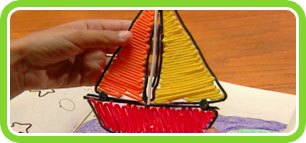 And then there’s Bendaroos. If you have a child with an insatiable artistic soul, then these colorful, bendable wax sticks promise to keep them busy for hours. You can even make your favorite picture book characters come to life by using the illustrations as a template. Your Bendaroo sculpture will lift right off the page when you’re done. As soon as ours arrive, I’ll post our creations.
The current publishing industry perception is that 500 words is the ideal length for a picture book. As a new writer, I have received this advice repeatedly. The reason behind the word count? Publishers believe that today’s busy parents want short titles to put their children to sleep quickly.
But there are publishers who prefer longer picture books, especially when a popular author is behind the title. Patricia Polacco comes to mind. Trinka Hakes Noble’s The Orange Shoes was my favorite picture book of 2007 and it easily breaks the 500-word barrier. And Flashlight Press wants manuscripts to be as close as possible to 1000 words. So it’s not the entire industry going wild for short.
Since I’m participating in the 21-day comment challenge with nearly 100 kidlit bloggers, I thought I’d ask you. Is length a factor when deciding upon a picture book purchase?
In our house, the story’s the thing. Short or long, as long as the kids love it and ask for it repeatedly, I’ll buy it.
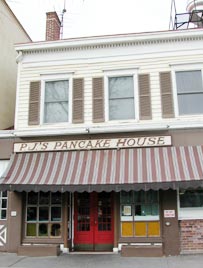
 Despite 40 years in business, changes in ownership, renovations and a fire, the names carved into the tables of PJ’s Pancake House remain a permanent record of all who have dined at the Princeton landmark. PJ’s must be the only restaurant that encourages patrons to slice into the tables and deface the walls with black Sharpies.
This morning my husband, youngest daughter and I sat at the “Table of Awesome.” How do I know the ranking of this booth? It said so right above the salt shaker.
Janine sat at our table the day she got her braces off: September 12, 2008. Katherine and Tate ate there in 2006 and they were in love. (I wonder if they’re still together?) Lena and Jeff traveled all the way from Gibson, GA. Dan drew a picture of the cigarette he wished he was smoking.
If a writer needs inspiration, a few minutes scanning the surfaces of PJ’s Pancake House promises to uncover thousands of stories.
Thankfully, I didn’t have to scold my two year-old when she took a red crayon and scribbled outside the lines. For once we had a peaceful meal out.
If you ever find yourself on Nassau Street in Princeton, definitely stop by. They serve fluffy, generous pancakes all day long, and if there’s a line to get in, don’t worry, it goes quickly. Plus, the griddle faces the window so you can decide upon your pancake order by watching what’s most popular. There’s chocolate chip, banana pecan, blueberry, pigs in blankets and even corn. Yeah, they serve other stuff, too…but when a food is in the restaurant’s name, you must order it! (Do you go to a steakhouse to order chicken?)
You might even dine next to friendly strangers if you’re seated at the long table in front, so say hello. Or, just listen to Groundhog-Day-like tales of Pennsylvania RV travels, like my husband did. One man’s peculiar voice rose above the plate clatter.
And the service goes miles beyond any restaurant I’ve ever seen. Today the hostess took a restless baby from her mother and bounced the little girl in her arms until the infant fell asleep. She held the baby while the mother enjoyed her pancakes. Wow. I hope the mother gave her a good tip!
This post is just one in a series about the 2008 Rutgers University Council on Children’s Literature One-on-One Mentoring Conference. Click the RUCCL tag above to read them all.
After lunch, RUCCL attendees separated into groups of five mentor/mentee pairs to discuss industry trends.
The first question was posed to the editors: “What are the biggest mistakes you’ve seen new writers make?”
Senior Editor Erin Molta from Scholastic Book Clubs said she dislikes when writers claim “their book is the next Harry Potter, especially when I read it and think, no, not at all!” Yes, writers are encouraged to compare their manuscript with a successful title, but she’s seen way too many Harry impersonations. On the other hand, she likes when a writer tells her why they have written this story. If the story comes from your heart, the genuine enthusiasm shines through.
Grace Kendall, Editorial Assistant at The Blue Sky Press/Scholastic, emphasized the need for a concise cover letter that tells her “how you see your book positioned in the bigger world.” You might have a great idea and a great character, but is it a good story? She receives great projects without story, and story trumps all. Tell her that “your book is like this [other] book, but it’s different because…” And you’d better have a good because!
Kendra Levin, Associate Editor at Viking and award-winning playwright, said her biggest pet peeve is when people call her on the telephone. One of the writers asked about sending a status query instead. “If it makes you feel better,” she said. “Honestly, if I have your manuscript, I will read it.” She also suggested, “Do your research before you send it out.” Target your manuscript to specific editors. Let her know why you are submitting to her. Information about editors is available online and she suggested looking in a comparable book’s acknowledgements. Authors often thank their editors.
Kiffin Steurer is an Assistant Editor at Philomel (and fellow Dahl fan). He wants writers to “get to the heart of the story as quickly as possible in the cover letter.” His pet peeve is “picture book authors who send [poor] illustrations with the story.” An editor will match your story with an illustrator. So if you’re not a professional artist, don’t send pictures. They can sour the entire manuscript. Let your words stand on their own.
Agent Alyssa Eisner Henkin said her pet peeve is “when someone sends a query to me…and everyone else in children’s publishing!” Agents want to know that you’ve researched their preferences and that you’re not just submitting blindly en masse. She’s impressed with a query when it mimics jacket flap copy, so do yourself a favor and read a lot of jacket flaps!
Kiffin Steurer added that he’s not looking for a message. “I’m looking for good stories. If you have a good story with a message, then it’s just icing on the cake. But if there’s no story, we don’t want it.”
This post is just one in a series about the 2008 Rutgers University Council on Children’s Literature One-on-One Mentoring Conference. Click the RUCCL tag above to read them all.
Chad Beckerman is a graduate of the prestigious Rhode Island School of Design. He worked at Scholastic and Greenwillow before taking on the role of Art Director at Abrams BFYR and Amulet Books. Besides designing book jackets, he illustrates YA covers and creates the artwork for novel interiors. In addition to all that, he’s got a wry sense of humor and knows how to work a microphone.

Chad Beckerman, Molly O'Neill, Lisa Cheng, Lisa Ann Sandell
Chad told us he’s unlike an editor. “They like to put their hands in everything,” he quipped. “I just have to make things look nice. And that’s…really nice.”
One of the things he likes to do is check out the competition. “I’m in the bookstores every weekend,” he said. He eyes what’s on the shelves, but he’s keenly aware that “you shouldn’t try to be what other books are being.” His job is to remain as unique as possible. “Look at what is out there, but do something totally original.”
Chad talked about translating novels into cool visuals and how difficult a task it can be to get it right for the audience. He recently worked on a book where a school prankster shoots classmates you-know-where with a watergun so it looks like they peed their pants. “That’s great,” he said, “here’s what we’re gonna do. We’ll put a watergun on the cover squirting yellow liquid!” But there’s some lines you can’t cross. It’s only a watergun, but it’s also a gun. And urine. “They told me we can’t do it, we just can’t. It made me sad, but I got over it.”
Chad is the savvy designer behind Jeff Kinney’s blockbuster novel-in-cartoons, Diary of a Wimpy Kid. “That one was really hard to do, even though it’s really simple.” There’s no color in the book; the interior illustrations are simple black drawings. But the book still needed a color identity if it was to be noticed on the shelves. People often associate a diary with a brown leather cover, but Chad felt that was “too literal” a translation for this book.
The Diary is a journal that the character’s mom gives him, so Chad looked at a lot of different diaries to get a feel for what this book should be. They settled on a typeset font for “DIARY” to suggest it was a bookstore purchase by Mom, but they scribbled “of a Wimpy Kid” in handwriting to demonstrate it was personalized by the main character Greg. Then they placed a ripped piece of paper with a drawing of Greg on the cover, seemingly torn right from the diary. (I personally love the wimpy, slouching pose.) The background is red to make it stand out, but it’s not a solid red—it has a slightly worn, leathery appearance. And each book in this series is color-coded. There’s a green one, a blue one and a do-it-yourself version in orange. “Some people think it’s brown, but it’s not brown, it’s orange,” Chad reminded us. The different colors help kids easily pick out the ones they don’t yet have!
People often ask Chad where he finds illustrators. In this digital age, he loves to browse websites and blogs looking for new talent. But the best way to get to him is by sending a postcard with a web address. It sits on his desk and reminds him to go online.
One point Chad emphasized to the RUCCL mentees is that “if you like what you’re writing about, then you need to go with it.” No matter what it is, he promises to make it jump off the shelves.
To wrap us this series, next I’ll post about the audience questions!
This post is just one in a series about the 2008 Rutgers University Council on Children’s Literature One-on-One Mentoring Conference. Click the RUCCL tag above to read them all.
Molly O’Neill began her career in school library marketing before becoming an Assistant Editor at The Bowen Press, an imprint of HarperCollins Children’s Books. “It’s hard to separate the marketing parts of my brain from the editorial parts,” she said, offering some background behind her perspective.
“If I love this manuscript, the first thing I ask is who is it for?” The answer will inform her decisions on everything from design to marketing. “Now I know what you’re thinking,” she addressed the audience of writers, “my book is for all the people in the world!” We all laughed. Sure, we’d love to believe that millions around the globe will buy our debut novel! But no, each book has a specific audience and her job is to make a book connect with that group. So she refines the question further, “Who’s going to love it first?”
Ms. O’Neill spoke about a new literary novel by a debut author (and if someone remembers the name, please let me know). Since literary novels are first embraced by librarians, they picked jacket illustrator Raul Colón, whose lush watercolors librarians instantly recognize as associated with other literary titles.
One of the best ways to make an audience connection is through artwork. The Emily the Strange graphic novel series uses black, white and red to paint the main character’s world. A visually stunning book appeals to Emily’s counterculture fans. Emily has pale white skin, jet black hair, and a brood of black cats. As HarperCollins works on a new YA series based on Emily, they even make these visual connections in the office, using bright red paper and black pens at their meetings.
Molly asks herself some very important questions about each manuscript. How is this book different? How does it stand out? And yet, how is it the same as successful books on the market? What does it compare to? This point was drilled into our heads throughout the day—think about how your manuscript compares to a brilliant best-seller, but tell editors and agents why it’s completely different!
Ms. O’Neill spoke about when a publisher distributes advance copies of a book. Tucked into the front is a letter from the editor explaining why this book is exciting. For Herbert’s Wormhole, a novel in cartoons, they ditched the letter in favor of a single cartoon. “Who is it for?” is still at play.
And the most important question editors may ask themselves is, “Am I going to enjoy working on this?” Two years is a long time to be involved with a project. But if the answer is yes, then they can believe that people are going to read it over and over again. That is an editor’s ultimate goal, for their book to become your favorite.
Chad Beckerman coming next in this series!
This is the fourth in a series of posts about the 2008 Rutgers University Council on Children’s Literature One-on-One Mentoring Conference. Click on the RUCCL tag above to read them all.
Vivian Grey, accomplished author and founder of the RUCCL conference welcomed attendees to an “extraordinary creative collaboration.” Why did she use those three words? The RUCCL is unlike any writing conference of its kind, matching new and aspiring authors with experienced professionals for an in-depth discussion of children’s literature—on whatever topic the mentee wishes to explore.
“Use this day to move your writing career forward,” Ms. Grey said. “The RUCCL pioneered and developed the one-on-one format and helped launch the careers of many well-known authors: Marcie Aboff, Laurie Halse Anderson, Denise Lang, Pamela Curtis Swallow, Kay Winters, and Rita Williams-Garcia.” (And I’m sure I didn’t catch them all!)
When Vivian Grey approached legendary Rutgers President Mason Gross in 1970, he enthusiastically supported her idea and assured the conference a permanent home at Rutgers through a presidential charter. The RUCCL is the only group in the country to be recognized in this manner. Aspiring authors can be confident knowing that this organization will continue to inspire us year after year.
Ms. Grey left us with words of wisdom based upon our difficult times. “We live in an era of great confusion and agitation,” she said, referring to the upcoming election, our suffering economy, and the wars raging overseas. “Children are vulnerable and powerless. But we can listen to them and be their voice. We can help them understand this increasingly confusing world.”
She continued, “There’s no better time than now to be writing for children. The vision we create for children becomes their future.”
Bravo, Vivian. The vision you created for us will indeed become our future, too.
This is the first in a series of posts on the 2008 Rutgers University Council on Children’s Literature One-on-One Mentoring Conference. (Because I have 20 pages of notes to share!)
Phew! What a whirlwind day! I mingled with editors, mixed with agents, and milled about with other aspiring authors at the RUCCL mentoring conference. My head is spinning with suggestions. So where to start? Well, I’ll begin at the end, with keynote speaker K.L. Going. The author of Fat Kid Rules the World and The Liberation of Gabriel King wrapped up the event with an inspiring speech about “writing across the lines.”

Agent Linda Pratt introduces K.L. Going
K.L. began by telling us what we already know: as writers, we have many, many rules to follow. Manuscript length. Formatting. Submission guidelines. Avoid passive voice. Don’t write didactic tales.
“But writers are creative souls,” she said. “It’s hard for us to color within the lines.”
She stopped her speech and asked everyone to stand up. And then she told us to shake off those rules! So I grabbed my friend Jill by the shoulders and shimmied her around. She returned the favor. Wubba wubba wubba! Boy, that felt good!
“Despite what anyone else says,” she said, “there are times you must step across those lines.” She relayed her early writing experience, sitting on the floor of her sparse employee housing at Mohonk Mountain House, typing away on her laptop. It was the happiest time in her life because she wrote without rules. She didn’t care if anyone read her work, she simply wrote because that’s what brought her the most joy. She wasn’t thinking about marketability, high-concept hooks, or the current list of best-sellers. However, it was also the least productive time in her life since she wasn’t writing with that intention to sell.
So how can writers be both happy and productive? You need to choose which lines you’re willing to cross while staying inside others. With Fat Kid Rules the World, she wanted to create a character that wasn’t familiar. Troy is dirty, smelly and raw. And to some, offensive. That was a line she was willing to cross, potentially alienating some readers. But, she still wanted Troy to be lovable by the end of the book. She could not compromise on that essential rule of writing: creating likeable characters.
 “You need to write what you want regardless of whether you think anyone else ‘gets it’,” she said. “But writing what you desire is always a risk.” With Fat Kid, she didn’t necessarily cater to the reader. There’s a hunk of bleeding leg and splattering of fat when Troy envisions the results of his own suicide, and some people may put the book down at that point. (In fact, her book was banned in some areas.) But others will stick with it and read on. If the reader’s journey isn’t easy, maybe it will be more redemptive and satisfying by the end.
She cautioned us further: you need to balance your risks. Troy may be unusual, but his emotional struggles are immediately known in the first chapter. Readers may not relate to his appearance, but they can relate to the critical inner voice we’ve all had whispering in our ears at some time in our lives.
K.L. told us it’s important to know the rules. Because you can only make educated decisions about your manuscript when you have knowledge of the industry. “But don’t forget that creativity has its own demands. Don’t be afraid to try something different. Step boldly across the lines!”
So, where are the lines for you?
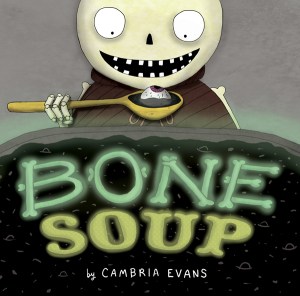 Succulent eyeballs float among tender bat wings, seasoning Cambria Evans’ Bone Soup with gross Halloween humor no five year-old can resist.
The main character Finnigin has a reputation for being a greedy eater. So when the witch finds out he’s coming to town, she warns her beastly neighbors. Everyone stashes their groceries away, hiding toenail clippings, frogs legs, and other ghoulish gourmet ingredients. No one offers him a bite to eat, not even a nibble of wormy cheese.
So the hungry, resourceful Finnigin boils a cauldron in town square. Into the bubbling pot he drops one dry bone, claiming it will create a magical delicacy. Of course, the curious creatures can’t help but add to the brew, and soon everyone is feasting on slimy gruel thickened with dried mouse droppings. Yum!

Evans’ pen-and-watercolor illustrations strike just the right balance between spooky and funny. The mummy wears a pretty pink bow and the werewolf looks more like a harmless hedgehog. The green and brown color palate makes every page feel like it’s glowing in the dark, adding to the fun Halloween spirit.
Stone Soup has been retold many times, but never with so much disgusting deliciousness.





 Writing for Kids (While Raising Them)