You are currently browsing Tara Lazar’s articles.
I am thrilled to share my Storystorm success story here!
 For those who don’t know me, my name is Jaime Zollars. I’m an illustrator who has been drawing pictures for young readers since 2003. I have illustrated many books for other authors, most notably, Kate Milford’s wonderful GREENGLASS HOUSE series and Claire Legrand’s enchanting FOXHEART.
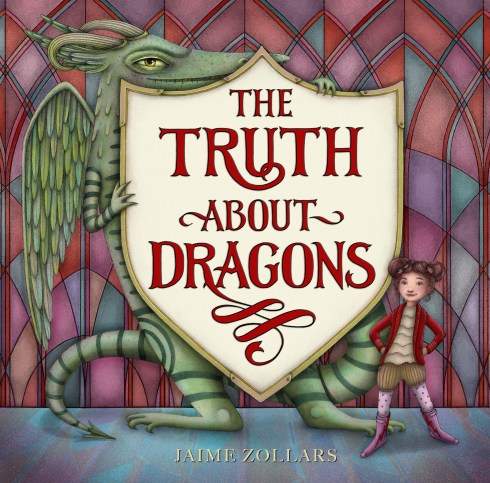
After years of illustrating the writings of others, my first solo picture book, THE TRUTH ABOUT DRAGONS, will be published by Little, Brown Books for Young Readers on September 15, 2020! This is very exciting to me because I told myself way back in 2003 that I was going to make my own book, and it took (WAY) longer than expected to make that happen.
WHY did it take so long to happen? Well, I keep an optimistic list of tasks for myself daily and only a fraction of them get done. Those remaining list items are carried over to the next day, and this series of events repeats daily. For 15 years. Turns out that nothing that isn’t at the very pressing top of my list will ever get done, unless: it is suddenly on fire, is very enjoyable, only takes a few minutes, or is decidedly easy. Writing a picture book (for me, at least) is not particularly enjoyable, takes more than a few minutes, and is not easy. Writing is an unpredictable creative process that takes energy and time and focus. Writing a picture book is simply a list item doesn’t get neatly checked off.
Enter the challenge to come up with one idea for a picture book a day. This is a task that is decidedly checkmark-able.
I resolved to give PiBoIdMo (Picture Book Idea Month, now Storystorm) a whirl back in 2014 with a friend and fellow-illustrator, Wilson Swain. (He is talented and you should check out his work at wilsonswain.com.) We kept each other accountable by checking in weekly and sharing our ideas. NOW, some of these ideas were not good. Truly, 90 percent of these ideas were terrible. BUT occasionally, something would trigger more thought. One of my ideas in particular, was just a title. “The Truth About Dragons” sat on my list for some time. It was all I could come up with on that particular day when I had to come up with something. But this title intrigued me enough to consider it well after the month was through.
About a year later, I was driving alone in my car and thinking about this title again. I asked myself pointedly: “What IS the truth about dragons?” (I often talk to myself when my kids are not in the car.) My brain struggled as usual with this query, but then surprised me by proclaiming that dragons LOVE mint chocolate chip ice cream, they are actually very afraid of kittens, AND they love their little sisters even if they pretend that they don’t. None of these examples actually made it into the book, but the concept stuck. Dragons are just like us! Over the next few days, this idea grew into the concept that sometimes things look different when we’re afraid, and if we can see past our fears, perhaps we’ll uncover the truth. I thought about how the illustrations could take the lead in this title and invite readers to figure out the visual puzzle for themselves (the dragons turn to kids one-by-one as the protagonist learns more about them). And THAT was when the task of making my own book went from just another checklist item that would be indefinitely carried over, to a checklist item on fire.
The rest of my PiBoIdMo ideas also helped me to feel confident soliciting an agent. I had several kernels of ideas ready to share as soon as I had agent interest, and I signed with the infectiously enthusiastic Stephen Barr at Writer’s House in 2015. He looked over my book ideas and The Truth About Dragons was his pick as well. He was invaluable as we started working with this story in the background of my other deadlines and sold the book at auction to the amazing Deirdre Jones at Little, Brown Books for Young Readers in 2017!
I’m honestly not sure I would have ever found the idea for this first solo book if it were not for Storystorm. I think we are mistaken if we assume (as I once did) that good ideas will come to us without some forced consideration. Waiting for inspiration to visit is a nice thought, but now I’m pretty sure that we can (and should) actively cultivate it. Storystorm, for me, was a low-pressure invitation to see things a little bit differently—if just for a month. Having to write something down, anything down, was a gift that trained my mind to actively pursue story alongside going about my days.
THE TRUTH ABOUT DRAGONS will be published on September 15, 2020. Kirkus even gave it a star (!) and calls it “A beautifully rendered, comforting, gentle lesson in overcoming fears.” I hope that it finds its way to the right parents, teachers, librarians, and readers as we all face a little bit of the unknown this fall.
Blog readers, Little Brown is giving away a copy of THE TRUTH ABOUT DRAGONS!
Leave one comment to enter.
A random winner will be chosen in a few weeks.
Good luck!
You can see more of Jaime’s art at jaimezollars.com, learn more about her art and writing process by following her on Instagram @jaimezollarsart, and preorder the Truth About Dragons here: https://bookshop.org/books/the-truth-about-dragons/9780316481489. Because there is just no way to do traditional book events at this time, send me a copy of a pre-order receipt from anywhere books are sold, along with your address, and I’ll even send you a signed mini-print to celebrate!
*Extra note for those interested: I also have a curriculum guide for this book for those who can use it—including parents who are doing some of the teaching in these strange times. I’m happy to send that out to anyone who e-mails me at jaime @ jaimezollars.com.
I’ve always loved the brainstorming part of the writing process. Endless possibilities! Bright, shiny story ideas! Hearts, unicorns, and rainbows! Imagine my excitement, then, when I discovered Tara Lazar’s PiBoIdMo, later re-envisioned into Storystorm. A whole month devoted to brainstorming? Yes, please!

Storystorm has become such an important part of my journey as a writer. Many of the posts shared by fellow kidlit authors have served as inspiration diving boards for my stories. I’ve filled notebooks with countless ideas. Some are only a few words or a title. Some have more fleshed-out plots. Others, though, explode into fully developed stories.
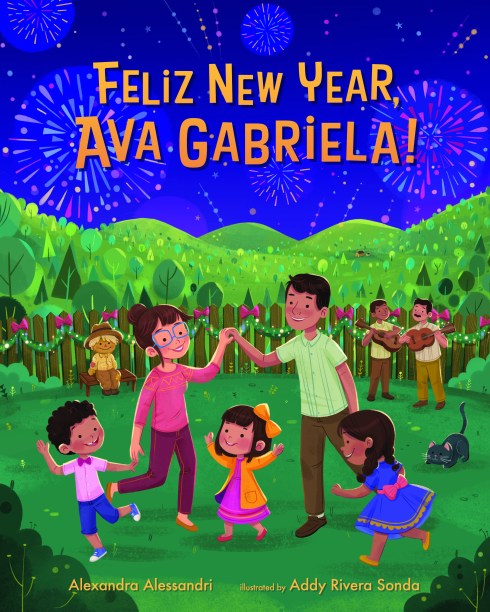
In fact, both of my upcoming picture books, FELIZ NEW YEAR, AVA GABRIELA! (Albert Whitman) and ISABEL AND HER COLORES GO TO SCHOOL (Sleeping Bear Press) were conceived during Storystorm.
In Storystorm 2018, Debbi Michiko Florence (Day 4) explored Culture and Family Tradition, and boy did her post resonate with me! I discovered that my Colombian heritage and memories provided a fountain of ideas. All of the foods, traditions, and family sayings came pouring out, and a few kept poking me to write them: the Colombian Andes and farms of my youth, the Año Viejo and our New Year’s Eve traditions, the energy of holiday get-togethers with my large extended family. But while I knew I wanted to include these elements in a story, I had no idea who or what the story was about, nor did I have a vision yet for its “about about.”
Then, on New Year’s Eve 2018, a week before Storystorm 2019 started, I watched as a friend’s young daughter shifted from hiding-behind-Mom-shy (just like I was at her age) to bouncing and squealing with excitement as the fireworks swished above us. I remember telling her, “Ava, you found your voice!” And thus my debut FELIZ NEW YEAR, AVA GABRIELA! (illustrated by Addy Rivera Sonda), which releases this October 2020, was born. It was the perfect mashup of memory, culture, and observation, and many of the details that came from Debbi’s post made it into the final draft.


That wasn’t my first experience with Storystorm, though. My very first was in 2015, back when it was PiBoIdMo (Picture Book Idea Month). That year, Jessixa Bagley (Day 7) activated her muse and urged us to search [our] memories. Carter Higgins (Day 15) rewound things and guided us through finding a story’s “about about.” Both of these posts helped me develop a budding tale about a little girl who didn’t speak English and who was scared to make friends because of the language barrier—a story that blossomed from my memories of being a kindergartener in New York, coming from a Spanish-only home. I wrote and revised and revised some more (rinse and repeat) until it was ready. ISABEL AND HER COLORES GO TO SCHOOL releases Fall 2021.
I swear magic really exists. All you have to do is read through the posts of Storystorm and PiBoIdMo past to see it. Of course, you need more than a great idea to publish a book. You need perseverance, hard work, and heaps of patience. You need willingness to revise your words over and over (and over) again.
But it all starts with a seedling of possibility that Tara Lazar makes possible through Storystorm. I will always be grateful to her for creating magic. Thank you, Tara!
You’re welcome, Alexandra! And thank you for sharing your successes. I hope everyone will join us for Storystorm 2021 in January!
 Alexandra Alessandri is a Colombian American poet, children’s author, and Associate Professor of English at Broward College. Her poetry has appeared in The Acentos Review, Rio Grande Review, Atlanta Review, and YARN. Her debut Feliz New Year, Ava Gabriela! releases October 1, 2020 from Albert Whitman & Company, followed by Isabel and Her Colores Go to School in fall 2021 from Sleeping Bear Press. Alexandra lives in Florida with her husband and son. Visit her at alexandraalessandri.com.
Tara: Well, howdy, Mr. Funk!
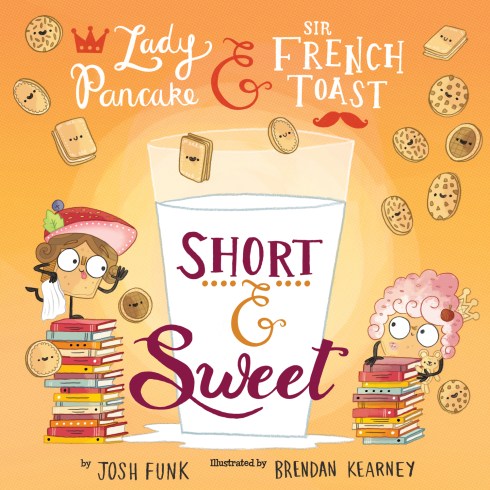
Josh: Hiya, Tara! Thanks for having me back to talk about SHORT & SWEET, the fourth book in the Lady Pancake & Sir French Toast series.
Tara: Actually, you’re here to discuss tips for writing about anthropomorphic characters. And, you’re not actually HERE. We’re still social distancing.
Josh: Oh.
Tara: So what’s the trick? How do you do it?
Josh: I don’t really think there is a trick.
Tara: Wow, this is gonna be a stellar post. [eyeroll]
Josh: Okay, okay. I think that maybe the trick is that there is no trick.
Tara: You already said that. You gotta do better.
Josh: I mean that there’s really nothing special about making a character who’s not a human have humanlike qualities. You just treat them as you would any human.
Tara: Aha. Like the Human League? You know I dig 80’s music.
 Josh: Well, think about any book featuring animals. Take one of my all-time favorites, BOATS FOR PAPA by Jessixa Bagley. The book is about a boy and his mother. It doesn’t matter that they’re beavers. They have the same connection a human child and parent would have. The emotions are all there. We, the readers, can immediately associate with Buckley, a boy who misses his father, and his Mama.
Tara: Okay, but animals are already pretty close to humans–they have eyes, nose, mouth, can move around… What about something that isn’t actually alive in the real world?
Josh: Like Patience and Fortitude in my book LOST IN THE LIBRARY illustrated by Stevie Lews about the lion statues that guard the steps of the New York Public Library?
Tara: Hmmm, I don’t know. They’re statues, but they’re statues of lions. And lions are animals. I don’t think that counts. BTW, great job sneaking in the title of another one of your books. [second eyeroll]
Josh: Thanks. The sequel, WHERE IS OUR LIBRARY? comes out on October 27th.

Tara: Geesh, I thought you were here to talk about SHORT & SWEET.
Josh: Right, sorry.
Tara: So let’s cut to the chase—how do you write anthropomorphic food characters? They’re not humanlike. They don’t have parents or built-in emotions. How does that work? What’s the trick?
Josh: It’s really the same answer. There is no trick. I just treat them as if they’re people in their specific setting. It’s really not all that different from Private I in another one of my favorite picture books, 7 ATE 9 written by Tara Lazar and illustrated by Ross MacDonald.

Tara: Good save, Papa J. Funk!
Josh: Or do I like the sequel, THE UPPER CASE: TROUBLE IN CAPITAL CITY better? It’s so hard to decide.
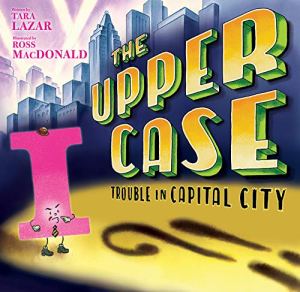
Tara: Aww, thanks.
Josh: Who knows, maybe I’ll enjoy book #3 the most when it comes out next—
Tara: Okay, you’re pouring it on a little thick now, pal.
Josh: Got it. But think of Private I. Private I is a detective in a well-defined world where all of the inhabitants are letters or numbers or punctuation and so forth. Do we know much about Private I other than the fact that he’s a private eye and he’s got a thing for B (and hard-boiled puns)? Not really. We know he loves to solve mysteries. He loves to discover the truth and save the day. But those are qualities common to most detective main characters. And that’s about all we know.
The charm of those books isn’t the fully fleshed out characters. It’s the world. It’s the mystery. It’s the cleverness, humor, quirkiness, and puns that we love.
Tara: I guess that makes some sense. That Tara lady is a pretty good writer.
Josh: Exactly. And, I treat Lady Pancake and Sir French Toast as I’d treat any other creature thrown into the world that they’re in: a fridge. They have wants and needs, emotions and feelings and on the first spread, I throw in the conflict.
There are only a limited number of things that can happen to characters in a fridge. They could be nearly out of syrup, resulting in an argument and race between two friends (see book #1: Lady Pancake & Sir French Toast).

There could be a terrible smell threatening to destroy the fridge, causing them to solve the mystery behind the stinky stench (see book #2: The Case of the Stinky Stench).

The fridge could start to freeze over, forcing them to team up with their nemesis, Baron von Waffle, to save the world from the next ice age (see book #3: Mission Defrostable).

But really, the two main characters are just generic hosts who experience these bad things happening. There’s not too much to them.
I think the charm is the setting and the adventure. The rhyme and the silliness. The hilarious illustrations from Brendan Kearney. But the truth is, after four books, we don’t really know all that much about the characters of Lady Pancake or Sir French Toast.
Tara: So to sum it up, the trick is there’s no trick. You treat the anthropomorphic characters as if they’re just like you and me, experiencing things in their own world, their own special setting.
Josh: I couldn’t have said it better myself. It’s almost like I’m writing your half of the blog post dialogue in addition to mine.* **
Tara: So tell me about this new, fourth book in the Lady Pancake & Sir French Toast series.
Josh: I try to change up the genre in each of the books. Book #1 was a race. Book #2 was a mystery. Book #3 was an action/adventure (inspired by Indiana Jones and the Last Crusade and James Bond, despite the title being a riff off Mission Impossible).
For Short & Sweet, I originally intended it to be a sci-fi/comedy (like The Absent-Minded Professor or Honey, I Shrunk the Kids), but it might be more like a magical-body-swap story (like Freaky Friday or Big).
After 3 literary adventures and over 5 years in the fridge, Lady Pancake and Sir French Toast are, regrettably, beginning to go stale. But have no fear! Professor Biscotti has a DE-spoiling ray that can help. Unfortunately it malfunctions and turns our titular characters back into tiny (adorable) toddlers who run amuck in the fridge causing culinary chaos once again. With a little STEM expertise and some maple syrup, it all works out in the end (spoiler alert – should I have said that before I told you it worked out? Probably. Oops).
Tara: Sounds delicious. And that’s the real problem with food books. I get so hungry reading them that I put the book down and get something to eat.
Josh: On that note, why don’t we end this interview and go grab some brunch.
Tara: Remember social distancing? We’d better dine over Zoom.
Josh: Sounds good. But how will we pass the salt?
Blog Readers, Josh is giving away ONE critique of a picture book manuscript. Just comment below…blah blah blah
* Josh actually did.
** But Tara changed some stuff. Except for the “blah blah blah” part. I kept that.

Photo credit: Carter Hasegawa
Josh Funk is a software engineer and the author of books like the Lady Pancake & Sir French Toast series, the It’s Not a Fairy Tale series, the How to Code with Pearl and Pascal series, the A Story of Patience & Fortitude series, Dear Dragon, Pirasaurs!, Albie Newton, and more. For more information about Josh Funk, visit him at joshfunkbooks.com and on Twitter, Instagram, and Facebook at @joshfunkbooks.
 Every year I’ve had the pleasure of asking the Carle Honor recipients a salient question about picture books, the medium in which they have made a profound impact.
That tradition continues, although the annual ceremony will be reimagined as a virtual benefit on Thursday, September 24, and this year’s Honorees will be commemorated at Carle’s 2021 in-person event.
For the Virtual Benefit, picture book art by some of publishing’s most esteemed artists will be auctioned off, with proceeds benefiting the museum. Bidding begins in mid-September and will culminate in a live two-piece auction during the virtual benefit.
Please support the museum and its mission here!
Sign up for the Virtual Event. It is absolutely free to attend, but you must register to get the link.

In 2020, given our extraordinary circumstances, I’ve asked this year’s distinguished honorees a question we all may need answering:
How do picture books provide a safe space for children and their families navigating through difficult times?
 Every Child a Reader
Angel Honoree
Represented by Carl Lennertz, Executive Director
The biggest benefit of picture books comes if parent and child read together. During these times, being together versus alone in one’s room is a huge plus and discussing a book’s themes brings the additional benefit of conversation and soothing voices. And even if one reads quietly in one’s room, pictures and stories take us away to another time and place. Books are love.
 Raúl Colón
Artist Honoree
Picture books take the readers to another world. Or at least through some sort of journey. Especially wordless picture books, which make the mind enjoy the trip a little more. Now the observers have to decipher what they see in front of them. Bring some sort of coherence to all the visuals that remain in a certain order in their eyes. Once they’re lost in that visual adventure, they leave the physical space they find themselves in, and fly away to another place—the difficult times left behind, if only for a moment. However, the lingering effects of a good story may last for hours—or even a lifetime.
 Patricia Aldana
Mentor Honoree
Publisher, Aldana Libros
My father was born in Guatemala in 1907 into a professional, military family of some means. In 1910 they lost their mother. And in 1917 the year he turned ten Guatemala City was almost completely destroyed by an earthquake, leaving my father and his siblings with nowhere to live. They were sent to stay with their grandmother, herself dependent on her son in law, in a small city in the east of Guatemala. Suddenly they had no money. My father, at twelve, had to go and work as a timekeeper on the railroad—a company then owned by the United Fruit Company which used the trains to bring their bananas to the port on the Gulf of Mexico. My father was very bright, but he had to leave school. By some miracle there was an outstanding library nearby. It had the great books of the Western Canon from Shakespeare, to Cervantes, to Racine, to Tolstoy to Dickens. By going and reading in this library every day after work my father succeeded in passing his bachillerato, his secondary degree. He then went to medical school, became a doctor, and a surgeon. He was one of the best-read people I have ever known. Eventually he became the Surgeon General of Guatemala and founder and first rector of the Universidad del Valle de Guatemala. I think it is correct to say that reading saved my father’s life.
Sad to say, there were no picture books in those days. Today’s children have a treasure trove of such books.
Around the world IBBY (the International Board on Books for Young People) has developed the practice of bringing wonderful books to children in crisis, reading aloud to them, and giving them books to read to themselves. Following earthquakes in Japan, Chile and Indonesia; with refugee children in countries ranging from Afghanistan to San Salvador to the US border, to Syrians in Lebanon, to refugee kids in Toronto, our experience has been that this practice of bibliotherapy has a hugely beneficial effect on children who may have faced death, displacement and loss. Many are able to talk for the first time about the trauma they have experienced. They sleep better. They play better. They can laugh again.
How could this not work with children stuck at home by Covid-19? After all this is a traumatic time, too. Setting aside a special reading time, separate from all other activities for an hour a day; reading aloud from really good picture books; talking about the books; drawing pictures, singing—letting the child lead the way. This should be time away from media, schoolwork, and should be completely free from any kind of didacticism.
There are several essential things to keep in mind. The first and most important: Let the child choose the books. Have a pile of great books, vary them, but let them choose. In our experience children in dire circumstances may want books that are funny, or about love, or that are sad. Let them talk, let them interrupt, but make it the most fun moment of the day. And even with older kids starting the special books time by reading aloud—as long as it’s a book the child has chosen, can help to engage them. And let them talk about the books. Reading saves lives.
Congratulations to the Honorees and thank you for sharing your wisdom!
The Carle Honors Honorees are selected each year by a committee chaired by children’s literature historian and critic Leonard S. Marcus, who was central to the founding of the Honors. The committee recognizes four distinct awards: Artist, for lifelong innovation in the field; Angel, whose generous resources are crucial to making illustrated children’s book art exhibitions, education programs, and related projects a reality; Mentor, editors, designers, and educators who champion the art form; and Bridge, individuals or organizations who have found inspired ways to bring the art of the picture book to larger audiences through work in other fields. This year’s Bridge Honorees are Dennis M. V. David and Justin G. Schiller, founders of Battledore Ltd.
Visit The Carle Museum online at carlemuseum.org.
Ready…set…
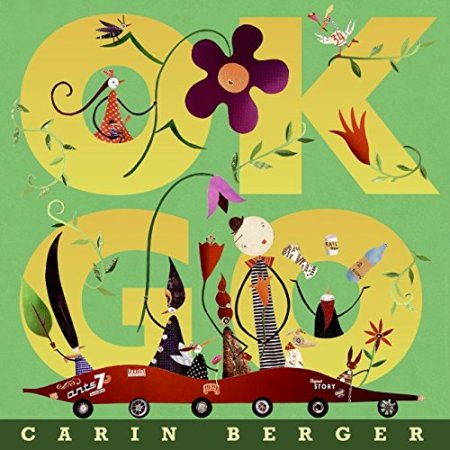
Yes, it’s time to GO!
Where, you ask?
To the Pen and Ink Brigade’s STAND UP Art Auction! Going on NOW!
But first, author-illustrator Carin Berger is here to tell us a little about it. Carin, what is the Pen and Ink Brigade and how did you get started?
The Pen and Ink Brigade is a group of women artists/activists who have joined forces to use our art to create progressive change. Many of us are well known picture book creators and illustrators.
The 2016 election really galvanized us. We gave ourselves the name, the Pen and Ink Brigade, and marched together in the women’s march. We began to realize that, collectively, we had a vast pool of talent and shared political beliefs. And, kind of on the fly, we organized a fundraiser, the BLUE WAVE project, which was an art show and an art sale that benefitted a get out the vote [GOTV] group, VoteRiders just in time for the 2018 midterm elections. Somehow, in a matter of weeks, we pulled the project together. Each artist created a blue wave, which, when they were put together, made a great blue tsunami. We held the show at the Diana Kane Boutique in Brooklyn, and managed to sell all the art. It was empowering and exhilarating. And we haven’t stopped!
Wow! What project did you tackle next?
After the BLUE WAVE project the women of the Pen and Ink Brigade worked together on a number of projects. We created a mural proposal for AOC’s office in Jackson Heights, NYC. We made a backdrop for a fundraising event, Persisticon, and we put together a bi-coastal art show, PINK NYC + PINK SF, with 80 artists, all women, who created work that reclaimed and re-defined the color pink. We raised over $20,000 for Stacey Abrams’s voting rights initiative, FAIR FIGHT ACTION, to help ensure people’s right to vote in the upcoming 2020 election. It was super inspiring to see the art come in, and for the color PINK to be reclaimed as something fierce and provocative and powerful.
What is this week’s STAND UP! Auction all about?
And now, in time for November, we have yet another project. STAND UP! is a fundraising auction. 100% of the proceeds will go to EMILY’s List to help diverse, progressive women candidates get elected. We came to this theme after watching people bravely working together to confront the many difficult challenges that we are facing as a country right now. The pandemic, the importance of BLM, the economic hardship so many of us are experiencing, the inequities that affect schooling and health for people. Climate change. These are tough times. But it has been heartening to see our communities coming together and standing up for what is right. We structure the call for entries to be flexible and open ended, allowing each artist to create a piece that addresses a specific issue that the artist was standing up for.
Please tell us what your piece for the auction is about!
My piece is titled STAND UP for ALL OF US!
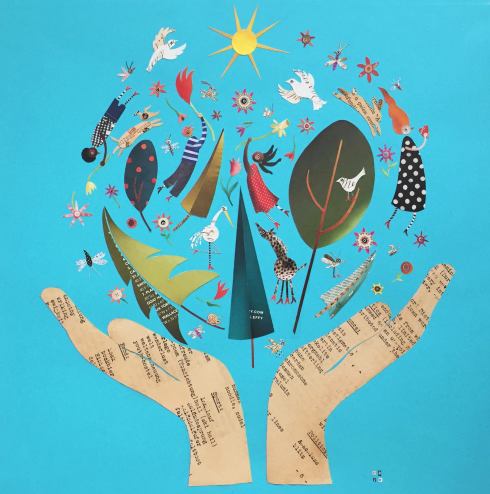
I was thinking about what our country and world needs to move forward, and on that list was diversity, inclusion, connection and community. That is my hope for this moment, that broadly, we will find a way to STAND UP and join forces and find the beauty in the wild diversity that we each offer, but also that deep need for connection that we all have.
These ideas also thread through many of my books like The Little Yellow Leaf and Forever Friends. And explicitly in All of Us, which I wrote in response to the 2016 election. I deeply believe in the power of love and community, and in these dark divisive times, I have been heartened by the way people have come together to STAND UP!
The STAND UP! Auction is going on today through August 28th! See all the artwork available at penandinkbrigade.com/standup.
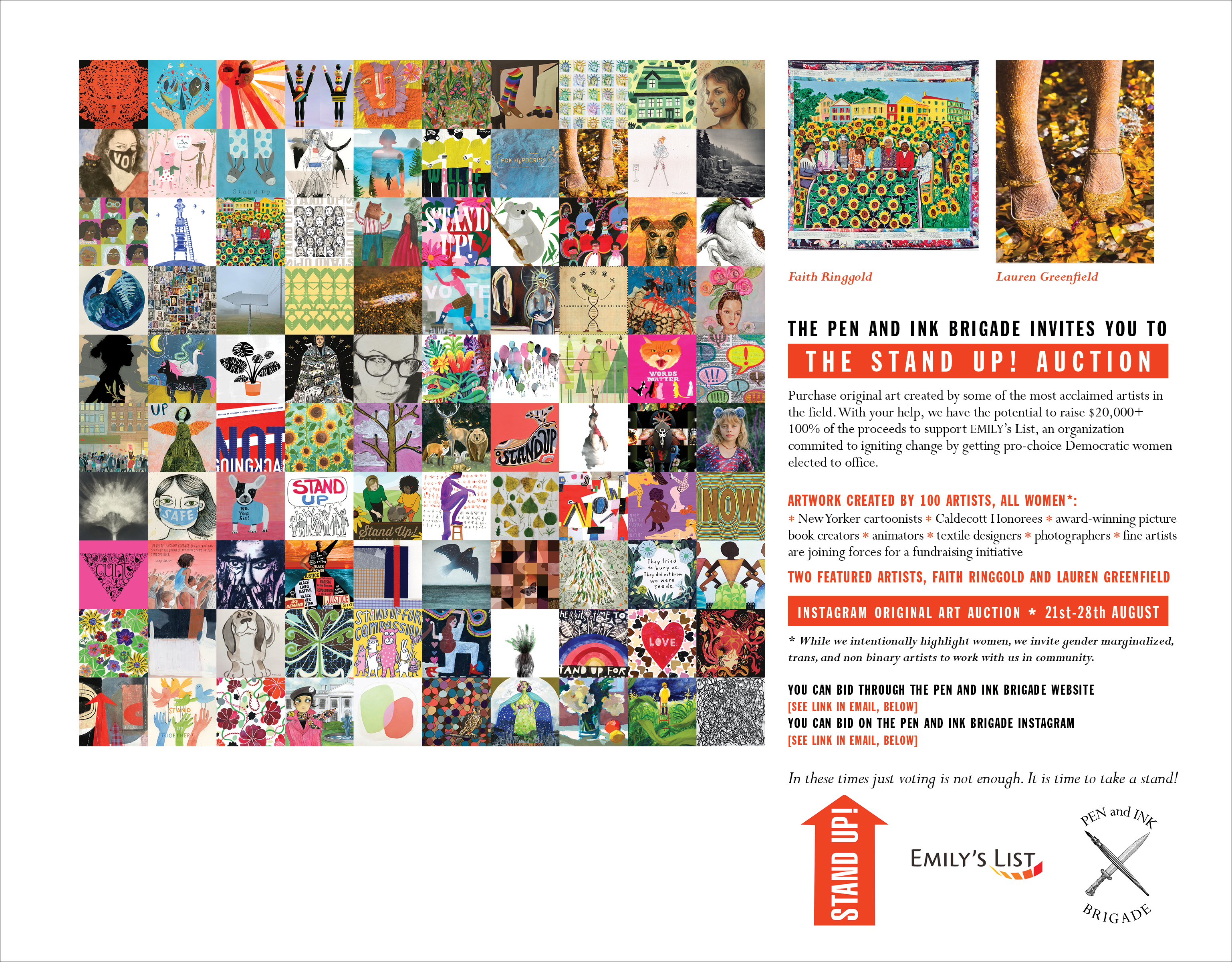
Also, you can tune into an interview with author-illustrator LeUyen Pham tonight on Instagram Live:


OPENING THE ROAD is the true story behind the Green Book guide Black Americans used to travel safely during legal segregation…and the mail carrier who wrote it.
Today author Keila Dawson is here to talk about how the 2017 Storystorm challenge inspired this story. Congratulations and take it away, Keila!
After reading a 2017 Storystorm post by Brenda Reeves Sturgis, Social Media Inspires Social Awareness, I heard an interesting story about the Green Book travel guides on a different type of media—the radio. The broadcast was an interview with the creator of a BBC documentary on the Green Book. I learned it was written and published in the 1930s during a time when finding places to eat, sleep, or get gas on road trips wasn’t easy or safe for Black Americans. I had always wanted to write a narrative nonfiction story and thought there was an audience for this story about the man and the book that changed lives for so many people.
Keila, how did your initial idea grow and change?
I followed the links provided by the broadcast host to learn more about the guide and fell down a research rabbit hole!
From a quick search, I found one other title published about the topic, a fiction picture book, and gave myself permission to dedicate the time to dig deeper. Filling in the gaps of my own personal knowledge of the history during that period made me even more determined to write this story.
My first draft read like a Wikipedia page with lots of dates and facts. There was very little public information available on Victor Green, the mail carrier who published the guides, but they were in the public domain. I read the introductions he wrote and articles he published in every guide. I learned he got the idea from the Jewish press.
I connected with experts such as a Jewish historian and museum curator, a photojournalist searching for Green Book sites once listed in the guides, a former mail carrier who is now a college professor that studies the history of postal workers activism, and a story arc emerged. After the movie “Green Book” released, I already had the bones of the story, but it sparked a lot of discussion about the guide and I had access to even more information.
What did your illustrator bring to the project?
When the publisher started looking for an illustrator, my editor told me they reached out to Alleanna Harris but not to get my hopes up because she was in such high demand. It was clear from other nonfiction books Alleanna illustrated that she would do the research and add so much more to the story, so I crossed my fingers and toes. Knowing she signed on the project assured me it was in talented hands. Literally!
The cover…which I will reveal now…

…and interior spread show exactly what I wanted readers to take away from this book: yes, legal segregation made travel and life difficult for Black citizens. Yes, there was unfairness, and protests, but there was also room for joy. And Victor Green found a solution that worked at that time. It felt like he led and won a battle in the war against racism. And Black families, their communities and allies helped create the change they wanted, together.
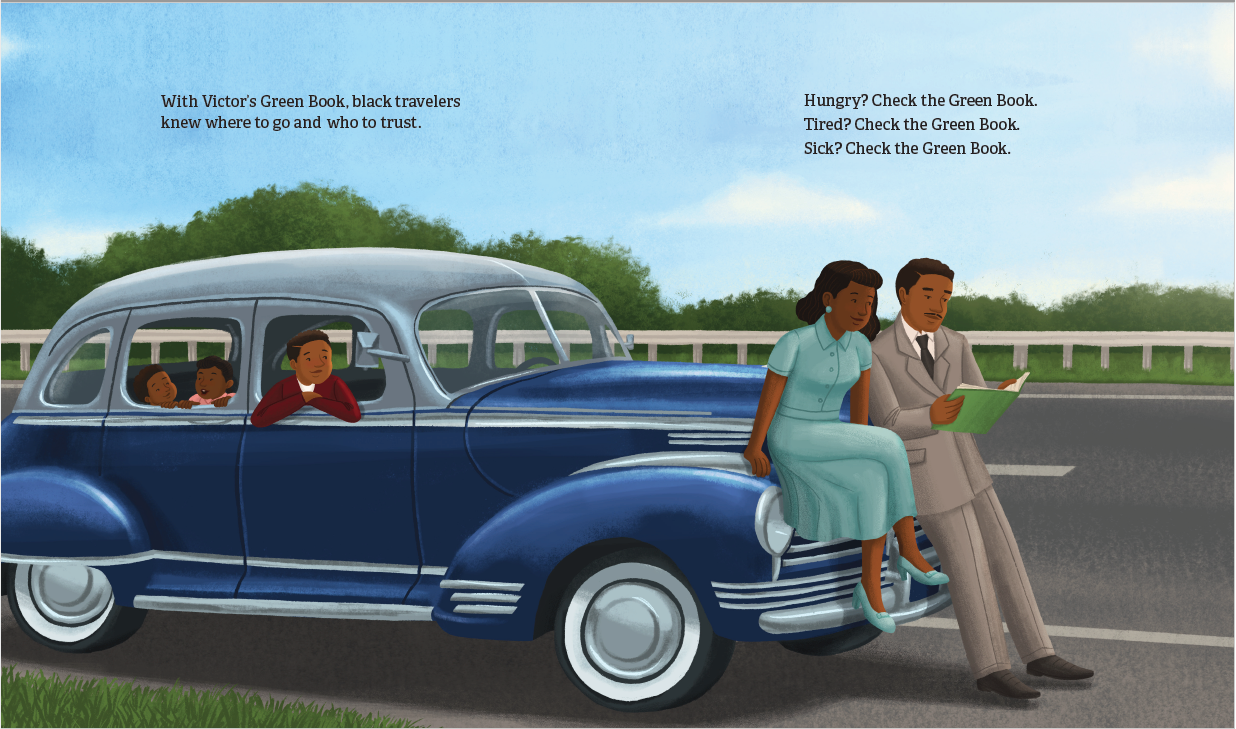
Although the story and art in OPENING THE ROAD: Victor Hugo Green and His Green Book take you back in time, kids will connect things that happened then to today’s events and see what has and hasn’t changed over the last 80 years.
Thank you, Keila, for introducing us to your book.
Keila will be giving away a copy of OPENING THE ROAD to one lucky blog reader.
Leave one comment below to enter.
A random winner will be selected next month.
Good luck!

Keila V. Dawson worked as a community organizer, teacher, school administrator, educational consultant, and advocate for children with special needs before she became a children’s book author. She is co-editor of No Voice Too Small: Fourteen Young Americans Making History, along with Lindsay H. Metcalf and Jeanette Bradley, illustrated by Bradley (Charlesbridge, September 22, 2020), the author of The King Cake Baby, and the forthcoming Opening the Road: Victor Hugo Green and His Green Book, illustrated by Alleanna Harris (Beaming Books, January 26, 2021). Dawson is a New Orleans native and has lived and worked in the Philippines, Japan, and Egypt. Visit her at keiladawson.com, on Twitter @keila_dawson, on Instagram @keilavdawson, and on Pinterest @keiladawson.
Thank you, Tara, for hosting the cover reveal for CAPTAIN GREEN AND THE TREE MACHINE!
READY TO ZOOM OFF ON A SPECIAL SUPERHERO MISSION?
Captain Green is back and this time he’s creating a gadget to help save the planet. As he fine-tunes his invention, disaster strikes. Hornbill’s tree has been chopped down and there’s tree trouble for Elephant and Orangutan, too. Captain Green scrambles to finish his invention—a TREE MACHINE—and speeds to the rescue! ZAP! ZOOP! ZINK! Trees pop up all around until…BANG! Oh no! How will Captain Green save the animals now?
This is the second story in a series, following on from Captain Green’s adventures in CAPTAIN GREEN AND THE PLASTIC SCENE. Both books are illustrated by the phenomenal Danny Deeptown and published by Marshall Cavendish.
CAPTAIN GREEN AND THE TREE MACHINE releases on Earth Day 2021 (April 22nd), but the cover is here today!
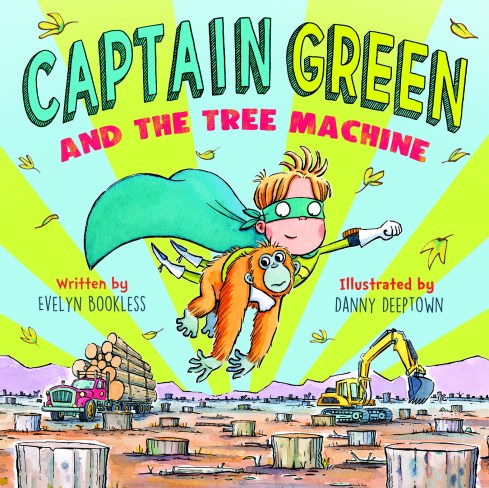
Evelyn and Danny asked one another tree—I mean three—questions about creating the book.
Evelyn: As you know Danny, I adore the cover for CAPTAIN GREEN AND THE TREE MACHINE. What were your main goals when creating it?
I wanted it to look fun and vibrant whilst revealing a side to the terrible truth about deforestation. Not easy combining the two, but I feel the uplifting expression of Captain Green is reassuring and will encourage children to look beyond the cover. It was also important to keep certain elements of the first cover as this book is the second in the series, e.g. with the title, background beams and a similar composition overall.
Danny: What surprised you with the end result?
I am always blown away by your work and am usually left in a bit of an emotional state upon seeing it for the first time, but once I mopped up my happy tears, I surprised at how well you told the essence of the story in only one image. We don’t see the tree machine on the cover, it’s left as a surprise for the reader because Captain Green still has to finish inventing it. We do see Captain Green working his little socks (and boots) off saving a desperate Orangutan, and the loggers leaving a path of destruction. I am delighted that the cover has tons of kid appeal, despite it portraying a very real scenario in our world today (sadly minus the superhero part!).
Evelyn: Did you sketch out different possibilities for the cover or had you a clear idea in your mind from the start?
I had the idea from the start, but it took a few sketches until I was happy. For me it was vital the Orangutan featured on the cover, as it’s sadly the one animal people most relate with deforestation.
Danny: What was your favorite part of the writing process for this story?
I enjoyed playing with superhero vocabulary and sounds to make Captain Green’s world come to life for readers and make the read-aloud experience as fun as possible. Even though this story is based on the real issue of deforestation, the story of Captain Green’s efforts to create a gadget to assist in his earth protecting endeavors, was where I had most fun as a writer.
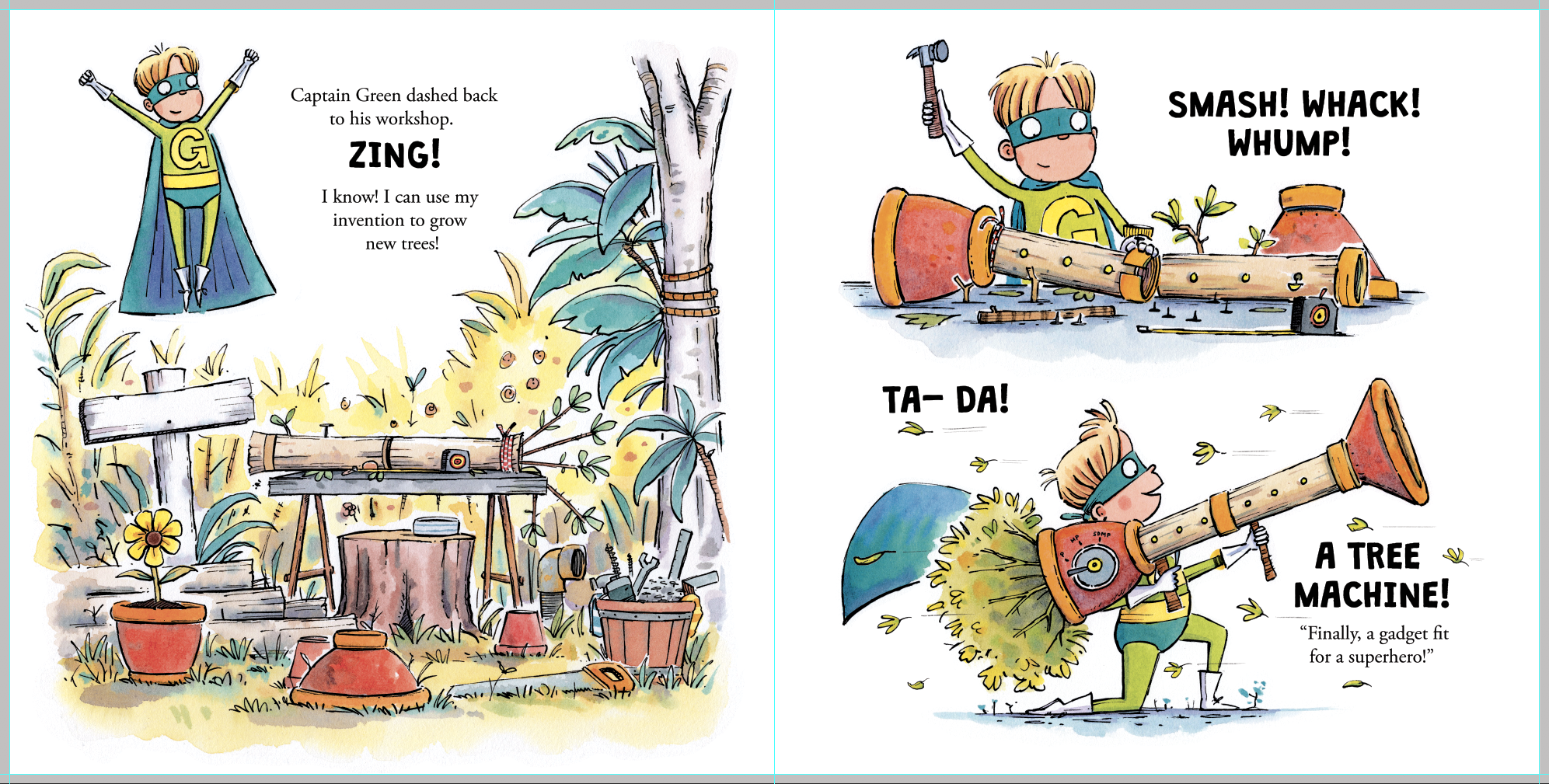
Evelyn: How did the illustrations for the first story affect the design for this book?
In regards to drawing Captain Green, it was easier as I had drawn him a thousand times before, therefore I didn’t have to worry about character design for this book. However, I wanted to improve him and the illustrations overall. There are a few illustrations that are purposely similar in layout to some in the first book. However, with a lot of spreads I had to be braver in terms of setting a scene of deforestation. To achieve this, I had to pan out so I could show as much deserted landscape as possible to get the message across. These are some of my favorite illustrations in the book.
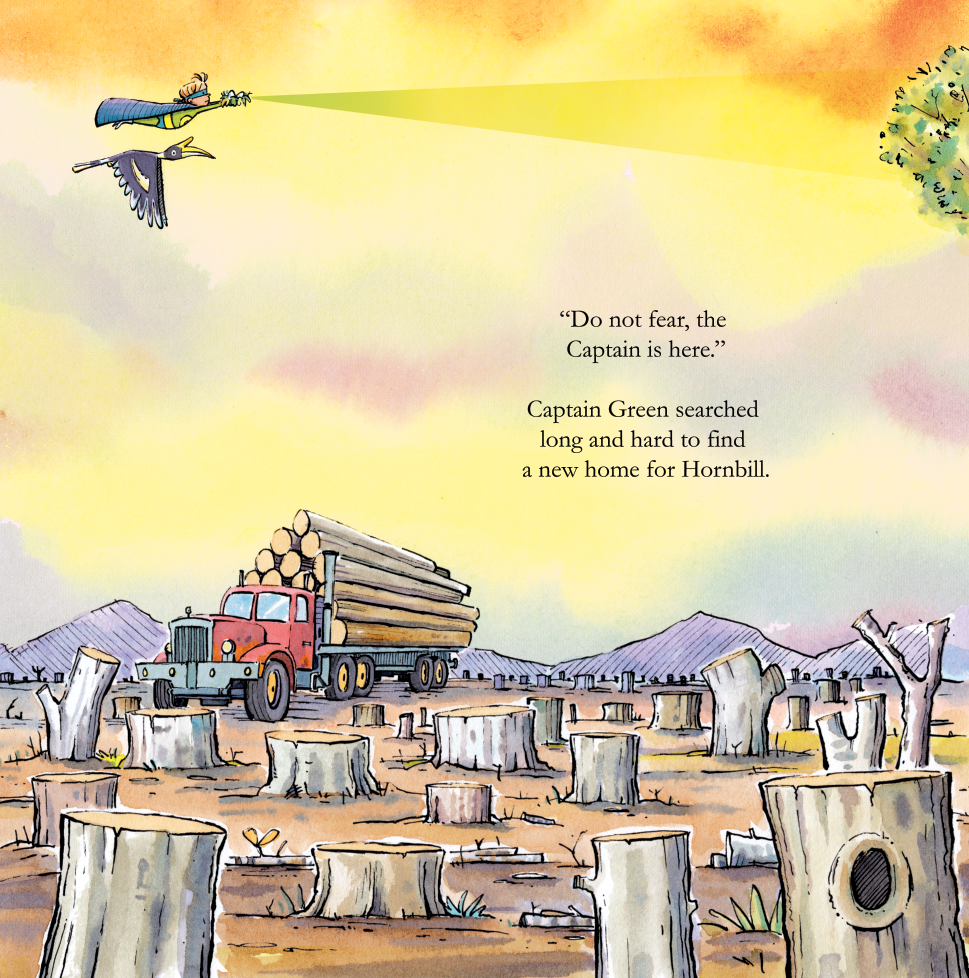
Danny: What made you decide on deforestation as the theme for Captain Green’s second adventure?
In in my travels throughout South East Asia (where the story is set), I saw huge areas of land that had been stripped of ancient rainforest for timber and to make way for agriculture and expanding populations. We know that a loss of trees leads to a rise carbon dioxide levels, soil erosion as well as the destruction of forest habitat and the loss of biological diversity of both plants and animals. As with CAPTAIN GREEN AND THE PLASTIC SCENE, I wanted to shine a light on an important issue in a way that is fun and engaging for children. I added some back matter that includes ways for young superhumans to help.

Set EARTH DAY off with a bang by pre-ordering a copy of CAPTAIN GREEN AND THE TREE MACHINE online today or through your local independent book store.
Evelyn and Danny will give away one copy of CAPTAIN GREEN AND THE TREE MACHINE to a lucky commenter (to be sent your way when it releases in April 2021)!
Leave one comment below.
A random winner will be selected next month.
Good luck!
 Evelyn Bookless grew up on a farm in the west of Ireland where she loved to make forts and play in the trees with her siblings. She is a nature lover, mum, teacher and writer. Evelyn spent ten wonderful years living in Asia but was saddened to see beautiful rainforests cut down during her travels around the region. She recently moved to the Netherlands, where she enjoys cycling her blue bike, Betty. Evelyn and Danny’s debut picture book, CAPTAIN GREEN AND THE PLASTIC SCENE, won a Northern Lights Book Award for Children’s Environmental Fiction. Visit her online at evelynbookless.com, on Instagram @evelynbookless and on Twitter @evelynbookless.
 Being obsessed with wildlife from a young age, Danny Deeptown found his love of drawing through hours of copying scientific illustrations from books of animals and dinosaurs. His artistic talent later led him to study Illustration in South Wales, UK. It was here he found a love for classic book illustration and the use of pen and ink. Today, Danny creates art for children and adults alike. He has illustrated numerous books that mostly involve characterised animals. When not in his studio, Danny likes to spend his time adventuring and seeking out new places in nature that are relatively remote. He is happiest in a secret place surrounded by trees with passing water. Visit Danny online at dannydeeptown.com, on Instagram @dannydeeptown and on Twitter @dannydeeptown.
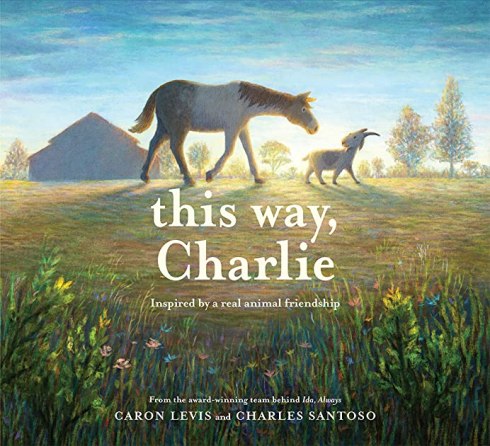
“The way I see it…Charlie would answer and Jack would listen.”
~ THIS WAY, CHARLIE by Caron Levis, with art by Charles Santoso
Guest post by Caron Levis
I have always been an eavesdropper and collector of things kids say and do. I’ve had a lot of opportunity to gather kid language through both my personal and professional life. I fill notebooks and index cards with verbatim quotes and observations; I re-tell my favorite anecdotes and kid moments over and over to adults or other kids; I’ve kept every anthology of student writing I’ve worked on. In the apartment I lived in during one of my first education jobs, I had the hallway plastered with quotes and writing from the students I was working with. I literally surrounded myself with their words and now, their words help me write books!

Notebook of kids’ words
I have always loved listening to kids and also the challenge of talking with them about their Big Questions and Big Feelings, so this—plus ye ole reading of plenty of wonderful kid’s books—has been where I’ve developed my writing ear and voice.
- LISTENING to kids has given me an internal sense of rhythm, vocabulary, phrase structures of many different children. As I draft, I’m reading aloud constantly to mostly imaginary (sometimes real-life) kids in order to feel how the words land.
- TALKING with real kids has given me practice in finding words that will meet their curiosity honestly while also being mindful of their feelings. These experiences help me imagine potential reader questions and reactions so I can try (it is so hard!) to be accountable to them.
- RECORDING things kids say and do has helped me remember ways kids have answered their own questions or made meaning out of challenging times. Most of my books have specific moments or quotes from children that guided the story in some way. Inspiration for STUCK THE BLOOZ came directly from a conversation with a kindergartener about being sad; IDA, ALWAYS got emotional direction from watching kids enact a funeral for a bug and a quote from a six year old who was grieving a close relative. THIS WAY, CHARLIE has many moments of kid inspiration that guided my writing choices.

THIS WAY, CHARLIE is about a horse named Charlie who is adjusting to going blind and a wary distrustful goat named Jack who meet at an animal sanctuary. After getting off to a bumpy start, the two navigate their own and each other’s challenges to become the best of buddies.
In one spread, Charlie urges Jack to hang out with some of the other animals but Jack is not ready. Overwhelmed by fear and frustration, Jack snaps something very mean to his beloved best friend.
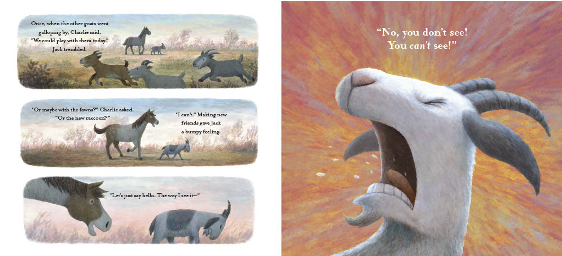
This moment with Jack was guided by many moments I’ve seen with kids (and adults!). I wanted to reflect, validate, and honor that these moments happen and that kids have the ability to unpack them. I found a quote in my notebook from a kindergartener who had had a fight with his best buddy. Like Jack, the goat, this child didn’t usually verbalize his thoughts and feelings, but rather communicated primarily through behaviors. So, when we sat down to unpack the fight with him, I admit I fully expected to have to give him language for his behavior—but instead, he explained it clearly to us. I have already heard young readers explaining Jack’s behavior in a similar way.
“I think part of it was a misunderstanding…then I said things, just because I was so mad, that were mean. But, like, I didn’t really want to say them.”
~ a kindergartener, after a fight with a good frien (2004)
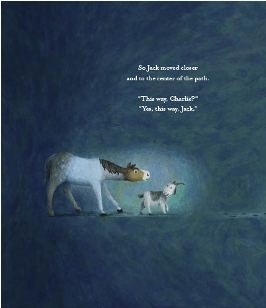
The animals in THIS WAY, CHARLIE come to depend on one another: Charlie depends on Jack for physical guidance to the field, and Jack relies on Charlie for emotional guidance as he begins to take chances on socializing. How do kids (or any of us) decide what makes someone dependable? Honestly, if you asked me in an interview to explain what being dependable means—I’d likely have some long garbled answer with a lot of ums in it. Luckily, my notebook has this gem in it from another kindergarten student who once told her class,
“Depending on someone means you really think they’ll help you.”
~ a kindergarten student
Now did I read these quotes in my book before I wrote THIS WAY, CHARLIE and consciously use them? Nope! But I had read through my blue-notebook a bazillion times and when I found these quotes after the book had gone to print, I recognized the influence. HOW I choose my words doesn’t come from my conscious Thinking brain so much as it comes from all I’ve absorbed from children over many years—and soooooo much nit-picking revision work.
Whenever I am stuck, or in need of inspiration, I turn to my collection of quotes for help—because I’ve learned I can always depend on the kids.
How have kids have inspired you?
Many thanks to Caron for guest blogging today…and for offering a copy of this lovely book.
Leave one comment below to enter the giveaway.
A THIS WAY, CHARLIE winner will be randomly selected in about two weeks.
Good luck!
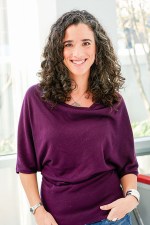 Caron Levis (MFA; LMSW) is the author of the award winning children’s picture book, IDA, ALWAYS (Atheneum) illustrated by Charles Santosos, which the New York Times Book Review calls, “an example of children’s books at their best.” Caron’s other picture book titles include: THIS WAY, CHARLIE (Abrams 2020, STOP THAT YAWN! (Atheneum); MAY I HAVE A WORD? (FSG), and MAMA’S WORK SHOES (Abrams.) Her stories for teens and adults have been published in magazines and anthologies; plays have been selected for the Estrogenius Festival and the Samuel French OOB Festival’s Final Forty; the film adaptation of Attendant won Best Short in Sunscreen Film Festival West (2018) and selected for the Garden State Film Festival. Caron is a professor at NYU and The New School’s Creative Writing MFA program where she is the advisor for the Children/YA concentration. Visit her at caronlevis.com.
It’s exciting to see new picture book covers since I can’t view them in the bookstore or library. (I know we all miss that!)
So today it’s time for Milly to make her entrance. She’s a donkey with dreams of attending the prestigious unicorn school. But when she’s accepted, she must make it through without anyone realizing what she really is: a donkey in a party hat. (Ha!!!)
Jess, how did you get the idea for FIRST DAY OF UNICORN SCHOOL?
On one level, the idea for this book came from watching my kids fight over a cardboard tube. Each of them wanted to use it as a unicorn horn. My daughter grabbed the tube and told my son, “You’re not a unicorn! You’re just a horse!” Boom. Instant story.
On another level, this book came from conversations I’ve had with other grown-ups. It seems like no matter where we are in our lives or careers, most of us feel like we’re totally faking it and live in fear of the day someone notices we aren’t special, we aren’t unicorns—we’re just donkeys in party hats. It made me realize that everyone feels like that sometimes. Normalizing imposter syndrome makes it feel less scary when it happens, and I think that’s a message both kids and adults could benefit from.
Absolutely! Every writer has suffered from feeling like a poser.
What hurdles, besides your own imposter syndrome, did you have to leap over while making this book?
This book almost didn’t happen! By December of 2018, I’d been working toward publication for six very long years and had racked up HUNDREDS of rejections from agents, writing contests, editors, mentoring contests, etc. If they were in publishing and could tell me no, they probably had. (In fact, my agent Rena Rossner rejected me twice on different projects before offering on UNICORN SCHOOL.) The night before a big Twitter pitch event, #PitMad, I decided enough was enough. It wasn’t going to happen for me. I scheduled some pitch tweets and if nobody liked them, I was done.
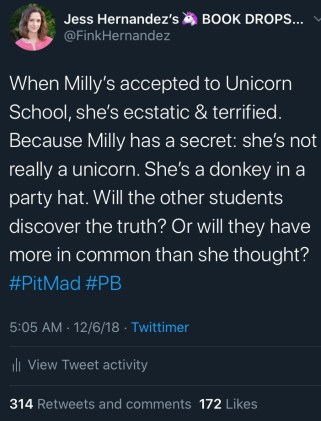
The next day, my pitch for UNICORN SCHOOL got over a dozen agent likes, more than 300 retweets, and a ton of comments offering encouragement. I didn’t get an agent from the experience, but it made me see that what I was doing had market appeal and was worth pursuing. The dream wasn’t dead yet!
It took another six months and joining an awesome critique group to get my “yes” from Rena, but even then, it was still touch and go with UNICORN SCHOOL. In the 18 months I spent querying the book, the market was flooded with unicorn stories. Every rejection we got from editors was some version of “nice, but we’ve already got one.” I was content to shelve it until unicorns stopped being the picture book version of YA vampire novels, but Rena was convinced it was different enough to sell. And thank heavens, she was right.
And here’s the cover! The book releases January 1, 2021 from Capstone:
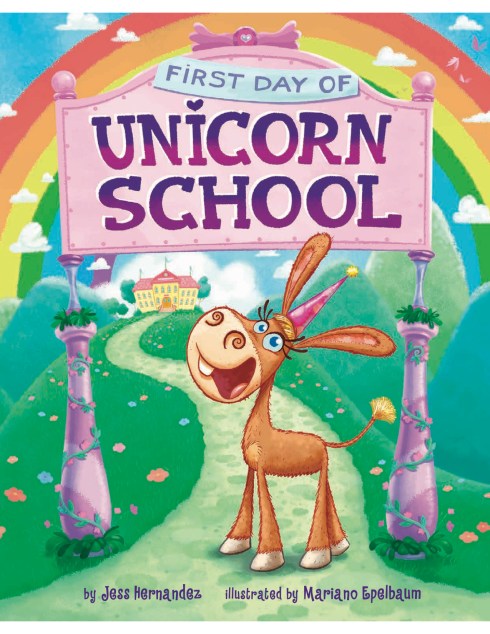
The cover is total happy-making, with eager Milly and a bright palette. Can you tell us about the illustrations?
When I was a kid, I read a lot of the classic picture books—Dr. Seuss, Eric Carle, Leo Lionni, H. A. Rey—and while they were great, the artwork didn’t really blow me away.
Then, as a teenager, I came across RED RANGER CAME CALLING by Berkeley Breathed. And I fell in love. The art was dynamic, hilarious, and felt almost three dimensional. So when my editor at Capstone asked me if I had any kind of vision for the illustrations, I knew exactly what style I wanted. And wow, did Mariano Epelbaum deliver. His work is fresh, fun, and full of life. I can’t wait for you all to see the interior, too!
Ooh, can we get a sneak peek?
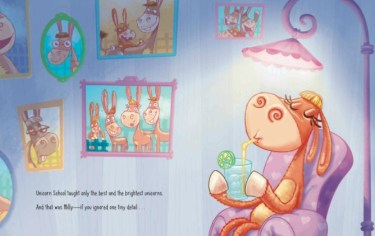
So cute! Love the family portraits.
Now let’s hear from Illustrator Mariano Epelbaum..,.
The cover is a bright and colorful invitation to a cute magical world where anything can happen.
Milly—the new student—wishes to be part of this ideal place, to be someone else.
Jess Hernandez invented a funny story full of messages about beauty, appearance, prejudice, and diversity—all human concepts but with imaginative wildlife characters where I feel so comfortable to show children that a better world is possible.
Thanks for stopping by, Jess and Mariano!
The creative duo behind Milly are giving away an ARC (F&G) of the book before it’s released!
Just leave one comment below to enter.
A random winner will be selected in a couple weeks!
Good luck!
 Mariano Epelbaum is an illustrator and character designer from Buenos Aires. He enjoys trying different styles of illustration, as he is inspired by each project he works on. Mariano worked as art director and character designer on the animated movie Underdogs. He has published books in the US, UK, Spain, Argentina, and Puerto Rico. When he´s not working, he likes playing with his two daughters, watching movies, and going for outdoor walks. Visit him online at mariano.artstation.com, and follow him on Instagram @mariano.epelbaum!
 Jess Hernandez has spent her grown-up life working with kids and books—as a teacher, a children’s librarian, a mother, and a picture book author. Her debut book, FIRST DAY OF UNICORN SCHOOL, illustrated by Mariano Epelbaum, comes out January 1, 2021 from Capstone. Jess lives in a very small, very LOUD house in Washington with her husband, their three children, a blind Labrador, and seven chickens. Find her on Twitter at @FinkHernandez, on Instagram @JessHernandezWrites, or at her website jesshernandezwrites.com.
Charlotte Offsay is celebrating her picture book debut with a cover reveal of THE BIG BEACH CLEANUP, illustrated by Katie Rewse, publishing in March 2021 with Albert Whitman. This book also happens to be a Storystorm Success Story!
THE BIG BEACH CLEANUP is about Cora, a young girl who joins hands with her local community to clean up plastic litter along the seashore and save the local sandcastle competition.
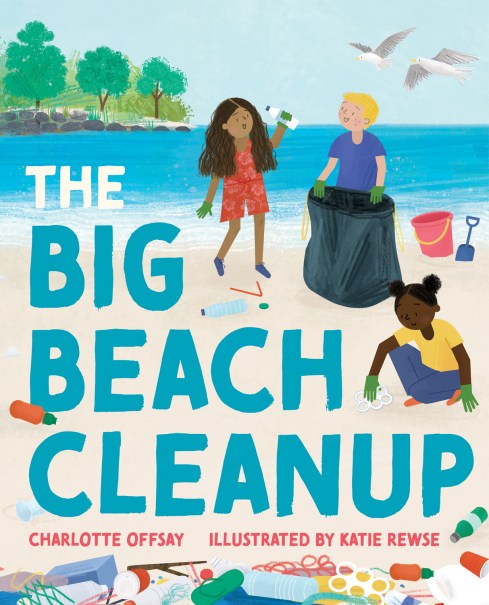
Congratulations on your debut picture book, Charlotte! Do you have a fun story about the making of the book you’d like to share?
THE BIG BEACH CLEANUP was the result of a few Storystorm ideas colliding. (As many of you reading this already know, for the month of January Tara Lazar runs Storystorm, where a number of kidlit creators help the writing community get their creative juices flowing and develop picture book ideas, which many of us then use to fuel our picture book writing for the rest of the year.)
During Storystorm I write down anything and everything that inspires me. My three-year-old son had just begun his superhero phase (which two years later is still going strong—maybe not a phase?) and I wanted him to clean up his toys before school. I attempted to motivate him by pretending we were superheroes who needed to clean up to save the world (whatever works right?!). Unfortunately, he saw right through my plot and responded with “I don’t feel like being a superhero today.” My first thought was “yea, I don’t feel much like a superhero today, either.” This thought stuck with me as I had to jog with the stroller uphill to get him and his five-year-old sister to pre-school on time. I added “I don’t feel like a superhero today” to my Storystorm list.
Later that month on one of our walks back from pre-school (which were always more leisurely that our walks to pre-school), as we paused to inspect whatever flower/leaf/bug my kids had spotted, I casually picked up a piece of trash and tossed it into a nearby garbage can. My kids immediately wanted to know what I was doing. Why was there trash outside? Who had put it there? Why was it important to throw it away? Their inquisitive nature lead to a series of environmental discussions, which resulted in their relentlessly pointing out garbage everywhere we went and “doing our part” eventually made its way onto my list.
Stay with me—this is the final puzzle piece, I promise. As part of my Storystorm process, I also look back to my lists from previous years for ideas that I still wanted to pursue. For a couple of years in a row I had written “how many hands.” This stemmed from my passionate belief that if we can convince enough hands to join together, we can change the world. I hadn’t found a path forward for this idea so I added it to my 2019 list.
These three Storystorm ideas…
- not feeling like a superhero
- doing our part to clean up after ourselves
- and small hands joining together to change the world
…collided and I wrote what will be my debut picture book: THE BIG BEACH CLEANUP.
Tell us more about the story!
THE BIG BEACH CLEANUP is about Cora, a young girl who plans to be a sandcastle-building champion. When the contest is canceled due to litter at the beach, Cora’s plans come to a halt. Cora and her Mama pull on gloves and get to work, but soon Cora realizes it will take more than two pairs of hands to solve a big problem.
THE BIG BEACH CLEANUP introduces young readers to the impact of human trash on the environment. With practical solutions for tackling the plastic problem, this heartfelt story demonstrates that a person doesn’t have to be a superhero to make big change. By joining hands with those around them and doing their part, they can change the world.
A portion of the book’s proceeds will be donated to Heal the Bay.
How did you find your publisher?
THE BIG BEACH CLEANUP is being published by Albert Whitman. I was fortunate to connect with my editor, Christina Pulles, during an Inked Voices workshop. My agent, the wonderful Nicole Geiger at Full Circle Literary then submitted THE BIG BEACH CLEANUP to Christina when it went out on submission last summer.
Do you have any words of advice for aspiring PB authors?
The journey to publication is a rollercoaster—don’t get off the ride before you get your yes!
Charlotte is giving back to the PB community by offering a critique to one lucky blog commenter.
Leave a comment below to enter.
A random winner will be chosen next month.
Good luck!
 When Charlotte Offsay isn’t busy building sandcastles with her husband and two small children, she can be found dreaming up and writing picture book manuscripts at home in Los Angeles, California. She passionately believes in the power of small hands joining together to make big change and wrote this book with the hopes of empowering young readers to follow in Cora’s footsteps. Her second picture book HOW TO RETURN A MONSTER is publishing in Fall 2021 with Beaming Books. Read more about Charlotte and her books at charlotteoffsay.com or follow her on Twitter @COffsay and Instagram @picturebookrecommendations. Her debut picture book THE BIG BEACH CLEANUP from Albert Whitman can be pre-ordered at BAM.




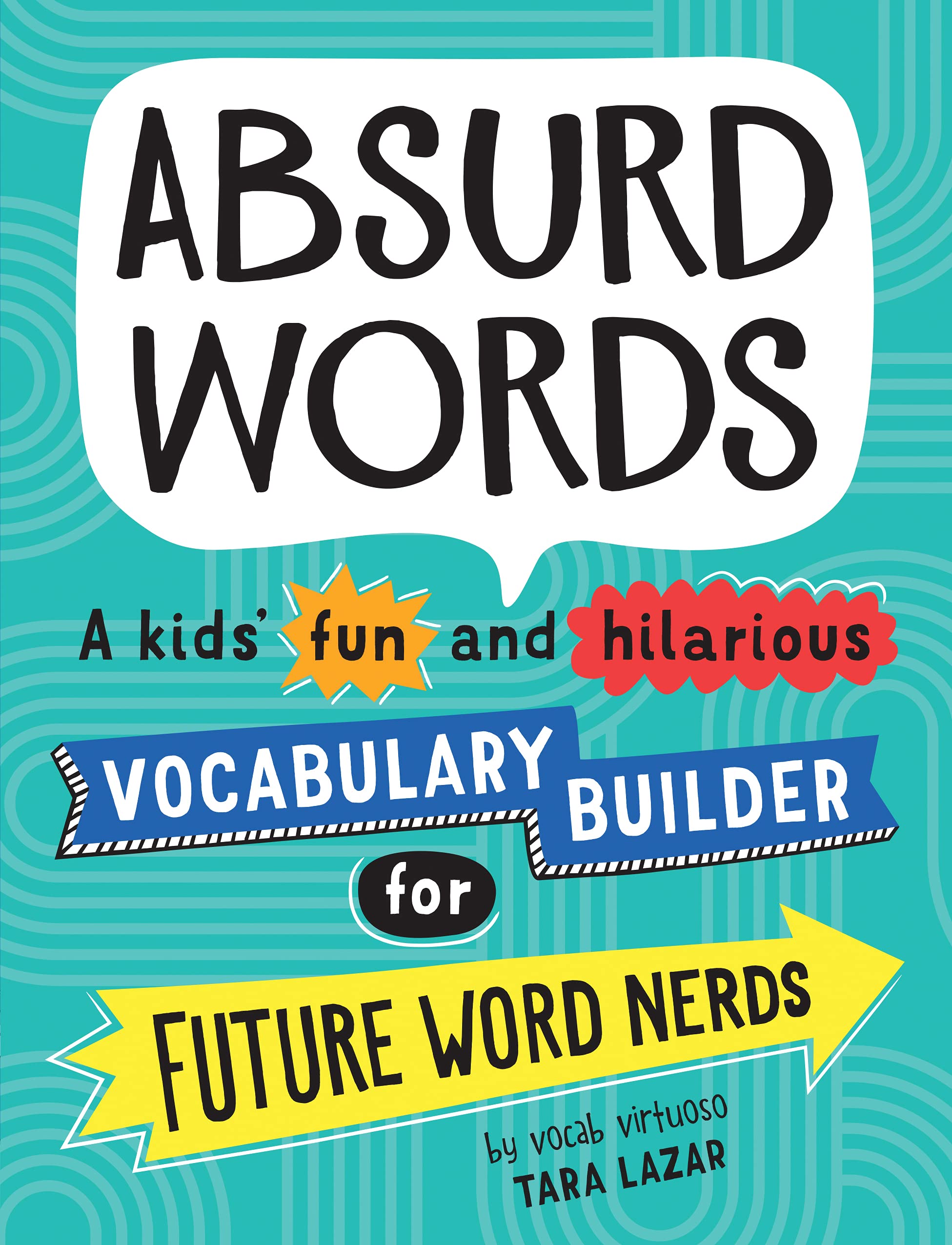

 Writing for Kids (While Raising Them)