You are currently browsing Tara Lazar’s articles.
 An interview with Joey Fly creators
Aaron Reynolds and
Neil Numberman
Last year Aaron & Neil taught us how to create a graphic novel with a demonstration from their 2009 debut Joey Fly. Well, the creepy-crawly duo is back and so is Joey, in his new buggy sequel. Aaron & Neil shed some insight on the process of creating a second book in a series.
If you like Aaron & Neil’s buggy caricatures, be sure to leave a comment. Neil will create you in buglife! For every 10 comments, we’ll randomly select one caricature winner. Good luck!
Aaron and Neil, in creating the Joey Fly sequel, what cues did you take from the first book?
 Aaron: I had established Joey and Sammy in the first book, and obviously that was staying the same, but I wanted to build on their relationship and take it to the next level. I think we did it…Sammy develops a love interest, but he’s in over his head. Joey still considers Sammy as much hindrance as help, but his concern for Sammy continues to deepen along the way.
I also really wrestled with the format of a customer showing up on the doorstep with a case for them to solve. That’s a very clear format for these types of books, a kind of throwback to old detective mysteries, Encyclopedia Brown, Scooby Doo, and Veronica Mars models of mystery, and works well for a kids’ mystery. In the end, I decided to keep things in that format, but I’ve also been intrigued to explore the idea of a mystery evolving right around Joey and Sammy, like you see happen in old Agatha Christie movies. I’m exploring that for an upcoming book in the series.
 Neil: There were a lot of things I wanted to bring from the first book for consistency’s sake. I start and end each book off with a one panel spread, which is an attempt to bring the readers into our world smoothly. We also stuck with the monochromatic look, which keeps that film noir vibe, but with many new colors in this book for many new themes. It’s actually something I wanted to get away from with this second book, but our editor, Reka Simonsen, was very smart and steered me back. I’m glad she did, especially based on the reception of the first book. Folks seem to dig the look, and it’s ours now! It lets us stand apart from the other kids’ graphic novels out there.
 What things changed?
Aaron: I think the mystery itself is better. I was torn in the first book between whether the mystery was too easy for a kid to solve before the end, or just right. That’s further complicated because this is a series that’s really accessible to mid-elementary kids, but also a great read for the 4th-8th grade set. In book #2, I feel like I got the balance just right. Writing mystery is a challenge unto itself. I hope, like all things, the more I do it, the better I get!
The other challenge is that, unlike many kids’ books, these characters aren’t kids. They live in an adult bug world…so the challenge becomes to create situations and obstacles that are kid-friendly and kid accessible, that you still believe these characters would encounter in the world we’ve created.
Neil: On my end, the quality in the art has really evolved, for the better. The character design has tightened up for Joey and Sammy, the city scenes are more involved. My favorite change, and I mentioned it above, is that I get to use the monochromatic look a lot more. Sometimes it’s used to set mood, sometimes as symbolism (the color I chose for Trixie Featherfeelers’ dressing room was very deliberate), and sometimes just to set up a joke.
I also played around with the panels a lot more, trying to make it more fun. I was so nervous with the first book, and I was very worried that my decisions would ruin the story, so the panel boxes are very tight and rigid. I had a lot more fun with the visual narrative in this one; tall panels, short panels, heart-shaped panels, no panel borders, it was a lot more fun.
As far as the actual drawing, this book takes place during a cold snap, so I got to draw a lot of bugs in scarves, jackets, and snowcaps!
 How did you develop new characters?
Aaron: I knew I wanted to set the book in a theatre, and that was a cue for the characters that evolved to tell the story. I wanted a ridiculous Alan Rickman from GalaxyQuest type character…addicted to the craft of theatre…and that came out in Fleeago. But it’s also fun playing with ethnicity and age. So we have a South American tarantula, and a geezer skeeter. Bottom line…bugs make fantastic characters and give you so much to explore because they themselves are so unique.
Neil: The characters Aaron made in this one are brilliant. I’ve always been fascinated with great characters, from Charles Dickens’ to J.K. Rowling’s, and Aaron really knows what he’s doing there. There’s nothing more fun in the process than creating the character sketches; a grandiose, dramatic tarantula, a villainous stinkbug, a love-struck gypsy moth, and a geriatric mosquito. They were a lot of fun to draw over and over again. Oh, and let’s not forget, an entire bedbug chorus.
Since you had already been paired for the first book, with the second title, did you collaborate more?
Neil: There was about as much collaboration between the two of us directly as there was with the first Joey Fly… none. The entire process of the books goes through the editor, and I think that benefits all parties involved. And of course, the publisher has every right to look over all communication, since, y’know, they’re paying us!
So I don’t see the manuscript until it’s basically whittled down to what you see in the book. I might request a line here or there to help the flow of the art. From then on, Aaron gets some say on the art, especially the character design, but really doesn’t see much until the finishes. And after that it’s just minor changes and adjustments that he requests.
Aaron: All true, we never collaborate during the creation of the book itself. It’s amazing what happens when you take two artists, a writer and an illustration, and unleash them completely separately on the same story. They each develop their own vision for it and something truly magical happens that doesn’t quite happen in the same way when you are working side by side on a project. Having said that, I love collaboration and hope Neil and I will have the chance to partner down the road on a project in a more give and take way. Would be fun!
 Are there more Joey Fly books in the works?
Aaron: I’ve already written a third book for the series and started a fourth. Neil and I love the characters and hope to continue the series with many more.
Neil: I really hope we get to do another. I suppose it all depends on the performance of this one, but Aaron’s told me some key components of the plot, and I already have a cover and more monochromatic themes in mind. Without saying too much, it involves maybe one of my most favorite things of all time: ghosts. Jeez, I hope I get the chance to draw insect ghosts!
Aaron: Book #3 contains ghosts, taxidermy, a run-down barrio, a pipe organ, a big game hunter, an orphanage in trouble, and two insect nuns. With that much of a sneak peek, you should be able to solve the mystery yourself!
 Aaron Reynolds is a human, not a bug, but he often writes about bugs. He is the author of Chicks and Salsa, Superhero School, Buffalo Wings, and, of course, the Joey Fly, Private Eye graphic novels.

Neil Numberman is a termite currently residing in New York City. Joey Fly, Private Eye was his first graphic novel, but he is also the author/illustrator of the picture book Do NOT Build a Frankenstein.
Be sure to leave a comment for Aaron and Neil. For every 10 comments, we’ll randomly select one winner to receive a bug caricature by Neil! Good luck!
 by
by I’ve always been fascinated by the idea of being little. I am a little sister (my sister is five years older than me). Now that we’re adults and friends that difference is pretty much nonexistent, but when we were young, five years was the Grand Canyon. All I wanted to do was spend time with my big sister, doing the things that she got to do. And all she wanted to do was… anything else. I even wrote a story about it in second grade called “It’s Not Fair!”
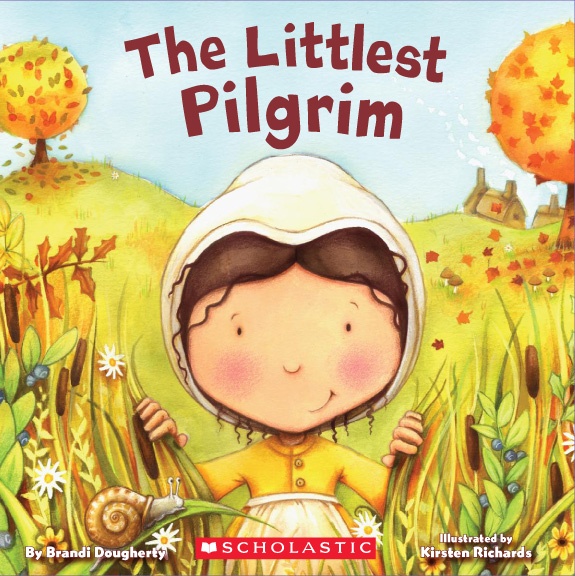 That’s where I got the idea for my first picture book The Littlest Pilgrim. Well, truth be told, the title actually popped into my head during a meeting and I thought it was cute and wanted to write a story around it. But it didn’t take long for me to circle back to my memories about being little. So, I wrote a story about Mini who is the littlest pilgrim in her village and she just wants to help. Everyone tells her she’s too little for all the grown-up chores and duties, so she strikes out on her own and finds something she isn’t too little for: making a friend.
After The Littlest Pilgrim came out and hit the New York Times Best Seller list (you still have to pinch me about that one!), I was thrilled to be able to write another “littlest” book. As I started thinking about holiday themes, a picture of me in my first grade Christmas play popped into my mind.
 I was one of the stars in the night sky (the yellow star in the green skirt, to be exact) leading Mary and Joseph to Bethlehem. I had one line to recite in the play. And I was a very shy kid, so it was kind of terrifying to stand on that big, bright stage and speak my one line. I loved the idea of turning that around and writing about Max (the littlest kid in his class, of course). Max wants nothing more than to be the star of his school Christmas play and have a million lines to recite, but he ends up being the actual star with only one line.
So, as you can see I like to take memories of my own experiences from childhood and turn them slightly to the right or to the left – adjusting the lens a little bit and discovering a different character or story hidden there.
Now it’s your turn. Peruse a class picture from elementary school, dig through that box of handprint turkeys and leaf collages, or just reach back in your mind and find a childhood memory that you can turn to the right or to the left. Who or what is hidden there?
In addition to her two picture books, Brandi Dougherty is the author of three middle grade novels: Miss Fortune (Scholastic, 2010), The Friendship Experiment (Scholastic, 2009), and The Valentine’s Day Disaster (Scholastic, 2008). She worked in publishing in New York for eight years and now resides in San Francisco where she is mom to an adorable and rather spoiled dog. Visit her at www.brandidougherty.com.
 by
by In my day-to-day life I’m a dreary, straight-laced stickler for rules. I’m obsessively punctual with my rent. I always wear my seatbelt. And I’d never dream of going through the Express Lane at the grocery store with more than fifteen items in my cart.
But when it comes to writing picture books, I’m proud to be a rule-breaking outlaw.
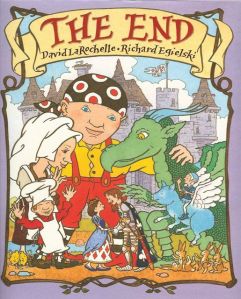 Who says a picture book needs to be told from start to finish? My fairy tale The End is told in reverse chronological order, from end to middle to beginning.
In fact, who says a picture book needs a traditional beginning, middle, and end at all? My latest book, 1 + 1 = 5 And Other Unlikely Additions, is simply a collection of surprising (but plausible) math facts. 1 + 1 = 3? 1 unicorn + 1 goat = 3 horns! 1 + 1 = 6? 1 duet + 1 quartet = 6 musicians! Who would have guessed that a list of equations could make a successful children’s book, but it works.
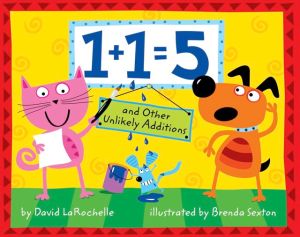 Which brings me to my writing tip for today: forget about the rule that says a good book needs a plot with a character and problem and solution. Today, just make a list. The Top Ten Ways to Avoid Doing the Dishes. Reasons Why I Should Have a Horse. My Favorite Things to Do with Peas Instead of Eating Them. You decide on the topic.
Come to think of it, maybe I’m not such a rule-breaker after all. There are plenty of wonderful picture books which are, at their hearts, simply lists:
Jane Yolen’s humorous How Do Dinosaurs Say Goodnight?
Lauren Stringer’s clever and beautiful Winter is the Warmest Season
Judith Viorst’s classic Alexander and the Terrible, Horrible, No Good, Very Bad Day
Of course successful list books like these are more than a recitation of boring items. They resonate with a child’s emotions, shine with beautiful language, explode with humor, or invite the reader to look at the world in a new way.
And you can write a memorable children’s book, too! Just pick up your pencil and start making a list.
David LaRochelle has been creating books for young people since 1988. His next picture book, The Haunted Hamburger and Other Ghostly Stories, illustrated by Paul Meisel, will be released by Dutton in 2011. He lives in White Bear Lake, Minnesota and is currently catching his breath after a busy month of carving pumpkins, some of which can be viewed at his website www.davidlarochelle.net.
Get Out and Live, Your Stories are Depending on You
 by
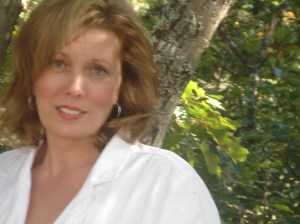
by Ideas are endless, and everywhere! You can find ideas on a backyard walk, or at a trek to the zoo. You can find them in the news, or in the newspaper. Keep your eyes open and really look around. Listen to the chatter of little children, look at the bark of trees. Discover life around you through the eyes of a child.
Trees have faces if you look closely enough. Clouds can create castles. And in the humdrum of everyday activities, you can find a story just waiting to be told. While on my way to take my daughter to school, I was delayed by turkeys in the road. Instead of allowing a panic mode to overtake me (because we were going to be late), I simply enjoyed that moment.
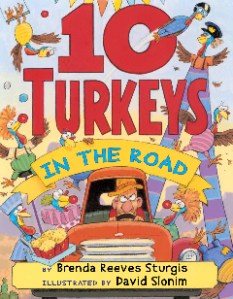 And my debut picture book, 10 Turkeys in the Road, Marshall Cavendish, 2011, was born. I stopped to smell the roses, or better yet, to watch the turkeys. Soon after, I was awakened with the story of the turkeys in my head.
And after 3 major revisions and a year later, editor Margery Cuyler discovered 10 Turkeys at the RUCCL conference.
A trip to the zoo resulted in my story waiting to be sold, My Gorilla Brother, and an afternoon outing to watch my nephew play football, resulted in my story Touchdown! which won first place in the 2007 Smart Writers Contest judged by Verla Kay.
You can find ideas everywhere! A sight, or a smell, or a sound triggers them, but you must to get “out,” and experience life to find them.
One place that most initial ideas will not be found is in front of a blank computer screen. Ideas must first take root in your soul, and then once they are rooted, they are ready for watering, shaping, and pruning.
Yes ideas are endless, and they are anywhere and everywhere you can possibly imagine. Your stories are waiting for you, so get busy and get outside. Live and enjoy your life so you can first imagine, and then write your stories, as only you can.
Brenda Reeves Sturgis began her writing career four years ago, after meeting Lynn Plourde at a school visit. She bought every one of Lynn’s books and asked the question that would change her life, “How do I become a writer?”
Lynn directed Brenda to the CWIM (Children’s Writer’s Illustrator’s and Market Guide book, by Alice Pope), and also to SCBWI (Society of Children’s Book Writer’s and Illustrator’s). One of Brenda’s favorite sayings is, “When the student is ready– the teacher will appear!”
Brenda is generously offering a picture book critique as one of the PiBoIdMo prizes. Finish 30 ideas in 30 days to become eligible to win!
Welcome to PiBoIdMo, 30 days of inspiration and motivation created for picture book writers.
Your mission, should you choose to accept it (and I know you will ’cause it’s a cakewalk), is to jot down one new picture book concept a day during November. That’s it. You don’t have to write a full manuscript, but if you want to, go ahead. No one’s stopping you!
Guest articles by published authors and illustrators will serve as your inspiration. Visit here once a day to read a new perspective on creativity.
Your motivation will be prizes. (Plus finishing the month with a file of ideas.) Sometimes you’ll need to comment on a post to qualify for a prize, but for most of the goodies, you’ll need to finish the month with 30 ideas.
To qualify for prizes, there are two steps:
- You must sign-up below (leave a comment) by November 7th.
- You must sign the 30-ideas-in-30-days pledge which will be posted on December 1st.
 The pledge is by honor system and will remain open for signing from December 1st thru 4th. Prizes will be announced on December 6th. Please note that if your name does not appear in both places–the sign-up and pledge–you will not be eligible to win.
So that’s the fine print!
Now Johnny, please tell us what they can win…
Feedback from Literary Agents


 Three winners will be paired with one of three agents: Ammi-Joan Paquette of Erin Murphy Literary Agency, Kelly Sonnack of Andrea Brown Literary Agency, Inc., and Joanna Volpe of Nancy Coffey Literary and Media Representation. Winners will send their five best ideas to their assigned agent. The agent will provide feedback on which ideas may be the best ones to pursue.
Picture Book Critiques
Seven winners will be randomly chosen and paired with one of these authors: Sudipta Bardan-Quallen, Brenda Reeves Sturgis, Corey Rosen Schwartz, Tiffany Strelitz-Haber, Lori Degman, Lori Calabrese and Linda Bozzo. Winners will send one picture book manuscript (up to 800 words) for a critique. (Linda Bozzo offers a non-fiction picture book or article critique. Lori Degman, Lori Calabrese & Tiffany Strelitz-Haber will critique rhyming PBs. Alternatively, Tiffany offers a lesson in rhyme and meter.)
Original Artwork
Some illustrators will be guest blogging in visual format. You can win original art by Neil Numberman, Bonnie Adamson, Jannie Ho, Adam F. Watkins and James Burks, who designed the PiBoIdMo logo and badge.
Picture Books
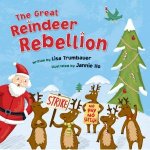
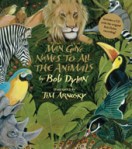

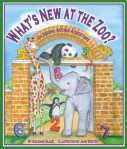


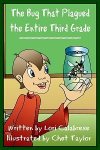
Picture books donated by Jannie Ho, Sterling Children’s Books, Alison Ashley Formento, Joan Waites, Pat Miller, Tammi Sauer, Jeannine Q. Norris, Lori Calabrese and Simon & Schuster.
Jewelry
 Stay inspired all year long with the “write” bracelet, donated by writer and artist Laura Hamor.
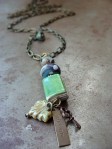 Heather Powers has donated her “Anne of Green Gables” book club pendant. Check out her Etsy store Humblebeads for more lovely nature- and literary-inspired wares.
Greeting Cards
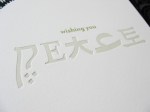 Artist Christina Peressini’s inventive die-cut greeting cards have also been donated. The winner chooses a mix & match 10-pack from her original designs, like the “Wishing You Peace” card.
And, there might be some extra-special stuff added as the month progresses, so stay tuned.
So there you have it. PiBoIdMo 2010.
Let the sign-up begin!
Then come back on Monday for the first of 30 posts to help you along your idea journey!
[Update 11/8: Comments are now closed. If you are not signed up below, you aren’t eligible for prizes, but you can still join PiBoIdMo–just visit every day for a new post about creativity to help you along your idea journey.]
 by Karen Collum
We creative types often talk about that moment when inspiration strikes. We get an idea, a phrase, an image, a scent, a sound that somehow switches something on in our brains and before we know it words are churning out faster than electric shocks on a trampoline. The concept of inspiration ‘striking’, however, is misleading. It sounds so passive, so unpredictable, so out of our control.
I’d like you to think about another sort of strike for a moment; a lightning strike. It’s true, lightning can strike people almost anywhere and at anytime, and we often hear amazing tales of the same person being struck more than once, but there are well-known factors that can increase or decrease the likelihood of being struck by lightning. I believe the same applies to the strike of inspiration. Here are a few ways you can increase the likelihood of being struck by inspiration (but please don’t use this advice in a storm as you are quite likely to get struck by lightning and although that might make a great story, it would in fact be terrible!):
1. Stand tall and in the open
Everyone knows that lightning strikes tall objects and the wisest thing to do in a storm is lie low. The opposite is true when waiting for inspiration to strike. Stand out in the open field of life, arms outstretched and reaching for the sky. Stand tall, lift your gaze above what is immediately in front of you and look around. Don’t be afraid to be different. Look at a picture, a scene, a group of people from a different perspective. Ask ‘what if?’ questions. Dare to look beyond what you first see. For me that often means taking a mental step back from the scene and surveying it as an observer. Why is that person frowning? Why is the lady in the car crying? Where is that person in a hurry to get to? Do this often enough and inspiration will surely strike.
2. Have your umbrella up
Umbrellas in a lightning storm are a no-no, especially if yours has a metal tip on the end, but for a writer, having your umbrella up means you are ready and waiting to be struck by inspiration. You are aware of what’s going on around you and that there may just be one tiny thing that will spark your creativity in amongst the mundane. I try to have my umbrella up all the time, consciously searching for things that might be useful. I listen carefully to the conversations that my children have and try to absorb their pattern of speech. I also have a notebook handy at all times so I can capture the strike when it happens. When I’m outside playing with my kids I watch for interesting things in my environment. Just the other day I saw a slow and steady march of butterflies heading to some important but unknown place, one at a time. Inspiration can strike on even the gentlest of wings.
3. Get on the phone
During a lightning storm it’s advisable to stay off the phone as lightning can travel down the phone line and end up quite painfully in your ear. As a writer, however, it’s essential that you connect and network with other creative people. Have conversations about interesting things, bounce ideas off one another, share with trusted creative friends what you’re working on. I don’t believe inspiration happens in a vacuum and by connecting with one another we can create surges of inspiration for all of us.
Don’t just wait for inspiration to strike. Stand tall, have your umbrella up and get on the phone. You might just find those thirty PiBoIdMo ideas flowing faster than you ever thought possible.
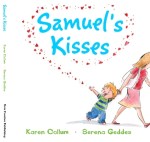 Karen Collum lives in Brisbane, Australia and is a stay-at-home mum to three pre-school boys. She is about to welcome a baby girl to the family in December. She is also a picture book author and co-convenor of the international online picture book chat group, #pblitchat. (You can find details about #pblitchat at http://picturebooksonly.wordpress.com.) Karen’s debut picture book SAMUEL’S KISSES is due for release in late November by New Frontier Publishing. You can follow Karen on Twitter (@KarenCollum) or find more about her and her books on her website http://www.karencollum.com.au.
This doesn’t require commentary. Just watch.
(I know, aren’t you amazed that I can be quiet for once?)
Venerable LA Times rock critic Robert Hilburn recently penned Corn Flakes with John Lennon and Other Tales from a Rock n’ Roll Life, a revealing memoir-style series of vignettes featuring the great rock icons of the last 50 years.
In the book, Hilburn recounts his seven-piece Times series on the most influential and prolific songwriters of the rock era, which was published earlier this decade. He chose Bob Dylan as his first subject. Hilburn wanted to learn about a songwriter’s creative process: what inspires them, how they begin to lay down the music and lyrics, if success or failure of past work influenced future songs. The interview with Dylan earned Hilburn his third Pulitzer Prize nomination. And, Dylan’s words may give other writers—perhaps even picture book writers—inspiration for their own work:
 “Some things just come to me in dreams,” Dylan told Hilburn. “But I can write a bunch of stuff down after you leave…about say, the way you are dressed. I look at people as ideas. I don’t look at them as people. I’m talking about general observation. Whoever I see, I look at them as an idea…what this person represents. That’s the way I see life. I see life as a utilitarian thing. Then you strip things away until you get to the core of what’s important.”
And picture books are indeed about what’s important; every picture book features an emotional truth, whether it be about family, friendship or fitting in. If you strip away what’s on the surface—the pirates or the penguins or the princesses—what remains is a story about the human experience.
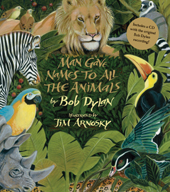
Noted illustrator Jim Arnosky found inspiration in Dylan’s music. “From the first time I heard [Man Gave Names to All the Animals], the lyrics created pictures in my mind of a land of primeval beauty,” said Arnosky. Dylan gave his permission to create a picture book, and the work was released by Sterling in September.
So that’s your inspirational thought for the day. Well, two inspirational thoughts! People and songs.
What do other people’s actions say to you? How do those actions translate to story? What music boosts your creativity?
And don’t forget, there’s much more inspiration to come when PiBoIdMo begins in November. Consider this a warm up, or as Dylan might say, a sound check.
 [UPDATE: The winner is Sheryl Tilley! Congratulations and enjoy!]
My story “The Juggler Triplets” will appear in the November issue of Abe’s Peanut, a micro-magazine for kids ages 6-10. Delivered in four postcard installments, the story appears on one side with full-color illustration by Lichen Frank on the other.
Independently published by editors Anna and Tess Knoebel, Abe’s Peanut launched this year after the success of Abe’s Penny, a micro-magazine for adults: “Off-set printed on double thick matte card stock, each issue dispenses art and literature while becoming a collectible, temporal object.” (In kidspeak: “They look cool tacked to your bedroom door.”)
Recent Abe’s Peanut contributors include Audrey Vernick, author of Is Your Buffalo Ready for Kindergarten?, and Lisa Tharpe, author of P is for Please: A Bestiary of Manners.
Kids love receiving their own mail, so here’s a chance to receive four postcards with your child’s name on the label.
Leave a comment naming your child’s favorite picture book for one contest entry. Mention the giveaway elsewhere for two additional entries. A winner will be chosen on Friday, October 22nd.
And stay-tuned for PiBoIdMo in November, when there will be several itty-bitty (plus some hugantic) giveaways!
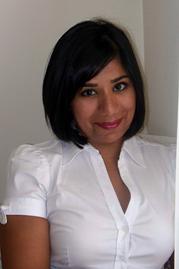
Authors always say that we write what we know, and it is completely true—you cannot tell an authentic story if it doesn’t come from a place of truth. The trouble, though, is when you write picture books for kids, how do you define what it is that you know?
I write books about talking pigs and lonely ducks, and I can assure you I am neither a pig (verbose or otherwise) nor a duck nor any other kind of animal featured in any of my books. And yet I feel very strongly that I only write about the things that I know and that almost every one of my picture books draws heavily from my own life.
Take QUACKENSTEIN HATCHES A FAMILY, for example, my newest book published by Abrams. In this story, poor, lonely Quackenstein looks on in envy as all the other animals in the zoo settle in with their families. So he hatches a plan to solve his problem—upon spying a sign for “orphaned eggs,” Quackenstein decides to adopt an egg to start a family of his own.
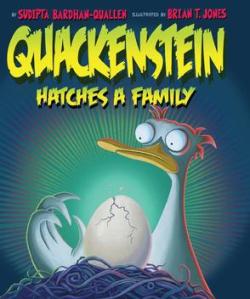 The previously cantankerous duck becomes a devoted father-to-be, even cooing to his “ducky-poo” that he will never be neglected. But when the egg finally does hatch, it is more than the eggshell that cracks—Quackenstein takes one look at his hatchling and runs off in terror.
Without giving away the whole book, suffice it to say that the hatchling eventually catches up to his father and a few choice words serve to melt Quackenstein’s heart and open his eyes to the fact that families can be different or strange but always find a way to work. Despite his fears, Quackenstein learns to be the father he wanted to be—and that his son deserves.
I wrote this story when I was pregnant with my son, Sawyer, who is my third child. I’d already had two girls, Isabella and Brooklyn, and I was convinced that baby number three was going to be daughter number three. So when the doctor told me that I was having a boy, my first response was, “No, I’m not, and you can’t make me.”
Turns out, I really was going to have a boy and nothing was going to change that.
I will freely admit being terrified at the prospect of having a son. After all, I knew lots and lots about how to be a good mother to girls, but knew absolutely nothing about mothering a boy. (Since then, I’ve learned that boys and girls truly are as similar as, well, ducks and platypi—they might as well be two different species.)
I honestly didn’t sit down to write a book about a parent who was both excited and terrified about having a baby. But looking back, I realize I did exactly that.
Had I written QUACKENSTEIN five years earlier, I am convinced it would have been a different story, because there were different things important in my life then. If I’d never written the book and started fresh on it now, it would definitely be a different story (and probably far scarier!).
As much as authors write what they know, the real test of a good story is whether the author has not only found his or her own truth, but also illuminated some truth for the readers. So I’ll leave you with this hope: that you can find a little Quackenstein in your own heart.
Thanks for giving us a warm-up for PiBoIdMo, Sudipta!
Want a sneak peek of QUACKENSTEIN? Look no further–the trailer is here! With every view, a donation will be made to the Association of Zoos and Aquariums!





 Writing for Kids (While Raising Them)