You are currently browsing the tag archive for the ‘SCBWI’ tag.
Agents and editors have told me they occasionally receive calls from writers who are brand new to children’s books. These aspiring authors ask, “How do I get my book published?”
Kindly folks that they are, these agents and editors don’t slam the phone down. They’ll sometimes spend a few moments providing basic details. But this information can be easily found online. That’s what makes being a new writer so exciting these days: there’s professional advice available via websites and blogs, you just have to search for it. It’s not all so mysterious anymore.
So if you’re looking to launch a kidlit career, please don’t call an agent or editor to learn the basics. Let them read manuscripts, sell books and do their jobs. Come here instead…
A New Children’s Writer’s To-Do List:
- Write.
I knew you’d like that one. - Read children’s books.
Become familiar with the genre in which you write. Understand appropriate length and content for specific age groups. See what’s being published. Don’t follow trends, but know the competition. When pitching editors and agents, it’s often helpful to compare your book to another title. You can’t compare if you aren’t well read. - Join SCBWI.
Take advantage of their resources—local chapter events, national conferences, online discussion boards and publications. - Join a critique group.
Find fellow writers who work in the same genre as you. They provide support, motivation, and helpful feedback. (And if you can, find a group with writers who are more experienced than you.) P.S. Your mother, daughter, spouse, and neighbor’s 2nd grade class are not a critique group. - Attend workshops, conferences and events.
Seek out opportunities to learn and network with authors, agents, editors and writing peers. - Read books on the craft.
Writer’s Guide to Crafting Stories for Children by Nancy Lamb
Writing Picture Books by Ann Whitford Paul
Writing for Children and Teens by Cynthea Liu
Writing with Pictures by Uri Shulevitz - Revise and rewrite.
It’s not going to be right the first time (or maybe even the second or the fifteenth). It’s just not. Resist the temptation to submit an early draft to a publisher. - Take time to develop your skill.
Your writing will improve with practice. Most professional authors need at least two years of serious writing to hone their craft, and it’s not unheard of to work for ten to fifteen years before becoming published. - Submit when you have more than one project polished.
Finished your first manuscript? Keep writing. If an editor or agent likes your manuscript, but not enough to make an offer, they may request other material. Have a few manuscripts at the ready. - Learn to have patience.
It can take many years to write publishable material, sell your first project, and develop a career. Even after you become published, the business is still full of waiting—waiting to hear from your agent and/or editor, waiting for a book to be released, waiting to earn out. You will never NOT be waiting. Patience and perseverance are key. - Call yourself a writer.
Because you are one!
If you have some newbie suggestions, let’s hear them. Please leave a comment.
 Children’s book writers were treated to another fun and informative first page session this week in Princeton, hosted by the NJ-SCBWI. Editors Michelle Burke and Allison Wortche of Knopf & Crown Books For Young Readers listened to 30 first pages read aloud as they followed along with each manuscript page. Then they gave their immediate first impressions of the work.
If you’ve never attended a first page critique, it’s a quick way to get a handle on what your peers are writing. A first page session shows you what it’s like for an editor to spend two hours in the slush pile. Common themes emerge. Mistakes reveal themselves. If you listen carefully, you’ll learn how to avoid first page problems and encourage an editor to read on.
So what did the editors say? I encourage you to read on…
Picture Books:
Use varying imagery in picture books. One manuscript conveyed a lot of emotion and the editors didn’t see where the illustrator would take inspiration for art. The same scene through several page turns may lose a child’s attention.
Dialogue needs to match the age of your character. A picture book character shouldn’t sound older than a five- or six-year-old child. Their actions should also match their age.
Cut excess detail in picture books. The first page of the manuscript should reveal a clear story arc. If the manuscript is bogged down with details, it slows the story down. For example, writing that a mother is carrying a napkin to the table and setting it down next to the plate is unecessary (unless that specific action is crucial to the story, and even so, it could probably be illustrated).
Premise and conflict should be apparent on the first page of a picture book manuscript. For example, dialogue between two characters should reveal a story, not just serve as adorable banter.
Every line in a picture book should move the story forward. There’s no room for chatting or extraneous stuff.
Picture books should have a linear approach. Moving back and forth in time can confuse a young child.
With holiday stories, you automatically have to work harder. Stories about specific times of year are a tough sell. There’s a lot of competition and a small sales window.
Some picture book stories are told better without rhyme. If the phrasing is unnatural in rhyme–things you wouldn’t ordinarily say–it can be jarring to the story. One bad line can ruin the manuscript’s chances.
Middle Grade/YA:
The narrator/main character should be the highlight of the first page. One manuscript began by describing a minor character as a way to compare/contrast the narrator. However, when that minor character disappeared from the rest of the page, the editors were confused. Was that comparison necessary to introduce the narrator?
Historial fiction should tell a story. The reader should get a sense of the main character first–how he/she is affected by historial details. Too much fact will bog the story down and lose the character.
Don’t be too reptitive in a novel–get on with the story. If a main character reveals the same thing over and over again on the first page, it feels overdone. Introduce a concept and then move on with the story; don’t circle back paragraph after paragraph.
A first person narrative should have more narrative than dialogue on the first page to take advantage of this device. Plus, the narrative voice and the dialogue voice should match (unless the disconnect is for a specific purpose).
Avoid the stereotypical whiny, displaced, unhappy middle-grade voice. More than one middle-grade manuscript began with a character learning that he/she had to move. The result was a whiny narrator who wasn’t necessarily likeable. Editors warned that they see a lot of the parents-uprooting-child theme, so to rise above the slush, consider a different approach.
Be cautious in stories with several important characters. It’s difficult to write a story with multiple characters because introducing them can sound like a laundry list. Reveal their personalities in a way that’s organic to the story. It also asks a lot of the reader, to keep track of several characters.
Watch tense. The switch from dialogue to narrative in one story felt very abrupt because the dialogue was in past tense and the narrative was in present.
The difference between MG and YA is edgy, gritty. If the main character’s personality feels innocent, the genre might be middle grade, not young adult.
Balance description and dialogue. Dialogue moves a story along fast. Description slows it down. Long stretches of each create a choppy storytelling rhythm.
Make descriptions specific, not generic. One story began with vague details that could be applied to almost any story setting. It wasn’t until further down on the page that the reader learned the unique time and place, something that attracted attention. The editors suggested moving that info higher up.
YA characters should be teenagers. College YA characters and those over the age of 19 can be a tricky sell. That moves the story into adult territory. YA readers need to relate to the characters, and 20+ seems like a lifetime away to a 15 year-old.
Finally, stories should be kid-friendly, not sprinkled with adult sensibilities. One of the editors warned, “this feels like it’s about kids rather than for them.” Don’t let a parental point of view creep into your writing–kids find that creepy.
Every SCBWI first-page session I’ve attended has had one thing in common: picture book manuscripts about new babies in the family. At least two or three are submitted each time. Editors and agents respond by warning new writers: “The market is saturated with mom-is-having-a-baby books. If you’re going to write about a new sibling, the idea must be unique to stand out.”
I remember a harsh moment. After reading the first page of a new baby tale, an editor said, “This isn’t special enough to continue.”
Daunting, isn’t it? Makes you want to toss your baby—erm, your manuscript—out the window!
So when they say the idea has to be unique, what do they mean?
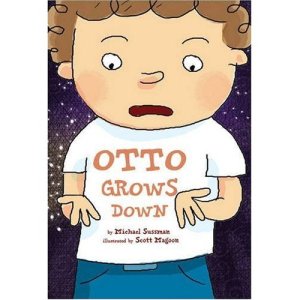 In a perfect world, they’d whip out Michael Sussman’s Otto Grows Down. Illustrated by Scott Magoon, it’s a tale of a boy who wishes his baby sister Anna was never born. “Be careful what you wish for” might be a cliché, but trust me, Otto Grows Down is an uncommon cautionary tale.
Otto makes his Anna-be-gone wish on his 6th birthday as he blows out the candles. Immediately, life begins to travel in reverse. Otto wraps up his gifts and hands them back to his friends. The second hand on his new watch ticks backward.
The next day at school, they start with mess-up time. Otto can’t get used to sliding UP the slide, and he’s so tired at the end of the day, he just wants to eat breakfast and get to bed. And going to the bathroom? Nasty business. (Nasty, hysterical business to my kids.)
Otto’s parents soon return Anna to the hospital and she disappears. Otto rejoices. But strangely, time doesn’t move forward again, it just keeps unraveling. Otto celebrates his fifth birthday, his fourth, his third…and he realizes that he may disappear, too! He’s slowly losing the words he needs to make his new wish come true: OTTO BIG!
Call it a dark comedy for kids. Scott Magoon’s film noir feel strikes the right balance between humor and horror. Dark shadows and warm colors mimic Otto’s flip-flopping emotions. (And hey, did you notice all the character names are palindromes? Another cool touch, huh?)
I won’t tell you where it ends—or where it begins—but let me just say: every editor who sent Mr. Sussman a rejection probably wishes they could make time go in reverse, too.
 Otto Grows Down
Story by Michael Sussman
Illustrated by Scott Magoon
Sterling, February 2009
Want it? Get it!
P.S. Author Heather Ayris Burnell interviewed Michael Sussman on her blog–plus she’s giving away a copy of the book!
…let it be Jarrett Krosoczka’s hilarious writer’s block adventure.
Starring Tomie dePaola, Jeanne Birdsall, Mo Willems, Jane Yolen, Grace Lin, John Scieszka, Adam Rex, and many others!
BOOK BY BOOK: the making of a monkey man from Jarrett Krosoczka on Vimeo.
Hooray! More notes from the September NJ-SCBWI first page session!
Those familiar with peer critiques know the “sandwich” method: begin with what you liked, then move onto what needs work, and end by pointing out the manuscript’s merits. The editors followed this method well and offered compliments to soften the criticisms. Everyone must have left feeling good about an aspect of their writing. But we still have plenty to work on.
Some common suggestions:
- Rhyme carefully. Rhyme should have a consistent beat and meter. The editors easily picked out when a rhyme stretched to make it work. There was only one rhyming manuscript that worked. The other manuscripts felt limited by rhyme, and one in particular featured subject matter for an older audience, so the rhyme felt out of place. There’s a lot to live up to if you’re going to rhyme, so read many rhyming picture books to get a sense of how it all fits together. It’s not impossible, but great skill is required. They advised rewriting in prose and suggested using alliteration, which can be as fun as rhyming, without the restrictions. But use alliteration in moderation! (Umm, I didn’t mean to rhyme there…)
- Amp up the humor. The editors felt picture book laughs weren’t taken far enough. They wanted the stories to go from simply funny to outrageous. There’s always room for more humor. Make it crazier and more outlandish.
- Avoid common themes. Pets dying. New babies in the family. Monsters. Imaginary friends. First words. Retellings of The Three Little Pigs. These have all been done before, and done well. Stories on these subjects need to dig deep to find something new to say. Stand out, don’t blend in.
The editors also discussed avoiding clichés, clarifying the conflict on the first page, and cutting text to move action along faster. Out of 26 manuscripts, only two or three were considered strong contenders as written, and even so, they still required a little tweaking.
[An interesting tidbit for all you artists: if you’re an author/illustrator, consider yourself at an advantage. An editor is attracted to working with you since they skip the difficult step of matching your PB manuscript with an illustrator. Instead of communicating with two professionals to produce a book, the editor works directly with just one person—you.]
My friends and I thought that for the most part, both editors agreed on the manuscripts. However, one editor thought they didn’t agree very much at all!
But I think we can all agree that we need to work smarter. Some questions to think about as you work on your manuscript:
- Why should a publisher choose your story? What makes it unique and appealing, different from any other book in the marketplace?
- Why should a publisher spend tens of thousands of dollars, work several months (and in the case of PBs, years), and utilize the resources of a dozen or more staff members to produce your book?
- Is this truly the best story you can write? How can you make it even better?
The New Jersey Chapter of SCBWI was treated to an afternoon of professional first page critiques yesterday in Princeton. (Heck, we even felt smarter just being on the campus of Princeton University!)
Editors Connie Hsu and Kate Sullivan from Little, Brown shared their literary insights with 30 aspiring authors. Manuscripts ranged from a whimsical picture book about goldfish to a compelling young adult novel set in a foreign village under siege.
After each first page was read aloud, the editors provided their immediate impressions of the manuscript–what worked, what didn’t.
Some helpful advice included:
- Use first person point-of-view to your advantage. It helps the reader get into your character’s head, so if there’s too much dialogue on the first page and not enough introspection, you’re not using that device to its full potential.
- Make sure the voice fits the genre. This is a common critique I’ve heard repeated at every first-page session. Some picture books were wordy, with long sentences and adult sensibilities. If it takes the entire first manuscript page to set up the story, then you need to cut, cut, cut. Little kids beg their parents to turn the page, so you must get to the story quickly. The first manuscript page needs a clear story arc. Regarding books for ‘tweens and teens, a young adult novel should have longer sentences and be more gritty than middle-grade. In general, the editors said an MG voice can sometimes be classified as “whiney,” whereas a YA voice is angrier and angst-ridden. Yes, let that YA voice curse and swear.
- Make room for illustration in a picture book. You don’t have to describe every detail. Instead of saying, “the girl’s hair was red and wavy like her mother’s red, wavy hair,” try instead, “the girl’s hair was just like her mother’s.” This provides the double benefit of cutting words and leaving the family’s appearance to the illustrator’s interpretation. (Read Linda Urban’s interview with illustrator Marla Frazee regarding The Seven Silly Eaters by Mary Ann Hoberman. Great example of how an illustrator fleshes out the story.)
- Don’t try to surprise your reader on the first page. It can lead to confusion instead. Some stories left important details aside (who/what/why/where) and forced the reader to guess what was happening. You don’t want your reader to guess wrong! If they do, then when the correct information is revealed, they will be confused. You want the reader to move forward, not double-back to re-read.
- Set the scene. The setting provides a clear context for your character’s actions and emotions. Again, don’t make the reader guess where your character is. Show the reader. Immerse the reader in your world.
One of the funnier moments occured when the editors cautioned against using the word “puberty” in a middle-grade work. It guarantees giggles of embarassment among that age group. “It’s a word no ‘tween wants to admit exists,” said Kate Sullivan.
While the insights above were specific to the pages submitted, they can be applied to your own manuscript. Keep in mind that rules can be broken, but it typically takes an experienced, talented author to make the unconventional work.
Want to read more about first pages? Check out these previous posts:
Children’s book editors Margery Cuyler and Emily Lawrence lent their time and talent to the NJ-SCBWI this evening by critiquing more than 30 first pages from aspiring authors. (Yours truly channeled her acting background to read the manuscripts with a booming voice.)
If you’ve not participated in a first page critique, you’ve missed out on the immediate impressions of seasoned editors who will tell you if your story has fallen flat or piqued their interest enough to turn the page. The value of their professional expertise is, well, invaluable.
A little bragging first. Margery Cuyler, publisher at Marshall Cavendish Children’s said of my work: “The voice is great. This writer has a talented voice and she should hold onto it for dear life.” I would have passed out if I wasn’t so engrossed in taking notes. I wanted to learn from all the manuscripts, not just my own.
Ms. Cuyler went on to point out that many things in a story can be fixed—setting, conflict, etc.—but a voice is something pure that is difficult to teach. In other words, if you don’t have a good, strong voice, it’s back to square one.
So, I’ve got a good voice—for writing and for reading aloud. What else did I learn at this session? Loads. Tons.
-
Don’t rhyme unless you’re an extraordinarily talented poet.
Neither editor was keen on rhyming stories. They found fault in the cadence of many stories and disliked stretching to make rhymes work. The rhymes interfered with telling the tales; the rhymes took over the stories. They suggested switching to prose. -
Know the age and comfort level of your audience.
A picture book about a pet python, while well-written, was thought to be too scary for the age range. They suggested it be rewritten for middle grade readers. -
It’s important to relate to your reader.
Certain genres are a hard sell, like historical fiction. While there are award-winning books in this genre, they tend to convey universal feelings and emotions, those that are relevant no matter what the setting. -
If you’re writing for kids, make the story primarily about kids, not grown-ups.
A delightful, humorous book had a slight problem because it was all about adults. The editors thought children would have a difficult time relating to the story without a young central character. -
Research existing books with your desired subject matter.
Both editors thought books about new babies in a family were overdone at the moment. Even though the manuscript had sweet moments, one editor felt the marketplace was saturated and that the story wasn’t special enough to continue. -
Don’t go into too much detail, especially in a picture book.
A book about twins tried to explain how different in size they were, but the story became bogged down in height and weight numbers. Both editors thought it was erroneous information. It might make sense to adults, but not to kids. Use comparisons children can relate to like “Timmy was one lollipop taller than Tommy.” Remember that illustrations can also convey a lot of information. Every little detail doesn’t need to appear in writing.
Some universal lessons:
-
Make the conflict known early in the story.
It should be there on the first page and it should compell the reader to continue. It’s all about the hook. -
Show, don’t tell.
We hear this a lot, but what exactly does it mean? Show your character in scene (dialogue, action in real time) rather than just expository writing. Instead of simply saying the teacher was angry over something your main character did, show the scene and the source of conflict. -
Remember to use settings that children can relate to.
School and summer vacation were two examples of settings that sell a story.
Many thanks to Ms. Cuyler and Ms. Lawrence for reading and commenting on our stories this evening. I’m inspired to work even harder!





 Writing for Kids (While Raising Them)