 by Kendra Levin
A few years ago, my friend and I joked that there should be a National Don’t Write a Novel Month. In fact, we even created a Twitter account for it and spent the month of November that year tweeting about all the things we were doing instead of writing a novel.
Writing is hard. Writing a novel in a month is even harder. And while NaNoWriMo and Tara’s own PiBoIdMo are fantastic ways to light a fire under your butt and get words on the page, it’s just as important for writers to spend time…well, not writing.
So this year, if you’re feeling creatively fried, emotionally exhausted, distracted by the election, or just plain burnt out, try spending November replenishing yourself artistically.
Consume culture. You already know how important it is for writers to read—and not just the genre or age category you write, but all kinds of books, articles, and other content. Go see an art exhibit, a dance performance, or a concert. Play a video game. Go to a movie you wouldn’t normally be interested in. Try art forms and genres you don’t expect to like and see what happens!
Explore your world. On the way home from the gym, your job, your kids’ school, any place you visit more than once a week, try a new route. Always go to the same gas station? Try a different one. Instead of walking, running, or riding your bike wherever you usually go, head to the next town over and investigate a neighborhood you’re not familiar with. See what inspiration is hiding in the world adjacent to you.
Learn a new skill and bring new people into your life. Join a club, a meetup group, or a casual sports team. Find an activity you’re curious about that’s different from anything else you do and give it a try. Go to a place that you know attracts people with different interests than you and see if you can make a new friend.
Read your journals. If you keep a journal, you have a potential goldmine of material in the experiences you’ve had and thoughts you’ve recorded. Go back and look at what you wrote this year, last year, five or 10 years ago, or even in high school, and see what you find that intrigues or surprises you.
Make non-writing art. See what it’s like to express yourself without words, and without the pressure that can come with doing your primary creative focus. Collage, draw, paint, compose music. Make a silly video on your phone. Create a whole story just using gifs. Don’t worry about it being good. Make art with no agenda and have fun!
Meditate, be present, nurture your spirit. If you love the idea of meditation but never seem to make time for it, now’s your chance. Take a contemplative walk alone, ideally in nature. Attend a service of a religion you don’t practice, or visit a place that is sacred or spiritual to you. Spend time alone without plans and see what you gravitate toward or where your thoughts take you.
This year, let the month of November be an opportunity to find inspiration, challenge your preconceptions about yourself, and rejuvenate your psyche. By the end, you’ll be ready to roll up your sleeves and write, or to take on the next challenge life brings: the holiday season!
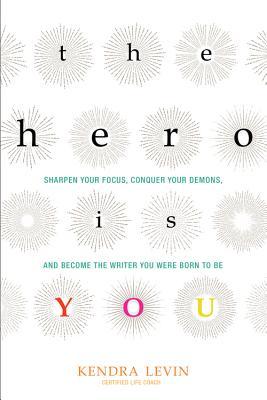 Kendra Levin helps writers and other creative artists meet their goals and connect more deeply with their work and themselves. She is a certified life coach, as well as a senior editor at Penguin, a teacher, and author of The Hero Is You. Visit her at kendracoaching.com and follow her @kendralevin.
And Kendra is giving away a free 30-minute Skype coaching session to one lucky writer. Just leave a comment below about your favorite way NOT to write. Winner will be selected randomly later this month. One comment per person, please. GOOD LUCK!
Check out Kendra’s new book THE HERO IS YOU, released today!
 Unlike many people who choose book publishing as somewhat of an accidental profession, it was always expected of me that I would one day work at Trident Media Group, a family-owned and operated literary agency. I think it comes as a comfort to many of my clients that I’m not leaving the literary agency, nor book publishing anytime soon. Anyway, you could say I was sort of groomed for the position at a young age. That’s why I chose Emerson College in Boston, as they were one of the only schools at the time offering an undergraduate study in publishing.
 My company bio expresses my professional journey from my time at Emerson College, onward:
 THE LITTLE LUMP OF CLAY taught me the importance of hope, a sense of belonging and what it means to be loved.
 I agree that it is difficult to convey a moral or lesson within a 32-page children’s book. Especially with very sparse text, without sounding to “preachy” or “teachy,” but that doesn’t mean it can’t be done. For instance A BALL FOR DAISY by Chris Raschka was a recent winner of the Caldecott Medal and it is a wordless children’s picture book that I feel accomplished that conveyance of message, an impressive feat without the use of text. A big part of it is giving kids a lot more credit than we do in understanding a picture book, especially since they will often have a parent or teacher reading with them.


 by
by  What? Yes, that’s right. My second book event took place at our local Chick-Fil-A! And we had a vrooming good time! Check out the sign they even displayed weeks in advance!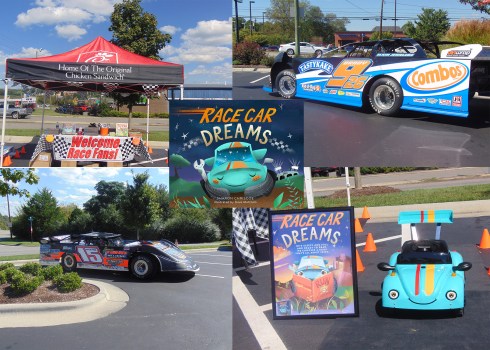
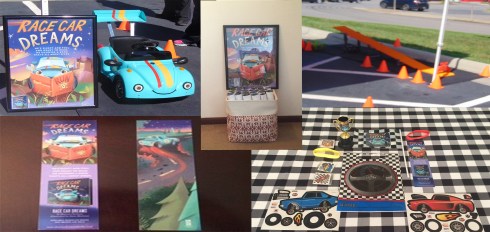
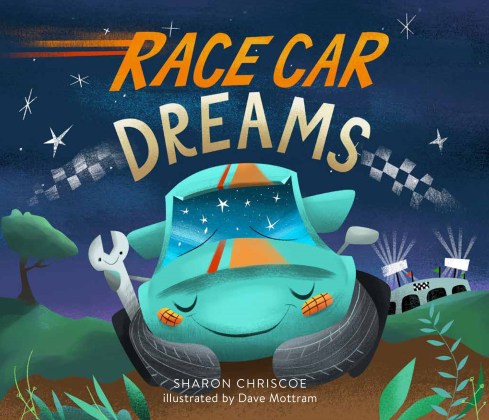
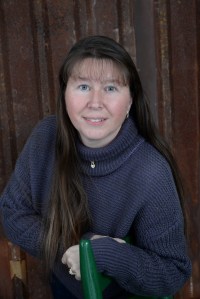 Sharon Chriscoe may not vroom around a race track, but she does zip and zoom around in a bread truck with her husband, Ricky. Fueled with fresh bread, snacks, and writing tools, Sharon has made this her mobile office! She and her husband live in Pilot Mountain, North Carolina. They have three children and one grandchild on the way, as well as an assortment of dogs, cats, bunnies and occasionally a groundhog. In addition to RACE CAR DREAMS, she is the author of BULLDOZER DREAMS (a companion book to RACE CAR DREAMS, Running Press Kids, 2017), and THE SPARROW AND THE TREES (Arbordale Publishing, 2015). She is also a contributor to several magazines such as Highlights High Five, Highlights Hello, and The Old Farmer’s Almanac for Kids. She is a member of The Society of Children’s Book Writers and Illustrators and is a graduate of The Institute of Children’s Literature. She is represented by Jessica Sinsheimer of the Sarah Jane Freymann Literary Agency. To learn more about Sharon, her books, and future events, visit her website:

 by
by 
 by
by 
 “Is there any better medium for bringing together such varied artists and writers and stories and styles? The book has not died after 500 years and the picture book continues to be the most accessible of media. It’s not a fad. It’s not obsolete technology. It is an intimate tactile entity for making ideas come alive. As long as there is paper, what better way to use it?”
 “A lot of American mothers today have become what the Japanese call “Education Mamas.” They want their offspring to start college at 12 and retire at 30, and book merchants are hell-bent on accommodating them. They have forgotten the Alice who asked for all children: “What is the use of a book without pictures or conversation?” Thanks to the conversation of Lewis Carroll and pictures by Sir John Tenniel, Alice is very much alive today. Would anybody remember Alice without Sir John?”
 “The demise of picture books is connected to other mistaken predictions like the death of the print book when e-books came on the scene years ago. There is a general backlash against electronic books because of the amount of time people are spending on their phones, online, and binge-watching TV. People need a break from screen time. Also, the e-book experience, when compared to the tactile experience of a print picture book is not significantly better. The time spent reading an actual book is still a great past time that relies on the power of imagination, and the close relationship of words and pictures.”
 “I never believed in the demise of the picture book! Picture books will always remain a vibrant art form. They are constantly evolving, constantly being reinvented as new authors and illustrator enter the field. Styles change; a new style surprises and delights, then there are imitators, and eventually something different will turn it all around again. I’ve seen a style dismissed as outdated, then a few years go by and it is fashionable again, maybe even considered classic.
 by
by