Excuse me while I go all fangirl for a moment…

I’ve admired Elisa Kleven’s work for years, beginning when I discovered the gorgeous delight THE PAPER PRINCESS…and then the sweet APPLE DOLL. My daughters and I had both books on our regular #bedtimereads rotation. In fact, for months the books never made it back to the bookshelf. They took up permanent nightstand residence.
So when Elisa contacted me about hosting her for THE HORRIBLY HUNGRY GINGERBREAD BOY: A San Francisco Story, I babbled high-pitched incoherent excitement like a Minion. Let me see if I can pull my overalls together to conduct an enlightening interview…
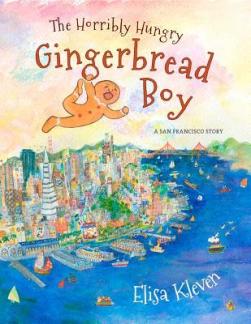
Elisa, in your new book’s backmatter, you mention that THE GINGERBREAD MAN was one of your favorite tales as a child. What made you want to rewrite it with your city AND a different ending?
When I was a kid, it seemed to me that almost everything had a life of its own. As in a fairy tale world, or in the eyes of Native American peoples, everything from stones to trees… to paper dolls, piñatas and gingerbread people seemed to have feelings and a spirit. And while I wasn’t too sensitive to eat my share of gingerbread people, I always had some qualms when it came to nibbling their smiling heads (I’d start with the feet, which seemed less “alive” and work upwards.)
I remember being simultaneously fascinated and upset by the original tale of THE GINGERBREAD MAN. Of course it was exciting to see the cookie-boy come to life and race out into the world with pluck and glee, daring everyone to catch him. But when he finally did get caught, in the jaws of the fox who had promised to take him across the river to safety, I felt his tragic sense of betrayal.
In my version of the story, THE HORRIBLY HUNGRY GINGERBREAD BOY, the cookie is just as energetic and confident as his forbear, but even more defiant: determined not to get eaten, but also to eat—everything in sight! He starts out with petty thefts: his makers’ school lunch (of which he was meant to be part), fruit and candy, noodles and milkshakes. But as he gets bigger, his fantasies grow more grandiose, and he threatens to chomp on the Golden Gate Bridge, gulp down San Francisco Bay, and even “swallow the sun, like a butterscotch drop.”
When the hungry gingerbread boy finally realizes that his creator, a little girl, would rather play with him than eat him, his anger disappears and he becomes both loved and lovable.
As for the story’s setting, San Francisco is such a beautiful city that on certain days and in certain lights it looks delicious. Of course there are many un-pretty aspects to it: homelessness and poverty, but there is also a wealth of exquisite details, including its famous “Gingerbread” architecture, the whimsically colored and decorated Victorian houses and buildings. And the city is also home to lots of amazing and diverse cuisine, So it was fun to let an imaginary cookie-child loose in the city and watch him eat his fill!
 Speaking of the San Francisco architecture, when I was visiting the city years ago, I was fascinated to learn that there are “color consultants” who help people choose the hues for their Victorian houses—the shingles, the shutters, the trim—every little swirling detail. Likewise, your new book is a feast for the eyes—so colorful and detailed. How would you describe your unique style—and how did it evolve?
Wow, Tara, I didn’t know that there are color consultants for the Victorian houses! And yes, they are amazing in every confection-like detail.
As for my art style, it grows right out of my childhood—or, more accurately—I never outgrew my childlike love for bright colors, tiny details, and enchantment. I used to spend hours making miniature dollhouse worlds, gingerbread houses and people, toy merry-go-rounds, and detailed paper characters and settings. When I grew up, this urge did not go away, but evolved into a passion for the magical worlds inside of picture books.
Well, I’m staring at your illustrations in wonder because there are so many teeny-tiny details. How do you plan your illustrations out? What is your medium and method? How long does it take to complete an illustration?
I make a book dummy, with pencil sketches of the illustrations and type pasted in. I often use photo references at this stage, especially if I’m depicting real locations (as opposed to fantasy or dream landscapes, which I pull out of my imagination). Once the publisher approves the sketches, I go on to the finished art. I combine watercolor, ink, collage, pastels and whatever else works to create the finished picture. I create everything in my pictures by hand, gluing, snipping, painting. And while I admire a lot of digital illustration and the technical wonders it can accomplish, I’m pretty tech-averse when it comes to creating my own images. I love the feel and textures of materials in my hands.
It takes me an average of two or three weeks to complete an illustration. Creating the rough sketch is actually the most difficult part, because I’m using a pencil and blank piece of paper to create a new little scene. Once the sketch is finished, it takes a week or two to create the finish.

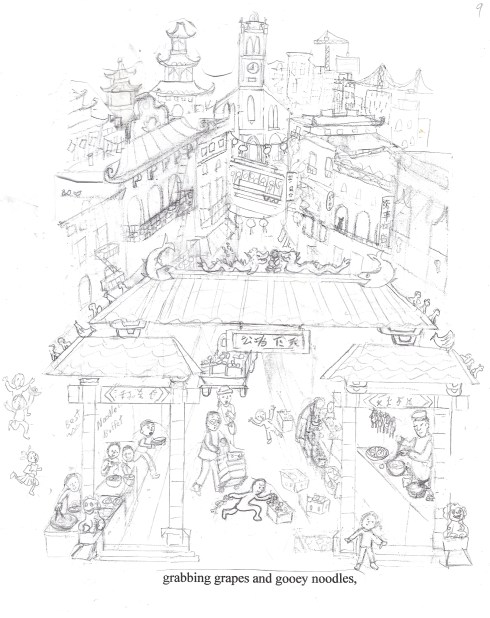
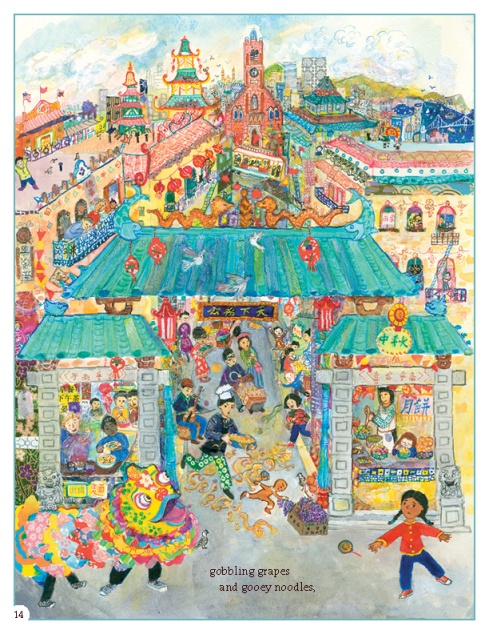


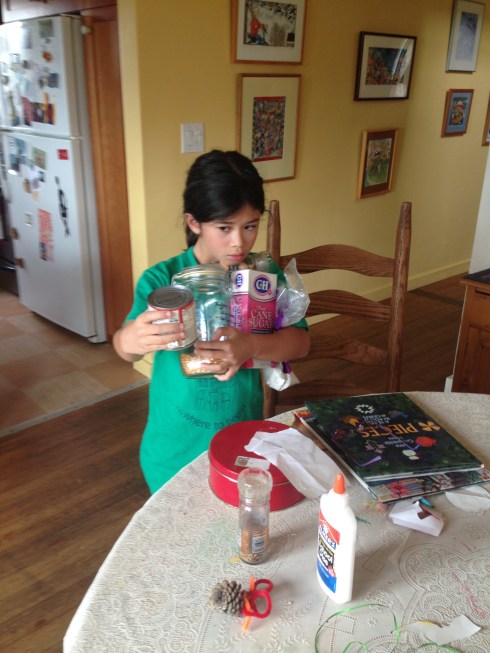

The Gingerbread Boy in progress:


Thinking about your other books, I think I see a theme in your work. In THE PAPER PRINCESS, a handmade gift blows away but returns to the person it was intended for. In THE APPLE DOLL, a girl makes a friend she cherishes. In SUN BREAD, a warm sun is baked on a cold winter’s day. The Gingerbread Boy comes home to the girl who created him. You write about creative pursuits mixed with thoughts of love at home—and speaking of home, this book is not your only one that features San Francisco. Do you think there is a common thread woven through your books?
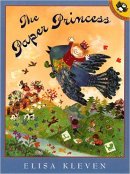


What a thoughtful and interesting question, Tara. The theme of creativity is definitely woven through all of my stories (as is the theme of flying). As a child I spent many happy hours creating all sorts of things, from paper dolls to decorative breads and bread sculptures, to apple dolls, and yes, gingerbread people and houses. (My mother and grandmother were both accomplished artists, but neither of them made particularly cheerful or colorful art). I suppose I created the art I wanted to see as a child, and the worlds that I wanted to live [and fly around!] in.
As for the theme of homecoming, who doesn’t want to return to a home, experienced or imagined, full of love, warmth and reassurance? Through my characters and stories I’m able to go to places I long for, and that I think many children long for, too. My favorite childhood memories are of playing in a dollhouse I made myself, while my mother worked on her own art in her studio in our backyard. I’m able to access that feeling of creativity and security when I write my stories and create my illustrations.
The beautiful San Francisco Bay Area has been my home since I started college at U.C. Berkeley (with the exception of a year spent in Boston). I never stop being moved by its beauty, both geographical and architectural. Its hills and waters, bridges and buildings, cultural diversity and creative food culture inspire me, and I enjoy sharing that inspiration with others, especially children, through my books.
Thank you, Elisa, for your gorgeous books and for stopping by on THE HORRIBLY HUNGRY GINGERBREAD BOY blog tour.
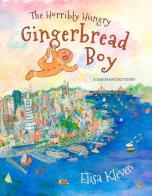 Elisa’s publisher is giving away a copy of the book—just leave a comment to enter. One comment per person, US addresses only please. You have until December 13 to enter so the winner can get their book in time for the holidays. GOOD LUCK!












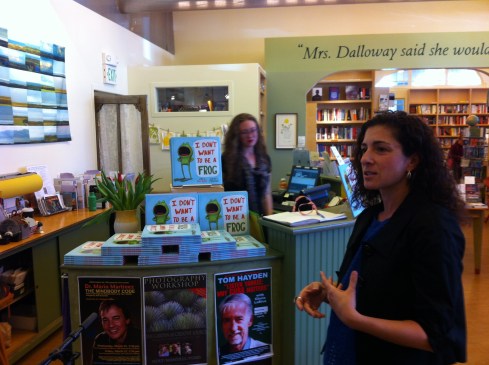


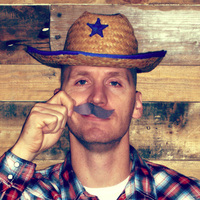 Kids like pictures. Well, duh Dev—of course kids like pictures…they draw them ALL THE TIME…on paper! But seriously, I found when I incorporate images into my reading, even a simple 20 minute reading, they are much more involved and attentive. Examples: I used to just say Mike Boldt illustrated the book…but then I put a funny picture of Mike in a big flowery frame and started bringing it along…they love it. I bring the alternate language versions of my book and pass them around. I draw a little. It’s pretty obvious what this means for writing—it means, think about the pictures! It means letting the pictures do a lot of the work for you, it means present, don’t preach.
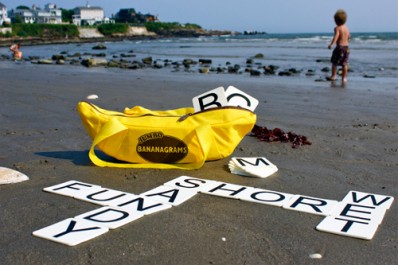
 Dev Petty is the author of I DON’T WANT TO BE A FROG, I DON’T WANT TO BE BIG, and CLAYMATES (L,B & Co. ’17). She is a former visual effects artist who loves writing picture books because they’re like tiny, paper movies. Dev is a Berkeley native, devout Californian, and she’s super good at word jumbles. She’s represented by Jen Rofé of ABLA. Visit her at

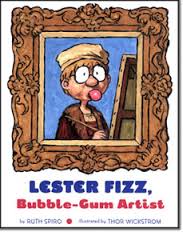 When my first picture book,
 I’m not sure where those postcards ended up, but it wasn’t in my friends’ and family’s mailboxes. Ordering a larger quantity turned out to be my only smart move, because once I learned that 90% of the postcards were never delivered, I had to re-do the entire mailing. (The others arrived at their destinations postage due!)
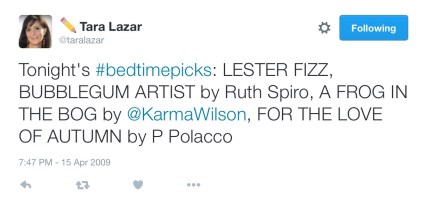

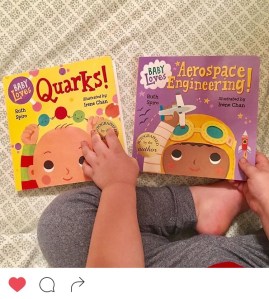

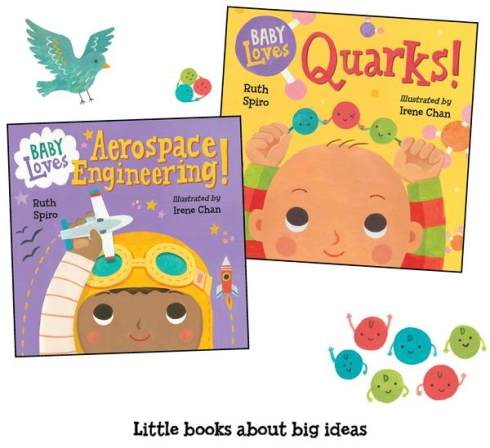
 Ruth Spiro is a children’s book author and freelance writer. Her Baby Loves Science board book series, published by Charlesbridge, includes Baby Loves Aerospace Engineering! and Baby Loves Quarks!. The next two titles, Baby Loves Thermodynamics! and Baby Loves Quantum Physics! will be published in 2017. Also forthcoming from Dial is a new picture book series, Made by Maxine, which sold at auction in a 3-book deal. The first book is scheduled for 2018.
 (Recommended for kids:
  by
by 
 Unlike many people who choose book publishing as somewhat of an accidental profession, it was always expected of me that I would one day work at Trident Media Group, a family-owned and operated literary agency. I think it comes as a comfort to many of my clients that I’m not leaving the literary agency, nor book publishing anytime soon. Anyway, you could say I was sort of groomed for the position at a young age. That’s why I chose Emerson College in Boston, as they were one of the only schools at the time offering an undergraduate study in publishing.
 My company bio expresses my professional journey from my time at Emerson College, onward:
 THE LITTLE LUMP OF CLAY taught me the importance of hope, a sense of belonging and what it means to be loved.
 I agree that it is difficult to convey a moral or lesson within a 32-page children’s book. Especially with very sparse text, without sounding to “preachy” or “teachy,” but that doesn’t mean it can’t be done. For instance A BALL FOR DAISY by Chris Raschka was a recent winner of the Caldecott Medal and it is a wordless children’s picture book that I feel accomplished that conveyance of message, an impressive feat without the use of text. A big part of it is giving kids a lot more credit than we do in understanding a picture book, especially since they will often have a parent or teacher reading with them.


 by
by  What? Yes, that’s right. My second book event took place at our local Chick-Fil-A! And we had a vrooming good time! Check out the sign they even displayed weeks in advance!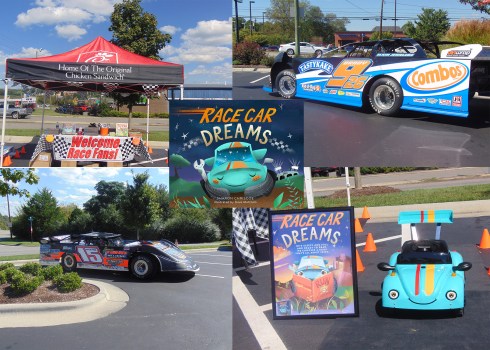
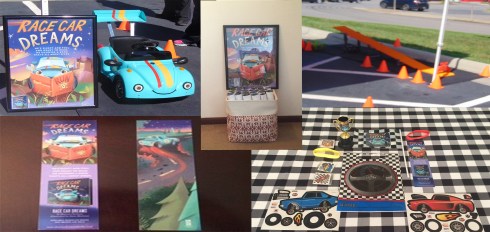
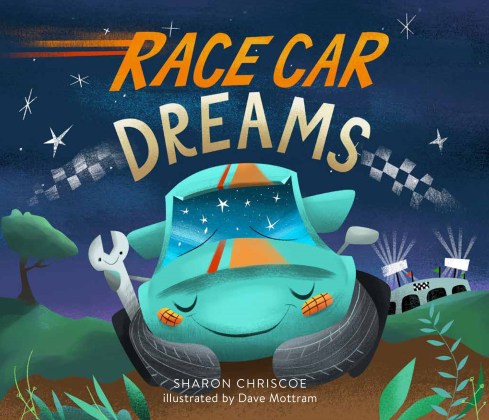
 Sharon Chriscoe may not vroom around a race track, but she does zip and zoom around in a bread truck with her husband, Ricky. Fueled with fresh bread, snacks, and writing tools, Sharon has made this her mobile office! She and her husband live in Pilot Mountain, North Carolina. They have three children and one grandchild on the way, as well as an assortment of dogs, cats, bunnies and occasionally a groundhog. In addition to RACE CAR DREAMS, she is the author of BULLDOZER DREAMS (a companion book to RACE CAR DREAMS, Running Press Kids, 2017), and THE SPARROW AND THE TREES (Arbordale Publishing, 2015). She is also a contributor to several magazines such as Highlights High Five, Highlights Hello, and The Old Farmer’s Almanac for Kids. She is a member of The Society of Children’s Book Writers and Illustrators and is a graduate of The Institute of Children’s Literature. She is represented by Jessica Sinsheimer of the Sarah Jane Freymann Literary Agency. To learn more about Sharon, her books, and future events, visit her website:






 Writing for Kids (While Raising Them)