You are currently browsing the category archive for the ‘Writing’ category.
 by Tammi Sauer
Psst. Hey, you there. Yes, you. Do you want to wow an editor with your next picture book manuscript? Great!
It only takes one thing. Come up with the next Fancy Nancy, Olivia, or Skippyjon Jones. Editors are wading through their slush and/or agented submissions in the hopes of finding an irresistible, can’t-put-down, character-driven manuscript. They want manuscripts that make them feel something and a great character can do just that.
Examples of strong characters in picture books:
OLIVIA by Ian Falconer
Olivia is a feisty little piglet who has too much energy for her own good.
FANCY NANCY by Jane O’Connor
Nancy is very into fanciness whereas her family is not.
SKIPPYJON JONES by Judy Schachner
Skippyjon Jones is a little kitty with a big imagination.
A PET FOR PETUNIA by Paul Schmid
An exuberant Petunia wants, wants, wants a pet she really shouldn’t have.
DINOSAUR VS. BEDTIME by Bob Shea
The seemingly unstoppable Dinosaur is very much into his own bad self.
CLARK THE SHARK by Bruce Hale
Clark has super-sized enthusiasm which leads to all kinds of mayhem.
Developing a unique and engaging character like the ones listed above, however, is a huge challenge.
When I’m working on a new picture book manuscript, I remind myself that if people don’t care about my main character, they won’t care about my story.
I always keep A.R.F. in mind.
A stands for Active.
I want my main character to be doing something. No one wants to read about a kid who just sits on the couch all day with a bag of Doritos.
R stands for Relatable.
I want my main character to connect with readers. I want readers to think, “Yeah, I know what that feels like.”
F stands for Flawed.
I want my main character to have some sort of flaw. Nobody longs to read about little miss perfect. Yawn. Perfect is boring. A flawed character is much more interesting. A bonus? A flaw often increases the story’s tension and makes the character more endearing and root-worthy to readers.
In my latest book, GINNY LOUISE AND THE SCHOOL SHOWDOWN (Disney*Hyperion), illustrated by Lynn Munsinger(!!!), Ginny Louise is the new kid at school.
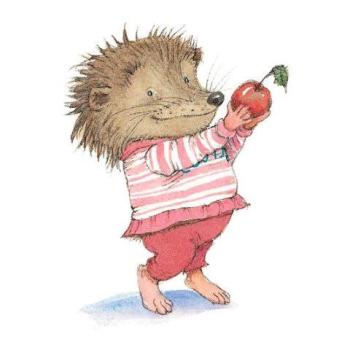
But Truman Elementary is no ordinary school. This is made clear at the very beginning of the book:
The Truman Elementary Troublemakers were a bad bunch.
Especially these three: Cap’n Catastrophe, Destructo Dude, and Make-My-Day May.
Day after day, these scoundrels made waves.
They dodged danger.
And in the classroom?
You don’t even want to know what went on.
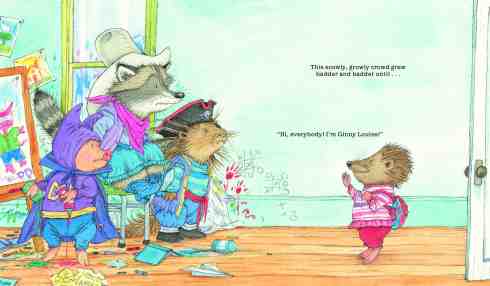
Ginny Louise is Active. She happily goes about her school day. She paints, she sings, she learns things. All the while, she is oblivious to the fact that everything she does drives the Truman Elementary Troublemakers bonkers.
Ginny Louise is Relatable. She doesn’t fit in with her classmates in the classroom or out on the playground. (Readers can empathize with her because everyone has experienced the feeling of not fitting in at one time or another.)
Ginny Louise is Flawed. She only hears what she wants to hear. This results in all kinds of miscommunication.
By the book’s end, this active, relatable, flawed character turns things around at Truman Elementary. Well. For the most part. 🙂
GINNY LOUISE AND THE SCHOOL SHOWDOWN debuts TODAY! Next summer, Ginny Louise and the rest of the gang return for more mayhem in GINNY LOUISE AND THE SCHOOL FIELD DAY.
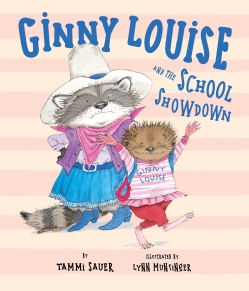
And now it’s a great giveaway for GINNY LOUISE!
Leave a comment naming your favorite PB character and you will be entered to win a signed, first-edition copy of GINNY LOUISE AND THE SCHOOL SHOWDOWN!
One comment per person, please.
A random winner will be selected in two weeks.
Good luck!
Tammi Sauer is a former teacher and library media specialist. She has sold 23 picture books to major publishing houses. In addition to winning awards, her books have gone on to do great things. Mostly Monsterly was selected for the 2012 Cheerios Spoonfuls of Stories program. Me Want Pet! was recently released in French which makes her feel extra fancy. And Nugget and Fang, along with Tammi herself, appeared on the Spring 2015 Scholastic Book Fair DVD which was seen by millions of kids across the nation. Tammi’s books Ginny Louise and the School Showdown (Disney*Hyperion), Your Alien (Sterling), and Roar! (Simon & Schuster/Paula Wiseman) debut in 2015.
You can visit Tammi online at tammisauer.com and at picturebookbuilders.com.
First, let’s announce some winners!
The winner of the LITTLE RED GLIDING HOOD F&G is:
NATALIE LYNN TANNER!
The winner of Dev Petty’s I DON’T WANT TO BE A FROG is:
JHAYSLETT!
Congratulations! Be on the lookout for an email from me.

…So this week I did a boatload of Skype visits for World Read Aloud Day. Almost TWO DOZEN! Phew. My own kids are fed up with THE MONSTORE, as evidenced by my elder daughter’s video—mouthing the words and rolling her eyes while I read in another room. (She thought she’d get away with it, but I found it on her iPad! Oooooh! BUSTED!)
One of the most frequently asked questions during these Skypes was: “Out of all your books, which is your favorite?”
Now I know some authors claim—like parents of multiple children—to love them all equally, to not to have a favorite. But I do. And I’m not ashamed about it!
It’s whatever I just finished writing. My newest manuscript.
Once I complete a new story that my agent approves, I just go NUTSO with excitement. I dream of who may acquire it, which rock star illustrator will be tapped to illustrate it…plus I imagine Merry Makers creating the must-have accompanying plush toy. (Or maybe even a stuffed me!)

Yeah, I told you I go NUTSO.
There’s something about a fresh story. It’s a feeling I wish I could recreate as I BEGIN a new story, but often with a new manuscript, there’s a lotta chewing of fingernails (which is why I haven’t been able to put on my new Jamberry nails).

How can you recreate that newly-subbed, fresh-and-juicy, shinier-than-Turtlewax feel?
The best way out is always through. Write something new and get-r-done. If writing were easy, then everyone would have a published book. There should be joyous celebrating once something is finished and submission-ready. If you’re feeling just ho-hum, that manuscript is not pumped up full of YOU.

Photo credit: Scott Beale
That’s another thing I want to talk about today, finding YOU as a writer.
Years ago, when I was writing flash fiction for adults, I stumbled across a marvelous piece in an anthology. It was about two young women with a strained relationship going back to their parents’ house to pack it up. Their mother was fading away, doing strange things, leaving herself bizarre notes to capture pieces of her memory. The sisters found one of these notes in the bookshelf, held each other sobbing, and then laughed at the absurdity of it all. The story was so lyrically written, and so poignant. Why couldn’t I have written that?
So I tried writing something based upon that style—that lovely, lilting, poetic style. Like a sunset watercolor over the rippling bay. And you know what? It stunk. Worse than the bay.
Even though it was stilted and forced, that story taught me a little about who I was as a writer…by showing me who I WAS NOT. It was one step in finding my true voice.
I always say no piece of writing is wasted time. It’s all practice. Even the junk is worth something!
So, tell me, out of all that you’ve written, what is your favorite?
Please leave a comment (with a link, if appropriate).
May you share a boatload.
by Sudipta Bardhan-Quallen
 It’s back to school season here in New Jersey (or, outside Philadelphia, as I typically refer to it) and that means big changes in my household. All summer, my kids and I are bums. We hang out at the beach, at the pool, at the mall. We travel, we sleep in, we do nothing. Summer is heaven.
But come September, my children’s lives change. Gone are the no schedule, no stress days and in their place we have wake up alarms, agenda books, and deliverables (and, it seems, a LOT of laundry!). The kids aren’t the only ones who go back to school—as a children’s book author, the school year means that I go back to school as well.
Every year, between school visits, Skype visits, and events like Dot Day or World Read Aloud Day, I connect with about 100 different schools all around the world. Because I spend so much time with school kids, I end up doing quite a bit of teaching, especially teaching writing. Which happens to be a completely different skill than actually writing.
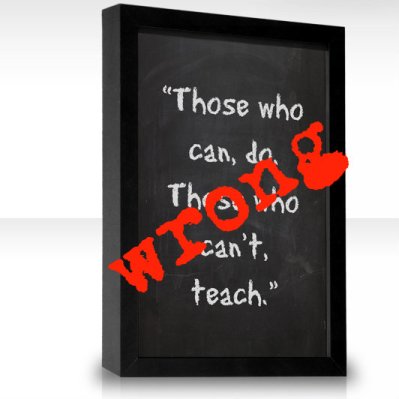
There is a very stupid expression that you sometimes hear people throw around: “Those who can, do. Those who can’t, teach.” I want to be very, very clear here: that is one of the dumbest things I’ve ever heard. Not only is it disparaging, inflammatory, and demeaning, it also has the distinction of being very WRONG. I definitely knew that before I personally started working with schools, but now that I teach on a regular basis, I can tell you that those who teach can do better than anyone else.
It has to do with the nature of teaching. In order to teach someone a skill, you have to know it so well that you can explain every step, even the ones you do automatically or on muscle memory. Here’s an example: when I was in graduate school, I bought a brand new Mustang that I couldn’t drive. Because it was a stick shift and I only knew how to drive an automatic. So I had a friend try to teach me how to drive stick. We got in my car, I started it up, and I asked him what to do next. He said, “OK, now drive.” I looked at him blankly. “Just don’t stall the car,” he added. I had no idea what that meant. So he said, “Don’t ease off the clutch to quickly. Or too slowly!”
At that point, I threw him out of the car. He, to this day, doesn’t understand what had upset me.
He knew how to drive a manual, and things that I needed to know—how to properly come off the clutch when changing gears, how to tell when to shift up or down, etc.—were things he’d stopped thinking about. So he couldn’t teach me to do them because he hadn’t been thinking about all those little steps that you do to succeed that once you’re successful, you completely forget about.
(For the record, I can now totally drive a stick.)
When I started teaching writing, I struggled with this same thing. I thought to myself, How can I teach something that I just DO? Trust me, this was very difficult to figure out. But the more I did figure it out—the better I got at teaching others how to write—the better I actually got at writing. Just like my friend who failed at teaching me how to drive my Mustang because there were so many things he was doing on autopilot that he couldn’t explain, as writers, we do that same thing. When you get to a certain point in your writing journey, you don’t even think about certain things like how to conceptualize a complex character or add layers to your plot, you just do it. But if you try to teach someone else how you do what you do, you have to break down every action into baby steps so that you can show your students how to mimic your actions. This forces you to think through your methods, and in the process, refine them even more.
So even if you’re not at the point in your publishing career where you are teaching, I’d like to encourage you to think like a teacher to become a better writer. For example, instead of saying, “I’m going to create a charismatic main character,” I’d ask you to analyze what steps you’d take to do that, like:
- Start with something familiar
- Add some positive unique features
- Give the character some flaws that make him or her relatable
- Give him or her positive relationships (family, best friend, etc.) and negative relationships (nemesis, villain, etc.)
- Temper every extreme (like “good” or “bad”) with something that brings it back a notch (like “good but hates kittens” or “bad but rescues kittens”)
The more you go through this process of treating your writing objectives like lesson plans, the deeper you’ll understand what you’ve done when something work—and what you may have left off inadvertently when something doesn’t work.
When you’re a good teacher, your students will benefit. When you yourself are your own student, your teaching skills make you so much better at doing.
Happy Back to School!
 Sudipta is an award-winning author of over 40 books and the co-founder of both Kidlit Writing School and Kidlit Summer School. Her books include DUCK DUCK MOOSE, TYRANNOSAURUS WRECKS, ORANGUTANGLED, and over thirty more books that have been acclaimed by the Junior Library Guild, the California Reader’s Collection, the Bank Street Books Reading Committe, the Amelia Bloomer list, and many more. Find out more about her by visiting Sudipta.com or her blogs Nerdy Chicks Rule and Nerdy Chicks Write.
Sudipta’s new class: Picture Book A to Z’s: Plotting in Picture Books
The Picture Book A to Z series is designed to be a collection of master level classes that cover all of the fundamentals of picture book craft. While each class is complete on its own, taken together, the series will teach you everything you ever wanted to now about picture books- and a lot more!
The ability to craft a strong picture book plot is one of the factors that separates unpublished writers from those who consistently sign publishing contracts to see their work in print. This course will teach you the essentials of creating compelling plots, starting with Arcs, Beginnings, and Climaxes — then literally taking you through the alphabet. Each topic will be explored in depth, both in the lessons and in the discussion forums and webinars. The writing exercises that are a part of of the course are designed to help you apply the lessons to your own writing seamlessly and immediately. By the end of the course, you will never look at plotting the same way again! The first course in this series, Plotting in Picture Books, will begin on October 6, 2014.
Bonus Critique: Register for Plotting in Picture Books before September 20, 2014 and receive a free picture book manuscript review and 20-minute Skype session with Sudipta Bardhan-Quallen, redeemable within six months of the course’s completion.
Thanks, Sudipta! And now for the giveaway…either a 20-minute telephone/Skype PB critique with Sudipta or one of her signed books. The choice is yours. Just comment once below by September 16th to enter!
 by
by “Show, don’t tell.”
We hear this all of the time. Yet, many writers struggle with this very idea.
Writers like to research. We travel to faraway places, we talk with people who live there. We look through old files and photographs. We mine our memories for tidbits and call upon our imagination to fill in the rest.
We stay cerebral.
But this is where we fail ourselves. This is where we fail our readers.
We all want to write books that make people feel, but in order to do that—we must feel first. We must cry. We must get angry. We must laugh. We must fall in love. We must face fear.
But to achieve true emotion with our words, we need to get out of our heads and tune into our guts.
To do this, I like to call upon the actor’s craft.
Here are 3 tips to get out of your writer’s head and write from the gut.

- Keep an Emotion Diary.
An actor knows that whatever happens to them in life is fodder for their craft. Even at a moment of extreme heartbreak, an actor knows, “I can use this.” Observe yourself on a daily basis. How are you feeling? Don’t detail the situations that are happening to you, but write down what an emotion feels like physically. Tune into your hands, your chest, your legs, and your jaw. These are places we hold emotion. - Be emotional.
An actor practices playing with emotion. They take the time to experiment in order to better know how to portray it when the time comes. Much like a yogi will hold a pose to build strength, actors practice holding emotion in their bodies to gain emotional fluency. Refer back to your Emotion Diary to remember how a certain emotion manifests in your body. Soak in it. Go about some daily tasks while in this emotional state. (Although keep these tasks solo. You are working on craft here, not ruining relationships and getting a reputation. Hint: scrubbing the tub while angry is amazing!) Observe how the emotion affects your movement and your actions. Of course, when play time is done, find ways to unwind…we don’t want you to end up a basket case. - Embrace the First Person.
An actor walks in the shoes of others to learn to live in their moments. They speak directly from the mouth, the heart, the gut of the very person they are performing. Spend some time pretending to be your character. You can go through the same emotional practice you did in the previous step, but this time with your character’s situation in mind.
Take your character to the most heightened moment in this emotion. How do they react? Write a letter or a diary entry as your character while holding this emotion. Or create audio or video as your character. Abandon flowery metaphor and other authorly devices for the time being and speak raw, from your character’s gut. You might be surprised what you learn.
It is so easy to fall into summarizing a scene instead of delving in and living each moment. Maybe as writers we prefer to play God and observe the tough situations from afar. It’s more pleasant to be omnipresent than personally absorbed.
But when we learn to write from the gut, our hands may tremble with each keystroke, a lump might form in our throat, tears might well. It’s not always comfortable. Yet it is essential that we learn to breathe life into each moment, so that the very DNA of our story can breathe on the page and fill the lungs of every reader it touches. This is the essence of “show, don’t tell.” In fact, it takes the idea one step further.
“Be, don’t show.”
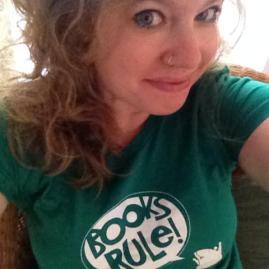 Before Marcie Colleen was a picture book writer, she was a former actress, director and theatre educator. In her 15 year career, Marcie worked within the classroom, as well as on Regional, Off-Broadway and Broadway stages. Formerly the Director of Education for TADA! Youth Theater, she also worked for Syracuse Stage, Camp Broadway, the Metropolitan School for the Arts, and Tony Randall’s National Actors Theater. She holds a bachelor’s degree in Secondary Education and Theater from Oswego State University and a Masters degree in Educational Theater from NYU. She has taught theater workshops in the UK and throughout the US, including Alaska.
Marcie’s From the Gut: An Acting for Writers Workshop (being held on September 14th at NJ-SCBWI) helps writers get out of their heads. Her up-on-your-feet techniques feature acting and writing exercises to tap into raw emotion. Through guided practice, writers learn to breathe life into the voice of every character. Time is spent exploring, playing and simply “being” emotion while learning how to transfer the discoveries onto the page in a way that creates immediacy and authenticity for the reader. Participants are given tools to deepen their writing through voice and movement even when alone in their writing caves.
Visit Marcie at www.thisismarciecolleen.com.

All writers love language. And we especially love fun, amazing words, don’t we? Some have funky spellings, tongue-twisting turns, a satisfying “ooh”…and some sound too hilarious to be true! So I’ve put together a list of favorite fun words that I’ll add to periodically. Have fun, lexicon lovers!
-

It’s a book! More words & super cool facts! Click to order!
abecedarian
- abracadabra
- accoutrements
- adagio
- aficionado
- agita
- agog
- akimbo
- alfresco
- aloof
- ambrosial
- amok
- ampersand
- anemone
- anthropomorphic
- antimacassar
- aplomb
- apogee
- apoplectic
- appaloosa
- apparatus
- archipelago
- atingle
- avuncular
- azure
- babushka
- bailiwick
- bafflegab
- balderdash
- ballistic
- bamboozle
- bandwagon
- barnstorming
- beanpole
- bedlam
- befuddled
- bellwether
- berserk
- bibliopole
- bigmouth
- bippy
- blabbermouth
- blatherskite
- blindside
- blob
- blockhead
- blowback
- blowhard
- blubbering
- bluestockings
- boing
- boffo (boffola)
- bombastic
- bonanza
- bonkers
- boondocks
- boondoggle
- borborygmus
- bozo
- braggadocio
- brainstorm
- brannigan
- breakneck
- brouhaha
- buckaroo
- bucolic
- buffoon
- bugaboo
- bugbear
- bulbous
- bumbledom
- bumfuzzle
- bumptious
- bumpkin
- bungalow
- bunkum
- bupkis
- burnsides
- busybody
- cacophony
- cahoots
- calamity
- calliope
- candelabra
- canoodle
- cantankerous
- catamaran
- catastrophe
- catawampus
- caterwaul
- chatterbox
- chichi
- chimerical
- chimichanga
- chitchat
- clandestine
- claptrap
- clishmaclaver
- clodhopper
- coccyx
- cockamamie
- cockatoo
- codswallop
- collywobbles
- colossus
- comeuppance
- concoction
- conniption
- contraband
- conundrum
- convivial
- copacetic
- corkscrew
- cornucopia
- cowabunga
- coxcomb
- crackerjack
- crescendo
- crestfallen
- cryptozoology
- cuckoo
- curlicue
- curmudgeon
- demitasse
- denouement
- derecho
- derring-do
- desperado
- diaphanous
- diddly-squat
- digeridoo
- dilemma
- dillydally
- dimwit
- diphthong
- dirigible
- discombobulated
- dodecahedron
- doldrums
- donkeyman
- donnybrook
- doodad
- doohickey (this is what I call a library due date card)
- doppelganger
- dumbfounded
- dumbwaiter
- dunderhead
- earwig
- eavesdrop
- ebullient
- effervescence
- egads
- eggcorn
- egghead
- elixir
- ephemeral
- epiphany
- ersatz
- eucatastrophe
- extraterrestrial
- finagle
- fandango
- festooned
- fez
- fiasco
- fiddle-footed
- fiddlesticks
- finicky
- firebrand
- fishwife
- fisticuffs
- flabbergasted
- flapdoodle
- flibbertigibbet
- flimflam
- flippant
- floccinaucinihilipilification
- flophouse
- flotsam
- flummery
- flummoxed
- flyaway
- flyspeck
- folderol
- foofaraw
- foolhardy
- foolscap
- footloose
- fopdoodle
- fortuitous
- fracas
- frangipani
- freewheeling
- fricassee
- frippery
- frogman
- froufrou
- fuddy-duddy
- fussbudget
- futz
- gadfly
- gadzooks
- gallimaufry
- gambit
- gangplank
- gangway
- gargoyle
- gasbag
- gazebo
- gazpacho
- gewgaw
- genteel
- ghostwriter
- gibberish
- gimcrack
- gizmo
- glabella
- glitch
- globetrotter
- gobbledygook
- gobsmacked
- googolplex
- goosebump
- gooseflesh
- gorgonzola
- gossamer
- grandiloquent
- greenhorn
- guffaw
- gumshoe
- guru
- gussied
- guttersnipe
- haberdashery
- haboob
- hairpin
- halcyon
- halfwit
- hangdog
- haphazard
- harebrained
- harumph
- harum-scarum
- headlong
- heartstrings
- heebie-jeebie
- heirloom
- helter-skelter
- hemidemisemiquaver
- heyday
- higgledy-piggledy
- highfalutin
- hijinks
- hillbilly
- hippocampus
- hippogriff
- hobbledehoy
- hobnobbed
- hocus-pocus
- hodgepodge
- hogwash
- hokum
- hoodoo
- hoodwink
- hooey
- hooligan
- hoopla
- hootenanny
- hornswoggle
- horsefeathers
- hotbed
- hotfoot
- hothead
- hubbub
- hullabaloo
- humbug
- humdinger
- humdrum
- hunky-dory
- hurly-burly
- hushpuppy
- huzzah
- hyperbole
- idiom
- idiosyncrasies
- igloo
- ignoramus
- impromptu
- incognito
- incorrigible
- incredulous
- indomitable
- indubitably
- infinitesimal
- interloper
- interrobang
- ironclad
- izzard
- jabberwocky
- jacuzzi
- jalopy
- jamboree
- jargogle
- jawbreaker
- jetsam
- jibber-jabber
- jink
- jitney
- jubilee
- juggernaut
- jujubes
- jumbo
- junket
- juxtaposition
- kaleidoscope
- kaput
- kerfuffle
- kerplunk
- kibosh
- killjoy
- kismet
- knickerbocker
- knickknack
- kowtow
- kumquat
- kvetch
- lackadaisical
- lagoon
- lambasted
- lampoon
- landlubber
- laughingstock
- lexicographer
- limburger
- lingo
- loco
- loggerhead
- logjam
- logophile
- logorrhea
- lollapalooza
- lollygag
- loofah
- loony
- loophole
- lugubrious
- lummox
- machinations
- madcap
- maelstrom
- magnificent
- majordomo
- malapropism
- malarkey
- manifesto
- mastermind
- mayhem
- mealymouthed
- mellifluous
- menagerie
- miasma
- miffed
- milquetoast
- misanthrope
- mishmash
- moocher
- mojo (also a character in THE MONSTORE)
- mollycoddle
- mondegreen
- moniker
- monkeyshines
- monsoon
- mnemonic
- moonstruck
- muckety-muck
- mudpuppy
- mudslinger
- muffuletta
- mufti
- mulligatawny
- mumbo-jumbo
- murmuration
- muumuu
- nabob
- namby-pamby
- nimrod
- nincompoop
- nitwit
- nomenclature
- nonplussed
- nonilllion
- nonuplets
- noodge
- nudnik
- numbskull
- onomatopoeia
- oomph
- orotund
- outfox
- outlandish
- oxymoron
- pachyderm
- pagoda
- palindrome
- palomino
- panache
- pandemonium
- pantaloons
- papyrus
- parabola
- parallelogram
- parapet
- paraphernalia
- peccadillo
- pedagogue
- peewee
- pell-mell
- persimmon
- persnickety
- petrichor
- pettifogger
- phalanx
- phantasmagorical
- phantonym
- phylactery
- piffle
- pizzazz
- plethora
- pogo
- pogonip
- pollex
- pollywog
- poltroon
- pomposity
- poppycock
- portmanteau
- potpourri
- pseudonym
- pugnacious
- pulchritudinous
- pusillanimous
- pussyfoot
- quibble
- quicksilver
- quicksticks
- quiddle
- quinzee
- quirky
- quixotic
- quizzity
- rabble-rouser
- raconteur
- rainmaker
- ragamuffin
- ragtag
- ramshackle
- ransack
- rapscallion
- razzle-dazzle
- razzmatazz
- rejigger
- rendezvous
- resplendent
- rickrack
- ricochet
- riffraff
- rigmarole
- riposte
- roundabout
- roustabout
- rubberneck
- ruckus
- ruffian
- rugrat
- rumpus
- sabayon
- sardoodledom
- sashay
- sassafras
- scalawag (also scallywag)
- scatterbrain
- schadenfreude
- schlep
- schluffy
- schmooze
- schmutz
- scintillating
- scrofulous
- scrumdiddlyumptious (Dahlism)
- scuttlebutt
- serendipity
- sesquipedalian
- shabang
- shenanigans
- skedaddle
- skirmish
- skullduggery
- slapdash
- slapstick
- slipshod
- smithereens
- smorgasbord
- snollygoster
- sobriquet
- sojourn
- spellbind
- splendiferous
- squeegee
- squooshy
- staccato
- stupefaction
- succotash
- supercilious
- superfluous
- surreptitious
- Svengali
- swashbuckler
- switcheroo
- swizzlestick
- synchronicity
- syzygy
- talisman
- taradiddle
- tchotchke
- teepee
- telekinesis
- thingamabob
- thingamajig
- thunderstruck
- tidbit
- tintinnabulation
- toadstool
- toady
- tomfoolery
- tommyrot
- toothsome
- topsy-turvy
- trapezoid
- tub-thumper
- tumultuous
- turducken
- typhoon
- ululation
- umlaut
- umpteen
- unctuous
- usurp
- uvula
- vainglorious
- vagabond
- vamoose
- verboten
- verisimilitude
- vermicious (well, if I included one Dahlism, why not another?)
- vertigo
- verve
- virtuoso
- vivacious
- vuvuzela
- wackadoodle
- wallflower
- wanderlust
- whatchamacallit
- whatsis
- whimsical
- whippersnapper
- whirligig
- whirlybird
- whizbang
- whodunit
- whoop
- widget
- wigwam
- willy-nilly
- windbag
- wipeout
- wiseacre
- wisecrack
- wisenheimer
- wishy-washy
- woebegone
- wonky
- woozy
- wordplay
- wordsmith
- wunderkind
- wuthering
- xylophone
- yahoo
- yokel
- yo-yo
- zaftig
- zeitgeist
- zenzizenzizenzic (yes, this is a word!)
- zephyr
- zeppelin
- ziggurat
- zigzag
- zonked
- zoom
- zydeco

Allow me to be Andy Rooney for a moment.
Imagine me as a white-haired, bulbous, salty old man with a whiny accent.

I know, it’s hard. But just IMAGINE. (By the way, isn’t “bulbous” a marvelous word? I think we, as writers, should seek its descriptive assistance more often. But sorry, I digress. Back to being Andy…)
“Ya ever wonder why so many children’s books feature THREES? Goldilocks and the THREE Bears? The THREE Little Pigs? Snow White and the SEVEN Dwarfs? No wait…I miscounted…I mean The THREE Billy Goat’s Gruff?”
Yes, there’s something downright appealing about the number THREE. (P.S., I’ve returned to being Tara. Thank goodness ’cause those eyebrows are itchy.)
It’s like two is too little. And four is too many. As Goldi would say, three is “just right”. Three is as satisfying as a warm, comfy little bed. (Until the three bears arrive home, that is.)
According to Wikipedia (yes, I’m quoting Wiki), “things that come in threes are inherently funnier, more satisfying, or more effective than other numbers of things. The reader or audience of this form of text is also more likely to consume information if it is written in groups of threes. From slogans (“Go, fight, win!”) to films, many things are structured in threes.”
The rule of threes is all around us. In photography, the “rule of thirds” dictates that the most visually striking elements of a photograph should align with the intersection of theoretical lines which break the image into thirds lengthwise and widthwise. (Geesh, what a clunker of a sentence.) Hence:

In interior decorating, objets d’art are often grouped in threes.
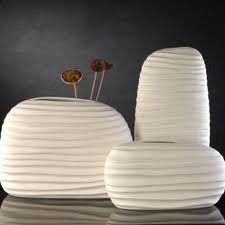
Architecture adheres to this rule as well. Three are more aesthetically pleasing than two or four. Threes help to balance the focal point in a room. Just ask Genevieve.

There’s the “three schema approach” in software engineering. But don’t ask me to explain. That’s the hubby’s forte.
Even religion espouses threes—the Father, the Son and the Holy Ghost.
“Omne trium perfectum” is a Latin phrase which translates to “everything that comes in threes is perfect”. The world seems to think so. You’ll see the “rule of threes” demonstrated everywhere. Hey, I even sneeze three times in a row.
So in picture books, where do we use this rule?
Descriptive groups of three.

“The Monstore” by Tara Lazar & James Burks
.
Three images upon a page.
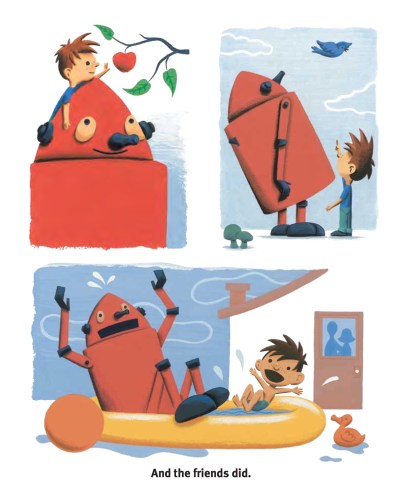
“Boy + Bot” by Ame Dyckman & Dan Yaccarino
.
Even three text boxes!
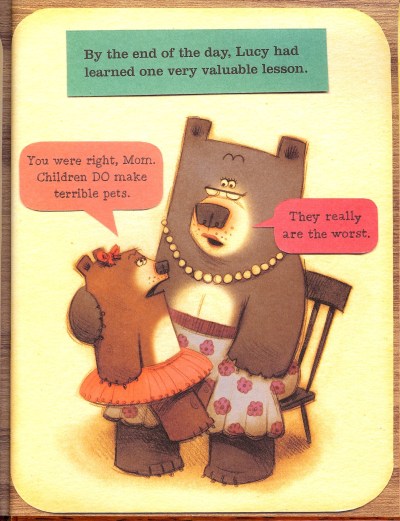
“Children Make Terrible Pets” by Peter Brown
.
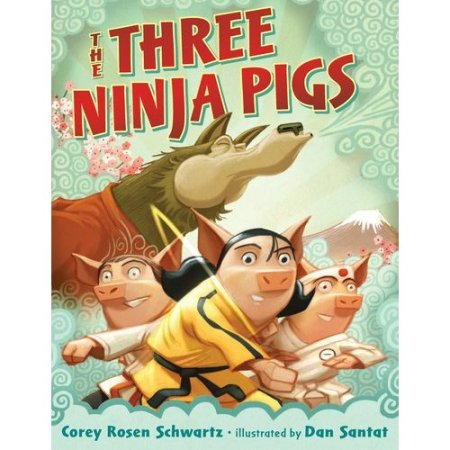
And the classic three characters.
.
But the most important rule of threes in picture books is three attempts to solve a problem. (Prior to the fourth successful attempt.)
These three attempts invest the reader in your hero’s struggles. Solving the problem in one fell swoop? That doesn’t feel genuine, and the reader won’t care about their journey because it’s over before it’s even begun. There’s no time to empathize with your MC. And with two attempts, the main character has not yet collected enough information to help complete his task. But third time’s the charm! (See that?) It’s when he tries again, fails, hits his lowest point, but then realizes just what he needs to rise again. Three attempts build tension and encourage the reader to turn the page–eagerly! Oooh, what happens NEXT?
Crack open your favorite picture book and you’ll notice threes abound. What did you find?
But now, I’m going to tell you about some different numbers…

THE MONSTORE author and PiBoIdMo creator Tara Lazar’s “7 ATE 9”, a pun-packed preschool noir mystery, starring a hard-boiled Private “I” and a mysteriously missing number, to Kevin Lewis at Disney-Hyperion, by Ammi-Joan Paquette at Erin Murphy Literary Agency (World).
Hip, hip, hooray!
(That’s three cheers!)
Now I know PiBoIdMo participants are awaiting a final post from me, your fearless leader.
Well, that is still to come, once I am feeling better. Perhaps tomorrow? Monday? It shall come soon, never fear, says Fearless Leader.
In the meantime, I have something to make YOU feel better.
Gifts for writers! And by gifts for writers, I mean gifts that you shall immediately place on your wish list. Why? They’re just THAT awesome.
I’ve put together this list of my 10 personal favorites, but I have a more than 100 other literary lovies to tickle your holiday fancy on my Pinterest board Things Writers Like. So hop on your sleigh and slip over there once you’ve perused this pile. (Geesh, enough with the corny alliteration, Tara.)
Let me know which gift is your favorite, and feel free to add to the list in the comments!
.
1. Modern Wooden Alphabet Necklace available via SevenSparrowGoods on etsy.com.
Men, don’t leave. I know this first gift is for the ladies. Don’t worry, I have plenty for you. See #2.

.
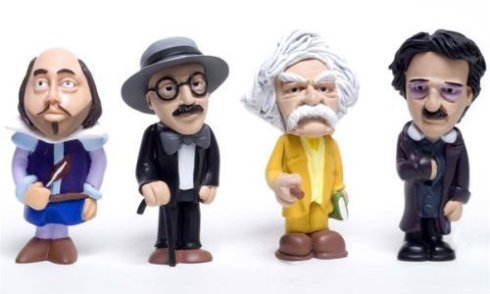
2. Famous Author Action Figures available via ebay.
Ka-pow! Bam! Zonk! NEVERMORE!
.
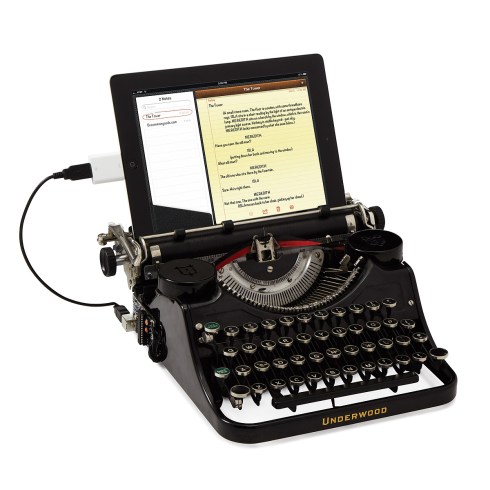
3. USB Typewriter available via uncommongoods.com.
If you miss the satisfying click-clack of an old-fashioned manual typewriter, here’s the perfect solution for you. It remains modern with a USB link to your preferred device–a PC, Mac or iPad.
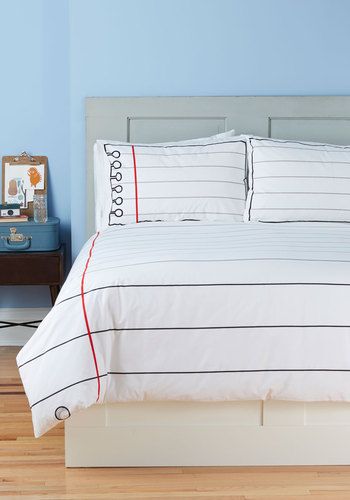
4. Notebook Paper bed linens available via modcloth.com.
Can’t find a piece of paper in the middle of the night? Write on your pillow. Yep, this duvet set comes with washable markers. You won’t even get mad at the kids for drawing on them.
.
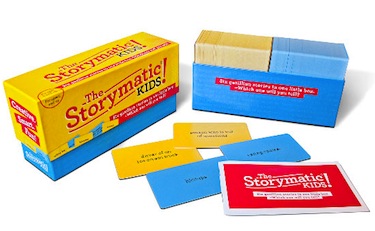
5. Storymatic Game (Kids Version) available via mentalfloss.com.
Maybe you’ve heard of Rory’s Story Cubes or Haikubes or even The Amazing Story Generator. Well, this is a writing prompt game with over 6 million possibilities.
.
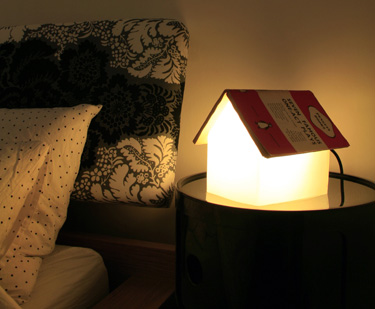
6. Book Rest Lamp available via mentalfloss.com.
Ah, there’s no place like home. Home for your latest read, that is. The soft glow of the lamp is enough to read by, plus you’ll never lose your page.
.
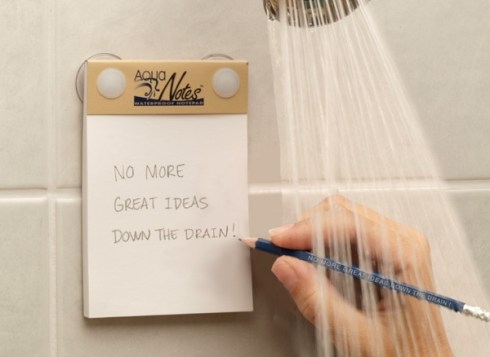
7. AquaNotes available via myaquanotes.com.
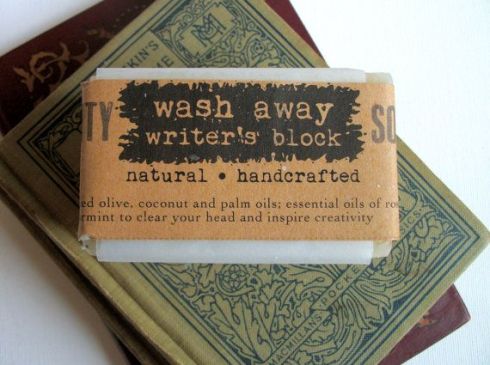
No more great ideas down the drain! (And while you’re getting clean, may as well use “Wash Away Writer’s Block” soap.)
.
8. The 3Doodler available via the3doodler.com.
OK, so maybe you wouldn’t want to write a novel with this, but wouldn’t it be cool to give your fans your characters or signature in 3D?
.
9. Vintage-style custom bookplates available via oiseaux on etsy.com.
Every writer is a reader, and your books are cherished keepsakes. So treat them that way with gorgeous vintage-style bookplates. This shop offers over 100 other vintage styles.

.
10. Charlotte’s Web tee available via outofprintclothing.com.
A classic gift. Out of Print Clothing offers tees inspired by your literary favorites, from Goodnight Moon to Call of the Wild, from Charlotte’s Web to The Great Gatsby. You can never have too many books or too many book tees.

.
Happy shopping for that special writer in your life!
And remember to stop by my Pinterest board “Things Writers Like” for even more!
 “I think what this fella Psy is tapping into…is the fact that people don’t want any meaning right now. The most popular music apparently is that without intelligible words…not reality, not feeling, not meaning.”
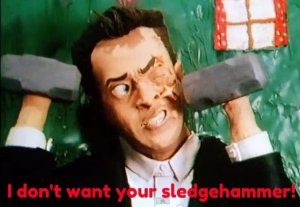 Darn straight, readers want a good beat. What they don’t want is to be beat over the head with a lesson you think they need to learn, sly Mr. Fox.
Three is a magic number. Not only because it’s the age when tiny toy parts no longer pose a choking hazard to your toddler, but because the universe is full of threebies.
Three square meals a day.
Three strikes and you’re out.
Three ring circus. And three ring government. (Excellent analogy, Schoolhouse Rock.)
Then there’s the “rule of thirds” design principle for composing visual images with tension and interest.
Ever heard of the FOUR LITTLE PIGS? Of course not. There’s just three, like THREE BLIND MICE and THREE BILLY GOATS GRUFF. Heck, there’s even THREE STOOGES.
In picture books, you’ll often find the protagonist struggling to solve their problem three times before finally succeeding. This technique encourages the reader to become invested in the hero’s journey. If the character were to try once and triumph, what fun is that? There’s no time to root for her!
Likewise, you’ll often see groups of three drawings on one picture book page. Three offers a nice balance because two is too few and four is too many. Like Goldilocks and the THREE Bears know, three is “just right”.
So today I’m going to extend “The Rule of Three” to you, the aspiring author. How so? I encourage you to have THREE polished manuscripts ready before submitting to an agent or editor.
Three manuscripts means that you’ve been writing for a while. Not a month or two, but most likely a year or two…or yes, even three. You’ve taken the time to hone your craft. Three manuscripts also means you’ve got a body of work an agent can review. If they don’t like your first story, but they see potential, they will ask for some more. Wouldn’t it be a missed opportunity if you didn’t have more?
In fact, even if they LOVE your first story, they will ask to see more. Picture books are a difficult sell, so if the first manuscript doesn’t find a home, they’ll want something else to submit. Three stories lets the agent know that your body of work, your style, resonates with them. On the flip side, they may LOVE your first book but not see a market for your other stories, or personally dislike them. Their lack of enthusiasm means they are not the right agent for you. You want to know this BEFORE you sign with someone, not AFTER….’cause breaking up? It’s hard to do.
And listen, if you have three manuscripts ready, I’m going to go a bit further and suggest you get FIVE ready. Because five is shiny, like “five golden rings” or “The Jackson Five”.
Yeah, it’s easy as A B C, 1 2 THREE.
 When I first began writing for children, my critique group invited an author to speak to us about the publishing process. But we hadn’t realized this author paid to be published with a vanity press. Was she an author? Technically, yes. But after listening to her story, we realized that she might have her name on a book, but she was definitely not an author.
Disclaimer: I am not suggesting everyone who publishes with a vanity press is not an author. Some are excellent authors who are commercially and critically successful. They have taken charge of their career and I applaud them.
But this is the story of the kind of person vanity presses take advantage of—or perhaps the kind of person who takes advantage of vanity presses. At the end, I’ll ask you—do you think she fits the definition of an author?
She began by touting how quickly she wrote her book. She admitted she didn’t think a traditional publisher would acquire it. “Random House? Simon & Schuster? I knew they wouldn’t want it.” So after a few Googles, she found a vanity press that claimed to screen submissions.
The week she submitted, they sent an enthusiastic message offering to publish her book. For a fee, of course. While she wouldn’t tell us exactly how much she paid, she admitted it was between $5,000 and $10,000, although she only had to pay that fee once. Each subsequent book she published would not cost her as much (although it would elicit other fees). More on the sequel later.
She handed out her book, a holiday title, and let us read it. The first few lines were a monologue—single words emphasized with exclamations—but no explanation. She intended those words to be said in disgust, but they were words that conjure excitement in children, so without any other clues, we interpreted them as positive statements. On the third page when the character finally elaborated on his hatred of the holiday, our group was thoroughly confused.
Could the story have benefitted from a critique or two? A revision or two? Certainly. But she didn’t belong to a writing group. She didn’t have the time. Her adult daughter corrected the story for grammar but those were the only changes.
She was very pleased with how “flexible” this publisher was and how much they listened to her illustrative input. (Well, if you’re paying thousands of dollars, you shouldn’t expect anything less.) She made the artist redraw her animal characters several times so they would exactly resemble her real-life pets, the stars of the story.
However, insistence on getting the drawings “just right” delayed the book and severely limited her sales window. The book released just 2-3 weeks prior to the holiday for which it was written. Her vanity press arranged a signing for her at a bookstore and she was thrilled when she heard herself referred to as “the author”.
But is she really an author, with all those missteps and instant gratification? In my opinion, no. One of my dear friends, whom I can hear in my head, is saying, “So if a book is what she wanted, why is that so bad? Be happy for her.”
OK, I can see that the book made this woman very happy. But honestly, her flippant attitude toward our craft irritated me. It’s so very different from what I’ve been taught about working hard for something, being professional, and the satisfaction of a job well done.
In a day when self-esteem is so highly regarded and protected, when we’re giving every kid on the team a trophy just for showing up, when party games like “pin the tail on the donkey” don’t have winners or losers, and “good job” is a common parent refrain even when the job is not good, vanity presses have slipped into the culture quite easily.
But the final part of her story is the most baffling. The vanity press expressed interest in releasing a series of books based upon her characters, and as mentioned previously, she would not have to pay the hefty initial publishing fee. Her response floored us.
“Well, I’m really busy right now, but maybe in a year or two.”
Huh? You mean you have a chance to actually sell more books and make back some of your money but you are “too busy”?
Five years later, a search for her name turns up just one book. No series ever materialized.
So my next question is—was she even a writer? I don’t know writers who are “too busy”—because we must write. It is what we do. We can’t NOT write.
We write for many reasons. Some are writing with the goal of publication. Some are writing for the sheer pleasure of creation. Why do you think this woman wrote? And is she an author?





 Writing for Kids (While Raising Them)