You are currently browsing the category archive for the ‘Storystorm 2021’ category.
by Samantha Berger
Did I just name this post with a whole bunch of poop and potty puns?
Yes. Yes, I did.
And it’s not just because my latest book is called THE GREAT BIG POOP PARTY!
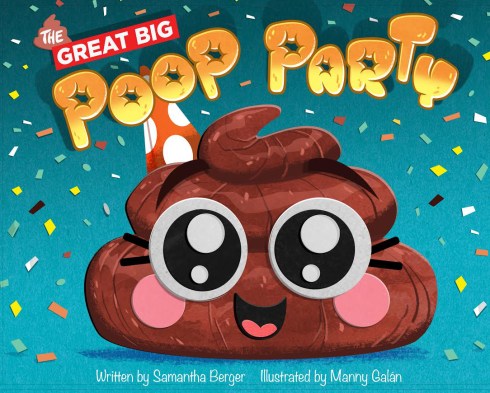
It’s because ideas, inspiration, and freedom need to…you know…move and flow freely!
Just like certain (…ahem…) other things.
So let’s get right into it.
Here are the TOP TEN WAYS I GET MY BRAIN TO LET IT ALL OUT, RELEASE THE IDEAS, and LAY DOWN SOME FRESH IDEAS!
(poop puns, again)
So…get a load of this:
10. Go play.
Build a sandcastle, bust out the Legos, doodle all over a cardboard box. Play with no stakes, no intended audience, and with nothing precious. Just PLAY. You wanna tell stories and connect with kids – go play like one. Pronto!
9. Make a list of words you love: hassenpfeffer, canoodle, gallop!
Jam out a list of words and rediscover your love of language. Cue the heavenly choir and behold…LANGUAGE!
8. Give yourself a short, fun warmup to do every day.
Again, pick one that’s FUN and not a pain in the butt, and hold yourself to it. Make up a new nail polish color name. Give yourself a new pseudonym: Samantha Berger aka Samdemic, aka Bergé, aka Bergermeister MeisterBerger aka The Impossible Berger, etc. Write a daily Postcard from the Pandemic: “Well, this still sucks. xox, me.” Whatever! Nothing stinks more than having to write something you dread. So write something you LOVE and you’ll be inspired to do it.
7. Shift your perspective. I mean literally. Find a way to look at the room like you never have before. This perspecto-shift does something GOOD to your brain.
6. Pick an inanimate object in your home, personify it, and write a paragraph from its point of view.
5. Pretend there is a five-year-old in the room, and tell them a story.
4. Think about one incident that happened when you were a kid, that helped inform who you are today. Write that down.
3. Pick one song you LOVE to sing, and sing it reeeeeally loudly.
This literally opens up your VOICE and opening your voice, gets you open to your VOICE! Duh.
2. Make up a reeeeeally dramatic telenovela about the squirrels and pigeons you see every day.
1. And the number one way to tap ideas and stay inspired is…

Truthbomb: your Inner Editor is a total bummer.
They second-guess every choice you make, always wondering if things could be better, or if you’re choosing the right word, action, character.
They thoroughly impede the whole storytelling flow, leaving you creatively constipated.
Soooo (and I cannot stress this enough) don’t bring them to your Storystorm Party.
Park them in a corner, lock them in a box, send them out for pizza—whatever it takes to keep them away, so you can let your freak flag fly.
You’re going to have your BEST brainstorms, ideajams, and breakthroughs without them. I promise.
They can always come in later with their red pens and harsh judgements, but not now!
I hope this list helps the ideas flow, helps you GO, and brings you LOADS of brand new ideas. I hope it was engrossing, but you know, not enGROSSing.
I want to thank the beyond kind Tara Lazar, as always, for having me guestblurt, and for doing this entire thing SO generously to help raise funds for Blessings in a Backpack (which helps feed children so profoundly in need). Tara is an angel with a kicktuchas sense of humor—ideal combo. I am also thrilled to give away a signed copy of my latest book THE GREAT BIG POOP PARTY—because if ever there was a time to (ahem) let it out and (ahem) release your inner genius and (ahem) stay regular(ly) writing—it is NOW!
May you have buttloads of brilliant ideas.
All my Bergerly best wishes,
Samantha

 Samantha is the award-winning author of over 85 books for young readers, including Crankenstein (illustrated by Dan Santat), What If…(illustrated by Mike Curato) and Rock What Ya Got (illustrated by Kerascoët). She is also a 3-time Emmy-nominated television writer, and just wrote The Sesame Street Podcast with Foley & Friends. Samantha lives in sunny Santa Monica with her dog Polly Pocket.
Visit her online at samanthaberger.com, Twitter @Bergerbooks, Instagram @samanthabergerauthor and Facebook Fans of Samantha Berger.

You read it above, Samantha is giving away a copy of THE GREAT BIG POOP PARTY!
Leave one comment below to enter.
You’re eligible to win if you’re a registered Storystorm participant and you have commented once below.
by Erin Dealey
Happy Day 5, Storystormers! This post is about playing with ideas—as an artist. Yep, I’m talking to all of you. Even if your illustrations are stick figures, what you write is ART. And by now you’ve (hopefully) got at least four picture book possibilities in your Idea Notebook and there are more to come. Hooray!
Wait—you do have an Idea Notebook, don’t you? Here’s mine, made from a repurposed book cover.

Many of my ideas stayed right here. Some I’ve gone back to and eventually shaped into manuscripts. A few became books. But having one place to jot ideas down is a huge improvement from my previous method: random scraps of paper + notes in my bullet-ish journal. I also believe that I’m far more creative if I write them down with pencil or pen, instead of going straight to my computer. My Idea notebook is my writer-version of a sketchbook. Do you think Michelangelo headed straight to the scaffolds of the Sistine Chapel or that slab of granite that became David without sketching things out? OK then. Where were we?

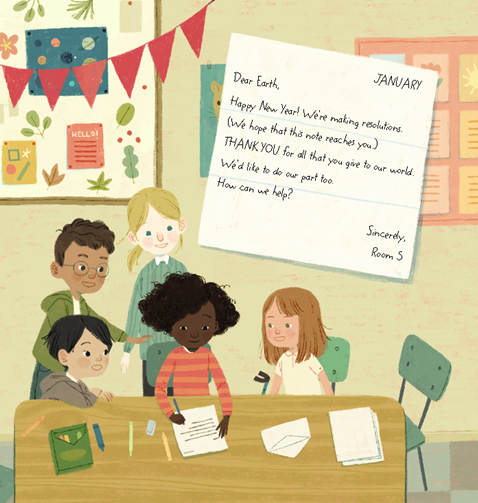
The initial idea for my newest picture book DEAR EARTH…FROM YOUR FRIENDS IN ROOM 5 (HarperCollins, illustrated by Luisa Uribe, Dec.1, 2020) is in this notebook. A few years back, I was wowed by a friend’s holiday illustration of a beautiful child-angel holding Earth in her hand. Those you who have read DEAR EARTH know that the main character is not an angel, nor is it a holiday book. So what happened?
Note: If you participated in Storystorm 2019, you’ll remember the fabulous Day 1 post by Cathy Breisacher Pictures Her Ideas and her list of brainstorming questions. As for me, I was so taken with the image of the angel, I wondered: Why is she holding Earth? Is she Earth’s protector? What about Climate Change? Does she take care of the other planets too? How?
That’s when I started playing around in my idea notebook.
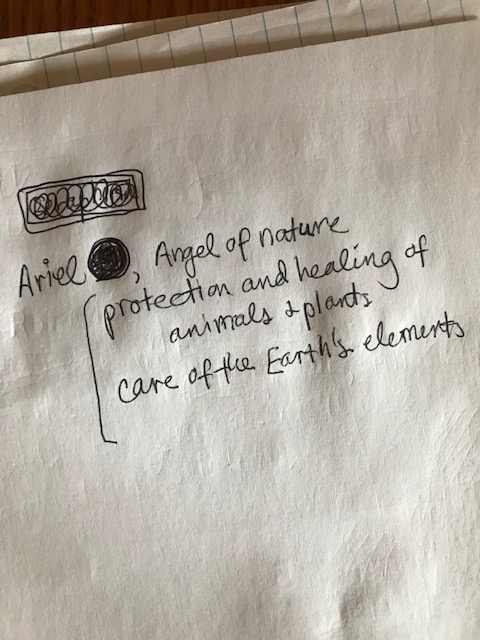
I wanted to find a way to show how KIDS could help the angel take care of Earth all year long—not just on Earth Day. Important: Books for kids should be about kids, or kid-centric topics. But how would the angel communicate to the kids? This got me thinking about a format I’ve always wanted to try: a story told only in letters. See my guest post on Lauren Kerstein’s blog for details: 6 Quick-Read Crafty Tips for Writing a Manuscript in Epistolary Format. (You’ll meet Lauren when she guest blogs for Storystorm later this month!)

Meanwhile, my writing group, the PBJers, made me realize the angel concept might make the book too preachy or worse—a bit morbid (“Aren’t child-angels dead kids?”) Yikes! Their questions and concerns got me thinking—WHAT IF… Room 5 is making New Year’s resolutions and wants to help Earth? What if they write directly to EARTH? And what if EARTH writes back?
What does all of this mean for you, dear Storystormers? On Day 4 of 2020 Storystorm, I hereby challenge you to:
Scroll through the wonderful #kidlitillustration #picturebookillustration examples posted by illustrators on social media. (For other places to find pictures, See Cathy Breisacher: Picture Her Ideas above.) Pick one that resonates with you. Ask it questions. Put the answers in your Idea Notebook so you can play with them and shape them later.
Last but not least, as we work our way through Storystorm 2021, DO NOT STRESS that your ideas are crazy or weird or even morbid or bleh. Instead, let’s think of ourselves as potters. No, not the wand-waving Harry kind. The artist kind. A potter wouldn’t just take some clay, throw a pot, and call it a day. Sometimes we’ll smush our newly thrown pot back into a wad of clay and start over. Sometimes we’ll throw pot after pot and end up with just one that we might glaze and fire. That’s writing, isn’t it? Every one of us is an artist. Storystorm is the start.
Let us resolve to use this month to gather our clay. Then let’s make some art, my friends!
 Erin Dealey is the author of 16 picture books & board books (so far), many in rhyme. She is currently revising a middle grade novel which will not go away. And then there were those angsty poems she wrote in college. Dealey’s original career goal was Olympic Gold Medal tetherball player. When that didn’t pan out, she became a teacher, theater director, actor, mom, and author—and welcomes any opportunity to connect kids with words. She lives in northern California with her husband and a very energetic Golden Retriever. You can find her online at erindealey.com and on Twitter @ErinDealey & Instagram @erindealey.
Erin is giving away 1 of your choice–either a picture book critique or a copy of DEAR EARTH…FROM YOUR FRIENDS IN ROOM 5!
Leave one comment below to enter.
You’re eligible to win if you’re a registered Storystorm participant and you have commented once below.
by Carole Lindstrom
The very first thing I want to begin by saying is that NO idea is a bad idea or a ridiculous idea. NONE. So put that thought out of your head immediately. Those ideas are gems and kernels of stories that can become stand-alone stories one day, or bits and smatterings of stories tomorrow. So, promise yourself, and me, before I go any further that you will keep EVERY idea you come up with!! Deal? Deal!!! I’m proud of you already!!
I want to spend some time talking to you about where I get my ideas and perhaps that will give you some thoughts or insights into places that you can mine for your ideas.
I want to add that ideas rarely come to me when I sit down to come up with story ideas, if that makes any sense. My best ideas usually come rushing at me when I’m in the middle of doing other things. But I always make sure I leave my mind open to letting in new ideas. And definitely keep a notebook with you or use your notebook app on your phone to write them down, because I can never remember them when I tell myself that I will. Get in the habit of writing them down as soon as soon as they flow into your brain.
To be honest, most of my ideas with reading the news and/or current events on social media. Seeing what is going on in the world almost always sparks my creative juices to flow.
And then I usually start asking the questions:
WHY? Why is that thing that way? Why did that happen? Why didn’t anyone do anything about it? Why did someone do something?
And/Or
HOW? How did that happen? How could no one have done anything about that? How did that thing do that?
And/Or
WHO? Who was involved? Who did it? Who did something about it? Who could have done something about it but didn’t?
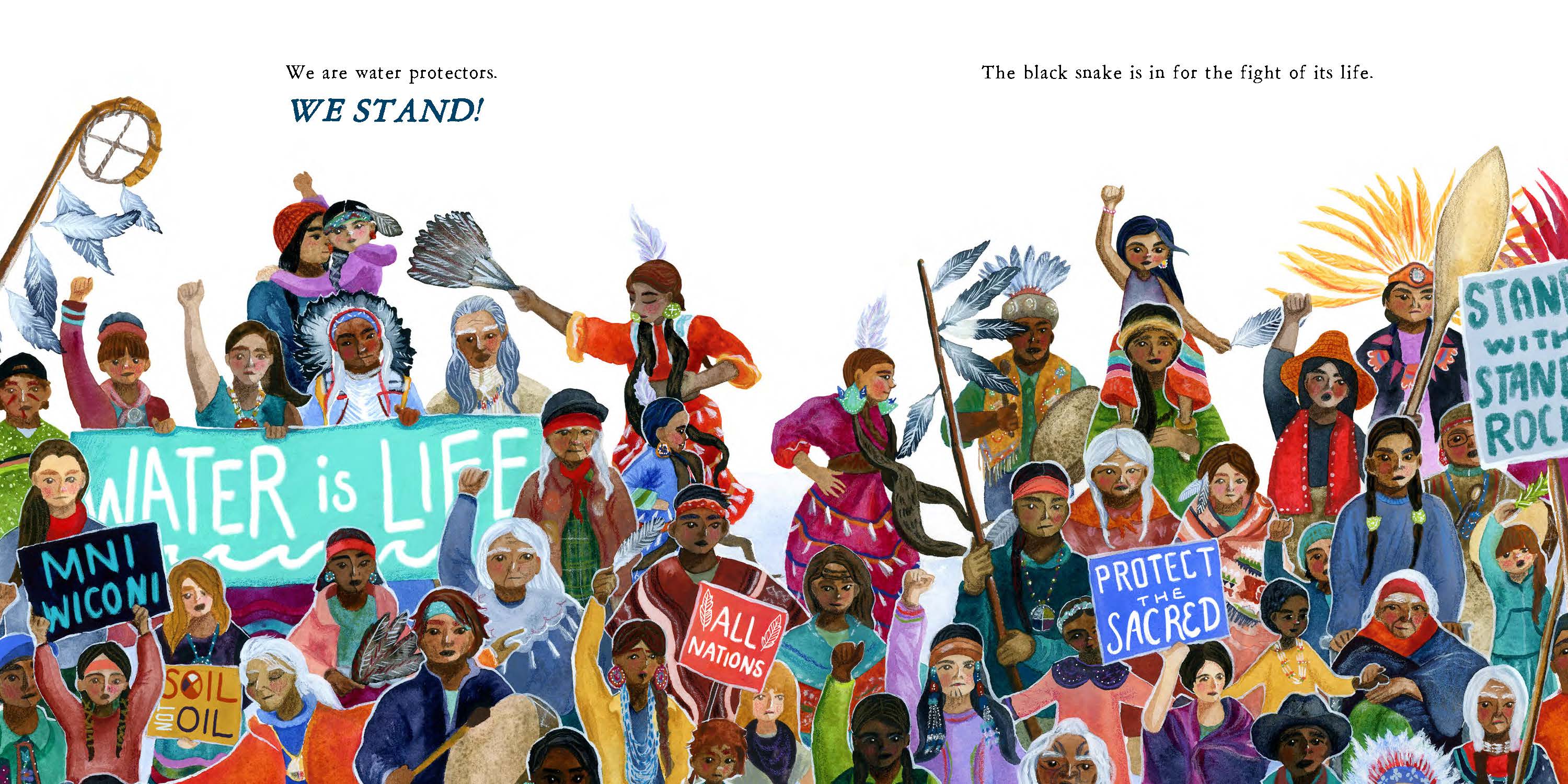
I tend to be drawn to writing stories that deal with environmental or social issues. So, what gets the ideas really popping in my brain is reading the news. Any type of story about environmental or social injustices would certainly be something I would read. If that isn’t your thing, and even if it isn’t, read things that you are interested in. Follow blogs and Facebook people/places that represent things that you find important or interesting. Their posts often spur ideas in me, as well. Oftentimes I find that the articles spark further questions in my mind. Or I want the article to go deeper, ask deeper questions, pick away at the real issues. And that’s where I, or you, come in. With the questions.
My mom always used to tell me that I was always asking “WHY?” as a kid. It seems to have followed me throughout my life and has come in handy as an author. Especially an author for children. Because aren’t they also always asking “WHY?”
I hope you find this helpful in some way. Enjoy the process.
Aapiji go Miigwech, Carole
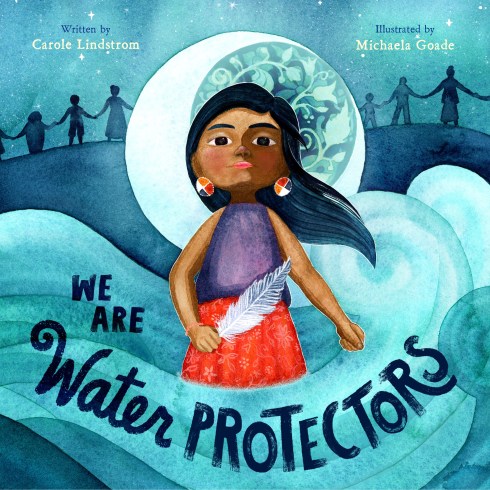
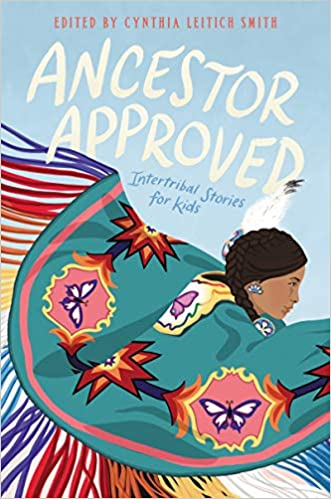
 Carole Lindstrom is an Anishinaabe/Métis author, and an enrolled member of the Turtle Mountain Band of Ojibwe Indians. She writes books for children and young adults. Her debut picture book, Girls Dance, Boys Fiddle, was published with Pemmican Publishers in 2013. Drops of Gratitude, is included in the anthology, Thank U: Poems of Gratitude, edited by Miranda Paul and Illustrated by Marlena Myles, (Lerner/Millbrook – Fall 2019). We Are Water Protectors, inspired by Standing Rock, and all Indigenous Peoples’ fight for clean water, illustrated by Michaela Goade, (Roaring Brook Press – March 2020). Circles, is included in the anthology, Ancestor Approved: Intertribal Stories for Kids, edited by Cynthia Leitich Smith, (Heartdrum – Feb 2021). She is represented by Andrea Brown Literary Agency. Carole lives with her family in Maryland. Visit her online at carolelindstrom.com.
Carole is giving away a 30-minute virtual visit.
Leave one comment below to enter.
You’re eligible to win if you’re a registered Storystorm participant and you have commented once below.
by Ashley Franklin
Hello there, writing friends! We’re at the start of a new year, so you know what that means: now is the time to tackle those writing goals with all the optimism you can muster.
Not feeling very inspired? It happens to the best of us. Don’t have a lot of time to commit to writing and need to be able to write on command? Well, that probably applies to many of us. What can you do? Stop waiting for inspiration to come to you and go get it.
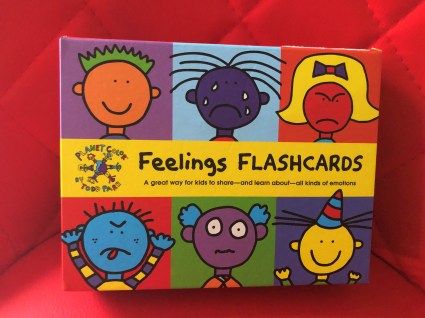
Whenever I need to generate ideas, I rely on feelings. No, this doesn’t mean that I only write when I’m feeling good. It doesn’t even mean that I write sad characters when I’m feeling sad. I consider the wide range of feelings and emotions that are out there and pair them with different scenarios.

Want to give it a try? Here’s what you do:
STEP 1: Write down a list of emotions.
(Hack: Google a list instead. There are tons.)
(Fun Hack: I put these in a box and pull one at random.)
STEP 2: Pick a scenario. (You can come up with as many as you like, but I’ll offer a few to get you started.)
- A day at the amusement park
- Learning a new sport
- First day of _____________
- New kid at _____________
- Finding something new
- Playing an instrument
STEP 3: Pair an emotion with the scenario from Step 2.
Example: Disgusted + A day at the amusement park
STEP 4: Get brainstorming! What could happen during a day at the amusement park that would make a character feel disgusted?
STEP 5: Write down your answer(s) to Step 4.
STEP 6: Repeat.
(Hack: Use the same scenario but pick a different emotion.)
(Fun Hack: Pick two feelings that the character must wrestle with.)
Simple, right? This works best if you don’t do it from your adult perspective. Turn on your childlike wonder and maybe even project how kid you would respond in these scenarios.
Why do I use this as one of my brainstorming techniques? I like to read and write books that have a large emotional pull. For me, it’s easier to already know what type of feeling I want the characters to explore from the very beginning because that will determine the choices that they make. If the character starts off with one emotion, I then think of what type of event must occur to cause a shift away from the original feeling.
Good luck as you try this out for yourself. You may find that once you brainstorm with feelings, it’s easier to get out of a writing slump and move toward completing your writing goals.

 Ashley Franklin is the author of NOT QUITE SNOW WHITE (2019), “Creative Fixes” from the anthology ONCE UPON AN EID (2020), “Situationally Broke” from the anthology WHAT WE DIDN’T EXPECT (2020), BETTER TOGETHER, CINDERELLA (2021) and more. Ashley received her master’s degree in English literature from the University of Delaware. She is an adjunct college instructor, freelance writer, and proud mom. Ashley currently resides in Arkansas with her family.
Ashley is represented by Kathleen Rushall of the Andrea Brown Literary Agency. Visit Ashley’s at ashleyfranklinwrites.com, on Twitter @differentashley, Facebook at Ashley Franklin, or Instagram @ashleyfranklinwrites.
Ashley is giving away a non-rhyming picture book critique.
Leave one comment below to enter.
You’re eligible to win if you’re a registered Storystorm participant and you have commented once below.
by Vivian Kirkfield
Ten years ago, I skirted the shadows of Tara’s 2011 PiBoIdMo (now Storystorm) Challenge. I walked away with a notebook filled with 30 ideas and a thirst for more. Two months later, I hopped aboard the first year of Julie Hedlund’s 12×12 Picture Book Challenge and wrote 12 picture book manuscripts. I got in the habit of gathering ideas from wherever they came and turning them into picture book stories. And that habit came in handy in the fall of 2017. I sold a manuscript to Ann Rider at HMH and she didn’t want just that manuscript—she wanted NINE! She wanted to create a compilation book about inventions that changed the way the world moves. My deadline was May 1, 2018—which gave me nine months to hand in nine submission-ready narrative nonfiction picture book biographies.
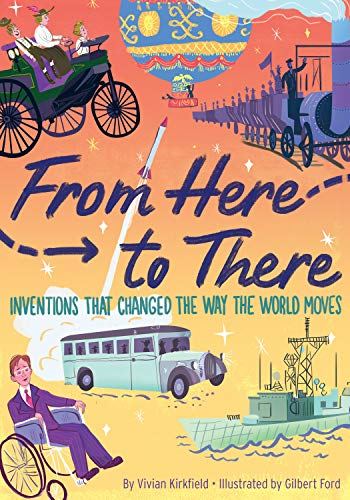
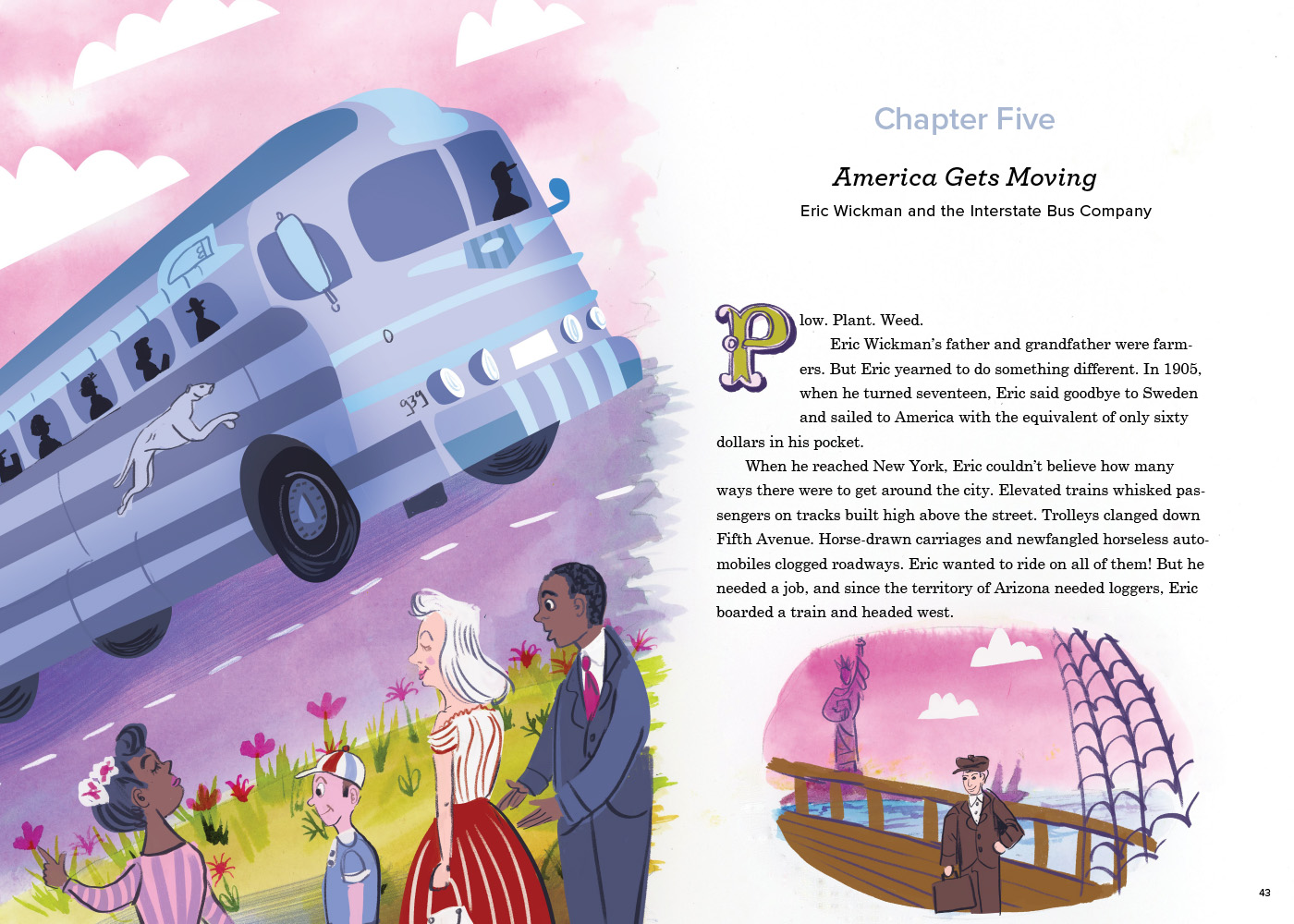
The idea for the first story actually came from my sister who had told me about a friend of a friend who was the granddaughter of the founder of the Greyhound Bus Company. It sounded like a fascinating story—my curiosity was piqued—and I dug deep into finding out more. After writing the rough draft and many rounds of revision and critique group feedback, my agent submitted it and we got interest from Ann. But the editor wasn’t sure if Eric and the bus were strong enough/popular enough to be a stand-alone picture book. Ann had an idea…would I be willing to write several more stories, similar in structure and tone, about the invention or creation of other things that move?
My answer, of course, was YES!
The editor wanted all the stories to include:
- Engaging opening lines.
- Child main character who has a dream/goal.
- AH-HA moment.
- Fun language/great rhythm/excellent pacing.
- Legacy paragraph that shows how the invention impacts us today.
- Satisfying ending that echoes the opening lines.
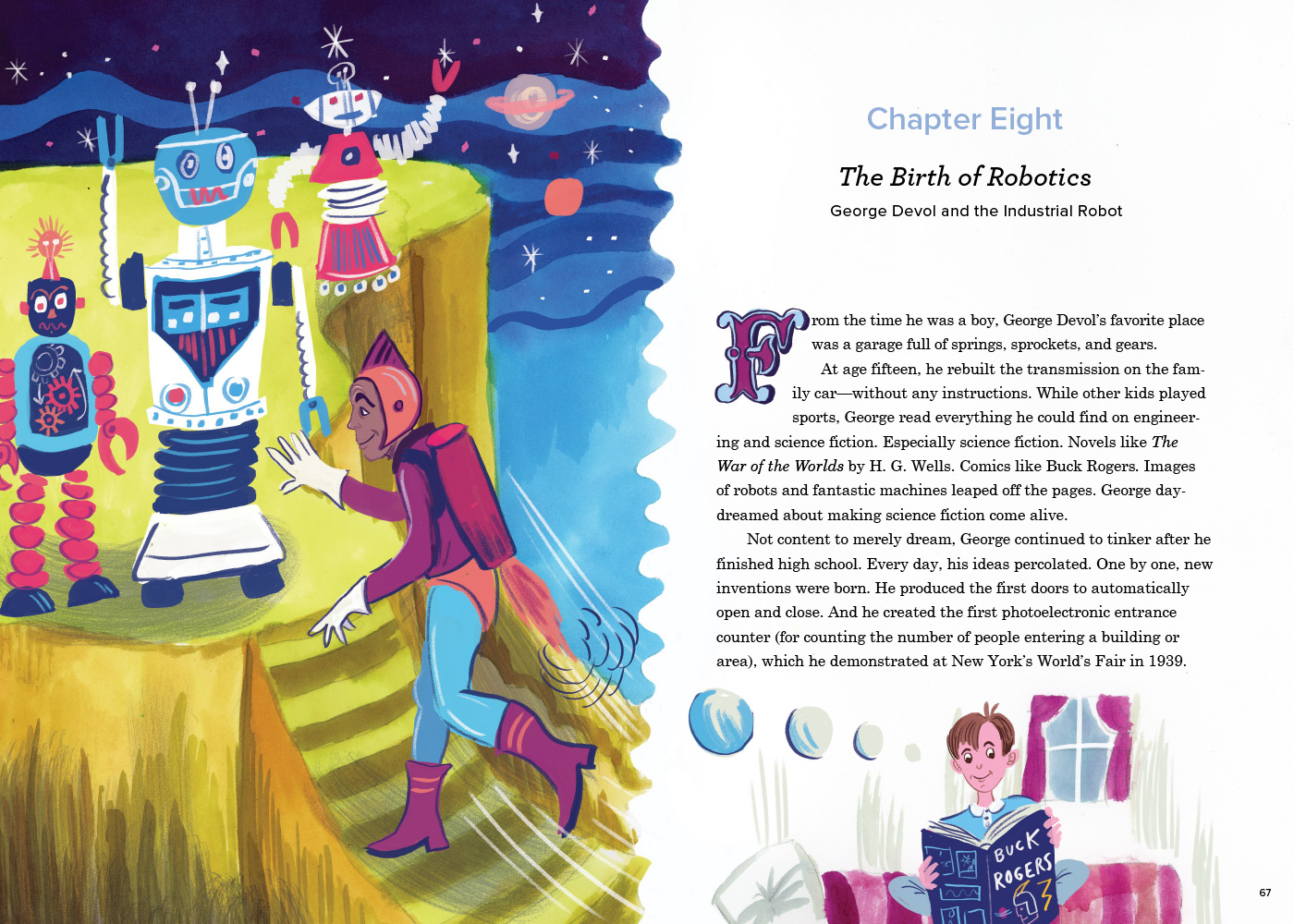
I got down to business. First, I made a list of vehicles, like the car and the train. I already had a manuscript about the invention of the hot-air balloon—maybe I could tweak it to fit this collection. But Ann also wanted me to think outside the box of things that move. Maybe a robot, she suggested. And I wondered, who invented the first robot? Early on, robots were part of science fiction—in the writings of H.G. Wells and Isaac Asimov. I dug deeper. I discovered the story of a young boy of fifteen who rebuilt the transmission of his family’s car—without an instruction manual. When he graduated from high school, he designed the first automatic doors. He engineered the first photoelectric entrance counters which were demonstrated at the 1939 World’s Fair. And he built the first robotic, a mechanical arm used at a General Motors factory in 1961 to weld car parts. His name? George Devol, the Father of Robotics. But I’d never heard of him and perhaps most of you haven’t either. I guess that’s another reason I write these narrative nonfiction biographies—I’m passionate about sharing the lives of these ordinary people who have done extraordinary things. I’m hoping to spark the curiosity of young readers to inspire them to create their own magic.
Another out-of-the-box moving invention was the folding wheelchair that opened doors, both literally and figuratively, for mobility challenged individuals. More digging revealed that this inventor had been a high hurdler in college. But after becoming a mining engineer, Herbert Everest broke his back in a mining accident. Paralyzed, but unwilling to forego his beloved road trips, Herbert and a mechanical engineering buddy, Harry Jennings, brainstormed until they came up with a wheelchair design that would allow the chair to fit in a car. Although there was a lot of information about their wheelchair company, there was almost nothing about Herbert’s early life. Where could I find that information? I consulted the census, I studied the online documents from the Colorado School of Mines where Herbert attended college, and I reached out to the special collections’ librarian at the downtown library in Oklahoma City where Herbert lived for many years. Lisa Bray was unbelievably helpful and I learned enough so that I could craft a credible story of Herbert’s early years.

The last chapter in this compilation book is one of my favorites. I know I wanted at least one water vehicle. But who invented the first boat? Canoes and kayaks have been around since before 8000 BCE. There was no way I would be able to pin down an AH-HA moment or delve into the childhood of those visionaries. So again, I tried to think outside the box. I googled ‘firsts in shipbuilding’ and I was lucky. Up popped the name of Raye Montague, who led the team of naval engineers in 1970 to create the first computer-generated ship design. More luck came my way when I uncovered several taped interviews she had given and I was able to hear her story, from childhood on, in her own voice.

My journey with FROM HERE TO THERE: Inventions That Changed the Way the World Moves, illustrated by the brilliant Gilbert Ford, has definitely been a labor of love—nine months, nine stories—and I think the journey is just beginning. But I’d like to leave you with a quote from Lisa Bray, that amazing Oklahoma City librarian, because it speaks to what the Storystorm Challenge is all about, and to what we, as writers, need to keep close to our hearts as we step into 2021 and craft stories that will engage young readers:
”There are interesting stories everywhere you look, and one doesn’t have to be famous to have a good story to tell.”
Writer for children—reader forever…that’s Vivian Kirkfield in five words. Her bucket list contains many more words—but she’s already checked off skydiving, parasailing, and visiting kidlit friends all around the world. When she isn’t looking for ways to fall from the sky or sink under the water, she can be found writing picture books in the picturesque town of Bedford, New Hampshire. A retired kindergarten teacher with a masters in Early Childhood Education, Vivian inspires budding writers during classroom visits and shares insights with aspiring authors at conferences and on her blog where she hosts the #50PreciousWords International Writing Contest and the #50PreciousWordsforKids Challenge. Her nonfiction narratives bring history alive for young readers and her picture books have garnered starred reviews and accolades including the Silver Eureka, Social Studies Notable Trade Book, and Junior Library Guild Selection.
 To connect with Vivian and learn more about her books:
Website: www.viviankirkfield.com
Facebook: www.facebook.com/viviankirkfield
Twitter: www.twitter.com/viviankirkfield
Linkedin: www.linkedin.com/in/viviankirkfield
Instagram: www.instagram.com/viviankirkfield
Vivian is offering a 60-minute Zoom meeting to chat about a specific manuscript or anything else writer-related.
Leave one comment below to enter.
You’re eligible to win if you’re a registered Storystorm participant and you have commented once below.
by your Storystorm hostess, Tara Lazar
I listened to the Hidden Brain podcast last night, all about habits—how to develop good ones, how to lose bad ones. Aha, I thought, Storystorm is all about making story ideation a habit! How serendipitous!
The episode revealed that the less “friction” there is surrounding an activity, the more you’re likely to do the task and eventually make it habitual. And when it’s habitual, you don’t have to think about it. You don’t need to make a decision to do it, you just do. There’s no thinking. It’s automatic.
“Friction” means the things that make doing something more difficult. If the gym is too far away, you won’t go regularly. Too much friction. Lessening—or even eliminating—friction is the key to forming a habit. Want to jog every morning? Getting up early is a hassle. What lessens the rub? Sleeping in your workout clothes. Wake up and go!

In 2021, you want to make forming new story ideas a habit. Why? Picture books are a numbers game. They’re notoriously difficult to sell. The more ideas you have, the more potential manuscripts you write, the more the odds tilt in your favor.
Plus, not every idea is a good enough for a story. Some are awful. Case in point, an idea I have in my 2020 pile: “Bobby Bubble Wrap”. What the heck???

You need to push past the terrible ideas to get to the good ones. If “Bobby” had been my only idea in 2020, I would be in trouble career-wise. Luckily, it was one of 100. Out of that 100, I wrote a dozen and eight went on submission.
So let’s talk about friction. What’s stopping you from daily idea generation? The reason most people forget an idea is because they don’t write it down. If we want to create less friction here, have everything you need ready and accessible. I now keep my ideas in the “Notes” app on my phone. My phone is always with me (it became a habit when my kids got them), so it’s easily accessible. Moreover, my notes are saved to the cloud, so they’re there for eternity. Or as long as my wi-fi works.
Don’t like the phone? Carry a pen and small notebook. Or at least carry a pen. There’s always space to write on your palm. Don’t forget “Aqua Notes” in the shower, too. Put paper all over the house! (Just don’t forget to consolidate it into one place or one file. Make it a habit to do every night before bed!)

Is this too much friction? Or piggybacking?
 The next tip is called “piggybacking”. Think about your day. What habits do you already have? Do you enjoy a morning cuppa? Start a new habit by tacking it onto an existing habit. When you sit down with your tea, read the blog, start daydreaming, get a new idea, write it down.
I’ve found that there’s no regular time of day for me to get a new idea, it just comes randomly. But that’s because I’ve become more attuned to what’s happening around me. My senses are sharper; I’ve been practicing story ideation for a long time. It’s second-nature. I don’t have to force myself to think of something. I overhear my kids talking, I watch a show, I read an article and BAM—an amorphous blob begins to take shape.
This is the goal. Standing in the storm with an umbrella means you’re more likely to get struck by lightning.
I highly recommend this Hidden Brain episode, and the entire podcast in general. Listening is one of my habits!

Drawing by Laurie Keller
Tara Lazar is a picture book author and the founder of Storystorm, now in its 13th year. Register for the challenge here, thru January 7th. If you can, please purchase Storystorm SWAG—all proceeds ($4 per item) will be donated to hunger charity Blessings in a Backpack.
Follow Tara on Twitter @taralazar, Instagram @taralaser and TikTok (new!) @taralazarbooks. Most of all, have a creative start to 2021!
Official registration for STORYSTORM 2021 is now closed.
You can still participate by reading the daily posts and creating story ideas, but you will not be eligible for prizes.
(But you will be eligible for a pile of brand new story ideas to keep you writing through the year!)
Every year when Storystorm rolls around, I like to pick a theme for this registration post.
This year’s theme will come as no surprise…
WE FINALLY MADE IT THROUGH 2020!

And that’s all I have to say about that.
Welcome to STORYSTORM 2021!
Four years ago I changed the name and month of my annual writing challenge, from Picture Book Idea Month (PiBoIdMo) to STORYSTORM. Why? Answer’s here.
Although this challenge begun as a picture book writer’s event, any writer interested in brainstorming new story ideas in January is invited to join the STORYSTORM challenge of 30 ideas in 31 days. Any genre, any style; student, amateur, hobbyist, aspiring author or seasoned professional.
How does STORYSTORM work? It’s simple…
- Register.
- Read the daily posts on this blog, beginning January 1st.
- Write down one (or more) story idea daily.
- At the end of January if you have at least 30 new ideas, you can sign the STORYSTORM PLEDGE and be eligible for PRIZES.
So are you ready? Follow these steps:
- Register ON THIS BLOG POST by signing your name ONCE in the comments below. Full name, nickname, whatever name you’ll use for the entire event.
- Teachers participating with a class can register under the teacher’s name.
- Please leave ONE comment ONLY. Do not reply to say “hi” to a friend. Do not comment to fix a mistake. ONE COMMENT. Don’t worry if it isn’t perfect.
- Registering makes you eligible for prizes.
Visit this blog daily (taralazar.com) in January for inspirational essays by guest bloggers—professional authors, illustrators and experts in creativity.
Instead of visiting the blog directly, you can receive the daily posts via email by entering your address and clicking the “Follow Tara’s Blog” button in the left column—look under my photo for it.
At the end of January, if you have at least 30 ideas, sign the STORYSTORM PLEDGE (to be posted on January 31) and qualify for prizes.
Prizes include agent feedback, signed books, original art, writerly gadgets and gizmos.
Remember, do not share your ideas publicly in January. They are YOURS. No need to prove that you have them at the end of the month. The pledge you will sign is on the honor system.
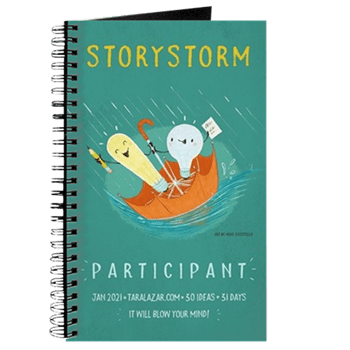
Are you in? Awesome. Optionally, pick up your Official Participant badge (by Mike Ciccotello) below and affix it to any social media account you wish. (Right click to save to your computer, then upload it anywhere.)

You can also opt to join the STORYSTORM Facebook discussion group. Everyone needs writing friends!
(Your writing pals this year are our lightbulb mascots, Earl and Pearl!)


The Facebook group remains a year-round source of writing information and support, mostly focused on picture books, I admit, because that is where this all began.
STORYSTORM registration will remain open through JANUARY 7th.
In the meantime, head over to STORYSTORM SWAG CENTRAL to pick up your official journal. All proceeds from sales ($4 per item) will be donated to children’s hunger charity Blessings in a Backpack. There are mugs and shirts, too!
Thank you for joining, and let’s have a month filled with creativity and joy!





 Writing for Kids (While Raising Them)