You are currently browsing the category archive for the ‘Publishing’ category.
“With over 3 million books being published every year, competition in the marketplace is enormously stiff. In fact, over 78% of all published books fail, and the average book, today, sells just 250 copies.”
Ouch! A sobering fact from book promotion guru Patricia Fry.
What’s an author to do?
You’ve got to be a book promotion machine.
But you’re not a machine, are you? No, you’re an author.
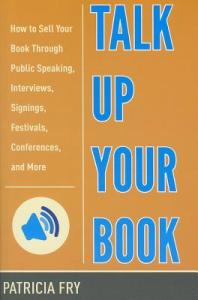
So that’s why I invited Patricia here today. After reading her book TALK UP YOUR BOOK, I realized even though I’m doing a lot to promote my book, I could be doing more. I SHOULD be doing more.
 Patricia, that 78% statistic is scary. Can you tell us what you mean by “fail”, and is there a difference in these stats between traditionally published and self-published titles?
By “fail,” they mean the books sell fewer than 100 copies. There are no statistics that I know of that indicates how many self-published authors versus traditionally published authors “fail.” However, I can tell you that around 78 percent of all books published today are produced by pay-to-publish “self-publishing” companies.
Why are so many books failing in the marketplace? Because most new authors neglect to study the publishing industry before getting involved. They don’t know the importance of writing the right book for the right audience and they don’t understand that it is up to the author to promote the book. Many new authors who do take the initiative and time to learn something about book promotion, find themselves in over their heads once they are faced with the huge responsibilities involved with marketing their books. They don’t realize how much time, energy and effort it takes. They become overwhelmed and disillusioned and they either never start a marketing program or they quit before they’ve gone very far with it.
Competition is another reason why some books fail in the marketplace. There are more books than ever before and statistics show there are actually fewer readers. But even in the face of competition, there are some books that do much better than others and the key is always–write a book that is needed/wanted by a segment of people, know who your audience is and write for that audience, have your book edited by a good book editor and, when it comes time to promote that book, it is vital that you know how to promote to your particular audience. No one will buy a book they don’t know about. It is up to the author to reach his/her audience. Something else authors often lose sight of is that once they stop promoting their book, it will die.
OK, so about 22% of all books are with traditional houses. Traditional houses will promote your book (right?), but the author still needs to do as much as they can. What do you say to the authors who think they can just sit back and watch sales roll in? And what do you say to those authors who complain, “But I’m not a natural promoter. I’m an introverted writer!”
I don’t know much about the statistics. That isn’t my strength. But I can tell you that in today’s publishing climate, all authors MUST be prepared to and expect to do the majority of the promoting and marketing for their books. There are hundreds of traditional publishers and they each have different ways of working with authors, but most are more interested in the author’s platform and what the author can and will do to spread the word about their books than almost anything else. Most of them want to work with authors who have a following, a reach—a ready-made audience for promoting their particular book and an understanding of book promotion.
By way of promotion from the publisher’s side—generally, a publisher will put the book in their catalog and on their website. They might send out press releases to their list of reviewers, newspapers, etc. They may give an author 3 months with an on-staff publicist. But, yes, the author is expected to be the main marketing agent for his/her book.
What do I say to authors who do not want to promote? I would hope to talk to them before they ever write that book. I would ask them to study the publishing industry and to learn what is expected of them—what their responsibilities are as a published author. I would urge them to learn what book promotion entails—to gain an understanding of this huge responsibility before ever deciding to write a book for publication. If they don’t want to do the promotion, they should seriously reconsider producing a book.
For those who have already written and published a book, I would recommend that they engage in the same study asap. There are hundreds of ways to promote a book. An author can find his/her level of expertise and comfort among them. They can pick and choose—but they must be realistic about what it’s going to take in order to reach their particular audience.
This means, they must know who their audience is, write the book with that audience in mind, know where their readers are and how to approach them. They must understand that it’s all about exposure. No one will buy a book that they don’t know about. Someone (in this publishing climate it is the author) must get word out to their particular audience.
With so many avenues of promotion available now, it can be overwhelming. And so part of an author’s job is to become familiar with those avenues and determine which ones are best for their book. There is usually no one or two activities that will help an author reach his or her audience. Authors must use a variety of activities, skills, methods, mediums toward getting exposure—getting their books noticed by their readers. And those methods, skills, etc. may differ from author to author and book to book.
Is there any particular promotional tool or event that is easiest for a new author to jump into? Is there anything you recommend doing first and foremost?
 First and foremost, the author must know who his audience is and where they are—what do they read, where do they hang out—on the Internet, around town, throughout the universe? Where do they go for the sort of information you provide in your book or for entertaining reading material? Then the author must find ways to reach his or her readers through these means.
Remembering that it is all about exposure, as an author, you must make sure your book is front and center where your readers are. This might mean having it for sale at specific specialty shops related to the theme or topic of your book. It might mean announcing your book in appropriate newsletters (members of organizations can usually place announcements in organization newsletters, for example), having it reviewed at appropriate blog sites and so forth. So the primary promotional activities might differ from author to author, depending on the genre and theme of the book and the nature and needs of the audience.
However, as for the basics for most authors, I would recommend building a website related to the genre/theme of your book. I can’t tell you how many authors miss out on opportunities because they don’t have a website that can be easily located and accessed. They rely on their publisher—even their self-publishing company—to get word out about their book through the company website. Bad idea!! If someone is looking for a good mystery involving horses, a handbook for beginning surfers, a guide to gardening in the northwest or a children’s book on hygiene, for example, and this is the nature of your book, you want them to find you first. A website is a good place to start making this happen.
The second thing you need to do is to advertise that website. Put it in your email signature, on your promo material, in your bio at the bottom of your articles, and so forth.
A good place to start introducing just about any book is locally. I urge authors to speak locally, reserve booths at local flea markets and book festivals, offer it as an auction item for charity and visit independent bookstores and appropriate specialty stores and other venues where you can sell the book. You’ll get an idea of the reader interest in your book. You’ll learn tips and techniques that will help you with future promotion. You’ll learn whether or not it would be a good idea for you to travel and speak about your book and whether to sign up at larger book festivals, for example. In other words, you can test your market locally without much expense.
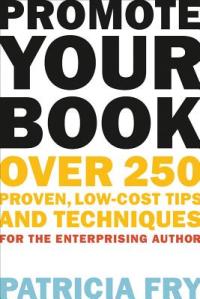
This is a good starting place for many authors. There are hundreds and hundreds of additional promotional tools and ideas–I have over 250 in my book, PROMOTE YOUR BOOK. John Kremer lists 1001 in one of his early books on book marketing.
Thank you, Patricia! I think we’ve got a lot to think about and a lot to do! I can’t thank you enough for your wisdom and your terrific books.
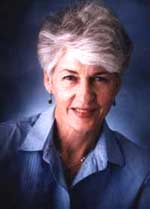 Considered “a maven when it comes to counseling authors in the art of publishing and selling their books” and “one of the most well-known writing gurus,” Patricia Fry has been working with other freelance writers and authors for over two decades. Currently, she has 39 books to her credit, representing an eclectic mix of subjects including several writing/publishing-related books. She is a literary and manuscript consultant, an editor and a teacher. She can help you write a book with more publishing potential, professionally edit your book manuscript, guide you in preparing a more effective book proposal and coach you in more successfully promoting your book. You can find promotional tips and free ebooks at PatriciaFry.com.
Anticipation, anticipa-yay-tion. It’s making me wait.
Carly Simon sang it, then Heinz stole it: “It’s soooo good.”
.
OK, I’m not waiting for ketchup here. It ain’t all that good.
This is not a job for the impatient. I used to work in high-tech where whole industries sprung up over breakfast, where innovation occurred during a coffee break and tomorrow’s ideas were outdated the day before yesterday.
And now, publishing.
Sure, the industry seems to be transforming rapidly with ebooks, book apps and new social media discovery tools, but manuscripts are pretty much bought the same way they have been for decades (with perhaps the exception of email submissions instead of postal mail). Editors still have to read and evaluate stories, and that requires thoughtful reflection. That takes time. Especially with thousands of them to sort through every week.
Moreover, whole departments must agree upon a manuscript’s merits. It’s not just one editor’s opinion. The entire editorial team, the art department, marketing, sales, publicity, the publisher—all have a say in whether a story fits its list. And besides fitting in—will the book sell? Will it make a profit? Publishing, despite all its artistic ambitions, is a business after all.
You can understand the myriad factors involved in an acquisition, but it doesn’t make waiting on a submission’s fate any easier.
I’m reminded of Schoolhouse Rock’s poor Bill sitting on Capitol Hill. Except his little ditty only lasted as long as a commercial break.
What to do while you wait—weeks, months, maybe even a year? The best remedy is to write something new. Or play Candy Crush.
No, really, write something new. Level 187 is impossible anyway.
For what are we? Are we obsessive email checkers, phone call screeners and mailbox watchers?
Well, yes. Yes we are.
But we are not WAITERS. We are WRITERS.
And writers write.
So get on with it!
And remember, besides “anticipa-yay-tion”, Carly also sang “these are the good old days.” (And she’s the daughter of Simon & Schuster co-founder Richard L. Simon, so maybe she was truly singing about publishing. Not ketchup, Heinz.)
Welcome back, Mira, now where were we? Oh yeah, that exclusive… Cookie and I have been real patient. Animal, well, not so much. Drum roll, please.

First off Tara, I’d like to respond to some of your comments regarding what can happen after you are published.
Oh, the suspense!
Getting a review in any of the top review journals is really tough because they get so many submissions and only have space for a few. Also the publisher’s marketing/publicity folks (often just one person) are so overworked and overwhelmed it really is up to the author and illustrator to get the word out these days. It also helps if you can make personal connections with their marketing/PR peeps to inspire them to help get the word out for you. Have you made a trailer for the movie? If you aren’t video savvy, Katie Davis’s video course, which I’ve taken, is terrific: VideoIdiotBootCamp.com. I’m also hoping that folks share the video of your book that we posted yesterday to help get the word out. It really is an exponential numbers game of people sharing.
I know how much heart and soul and time and sweat goes into writing a good manuscript and then the emotional ups and downs of actually getting it published only to have it fall through the cracks of the biggest retail chain because of negotiation issues that have nothing to do with you. Aaargh. It’s heartbreaking. Also I loved what you had to say about your relationship with your illustrator. You do have to trust and most times what they do far exceeds anyone’s imagination or expectations.
In terms of an exclusive offer… Here’s what I’d like to give your wonderful readers, many of whom I know ☺.
- I’d like to provide the opportunity to register with the early bird special price of only $249 (regular price $289) for the upcoming Craft and Business of Writing Children’s Picture Books e-course starting August 26th, with this link: https://www.e-junkie.com/ecom/gb.php?c=cart&i=1111301&cl=210181&ejc=2.
- …or the Big Bonus Craft and Business of Writing Children’s Picture Books for $279 (regular price $325) with this link: https://www.e-junkie.com/ecom/gb.php?c=cart&i=1156535&cl=210181&ejc=2. The e-course includes over 30 lessons and more goodies than you can shake a stick. The Big Bonus includes interactivity with our Facebook group and live webinars. The offer is time-sensitive, so you need to sign up before July 29th to take advantage of it.
- In addition, I’d like to offer an exclusive opportunity for 5 people to pitch a picture book manuscript to me at Hummingbird Literary. To win the pitch contest all you need to do is suggest some creative marketing strategies in the comments below and help to get the word out for THE MONSTORE (yes I love Tara and her book). And of course Tara gets to choose the winners ☺ (deadline July 29th). The winners will receive a special priority email address from Tara for you to send a manuscript and pitch letter describing your other projects. For ethical reasons, students who take any of my personally taught course have to wait 6 months following a course before submitting to Hummingbird Literary, but I will make an exception if any of my former or near future students win here. Also because I want to give my heart and soul to my new clients, I won’t be teaching many more of the PBA courses myself and they will either be self-paced or have guest instructors. I’ll be sad but my new venture is also VERY exciting.
For more information on the courses, check out http://www.picturebookacademy.com/writing-childrens-picture-books.html.
Mira, that’s a terrific offer, thank you! You are so generous! Thank you so much for helping me get the word out about my book, and for helping other authors polish and sell their work. This really demonstrates what a big-hearted community we have in kidlit.
Before you go, Mira, I think one of the most interesting and telling things about an agent is their list of favorite all-time children’s books. Which PBs really stand out for you and why? What about them makes them special and inspiring?
This is such a hard question to answer. I have tons of video reviews over at the Picture Book Academy in the Blog section of books that I love, but all time favorites… Wow!!
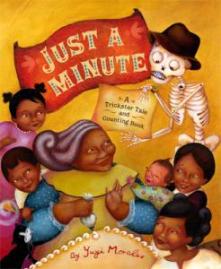 I love Yuyi Morales’s JUST A MINUTE because it’s fun, soulful, and has a fabulously powerful elderly female protagonist who outsmarts Señor Death. Besides being a counting book, it has many other layers of meaning and importance. I also love how despite being repeatedly told that no-one would ever publish a picture book with death as a main character, Yuyi believed in her story, persisted, and eventually went on to win all sorts of awards for it. The book launched her career.
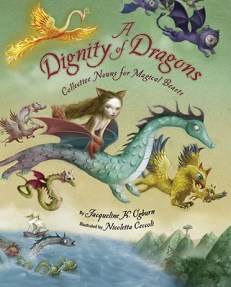
I’m a huge fan of Nicoletta Ceccholi’s art, which is positively luminous in A DIGNITY OF DRAGONS: Plural Nouns for Mythological Beasts, which has minimal, elegant text in a non-fiction format. It also has a multicultural aspect, which I love and is just so exquisitely done.
 Another favorite is VOICES IN THE PARK by Anthony Browne, which I consider a perfect book for way too many reasons to describe, Mo Willems’ LEONARDO THE TERRIBLE MONSTER for its simplicity, cleverness and underlying meaning, I SEE THE RHYTHM, another near perfect book that works on multiple layers.
I think I’m quite promiscuous when it comes to having favorite books as there are so many more that I adore.
And these are some of the many books by my super talented former students!
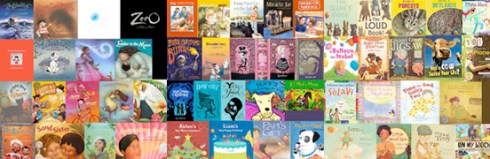
Also, I’m doing a free writing workshop/webinar this Wednesday with Mark Mitchell of Make Your Splashes at 6PM Pacific Standard time here: http://makeyoursplashes.com/a-writing-workshop-with-mira/. I’ll try and include these books and other favorites as part of it. If you are interested, do sign up for it soon as the webinar space can only hold a limited number of people.
Tara, what are some of your faves? I know you have a wicked sense of humor so I imagine there will be some funny ones in there from you.
Yes, I love the quirky picture books. I adore THIS RABBIT BELONGS TO EMILY BROWN by Cressida Cowell, ARNIE THE DOUGHNUT by Laurie Keller and OTTO GROWS DOWN by Michael Sussman. They are all funny, layered stories with smart kid sensibilities that are a bit longer in length than some of the more recent hits. I like more meat in my picture books. One of my favorite non-fiction picture books is by Shana Corey—THE MERMAID QUEEN. Corey, also an editor at Penguin Random House, focuses her stories on little-known but important women in history.
And finally, Mira, how would you describe your ideal client?
My ideal client with be tall and tan and young and lovely, wait, that’s a song. No. I love working with people who are smart, fun, soulful, in touch with the emotional core of their stories or art (i.e. character-driven), able to let go of their egos to work gently and collaboratively doing whatever it takes to make the story or art be the best it can be if needed, playful, culturally sensitive, warm, loving, diverse, interested in all sorts of things including non-fiction, either non-rhyming or a professional poet, a skilled artist open to possibly writing, a skilled writer open to possibly illustrating, and someone who really wants to work with me and has the patience to see the long term goals. Another quality that my ideal client will have is an appreciation for community as Hummingbird Literary will also be a community for its clients with our own group blog, our own secret social media space where folks can critique each others work and support each other with a spirit of camaraderie and celebration of creativity and life!
Before I go, I wanted to share something from my office.

On Saturday I refinished this file cabinet with rice paper to hold Hummingbird Literary files and it’s named “The Karen” after my mentor, Karen Grencik. With time, I’ll be collaging images from our client’s books all over it. It was exciting to make.
Wow, Tara, this post turned out a bit epic. I sure had fun doing it with you and send my love to you and your readers. I look forward to see the practical and creative approaches to promoting THE MONSTORE ☺!
Thank you, thank you, Mira! I know you’re going to have a long and successful career as an agent, and I know so many people who would benefit greatly from your guidance. My best wishes to you in all your endeavors!
I enjoy discovering new social media tools, and today I stumbled across Padlet!
Padlet gives you a wall. You can post anything you’d like, plus invite others to participate. “Simple yet powerful” is their motto. Dude. Right on.
Excited to try it out, I began a “Picture Book Writing” wall. Ask me any question about writing picture books. Plus, read other Q&A’s.
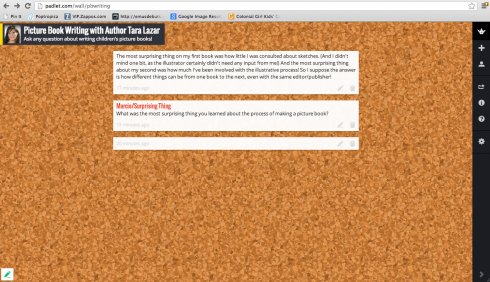
OK, it looks a little plain right now. Don’t worry, I’ll jazz it up soon like a tween girl’s locker, full of sparkly doo-dads, baby animal posters and I heart this, I heart that.
Join me there: http://padlet.com/wall/pbwriting.
I’ve set up this wall in “stream” format, meaning the most recent post will appear at the top. Padlet also offers “freeform” format so you can pin stuff all willy-nilly like you would on a real corkboard.
To post a question on this Padlet, click the green pencil icon on the lower left of the screen. Please be sure to include your name at the top of the text box (it will appear in red) before typing your question.
Padlet was previously named “Wallwisher” but that wasn’t catchy enough. If they’re riding on the coattails of the iPad, I won’t blame ’em.
Enjoy, and let me know if you create your own Padlet!
The possibilities are endless! Classroom notices, brainstorming with friends, artwork in progress, travel itineraries, family menus, reunion planning…

Hope. Dream. (See attached necklaces.)
When people find out I’m a children’s author, I typically get this response:
“Oh, wow! You know, my sister/cousin/neighbor/son’s teacher wrote a children’s book a while back. You could probably help her/him to get it published.”
This is so common. You know the saying “everyone has a book in them”? That’s incorrect. “Everyone has a children’s book in them” is far more accurate!
In the early days, I was naive. I said, “Of course!” I gave the person my contact info, then I spent hours with their acquaintance critiquing their manuscript, teaching them about picture book structure, and ultimately causing this person great disappointment when they realized the tale they whipped out on a rainy afternoon wasn’t publishable exactly as they had written it.
It made them feel awful. It made me feel awful. It was not worth it.
Then I realized—these casual writers think having a published book would be “neat”. And it’s not neat. It’s hard work.
So now, I take a very honest approach. Instead of offering my assistance right away, I say this instead: “If they have a passion for children’s books, by all means, send them my way and I’ll do all I can to help. But if this person wrote a story on impulse and they don’t have any desire to have a career in children’s literature, they’ll find it extremely difficult to get published and end up being very frustrated and disappointed.”
This is usually followed by an “Oh. Gotcha.”
They understand. (I hope.)
I don’t know why being a children’s author is perceived as such a simple skill as opposed to something like playing in the NHL or becoming a doctor or lawyer. You never hear someone say, “You know, my sister/cousin/neighbor/son’s teacher wrapped an ace bandage around a kid’s ankle a while back. You could probably help him/her to become a pediatrician.” OK, I realize you don’t need a degree to become an author, but you do need several years of concentrated study and practice. You need to be dedicated. Passion for your craft is essential.
So now I let people know this. Publishing is not something to enter into partway. The industry is full of criticism, rejection and waiting…more waiting than the DMV times a thousand. It’s frustrating. It’s challenging. If you don’t love it, you won’t live through it.
So hope and dream. And work hard.
The kids deserve it.
 I’ve often heard people—Publishing Professionals—talk about wanting to “publish books that stand the test of time.”
There’s something unnerving about the way the phrase is used. As though it were written into their code, rather than contemplated carefully and reevaluated case by case. It’s a slogan, rather than a creed. And there’s a reason for that.
While it sounds good to be the publisher known for publishing books that “stand the test of time,” publishing is a business. And in order to be successful, units need to be moved. Not books. Units. Units do not stand the test of time.
Now, it’s true, publishing professionals often come to their jobs with a love of books. And for that reason, they often sell books in spite of their better judgment. They sell them out of love. Sometimes the PP will wake clear-eyed at a meeting a year later, looking at some abominably small number in a column and wonder what they ever saw in that silly little volume.
But sometimes that love will win the day and that number will not be small. It will be large. If it is large the first year, it will, perhaps, continue to be large the second year (this is often the case with the books that are loved very well). In fact, it will sell year after year. And we will, indeed, end up with a book that stands the test of time.
Friends, this is where you come in. When you look at a bestseller list of picture books, you are often—not always—looking at a list of units. When you look at shelves of sparkly pink princesses and less sparkly dumptrucks, you are looking at units. So, as you are making lists of ideas, I want you to consider the following five point entreaty:
- Don’ t pull your ideas from the bestseller list. Pull them from your soul. What combination of experiences, relationships and ideas has come together to make your thoughts what they are? This is the same equation that should make your book. Don’t try to insert some new variable derived from market research.
- Don’t follow the rules. At least, don’t follow them just *because* they are the rules. Use them as guidelines. Mitigate them thoughtfully with your own point of view.
- Your structure is a springboard. If you are using a traditional structure, of the kind that Tammi Sauer recommends in this post, great! But don’t use it as a fetter, let it be the springy energy beneath your feet (or keyboard, as it were).
- Don’t be afraid to steal. But if you’re going to steal an idea, make it good. Pay tribute to something that you’ve been in love with for some time and can’t seem to forget. Don’t riff on something because it’s marketable. Do it because it’s good and you love it.
- Be giddy. You know those ideas that are so good you can’t believe that they came from your brain? The ones that make you do a little dance and clap your hands with glee? Those are books. Use them.
There are a lot of wonderfully quirky picture books that are having their day out there. And you can bet that these books are not a result of market research. They are a result of love.
Tamson Weston is a published children’s book author, founder of Tamson Weston Books, and an editor with over 15 years experience. She has worked on many acclaimed and award-winning books for children of all ages. When she doesn’t have her nose in a book, Tamson likes to run, bike, swim, lift heavy things and, most of all, hang out with her family in Brooklyn, NY. Visit her online at www.tamsonweston.com.
I was stunned, honored and thrilled when renowned author/illustrator Trinka Hakes Noble asked if I would be the Rutgers University Council on Children’s Literature “Success Story” speaker this year. She asked me to tell the RUCCL attendees about my path to publication, to inspire them, to make them realize that they are the stars of the day. So I tried to be funny and touching and inspirational, and I hope I succeeded with the success story. For those of you who couldn’t be there, and for those who heard it and want a recap, here’s my speech.
Please note: I begin in costume, speaking with a deep English accent like a terrible, stereotypically stuffy author.
 Good morning, ladies and gentleman.
Allow myself to introduce…myself.
I am a published author.
I have a luxuriant beard.
I smoke pipes.
I wear tweed jackets with elbow patches.
I take afternoon tea with Joan Didion. Ahh, dear, dear, Joan. Occasionally Joyce Carol Oates pops in with Michael Chabon. Oh, those two are a bloody riot! One time JC snuck a whoopee cushion on Michael’s chair and…well, that’s not a story for mixed company.
Ever since I signed my first contract, I have never received another rejection. Publishers fall at my feet and kiss my freshly polished Oxfords!
I use words like “verisimilitude” in everyday conversation. See, I just used it. “Verisimilitude, verisimilitude, verisimilitude.”
My toilet scrubs itself under the rim.
I have not a care in the world. Ahh, yes, the life of a published author is so very glamorous and elegant, don’t you agree?
[Remove costume. Shake hair loose.]
Yeah, right.
OK, this is really me.
Just an ordinary housewife and mother from Jersey. No, I didn’t say Jersey Shore. Snooki and I, we’re not author buddies.
But listen, just four years ago, I was you.
Sitting out there.
 RUCCL 2008 was my first big conference. Heck, it was my first conference, period. I looked across the room to Kay Winters speaking and thought there was this enormous divide between me, the great unwashed, and Kay, the successful, multi-published author.
Turns out the divide was only five tables wide. Because that’s how far away I was sitting!
Once I approached Ms. Winters to thank her for the inspiring speech, we shook hands and suddenly there was no divide. And I’m here to tell you just that—there is no divide.
You’re here today because you’ve earned it. You’ve written something exceptional that has gotten noticed. Out of—how many applications were there this year, Trinka?—62.8 million applications, 88 of you are here! Amazing! You have great potential. You are on your way. You are so close to becoming published and you don’t even realize it!
 If you think, like I did, that there is some great divide and you are going to be a transformed person once you sign a publishing contract, then, I’m sorry, but you are mistaken.
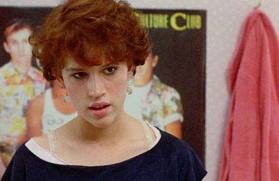
You’ll be just like Samantha Baker waking up on her 16th birthday, staring at her boobies in the mirror and realizing they’re the same size they were yesterday. (Sorry, fellas.)
Listen—we writers are one. We all share a common goal—to tell the best story we possibly can. I strive to do that every day, and so do you. There is no divide.
Of course, you will be jubilant when you receive an offer, but you will still be you. Unfortunately, your toilet will not clean itself. I should know. I’ve been staring at that damn toilet for three years!
So let me tell you a little about how I got here. I took 287 South, got off at Exit 9, merged right and…no sorry…
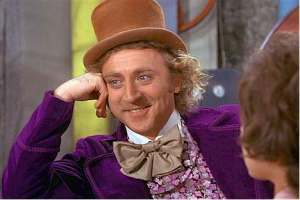
It began in second grade when I read CHARLIE AND THE CHOCOLATE FACTORY. (And let me tell you, Gene Wilder will always be my Willy Wonka, not Johnny Depp.)
 That book was so outrageously delicious, I knew immediately that I wanted to create fantastical stories like that. So my best friend Francine and I collaborated on our own book, a series of fractured fairy tales. I wrote and she illustrated. It was a beautiful little thing, and I still remember the jaunty little cap she drew on the main character. We were so proud of this thing, we called all our relatives and told them it was published.
After all, we were sure it would get published. It was perfection. Who would turn it down? They’d be crazy. If Ally Sheedy was only 12 when she wrote SHE WAS NICE TO MICE, we could beat her record and get published at age 8!
So we made our announcement prematurely and my two 80-yr-old great-grandparents fired up the ’67 Chrysler for the first time in months and creaked their bones to the local bookstore…but of course, our masterpiece could not be found.
So OK, it was my first newbie mistake!
I loved writing as a child and I did not understand why everyone else did not love it. When it was time for creative writing I jumped out of my seat and cheered. Everyone else groaned. Especially when the teacher gave the word count. I always asked, “Please sir, may I have some more?” Yes, Tara, you can write as many words as you want.
 So flash forward to college…right here on the banks of the Old Raritan, I studied English and Creative Writing. I had every intention to land a job in children’s publishing so I could learn the business inside-out. But it was 1992, and our country was in a recession. There were no kidlit openings. But I did get a job in publishing. COMPUTER PROGRAMMING BOOKS. Blech.
Bored out of my mind, I didn’t stick around long. I then rode the wave of irrational exuberance of the “Information Superhighway” age and was too busy in high-tech marketing to write for children. Besides working insane hours, I was figure skating four times a week. Who had time to write?
I got married. I had my first daughter. I stayed home. We read together. And then those old feelings bubbled up to the surface. (And this analogy has nothing to do with nursing. Sorry again, fellas.) But I had a colicky baby and even less time. (Well, I really had more time than I wanted—I had 2am, 3am, 4am…)
When I was pregnant with my second daughter, in 2006, I saw an ad in my local paper for an organization called Women Who Write. They were organized into critique groups by genre, and they had an opening in their Writing for Children group. I told my husband I wanted to join. He agreed to put our toddler to bed (no easy feat, she didn’t sleep for four years and now I can’t get her out of bed) and I waddled off to evening meetings twice a month. I was only in the group two months when they went on summer hiatus. Then I took time off to have my daughter, but vowed to return in six months.
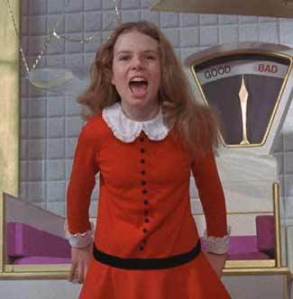 Well, six months turned into 12 months and I was more impatient than ever to get published. After all, I had postponed it most of my life. I was like Veruca Salt—“But Daddy, I want to publish a book NOW!”
But my early picture books were dreadful. Didactic. Adult protagonists. 1500 words. I didn’t know a thing about writing them.
So I joined SCBWI. I attended every NJ event I could, beginning with first page sessions. I took copious notes about every manuscript the professionals critiqued. I put those notes on a blog. And some knowledge started seeping in.
And then a mutual friend introduced me to author Corey Rosen Schwartz. Again, I imagined this great divide between us. I thought there was no way this woman, a published author, would want to be friends with me, a nobody, a wannabe. But remember, there is no divide. It only exists in our heads. Corey and I became fast friends. And we started critiquing each other’s work. And my stories began getting better.
Things were going pretty well for me. The Rutgers acceptance in 2008 gave me the confidence to know that I was on the right track.
And then, in 2009, I veered off track. Or rather, my body did. (OK, this is the sad part now. So everybody get your hankies out.)
On Halloween, I slipped on some wet leaves while trick-or-treating with my daughters and sprained my ankle. It was no big deal for me because I always sprain my ankle. I was a figure skater and my ankles had suffered a lot of damage over the years.
So I went home and put my feet up.
But the next day I woke up and half my foot was numb.
It was odd, but I thought maybe I had exacerbated an old injury. I had ankle surgery years ago and I remember my toe going numb at that time. So I just ignored it.
Until my entire left foot lost feeling.
And then my right foot joined the numb party.
Something was terribly wrong.
I went around like this until Thanksgiving, when the pressure of cooking a five-course meal collided with the distinct lack of pressure in my feet. I exploded at my family. I was sick and I needed help.
Three months worth of doctor’s visits and I had a diagnosis: Multiple Sclerosis.
I was devastated. And if there is a word that means beyond devastated, that’s what I really should insert here.
And the timing was really bad. I got the diagnosis a mere week before I was to attend an NJ-SCBWI Mentoring Conference. I had already sent in a manuscript called THE MONSTORE and I was supposed to be meeting with an editor from Sterling to discuss it.

There was no way I could attend.
The organizer was a friend so I called her and bawled, explaining that I was too sick to make it. She said she’d have the editor write up my critique and mail it out.
But I was in a deep depression. Not only was my walking impaired for the rest of my life, I thought my dream of becoming a kidlit author was kaput. Now, you don’t have to WALK to be able to TYPE so I don’t know why I thought this way, but I was not in a rational state of mind.
So when that envelope from the editor at Sterling arrived, I ignored it. I stayed in bed for days on end. My life was over.
Then I received an email from my friend at NJ-SCBWI. She said the editor was upset that I couldn’t make the workshop; she had wanted to meet me in person.
Meet me? WHY on earth would she want to do that? Remember the great divide?
 This manuscript had been rejected from Rutgers (GASP! SHOCK! HORROR! I know, you weren’t expecting that, right?) and I had met with a picture book consultant who had gently pushed it back across the table like it was pea soup with a fly in it and she dubbed it “a practice manuscript”.
So I sneered at that envelope, skeptical of what lay concealed inside. It was thick. I assumed she hated it and she wanted to meet me in person to scold me about all the things I did wrong.
Instead I opened the envelope to read, “What a fun title and a unique premise. I was hooked on page one.”
She liked me! She really, really liked me!
I mean, she liked the STORY. (Don’t make that mistake of equating your work with YOU.) She asked to see a revision.
But I had always known I wanted an agent. Holy bacci balls, it was time!
Things then started happening fast. Corey had won a critique with author Jean Reidy and sent THE MONSTORE instead because she had nothing ready. Jean read THE MONSTORE and then Tweeted about how awesome it was. Then Ammi-Joan Paquette saw the Tweet and asked what she was reading. All of a sudden, I had a referral to Joan.
I got busy sending out queries to four other agents I had targeted.
Now you must realize at this time, I was still so sick and filled with anxiety and dread that I couldn’t get out of bed most of the day. In fact, I could barely speak until noon because I was on the wrong medication.
So when an agent called me two hours earlier than he said he would, I don’t know how I did it, but I managed to talk. Thank goodness I had an acting background because it was the best performance of my life.
But ultimately, I signed with Joan. I would like to say that signing with her finally lifted me out of my MS funk, but it didn’t. I knew I was doing something big, something I had dreamed of all my life, but I couldn’t even walk the contract to the post office. And I focused on what I couldn’t do instead of what I had accomplished.
Even when the offer from Aladdin came in a month later, I was only pretending to be happy. I had about two seconds worth of “I DID IT!” and then I went back to bed.
 But, I went back to bed with a purpose…and a laptop. If I was now published, I certainly wasn’t going to stop with one book. I needed more. I could not be a one-hit wonder. The name KajaGooGoo Lazar does not look good on the cover of a picture book. (C’mon, who knows KajaGooGoo, the one-hit wonder from the 80’s? “Too shy shy, hush hush, eye to eye.”)
Writing slowly lifted me out of my funk. And once I was brave enough to tell my friends and family what was happening with my health, they began to lift me up, too.
And so, two years after I signed my first contract for THE MONSTORE, I now have two more books under contract…and I’m waiting to hear on a few more. There’s a few editors here I need to speak to…
But again, because I am up here and you are sitting down there does not mean there is a divide. As Kay Winters spoke in 2008, I said to myself, that’s going to be me someday. And look! Here I am! There is a space for you up here, too.
You should be proud of yourselves for making it here. When I attended in 2008, I really had only an inkling of how important this day was. And I had no idea that everyone was here for ME.
That’s right.
We’re all here for YOU.
This is YOUR special day. Like Katy Perry says, “Baby, you’re a firework. C’mon let your colors burst!” (Singing is not one of my talents.)
Remember that everyone assembled is here to help you take the next step in your career. This day was planned with you in mind. This fact was a little difficult for me to grasp back in 2008, so I put together something to help you remember this.
And because our chair informed me it was a fire hazard to set off Grucci fireworks in this room, I have something else that sparkles and glows all day long, just like you. (Will Sheri, Anita, Marcy and Andrew please come help me.)
 These glow bracelets are for you to wear today, to remind you of how special you are. Of how you are the star of today. Every time you look down at your wrist, remember that we’re all supporting you. Any question you have, ask it. Anyone you want to approach, step right up, don’t be “too shy shy”. This is YOUR day. Make the most of it. And be a little kid at the same time.
So I leave you with these words:
There is no divide.
But there are glow bracelets!
Enjoy and have fun today!
“Don’t use art notes,” is what you may hear as a new writer.
It’s not that editors don’t like art notes. It’s just that many new writers want to dictate illustrations that do not require direction.
 For instance, you shouldn’t pick what your character looks like. Red hair, blue shirt, green sneakers, pigtails, etc. are not for you to decide. The editor of Mary Ann Hoberman’s THE SEVEN SILLY EATERS thought the characters should be animals, like crocodiles. Marla Frazee, the illustrator, thought they should be people, and she was right. She even made the mother a cello player, which was not in the text, but it added a delightful layer to the mother’s personality. The options were wide open—the author never described the characters’ appearance.
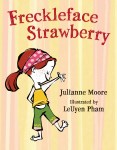 The exception to this rule is when your character’s appearance is crucial to the story, like FRECKLEFACE STRAWBERRY. Although the title pretty much says it all, right?
You must trust that your editor and illustrator have ideas for what your scenes should look like. Better ideas than you. Leave the art direction to them (and the art director). Writing that the house has a front porch, or that the cat is calico, or that the car is yellow is all unnecessary. Again, unless that car needs to be yellow for your story to work.
But you will no doubt read picture books with subversive text—where the character is doing completely opposite what the words say. Or books with text so spare, the action comes thru only in illustration. These are times when your text requires art notes. SCREAMS for them.

But if you have an art-heavy manuscript, where much of the story relies upon the illustrations, how do you submit it? Putting the art notes in [brackets and italics] is typically the way to go. However, too many art notes can interrupt the flow of the story. It gets difficult to read and comprehend.
So what do you do?
Maybe…submit your manuscript in grid format.
What?! But Tara, I’ve NEVER heard of this before.
I know, me neither. But my agent just submitted a manuscript like this. I was skeptical at first, but then I realized the grid was the best no-nonsense way to present the text with the illustrative mayhem. Yes, this book has MAYHEM. And FRACAS and PANDEMONIUM, too.
Here’s what the grid looks like in manuscript format:

The header includes your name, contact details and a word count.
Then the title (in caps) and your byline.
There is a general art note at top which introduces the story idea. Moreover, it states the art notes are “intended as a guideline.” Again, as an author, you cannot rule over all that is picture in picture books.
Next comes the grid. On the left is the story text, on the right appears “rough art direction.” Notice we said “rough” because they are only suggestions for the editor to understand the story. Remember that the illustrator may create something even better, funnier, more poignant. Remember the CELLO.
The grid continues for as long as it takes to tell your story. Typically one or two more manuscript pages.
Please note this isn’t a standard way to submit, it only serves as an example of what one author and her agent did. It’s like the photos on the front of frozen food boxes that say “serving suggestion”.

Now if you’ll excuse me, I suddenly became very hungry.

Remember my video about the nightmare book signing?
Well, bad signings make frequent appearances in author circles.
Recently a friend set up a table at a “free” outdoor event for parents and toddlers. She thought it would be a good opportunity to showcase her picture book and sell some copies.
No one approached her all morning. She was getting very discouraged.
Finally, a woman who had been manning another table walked up. “I’d like one for my son,” she said. “His name is [very unusual name].”
My friend picked up her pen, personalized the book to the woman’s son, wrote a special note, and autographed it. “That will be $15, please.”
The woman stared. “Oh, I thought it was free.”
My friend was taken aback. “Free? This is a picture book from [Big 6 Publisher].”
“But everyone here is giving away free stuff,” the woman said.
My friend then felt bad. SHE FELT BAD?! “Well, since you didn’t know, I will let you have it at cost. I paid $10 for it.”
“Never mind,” the woman said. “I don’t want it.” And she turned back to her table.
My friend was near tears. She hadn’t sold a single book and now she was stuck with one signed to “Jakellen.” What were the odds that another “Jakellen” would come to a future book signing? About a Jakellen-to-one!
This serves as a cautionary tale for both readers and authors.
Authors do not get their own books for free.
They are offered a very limited quantity upon publication, usually somewhere between 5 and 15 copies, most of which they use for promotional purposes. The rest they have to pay for themselves, typically at 30-40% off the retail price. Sometimes they do better purchasing from Amazon and not the publisher-direct! Free books are very rare.
And remember, that author has worked years to publish that book. And authors do not get paid while they are writing it. A lot has been sacrificed to get that book onto shelves. So please don’t expect a book for free. And don’t walk away from a book that has already been personalized. That author has now lost whatever they paid for the book, and the royalty they earned doesn’t even cover 10% of it.
While tempting, it may not be the best idea to do signings at advertised “free” events. People arrive with the expectation that they’ll never have to dip into their wallets. (And considering the economy, that’s the kind of feeling they want to experience often!) They are not in the mood to buy, and therefore may avoid you, even if what you’re selling looks good. They have not arrived with the mindset (or the money) to make a purchase.
And finally, it may be proper to let the reader know the price before you sign a book. Or else you might get stuck with a lot of “Jakellen” copies. And frankly, “Jakellen” isn’t even on the Social Security Administration’s List of Top 1000 Names. FOR ANY YEAR.
But who knows, maybe like “Splash” I’ve inadvertently begun a Madison-like name craze?!
My friend may be Jakellen-sellin’ after all!
.
Book and pen photo courtesy of Flickr user Jain Basil Aliyah.
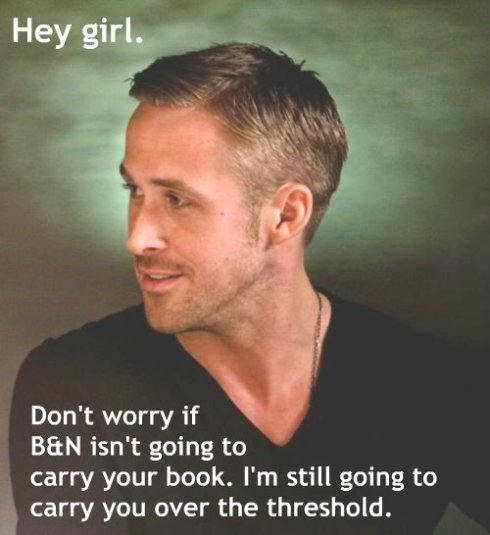
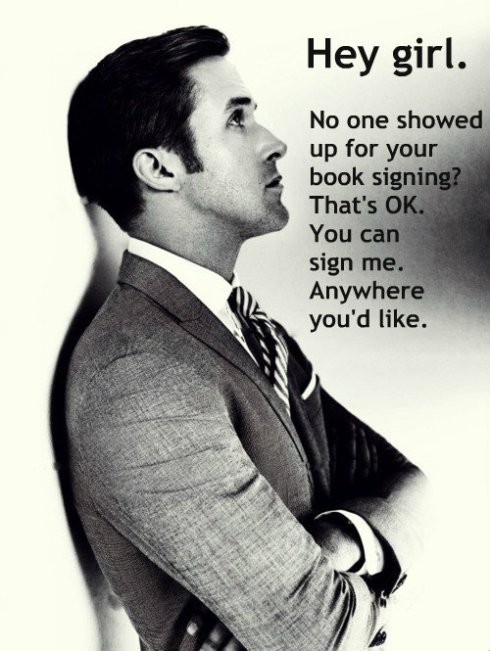
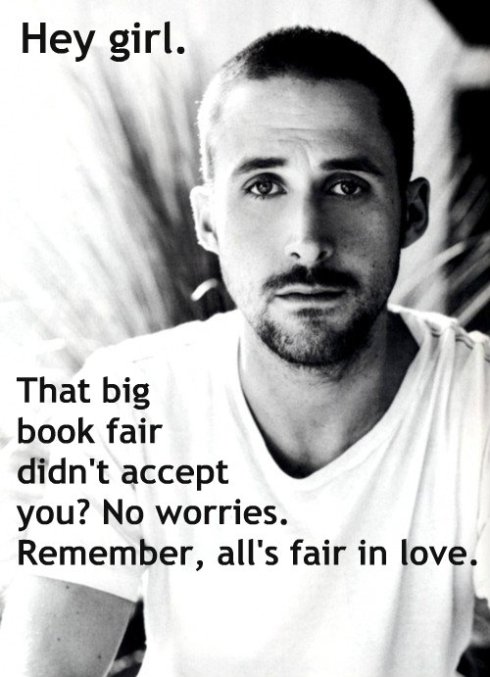
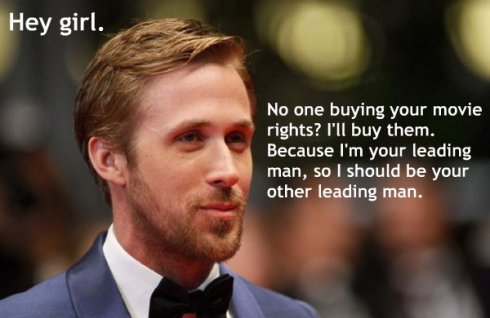
My debut book is still 9 months away, but what I’m hearing from friends is that the promotion process is fraught with dilemmas and doubts. Yes, we managed to write a book, submit it and get it accepted for publication, BUT WILL ANYONE BUY IT? And what if some bookstores don’t even carry it?
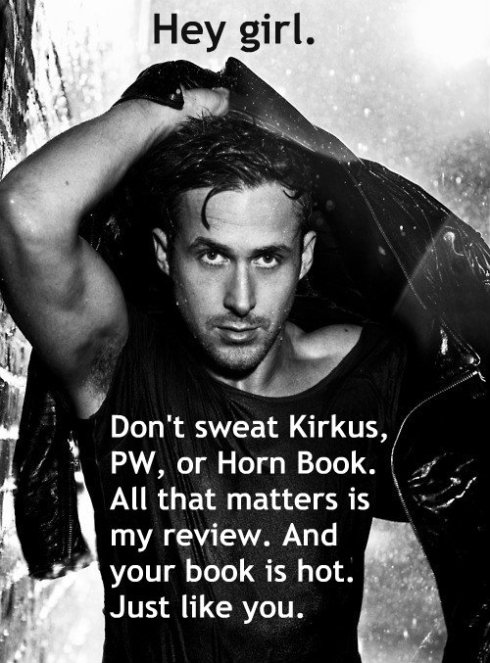
Well, don’t worry. Ryan Gosling is here again today to calm your fears.






 Writing for Kids (While Raising Them)