You are currently browsing the category archive for the ‘Picture Books’ category.
Cheaper by the Dozen
by Mark Ury
Ideas are not a dime a dozen. They’re closer to $0.0001. That’s because they’re commodities. Everyone has them, everyone can think of them, and, as a culture, we’re saturated with them. Like most raw materials, ideas are worthless unless you turn them into something else, something of greater value.
How do you add value to ideas? With other ideas.
The concept of wit—one of our most enjoyable forms of ideas—is premised on taking one cliché and combining it with another to make something unexpected and remarkable.

An arrow pointing right is a cliché for a courier company. But burying it between the negative space of the “E” and “x” of FedEx makes it new. It makes the image memorable, if not surprising, and the idea valuable.

“You can’t teach an old dogma new tricks” is the written equivalent of the FedEx logo, as are many of Dorothy Parker’s best quips. “Take care of luxuries and the necessities will take care of themselves” and “It serves me right for keeping all my eggs in one bastard” whip two lazy ideas into shape and keep them marching for decades.
The economics of wit are 1+1=3. When your ideas are competing for a publisher’s or reader’s attention, those are valuable numbers to have on your side.
How do you create wit? The simplest technique is to tinker with clichés since they contain recognizable patterns that your audience can latch onto. For example, the cliché “ideas are a dime a dozen” gives you three things to mess about: ideas, money, and—thanks to the word “dozen”—eggs. If you were drawing, you might play with the notion of ideas as light bulbs and then substitute them for the eggs in a carton. You now have a new image to play with and the shadows of a scene. Who needs ideas? Inventors. But why cheap ones? Well, perhaps this inventor is down on his luck. Can’t you see him there at the register, digging into his empty pockets looking for a dime? Around him are other wealthy inventors, buying cartons of the stuff. But he can only afford one bulb for his last, terrible experiment…
 The key to playing with clichés is to think visually AND conceptually. Sometimes the images line themselves up, like the example above. Other times, the concept is unlocked through narrative interplay. For instance, you might start with the visual of ghosts, creeping around in a mansion and scaring people. But then you flip to the narrative pieces and start toying with their DNA: the ghosts aren’t the antagonists. The ghosts don’t know they’re ghosts. The audience doesn’t know they’re ghosts. Before you know it, you’re in Spain with Nicole Kidman filming The Others.
In fact, if you want to study the blending of routine ideas into something fresh, Hollywood has a not unsuccessful record. Alien is the fusion of the shark thriller (Jaws) and outer space (Star Wars). Mad About You was pitched as thirtysomething, but funny. The Sixth Sense, Unbreakable, The Village—many of M. Night Shyamalan’s films—rely on flipping everyday ideas to produce entertaining new ones that “unpack” their meaning as you watch.
That’s the benefit of folding two ideas into one. The audience experiences it in reverse: one idea unfolds into two and the brain has the joy of connecting the dots to find the hidden meaning.
Don’t worry about great ideas. Look for everyday, unbankable ones. If you invest and repackage them, they’ll outperform your reader’s expectations.
That’s my two cents.
 Mark Ury is the co-founder of Storybird.
If you’re a picture book writer, you’ve read hundreds of picture books. Maybe even thousands. (And if you haven’t, I’m sending you to bed without supper!)
I know you have favorites. But have you ever stopped to analyze why a picture book has earned your top rank? Is it the premise? The voice? The twist on the final page? Does the book’s heartfelt sentiment or cheeky sense of humor hook you? Is it all of the above?
 Timothy Knapman’s Guess What I Found in Dragon Wood stands out among recent reads. Why? When I began Knapman’s story, I assumed it had a been-there-done-that premise: boy discovers a creature in the forest. But on the third page, I was thrown.
This is no ordinary boy-meets-dragon story. It’s dragon-meets-boy.
Told from the dragon’s point of view, Dragon Wood turns a common premise upside down. When the young dragon finds a boy “called a Benjamin,” he brings it home and asks his mom if he can keep it. Slowly the dragon uncovers strange facts about the human world—the Benjamin’s striped boots aren’t his feet, his eyes leak when he’s sad, and he loves a game involving a black and white ball. But the dragons have a tough time learning soccer. They just want to burn down the goalposts and eat the ball.
In Dragon Wood, young readers know more than the main character. And kids love that. Think about it—all day long they’re in school, being told how much they don’t know. When they can be smarter than a picture book character, it’s a fun feeling. (Just like when we adults are smarter than a fifth grader.)
Knapman’s book has several things going for it: surprise, humor, a unique voice, kid sensibilities and adult appeal. Let’s not forget that a picture book should keep the grown-up—the one with the wallet who’s reading—entertained as well.
When I boil this dragon tale down, it’s a story about friendship. I could also argue that it’s a book about the importance of family and finding one’s true place in the world. These are universal themes that will never go out of style.
As I come up with ideas this month, I think about the theme at its heart. Will my theme stand the test of time? Can I write this theme with humor and an element of surprise? What have I learned from Dragon Wood that I could apply to my own unique story?
Other favorites:
 In Cressida Cowell’s That Rabbit Belongs to Emily Brown, the relationship between a little girl and her favorite toy is magic, a love that everyone can understand because they’ve experienced it, too.
In The Louds Move In by Carolyn Crimi, the author balances seven distinct characters—an entire family of Louds plus three quiet neighbors. Even the names are brilliant: Earmuffle Avenue, Miss Shushermush, Mr. Pitterpatter.
 In Laurie Keller’s Arnie the Doughnut, I guffaw at its crazy, quirky humor. Arnie is alive—and the poor chocolate-frosted treat doesn’t realize that doughnuts are for eating.
Okay! Are you ready to try it? Go play with a favorite book. What do you love about it? How can you create something lovable?
So, how’s it going today?
 I am not like most writers. Ideas don’t just slam into me while I am out for a walk. I don’t get “Aha!” moments while luxuriating in a steamy tub. I have to work hard for my ideas. I have to dig deep to find them.
One of the ways I do this is by brainstorming with a partner. I find it so much easier to generate ideas when I can bounce them back and forth. It’s kind of like tennis. I can’t get a rally going without a partner.
Here is a sample of a very condensed brainstorming session with my partner, Becky.
ME: Jordan came home from school today with a new expression, “Flip Flop. Over the Top.” It’s how they learn to put their coats on. Catchy, huh? Love how it rolls off the tongue. What can we do with it?
BECKY: Hmm…over the top? The top of what? A fence? A wall?
ME: Could be a wall? What goes over? Football? Frisbee?
BECKY: How about a baseball. Two characters are playing baseball and one hits it over the wall. How do they get it back?
ME: Try climbing, scaling?
BECKY: Jumping on a trampoline?
ME: Shooting each other out of a cannon?
BECKY: Catapulting.
ME: Grabbing onto a bunch of balloons and flying over.
BECKY: All of the above?
We may use none, some, or all of the ideas in the end, but I am convinced that when it comes to brainstorming, the sum is greater than the whole of its parts. In other words, ideas will be triggered when we are together that NEITHER of us would have come up with if we had both brainstormed independently.
Give it a try sometime.
Can’t find a partner? I am always up for a collaboration!
And if you’re wondering how our characters get their ball back in the end?
They dig a hole…and go UNDER!
 Corey Rosen Schwartz is the author of Hop! Plop!, an Eric Carle Museum Picture Book of Distinction. Her next book is due for release in 2012 (not soon enough in Tara’s opinion). She attended Brown University and has a Masters in Deaf Education from Gallaudet. Corey lives in New Jersey and spends a lot of afternoons at playgrounds with her five-year-old daughter, Jordan, and four-year-old son, Josh. Corey has no free time, but if she did, she would spend it scuba diving!
 Brief Encounters of the Picture Book Kind
by Melissa Azarian
I think you can find a picture book idea in even the briefest encounter, and I’ll prove it.
Years ago, I celebrated my best friend’s birthday at Lucky Cheng’s, a Drag Queen Cabaret Restaurant. Lucky Cheng’s was not so lucky for me. All day long, I had a migraine brewing, and shortly after ordering dinner, I could not fight it off anymore. I ran downstairs to the bathroom, shut the stall door, and prayed to the porcelain Goddess of Migraines.
When I finally emerged from the stall, I realized I was not alone in the ladies room. A 6 foot 1 drag queen—6 feet 4 in those stilettos—was reapplying lipstick. He turned around, gave me the once over, and said, “Honey, you don’t look so good.”
As ill as I was, I had to smile. I don’t look so good? Certainly, I could’ve said the same to him. He overdid his makeup (such a pretty face didn’t need so much makeup), and that V-neck dress was all wrong for him! But why ruin the moment?
I told him that I’d had a lot of migraines and this was another doozy. He sympathized.
So how do you turn a migraine, a drag queen, and bathroom bonding into a picture book? Easy. Just view the whole scene from a child’s perspective. And tweak it a bit.
It could be a picture book about a girl who is excited to go to a party because she bought the perfect gift. She loses the present on the way, but she meets an unlikely friend, who makes her laugh and saves the day.
Maybe it’s about a quiet girl who gets paired up for a class project with a talkative, confident kid. She doesn’t think they can work together until she discovers that they each have something unique to contribute.
Or it’s about an outspoken child who is always hushed, but in the end, his outspokenness helps prevent a mishap at the park.
I could probably come up with ideas all day, based on this one incident. And it’s because, at its core, this is a story about a memorable character.
Think about someone you met briefly and have never forgotten. What quality makes this person so unforgettable? Maybe—if you tweak it a little—the brief encounter will inspire your next picture book.
 Melissa Eisen Azarian is the author of The Amistad Mutiny: From the Court Case to the Movie (Enslow Publishers 2009). A former assistant district attorney, legal editor, and newspaper reporter, Melissa is now a children’s writer. She co-chairs her local PTO’s Visiting Authors Committee. Besides occasional migraines, Melissa suffers from revisophobia, a condition that causes her to write new manuscripts rather than revise existing ones. She is thinking of starting a support blog for fellow revisophobics.
What Is Your Voice?
by Jeannine Q. Norris
As we are in the middle of PiBoIdMo, ideas are flying fast and furious, right? And are you hearing voices in your head? Hooray for you! When writers hear voices, that’s a good thing. The tricky part is identifying the voice that will get you published.
With the tight economy and a tough picture book market, publishers are looking for a unique angle. Chances are good that your picture book idea has already been published. The challenge is finding a way to make it unique, and that often involves a different voice.
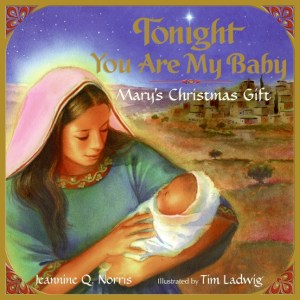 While you are brainstorming, and the creative juices are flowing, choose to look at your manuscript from a different perspective. A unique voice is how I landed a contract with Tonight You Are My Baby: Mary’s Christmas Gift (HarperCollins, 2008). Certainly, there are countless Nativity books on the market, and more every year, but the voice of a mother speaking to her baby was my hook. Christmas suddenly had a different perspective.
Look at your manuscripts and try to push the envelope a bit. Can you find a different voice? Something that sets you apart from the other fantastic books that have already addressed the subject. Perhaps you are writing about a cowboy. Can you write about the cowboy from the horse’s perspective? Picture book about the new kid in school? How about the new kid from the bully’s perspective? You get the idea.
Be open to new ideas, new voices. Sometimes you have to search. If you are lucky, they magically appear—like our dog, Harry Potter, trotting past me in a denim skirt and pink bandana. Our daughter had dressed him in her clothes, and he was proud and embarrassed at the same time. That was a eureka moment for me, and two picture book manuscripts were born. The voice, of course, is our long-suffering dog.
Good luck with your writing and listen carefully to those voices—they’re trying to sell your manuscript!
 Jeannine Q. Norris comes from a family of authors—her mother and brother are also published. She’s a mother and an animal lover who wanted to be a veterinarian when she grew up. Jeannine and her husband created the At Least Kids Foundation, a non-profit charitable organization dedicated to assisting children with brain tumors. ‘Tis the season for her debut picture book Tonight You Are My Baby, so she’s busy visiting schools all through December.
 Inspire and Be Inspired: Volunteer
by Heather Ayris Burnell
Sure, inspiration is all around us, but it doesn’t hurt to give our inspiration arsenal a little boost. Going new places, having new experiences, and meeting new people are sure-fire ways to have ideas. How can we do these things without leaving on a long, expensive vacation?
By becoming a volunteer.
Don’t be fooled, the act of volunteering can be mutually beneficial. We certainly don’t have to limit ourselves, but since we’re picture book writers we might benefit most from volunteering at places we can interact with our audience–kids. Being around books doesn’t hurt either. There are two obvious places where we can volunteer: schools and libraries.
Schools are always in need of volunteers and right now cutbacks are making them even more appreciated. You might be able to help with the school’s reading program. My kid’s school has a HOSTS (Help One Student to Succeed) program where a mentor works with a child one on one for about forty-five minutes once a week. They read together, and it looks like they even have a good time.
School librarians might love some help with shelving books or perhaps could use a knowledgeable adult to help students find the type of book they’re looking for, whether it’s just for fun or for figuring out what books they are allowed to read according to their reading level. Major bonus: you will be surrounded by children’s books. Think of all the cover illustrations and back cover blurbs you will have the chance to take a look at!
Public libraries love volunteers too. Most have at least a weekly storytime for children. Volunteer to be a reader or an assistant. I know my library is always looking for more people to help with storytime. The Summer Reading Program is another fun kid’s program that your library might love help with.
Not feeling like interacting much? You can volunteer to shelve books or help with the book sale. I absolutely love shelving books, so many different books cross my path that may not have otherwise. As for book sales, they can be quiet events with lots of book sorting, but my fellow book sale workers and I have a running list of “The World’s Funniest Book Titles” that we add to every sale. Possible book sale bonuses: camaraderie and great book discussions.
Sure, writers can benefit from volunteering at other places like museums, art galleries, or wildlife preserves too. Find a place that appeals to you and give it a try. Don’t be afraid if you don’t have much time to spare, any little bit will be appreciated. Snippets of conversation, different points of view, fascinating or silly ideas, and looking at the world with the help of someone else’s perspective are all things we might be inspired by when volunteering.
If we go into it with our eyes, ears, and hearts open, we just might get back more than a good idea for a book.
 Heather Ayris Burnell started volunteering at her local library because she was there all the time anyway. She has run the book sale, organized a storytelling festival, and put on an author fair, among other fun things. Her first picture book, Bedtime Monster (illustrated by Bonnie Adamson) comes out in 2010 from Raven Tree Press.
 Today, bookish Brooklynite Elana Roth of Caren Johnson Literary Agency agreed to join PiBoIdMo to offer grand prize number THREE.
If you haven’t checked the prize announcement page, please do! It’s been updated with Elana’s information and the tentative prize schedule.
I’m also planning to give away books and other goodies, so stay tuned. I’ve got more figuring to do. And you’ve got ideas to flesh out.
Have you ever considered writing a picture book biography?
I’ll be honest. I never did.
My perception of bio writing was that it was snooze-worthy, the stuff read by droning teachers in echoing classrooms. Don’t ask me where I got that impression, although it might have to do with Doc Shapiro’s U.S. History class circa 1986.
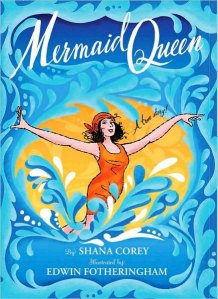 Then, at the recommendation of Kelly Fineman, I read Mermaid Queen: The Spectacular True Story of Annette Kellerman, Who Swam Her Way to Fame, Fortune & Swimsuit History!
Wowza. Have you seen this book? The splashy, colorful illustrations grabbed me, but it’s the story that kept me turning the pages. And it’s not about some über-famous woman, either. I had never even heard of Annette Kellerman until I read this book.
Kellerman invented water ballet, introduced the idea of the female athlete to the masses, and became the first woman to attempt swimming across the English Channel. She designed the modern swimsuit, freeing women from their heavy woolen garb.
Shana Corey’s mermaid tale proves that picture book biographies can be imaginative and fun, and they don’t have to be about a president to make a splash. (Yeah, I used that pun twice. Sorry. It’s day 15. Stick with me here.)
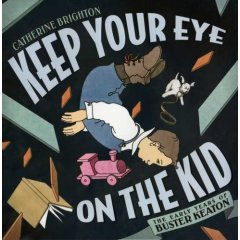 Catherine Brighton’s Keep Your Eye on the Kid focuses on the early years of Buster Keaton.
Did you know Harry Houdini gave Buster his name after watching baby Keaton tumble down the stairs? (“Gee, that was some buster the kid took!”) His parents had a touring act and would throw him across the stage every night. These unusual details, told in Buster’s voice, toss you into the story. The sentences are crisp and tight, and Brighton doesn’t dwell on the demanding reality of Buster’s touring lifestyle. She keeps it fun and lighthearted, with illustrations that mimic an old comic book. And the cover? You’ll fall head over heels for it. [Insert corny laugh track.]
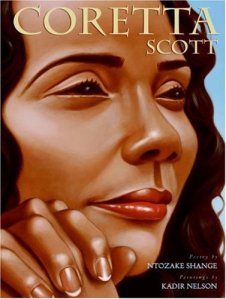 Coretta Scott by is a lyrical biography by Ntozake Shange, illustrated with bold paintings by Kadir Nelson.
It doesn’t begin “I was born on April 27, 1927” and thank goodness for that. Instead the first page reads, “some southern mornings/the moon/sits like an orange/sliver by the treetops.” There’s a simple, glorious painting of the glowing sliver above a silhouette of trees, the sky wide open. Yet the next page introduces the reality of segregation. Coretta and her siblings “walked all/of five miles to/the nearest colored school/in the darkness/with the dew dampening/their feet.” The rest of the story sings, as Coretta meets Martin Luther King, Jr., marries, and helps lead the Civil Rights Movement.
These three books represent the best of picture book biographies, telling a story with style rather than bogging it down in facts. This is not your history teacher’s non-fiction. No siree.
Today for PiBoIdMo, do research. Read picture book biographies. Which ones sing to you?
Is there a figure in history who fascinates you? What has been written about that person? Are there picture book biographies or texts for older children? How can you tell that person’s story in 32 pages, in a way that’s suitable for young children? Which details would you keep? Which would you toss? Would you tell the story in verse or prose?
So, how’s it going today?
Picture Book Confessional
by Jacqui Robbins
Here is a confession: I have problems. And I want you to have them too.
I know it’s PiBoIdMo. But I don’t get ideas, really. I get problems, and characters that have them.
It starts with a voice whispering. Usually it’s one line.
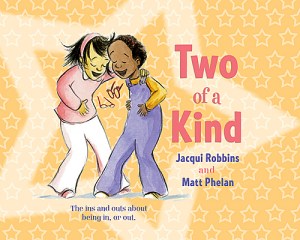 “Kayla and Melanie are two of a kind.”
There’s a rhythm in the line and it gets stuck in my head. I try to ignore the voice, but it chases me around. It talks at me while I drive, when I run, when I’m on my fiftieth game of Sorry with my son. I hear the voice, and I start to fall in love with the character behind it. “Who is this poor girl who wants so badly to be the third in the two of a kind?”
Well, once I’m in love with my character, I can’t just leave her there, stuck in her problem. I have to write her out of it.
“What can she do?” I ask myself. And the book is born.
You’ve been thinking of picture book ideas all month. If you’re anything like me, you’ve used up your “been saving this one a while” ideas. You’ve gone through your “Hmm, that might be good” ideas and are starting in on your “well, it’s something, I guess” ideas. By next week, you’ll be on your “please, lord, don’t let anyone read this even if I’m dead I’ll be so embarrassed” ideas.
So today, try this. Start with a character.
Who is he? Where does he spend most of his time? What does he think about? What does his voice sound like in your head?
Now, what does he love more than anything else in the world?
Well, he can’t have it.
Why?
Ooh, now he has a problem. Poor guy. You can’t just leave him there. There’s only one thing to do.
Write him out of it.
 Jacqui Robbins has filed resumes, sold books, written grants, worked the grill at a snack bar, and taught students from ages 6 months to 65 years.
Jacqui’s first book, The New Girl…And Me was published in June, 2006 (illustrated by Matt Phelan, Atheneum/Richard Jackson Books). Jacqui’s next book, Two of a Kind, came out in July, 2009 (also illustrated by Matt Phelan, Atheneum).
“The value of an idea lies in the using of it.” – Thomas Alva Edison
“In my experience, there’s no such thing as luck.” – Ben Kenobi
Happy Friday the Thirteenth and happy Picture Book Idea Month! My name is Ryan Hipp, I am an author-illustrator of picture books and today’s guest writer for Tara’s blog.
Black cats crossing your path, 13’s abounding, broken mirrors shattering, and walking under ladders are dangerous portents. To an author, these omens cannot compare to the terror of writer’s block! Today I will present the two most important words in picture book publishing: Ideas and luck…and I’ll share why I feel both of those words are meaningless superstitions.
Really.
Let’s start with IDEAS.
When people enjoy a book, they often say, “what a great idea.” As someone who makes books for kids, I often get asked, “where do you get your ideas?”
I answer, “Finding ideas is not the challenge for me. The challenge is knowing what idea is the one to build on.” (Tara’s note: see the PiBoIdMo grand prize announcement.)
I don’t know why I have come to this conclusion, but I never understood why so many people focus on the “idea” as being so critical to a successful book. I have exactly 47 great ideas and even more acceptably average ones; more than enough ideas to feed my family for the next 60 years. Unfortunately, before you can spend ideas, you have to invest them––and the exchange rate in the publishing world is blood, sweat, and tears.
Sometimes people want to share with me that they also, “have a great idea for a book.”
Similarly, I am not impressed with people with ideas. Never. Ideas are cheap. They come too easily to all of us. The truth is, there is not a shortage on ideas. Everyone has ideas. Everyone. I am more impressed with something more rare and valuable than an idea: perseverance, practice, dedication, commitment, hard work, and patience. The best idea in the world is a moot point until you start climbing that mountain and joining the other hard workers on the summit.
I don’t want to discount the importance of ideas. Every good book starts with a good idea; but they are just building blocks, not a castle. So my advice is to keep dreaming, and keep generating ideas; but don’t forget the more important step: bring those ideas to life.
Now let’s move on to LUCK.
“Luck is simply how something is explained after it has happened. It isn’t real,” says editor Tim Travaglini.
Your car breaking down is not bad luck. Finding a silver dollar on the ground is not good luck. These events are simply the eventuality of your radiator overheating and someone else having a hole in their pocket. It is that simple. Things happen.
I sometimes hear authors and illustrators humbly say, “I was in the right place at the right time,” when answering questions about their “good luck” in the world of publishing. Needless to say, talent and work may have played a more significant part. To get a picture book deal, good luck is not real. Bad luck is not real. Perseverance, practice, dedication, commitment, hard work, and patience are real.
So on this day filled with luck in this month filled with ideas, I ask of you: keep building, keep working, and have an unlucky Friday the Thirteenth!
 Ryan Hipp is a published author-illustrator of picture books who lives in Grand Rapids, MI. His style is whimsical and obtainable for all ages. Another big part of Ryan’s career is giving presentations: Ryan has developed seminars for teachers, parents, and students––to get kids excited about creativity and to help adults facilitate creativity in kids, too.
(Ryan created the PiBoIdMo logos, so let’s hear a Hipp-Hipp Hooray!)





 Writing for Kids (While Raising Them)