You are currently browsing the category archive for the ‘New Jersey’ category.
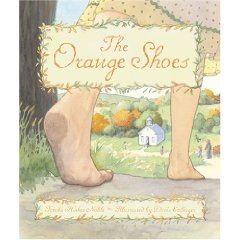 Trinka Hakes Noble once described the joy of being a children’s writer: she can relive her childhood. And not just the fun times, but the difficult ones, too. And why would that be a good thing? As an author, she has the opportunity to rewrite her own history—to take an unfortunate situation from her past and finally make it right.
She does just that in the poignant story The Orange Shoes.
Ms. Noble grew up in rural Michigan as the fifth of seven children. The hand-me-downs that defined her childhood became the inspiration for this tale.
Each child in her family received just one sturdy pair of shoes per year, and since they were to be passed down between boys and girls, they were plain loafers. At school she was teased for her boyish Buster Browns. One afternoon while browsing the sole department store in town, she set her eyes upon a pair of lovely orange Mary Janes and instantly fell in love. She does not know how they afforded it, but the next day her parents presented her with that special pair of shoes.
As a young innocent, she showed them off to the children at school so they would finally admire and compliment her shoes. Instead, the children kicked dirt on her shoes, stomped on her feet and destroyed them, leaving her heartbroken.
In The Orange Shoes, marvelously illustrated by Doris Ettlinger, the main character Delly comes from a poor, rural family who cannot afford shoes until October, when the weather demands them. And yet, Delly’s character does not feel sorry for herself without shoes. Instead, she relishes the feel of the cool earth beneath her bare feet.
Like Ms. Noble, Delly is a talented artist. The inside of unfolded, used envelopes are her canvases. Her teacher, Miss Violet, encourages her students to decorate boxes for a “Shoebox Social” which will raise money for art supplies. When Delly sees a pair of orange Mary Janes in town, she immediately wants them to wear to her school’s social, but she knows they will never be hers.
To Delly’s surprise, her father buys the shoes she so admires. The delighted young girl wears her shoes to school and her jealous classmates ruin them.
This is where Ms. Noble fixes the situation from her childhood. Delly becomes a resourceful artist, painting each crack and crease with vines, transforming bigger scuffs into flowers. She decorates her Shoebox Social box to match perfectly. At the event, her box draws the highest bid, but it comes from an unexpected source.
The Orange Shoes was easily my favorite picture book of 2007 and it deserves a place on your shelf. The illustrations and story marry beautifully, and the message is uplifting and powerful. This being said, it is a more complex tale meant for older children, making it a great snuggle-up-together tale which elicits discussion between parent and child. And those are some of my favorite moments with my kids, when we can talk about books that we love.
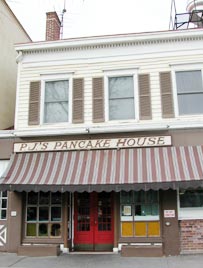
 Despite 40 years in business, changes in ownership, renovations and a fire, the names carved into the tables of PJ’s Pancake House remain a permanent record of all who have dined at the Princeton landmark. PJ’s must be the only restaurant that encourages patrons to slice into the tables and deface the walls with black Sharpies.
This morning my husband, youngest daughter and I sat at the “Table of Awesome.” How do I know the ranking of this booth? It said so right above the salt shaker.
Janine sat at our table the day she got her braces off: September 12, 2008. Katherine and Tate ate there in 2006 and they were in love. (I wonder if they’re still together?) Lena and Jeff traveled all the way from Gibson, GA. Dan drew a picture of the cigarette he wished he was smoking.
If a writer needs inspiration, a few minutes scanning the surfaces of PJ’s Pancake House promises to uncover thousands of stories.
Thankfully, I didn’t have to scold my two year-old when she took a red crayon and scribbled outside the lines. For once we had a peaceful meal out.
If you ever find yourself on Nassau Street in Princeton, definitely stop by. They serve fluffy, generous pancakes all day long, and if there’s a line to get in, don’t worry, it goes quickly. Plus, the griddle faces the window so you can decide upon your pancake order by watching what’s most popular. There’s chocolate chip, banana pecan, blueberry, pigs in blankets and even corn. Yeah, they serve other stuff, too…but when a food is in the restaurant’s name, you must order it! (Do you go to a steakhouse to order chicken?)
You might even dine next to friendly strangers if you’re seated at the long table in front, so say hello. Or, just listen to Groundhog-Day-like tales of Pennsylvania RV travels, like my husband did. One man’s peculiar voice rose above the plate clatter.
And the service goes miles beyond any restaurant I’ve ever seen. Today the hostess took a restless baby from her mother and bounced the little girl in her arms until the infant fell asleep. She held the baby while the mother enjoyed her pancakes. Wow. I hope the mother gave her a good tip!
The earliest New Jersey snowfall in sixty years.

My pumpkin felt a little betrayed when I made gingerbread cookies instead of carving him. But he got his light on eventually.

Happy Halloween!
 Leaves crackle underfoot and the early-morning air smells like an ice cube. It’s autumn. Time for apple picking and jack-o-lanterns. Time for the annual public library pie contest.
My mother did not bake ordinary pies. Creating a pie was a day’s event, begun with two knives cutting butter and shortening into flour until it resembled sand, a forgotten summer sight resurrected with culinary precision. She floated from cupboard to bowl, bowl to counter with a grace befitting a ballerina. She folded. She whipped. She dolloped. She made the house smell better than Willy Wonka’s factory.
And so, when I was nine years old, I thought my mother finally deserved public acknowledgement of her pie prowess. When I saw a poster announcing our library’s fall pie contest, I entered her name. When I returned home and told her, she was more excited than I was.
Which pie shall it be? The apple-cranberry? No, too predictable. The three-berry pie? No, out of season. Ahh, I know. The chocolate-amaretto chiffon pie.
Children aren’t supposed to have a taste for amaretto. I was the exception. The almond-flavored liquor enhanced the chocolate flavor so well, I thought I might faint. Her creation began with homemade chocolate pudding, then a tall dome of fresh whipped cream, onto which she drizzled an amaretto-chocolate reduction. Slivered almonds and chocolate shavings dotted the top evenly, like she had artfully arranged each piece with tweezers. I do not know how we transported the pie unscathed, but we arrived and unveiled the masterpiece to such gasps of amazement, the librarians had to shush us.
The event boasted eight pies, but zero competition. An apple pie with a rustic crust appeared soggy and deflated. Mom’s hand-fluted crust resembled the delicate ripples of a golden pond. My teeth stuck together at the sight of the gummy shoo-fly pie. The chocolate-amaretto pie melted on the tongue.
A librarian instructed three judges to score the pies on a scale of 1 to 3 according to three criteria: appearance, taste and originality. Yes, yes and yes. She would win all three. I would be so proud. She would remember that it was I, her eldest daughter, who launched her pie celebrity.
Then one judge glanced at another’s appearance score for Mom’s pie. “Wow, you’re a tough cookie!” she said. Translation: Mom probably received a 1 from the Russian Judge instead of a well-deserved 3. There would be a contest after all.
Tasting came next. The judges took one bite of each pie. There was tongue swishing, water gulping, and lip pursing. A gentle scribble, scribble on their note cards.
Finally, originality. With pumpkin, pecan, and plain ol’ lemon meringue, Mom’s fusion of almond and chocolate would take that category for certain.
Our entire family waited nervously for the awards to be announced. The whipped cream on Mom’s pie stood high and tall, proud and confident.
“Third place: the shoo-fly pie!” A tiny, elderly woman shuffled to the front of the room and accepted a ribbon and a cookbook. She posed for the town photographer.
If Mom did not take second, then I knew first prize would be hers.
“Second place: the pumpkin pie!”
Hooray! Victory! A pie for the record books! A pie to launch a career! My mother, the world’s best baker! Or, at least the best baker in this town of 20,000! My face warmed with excitement.
“And the winner is…and we have to say, this was a unanimous decision…the apple pie!”
What?! That sorry-looking blob? It’s just APPLE! Anyone can make an apple pie! It takes a creative genius to pair chocolate with amaretto (especially in 1979, before The Food Network)!
The worst part of the defeat was that the woman who won was not even present. Yep, it was a drive-by pie.
First prize remained on the judging table, unwrapped and unclaimed. I could only imagine what it might be–and it was far grander in my mind than in reality, I’m sure. The big fish that got away, growing ever longer over the years.
Once the winners were announced, the pies were cut and plates distributed. And which pie do you think disappeared first? Mom’s chocolate-amaretto chiffon. Our family snubbed the other pies and dug into our favorite.
In the end, I learned that people prefer the familiar and comfortable. That’s what Mom’s pie was to me, a little piece of her. The extraordinary was ordinary in our home, and that’s a family legacy I’m striving to uphold.
Pie, anyone?


Women Who Write, a collective of aspiring and published New Jersey writers, is hosting a fall reading at the Morris County Library this weekend. Please join us for an inspiring afternoon of poetry, prose, haiku and memoirs. Admission is free and refreshments will be served.
(Yes, I will be there! Hence the tooting horn.)
Women Who Write
Fall Reading
Sunday, October 26, 2 p.m.
Morris County Library
30 East Hanover Ave.
Whippany, NJ
Hope to see you!
This is the fourth in a series of posts about the 2008 Rutgers University Council on Children’s Literature One-on-One Mentoring Conference. Click on the RUCCL tag above to read them all.
Vivian Grey, accomplished author and founder of the RUCCL conference welcomed attendees to an “extraordinary creative collaboration.” Why did she use those three words? The RUCCL is unlike any writing conference of its kind, matching new and aspiring authors with experienced professionals for an in-depth discussion of children’s literature—on whatever topic the mentee wishes to explore.
“Use this day to move your writing career forward,” Ms. Grey said. “The RUCCL pioneered and developed the one-on-one format and helped launch the careers of many well-known authors: Marcie Aboff, Laurie Halse Anderson, Denise Lang, Pamela Curtis Swallow, Kay Winters, and Rita Williams-Garcia.” (And I’m sure I didn’t catch them all!)
When Vivian Grey approached legendary Rutgers President Mason Gross in 1970, he enthusiastically supported her idea and assured the conference a permanent home at Rutgers through a presidential charter. The RUCCL is the only group in the country to be recognized in this manner. Aspiring authors can be confident knowing that this organization will continue to inspire us year after year.
Ms. Grey left us with words of wisdom based upon our difficult times. “We live in an era of great confusion and agitation,” she said, referring to the upcoming election, our suffering economy, and the wars raging overseas. “Children are vulnerable and powerless. But we can listen to them and be their voice. We can help them understand this increasingly confusing world.”
She continued, “There’s no better time than now to be writing for children. The vision we create for children becomes their future.”
Bravo, Vivian. The vision you created for us will indeed become our future, too.
This is the first in a series of posts on the 2008 Rutgers University Council on Children’s Literature One-on-One Mentoring Conference. (Because I have 20 pages of notes to share!)
Phew! What a whirlwind day! I mingled with editors, mixed with agents, and milled about with other aspiring authors at the RUCCL mentoring conference. My head is spinning with suggestions. So where to start? Well, I’ll begin at the end, with keynote speaker K.L. Going. The author of Fat Kid Rules the World and The Liberation of Gabriel King wrapped up the event with an inspiring speech about “writing across the lines.”

Agent Linda Pratt introduces K.L. Going
K.L. began by telling us what we already know: as writers, we have many, many rules to follow. Manuscript length. Formatting. Submission guidelines. Avoid passive voice. Don’t write didactic tales.
“But writers are creative souls,” she said. “It’s hard for us to color within the lines.”
She stopped her speech and asked everyone to stand up. And then she told us to shake off those rules! So I grabbed my friend Jill by the shoulders and shimmied her around. She returned the favor. Wubba wubba wubba! Boy, that felt good!
“Despite what anyone else says,” she said, “there are times you must step across those lines.” She relayed her early writing experience, sitting on the floor of her sparse employee housing at Mohonk Mountain House, typing away on her laptop. It was the happiest time in her life because she wrote without rules. She didn’t care if anyone read her work, she simply wrote because that’s what brought her the most joy. She wasn’t thinking about marketability, high-concept hooks, or the current list of best-sellers. However, it was also the least productive time in her life since she wasn’t writing with that intention to sell.
So how can writers be both happy and productive? You need to choose which lines you’re willing to cross while staying inside others. With Fat Kid Rules the World, she wanted to create a character that wasn’t familiar. Troy is dirty, smelly and raw. And to some, offensive. That was a line she was willing to cross, potentially alienating some readers. But, she still wanted Troy to be lovable by the end of the book. She could not compromise on that essential rule of writing: creating likeable characters.
 “You need to write what you want regardless of whether you think anyone else ‘gets it’,” she said. “But writing what you desire is always a risk.” With Fat Kid, she didn’t necessarily cater to the reader. There’s a hunk of bleeding leg and splattering of fat when Troy envisions the results of his own suicide, and some people may put the book down at that point. (In fact, her book was banned in some areas.) But others will stick with it and read on. If the reader’s journey isn’t easy, maybe it will be more redemptive and satisfying by the end.
She cautioned us further: you need to balance your risks. Troy may be unusual, but his emotional struggles are immediately known in the first chapter. Readers may not relate to his appearance, but they can relate to the critical inner voice we’ve all had whispering in our ears at some time in our lives.
K.L. told us it’s important to know the rules. Because you can only make educated decisions about your manuscript when you have knowledge of the industry. “But don’t forget that creativity has its own demands. Don’t be afraid to try something different. Step boldly across the lines!”
So, where are the lines for you?
The most recent edition of The New Oxford American Dictionary added 2000 words to the English language, including “agritainment,” a noun that means “farm-based entertainment.”
Here in New Jersey, the term is closely related to “agrivation,” a feeling of exasperation that descends upon a single farm when thousands of city-dwellers cause traffic jams, create parking snafus, and empty an entire pumpkin patch so that the only form of entertainment left is a hayride to nowhere with two exhausted, disappointed children.
Thankfully we had a copy of Doreen Cronin and Betsy Lewin’s Click Clack Moo: Cows That Type in the car for the ride home. Now that’s the kind of funny farm we were looking for.
Hooray! More notes from the September NJ-SCBWI first page session!
Those familiar with peer critiques know the “sandwich” method: begin with what you liked, then move onto what needs work, and end by pointing out the manuscript’s merits. The editors followed this method well and offered compliments to soften the criticisms. Everyone must have left feeling good about an aspect of their writing. But we still have plenty to work on.
Some common suggestions:
- Rhyme carefully. Rhyme should have a consistent beat and meter. The editors easily picked out when a rhyme stretched to make it work. There was only one rhyming manuscript that worked. The other manuscripts felt limited by rhyme, and one in particular featured subject matter for an older audience, so the rhyme felt out of place. There’s a lot to live up to if you’re going to rhyme, so read many rhyming picture books to get a sense of how it all fits together. It’s not impossible, but great skill is required. They advised rewriting in prose and suggested using alliteration, which can be as fun as rhyming, without the restrictions. But use alliteration in moderation! (Umm, I didn’t mean to rhyme there…)
- Amp up the humor. The editors felt picture book laughs weren’t taken far enough. They wanted the stories to go from simply funny to outrageous. There’s always room for more humor. Make it crazier and more outlandish.
- Avoid common themes. Pets dying. New babies in the family. Monsters. Imaginary friends. First words. Retellings of The Three Little Pigs. These have all been done before, and done well. Stories on these subjects need to dig deep to find something new to say. Stand out, don’t blend in.
The editors also discussed avoiding clichés, clarifying the conflict on the first page, and cutting text to move action along faster. Out of 26 manuscripts, only two or three were considered strong contenders as written, and even so, they still required a little tweaking.
[An interesting tidbit for all you artists: if you’re an author/illustrator, consider yourself at an advantage. An editor is attracted to working with you since they skip the difficult step of matching your PB manuscript with an illustrator. Instead of communicating with two professionals to produce a book, the editor works directly with just one person—you.]
My friends and I thought that for the most part, both editors agreed on the manuscripts. However, one editor thought they didn’t agree very much at all!
But I think we can all agree that we need to work smarter. Some questions to think about as you work on your manuscript:
- Why should a publisher choose your story? What makes it unique and appealing, different from any other book in the marketplace?
- Why should a publisher spend tens of thousands of dollars, work several months (and in the case of PBs, years), and utilize the resources of a dozen or more staff members to produce your book?
- Is this truly the best story you can write? How can you make it even better?
The New Jersey Chapter of SCBWI was treated to an afternoon of professional first page critiques yesterday in Princeton. (Heck, we even felt smarter just being on the campus of Princeton University!)
Editors Connie Hsu and Kate Sullivan from Little, Brown shared their literary insights with 30 aspiring authors. Manuscripts ranged from a whimsical picture book about goldfish to a compelling young adult novel set in a foreign village under siege.
After each first page was read aloud, the editors provided their immediate impressions of the manuscript–what worked, what didn’t.
Some helpful advice included:
- Use first person point-of-view to your advantage. It helps the reader get into your character’s head, so if there’s too much dialogue on the first page and not enough introspection, you’re not using that device to its full potential.
- Make sure the voice fits the genre. This is a common critique I’ve heard repeated at every first-page session. Some picture books were wordy, with long sentences and adult sensibilities. If it takes the entire first manuscript page to set up the story, then you need to cut, cut, cut. Little kids beg their parents to turn the page, so you must get to the story quickly. The first manuscript page needs a clear story arc. Regarding books for ‘tweens and teens, a young adult novel should have longer sentences and be more gritty than middle-grade. In general, the editors said an MG voice can sometimes be classified as “whiney,” whereas a YA voice is angrier and angst-ridden. Yes, let that YA voice curse and swear.
- Make room for illustration in a picture book. You don’t have to describe every detail. Instead of saying, “the girl’s hair was red and wavy like her mother’s red, wavy hair,” try instead, “the girl’s hair was just like her mother’s.” This provides the double benefit of cutting words and leaving the family’s appearance to the illustrator’s interpretation. (Read Linda Urban’s interview with illustrator Marla Frazee regarding The Seven Silly Eaters by Mary Ann Hoberman. Great example of how an illustrator fleshes out the story.)
- Don’t try to surprise your reader on the first page. It can lead to confusion instead. Some stories left important details aside (who/what/why/where) and forced the reader to guess what was happening. You don’t want your reader to guess wrong! If they do, then when the correct information is revealed, they will be confused. You want the reader to move forward, not double-back to re-read.
- Set the scene. The setting provides a clear context for your character’s actions and emotions. Again, don’t make the reader guess where your character is. Show the reader. Immerse the reader in your world.
One of the funnier moments occured when the editors cautioned against using the word “puberty” in a middle-grade work. It guarantees giggles of embarassment among that age group. “It’s a word no ‘tween wants to admit exists,” said Kate Sullivan.
While the insights above were specific to the pages submitted, they can be applied to your own manuscript. Keep in mind that rules can be broken, but it typically takes an experienced, talented author to make the unconventional work.
Want to read more about first pages? Check out these previous posts:





 Writing for Kids (While Raising Them)