You are currently browsing the category archive for the ‘Middle Grade Fiction’ category.
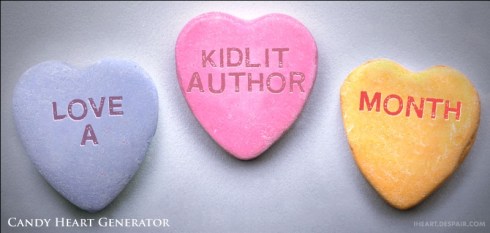
Yeah, I changed the name of my February blogfest. Mostly because “Children’s” didn’t fit on the candy heart generator. Oh, the sacrifices we make for our art.
Here’s a sneak peek at the upcoming author interviews…
Jessica Burkart, author of the brand new tween series Canterwood Crest, billed as “The Clique” meets “The Saddle Club.”
Toni De Palma, author of Under the Banyan Tree, an Association of Booksellers for Children Best New Voices pick.
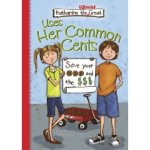 Lisa Mullarkey, author of the new Katharine the Almost Great chapter book series from Magic Wagon.
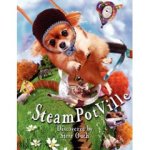 Steve Ouch, author/illustrator of SteamPotVille, a little independent title making big Tweets.
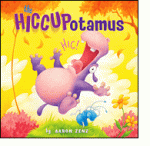
Aaron Zenz, author/illustrator of HICCUPotamus and the groovy dad behind Bookie Woogie book reviews.
Plus authors Jennifer Brown, Brenda Reeves Sturgis, Mary Ann Scott, Corey Rosen Schwartz…and I’m working on a few more.
And now the prize announcements!
Each comment you leave in February counts as an entry to win a $25 gift certificate to the bookstore of your choice. (Be sure I can reach you via your comment link. Comment as many times as you wish, but only one comment will count per blog post.) If your choice is your local independent bookseller like The Bookworm in Bernardsville, NJ, you’ll win a $35 gift certificate. 
The winner will be chosen out of a hat, which may or may not be an actual hat. Probably a melamine mixing bowl like one of these:
Plus, some of our featured authors will be giving away autographed copies of their books! Woo-hoo!
I’m having a blast putting this together, learning a lot from these new authors and getting inspired. I hope you will be, too!
Writers are entertainers. We immerse readers in a magical world, letting them escape with our words as a guide. If a reader enjoys your ride, chances are they’ll seek you out again. And again.
This week I read a lot about branding yourself as a writer, thanks to writing friend Jill Corcoran. The subject isn’t foreign to me, having worked in marketing for a decade. But just what is branding for writers? Developing a consistent style in your stories, offering readers a place that’s as comfortable to return to as their favorite chair. It’s not about writing books so similar that no one finds value in buying more than one. It’s about finding your niche in the publishing world and working within it.
Let’s compare this idea to chain restaurants in the US. Why are they popular? Diners know the menu, they know exactly what to expect. Olive Garden promises that the chicken parmigiana in Spokane will taste the same as the one in Cleveland. They don’t just sell unlimited salad and breadsticks, they serve predictability and comfort. Repeat diners know they’ll enjoy their meal.
People often buy the same laundry detergent, the same rice and the same cheese year after year. How many of you use the same brands your mother bought? Consumers will buy an item simply because they know it and they don’t know the competitors.
Brands also have unique qualities that make them more attractive than similar products. I prefer Barilla Plus pasta because it has added protein without a significant change in flavor. While it’s just pasta, it’s very different from the other noodles on the grocery shelves.
As a new writer in an increasingly difficult book market, developing a brand may give you an edge over the competition. When I think of Grace Lin, I think of whimsical illustrations with colorful patterns like origami paper. John Scieszka? Fairytale spoofs. Roald Dahl writes humorous, fantastical tales. Think about some of your favorite authors and what kind of feelings their name brings to mind. You want to elicit that same kind of recognition when readers think of you.
On the flip side, author K.L. Going admitted that her interest in multiple genres makes it difficult for readers to get a handle on her. At the Rutgers One-on-One Mentoring conference last October she said, “You never know what you’re going to get with a K.L. Going book.” She suggested not doing this as a new author, although she also encouraged us to write what we love.
But what if we love crossing genres? What if writing a supernatural YA mystery comes as naturally as a quiet non-fiction picture book? Perhaps you can be predictable in your unpredictability? Isn’t that a brand as well? Sure it is. But is it one you want as someone who’s trying to break into a tough, competitive business? Agents and editors tout “high concept” in novels, so why not come up with a “high concept” for yourself?
I realize that branding yourself as a writer is a complex task, especially for someone new who is still experimenting with style, genre, voice and subject matter. Stories are more complex than shampoo. You can’t guarantee thicker, fuller hair and a fresh lavender scent with each turn of the page. So what do you guarantee your readers?
Ask your critique partners what your brand might be. What perceptions do they have about your stories? What qualities in your writing are consistent? What do they look forward to when you hand them a new tale? Where does your work really shine?
You might have a very good idea about what your brand is. But remember that branding is all about someone else’s perception, not yours. You can have an image or a message you wish to relate to your readers, but are you sending it? Start asking around. Get to know your own brand so readers can get to know you.
What are you thoughts on branding for writers?
Tonight I attended a chat with Sean McCarthy, assistant agent with the Sheldon Fogelman Agency. Sean talked to aspiring authors about the children’s book market and how to find the right agent for your work.
It’s late and I’m tired, but you all know my obsession with taking notes! Here are just a few of the major points Mr. McCarthy touched upon during this informative session:
What’s the ideal picture book length?
Sean suggested that 500-word manuscripts tend to be a bit slim. They’re seeing the most success with stories above 500 but under 800. The 900 to 1000-word length is a difficult sell right now and he doesn’t see that changing anytime soon.
How many PB manuscripts should a new author have before querying?
His agency prefers to see at least two completed PB manuscripts. The ideal number would be five viable manuscripts. Sean said the market is difficult and there are so many variables for new authors–editor preferences vary and timing is another crucial element that’s out of an author’s hands. The one thing you can control is how many projects you have ready to go—so the more, the better. (Jack be nimble!) In other words, if you only have one completed PB manuscript, keep writing. Don’t submit yet. Sean urged “prolific-ness” as an ideal author quality.
What’s a hot niche in children’s publishing?
Sean thinks that middle grade is wide-open, with fewer and fewer boundaries, making this area particularly exciting. Sci-fi and dystopian books are a blossoming market, and he’d personally like to see more boy-friendly middle grade novels and hybrid prose/graphic projects. There’s room for mixing genres in middle grade. The biggest development in picture books is the character-driven movement. He wants to see clever and funny stories that have a clear beginning, middle and end, wherein the central conflict is resolved by the main character.
What’s cooling off?
YA has been hot for the past several years, so with the exception of Stephenie Meyer, he sees this area slowing down, since the industry tends to be cyclical.
Is it better for YA novelists to query with a series or just one book?
Mr. McCarthy said that series are tricky for a first-time author. Nine times out of ten, the 1st book in a trilogy will be the most successful. A series is not necessarily more attractive than a stand-alone novel.
Should new authors secure magazine credits before querying an agent?
Only if they are applicable to the genre you’re writing for. Publishing a literary adult short story won’t be helpful if you’re writing a juvenile novel. But he does like to see that you have been actively writing and publishing recently, even if it’s in small places.
Should new authors wait until they have an offer in hand before querying an agent?
While an offer is great and it can grab an agent’s attention, it can unfortunately lead to a “knocked up” scenario, where the author-agent relationship is borne out of convenience and necessity, not because it’s a great match. So he tends to be wary of these situations.
How is the economy affecting the children’s book market?
In the short term, it will be more difficult to place projects, since there are fewer editors. But the good news is that for the most part, children’s books have been one of the few bright spots for many publishers. He definitely thinks things will improve, although the time frame for that is uncertain–6 weeks, 6 months or 6 years…?
One last thought: Mr. McCarthy mentioned that the #1 method of obtaining new clients is by referral–either by meeting someone at a conference or by receiving a recommendation from a current client.
Writing may seem like a solitary occupation, spending hours on your own with a pen or keyboard, but like any other business, making contacts is vital to your success.
So get out there! Attend conferences. Meet editors, agents and other writers. It’s a small world…and, to borrow a phrase from the NY Lottery…”you’ve got to be in it to win it!”
Who doesn’t love first page sessions? Where else can you get two non-stop hours of professional, editorial feedback? They pack quite a picture book pow. (And a middle grade wallop. And a YA smack.)
But how do you get the most out of these sessions? Take care in what you submit and how you submit it. Let the editors focus on your story rather than procedure.
These suggestions are based upon the November 19 NJ-SCBWI first page session with Kendra Levin of Viking and Lauren Hodge of Little, Brown.
1. Format properly. Some submissions didn’t use standard paragraph breaks and indents. While the editors understood that these writers were eager to submit as much story as possible, the manuscripts were confusing to read. Everything ran together. Format your first page just as you would a professional submission. Honestly, you will get more out of less.
2. Use Times New Roman font. A serif font reads well. Courier, the traditional typewriter font, is a monospaced font, meaning each letter is the same width. This wastes space. If you submit with Courier, you’ll have 50% less story on your first page.
3. Research your genre. Some manuscripts felt inappropriate for the genre the author indicated. The topic, word choice and level of sophistication need to match your audience’s age. If you submit with the correct genre, the editors will spend more time assessing your writing than genre counseling.
4. Don’t limit yourself to one gender. One manuscript indicated it was for girls. If you write this on a submission, an editor will immediately think your work doesn’t have broad appeal. Let the editor decide if both boys and girls will love your story.
5. Skip the prologue. Go right to the story. Submit page one of the first chapter, not the backstory.
6. Don’t include an explanation. One picture book began with an intro about why the author had written the story, based upon an experience with her children. And here is where editor Kendra Levin was gracious and tactful. She thought the children in this author’s life were incredibly lucky to have such a playful, creative parent. But stating how children you know enjoy your work doesn’t help sell it. The story does. The intro only left room for five lines of the tale, so the editors could not comment fully. They also emphasized that if the story is written well enough, an explanation becomes unneccesary.
7. Take notes. Don’t just wait for what the editors/agents have to say about your manuscript. Listen to the comments about every page. There’s something to learn from everyone’s manuscript.
There’s more to come from this dynamic first page session. Watch for another post this weekend. And please add your own first page tips!
 This week my India-born critique partner submitted an engaging group of multicultural poems.
“Summer Paintings” featured three young girls decorating their palms in the mehndi tradition, embedding secrets in the scrolled henna designs—initials of boys and dreams and all the hushed longings of adolescence. Toward the end of the poem, the girls washed away the paste to reveal the designs. The next line, Finally freed from our impatience, caused debate among our group.
The girls in the poem had a wonderful time waiting for the henna to dry, for the patterns to stain their skin. They laughed and talked, giggled and blushed. Why were they impatient if they enjoyed the journey?
The answer? This is what childhood is about: impatient eagerness.
While children take pleasure in their activities, they are always rushing forward to the next thing. As a child, every experience is new. There is little time to let events soak in when there is something else to explore. They are motivated by an insatiable curiosity.
Moreover, children wish to repeat favorite experiences over and over again, and not soon enough. I’m reminded of this when my family leaves Chuck E. Cheese. Two seconds into the parking lot and my daughter pops like a balloon: “Mommy, when are we going to Chuck E. Cheese again?”
When writing, I will try to remember the impatient eagerness that my critique partner so eloquently showed.
Does your character display an impatient eagerness? What is next big thing for them?
This post is just one in a series about the 2008 Rutgers University Council on Children’s Literature One-on-One Mentoring Conference. Click the RUCCL tag above to read them all.
My notes have been exhausted. I’ve taken a week to think hard about all the suggestions I received. About all that I learned. So what lessons have I taken away from this experience?
I just gotta be me. I may be a little more educated now, but I can’t change who I am.
One of the questions posed to writers during the five-on-five discussion was where we get our ideas. I find it odd when non-writers ask this question because the answer seems very obvious to us: we don’t know.
A spark fires in our brains, as unexpected as a lightning strike on a cloudless day. We feel an attraction to the idea and it becomes a part of us. We cherish it and nurture it like a mother cares for her child. It is ours and ours alone; we have created it. If you asked me exactly how I arrived at the idea, I might have a concrete example to throw at you. Or I might not. Writers often look for the fabulous realities in everyday life, but I get just as many ideas while I’m flossing my teeth.
I don’t look at the current list of best-sellers to find my next idea. Stephenie Meyer’s Twilight series is wildly popular, but I’m not going to drop my projects to write about vampires. It’s not my thing. It’s hers. Graphic novels are hot. Not exactly my thing, either. Yes, it’s important to be up-to-date with market trends, but follow fads too closely and by the time your work has been completed and published, the fad may have faded. Know the competition, but know how to be different and fresh.
K.L. Going was correct when she told us to write what we like, even if no one else “gets it.” Our enthusiasm is what injects our story with excitement. It’s what keeps us writing. If you try to be someone else just to please a specific audience, you won’t be a happy writer. And that can lead to not being a writer at all.
A few days before the conference, I went shopping for a new outfit. (Yes, this segue has a point.) The business-casual clothes in my closet are six years old, from my life before daughters. They’re dated and they don’t fit anyway. So I bought something very professional-looking in neutral colors. The morning of the conference, I put it on. It didn’t feel right. I didn’t feel right. So I took it off and put on a ruffled magenta-purple blouse and wide-leg jeans. Ahhh. Much better. Now that’s Tara.
So I’m going to run with my ideas. Not only do I love them, I don’t know how to exist any other way. I do have a new appreciation for how to mold my ideas to the market, however. It’s all about balance, but with the scale tilted ever so slightly in my direction.
So what did you learn at RUCCL?
This post is just one in a series about the 2008 Rutgers University Council on Children’s Literature One-on-One Mentoring Conference. Click the RUCCL tag above to read them all.
After lunch, RUCCL attendees separated into groups of five mentor/mentee pairs to discuss industry trends.
The first question was posed to the editors: “What are the biggest mistakes you’ve seen new writers make?”
Senior Editor Erin Molta from Scholastic Book Clubs said she dislikes when writers claim “their book is the next Harry Potter, especially when I read it and think, no, not at all!” Yes, writers are encouraged to compare their manuscript with a successful title, but she’s seen way too many Harry impersonations. On the other hand, she likes when a writer tells her why they have written this story. If the story comes from your heart, the genuine enthusiasm shines through.
Grace Kendall, Editorial Assistant at The Blue Sky Press/Scholastic, emphasized the need for a concise cover letter that tells her “how you see your book positioned in the bigger world.” You might have a great idea and a great character, but is it a good story? She receives great projects without story, and story trumps all. Tell her that “your book is like this [other] book, but it’s different because…” And you’d better have a good because!
Kendra Levin, Associate Editor at Viking and award-winning playwright, said her biggest pet peeve is when people call her on the telephone. One of the writers asked about sending a status query instead. “If it makes you feel better,” she said. “Honestly, if I have your manuscript, I will read it.” She also suggested, “Do your research before you send it out.” Target your manuscript to specific editors. Let her know why you are submitting to her. Information about editors is available online and she suggested looking in a comparable book’s acknowledgements. Authors often thank their editors.
Kiffin Steurer is an Assistant Editor at Philomel (and fellow Dahl fan). He wants writers to “get to the heart of the story as quickly as possible in the cover letter.” His pet peeve is “picture book authors who send [poor] illustrations with the story.” An editor will match your story with an illustrator. So if you’re not a professional artist, don’t send pictures. They can sour the entire manuscript. Let your words stand on their own.
Agent Alyssa Eisner Henkin said her pet peeve is “when someone sends a query to me…and everyone else in children’s publishing!” Agents want to know that you’ve researched their preferences and that you’re not just submitting blindly en masse. She’s impressed with a query when it mimics jacket flap copy, so do yourself a favor and read a lot of jacket flaps!
Kiffin Steurer added that he’s not looking for a message. “I’m looking for good stories. If you have a good story with a message, then it’s just icing on the cake. But if there’s no story, we don’t want it.”
This post is just one in a series about the 2008 Rutgers University Council on Children’s Literature One-on-One Mentoring Conference. Click the RUCCL tag above to read them all.
After we heard from the panelists, Alyssa Eisner Henkin opened the floor to questions.
One writer asked, “In the editor and agent bios, a lot of you say that you’re looking for two things: high concept and unique voice. Could you please tell us exactly what you mean by that?”
Chad Beckerman couldn’t resist: “Diary of a Wimpy Kid: high concept, unique voice.” Then one of the editors explained high concept as boiling the essence of a story down to one line.
Agent Stephen Barbara offered an example, shouting down from the audience, “Phonebooth!” The movie is about a man trapped in a phonebooth by a sniper. You can summarize the entire film with that single concept.
On the other hand, a literary novel or a coming-of-age story isn’t necessarily about a single concept. You may still be able to describe the story in a sentence, but it doesn’t offer the instant understanding of a high-concept pitch. The industry wants the next big thing, and high-concept often delivers it.
Next, the editors talked about unique voice. One editor told us about her friend’s personality. “She’s the most bubbly, interesting person I’ve ever met. But in an email, she comes through flat. Hi. How are you? I am fine.” That’s not what you want to do. Your writing should capture the essence of your character. Inject your writing with its own personality. The voice is what makes your story stand out among similar tales. It’s the way you tell your story that allows kids to connect and relate to your characters.
Another question from the audience had the editors a little tight-lipped. “What are the new themes coming in the next 1-2 years?” They looked around but no one spoke. The writer pressed, “Come on, what are you working on right now that you think is going to be big?”
Chad Beckerman said he hoped there would be “more books without words.” Just like an art director! Lisa Cheng talked about a new novel that’s told in text, IM and blog posts. Chad offered, “High concept!”
Then Molly O’Neill gave a fabulous answer to the next question regarding the border between YA novels and adult fiction. What distinguishes them from one another? “This is going to sound like a perfect, rehearsed answer,” she said, “but honestly I’ve been thinking a lot about this lately.”
YA novels have a sense of immediacy. When you’re a teen, every experience is new. Every hour of every day is heartbreak, tragedy, elation. There’s a heightened sense of reality and being in the moment. There’s no time for pondering, you’re too busy living. Adults have their entire lives on which to base decisions, but a young adult doesn’t have that experience to draw on. They’re making decisions in the here and now, raw and full of emotion.
Lisa Cheng agreed and added that in a YA novel, she doesn’t want to leave the reader feeling hopeless.
With their thoughtful answers and wealth of industry knowledge, the editors didn’t leave any of the writers feeling hopeless, either. (Yeah, corny ending, but gimme a break, I’ve written a lot of these posts!)





 Writing for Kids (While Raising Them)