You are currently browsing the category archive for the ‘KidLit’ category.
Every Monday at 10pm EST children’s writers and illustrators jump on Twitter to chat about picture books. The brainchild of Aussie authors Karen Collum and Kat Apel, #pblitchat churns away for an hour, with topic schedules and transcripts posted on the Picture Books Only blog. Below are highlights from this week’s chat on writing for the very young–children from birth to age 3.
- Unless you’re an author/illustrator, board books are a difficult sell. The word count is low and the stories are less complicated than picture books for 4-8 year-olds, so illustrations become even more crucial to bring life to the story. For example, the visual cues in Sandra Boynton’s Blue Hat, Green Hat allow non-readers to “read” the story themselves. As a new writer, you want to write a story with the broadest possible appeal to maximize your chances of being published, so writing specific to the board book format may limit you.
- A trend in board books is to republish books that have been popular sellers in hardcover/paperback. Board books are expensive to produce, and at the same time, parents want to pay less for them, so publishers may prefer to go with a proven story rather than a new one. Great example: Snowmen at Night by Caralyn and Mark Buehner was first a successful hardcover title, released in 2002. A few years later, the publisher created board books and sold them with a stuffed snowman during the winter holidays. A jigsaw puzzle board book and a pop-up version (a new story) were also created.
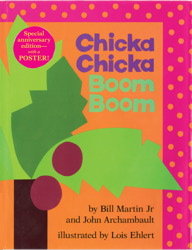 Rhyme (internal and external) and a jaunty meter delights young ears. Great examples: Chicka Chicka Boom Boom by Bill Martin Jr., John Archambault and Lois Ehlert; Hand, Hand, Fingers, Thumb by Al Perkins and Eric Gurney.
- Average word counts for young books are typically less than 500 words and could be fewer than 100 words.
- The market is saturated with ABC concept books, but books with a completely fresh take can be successful, like Shiver Me Letters, A Pirate ABC by June Sobel and Henry Cole.
- Repetition helps young children understand story and recognize words, plus it encourages participation in reading aloud.
- Lift-the-flap books offer peek-a-boo surprises and drive the story forward, but again, they’re a tough sell unless you’re an established author and illustrator.
- Novelty books (pop-ups, foldout pages, liftable flaps, or hidden sound chips) are often published by mass-market publishers and not trade publishers. What does this mean to you? In-house talent or work-for-hires create these books.
- The jury is split on interactive titles for the very young. Do parents want their toddlers drooling on an $800 iPad? Do electronic titles lose the “cuddle factor”? Or does the new interactive medium offer an unprecedented opportunity to unknown author/illustrators? A recent article cited a new 3D book as one of the top 20 ebook apps for the iPad, right up there with Dr. Seuss and Disney titles.
My favorite #pblitchat moment? Board books get gnawed and chewed by babies, so how about an edible board book? (As suggested by @RedStepChild a.k.a. illustrator Lynn Alpert.) I think this is an idea whose time has come, especially if they’re made out of freeze-dried astronaut ice cream. Mama may want to chow down on tasty kidlit, too! (I can see it now–Chicka Chicka Yum Yum.)
What else is important to know about writing and illustrating for the very young?
Don’t worry, I haven’t slid off the children’s book wagon to blog about the policies of Franklin Delano Roosevelt. No, “the new deal” to which I refer is my first picture book deal.
Did you hear what I said? FIRST PICTURE BOOK DEAL!

Tara Lazar’s debut THE MONSTORE, about a shop which sells only the most useful monsters, and has only one rule: no refunds, no exchanges, to Emily Lawrence at Aladdin, for publication in summer 2012, by Ammi-Joan Paquette at Erin Murphy Literary Agency (NA).
I’m thrilled to be working with Emily, who not only loves tacos as much I as do, but also made an appearance on this blog two years ago (unbeknownst to her). Joining Emily in the monsterly hijinx is assistant editor Alyson Heller, who shares my passion for figure skating.
(Note: Please don’t send these editors stories about TACO HARDING AND JEFF GUACAMOLE. Mexican food and figure skating don’t mix! Not even with some good queso!)
Next up, an illustrator will be chosen and then we’ll work on revisions.
And hey, what the heck, I’ll drag you along on the journey. I’ll share as much as I can about the behind-the-scenes process–from getting a book signed to signing books!
The journey thus far:
1. I was born.
2. I wrote my first picture book with my 2nd-grade BFF and told my great-grandparents it would be published soon.
3. I apologized to my 80-something great-grandparents for making them drive an hour to the bookstore.
4. I went to college and wrote awful short stories and lousy poetry.
5. I worked in high-tech and wrote awful press releases, shouldering some of the blame for “irrational exuberance.”
6. I got married and had two kids.
7. I decided to take up my 2nd-grade passion again (without BFF).
8. I wrote.
9. I revised.
10. I conferenced.
11. I rinsed and repeated.
12. I submitted.
13. I wrote this post. (And you commented!)
 One winter morning in 1976, my father was reading the Sunday paper when he stumbled across an ad for ice-skating lessons. He snapped the paper in front of me and asked, “It says you have to be able to skate across the length of the ice to sign up. Can you skate across the ice?”
“Of course I can skate across the ice,” I said, and then gulped a spoonful of oatmeal.
A minute later he was on the phone, registering me. What on earth made him believe a five year-old who had never put on a pair of skates could cross a slippery arena, I’ll never know. But I was excited to begin lessons and I imagined zooming around in circles, faster than everyone at South Mountain.
The next week I proudly stepped onto the ice in my new skates.
And promptly fell.
And fell again.
And again.
Then I learned to hold onto the side. And then I learned what it’s like to hit the boards AND the ice. And this was in the days before helmets.
A guard helped me off the ice. She told my father I could not be in group lessons. I thought I might cry. Then she suggested I spend a private lesson with her, learning to skate. My father agreed and by the end of the lesson, I was indeed moving across the ice.
I took group lessons every winter for a few years, earning my USFSA patches faster than everyone else. And when I had completed those patches, they told me I was ready for a coach and private lessons–lessons my family could barely afford.
I went for one private lesson and waited for my coach in the corner, practicing simple figures. The older skaters yelled at me because, unbeknown to me, I was hogging the JUMP corner. I was trying to stay out of the way, but I was totally screwing up their double lutzes.
And then when my father heard what time the coach wanted me at the arena–5:30am twice a week–that was the end of private lessons.
Over the years, I skated recreationally instead, going to the arena once a week and trying to teach myself. I was able to do a scratch spin and a waltz jump, crossovers in every direction, and a few fancy turns. But my real desire was to compete. I always thought…some day.
That day came as an adult. As soon as I had my own money, I took lessons. And like I had done as a child, I quickly moved up through the ranks. I hired a coach. I competed. And I won. In 2002, I competed at Adult Nationals in Ann Arbor, Michigan, after winning Gold at Eastern Sectionals and two other Golds, a Silver and a Bronze in other competitions that year. It was a dream come true.
I thought–if I can do this, I can do anything.
And now, here I am today, accepting an offer of literary representation. Skating gave me the confidence to pursue another dream, that of becoming a published children’s author. And now I’m one step closer to that dream.
I’m here to tell you–work hard, believe in yourself and your talents, find a great critique group and writer friends who support you, and go for it!
You will stumble. You will fall. But brush yourself off and soon you’ll hit your stride–or in my case–glide!
 OK, excuse the bad rhyme in the title. I told you before, I don’t write rhyming picture books. (I hear you breathing a sigh of relief. Me too.)
Kidlit agent Mark McVeigh is running a contest on his new blog. Well, it’s not really a contest, it’s a give-away. Of his time. Find 10 friends to follow his blog and he’ll give you a 15-minute Skype or phone chat.
So, if you follow him, let me know by leaving a comment!
(You should follow him. Don’t make me come over there and beg. It won’t be pretty.)
 A typical day as a newbie writer: sit down at the computer, start writing.
At least, that’s what I did two years ago. I got an idea and I didn’t stop to think: is this a good idea? Is it marketable? Has anyone written something like this before? Nope. I just wrote, motivated by my muse.
And perhaps this was good back then. I was honing my skills, finding the right words, crafting sentences, building stories.
But they were looooong stories. At an average 1,500 words my tales were neither picture books nor chapter books. I insisted I was writing picture storybooks, and I used Patricia Polacco’s body of work as an example of how my stories could be published, not realizing, c’mon, she’s PATRICIA POLACCO.
It took me a while to learn to THINK before I write.
An idea begins. I ponder it. I write down the initial concept. What is my topic—what is this story about on its surface? Bulldozers or ballet dancers or dragons? What is at its heart? Is it about friendship or fitting in or family? Who is my character and what does he want? What is my hook? Can I boil the concept down to one line?
Then I research. Is there anything similar already published? If so, I’ve got to change it up a bit. Or let it go.
I ask myself these important questions:
- Is this picture book marketable?
- Will someone pay $16 to buy it?
Granted, these are difficult questions to answer objectively. Of course you want to believe that everyone will buy your book! But as a mother of two picture book age kids, I know this isn’t the case. If we don’t love reading the book over and over again, I won’t buy it. I try to use my motherly instinct to answer these questions and I think of my other parent friends. (And then I stalk parents in the bookstore and ask them what they think. No, just kidding. But I’m tempted.)
If I can’t answer “yes,” the idea gets filed away for the future, when I can perhaps transform it into something more extraordinary.
If I do answer “yes,” (or even “maybe”) then I create a brief outline or I just write. And I keep the proper length in mind: 500 to 700 words.
Some writers may call this process stifling. But I call it smart. Because if you want to be published, you have to examine these elements before you write. Because although picture books are short, they don’t take a short time to write.
Sure, you may pump out a first draft in a few days, or even less, but picture book revisions could go on for weeks, months, even years until you get it right. You whittle down the length so every word packs a punch, while still presenting a compelling page-turner, full of illustrative potential. (Which means you have to leave some things unsaid.) With all that time invested in a product you want to sell, you’re playing Russian roulette if you haven’t researched the story’s potential first.
It took me a while to learn this, to realize this, so I’m just paying it forward. Many of you are probably nodding your head in agreement. And maybe some of you are waving a finger at me for being a creativity killer.
In any case, I’m eager to hear from both sides! Think or write? Or a hybrid of both?
Parents of the previous generation who wanted to bestow all their mushy, gushy love on their kids–in book form–had Robert Munsch’s Love You Forever and Sam McBratney’s Guess How Much I Love You for bedtime reading. Cuddled under the covers, snug and cozy while turning pages, is there any better way to share a deep parent-child bond?
But it’s time for those books to move over and make way for new Valentine’s classics!
I can’t think of a better gift for the holiday than a book. Candy rots their teeth, plus you end up eating most if it yourself, don’t you? (Well, I do.) And where will you store yet another Build-A-Bear that gets forgotten by March?
Valentine’s Day belongs to books. And these three are perfect picks to declare all your mushy, gushy love. And grandparents, take note. These books are just right for you and your grandkids, too.
 I Love You More Than Rainbows
by Susan Crites
Illustrated by Mark & Rosemary Jarman
Published by Thomas Nelson
With whimsical illustrations as bright as rainbows, Susan Crites’s book uses analogies children can easily understand to explain the concept of love. Kids are crazy about ice cream cones with sprinkles on top, puppies, birthday parties, sleigh riding and hot cocoa. But as great as those childhood favorites are, parental love still trumps them all.
Try inserting your child’s favorites while you read this book. With my kids, “I love you more than albino rock pythons, Sun Chips and Daphne from Scooby-Doo” might work well. Don’t ask about the snake, but I could use help finding something to rhyme with Scooby-Doo. Yabba-Dabba Doo? Anyone have a Hanna-Barbera rhyming dictionary?
But I digress…
With a jaunty rhyme that never gets too sing-songy, this book is a joy to read aloud, and the bold colors will delight a young audience.
Published by Thomas Nelson, I Love You More Than Rainbows won a Mom’s Choice Award and is available in hardcover and in board book form—at a great price, too. There’s even a Kindle version.
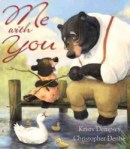 Me with You
by Kristy Dempsey
Illustrated by Christopher Denise
Published by Philomel Books
When Kristy Dempsey wrote this story, she couldn’t imagine that her editor and illustrator Christopher Denise would interpret her characters as granddaughter and grandfather. But after reading this book, you’ll agree, there’s no more perfect a pair.
Me with You celebrates the joys of being yourself around someone you love, the comfort a great relationship brings. Grandpa is always there to support his favorite young cub, even when she’s feeling selfish and gruff. The two allow each other to express themselves, always knowing their love will not waver.
Me With You also highlights the importance of spending time apart from those you love, “to be the kind of you that you can be when you’re alone.” This book is a good choice for children who are apprehensive about separation from a loved one.
This rhyming book offers a smooth, gentle beat, and the light, airy illustrations breathe of spring. Denise has mastered body language and facial expressions to demonstrate the deep bond shared by this “pair beyond compare.” A favorite page features Grandpa in a Babe Ruth pose, pointing to the outfield as his granddaughter cheers him on. (I have to mention the blades of grass, which you may think are insignificant, but I’ve never seen such luscious fields, I want to take off my shoes and run across this book.)
You don’t have to be a grandparent to fall in love with it this Valentine’s Day.
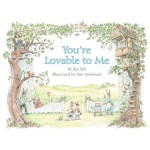
You’re Lovable to Me
by Kat Yeh
Illustrated by Sue Anderson
Published by Random House
The theme of You’re Lovable to Me is unconditional love: parents love their children no matter what they do.
Mama Bunny is having a rough day keeping track of her Bunny Babies and all their hare-y mischief. But no matter what they do, Mama Bunny reminds them that through their joy and sadness, their frolic and frustration, “You are my bunnies. And you’re lovable to me.”
Once her bunny babies are tucked in, Mama bunny crashes on the couch. Oh, how we parents can relate! Mama Bunny’s father arrives and upon seeing his exhausted daughter, he reminds her, “You’re lovable to me.”
If this review had a soundtrack, it would be Elton John’s “Circle of Life!” This book reminds our children that we were once children, too–and that everyone needs to be reminded that they are loved.
Sue Anderson illustrates in a simple, pastel style that takes advantage of white space, complementing the sweet story with a gentle, relaxed mood. The nostalgic feel of this book makes it my top pick for being a New Valentine’s Classic!
What are your New Valentine’s Classics?
So this self-proclaimed intergalactic superpower Mike Jung and I have a little middle grade book review thing going. You may have read our bookish banter regarding Nan Marino’s touching Neil Armstrong is My Uncle and Other Lies Muscle Man McGinty Told Me or our unique take on Newbery Medalist Rebecca Stead’s time-travel thriller When You Reach Me. (After all, Elizabeth Bird did mention our review in FuseNews.)
In a pathetic, fly-by-the-seat-of-our-pants fashion we dubbed ourselves the Ebert and Roeper of children’s book reviews.
We think you agree that the name lacks the imaginative flair and je-ne-sais-quoi mystique you’ve come to expect from Tara and Mike. Especially Mike. In the words of the immortal Steve Martin, he’s a wild and crazy guy.
So we thought–hey–we’re writers! We can do better than that. What’s better yet–we know a lot of writers! Smart writers! (Notice how I’m buttering you up.) They can certainly do better than that! In fact, why don’t we sit back and do nothing while they do all the work? Yes, we’ll have THEM choose the title for our review series while we collect all the middle grade glory!
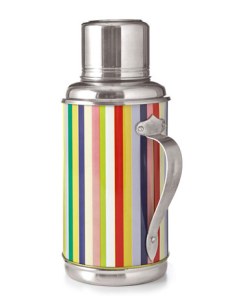 We’re even offering up a prize! And again in the words of the immortal Steve Martin: “I’m picking out a Thermos for you. Not an ordinary Thermos for you. But the extra best Thermos that you can buy, with vinyl and stripes and a cup built right in.”
Well, I’m not sure if the prize is a Thermos. But it’s gonna be somethin’. Yes, you’re guaranteed SOMETHIN’.
Head on over to Mike’s Little Bloggy Wog for more details.
And tell him Ebert sent you. Or Roeper. We haven’t quite figured out who is who. (You see why we need a new name?)
This is the second art gallery by illustrators who participated in November’s 30-picture-book-ideas-in-30-days PiBoIdMo challenge. You can see ideas taking shape–in the form of characters. (If you didn’t already know, editors are keen on character-driven picture books these days.) And just think, once these stories are published, you can say “I knew them when…”
Loni Edwards
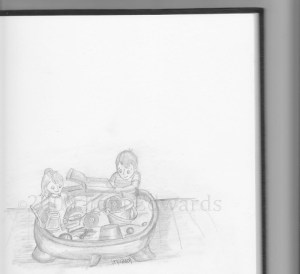
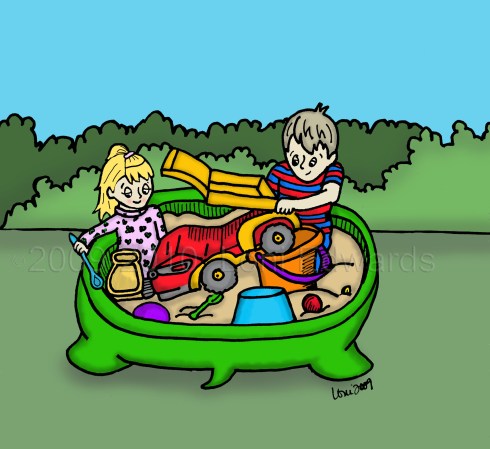
“This is a sketch from my story about going to Nana’s house. I’m entitling it ‘Two Kids in a Sandbox’ until I evolve the story more. I sketch, then I ink using a light table. I scan the piece into Photoshop where I color with a Wacom Tablet.”
Lynn Anne Bemis
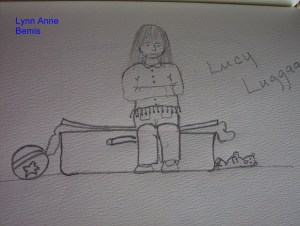
“I have not taken lessons as an illustrator. I am a ‘wannabe’ and this is the first year I started adding drawings to my story ideas. So as simple as they are, I am showing them to you. I am, you could say, ‘A work in progress.'”
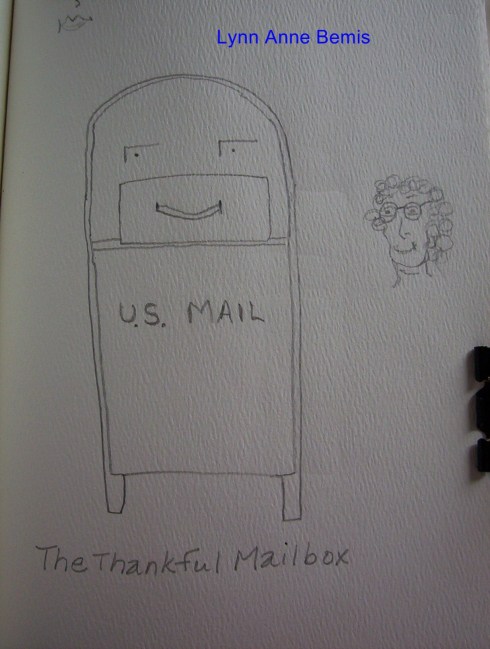
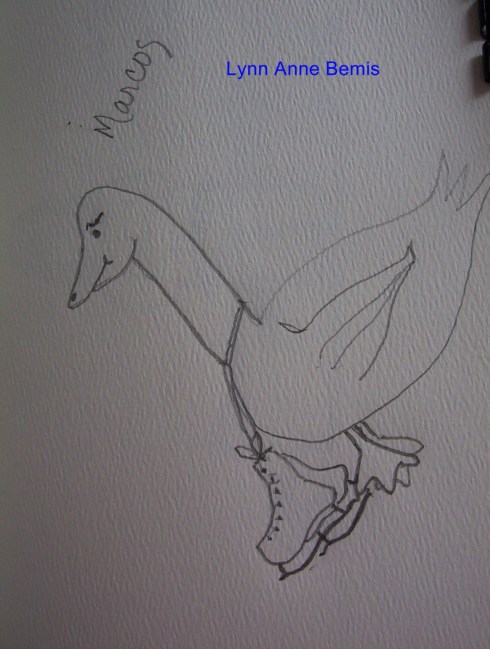
Debbie Ridpath Ohi
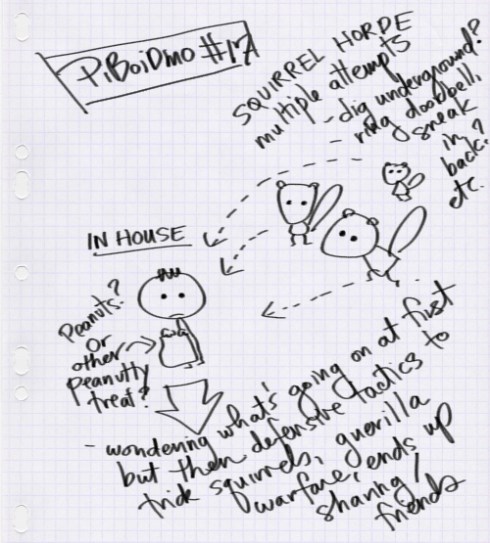
“Regarding the first sketch, this is how I brainstorm sometimes and I figured I’d try it for PiBoIdMo. As you can tell, um, my sketches are VERY rough.
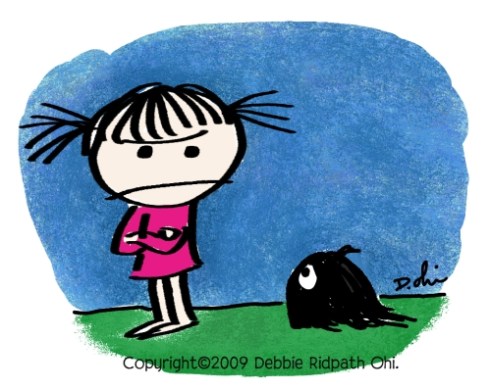
“I’ve always been fascinated by the juxtaposition of cute and scary. The monster guy in the second drawing was inspired by Little Nightmares, which I’d eventually like to include in a picture book. The girl is a character I came up with for my Snarkface cards and she demanded to be included in the drawing as well.
“The third sketch looks drawn on paper, but I actually did it in Corel Painter. I find that experimenting with different virtual media is fun, plus I enjoy trying out different styles. I did this sketch to accompany a text picture book idea. One of the reasons I enjoyed PiBoIdMo so much was because it not only inspired me as a writer but also as an illustrator.”

One more gallery to come, kidlit fans! Stop back soon for more insight into the illustrative process.
Once there were crowds, and clinging jockeys, and horses to ride against in the razor-fine seconds it took to be first across the finish line.
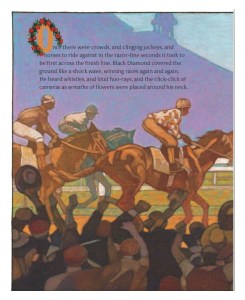 As an aspiring author, I’ve been told countless times about the importance of a first line. Never before has a picture book opening reined me in so tightly, so swiftly as Deborah Blumenthal’s Black Diamond and Blake, the story of a racehorse saved by friendship.
Black Diamond, a beloved racehorse, hero of the grandstand crowds, wins race after race. His jockey and owner feed him sweet apples, warm him with a red velvet blanket, and wrap him with such kindness that the horse only wants to win and make them proud.
But no athlete can dominate forever. Black Diamond grows sore, tired and eventually becomes injured. His fans boo instead of celebrate, ripping their losing tickets and tossing them to the ground. The sweet apples and sweet attention disappear.
A gruff, cigar-smoking man purchases Black Diamond and takes the horse to a prison rehabilitation program. The author was inspired by a New York Times article about inmates who cared for retired racehorses. “I read of the deep emotional connections that some inmates made with the animals, so that in the end, men saved horses and horses saved men,” Blumenthal explains.
At the prison, Black Diamond meets Blake, a soft-spoken man who feeds the horse cinnamon candies and takes him on long walks. The two bond in friendship. And then, one day, Blake is released and Black Diamond becomes despondent and difficult, longing for his caretaker, his best friend.
As usual, I never reveal a book’s ending, but the book is titled Black Diamond and Blake for a reason.
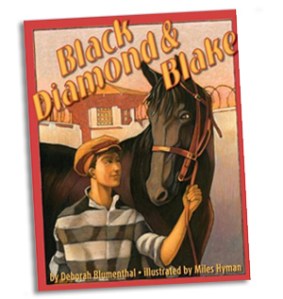 The Art-Deco-inspired illustrations by Miles Hyman render bold forms with a soft pastel stroke, a visual juxtaposition befitting this tale of a strong yet sensitive racehorse. The book is gorgeous in all respects—from the language, to the theme, to the green hills of the final spread.
Parents may appreciate Blumenthal’s beautiful words more than children (“in a minute that grew heavy with time”) and those younger than five may not be able to sit for the entire tale, although my horse-lovers, aged three and six, were mesmerized. While the publisher claims it’s appropriate for children up to age eight, I foresee this book being enjoyed by children as old as ten or twelve, especially if they love animals.
Black Diamond and Blake never gets too sappy or sentimental, but instead tells a story of friendship and second chances from the thrill of the races to the gentleness of a rolling countryside.
Black Diamond and Blake
Story by Deborah Blumenthal
Illustrations by Miles Hyman
Alfred A. Knopf, February 2009
Thanks to illustrator Bonnie Adamson, everyone who completed the 30 ideas in 30 days PiBoIdMo challenge has a winner badge to proudly display on their blog or website. Pick it up here!
If you’d like, link the badge back to the first PiBoIdMo post, so curious visitors will know what it is. This isn’t a requirement, just a suggestion.
Onto the Naoko Stoop print winners.
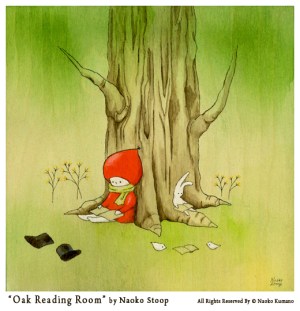
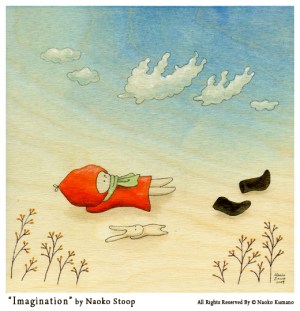
The winners of the prints were not drawn by random. Rather, I chose two people who were, in my opinion, the two most enthusiastic PiBoIdMo supporters. They commented frequently during the month and they both ended the event with nearly twice the number of ideas they were supposed to create.
Congratulations KELLY FINEMAN and JEWEL SAMPLE! You’ll receive an email to arrange delivery of your prizes.
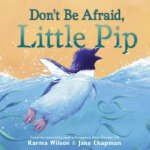 The random winner of the signed Karma Wilson book Don’t Be Afraid, Little Pip is BETH COULTON! You’ll receive an email asking for an address.
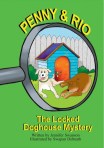 The random winner of the signed Jennifer Swanson Penny and Rio book is LORI DEGMAN! An email’s coming your way, too.
Congratulations again to all the winners! You all deserve thanks for making PiBoIdMo a success!
And…stay tuned for a PiBoIdMo Art Gallery, brought to you by the many talented illustrators who sketched their way through November.





 Writing for Kids (While Raising Them)