You are currently browsing the category archive for the ‘KidLit’ category.
Without further ado (I know you’ve been waiting all day), here are the PiBoIdMo Grand Prize winners! With the help of Random.org, winners were selected from the eligible pool of 51 picture book writers who signed the PiBoIdMo pledge.
Grand Prize Winner #1:
AUNTIE FLAMINGO! You have been assigned to agent Jill Corcoran of Herman Agency Inc.
Grand Prize Winner #2:
AMBER ALVAREZ! You have been assigned to agent Lauren E. MacLeod of Strothman Agency.
Grand Prize Winner #3:
LONI EDWARDS! You have been assigned to agent Elana Roth of Caren Johnson Literary Agency.
Congratulations to the three winners! You’ll receive an email soon with instructions asking you to contact your assigned agent by December 7th. So start picking out your 5 best ideas!
Congratulations to everyone else who completed the month with 30 ideas. It was quite a challenge and YOU DID IT! Please come back next week! There will be a winner badge for your blog and more prizes: the Karma Wilson signed book, Jennifer Swanson signed book, and the Naoko Stoop prints.
Thanks again to everyone for making PiBoIdMo a success! See you next year! (Um, well, I hope I see you before that! Lots more kidlit goodies to come!)
OK, time’s up! Do you have 30 new picture book ideas? You do? Excellent! Time to take the PiBoIdMo pledge to qualify for one of our keeno-Yaccarino prizes. (Sorry, there are no Dan Yaccarino books to give away. I just like that phrase.)
I do solemnly swear that I have faithfully executed
the PiBoIdMo challenge, and will to the best of my ability,
parlay my ideas into picture books from the list of 30 I have created.
Now I’m not saying all 30 ideas have to be good. Some may just be titles, some may be character quirks. Some may be problems and some may create problems when you sit down to write. Some may be high-concept and some barely a concept. But…they’re yours, all yours. Small seeds that may sprout into a story.
You have until December 3rd at 11:59:59PM EST to sign the pledge. Remember, this is an honor system pledge. Those who sign will be entered into the random grand prize drawing: review of your best 5 ideas by a literary agent. There are three grand prizes! Thanks to Jill Corcoran of Herman Agency, Inc., Lauren E. MacLeod of Strothman Agency, and Elana Roth of Caren Johnson Literary Agency for volunteering their time and expertise to PiBoIdMo.
In addition, I have two adorable kidlit prints by illustrator Naoko Stoop to give away–something to keep you inspired throughout the year.

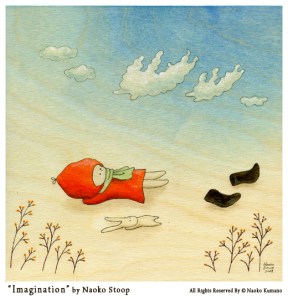
Winners will be drawn and alerted on December 4th. Grand prize winners must contact their assigned agent no later than December 7th. Winners will be given full instructions…when they win!
If you’re an illustrator who participated and want to display your artwork, when you sign the pledge, please let me know that I should contact you to collect images. I’ll create a special PiBoIdMo art gallery to showcase your sketches.
Illustrator Ryan Hipp, who so generously created the PiBoIdMo logo and participator badge, is busy making you an “I did it!” badge to proudly display on your blog. Everyone’s a winner, so it will be posted when the grand prize winners are announced.
Finally, a ginormous THANK YOU to everyone who participated in PiBoIdMo, from the guest bloggers to the aspiring writers and illustrators to the authors and agents. This has been a inspiring month full of creativity and imagination and, not to sound corny, but I couldn’t have done it without your support and enthusiasm!
*Sniff, Sniff*
So enough of the sappy stuff, go sign the pledge. When you leave a comment, be sure to put your email address in the email field so I know how to contact you. You do not have to put your email address in the comment itself. And, you do not have to submit your 30 ideas–they are yours. Treasure them. Just your name and “I did it!” will suffice. Let everyone see your virtual John Hancock. Or maybe that should be a virtual Jon Scieszka?
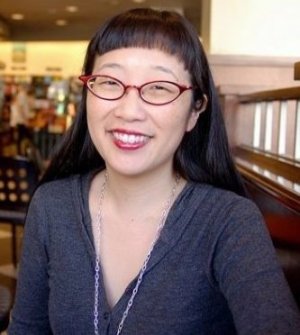
Paula Yoo photo courtesy Jennifer Oyama, Audrey Magazine
30 picture book ideas in 30 days?
Are you CRAZY?
Oh wait. You’re a writer. OF COURSE you’re nuts! 🙂
And I’m a writer, too. Which means we’re both in the same boat.
Tara asked me to give you some words of advice as you hunker down for that final idea for Day 30 of the 2009 PiBoldMo–Picture Book Idea Month!
I thought I’d talk a bit about my “other” job to give you some ideal inspiration! In addition to my YA novels and picture books, I am also a TV writer. I’ve written for NBC’s The West Wing, FOX’s Tru Calling, and currently The SyFy Channel’s Eureka.
As a working TV writer in Hollywood, I have to come up with ideas every single day. In fact, I have to come up with DOZENS of ideas every single hour of every single day when I’m working on a TV show.
Here’s how most scripted TV shows work: several writers are hired to literally sit around in a room called “The Writers’ Room” all day long and come up with ideas for episodes. Each show is run differently, but the basic day usually involves the writing staff discussing what storylines should happen in each episode, along with in-depth dialogue about character development and themes. It’s a really fun job when you think about it–you’re getting paid to make up stuff!
At the same time, it’s also a really TOUGH job. You can get burned out very easily when trying to brainstorm episode storylines and figuring out which character does what and why. It’s often like solving a puzzle–there’s a ton of logic and plausibility that you have to consider when pitching ideas.
I’ve learned a lot from having worked in TV about how to brainstorm effectively when it comes to ideas. Of course the sky’s the limit when it comes to brainstorming–anything from a pebble on the beach to a squirrel running across the street to the cranky lady standing in front of you in line at the bank can lead to an amazing story idea for your picture book.
But a cool image, compelling character, or interesting conflict isn’t enough to create a fully-fleshed out idea. You have to combine all three areas–image, character, conflict–into one idea in order to have a viable story for a potential picture book.
As a TV writer, I was constantly told that story equals intention plus obstacle. Memorize this formula!
INTENTION + OBSTACLE = STORY
In other words, your main character has an INTENTION. But there is an OBSTACLE standing in your character’s way. This creates CONFLICT… which is another way of saying STORY! Ah ha! So STORY EQUALS CONFLICT! And how that character overcomes that obstacle reveals his or her journey towards that end goal.
As long as you can make this equation work, you’ve got yourself a viable story idea! It’s actually a fun formula to apply to published books, movies, and TV shows to break down a completed project to its very essence–the idea. Sometimes working backwards and analyzing published books and figuring out their basic idea can help you as you brainstorm your own ideas.
In other words, try this formula on published books or movies etc. as a “warm up” exercise before you begin your own brainstorming. For example…
In Mo Willem’s Knuffle Bunny, Trixie and her dad go to the laundromat. Trixie accidentally leaves her stuffed toy, Knuffle Bunny, behind. She is unable to speak in full words yet, so complications arise when her father has no idea what she’s talking about when she tries to convince him to take her back to the laundromat to rescue Knuffle Bunny.
So Trixie’s INTENTION is that she wants to return to the laundromat to get her toy!
The OBSTACLE is her inability to speak in words yet to communicate her thoughts!
INTENTION (Trixie wants Knuffle Bunny back) + OBSTACLE (can’t speak inwords yet) = STORY (Trixie must figure out how to communicate to her father that they must return to the laundromat to rescue Knuffle Bunny!)
And how Trixie overcomes this obstacle shows her delightfully feisty personality and inventiveness.
See how that works? Try seeing if you can simplify your favorite picture book down to this formula. It’s a lot of fun and a good warm up exercise to jump start your own imagination!
Then apply this formula to your own original ideas–if you can create a compelling character who has to overcome an obstacle to reach his or her goal, then you’ve got your 30th picture book idea for this year’s PiBoIdMo!
CONGRATULATIONS!!!!
And now that you have your 30 ideas, please join me this May 1-8, 2010 for the second annual NaPiboWriWee event sponsored by my website at http://paulayoo.com!
For more information on NaPiBoWriWee, check out this link:
http://paulayoo.com/content/natl-picture-book-writing-week-may-1-7-2009
NaPiBoWriWee is short for National Picture Book Writing Week where I challenge writers to write an entire picture book every day for a whole week–7 picture books in 7 days!
See, I told you we were crazy! 🙂
Best,
Paula Yoo
 Paula Yoo is the author of the YA novel GOOD ENOUGH (HarperCollins ’08) and the children’s non-fiction picture books SHINING STAR: THE ANNA MAY WONG STORY (Lee & Low ’09) and IRA Notable SIXTEEN YEARS IN SIXTEEN SECONDS: THE SAMMY LEE STORY (Lee & Low ’08). She is also a TV writer, whose credits include THE WEST WING, TRU CALLING, and SIDE ORDER OF LIFE. She is currently a co-producer on The SyFy Channel’s series, EUREKA.
Tara’s Note:
Thanks, Paula! No one could have summed up PiBoIdMo better.
Everyone, stay tuned tomorrow for the PiBoIdMo pledge.
What’s the PiBoIdMo pledge? It’s your word that you have 30 ideas. I’ll ask you to leave a comment letting me know you’ve completed this month’s challenge. (Please note you do not have to submit your 30 ideas. Those are yours to keep!)
You’ll have until December 3rd to take the pledge, then on December 4th I’ll announce the randomly-selected PiBoIdMo prize winners.
Good luck!
 I loved Tara’s post from Day 22 because I get a lot of my ideas in the opposite way. Re-read your favorites and examine what you love about them? I like doing this too, but it completely freezes my creativity. I end up thinking I could NEVER write anything THAT wonderful and I go eat a pint of chocolate ice cream instead.
I would LOVE to be inspired by good books, but (sadly) I’m not. My biggest-ever writing epiphany (next to understanding rhyme) was learning this about myself: good books are bad for me.
No, what I need to feed my creativity is bad books. Nothing gets me more fired up than a book/story/idea that I think could be improved. Books that I read which annoy me in some way that I recognize instantly, or the ones that gnaw at me weeks later, asking me, “Why…? Why…? Why…?”
Books with ill-conceived plots that obviously should have gone This Way instead of That Way (obviously to ME, anyway–ha!) Books with poor structure. Books with over-worn themes that bring nothing new to the world. Characters that should be funnier. Characters who do things I don’t understand. Settings that don’t matter, but could–or should! Why did the author set it there when here would have been so much better?
Wasted opportunity–that’s what basically gets my creative juices flowing. It plays into re-tellings and re-interpretations and parodies very nicely (and I write a lot of those), but you can also use the ideas you come up with in original stories.
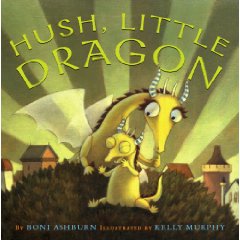 When I grew tired of singing Hush, Little Baby to my twins several times every night, wondering at the wisdom of giving breakable (a mirror), small (a diamond ring) or potentially stampeding (a bull and cart) items to a baby who’s screaming, wondering at the lack of funny lullabyes to entertain the parent AND send the child off to Sleepyland with a laugh in their heart, those cogs in my brain just started grinding away.
Most versions I could find at the time were built around a human baby (although several others have proliferated in the last five years), but what if it was a baby… dragon? What would his mother bring him that both made more sense AND was funny? When I thought of a princess to eat, I laughed and started writing.
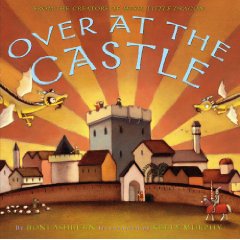 Most versions of the song Over In The Meadow center on animal communities. And there are so many different versions, every ecosystem on earth! Geesh- nothing new there. But wait. What about all the people at a busy place… like a castle! I did some research, and Bingo! Book #2.
I wrote a twin manuscript because I was tired of picture books that only showed the twice-as-nice, double-the-love side of twins. If you have twins, you KNOW this is only half of the story. Where are the twins who love each other but ALSO shove each other because they’re tired of 24/7 sharing? Mine DO that! So I wrote it.
When I’m stuck, I go to books. I read good ones and say, “Oh, that’s lovely. I wish I could write like that!” And I put them back on the shelf. Then, I find books that I don’t like and say, “Wow, I know how to take an idea/character/plot/theme/whatever like that and make it better.”
Bad books–I love them!
Boni Ashburn lives in the Upper Peninsula of Michigan with her husband and four kids. Her first book, Hush, Little Dragon, was called “Sweeney Todd for the sandbox set” by the San Francisco Chronicle and she can now die happy. First, however, she’d like to publish a whole shelf-full of children’s books. Boni’s next book, Over At The Castle, comes out in March, 2010, and she has two more picture books under contract for 2011.
Not All Who Wander Are Lost
By Dana Lardner
Languages and cultures have always been a fascination of mine. For as long as I can remember, I have always wanted to visit foreign places, exist in foreign spaces. I have been told repeatedly to slow down, put down some roots, and find a spot in the world to call my own. Every time I tried to heed this advice, however, it only seemed to stifle my creativity.
The challenge of ‘staying put’ had been something my head and heart had yet to reconcile until several years ago, when I spotted a bumper sticker in popular San Diego diner: “Not all who wander are lost.”
To this day, I find great solace in what I consider to be wisdom in two parts:
- Just because people may like to move to different places does not mean that they have not found their “place” in the world.
- Try not to apply judgment to things we may not understand.
So how does this apply to finding picture book inspiration? Regardless of if your bags are packed ready to hop on a plane to places unknown, or if you’ve lived in the same town since you were three years old, the bumper sticker is reminder to break out of the everyday patterns that often consume us.
We drive the same way to work. We read the same newspapers and blogs. We plan the same dinner menus week after week. How can we expect to see the world differently if we don’t change our daily perspective? If we don’t slow down and wander a little bit, how will we ever see what other grand things the world has to offer?
I therefore present the following suggestions to give you a jump start:
- Change the route you take to the grocery store once in a while even if it takes you longer to get there. What stores or subtle nuances on the street didn’t you notice before?
- If you typically drive a car, take public transportation. What types of people are riding with you and where do you think they’re headed?
- Take your children to a new park on the other side of town. How do they interact with the other kids and the play structures differently than at their usual park?
- Follow someone on Twitter or subscribe to a blog feed of someone who does not see the world in the way you do. What have they said that makes you stronger in your resolve or more open to new ideas?
- Take a stroll around your neighborhood and be sure to walk on both sides of the street. Has the neighbor done something new to the yard?
Remember: Not all who wander are lost.
Where will you wander today?
 Dana Lardner has a bag waiting by the door to travel at a moment’s notice. She is currently developing picture books that teach children about culture and difference while also keeping her belly laugh in shape with her line of motivational workout towels called Words to Sweat By™.
Making a Difference with Diversity
by Tara Michener
 I have been blessed to have my own informal mini-focus group for picture book ideas. I have been mentoring children alongside my husband Jason for over five years. If you listen really closely, kids will tell you what they want to read by the questions that they ask.
We work with a diverse bunch of young people and we often have heard questions like Am I pretty? and What am I? and Why can’t I be like everybody else? I provide answers to these questions in my first book Who I Am, Not What I Am.
Main character Janelle is bi-racial and finds that her classmates ask her lots of questions about her race, which in turn makes her question herself.
I had a great chat with a lady of mixed heritage at one of my book signings. She told me that she wished that she had seen more books like Who I Am when she was growing up. She mentioned that people always wanted her to claim a race and they did not understand her as an individual. The idea of being a part of more than one racial group boggled their minds.
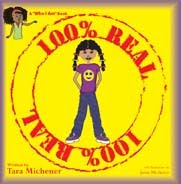 Jason and I thought deeply about the types of books that we would want our future child to read considering we are an interracial couple. We also observed the bond of friendship in those we mentor. A child may not be happy or outgoing but when he/she finds that special friendship, something magical happens. That magic belongs in a book to show children how important it is to be a great friend. 100% Real, my second book, explores a friendship between Janelle and a newly-adopted child in her class.
Children need to see themselves in books and find the answers to their questions in regards to self-worth. They also need to have a greater understanding of those around them. This helps them to see the world from a diverse perspective and allows them to embrace those who are different from themselves.
How can you explore diversity in your writing?
Have you ever considered researching a neighborhood that differs from your own?
Be creative and remember that diversity is more than just race.
Think about reaching a demographic that is under-served in the kidlit genre.
Explore the shelves at the bookstore. Be active in outreach and community service and find out what is missing from those shelves by your best resource… the reader.
I am blessed to be able to be around so many young people to help but also to observe issues that may challenge them so that I can use the written word to help them through the tough times.
The best ideas come from thinking outside the box.
Read something great!
 Tara Michener is an author and speaker who teaches children and adults the importance of diversity and self-esteem.
Putting Your Best Paw Forward
by Jennifer Swanson
Who’s an animal lover? Come on raise your hand. Do you own a pet now? Did you once? Besides being empathetic friends to us when we are down or energetic reasons to exercise, pets can also be great inspiration to aspiring picture book authors. What child doesn’t love to read about the crazy antics of the myriad of dogs in Go, Dog, Go by P.D. Eastman. And of course, who can forget the hours of enjoyment from The Cat in the Hat by Dr. Suess or even the best known hippopotamus friends, George and Martha by James Marshall. Animals or pets in general are found in abundance in children’s picture books.
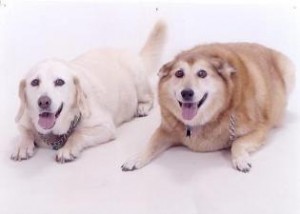 So, why not use your own pets for inspiration? That’s what I did when I created my dynamic canine detective duo, Penny and Rio. My two real dogs (who are also named Penny and Rio) served as the creative map for my characters.
Luckily my real dogs had very distinctive personalities and were always doing crazy things. That’s what caught my imagination.
 In this picture, Penny had just dug out our flower planter at the end of the deck. She used to lie in this for hours, just staring at the yard.
Naturally, this meant to me that she was a pet detective determined to solve a mysterious case. This is how I got my plot for my first book, Penny and Rio: The Mysterious Backyard Meeting.
For me a mystery was the logical choice as I have been a die-hard Nancy Drew fan since I first began to read, but you could have your pets do anything.
Perhaps your cat will become an astronaut and fly through space to land on a planet inhabited only by mice. Or your pet fish possesses super powers so that at night it flies out of the tank to save the lives of the Palmetto bugs living in your garage. Maybe the fireflies you catch at night are really beings from another planet and wish to take over the world.
Your imagination is limitless. So next time you are stumped for a picture book idea, take your notebook and observe some animals. Go to the zoo if you can. See how they interact. Then give them human characteristics and situations. Make the elephant set out on a quest for magic peanuts. Have the lion be a bus driver. Whatever you want? The more outrageous the better.
If you are still stumped, read the newspaper or the internet for articles on humans or animals. I’ve actually written several stories from the ideas I’ve seen in the newspaper.
Whatever you do, have fun and don’t forget to always, put your best paw forward.
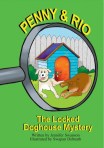 Jennifer Swanson is the award-winning author of the Penny and Rio early reader series.
Jennifer is generously giving away a signed copy of Penny and Rio: The Locked Doghouse Mystery.
Just leave a comment to be entered. You do not have to be a PiBoIdMo participant to enter.
Winner will be chosen randomly at the conclusion of PiBoIdMo!
Cheaper by the Dozen
by Mark Ury
Ideas are not a dime a dozen. They’re closer to $0.0001. That’s because they’re commodities. Everyone has them, everyone can think of them, and, as a culture, we’re saturated with them. Like most raw materials, ideas are worthless unless you turn them into something else, something of greater value.
How do you add value to ideas? With other ideas.
The concept of wit—one of our most enjoyable forms of ideas—is premised on taking one cliché and combining it with another to make something unexpected and remarkable.

An arrow pointing right is a cliché for a courier company. But burying it between the negative space of the “E” and “x” of FedEx makes it new. It makes the image memorable, if not surprising, and the idea valuable.

“You can’t teach an old dogma new tricks” is the written equivalent of the FedEx logo, as are many of Dorothy Parker’s best quips. “Take care of luxuries and the necessities will take care of themselves” and “It serves me right for keeping all my eggs in one bastard” whip two lazy ideas into shape and keep them marching for decades.
The economics of wit are 1+1=3. When your ideas are competing for a publisher’s or reader’s attention, those are valuable numbers to have on your side.
How do you create wit? The simplest technique is to tinker with clichés since they contain recognizable patterns that your audience can latch onto. For example, the cliché “ideas are a dime a dozen” gives you three things to mess about: ideas, money, and—thanks to the word “dozen”—eggs. If you were drawing, you might play with the notion of ideas as light bulbs and then substitute them for the eggs in a carton. You now have a new image to play with and the shadows of a scene. Who needs ideas? Inventors. But why cheap ones? Well, perhaps this inventor is down on his luck. Can’t you see him there at the register, digging into his empty pockets looking for a dime? Around him are other wealthy inventors, buying cartons of the stuff. But he can only afford one bulb for his last, terrible experiment…
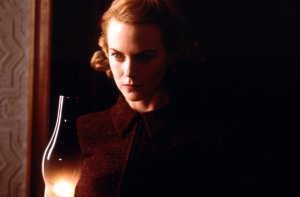 The key to playing with clichés is to think visually AND conceptually. Sometimes the images line themselves up, like the example above. Other times, the concept is unlocked through narrative interplay. For instance, you might start with the visual of ghosts, creeping around in a mansion and scaring people. But then you flip to the narrative pieces and start toying with their DNA: the ghosts aren’t the antagonists. The ghosts don’t know they’re ghosts. The audience doesn’t know they’re ghosts. Before you know it, you’re in Spain with Nicole Kidman filming The Others.
In fact, if you want to study the blending of routine ideas into something fresh, Hollywood has a not unsuccessful record. Alien is the fusion of the shark thriller (Jaws) and outer space (Star Wars). Mad About You was pitched as thirtysomething, but funny. The Sixth Sense, Unbreakable, The Village—many of M. Night Shyamalan’s films—rely on flipping everyday ideas to produce entertaining new ones that “unpack” their meaning as you watch.
That’s the benefit of folding two ideas into one. The audience experiences it in reverse: one idea unfolds into two and the brain has the joy of connecting the dots to find the hidden meaning.
Don’t worry about great ideas. Look for everyday, unbankable ones. If you invest and repackage them, they’ll outperform your reader’s expectations.
That’s my two cents.
 Mark Ury is the co-founder of Storybird.
If you’re a picture book writer, you’ve read hundreds of picture books. Maybe even thousands. (And if you haven’t, I’m sending you to bed without supper!)
I know you have favorites. But have you ever stopped to analyze why a picture book has earned your top rank? Is it the premise? The voice? The twist on the final page? Does the book’s heartfelt sentiment or cheeky sense of humor hook you? Is it all of the above?
 Timothy Knapman’s Guess What I Found in Dragon Wood stands out among recent reads. Why? When I began Knapman’s story, I assumed it had a been-there-done-that premise: boy discovers a creature in the forest. But on the third page, I was thrown.
This is no ordinary boy-meets-dragon story. It’s dragon-meets-boy.
Told from the dragon’s point of view, Dragon Wood turns a common premise upside down. When the young dragon finds a boy “called a Benjamin,” he brings it home and asks his mom if he can keep it. Slowly the dragon uncovers strange facts about the human world—the Benjamin’s striped boots aren’t his feet, his eyes leak when he’s sad, and he loves a game involving a black and white ball. But the dragons have a tough time learning soccer. They just want to burn down the goalposts and eat the ball.
In Dragon Wood, young readers know more than the main character. And kids love that. Think about it—all day long they’re in school, being told how much they don’t know. When they can be smarter than a picture book character, it’s a fun feeling. (Just like when we adults are smarter than a fifth grader.)
Knapman’s book has several things going for it: surprise, humor, a unique voice, kid sensibilities and adult appeal. Let’s not forget that a picture book should keep the grown-up—the one with the wallet who’s reading—entertained as well.
When I boil this dragon tale down, it’s a story about friendship. I could also argue that it’s a book about the importance of family and finding one’s true place in the world. These are universal themes that will never go out of style.
As I come up with ideas this month, I think about the theme at its heart. Will my theme stand the test of time? Can I write this theme with humor and an element of surprise? What have I learned from Dragon Wood that I could apply to my own unique story?
Other favorites:
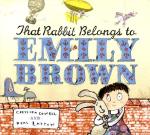 In Cressida Cowell’s That Rabbit Belongs to Emily Brown, the relationship between a little girl and her favorite toy is magic, a love that everyone can understand because they’ve experienced it, too.
In The Louds Move In by Carolyn Crimi, the author balances seven distinct characters—an entire family of Louds plus three quiet neighbors. Even the names are brilliant: Earmuffle Avenue, Miss Shushermush, Mr. Pitterpatter.
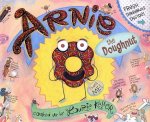 In Laurie Keller’s Arnie the Doughnut, I guffaw at its crazy, quirky humor. Arnie is alive—and the poor chocolate-frosted treat doesn’t realize that doughnuts are for eating.
Okay! Are you ready to try it? Go play with a favorite book. What do you love about it? How can you create something lovable?
So, how’s it going today?
 I am not like most writers. Ideas don’t just slam into me while I am out for a walk. I don’t get “Aha!” moments while luxuriating in a steamy tub. I have to work hard for my ideas. I have to dig deep to find them.
One of the ways I do this is by brainstorming with a partner. I find it so much easier to generate ideas when I can bounce them back and forth. It’s kind of like tennis. I can’t get a rally going without a partner.
Here is a sample of a very condensed brainstorming session with my partner, Becky.
ME: Jordan came home from school today with a new expression, “Flip Flop. Over the Top.” It’s how they learn to put their coats on. Catchy, huh? Love how it rolls off the tongue. What can we do with it?
BECKY: Hmm…over the top? The top of what? A fence? A wall?
ME: Could be a wall? What goes over? Football? Frisbee?
BECKY: How about a baseball. Two characters are playing baseball and one hits it over the wall. How do they get it back?
ME: Try climbing, scaling?
BECKY: Jumping on a trampoline?
ME: Shooting each other out of a cannon?
BECKY: Catapulting.
ME: Grabbing onto a bunch of balloons and flying over.
BECKY: All of the above?
We may use none, some, or all of the ideas in the end, but I am convinced that when it comes to brainstorming, the sum is greater than the whole of its parts. In other words, ideas will be triggered when we are together that NEITHER of us would have come up with if we had both brainstormed independently.
Give it a try sometime.
Can’t find a partner? I am always up for a collaboration!
And if you’re wondering how our characters get their ball back in the end?
They dig a hole…and go UNDER!
 Corey Rosen Schwartz is the author of Hop! Plop!, an Eric Carle Museum Picture Book of Distinction. Her next book is due for release in 2012 (not soon enough in Tara’s opinion). She attended Brown University and has a Masters in Deaf Education from Gallaudet. Corey lives in New Jersey and spends a lot of afternoons at playgrounds with her five-year-old daughter, Jordan, and four-year-old son, Josh. Corey has no free time, but if she did, she would spend it scuba diving!