You are currently browsing the category archive for the ‘Children’s Writing’ category.
 by
by In my day-to-day life I’m a dreary, straight-laced stickler for rules. I’m obsessively punctual with my rent. I always wear my seatbelt. And I’d never dream of going through the Express Lane at the grocery store with more than fifteen items in my cart.
But when it comes to writing picture books, I’m proud to be a rule-breaking outlaw.
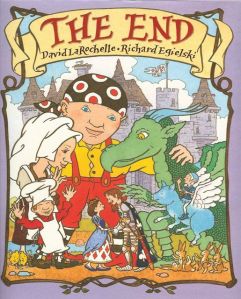 Who says a picture book needs to be told from start to finish? My fairy tale The End is told in reverse chronological order, from end to middle to beginning.
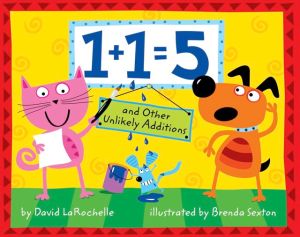
In fact, who says a picture book needs a traditional beginning, middle, and end at all? My latest book, 1 + 1 = 5 And Other Unlikely Additions, is simply a collection of surprising (but plausible) math facts. 1 + 1 = 3? 1 unicorn + 1 goat = 3 horns! 1 + 1 = 6? 1 duet + 1 quartet = 6 musicians! Who would have guessed that a list of equations could make a successful children’s book, but it works.
 Which brings me to my writing tip for today: forget about the rule that says a good book needs a plot with a character and problem and solution. Today, just make a list. The Top Ten Ways to Avoid Doing the Dishes. Reasons Why I Should Have a Horse. My Favorite Things to Do with Peas Instead of Eating Them. You decide on the topic.
Come to think of it, maybe I’m not such a rule-breaker after all. There are plenty of wonderful picture books which are, at their hearts, simply lists:
Jane Yolen’s humorous How Do Dinosaurs Say Goodnight?
Lauren Stringer’s clever and beautiful Winter is the Warmest Season
Judith Viorst’s classic Alexander and the Terrible, Horrible, No Good, Very Bad Day
Of course successful list books like these are more than a recitation of boring items. They resonate with a child’s emotions, shine with beautiful language, explode with humor, or invite the reader to look at the world in a new way.
And you can write a memorable children’s book, too! Just pick up your pencil and start making a list.
David LaRochelle has been creating books for young people since 1988. His next picture book, The Haunted Hamburger and Other Ghostly Stories, illustrated by Paul Meisel, will be released by Dutton in 2011. He lives in White Bear Lake, Minnesota and is currently catching his breath after a busy month of carving pumpkins, some of which can be viewed at his website www.davidlarochelle.net.
Get Out and Live, Your Stories are Depending on You
 by
by Ideas are endless, and everywhere! You can find ideas on a backyard walk, or at a trek to the zoo. You can find them in the news, or in the newspaper. Keep your eyes open and really look around. Listen to the chatter of little children, look at the bark of trees. Discover life around you through the eyes of a child.
Trees have faces if you look closely enough. Clouds can create castles. And in the humdrum of everyday activities, you can find a story just waiting to be told. While on my way to take my daughter to school, I was delayed by turkeys in the road. Instead of allowing a panic mode to overtake me (because we were going to be late), I simply enjoyed that moment.
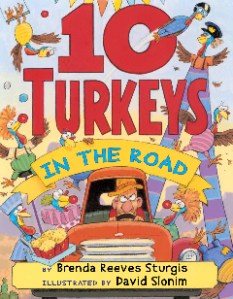 And my debut picture book, 10 Turkeys in the Road, Marshall Cavendish, 2011, was born. I stopped to smell the roses, or better yet, to watch the turkeys. Soon after, I was awakened with the story of the turkeys in my head.
And after 3 major revisions and a year later, editor Margery Cuyler discovered 10 Turkeys at the RUCCL conference.
A trip to the zoo resulted in my story waiting to be sold, My Gorilla Brother, and an afternoon outing to watch my nephew play football, resulted in my story Touchdown! which won first place in the 2007 Smart Writers Contest judged by Verla Kay.
You can find ideas everywhere! A sight, or a smell, or a sound triggers them, but you must to get “out,” and experience life to find them.
One place that most initial ideas will not be found is in front of a blank computer screen. Ideas must first take root in your soul, and then once they are rooted, they are ready for watering, shaping, and pruning.
Yes ideas are endless, and they are anywhere and everywhere you can possibly imagine. Your stories are waiting for you, so get busy and get outside. Live and enjoy your life so you can first imagine, and then write your stories, as only you can.
Brenda Reeves Sturgis began her writing career four years ago, after meeting Lynn Plourde at a school visit. She bought every one of Lynn’s books and asked the question that would change her life, “How do I become a writer?”
Lynn directed Brenda to the CWIM (Children’s Writer’s Illustrator’s and Market Guide book, by Alice Pope), and also to SCBWI (Society of Children’s Book Writer’s and Illustrator’s). One of Brenda’s favorite sayings is, “When the student is ready– the teacher will appear!”
Brenda is generously offering a picture book critique as one of the PiBoIdMo prizes. Finish 30 ideas in 30 days to become eligible to win!
Welcome to PiBoIdMo, 30 days of inspiration and motivation created for picture book writers.
Your mission, should you choose to accept it (and I know you will ’cause it’s a cakewalk), is to jot down one new picture book concept a day during November. That’s it. You don’t have to write a full manuscript, but if you want to, go ahead. No one’s stopping you!
Guest articles by published authors and illustrators will serve as your inspiration. Visit here once a day to read a new perspective on creativity.
Your motivation will be prizes. (Plus finishing the month with a file of ideas.) Sometimes you’ll need to comment on a post to qualify for a prize, but for most of the goodies, you’ll need to finish the month with 30 ideas.
To qualify for prizes, there are two steps:
- You must sign-up below (leave a comment) by November 7th.
- You must sign the 30-ideas-in-30-days pledge which will be posted on December 1st.
 The pledge is by honor system and will remain open for signing from December 1st thru 4th. Prizes will be announced on December 6th. Please note that if your name does not appear in both places–the sign-up and pledge–you will not be eligible to win.
So that’s the fine print!
Now Johnny, please tell us what they can win…
Feedback from Literary Agents


 Three winners will be paired with one of three agents: Ammi-Joan Paquette of Erin Murphy Literary Agency, Kelly Sonnack of Andrea Brown Literary Agency, Inc., and Joanna Volpe of Nancy Coffey Literary and Media Representation. Winners will send their five best ideas to their assigned agent. The agent will provide feedback on which ideas may be the best ones to pursue.
Picture Book Critiques
Seven winners will be randomly chosen and paired with one of these authors: Sudipta Bardan-Quallen, Brenda Reeves Sturgis, Corey Rosen Schwartz, Tiffany Strelitz-Haber, Lori Degman, Lori Calabrese and Linda Bozzo. Winners will send one picture book manuscript (up to 800 words) for a critique. (Linda Bozzo offers a non-fiction picture book or article critique. Lori Degman, Lori Calabrese & Tiffany Strelitz-Haber will critique rhyming PBs. Alternatively, Tiffany offers a lesson in rhyme and meter.)
Original Artwork
Some illustrators will be guest blogging in visual format. You can win original art by Neil Numberman, Bonnie Adamson, Jannie Ho, Adam F. Watkins and James Burks, who designed the PiBoIdMo logo and badge.
Picture Books



Picture books donated by Jannie Ho, Sterling Children’s Books, Alison Ashley Formento, Joan Waites, Pat Miller, Tammi Sauer, Jeannine Q. Norris, Lori Calabrese and Simon & Schuster.
Jewelry
 Stay inspired all year long with the “write” bracelet, donated by writer and artist Laura Hamor.
 Heather Powers has donated her “Anne of Green Gables” book club pendant. Check out her Etsy store Humblebeads for more lovely nature- and literary-inspired wares.
Greeting Cards
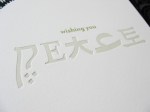 Artist Christina Peressini’s inventive die-cut greeting cards have also been donated. The winner chooses a mix & match 10-pack from her original designs, like the “Wishing You Peace” card.
And, there might be some extra-special stuff added as the month progresses, so stay tuned.
So there you have it. PiBoIdMo 2010.
Let the sign-up begin!
Then come back on Monday for the first of 30 posts to help you along your idea journey!
[Update 11/8: Comments are now closed. If you are not signed up below, you aren’t eligible for prizes, but you can still join PiBoIdMo–just visit every day for a new post about creativity to help you along your idea journey.]
 by Karen Collum
We creative types often talk about that moment when inspiration strikes. We get an idea, a phrase, an image, a scent, a sound that somehow switches something on in our brains and before we know it words are churning out faster than electric shocks on a trampoline. The concept of inspiration ‘striking’, however, is misleading. It sounds so passive, so unpredictable, so out of our control.
I’d like you to think about another sort of strike for a moment; a lightning strike. It’s true, lightning can strike people almost anywhere and at anytime, and we often hear amazing tales of the same person being struck more than once, but there are well-known factors that can increase or decrease the likelihood of being struck by lightning. I believe the same applies to the strike of inspiration. Here are a few ways you can increase the likelihood of being struck by inspiration (but please don’t use this advice in a storm as you are quite likely to get struck by lightning and although that might make a great story, it would in fact be terrible!):
1. Stand tall and in the open
Everyone knows that lightning strikes tall objects and the wisest thing to do in a storm is lie low. The opposite is true when waiting for inspiration to strike. Stand out in the open field of life, arms outstretched and reaching for the sky. Stand tall, lift your gaze above what is immediately in front of you and look around. Don’t be afraid to be different. Look at a picture, a scene, a group of people from a different perspective. Ask ‘what if?’ questions. Dare to look beyond what you first see. For me that often means taking a mental step back from the scene and surveying it as an observer. Why is that person frowning? Why is the lady in the car crying? Where is that person in a hurry to get to? Do this often enough and inspiration will surely strike.
2. Have your umbrella up
Umbrellas in a lightning storm are a no-no, especially if yours has a metal tip on the end, but for a writer, having your umbrella up means you are ready and waiting to be struck by inspiration. You are aware of what’s going on around you and that there may just be one tiny thing that will spark your creativity in amongst the mundane. I try to have my umbrella up all the time, consciously searching for things that might be useful. I listen carefully to the conversations that my children have and try to absorb their pattern of speech. I also have a notebook handy at all times so I can capture the strike when it happens. When I’m outside playing with my kids I watch for interesting things in my environment. Just the other day I saw a slow and steady march of butterflies heading to some important but unknown place, one at a time. Inspiration can strike on even the gentlest of wings.
3. Get on the phone
During a lightning storm it’s advisable to stay off the phone as lightning can travel down the phone line and end up quite painfully in your ear. As a writer, however, it’s essential that you connect and network with other creative people. Have conversations about interesting things, bounce ideas off one another, share with trusted creative friends what you’re working on. I don’t believe inspiration happens in a vacuum and by connecting with one another we can create surges of inspiration for all of us.
Don’t just wait for inspiration to strike. Stand tall, have your umbrella up and get on the phone. You might just find those thirty PiBoIdMo ideas flowing faster than you ever thought possible.
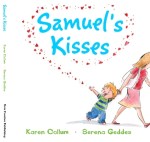 Karen Collum lives in Brisbane, Australia and is a stay-at-home mum to three pre-school boys. She is about to welcome a baby girl to the family in December. She is also a picture book author and co-convenor of the international online picture book chat group, #pblitchat. (You can find details about #pblitchat at http://picturebooksonly.wordpress.com.) Karen’s debut picture book SAMUEL’S KISSES is due for release in late November by New Frontier Publishing. You can follow Karen on Twitter (@KarenCollum) or find more about her and her books on her website http://www.karencollum.com.au.
 [UPDATE: The winner is Sheryl Tilley! Congratulations and enjoy!]
My story “The Juggler Triplets” will appear in the November issue of Abe’s Peanut, a micro-magazine for kids ages 6-10. Delivered in four postcard installments, the story appears on one side with full-color illustration by Lichen Frank on the other.
Independently published by editors Anna and Tess Knoebel, Abe’s Peanut launched this year after the success of Abe’s Penny, a micro-magazine for adults: “Off-set printed on double thick matte card stock, each issue dispenses art and literature while becoming a collectible, temporal object.” (In kidspeak: “They look cool tacked to your bedroom door.”)
Recent Abe’s Peanut contributors include Audrey Vernick, author of Is Your Buffalo Ready for Kindergarten?, and Lisa Tharpe, author of P is for Please: A Bestiary of Manners.
Kids love receiving their own mail, so here’s a chance to receive four postcards with your child’s name on the label.
Leave a comment naming your child’s favorite picture book for one contest entry. Mention the giveaway elsewhere for two additional entries. A winner will be chosen on Friday, October 22nd.
And stay-tuned for PiBoIdMo in November, when there will be several itty-bitty (plus some hugantic) giveaways!
Lately many writers have wondered, “Are you hosting Picture Book Idea Month again in November?”
Since this is a children’s lit blog, I have to tone down the language of my reply:
HECK, YEAH!
We’re gonna make NaNoWriMo novelists wish they were PiBoIdMo writers this year!
We’ve lined up great guest bloggers.
And three picture book agents to provide feedback to three winners.
And prizes! Oh, the prizes!
Just remember, you’ll have to complete 30 ideas in 30 days to qualify for the prizes. And you’ll have to officially sign up, too.
Watch for the kick-off post and sign-in on Halloween! You’ll have from then through the first week in November to sign-up.
And for now, I’m signing out!
What happens after a manuscript is bought by a publisher? Well, you pop a cork of bubbly and break the glass shade on your kitchen chandelier. But don’t worry, your advance will cover the repair. (That’s what I told my husband.)
I received an offer for my first picture book, THE MONSTORE, from Aladdin/Simon & Schuster in early May and accepted, after brief negotiations, shortly thereafter. By the end of June, my editor sent me the first round of edits, with the first revision due August 1st.
I opened the Word document and couldn’t believe all the RED.
Stuff was slashed. Crimson comment boxes asked me to change words…and entire passages. And most baffling of all, I thought my editor didn’t like my ending. I felt overwhelmed.
That’s when a good agent swoops in and saves you from having a toddler-like meltdown. A conference call was what I needed to understand the reasoning behind the red. The following week, my editor, editorial assistant and agent called and we ran through every detail. And, guess what? I didn’t feel so overwhelmed anymore. That’s what. (Sorry, there’s a little Junie B. Jones creeping in.) My editor had a great vision, and I agreed with every change she suggested. Big sigh of relief.
Then I had a month to make the changes.
I tried procrastinating. I played a lot of online Boggle. (My high score is 174.)
Honestly, I didn’t know how to tackle the revision—how I would solve the little problems that, at the time, seemed HUGE.
Then I remembered Anne LaMott’s BIRD BY BIRD. So that’s what I did. I took it bird by bird.
The first day I changed the manuscript from 1st person to 3rd. Send over the red button from Staples because that was easy.
The next day, I thought visually. My editor said some of the objects and actions in the manuscript, like a bag of moldy bread, and a monster slithering, wouldn’t come across well in illustrations. She asked me to think of details that were more visually interesting—things that would be humorous to draw, but also fun to read aloud. And, one of those things had to tie into the denouement.
My editor had paginated the manuscript, and she asked me to think of each page turn as a mini-cliffhanger. She did such a bang-up job on the pages, I didn’t need to do much there.
Then came the ending. Remember how I thought my editor didn’t like it? Well, she loved it. She just wanted me to stretch out the denouement. But how? I spent days staring at the screen. I’d come up with an idea, then erase it. And another. Delete. Then save. Then trash. This went on for a fortnight, until, by George, I think she’s got it! (I’ve always wanted to feel like Audrey Hepburn. That was my moment.)
I finished the first revision on June 27th, with enough time to email it to my agent for review before sending it to my editor just under the August 1st buzzer. My agent was thrilled, I was thrilled that my agent was thrilled, and let’s just say the word THRILLED ping-ponged between us that week.
My manuscript had gone from 522 words up to 730 to fit in the changes, but I thought that would be OK.
I was wrong.
The second round of edits arrived in early September. MORE RED. Cut, cut, cut! My editor liked the new denouement, but it was too wordy, bogging down the pace of the story. “This can be shown in illustration,” she said several times. I agreed. (And added those devilish art notes.) I slashed and burned, taking the manuscript down to 589 words.
So now it’s ready to ship out once again, way ahead of my November 1st deadline for the final manuscript.
But guess what? I think there will a lot more changes from now until then, but they’ll make the story even better. That’s what.
Last November this blog hosted “Picture Book Idea Month,” a daily exercise for picture book writers. The object was to create one new picture book idea a day. (As an added benefit, it kept us from having NaNoWriMo envy.)
When I tried PiBoIdMo on my own the year prior, I came up with the concept for THE MONSTORE, which became my first book to be purchased. It’s set for release with Simon & Schuster in 2012. And, this week, my editor is meeting with the art director to talk about illustrators. Oh yeah, it’s a fun time.
Then this week I got word that Diana Murray won the 2010 SCBWI Barbara Karlin grant with one of her PiBoIdMo 2009 ideas! Wow! So I asked her to tell the story…take it away, Diana!
 When Tara announced PiBoIdMo on the blueboards, I was thrilled. One idea per day was something I could handle time-wise and I was looking forward to an excuse to ramp up my picture book writing. It was more challenging than I expected, but the best part was, it helped me figure out my main problem: I’m a compulsive writer. As soon as I think of an idea, I run for my laptop and I can’t stop writing until I get the whole story out of me. I literally find myself waking in the middle of the night to jot things down. In other words, I’m completely nuts. In many ways, this can be a good thing. Motivation has never been an issue for me. But participating in Piboidmo forced me to delay my compulsion to write about anything that popped into my head, and for me, that ended up being more efficient.
I came up with most of my ideas during little “holes” in time throughout the day, like while pushing the stroller or putting my kids to sleep. Some of these ideas were pretty awful, like: “Tabby Moves to Dogtown” and “Mabel’s Amazing Hat,” about a do-everything hat with a remote control. Ha! That one still cracks me up. Some of the ideas were worth investigating and I kept getting tempted to drop everything and start writing. But I held back in the interest of coming up with at least one new idea each day. I knew that if I started writing, I wouldn’t be able to stop and move on to thinking of other ideas. I held off as long as I could.
Finally, on idea #23, I couldn’t take it anymore. The idea of a stubborn, messy witch who keeps losing things resonated with me (Gee, I wonder why?). It’s a very personal experience, of course. An idea that works for one person may not appeal to somebody else. But for me, it just clicked. For a few days, I thought about it and planned it out in my head. Actually, idea #23 had been brewing since idea #1 (to borrow a metaphor from my MC, Grimelda). That’s the good thing about ideas: even the bad ones can ultimately lead to something that inspires you. By the time I started writing, I was overflowing with creative juices and the whole manuscript just poured out.
So, long story short, I’m a PiBoIdMo loser! My compulsion got the best of me, and I didn’t get past idea #23. But the good news is, I won the 2010 SCBWI Barbara Karlin Grant and learned something in the process.
For the record, I announced my participation on the blueboards but not on Tara’s blog. Let’s just say I was a little new to the concept of blogs at the time. Luckily, I was able to read all the inspiring posts after the event.
Congraulations, Diana! I hope you’ll let us know when your manuscript gets purchased!
Do you have a PiBoIdMo success story to share?
Editor and author Ken Geist recently spoke at the New England Children’s Booksellers Advisory Council, asking independent booksellers to get behind picture books, as reported by Publishers Weekly.
Why the impassioned plea? While picture books aren’t disappearing from the market, they have been a tough sell lately. Jacketed picture books are $16.99–not an inexpensive purchase–and customers seem unwilling to buy unjacketed titles. Lower-cost paperbacks aren’t usually produced until the hardcover has proven sales. And big retailer Barnes & Noble is removing its picture book wall and instead showcasing higher-margin activity books. (Say it isn’t so!)
The most interesting tidbit from the article–one that contradicts the word count guidelines heard lately (500 to 700 words, the less, the better)–is that “many [consumers] don’t know what a picture book is, and those who do are looking for more text.”
More text?
Can it be that picture book consumers feel slighted by the $16.99 price tag when they only get 400 words? Does this mean picture book word counts might be on the rise? This is difficult to tell, considering the article also mentioned that 4- and 5-year-olds are being pushed toward chapter books. Lower word counts serve the younger audience this suggests. But do we believe that 4-, 5- and even 6-year-olds are going to give up on picture books completely? Are teachers going to stop using them in their Kindergarten, 1st and 2nd grade classrooms?
And could picture book series be turning off some parents? Once there’s a hit book, publishers release new titles with the same character. Is this strategy a sure money maker, or are parents getting tired of the same premise repeated a half dozen times?
On one hand, familiarity is a strong selling point. Think of the popularity of chain restaurants–customers know the menu is the same in Boston or Boise, so they are assured an enjoyable meal. So a picture book with a character they and their children already know is appetizing, but when do they get full? Editors have been asking for character-driven manuscripts to take advantage of sequel potential, but will this trend level off?
I’m curious to see if publishers will change their acquisitions strategies in light of bookseller changes. What do you think?
One of the booksellers at the event suggested a grass-roots effort to make 2011 “The Year of the Picture Book.” I’m all for that! Who’s with me? What can we do to help a sagging picture book market? (Besides the obvious–write awesome books!)
I was taken aback this week when a girl posted a comment on my blog in regards to the 365+ Things Kids Like post:
what the hell im i kid i dont like most the things on that list [sic]
OK, so we’ve got one unusual and outspoken kid out there. I mean, nearly 365 things is a lot NOT to like. Although I assume that this kid does like #21 Being Independent, #175 Ignoring Adults and #201: Knowing More than Everyone Else. And this kid may not be of picture-book age (less than 8 years old), given the language.
I add to this list periodically, to keep track of subjects that may work in a future picture book manuscript. But one thing I forgot is that kids like to be unique individuals. Not every child loves riding skateboards and roller coasters. Some are scared of clowns or think they’re stupid. And licorice? Blech. I know I hate it.
This leads me to ask–how do you know the subject of your story will appeal to a broad range of children?
Because at its heart, a picture book isn’t about a dragon or a robot. It’s about an emotional truth–friendship, family, fitting in. Carving out your place in the world. Accomplishing your goals.
So I have to add two things to the list of 365+ Things That Kids Like:
- Being loved and appreciated.
- Having their voice heard.





 Writing for Kids (While Raising Them)