You are currently browsing the category archive for the ‘Children’s Writing’ category.
Every Monday at 10pm EST children’s writers and illustrators jump on Twitter to chat about picture books. The brainchild of Aussie authors Karen Collum and Kat Apel, #pblitchat churns away for an hour, with topic schedules and transcripts posted on the Picture Books Only blog. Below are highlights from this week’s chat on writing for the very young–children from birth to age 3.
- Unless you’re an author/illustrator, board books are a difficult sell. The word count is low and the stories are less complicated than picture books for 4-8 year-olds, so illustrations become even more crucial to bring life to the story. For example, the visual cues in Sandra Boynton’s Blue Hat, Green Hat allow non-readers to “read” the story themselves. As a new writer, you want to write a story with the broadest possible appeal to maximize your chances of being published, so writing specific to the board book format may limit you.
- A trend in board books is to republish books that have been popular sellers in hardcover/paperback. Board books are expensive to produce, and at the same time, parents want to pay less for them, so publishers may prefer to go with a proven story rather than a new one. Great example: Snowmen at Night by Caralyn and Mark Buehner was first a successful hardcover title, released in 2002. A few years later, the publisher created board books and sold them with a stuffed snowman during the winter holidays. A jigsaw puzzle board book and a pop-up version (a new story) were also created.
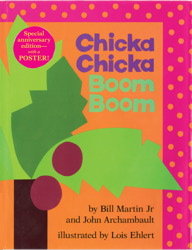 Rhyme (internal and external) and a jaunty meter delights young ears. Great examples: Chicka Chicka Boom Boom by Bill Martin Jr., John Archambault and Lois Ehlert; Hand, Hand, Fingers, Thumb by Al Perkins and Eric Gurney.
- Average word counts for young books are typically less than 500 words and could be fewer than 100 words.
- The market is saturated with ABC concept books, but books with a completely fresh take can be successful, like Shiver Me Letters, A Pirate ABC by June Sobel and Henry Cole.
- Repetition helps young children understand story and recognize words, plus it encourages participation in reading aloud.
- Lift-the-flap books offer peek-a-boo surprises and drive the story forward, but again, they’re a tough sell unless you’re an established author and illustrator.
- Novelty books (pop-ups, foldout pages, liftable flaps, or hidden sound chips) are often published by mass-market publishers and not trade publishers. What does this mean to you? In-house talent or work-for-hires create these books.
- The jury is split on interactive titles for the very young. Do parents want their toddlers drooling on an $800 iPad? Do electronic titles lose the “cuddle factor”? Or does the new interactive medium offer an unprecedented opportunity to unknown author/illustrators? A recent article cited a new 3D book as one of the top 20 ebook apps for the iPad, right up there with Dr. Seuss and Disney titles.
My favorite #pblitchat moment? Board books get gnawed and chewed by babies, so how about an edible board book? (As suggested by @RedStepChild a.k.a. illustrator Lynn Alpert.) I think this is an idea whose time has come, especially if they’re made out of freeze-dried astronaut ice cream. Mama may want to chow down on tasty kidlit, too! (I can see it now–Chicka Chicka Yum Yum.)
What else is important to know about writing and illustrating for the very young?
Want a great piece of writing advice? As a new writer, surround yourself with more experienced professionals. You’ll grow and learn far more quickly than if you remain in a critique group comprised of writers on your level.
Unfortunately, it’s not always easy to find an experienced critique group. However, paid critiques are one way to gain access to knowledgeable professionals and speed-up your learning curve. You can receive paid critiques at SCBWI conferences and through independent editors, and once in a while critiques go up for auction to benefit good causes. But these critiques, while thorough and worth every penny, can sometimes cost a lot of pennies.
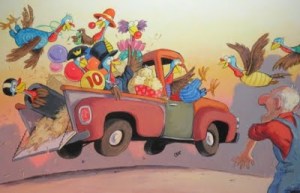 I met award-winning author Brenda Reeves Sturgis at the 2008 Rutgers One-on-One Plus Conference and we had instant chemistry. Easy-going, lovely, and full of fun, Brenda possesses a great personality and a penchant for picture books. Her debut TEN TURKEYS IN THE ROAD releases fall 2011 with Marshall Cavendish, and her poetry appears in the SWEET DREAMS anthology later this year from Blooming Tree Press. And guess what? OK, you’ve guessed it, she has begun a new critique service for picture book writers (and for not that many pennies).
Hey–did you notice–critique service, Reeves Sturgis. That rhymes! Well, kind of. Maybe just a little? Huh?
But believe me, her critiques are far better than my rhymes.
Dust cobwebs off the fake plants!
[Check email.]
Play online Bingo Luau!
[Jump when the phone rings.]
Give away old clothes circa 1994!
[Check email. For the 27th time this hour.]
Refill the bird feeders!
[Check answering machine.]
Clear unidentifiable aluminum-foiled bricks out of the freezer!
Yes, such is the glamorous life of a newly-agented writer who hopes to someday soon be a bonafide author.
What’s that you say?
I should be doing something else while I wait for an editor response?
Something like…writing???
Bahhh! What a crazy idea.
Well, what would YOU do?
Besides writing for kids, I’m raising them, too. (You may have already figured this out by the blog title. I’m not that full of surprises.)
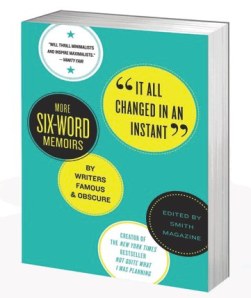 Two years ago I won a Six-Word Momoir contest from Smith Magazine, and now another one of my Momoirs is featured in their new book It All Changed in an Instant: Six Word Memoirs by Writers Famous and Obscure:
Wanted independence but had two dependents.
Probably would have sounded better if I went all Duggar and said nineteen dependents, but I digress…
Sometimes we need a break from our current manuscript, but we still want to write. Well, what better way to be succinctly witty and wittily succinct than by writing six-word memoirs? Picture book writers are expected to write short, so here’s the ultimate exercise. In my case, I’m sticking to momoirs. Here’s a few to get your creative sixes flowing:
Woman with awesome body becomes homebody.
Two words bring joy: “She pooped!”
You really do become your mother.
How many years until Kindergarten begins?!
Naptime: my favorite time of day.
Wake me up when they’re grown.
Stuffed animals must breed at night.
Motherhood should require an entrance exam.
Hug tight. The years move fast.
Say “yes” as often as possible.
Except when muddy nightcrawlers are involved.
Grant wishes. Encourage dreams. Inspire hope.
Give birth. Give lessons. Give freedom.
OK, I apologize for the poop. I have no reason to sink that low. But I do have something to tell new mothers in six words: “Stay far away from rice cereal.”
So, give it a shot. If you’re a parent or not, try a six-word memoir. I expect to see at least six below in the comments!
A few days ago in Think Before You Write, I mentioned that although a picture book is short, it doesn’t take a short time to write:
You whittle down the length so every word packs a punch, while still presenting a compelling page-turner, full of illustrative potential. (Which means you have to leave some things unsaid.)
So what does that mean? Leaving some things unsaid? Well, I’ve found perfect examples from Kathi Appelt. (Yes, Newbery Honoree Kathi Appelt. She knows her stuff.)
 Today my daughter asked me to read Appelt’s Bubba and Beau Meet the Relatives, one of our favorite picture books.
Appelt says a lot with a little, meaning she uses a few words to describe a situation, leaving illustrator Arthur Howard to fill in the blanks.
Bubba and Beau Meet the Relatives is about a baby boy, his bloodhound puppy and the Texan family relatives who come to visit one afternoon. Bubba’s Mama Pearl quickly prepares for the relatives’ arrival.
Appelt says: “First Mama Pearl went on a home improvement spree.”
Howard draws: Mama Pearl shoving clothes into a drawer, pushing an overstuffed closet closed, and sweeping Bubba’s toys underneath the bed.
Notice it took 19 words to describe the illustrations, but Appelt only used 9 words to set the scene.
Appelt says: “Then she handed out orders.”
Howard draws: Mama Pearl pointing to a cobweb which Big Bubba swats with a broom, Mama Pearl holding a bag for the bloodhound to put away his bones and balls, Big Bubba vacuuming with Beau riding the cleaner.
And there it took 36 words to describe the illustrations, but Appelt only used 5. (OK, I could have described the art in a tighter fashion, but I think you see my point.)
Later in the story, Appelt introduces “…Cousin Arlene and her dog, Bitsy.”
Appelt says: “Honey, it was froufrou city.”
Howard draws: Cousin Arlene in a frilly pink dress, with a pink bow to match the one atop Bitsy’s fluffy head.
Once again, Appelt’s petite word count packs a humorous punch, with Howard’s illustrations telling half the story.
In our favorite scene of the story, Bubba, Beau, Arlene and Bitsy have just been discovered in the mud hole. “Only one thing to do,” says Big Bubba.
Page turn. (Which means a surprise is coming!)
Appelt says: “Yeehaw, honey! It was a picture-perfect day in Bubbaville.”
Howard draws: The entire family sitting in the back of Big Bubba’s truck, which has been filled with a hose so it’s a southern-style pick-up truck pool.
At kidlit conferences and events I’ve repeatedly heard that picture book writers must leave room for illustrations. Bubba and Beau provides a superior example of how to write a successful tale that inspires brilliant pictures. The words and images work beautifully together like Bogey & Bacall, Astair & Rogers, and Lady Gaga & Elton John. (OK, maybe that last analogy wasn’t so good. But I needed something current.)
If you have a recommendation of a picture book that says a lot with a little, let’s hear it!
 A typical day as a newbie writer: sit down at the computer, start writing.
At least, that’s what I did two years ago. I got an idea and I didn’t stop to think: is this a good idea? Is it marketable? Has anyone written something like this before? Nope. I just wrote, motivated by my muse.
And perhaps this was good back then. I was honing my skills, finding the right words, crafting sentences, building stories.
But they were looooong stories. At an average 1,500 words my tales were neither picture books nor chapter books. I insisted I was writing picture storybooks, and I used Patricia Polacco’s body of work as an example of how my stories could be published, not realizing, c’mon, she’s PATRICIA POLACCO.
It took me a while to learn to THINK before I write.
An idea begins. I ponder it. I write down the initial concept. What is my topic—what is this story about on its surface? Bulldozers or ballet dancers or dragons? What is at its heart? Is it about friendship or fitting in or family? Who is my character and what does he want? What is my hook? Can I boil the concept down to one line?
Then I research. Is there anything similar already published? If so, I’ve got to change it up a bit. Or let it go.
I ask myself these important questions:
- Is this picture book marketable?
- Will someone pay $16 to buy it?
Granted, these are difficult questions to answer objectively. Of course you want to believe that everyone will buy your book! But as a mother of two picture book age kids, I know this isn’t the case. If we don’t love reading the book over and over again, I won’t buy it. I try to use my motherly instinct to answer these questions and I think of my other parent friends. (And then I stalk parents in the bookstore and ask them what they think. No, just kidding. But I’m tempted.)
If I can’t answer “yes,” the idea gets filed away for the future, when I can perhaps transform it into something more extraordinary.
If I do answer “yes,” (or even “maybe”) then I create a brief outline or I just write. And I keep the proper length in mind: 500 to 700 words.
Some writers may call this process stifling. But I call it smart. Because if you want to be published, you have to examine these elements before you write. Because although picture books are short, they don’t take a short time to write.
Sure, you may pump out a first draft in a few days, or even less, but picture book revisions could go on for weeks, months, even years until you get it right. You whittle down the length so every word packs a punch, while still presenting a compelling page-turner, full of illustrative potential. (Which means you have to leave some things unsaid.) With all that time invested in a product you want to sell, you’re playing Russian roulette if you haven’t researched the story’s potential first.
It took me a while to learn this, to realize this, so I’m just paying it forward. Many of you are probably nodding your head in agreement. And maybe some of you are waving a finger at me for being a creativity killer.
In any case, I’m eager to hear from both sides! Think or write? Or a hybrid of both?
OK, time’s up! Do you have 30 new picture book ideas? You do? Excellent! Time to take the PiBoIdMo pledge to qualify for one of our keeno-Yaccarino prizes. (Sorry, there are no Dan Yaccarino books to give away. I just like that phrase.)
I do solemnly swear that I have faithfully executed
the PiBoIdMo challenge, and will to the best of my ability,
parlay my ideas into picture books from the list of 30 I have created.
Now I’m not saying all 30 ideas have to be good. Some may just be titles, some may be character quirks. Some may be problems and some may create problems when you sit down to write. Some may be high-concept and some barely a concept. But…they’re yours, all yours. Small seeds that may sprout into a story.
You have until December 3rd at 11:59:59PM EST to sign the pledge. Remember, this is an honor system pledge. Those who sign will be entered into the random grand prize drawing: review of your best 5 ideas by a literary agent. There are three grand prizes! Thanks to Jill Corcoran of Herman Agency, Inc., Lauren E. MacLeod of Strothman Agency, and Elana Roth of Caren Johnson Literary Agency for volunteering their time and expertise to PiBoIdMo.
In addition, I have two adorable kidlit prints by illustrator Naoko Stoop to give away–something to keep you inspired throughout the year.

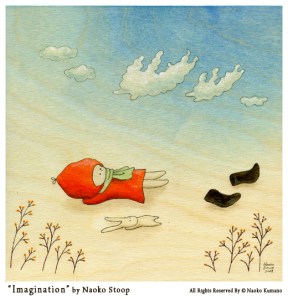
Winners will be drawn and alerted on December 4th. Grand prize winners must contact their assigned agent no later than December 7th. Winners will be given full instructions…when they win!
If you’re an illustrator who participated and want to display your artwork, when you sign the pledge, please let me know that I should contact you to collect images. I’ll create a special PiBoIdMo art gallery to showcase your sketches.
Illustrator Ryan Hipp, who so generously created the PiBoIdMo logo and participator badge, is busy making you an “I did it!” badge to proudly display on your blog. Everyone’s a winner, so it will be posted when the grand prize winners are announced.
Finally, a ginormous THANK YOU to everyone who participated in PiBoIdMo, from the guest bloggers to the aspiring writers and illustrators to the authors and agents. This has been a inspiring month full of creativity and imagination and, not to sound corny, but I couldn’t have done it without your support and enthusiasm!
*Sniff, Sniff*
So enough of the sappy stuff, go sign the pledge. When you leave a comment, be sure to put your email address in the email field so I know how to contact you. You do not have to put your email address in the comment itself. And, you do not have to submit your 30 ideas–they are yours. Treasure them. Just your name and “I did it!” will suffice. Let everyone see your virtual John Hancock. Or maybe that should be a virtual Jon Scieszka?
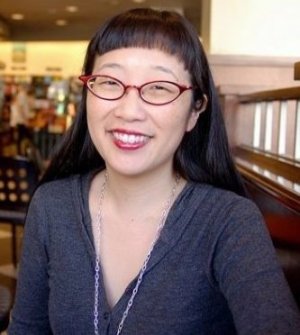
Paula Yoo photo courtesy Jennifer Oyama, Audrey Magazine
30 picture book ideas in 30 days?
Are you CRAZY?
Oh wait. You’re a writer. OF COURSE you’re nuts! 🙂
And I’m a writer, too. Which means we’re both in the same boat.
Tara asked me to give you some words of advice as you hunker down for that final idea for Day 30 of the 2009 PiBoldMo–Picture Book Idea Month!
I thought I’d talk a bit about my “other” job to give you some ideal inspiration! In addition to my YA novels and picture books, I am also a TV writer. I’ve written for NBC’s The West Wing, FOX’s Tru Calling, and currently The SyFy Channel’s Eureka.
As a working TV writer in Hollywood, I have to come up with ideas every single day. In fact, I have to come up with DOZENS of ideas every single hour of every single day when I’m working on a TV show.
Here’s how most scripted TV shows work: several writers are hired to literally sit around in a room called “The Writers’ Room” all day long and come up with ideas for episodes. Each show is run differently, but the basic day usually involves the writing staff discussing what storylines should happen in each episode, along with in-depth dialogue about character development and themes. It’s a really fun job when you think about it–you’re getting paid to make up stuff!
At the same time, it’s also a really TOUGH job. You can get burned out very easily when trying to brainstorm episode storylines and figuring out which character does what and why. It’s often like solving a puzzle–there’s a ton of logic and plausibility that you have to consider when pitching ideas.
I’ve learned a lot from having worked in TV about how to brainstorm effectively when it comes to ideas. Of course the sky’s the limit when it comes to brainstorming–anything from a pebble on the beach to a squirrel running across the street to the cranky lady standing in front of you in line at the bank can lead to an amazing story idea for your picture book.
But a cool image, compelling character, or interesting conflict isn’t enough to create a fully-fleshed out idea. You have to combine all three areas–image, character, conflict–into one idea in order to have a viable story for a potential picture book.
As a TV writer, I was constantly told that story equals intention plus obstacle. Memorize this formula!
INTENTION + OBSTACLE = STORY
In other words, your main character has an INTENTION. But there is an OBSTACLE standing in your character’s way. This creates CONFLICT… which is another way of saying STORY! Ah ha! So STORY EQUALS CONFLICT! And how that character overcomes that obstacle reveals his or her journey towards that end goal.
As long as you can make this equation work, you’ve got yourself a viable story idea! It’s actually a fun formula to apply to published books, movies, and TV shows to break down a completed project to its very essence–the idea. Sometimes working backwards and analyzing published books and figuring out their basic idea can help you as you brainstorm your own ideas.
In other words, try this formula on published books or movies etc. as a “warm up” exercise before you begin your own brainstorming. For example…
In Mo Willem’s Knuffle Bunny, Trixie and her dad go to the laundromat. Trixie accidentally leaves her stuffed toy, Knuffle Bunny, behind. She is unable to speak in full words yet, so complications arise when her father has no idea what she’s talking about when she tries to convince him to take her back to the laundromat to rescue Knuffle Bunny.
So Trixie’s INTENTION is that she wants to return to the laundromat to get her toy!
The OBSTACLE is her inability to speak in words yet to communicate her thoughts!
INTENTION (Trixie wants Knuffle Bunny back) + OBSTACLE (can’t speak inwords yet) = STORY (Trixie must figure out how to communicate to her father that they must return to the laundromat to rescue Knuffle Bunny!)
And how Trixie overcomes this obstacle shows her delightfully feisty personality and inventiveness.
See how that works? Try seeing if you can simplify your favorite picture book down to this formula. It’s a lot of fun and a good warm up exercise to jump start your own imagination!
Then apply this formula to your own original ideas–if you can create a compelling character who has to overcome an obstacle to reach his or her goal, then you’ve got your 30th picture book idea for this year’s PiBoIdMo!
CONGRATULATIONS!!!!
And now that you have your 30 ideas, please join me this May 1-8, 2010 for the second annual NaPiboWriWee event sponsored by my website at http://paulayoo.com!
For more information on NaPiBoWriWee, check out this link:
http://paulayoo.com/content/natl-picture-book-writing-week-may-1-7-2009
NaPiBoWriWee is short for National Picture Book Writing Week where I challenge writers to write an entire picture book every day for a whole week–7 picture books in 7 days!
See, I told you we were crazy! 🙂
Best,
Paula Yoo
 Paula Yoo is the author of the YA novel GOOD ENOUGH (HarperCollins ’08) and the children’s non-fiction picture books SHINING STAR: THE ANNA MAY WONG STORY (Lee & Low ’09) and IRA Notable SIXTEEN YEARS IN SIXTEEN SECONDS: THE SAMMY LEE STORY (Lee & Low ’08). She is also a TV writer, whose credits include THE WEST WING, TRU CALLING, and SIDE ORDER OF LIFE. She is currently a co-producer on The SyFy Channel’s series, EUREKA.
Tara’s Note:
Thanks, Paula! No one could have summed up PiBoIdMo better.
Everyone, stay tuned tomorrow for the PiBoIdMo pledge.
What’s the PiBoIdMo pledge? It’s your word that you have 30 ideas. I’ll ask you to leave a comment letting me know you’ve completed this month’s challenge. (Please note you do not have to submit your 30 ideas. Those are yours to keep!)
You’ll have until December 3rd to take the pledge, then on December 4th I’ll announce the randomly-selected PiBoIdMo prize winners.
Good luck!
 I loved Tara’s post from Day 22 because I get a lot of my ideas in the opposite way. Re-read your favorites and examine what you love about them? I like doing this too, but it completely freezes my creativity. I end up thinking I could NEVER write anything THAT wonderful and I go eat a pint of chocolate ice cream instead.
I would LOVE to be inspired by good books, but (sadly) I’m not. My biggest-ever writing epiphany (next to understanding rhyme) was learning this about myself: good books are bad for me.
No, what I need to feed my creativity is bad books. Nothing gets me more fired up than a book/story/idea that I think could be improved. Books that I read which annoy me in some way that I recognize instantly, or the ones that gnaw at me weeks later, asking me, “Why…? Why…? Why…?”
Books with ill-conceived plots that obviously should have gone This Way instead of That Way (obviously to ME, anyway–ha!) Books with poor structure. Books with over-worn themes that bring nothing new to the world. Characters that should be funnier. Characters who do things I don’t understand. Settings that don’t matter, but could–or should! Why did the author set it there when here would have been so much better?
Wasted opportunity–that’s what basically gets my creative juices flowing. It plays into re-tellings and re-interpretations and parodies very nicely (and I write a lot of those), but you can also use the ideas you come up with in original stories.
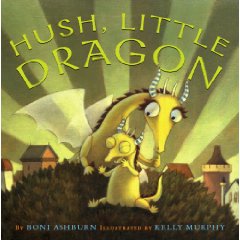 When I grew tired of singing Hush, Little Baby to my twins several times every night, wondering at the wisdom of giving breakable (a mirror), small (a diamond ring) or potentially stampeding (a bull and cart) items to a baby who’s screaming, wondering at the lack of funny lullabyes to entertain the parent AND send the child off to Sleepyland with a laugh in their heart, those cogs in my brain just started grinding away.
Most versions I could find at the time were built around a human baby (although several others have proliferated in the last five years), but what if it was a baby… dragon? What would his mother bring him that both made more sense AND was funny? When I thought of a princess to eat, I laughed and started writing.
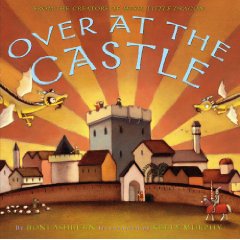 Most versions of the song Over In The Meadow center on animal communities. And there are so many different versions, every ecosystem on earth! Geesh- nothing new there. But wait. What about all the people at a busy place… like a castle! I did some research, and Bingo! Book #2.
I wrote a twin manuscript because I was tired of picture books that only showed the twice-as-nice, double-the-love side of twins. If you have twins, you KNOW this is only half of the story. Where are the twins who love each other but ALSO shove each other because they’re tired of 24/7 sharing? Mine DO that! So I wrote it.
When I’m stuck, I go to books. I read good ones and say, “Oh, that’s lovely. I wish I could write like that!” And I put them back on the shelf. Then, I find books that I don’t like and say, “Wow, I know how to take an idea/character/plot/theme/whatever like that and make it better.”
Bad books–I love them!
Boni Ashburn lives in the Upper Peninsula of Michigan with her husband and four kids. Her first book, Hush, Little Dragon, was called “Sweeney Todd for the sandbox set” by the San Francisco Chronicle and she can now die happy. First, however, she’d like to publish a whole shelf-full of children’s books. Boni’s next book, Over At The Castle, comes out in March, 2010, and she has two more picture books under contract for 2011.
Not All Who Wander Are Lost
By Dana Lardner
Languages and cultures have always been a fascination of mine. For as long as I can remember, I have always wanted to visit foreign places, exist in foreign spaces. I have been told repeatedly to slow down, put down some roots, and find a spot in the world to call my own. Every time I tried to heed this advice, however, it only seemed to stifle my creativity.
The challenge of ‘staying put’ had been something my head and heart had yet to reconcile until several years ago, when I spotted a bumper sticker in popular San Diego diner: “Not all who wander are lost.”
To this day, I find great solace in what I consider to be wisdom in two parts:
- Just because people may like to move to different places does not mean that they have not found their “place” in the world.
- Try not to apply judgment to things we may not understand.
So how does this apply to finding picture book inspiration? Regardless of if your bags are packed ready to hop on a plane to places unknown, or if you’ve lived in the same town since you were three years old, the bumper sticker is reminder to break out of the everyday patterns that often consume us.
We drive the same way to work. We read the same newspapers and blogs. We plan the same dinner menus week after week. How can we expect to see the world differently if we don’t change our daily perspective? If we don’t slow down and wander a little bit, how will we ever see what other grand things the world has to offer?
I therefore present the following suggestions to give you a jump start:
- Change the route you take to the grocery store once in a while even if it takes you longer to get there. What stores or subtle nuances on the street didn’t you notice before?
- If you typically drive a car, take public transportation. What types of people are riding with you and where do you think they’re headed?
- Take your children to a new park on the other side of town. How do they interact with the other kids and the play structures differently than at their usual park?
- Follow someone on Twitter or subscribe to a blog feed of someone who does not see the world in the way you do. What have they said that makes you stronger in your resolve or more open to new ideas?
- Take a stroll around your neighborhood and be sure to walk on both sides of the street. Has the neighbor done something new to the yard?
Remember: Not all who wander are lost.
Where will you wander today?
 Dana Lardner has a bag waiting by the door to travel at a moment’s notice. She is currently developing picture books that teach children about culture and difference while also keeping her belly laugh in shape with her line of motivational workout towels called Words to Sweat By™.





 Writing for Kids (While Raising Them)