You are currently browsing Tara Lazar’s articles.
Come visit a new website that lets kids spread their storytelling wings.
Storybird is “collaborative storytelling for family and friends.” When I first heard the tagline, I scratched my head. What is this all about? Then I got the beta tester invite. And I played on the site for hours. Days. My daughter begged, “Mommy, can we make another Storybird?”
So what is this high-flying new creature?
Storybird helps you create a tale with an intuitive book-like interface and a whimsical selection of artwork. (We’re not talking stick-figures here. These are high-quality images from some of the most talented “undiscovered” children’s illustrators today, like Irisz Agocs and Victoria Usova.)
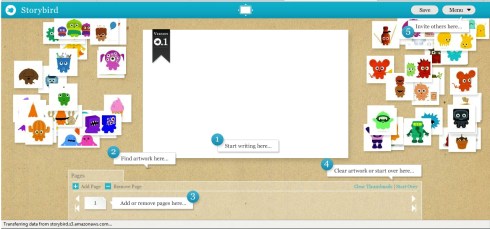
Select an artist’s work to begin. A page appears in the center of the screen, surrounded by thumbnail images. Simply drag and drop an image onto a page, then write text to accompany the picture. Add as many pages as you like and you’ll soon have a bonafide book—one that looks professional, one that can be read online over and over again. You can choose to keep your Storybird private, or you can share it with the Storybird community. And they can read it online over and over again.
But the smartest feature of Storybird brings family and friends together. Is Grandma in Gary, Indiana? Cousin Kate in Kalamazoo? You can invite them to write a page in your story. Or two pages. There’s no limit…and what’s better, there’s no fee to join Storybird. According to CEO Mark Ury, “Making, sharing, and reading Storybirds online will always be free. Printing and premium services—when we introduce them later this year—will have a fee associated with them.”
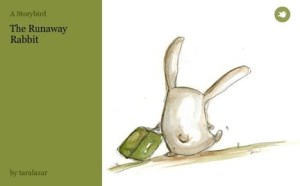
Read this Storybird
(Uhh, Mark, could you please hurry up with that? My daughters want a copy of The Runaway Rabbit in their hands right away.)
Other planned features include the ability to: choose artwork based upon theme, upload your own images, and record your voice to accompany Storybirds. For those on the go, an iPhone app is coming, too.
What’s more, Storybird wants your ideas to improve and enhance the service. The site has only been live for 6 days, but educators in over 100 countries have already asked for a multi-user platform to help teach literacy skills in classrooms. Ury says his company is working on a teacher log-in that would enable students to work under that account without having to submit their information. Storybird be nimble, Storybird be quick.
And Storybird be popular! Some stats from their not-quite-a-week online:
- 1,000 users in 100+ countries
- 8,000 unique visits
- 76,000 page views
- 7-minute average visit
- some Storybirds viewed 325+ times each
Families and teachers will see enormous benefits in Storybird, as will artists. Storybird creates a marketplace to share your work and develop a fan following. If you’re an aspiring children’s illustrator, I encourage you to sign up.
So what are you waiting for? Slide a kid onto your lap and flap your wings on over to Storybird. (Or, if you’re like me, you don’t even need a kid. The child inside you will have plenty of fun on her own!)
 When my father got a Kindle, he was awestruck by its instant gratification: “The books come out of the air!”
And now, I have a similar cry of joy: “The books hover in the air!”
I’m not talking about a Kindle, which is still too steep for me to consider. No, I’m referring to the amazing Umbra conceal bookshelf. (Which, at less than $10 from The Container Store, is a whole lot cheaper than any e-reader.)
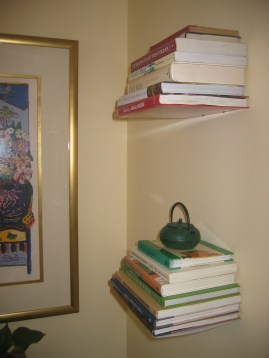
Magically, a stack of books sits upon the wall, seemingly suspended sans anchor. An artful arrangement, as minimal as minimalism gets, the Umbra conceal bookshelf creates a floating home for a flotilla of tomes.
How it works: the L-shaped bracket screws into the wall. Place the last page of a book on top of the shelf and slide it to the wall. Below the shelf, two tiny hooks hold the back cover up—ingenious! You can then stack 6-8 books on the first, concealing the bracket on the wall to create the levitation illusion.
 However, there are a few caveats. With the large shelf, the books should be no deeper than 10”, and the total weight of the books shouldn’t exceed 20 lbs. or they will sag. (Grab a stack of books and weigh it on your bathroom scale. I had what I thought was a heavy bunch, but it was only 13 lbs. No sweat for the Umbra.)
Next, the arrangement of books can be a little tricky. I bought two shelves for cookbooks. I have about 40, and it took some shuffling to create perfect pyramids of progressively smaller books. Some books were smaller in length, but not in width—and vice-versa. If you have a large collection of books, however, finding a pleasing aerial aesthetic shouldn’t be an issue. You can even display small objets d’art atop the books, as I did with a Japanese cast-iron teapot.
Finally, you need to install the shelf into a stud and use a hardcover for the bottom book. But paperbacks work well mid-stack, as you’ll see I put the meatless Moosewood between Jim Dodge and the Barefoot Contessa.
Books are works of art, and never before have they been so suitably displayed. I can’t imagine the Kindle being hung on the wall for artistic appreciation. But go ahead, get your e-reader. I’ll just keep buying more books…and more Umbra bookshelves.
Kidlit Book Trailers
Bookselling is changing rapidly with advances in technology and the belt-tightening economy. Publishers and authors are having an ongoing discussion of electronic rights, trying to anticipate the future of digital books.
But the forces of technology aren’t all daunting. Heck, authors are having a blast creating book trailers to promote their titles. What better way to capture the attention of an increasingly online, plugged-in audience?
Award-winning storyteller Dianne de Las Casas has created a Ning community for sharing and discussing kidlit book trailers. Authors are invited to post their trailers and other videos (like a school visit). Bibliophiles can browse the selections to discover great reads.
http://kidlitbooktrailers.ning.com
Haven’t seen a book trailer? Here’s a gorgeous one from the site: Where the Mountain Meets the Moon by author/illustrator Grace Lin.
The Unread
Here’s where you cover your ears because I’m gonna toot my own horn. Picture book author Heather Ayris Burnell (Bedtime Monster, Raven Tree Press 2010) interviewed me for her Unread series of aspiring authors. As you may have guessed, there’s almost as much talk about food as there is about books.
Besides Unread, Heather’s blog is dedicated to author interviews, book reviews and being a writer and librarian. So there’s lots of reasons to visit regularly.
http://frolickingthroughcyberspace.blogspot.com/2009/08/unread-interview-with-tara-lazar.html
Mitali Perkins’ Fire Escape
I am in awe of this woman. Not only is Mitali Perkins an amazing novelist, she shares the most compelling kidlit news and information via Twitter and her blog, with special emphasis on multi-cultural issues. If you haven’t visited, you really need to.
http://www.mitaliblog.com
http://twitter.com/mitaliperkins
Meet Eric Carle
August 23, 2009 marks Eric Carle’s 80th birthday and there’s a big bash at The Eric Carle Museum of Picture Book Art in Amherst, MA. Crayola will unveil “The Very Hungry Caterpillar Green” crayon as part of the celebration. Wow, getting a crayon named after your work. Now that’s iconic.
http://www.carlemuseum.org/Programs_Events/Upcoming/Meet_Eric_Carle/
Sudipta Bardhan-Quallen’s Picture Book Intensive
On November 15, picture book author Sudipta (yes, she has earned one-name status) will lead a four-hour picture book intensive workshop in Princeton, NJ for the NJ-SCBWI.
Some topics she’ll cover:
- Choosing Timeless Themes
- Ebb & Flow of Tension
- Creating Emotional Attachment to the Main Character
- Finding Ways to Make Your Book Re-Readable
- Humor and Heart
- Query Letters
- Marketing
I know I’ll be there!
For more info:
http://sudiptabq.wordpress.com/2009/08/10/picture-book-writing-intensive-workshop/
To Register:
http://www.newjerseyscbwi.com/events/091115-pbintensive.shtml
Do you have any can’t-miss kidlit links to share?
Remember Andy from the movie Funny Farm? Chevy Chase in his post-Caddyshack and SNL days, sliding down fame’s slippery slope, but still hilarious as a wanna-be author who moves to rural Vermont to pen The Great American Novel.
Instead of peace and quiet, Andy gets a crazy mailman and an acute case of writer’s block. It’s a fish-out-of-water story, one that inspires his wife Elizabeth to name a squirrel after him in her first children’s book—a book that a publisher accepts with a $5,000 advance. (She asks, “Is that much for a first book?” as he reels.)
Many children’s book editors warn against submitting talking squirrel tales. Seems they’re overdone. Was Elizabeth from Funny Farm to blame for an influx of fluffy rodent submissions? The world may never find out.
Despite the creature caveat, I’m writing about squirrels. But non-fiction, based upon our recent experience.
A violent July storm blew a squirrel’s nest from a tree near our property. A neighbor and I found day-old squirrels on the bike path. Gently, we moved the nest onto the grass. I assured her since the tree was closest to my home, I would contact the proper authorities. I assumed the police or animal control would be the right call.
I was wrong. Had I telephoned those authorities, the squirrels might have been destroyed.
Instead, I found an informative resource in Squirrel-Rehab.org. I learned that if the babies were cold, the mother would not take them back. The nest was covered in hail from the storm. The pups were indeed cold and wet, squirming and chirping, in obvious distress. I followed the instructions to warm the babies and tried to reunite the family, but by 10pm, the mother was still missing as another raging storm began. I brought the babies into my home.
I cared for them for nearly 48 hours and then brought them to licensed wildlife rehabilitators Wild Baby Rescue in Blairstown, NJ. The video below documents our short time with the squirrel pups, the inspiration for a new story. Elizabeth, you ain’t stopping me.
I’m back from vacation.
We unlocked the door and dumped our bags, adding to the stray belongings flung about during our packing tornado. Then big sighs on the couch, surveying our natural disaster.
This stinks. Or maybe I should say the house stinks, being closed up for two weeks with a cucumber rotting in the fridge, mossy and shriveled like a dead pickle.
We’re home and I’m in a funk. There’s no sugar-coating the post-vacation blues. (And since the cupboard is bare, I have no sugar anyway.)
 There was no fiction writing on vacation. I barely even thought about writing. I snapped a photo of the charming Beach Haven Public Library to serve as inspiration for a new story, but that was it. The needle is pointing to “E” on my inspiration gauge.
So how do I jump back in the saddle again, I wonder? From where does the motivation arise? I sent nothing out on submission recently, and my middle grade work in progress has been frozen in mid-chapter ever since I received conflicting feedback at the NJ-SCBWI conference.
I used to be in a hurry to get my work published. I had a timeline for getting stories done and accepted. I’m not making that deadline, and what’s worse, I feel guilty that I’ve let this self-imposed schedule slip. I have friends with new agents, friends with new book deals, exciting happenings that should shove me into gear.
But, no. I’m still sculpting sand mermaids on the beach.
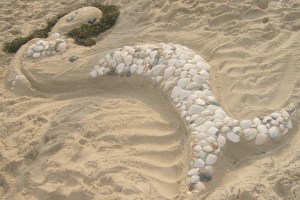 Perhaps that’s as it should be. I hear you saying, “Everyone needs a break, even writers!” But for the past few years, I didn’t believe this to be true. I write because I must write. I possess a DNA code that compells me to be creative. Shouldn’t I be writing every free moment of the day? And if I’m not, can I still call myself a writer?
An epiphany came yesterday while out to brunch. An elderly woman stopped by our table. With her fingertips brushing the tablecloth she said, “You look like a happy family. That’s so nice to see.”
I nearly teared up at her kindness…and at the realization that my publication woes are stupid, silly. I have a healthy family. A good life. I am a writer. I will write. The stories will come. Someday, they will be published. I will keep working until they’re good enough.
So for now, I’ll ride Western side-saddle. No need to gallop when I can mosey back in.
How about you? Do you have the late-summer blahs? How do you get motivated again after a break? After a rejection?
 When one arrives at their summer rental home, the sandy carpets, wood paneling and fishnet curtains can be largely ignored. You’re there for the beach, not for the house.
But when a foodie arrives in their temporary accommodations, the heart sinks upon discovering a less-than-accommodating kitchen.
Preparing for our annual excursion to the Jersey shore, I packed the extra virgin olive oil, garlic, ginger and jars of spices. I collected basil, chives, parsley, cilantro and mint from my garden. Yet I didn’t bring my trusted chopping knife, so I’m forced to mince and julienne with a butter knife. What I wouldn’t give for a serrated edge.
The hutch stores silverware for 50 people and wine glasses for 75, but not a single can opener that works. I must remind myself to buy dried beans next year.
Paper-thin pans burn their sizzling contents even on the lowest heat, so I’ve adapted a cooking method of removing them from the stove every few seconds. On, off. On, off. The scrambled eggs cannot brown, or else the kids will deem them “dirty.”
The first few days were filled with frustration. I cursed the dull peelers, all seven of them. I laughed at the bevy of bottle openers. If two dozen people wanted to open their Coronas in unison, no problem. There’s an entire shelf of serving platters, but not a single baking dish.
But now I’ve settled into the groove of my poorly stocked summer kitchen. Forced into a culinary simplicity, I plan our meals accordingly. Grilled chicken with roasted tomatoes. Pasta with grated cheese and torn herbs. Sole with browned butter sauce (I knew those pans were good for something). Cutting shortening into flour for biscuits works just as well with two forks as a pastry blender.
When I’m forced to do without, doing with seems complicated. For instance, my cupboard at home features the fruits of a ridiculous Nordicware Bundt pan fixation. But the shape has nothing to do with taste. Baking on an island with inferior cookware feels like a greater accomplishment than serving a cake that resembles a castle. Those pans allow me to cheat. What epicurean expertise can I claim if I own every tool of convenience?
So I’m learning to love my summer kitchen and the skills of culinary compromise it’s teaching me. Now if I could just rip that fishnet off the window, this house might be perfect.
Yes, I’m on vacation and this blog is quiet. Can you guess today is rainy? I will return to kidlit upon returning home. I hope you’re having a fun and relaxing summer!
Agents and editors have told me they occasionally receive calls from writers who are brand new to children’s books. These aspiring authors ask, “How do I get my book published?”
Kindly folks that they are, these agents and editors don’t slam the phone down. They’ll sometimes spend a few moments providing basic details. But this information can be easily found online. That’s what makes being a new writer so exciting these days: there’s professional advice available via websites and blogs, you just have to search for it. It’s not all so mysterious anymore.
So if you’re looking to launch a kidlit career, please don’t call an agent or editor to learn the basics. Let them read manuscripts, sell books and do their jobs. Come here instead…
A New Children’s Writer’s To-Do List:
- Write.
I knew you’d like that one. - Read children’s books.
Become familiar with the genre in which you write. Understand appropriate length and content for specific age groups. See what’s being published. Don’t follow trends, but know the competition. When pitching editors and agents, it’s often helpful to compare your book to another title. You can’t compare if you aren’t well read. - Join SCBWI.
Take advantage of their resources—local chapter events, national conferences, online discussion boards and publications. - Join a critique group.
Find fellow writers who work in the same genre as you. They provide support, motivation, and helpful feedback. (And if you can, find a group with writers who are more experienced than you.) P.S. Your mother, daughter, spouse, and neighbor’s 2nd grade class are not a critique group. - Attend workshops, conferences and events.
Seek out opportunities to learn and network with authors, agents, editors and writing peers. - Read books on the craft.
Writer’s Guide to Crafting Stories for Children by Nancy Lamb
Writing Picture Books by Ann Whitford Paul
Writing for Children and Teens by Cynthea Liu
Writing with Pictures by Uri Shulevitz - Revise and rewrite.
It’s not going to be right the first time (or maybe even the second or the fifteenth). It’s just not. Resist the temptation to submit an early draft to a publisher. - Take time to develop your skill.
Your writing will improve with practice. Most professional authors need at least two years of serious writing to hone their craft, and it’s not unheard of to work for ten to fifteen years before becoming published. - Submit when you have more than one project polished.
Finished your first manuscript? Keep writing. If an editor or agent likes your manuscript, but not enough to make an offer, they may request other material. Have a few manuscripts at the ready. - Learn to have patience.
It can take many years to write publishable material, sell your first project, and develop a career. Even after you become published, the business is still full of waiting—waiting to hear from your agent and/or editor, waiting for a book to be released, waiting to earn out. You will never NOT be waiting. Patience and perseverance are key. - Call yourself a writer.
Because you are one!
If you have some newbie suggestions, let’s hear them. Please leave a comment.
 Ever have one of those light-bulb moments when your manuscript finally gels? Your plot falls into place and you wonder why you didn’t think of something so simple and perfect before.
Sitting in on Sudipta Bardhan Quallen’s picture book workshop last month, I had a dozen lightbulb moments. She dissected picture book structure like a biology teacher dissecting a frog–she split it wide open and showed us its heart. (OK, maybe that analogy wasn’t good for the squeamish, but she has a science background, so I think it works.)
For example, she suggested inserting a “ticking clock” into our manuscript. A deadline makes the story urgent and exciting. (Eureka!) If you’ve never heard her speak, you’re missing out on one of the finest picture book tutorials anywhere.
Besides being wicked sharp, Sudipta has a nervous energy that’s endearing. Get her engaged in conversation, and she’ll talk non-stop about her love of children’s literature. (And high heels and shopping on Bluefly. Yes, she’s a girly-girl like me.)
Surprisingly, she never dreamed of becoming a kidlit writer. She’d thought of being a doctor (but she’s afraid of blood), a model (but she likes to eat), and the President (but she had a dissolute youth). So much for childhood dreams.
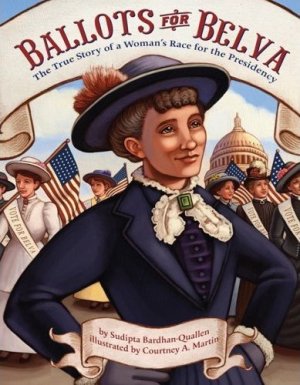 But now she’s the author of 11 picture books and 16 non-fiction books for children including The Hog Prince (Dutton), Ballots for Belva (Abrams) and Tightrope Poppy the High-Wire Pig (Sterling).
So Sudipta, if you didn’t want to be a writer, how did you get into the kidlit business?
I got pregnant twice in the span of 15 months and had to move from California (where I’d been going to grad school) to New Jersey (where a little piece of me dies every day). Like every other new mom in the world, I decided I had stories that I just had to tell my kids and so I started writing. I also had this idea that writing was totally a job I could do with two babies in the house, which was just stupid because you can’t do anything with two babies in the house.
Amen to that! I can’t do anything with two babies out of the house, either. (And by the way, I’ll let that NJ crack slide.)
When I started writing, everything was really bad. Some day, when I am super-famous, I will pull out my Alphabet book, and my going-to-the-zoo book, and all the other requisite bad stories we all write when we start. But eventually, I figured out to go to conferences and read up on the craft of writing, and I started to get things published.
How did you get your first big break?
About two months after I started writing, I wrote up a short story for Highlights. It was something that had actually happened to a friend of mine, with a bit of fictional dramatization. Highlights bought it and it was the first $200 I made writing.
 I also randomly got a foot in the door of children’s publishing by mentioning my science background in a cover letter. I’d sent a picture book manuscript to Sterling, which they rejected, but in the rejection the editor asked if I’d consider writing a science experiment book for them. That became Championship Science Fair Projects, which still sells really well for me, and a few years later, my first picture book, Tightrope Poppy, was published by the same editor.
New writers are often told not to mention irrelevant information in queries, but your science background landed you a contract. What exactly is your science background?
I graduated Caltech in 1998 with a BS in Biology (by the way, with the passage of years and my gradual failure to remember even the most basic biology concepts, BS is becoming more and more appropriate). I spent a year at Harvard, but it really wasn’t for me, and then headed back to Caltech as a PhD candidate in developmental neurobiology. But those plans went off the rails when I had two babies. I had this crazy idea that I could write with two kids in the house—which you totally cannot do—but that’s how I got into the writing-for-kids business.
Normally, I recommend that you don’t mention anything other than kidlit in your cover/query letters, but if you keep it short and sweet, you can throw some things in there. I think the line I wrote was something like: “I have a Master’s degree in Biology from the California Institute of Technology and have published several scientific articles.” That doesn’t take up so much space that it is annoying.
What has surprised you most about being a published author?
So many things have surprised me about being a published author. Hard to pick just one. So I wrote a Top Ten list. I love Top Ten Lists. Except after I start writing and realize that I only have six interesting things to say. But who’s ever heard of a Top Six list?
Top Ten surprising things about being a published author:
- That the advances are so small that after everyone has had their cut and you’ve paid all your expenses (whether it’s permissions, or research costs, or just the cost of babysitting that allowed you to write the book) you have just enough money left over to take your family out to dinner. But only if they agree to go Dutch.
- That you can’t just show up at a book store and expect them to have your book. Or believe that you are a real author.
- That there’s a 50-50 chance that the number of kids that are biologically related to you who show up for a book signing will outnumber the number of kids that are NOT biologically related to you.
- That no matter how much market research you’ve done, there’s a good possibility that there is a really similar book out there that no one has ever heard of – except the person writing the review.
- That even though the publisher picks up the tab for producing the book, all of the marketing responsibility is on you. So if you want anyone beyond your mother and your best friend to know about it, you need to get your butt in gear.
- That you know no more about writing or publishing after the contract than you did before. Even though everyone expects that you do.
- That the more successful you get and the more books you publish, the less of your writing time will actually be devoted to writing.
- That when you and a group of writing colleagues meet certain editors (who may now be agents…), no matter how many books you’ve done, the first comment he will make is, “So… you all are *moms*, huh?”
- That it is a long time before you move “real author” into the list of things you consider yourself. I still haven’t really gotten there.
- That going to a school for an author visit is as close to being Angelina Jolie as you will ever get. And it’s a pretty cool feeling.
How did you begin to bill yourself as a speaker?
I started to volunteer to speak at conferences because I wanted to teach what I had learned about the craft of writing picture books to other aspiring writers. I got a lot out of SCBWI events in New Jersey, and I wanted to give back. Also, teaching helps you learn in ways that doing does not. For example, at this year’s NJ-SCBWI annual conference, I gave a workshop about rhythm, rhyme, and repetition. I talked about using a refrain in your picture book manuscript to give it narrative structure—and it was the first time I had consciously realized that that was something I do a lot in my own writing. Having to teach it, however, was what made me conscious of it.
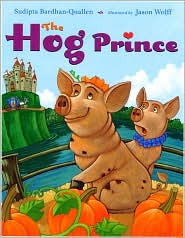 Some authors say they learn something about themselves with each new book. What did writing The Hog Prince teach you?
In my workshops, I emphasize the importance of the market over and over again. I’m constantly saying that I only write what I know I can sell. But as I review my own body of work, which has finally grown large enough that I feel comfortable calling it a body of work, I notice that, within the confines of what I feel the market can bear, there are themes that I subconsciously explore time and again. And these are the themes that resonate most strongly for me.
In The Hog Prince, Eldon dreams of being something he is not. He believes that if he were to change by magic, his life would be better, that everything would be shiny and pretty and luxurious and grand. And while I run the risk of coming off as having no self-esteem at all (which is not true, I have an itty-bitty bit), I can say that there have been plenty of times in my life that I have felt this way. In fact, I don’t think it is just a childhood thing–I’m not sure that we ever completely grow out of feeling like everything about our lives would be improved if only we could change ONE little thing. Except that it is never a little thing, nor is it one thing, nor will your life actually get better.
What’s nice about the story is that Eldon figures out that he is worthy and precious just the way he is, and that the folks who really matter (in his case, Petunia) don’t want him to change one muddy little thing. I struggle with this lesson, and I think a lot of kids do, too. Hopefully, that’s what makes the story timeless.
So, here is what I learned about myself:
- I sometimes wish I could change into royalty;
- I use my books to sort out emotional issues;
- I think that every story is better is you replace the main character with a pig.
You may be right there. Who doesn’t love pigs? I mean pigs in literature. Real pigs, not so much.
Thanks for the interview, Sudipta! I think I know what the blog market can bear, and although I’d love to talk to you for another thousand words, something’s telling me to wrap it up here.
More of Sudipta’s serious-yet-sassy picture book philosophies can be found on her new blog, including a picture book writer’s Ten Commandments. Thou shalt not submit a manuscript before its time…
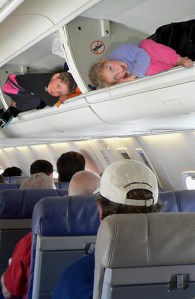
Image courtesy of Ma1974
I hate air travel with children. I mean with my own children. My goal for the flight is to ensure that my toddler and Kindergartener don’t disturb the other passengers. I don’t want them whining, crying, screaming, running through the aisles or otherwise causing mayhem. I remember being a stressed-out businesswoman and being seated near a miserable child. I have empathy for the childless travelers, honestly I do.
I spend a ridiculous amount of time preparing for the trip and devising solutions for worst-case scenarios. Flight delays. Missed naps. Sudden fever. Soiled clothes. Motion sickness. I’ve got it all covered, people.
My foolproof plan involves a bag of books. I read to my children on the flight. (Oh yeah, I can’t forget the lollipops…great for easing the pressure on take-off and landing.)
However, I found out that my efforts to entertain and enlighten my children aren’t necessarily appreciated.
The older woman in front of me turned around in the middle of a story and asked, “How long do you plan on reading aloud?”
So continued a rudeness I’ve never experienced before, someone complaining about a happy, content family. She mistakenly said I had been reading for an hour when the flight had been in the air only 25 minutes, and she told me that if I was going to “read for another hour” she “wouldn’t be able to take it.”
Did you ever have one of those conversations where you wish you could say something different than what leaves your mouth?
I could let my children play bongos on the tray tables if you prefer.
A crying jag can be arranged.
We’re going to peek over the seats and force you into an endless game of peek-a-boo later.
Instead, I apologized like the polite person I am. I was sitting in the last row with a terrible jet engine din and could barely hear what I was reading. Was I a little loud? Maybe. Could she have approached the subject differently? Sure. So could the cowardly husband who decided to give a rude stare and play with his seat, knowing that we in the last row had nowhere to recline ourselves.
She finished by not making eye contact. “Well, just lower your voice.”
Hmmm. I didn’t hear “please.”
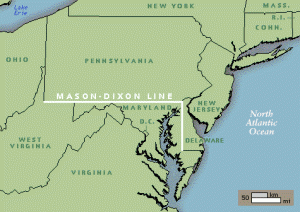 What separates the south from the north? Nope, it ain’t the Mason-Dixon. It’s the road signs.
New Jersey’s exit signs remind us that the road we’re on is not the road we want. Ads for dating websites wilt on the medians. The giant green gecko stares down at our cars, telling us to save on insurance. There’s not much personality there.
But South Carolina? There’s treasures along the roadside. And I’m not talking about boiled peanuts.
Reading the signs along a rural route, I was reminded of how small, specific details in your writing–like a street name or a slogan on a church billboard–can contribute loads to the mood and setting of your story.
Here’s the southern road signs that charmed me.
DAN
THE
MAN’S
Tractor Service
814-DIRT
Christians Like Pianos
Need Frequent Tuning
Minnows Crickets
Worms Sodas
Bee City
Honey Farm
Petting Zoo
Pumpkin Girl Road
Heavy Father Lane
There’s Only One Heaven
and Only One Way
to Get There
Groceries & Hunt’n Stuff
Welding
Organic Produce
Today’s Sons
are Tomorrow’s Fathers
Mars Oldfield Road
Vincent’s Venison
Processing Plant
There are stories buried in these signs.
Do you pet bees at Bee City?
Was Pumpkin Girl related to Heavy Father?
Is the welder married to the organic farmer? Or are they the same person?
Did aliens once land on Mars Oldfield Road?
What stories do your town’s signs tell?








 Writing for Kids (While Raising Them)