You are currently browsing the monthly archive for July 2019.
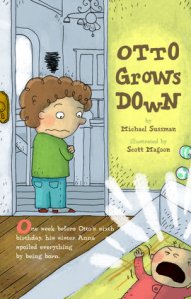
I first met author Michael Sussman when I reviewed his debut picture book OTTO GROWS DOWN, illustrated by Scott Magoon. I LOVED IT! In fact, OTTO remains one of my favorite picture books of all time, and I often refer to it when teaching humor and picture book workshops.
Michael wrote me a lovely thank-you email and we became fast friends and critique partners. He went on to write novels, but now he’s back to picture books and his latest, DUCKWORTH THE DIFFICULT CHILD, is creating a kidlit buzz for its retro vibe and dark humor.

 Michael, I’m so thrilled to have you back in picture books! It’s been a while since OTTO GROWS DOWN!
OTTO is the boy who wants his little sister to disappear, and she does. In DUCKWORTH, he himself “disappears,” but he didn’t want to!
For fun, can you compare and contrast OTTO and DUCKWORTH as characters?
What a wonderful question!
First off, I want to thank you, Tara, for all your help in promoting OTTO GROWS DOWN, and for being such a wonderful critique partner for so many years.
To my mind, what links Otto and Duckworth is that they both face dire circumstances which they must overcome without any help whatsoever from their parents. Unbeknownst to his mom and dad, Otto is trapped in backward time and will disappear altogether if he doesn’t figure out how to return to the present. Duckworth’s parents are oblivious to the fact that he has been swallowed by an enormous cobra, and he is left to his own devices to escape from inside the snake.
In contrast to Duckworth, Otto has a loving family, but must come to terms with an interloper: a new baby sister. In order to overcome his understandable resentment and animosity toward Anna, he must grow up and become aware of his burgeoning love for his sibling.
Duckworth is an only child and is faced with a far more difficult predicament: narcissistic parents who are utterly oblivious to his needs and concerns. Although Duckworth is as successful as Otto at conquering his life-and-death dilemma, the ending of his story remains bittersweet, as he is still stuck with woefully inadequate parents.
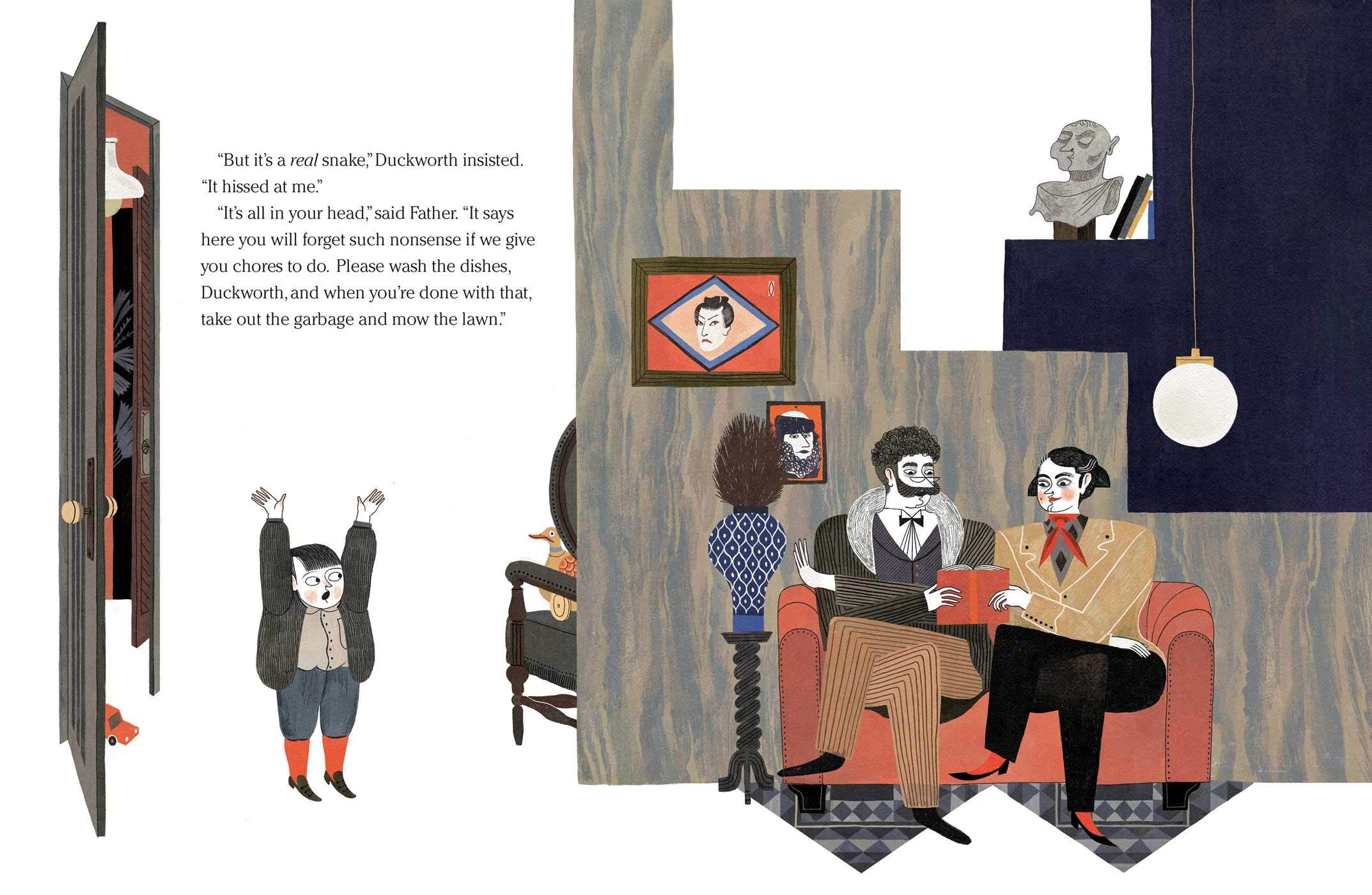
Poor Duckworth, stuck with oblivious parents who seem like the despicable adult characters in a Roald Dahl story. DUCKWORTH, as a whole, has a very nostalgic energy, like a picture book from days long ago. Did you get any inspiration from “dark humor” authors of the past?
 DUCKWORTH is my homage to the classic picture book, THE SHRINKING OF TREEHORN, by Florence Parry Heide and Edward Gorey, soon to be a motion picture directed by Ron Howard. I love the dark humor of Gorey, Dahl, and William Steig’s SPINKY SULKS.
What is it about those dark humor books that you admire? Why did you want to pay homage to them?
I guess I just like dark humor in general, and have featured it in both my picture books and novels. Dark humor presents unpleasant and taboo aspects of life in a satirical manner, taking the edge off and relishing in the absurdity of the human condition. In stories, it allows authors to address potentially painful topics—such as sibling rivalry in OTTO and poor parenting in DUCKWORTH—in a manner that’s less threatening and more enjoyable than a straightforward or didactic approach.
I was also eager to riff on THE TREEHORN TRILOGY because I felt it was under-appreciated and falling into obscurity. Now, thanks to me and Ron Howard, it’ll be rediscovered! 😉
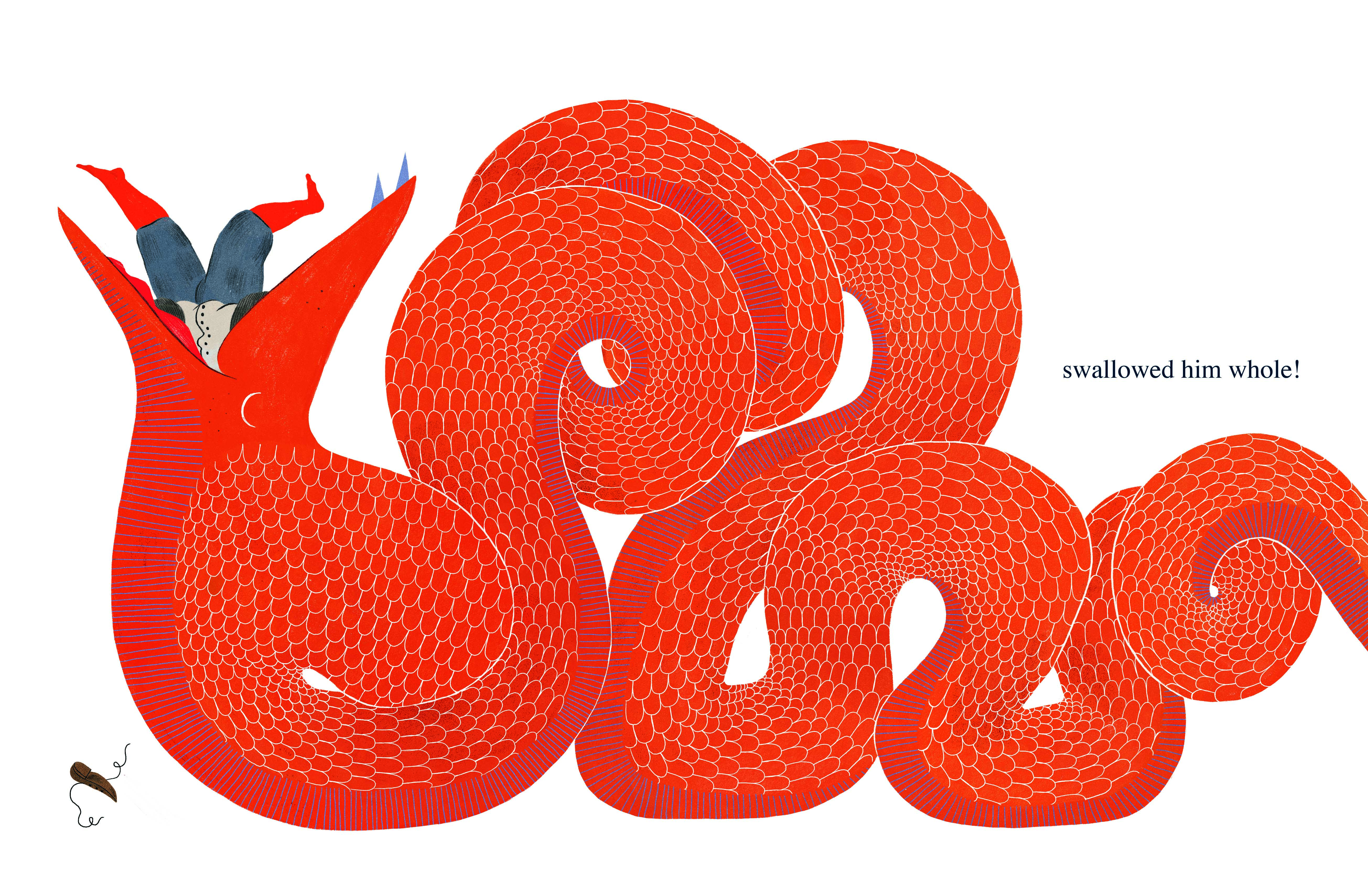
Let’s talk about the illustrations by Júlia Sardà. They are dark and mysterious, with a retro European surrealist vibe. (Maybe I think that because the mother looks like Salvador Dali?) The gorgeous cinnabar of the cobra jumps out and bites you.
The art takes full advantage of perspective—I love the illustration of Duckworth in the serpent’s stomach, surrounded by floating items the cobra has swallowed.
Is the art what you had imagined?
Júlia Sardà’s illustrations are spectacular, and way beyond anything I could have imagined or hoped for. Her style, sense of composition, and attention to detail are extraordinary, and perfectly complement the story. The illustrations are so striking that I actually became concerned that they’d overshadow the text, and convinced my editor—the wonderful Emma Ledbetter—to switch to a more dramatic font, and make use of drop-down letters to highlight the first word on some pages.
I was initially surprised by some elements of the artwork that diverged from what I’d expected. The snake is WAY bigger than I’d anticipated, and I think that was a brilliant choice. The mother’s face, body, and attire are quite masculine-looking, which bothered me at first, but I think this allows the parents to be presented as a single unit, which fits the story. (Not to mention that the mother, as I wrote her, is utterly devoid of maternal concern!) I expected Mr. and Mrs. Snodgrass, the neighbors, to look British, but they are decidedly Russian in appearance. Finally, Duckworth looks more peculiar than I’d envisioned him, but I’ve grown to like that. Initially, he looked far too old, but Emma and I convinced Júlia to make him younger.


So there were some changes and edits to the art. What about to your original manuscript? Did anything turn out differently than the version you submitted?
Initially, the boy’s name was Bowlby. I wanted an odd name, to parallel Treehorn, and I think I unconsciously selected Bowlby because of the famous British psychologist, John Bowlby, who did pioneering work on maternal deprivation. But Emma wasn’t wild about the name, so I made a list of unusual monikers, and the two I liked the best were Duckworth and Digby. My son, Ollie, preferred Duckworth, which Emma liked as well, so I used Digby for the name of Duckworth’s cousin.
Ha, Bowlby is a funny name, but I do like Duckworth far better!
In giving a workshop on humor recently, I talked about “superiority humor” and how feeling superior to someone else is a cause of laughs.
In DUCKWORTH, the child feels superior to the parents, and I think your reader will also feel superior to the Mr. & Mrs. Was that a deliberate decision to make the adults in the book so hapless?
Superiority theory states that we laugh at the misfortunes and shortcomings of others because it makes us feel better about ourselves. And indeed, a portion of the story’s humor stems from seeing the pompous stupidity and ineptitude of Duckworth’s parents. The vast majority of parents who read the book to their kids will be able to pat themselves on the back, thinking I may have my faults, but I’m a far better parent than these hapless twits.
But I think that Incongruity theory, the notion that humor derives from the enjoyment of a perceived or imagined incongruity, is a better fit here. The discrepancy between Duckworth’s desperate plight and his parents’ haughty indifference and self-preoccupation, is amusing.
Surrealist or absurdist humor is also at play, in that the story presents a ridiculous situation that is impossible to take seriously, and the obliviousness of Duckworth’s parents is exaggerated to the point of absurdity.
Well, I think you use all those forms of humor brilliantly.
I’ll close our interview with how I typically begin…
You know I host Storystorm to inspire writers. So what inspired DUCKWORTH?
Well, I was suffering from writer’s block at the time, so I resorted to my patented Whack-a-Plot™ titanium mallet, which I invented for your 2010 PiBoIdMo (forerunner to Storystorm). Within seconds of regaining consciousness, the story came to me in a flash.
Seriously, folks, the story was inspired by a visual image, which is unusual for me since I have aphantasia, a condition where one does not possess a functioning mind’s eye and cannot voluntarily visualize imagery. (I’m not making this up.)
One summer evening, while taking a stroll, an image passed through my mind of a snake that had swallowed a child. As I imagined the bulge working its way down the length of the serpent, it struck me as a compelling (if somewhat macabre) basis for a picture book. I recalled a similar image from The Little Prince, but when I returned home, I discovered that the prince’s drawing was of a boa digesting an elephant. (Although, as the prince notes, grown-ups all thought it was a picture of a hat.)
I worried that my concept might be too scary for young children, unless I made it a funny story, so I decided to model the tale on THE SHRINKING OF TREEHORN.
Michael, I think you’ve created a new classic! Thank you for chatting with me about DUCKWORTH!
Blog readers, Simon & Schuster is giving away 2 copies of DUCKWORTH THE DIFFICULT CHILD.
Just leave one comment below to be entered in the giveaway.
Two random winners will be selected in mid-August.
Good luck!
 Abandoned by a cackle of laughing hyenas, Michael Sussman endured the drudgery and hardships of a Moldavian orphanage until fleeing with a traveling circus at the age of twelve. A promising career as a trapeze artist was cut short by a concussion that rendered him lame and mute. Sussman wandered the world, getting by on such odd jobs as pet-food tester, cheese sculptor, human scarecrow, and professional mourner while teaching himself the art of fiction. He now lives in Tahiti with Gauguin, an African Grey parrot. Visit him at MichaelSussmanBooks.com.
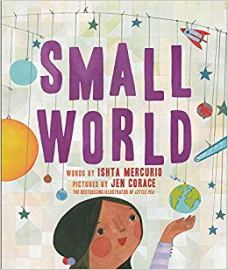
A few weeks ago, I saw a joyous tweet from Minh Lê praising SMALL WORLD, Ishta Mercurio’s debut picture book, illustrated by Jen Corace.
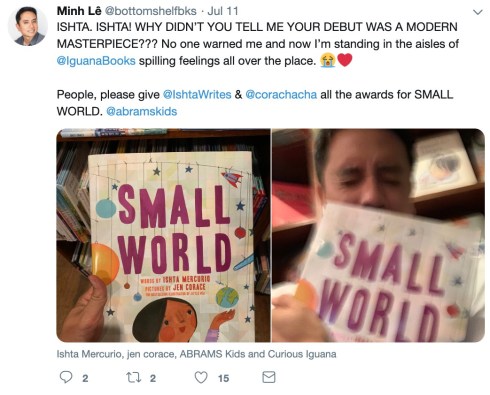
And then I remembered—I’m supposed to be interviewing Ishta about this very book! WHAT A SMALL WORLD!
But no, this SMALL WORLD is not like that Small World. No earworm here.
This book is about our changing perspective as we grow, learn and achieve…and our place in the world through the stages of life. It’s a beautiful book that landed at just the right time.
Ishta, since I run Storystorm, let’s talk about the idea for this book first. How did it originate?
I love this question, because it shows how ideas really can come from anywhere.
I was on a plane (in the window seat, which is my FAVORITE SEAT—it’s one of the perks of being short!), flying home from Oregon, looking down at a large body of water. I noticed that there was a cluster of white flecks on the surface of the water that kept disappearing, then reappearing further along, then disappearing and reappearing again, and it occurred to me that they were probably caused by a pod of whales or dolphins or something. And that got me thinking about how tiny those flecks were from my vantage point inside the plane, but how big a whale would be if I were sitting next to one… And I also started thinking about how much diversity the world holds: in plant and animal species, in cultures, in land forms… And I wanted to explore how a child might sit with and come to terms with that, with this knowledge of the world’s complexity and of our small-but-also-big role within it.
I see your other published book is about insects. Do your ideas often come from nature?
t’s funny, but most of the time, they don’t. Or if they do, I get about halfway through the brainstorming session before I realize that my idea is actually just an extension of SMALL WORLD, or of another manuscript that I’ve already written. Most of the time, my ideas come from something I’ve overheard in a cafe or on the train, or from a news article, or something my kids will say, or my dog. (I have a couple of ideas I’m playing with that have come from my dog…)
OK, I’ll bite! Tell us about your dog and dog stories!
We got him from a rescue organization. His name is Rocket, and his mother was a feral dog in an area that’s a bit overrun with feral dogs, and she gave birth to his litter next to someone’s shed and abandoned them. So we have no idea what kind of dog he is! He looks a little bit Lab/Rottweiler/German Shepherd/Boxer. He’s stereotypically “dog-shaped”. And he’s big! He weighs 80 lbs., which is almost as much as me.
Without giving too much away, my dog stories were both inspired by this one silly thing that he does. But one is serious, and deep, and essentially social commentary, and the other is light and funny and very silly. I don’t know if they’ll both be published, but I’m having fun writing them.
Rocket is a cool name! And so in Nanda, the MC in SMALL WORLD. Can you give us the story behind the unique choice?
Finding a name for this character was a challenge! I went through several different names, looking for the one that was just right. At first, this character was a boy. I’m a mom of two boys, so I think it just felt natural for me to think of this character—who shares a lot of interests with me, but whose story isn’t really based on my own childhood at all—as a boy. But then about halfway through the revision process, I thought, “You know what? I have a lot of common interests with this character. And where are the books about girls who get to do things like this?” And so I decided that this character needed to have a girl’s name.
And then it came down to what girl’s name to choose! It needed to have two syllables, with the stress on the first syllable, to match the rhythm of the rest of the text. I wanted something soft sounding, that ended in an “a” sound or some other open vowel sound (as opposed to a closed vowel sound, like a long “e” sound), because this is a soft flowing lyrical kind of book. And, of course, a name can tell us a lot about a person’s background and family, and Nanda’s family is important in the first half of this book.
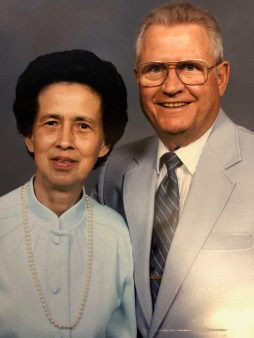 One of the things that people might be surprised to learn is that I come from a mixed background: my dad is Italian on his father’s side and Irish and German on his mother’s side, and my mom is Polish on her father’s side and Filipino on her mother’s side. Her dad was an American GI stationed in the Philippines during WWII, and he fell in love with a Filipino woman (my Lola) and they raised my mom and her brothers and sister there. My mom and each of her siblings came over to the US one at a time, as they each finished high school in the Philippines and enrolled in college in the States. And what’s interesting to me is that even though I take after my Filipino side in stature and bone structure and build, which is, like, 90% of my body, because I have my Italian grandfather’s face, most people are surprised to learn that I’m part Filipino. And I think that this is partly because we see what we’re conditioned to see: in other words, if the majority of books and movies and TV shows we see feature Caucasian characters, as most of them do, we become conditioned to look for the signs that point to that heritage. And we miss or gloss over the rest. I want us to be able to see each other more completely, and more clearly. And I want us to accept one another more readily. And giving books to children that broaden and deepen their understanding of people from a variety of backgrounds, and that illustrate the things that are different as well as the things we share, is part of that work.
So I wanted this child to come from an immigrant background. And the rest of the story of how I chose Nanda’s name is in the back matter of the book, so people will have to go and read that for themselves.
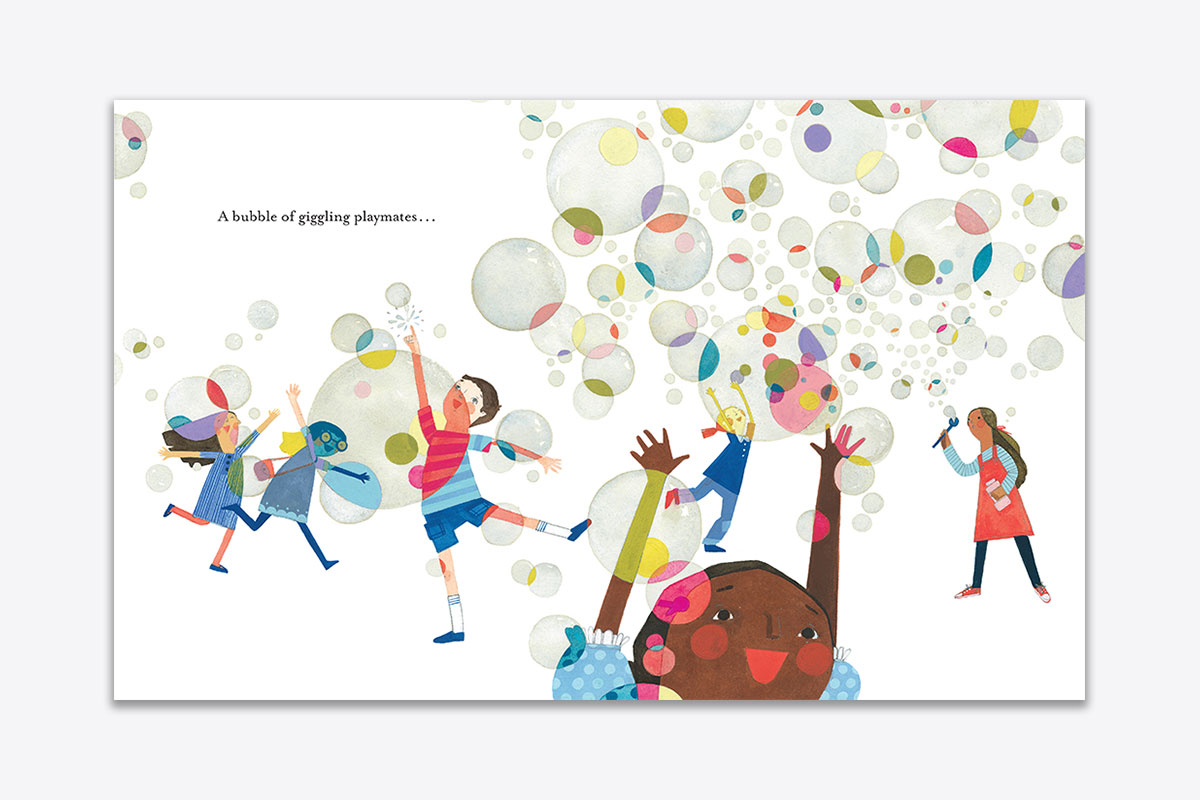
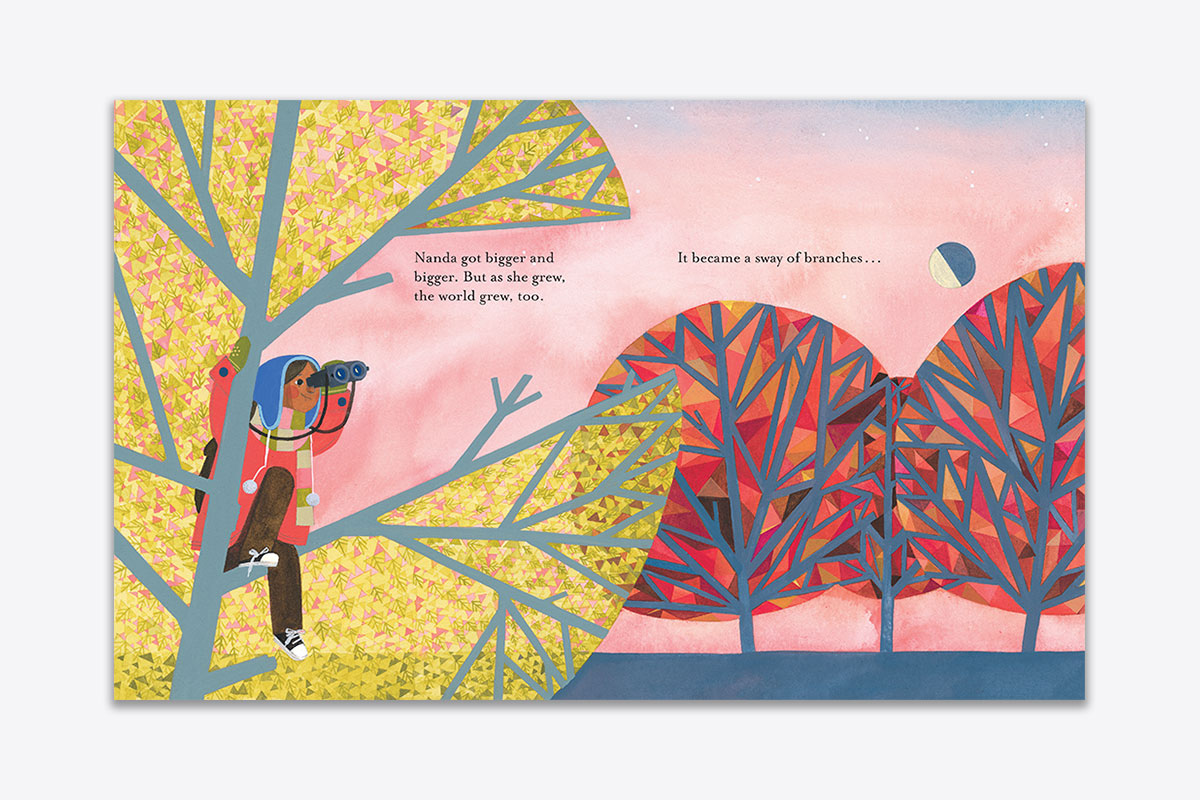
I was surprised at Jen Corace’s illustrations because they are a wildly different style from LITTLE PEA (with Amy Krouse Rosenthal), one of my favorite books. I suppose I should know that illustrators are wildly talented! Jen’s style in LITTLE PEA is spare and simple, lots of white space, childlike. While SMALL WORLD also has a childlike feel, the art is complex, layered and bursting with color. It emits a palpable energy!
Jen Corace did such an amazing, amazing job with the illustrations in this book. I love the way she picked up on the geometry references in the text and took them to a whole other level. But my favorite thing, and the most delightfully surprising thing, was the spread of Nanda building a cityscape with blocks in her bedroom! I love the way the city skyline she sees through her window echoes the skyline she’s building, and the star chart on her wall, and I especially especially love the pictures of female astronauts on her wall. When I recognized Sally Ride and Mae Jemison and Kalpana Chawla’s portraits, I gasped. Seeing these real women on the walls of this fictional character–tying Nanda to real kids, in the real world—was such a special moment.

What is the hope that you want to pass onto those who read SMALL WORLD? What do you want your readers to feel as they finish the book?
 I want them to be left with the feeling that even though each of us is one small person, we can still do great things. And I also want them to have a deeper appreciation for the Earth, which is the one place in all the Universe that we call home. It’s ours, and we *all* belong here.
Thank you, Ishta, for the interview and this gorgeous new book!
A book that blog readers can win!
Leave one comment below and a random person will be selected to receive a copy of SMALL WORLD, which is available in bookstores now!
A winner will be chosen in August.
Good luck!
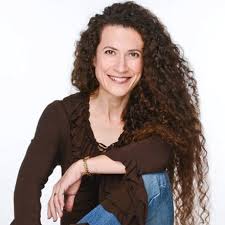 Ishta Mercurio was born and raised in Cincinnati, Ohio, until she was 16. Then she attended college in the Berkshires, spent a rustic summer on a Maine island, grew up and got married in England, found her home in Scotland, and made a new home in Canada.
She has been an environmental activist, a barista, a behavior therapist, an actor, and an author. I still am most of those things, but I only do a couple of them for money. Mostly, I am a storyteller.
Pull up a chair at ishtamercurio.com.





 Writing for Kids (While Raising Them)