You are currently browsing the monthly archive for October 2018.
SUN! ONE IN A BILLION released last week. I meant to have Stacy on the blog then to talk about her newest book. But the website went down, I had conferences and school visits, and my plans were sunburned to a crisp.
But the SUN rises again another day!

Stacy, I did not realize you had an “Our Universe” series, but it makes total sense since your book EARTH! MY FIRST 4.54 BILLION YEARS was such a hit.
Did you pitch EARTH as a series, or is it something the publisher requested?

EARTH was not pitched as a series. She’s a pretty independent planet and went on submission solo. When we sold the book to Henry Holt, it was a two-book deal but the only requirement for book 2 was that it needed to be funny nonfiction. Once EARTH was a finished book, we knew we had something special, and the publisher wanted to do more. And I wanted to do more! Currently, “Our Universe” consists of EARTH, SUN, MOON (2019), and OCEAN (2020).
That’s out of this world! But no Pluto?
What’s your take on Pluto, by the way? Planet or not?
 I just wish scientists would make up their collective mind! I heard Neil deGrasse Tyson speak last year, and he convinced me that Pluto is absolutely not a planet. But I recently read about a new study that wants to change the planet definition again (currently, the IAU—International Astronomical Union—sets the rules) and that would allow Pluto back into the group. For now, I will say Pluto is a dwarf planet and a loyal dog to Mickey.
You know this blog often focuses on how children’s book creators get ideas for stories.
So, what’s the genesis of EARTH?
And why is SUN the next in the series?
EARTH emerged from the wreckage of a failed project. I’d written a story about a pet rock, who lived with kids from cave times up to modern day. My critique group hated it. But I realized I wasn’t trying to tell a story about a rock. I was trying to tell a story about time and how humans are here for just a blink (in geological terms). So I refocused on telling Earth’s story because she’s been around for a bit.
When I talked to my publisher about doing more books, I pitched Sun, Moon, and Mars—all are extremely interesting. They selected Sun. (I’m glad they picked. I would have had a hard time making that choice.)
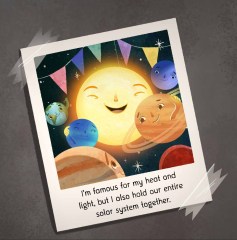

If you could be any planet, star or other object in the universe, who would YOU be?
I’d say Mars. I don’t want to be the center of attention—like Sun. Moon is a bit too familiar. Mars is the right balance of mysterious and recognizable. Plus, I think it’ll be the first planet Earthlings visit.
Well, thank you for visiting this blog, Stacy.
Henry Holt is giving away copy of SUN to a random commenter.
Leave one comment below and a random winner will be selected soon.
GOOD LUCK!
Happy Birthday, SUN!
Is it your 4,603,000,004th birthday? Or the 4,603,000,005th? Well, it’s OK, enjoy, who’s counting anyway?
STACY MCANULTY! She’s counting, that’s who! And she was counting on me to host her on the blog today.
But, you may have noticed, the blog has been DOWN for DAYS…while I co-chaired the RUCCL One-on-One conference this past Saturday and could do nothing about it. So, frantically on Sunday, I renewed the domain (after having mucho problems logging in), but it remained unprocessed. Then I woke up from a nightmare. Yes, this morning, I woke up from an actual nightmare, checked the URL and BAM! It’s back!
But I am also backlogged because I did not work with Stacy to create this wonderful blog about her second book in the Universe series, SUN, releasing TODAY!
So, consider this post a placeholder until I am able to get something worthy of Stacy, Stevie Lewis, and YOU, my dear blog readers, up and running today.
My apologies to SUN!!! Our favorite celestial body deserves better.
For many years I did a school visit presentation on voice. I’d begin by reading a line or two from popular books that I felt had distinct voices and then I’d ask the students to guess the titles. They always got them right!
So how do you create an unforgettable voice for your manuscript? I suppose the process is a little different for every writer but here are a few things I’ve discovered over the years.
1. Let the voice come to you.
I usually let my ideas percolate for several weeks before writing down a single word. During this waiting period the story is being worked out in my head and in the process, it’s forming its own personality. This personality continues to grow until one day it becomes too large to contain and the story (and its unique voice!) is literally told to me, not by me.
2. Never try to copy someone else’s writing voice.
It just doesn’t work and it’s not very honorable. However, you can (and must!) study other voices. Doing this might cause you to feel annoying pangs of envy. I can’t even begin to tell you how often I swoon and sigh and lament that a particularly charming voice in a book is not my own. The envy eventually turns into admiration and I’m inspired to work even harder at improving my craft.
3. Don’t try too hard.
If you try to force an overly clever voice it’s going to come across sounding disingenuous or convoluted and there’s a good chance you’ll end up ruining your story.
4. Less can definitely be more.
Sometimes writing short, punchy lines without a lot of frills can create the loudest, most memorable voices. A minimalist approach gives the illustrations more room to shine and tell the story.
5. Be flexible.
Personally, I don’t have much luck changing the voice in a story after it initially comes to me. I kind of feel like the story is telling me who it is and who am I to disagree? However, if for whatever reason, the manuscript is missing a spark, you may need to consider a new approach. Many stories that initially came to me in rhyme were eventually rewritten in prose. I almost always despise the non-rhyming version at first, but if I push through and give myself some time to adjust, I usually end up liking it better than the original.
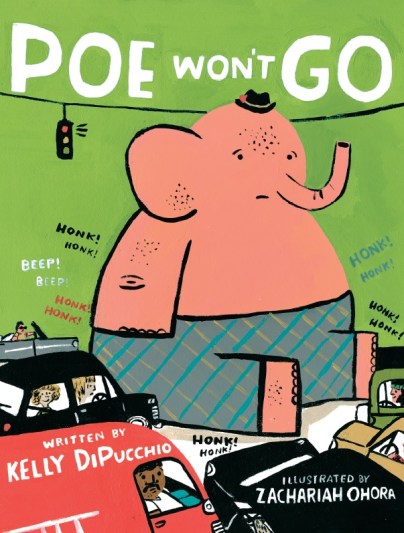
I didn’t set out to write a story about telepathy and the value of listening in my new picture book, POE WON’T GO. I thought I was writing a story about a stubborn elephant. But more often than not, I’m just a passenger when it comes to writing the first draft of any new story. I’m not entirely sure where the omniscient voice in my head is going to take me and I learned a long time ago it’s better to just relax and go along for the ride.
I thought it would be fun to ask Zachariah OHora, the illustrator of POE WON’T GO, for his thoughts behind the creation of the art of our new picture book and this is what he had to say:
First off, I’ve been a huge fan of your work, so I was pinching myself that we actually were doing a book together! After the happy delirium wore off a bit and I had time to think about the story. I started thinking about elephants and pink elephants like those from Dumbo. Delirium Tremens. A symbol of hallucination. And it made me think about how some of our problems can be a collective hallucination and that if we talked it out we could solve it.
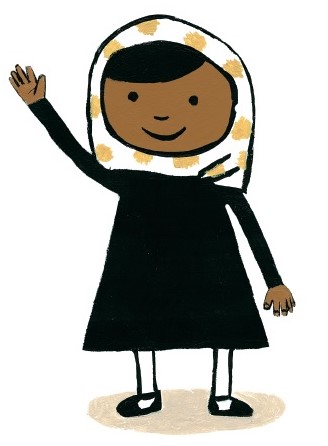
At the same time I was sketching it out, the White House was trying to ban people coming in from a seemingly random list of countries. All Muslim countries though, and they were obviously stirring up some racial and ethnic hatred. Which gave me the idea that the main character Marigold would wear a hijab and she would hold the solution for solving the town’s collective hallucination/problem.
And the solution is listening, right?
Speaking someone else’s language, or stepping into their shoes.
Try to understand what they are struggling with or worried about.
The small town of Prickly Valley then became a stand in for the whole world, which is why they are illustrated as impossibly diverse for a town that has only one light and intersection.

Each group of people tried and failed to solve the problem in how they were trained, usually by some form of force.
I had a lot of fun illustrating these constructions, some of which were in the text but there were plenty of others that were left wide open for anything I could think of. I got to illustrate four pages of text that were just:
“Remarkably, that plan failed as well.
As did this one.
And that one.
Nope. Nothing doing.
Seriously?”
What a gift for the illustrator! To have the openness to be surprised by the outcome.
That kind of generosity of spirit and trust which leaves room for real collaboration is the solution!
Marigold would approve!

Thank you, Zach! It’s been a true honor for me to work with you on POE WON’T GO. I couldn’t love it more. And thank you, Tara, for generously giving us both a voice here on your blog!
Thanks, Kelly, for teaching us how to speak elephant. And now, the elephant will sound the trumpet because we are giving away a copy of POE WON’T GO to a lucky blog reader who comments below.
One comment per person, please.
A winner will be randomly selected in a couple weeks.
Good luck!
 Kelly DiPucchio is the New York Times bestselling author of twenty-eight picture books for kids including Grace For President, Zombie In Love and Gaston. Visit Kelly at kellydipucchio.com or connect with her on Twitter @kellydipucchio.
Zachariah OHora is an award-winning illustrator and author. His work has appeared in numerous publications, including The New York Times, The Atlantic, and Bloomberg Business Week, and on posters and record covers. He lives and works in Narberth, Pennsylvania, with his wife and sons. Visit him at zohora.com or connect with him on Twitter @ZachariahOHora.
Last October, I headed into our pediatrician’s office with my 12-year-old who could not shake a deep, rattling cough. While we waited in a small, astronaut-themed room I wondered if my son might have pneumonia. While we waited some more, I wondered about this picture hanging on the wall.
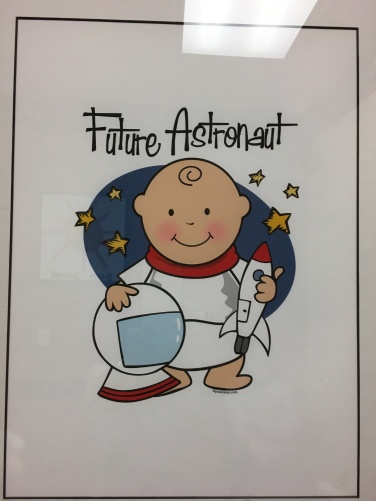
As a seasoned Storystormer, I knew inspiration could strike just about anywhere. The image of the baby got me thinking about board books. I knew science-themed board books were selling well. But I didn’t have much interest in writing a book of facts for toddlers. What about a book that showed a baby’s current skills and how they might tie-in with a future career? I made a few notes in my phone, snapped the picture, and got back to checking my son’s temperature with the back of my hand.
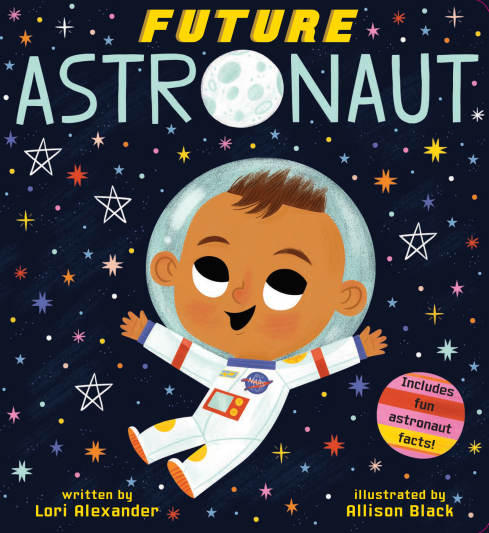
One year later, I’m excited to share FUTURE ASTRONAUT (Cartwheel/Scholastic), illustrated by the amazing Allison Black. Part of the “Future Babies” board book series, upcoming titles include FUTURE ENGINEER, FUTURE CEO, and FUTURE PRESIDENT. And because I’m such a fan of Allison’s, here’s a peek inside Book #1 and a few words from the illustrator herself:
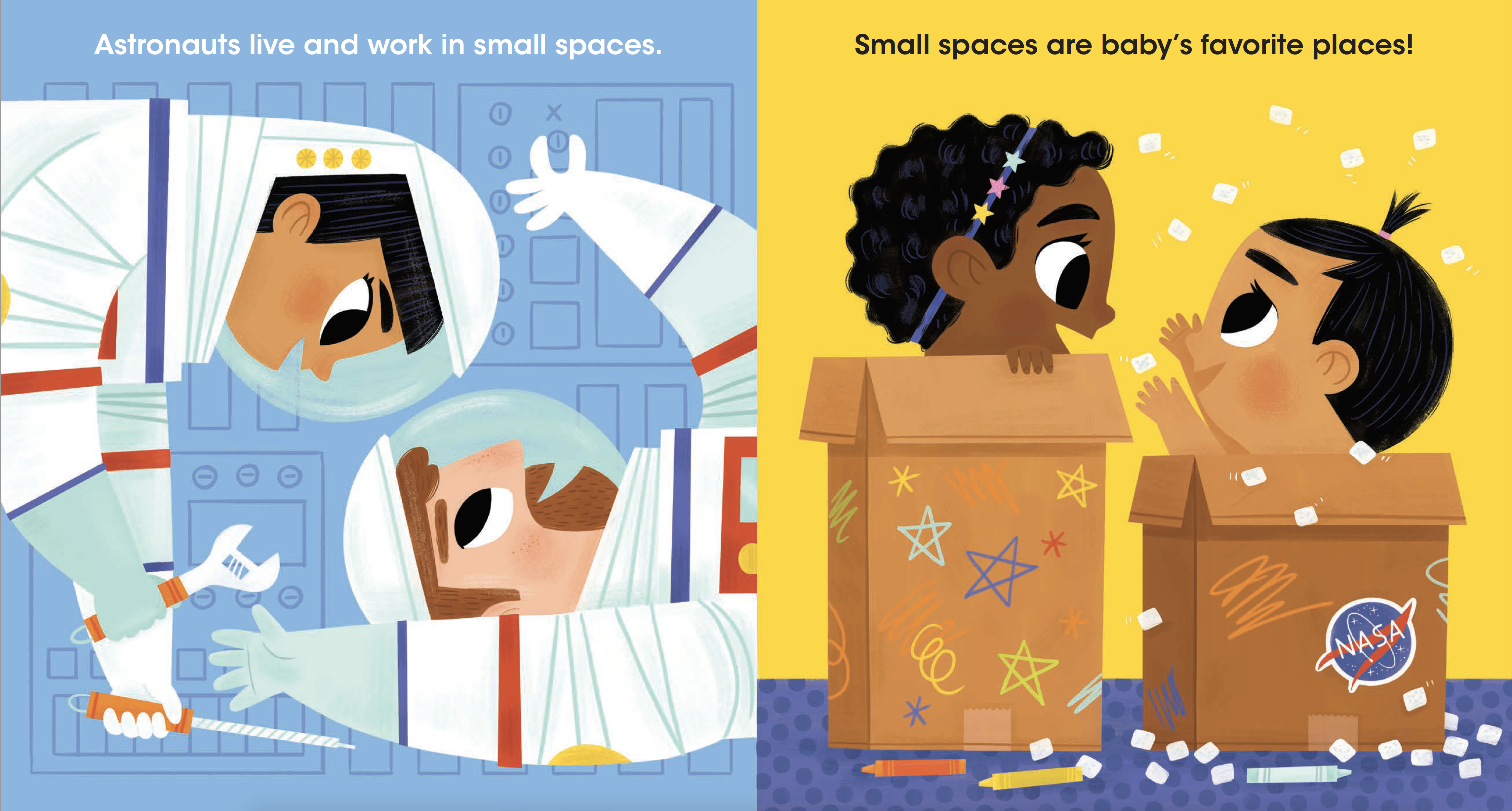
Allison, your style is so perfect for the youngest “readers.” Is this your first time illustrating board books?
 Thank you! This is not my first time working on board books. I currently have three published, but I think this series is really special and I can’t wait for them to be released! I love making board books because I have a one-and-a-half-year-old son and it’s nice to be able to read to him without worrying that he’s going to rip, eat or destroy them!
How did you get your start in children’s publishing?
I’ve always been interested in children’s publishing, but I didn’t get really involved in it until 2016. That year I was approached by a couple of publishers who had discovered my art through my stationery line and my work with Target. I enjoyed making those books so much that I decided to get an agent and leave my job to be able to focus on this type of work – and I’m so happy I did!
What else are you working on, if you’re able to share?
Right now I’m working on a few books (which is all I can say about those), as well as developing some new items for my shop. I just released my Fall line a couple weeks ago so now I’m focusing on holiday products. I’ve also started to write some children’s book manuscripts. There’s a lot more work to be done on those (authors really are amazing!), but it’s exciting to try something new!
Plan for the future and pre-order a copy of FUTURE ASTRONAUT today.
Lori will give away one copy of FUTURE ASTRONAUT to a lucky commenter (in the future, release date is June 2019)!
Leave a comment below and a random winner will be selected next month.
Good luck.
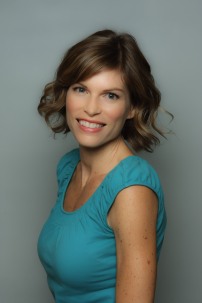 Lori Alexander is the author of picture books BACKHOE JOE (Harper, 2014) and FAMOUSLY PHOEBE (Sterling, 2017) as well as the FUTURE BABY board book series (Scholastic, 2019). She also writes non-fiction for older readers. ALL IN A DROP, a chapter book biography of scientist Antony van Leuwenhoek releases in fall 2019 from Houghton Mifflin Harcourt, followed by A SPORTING CHANCE, a biography of Ludwig Guttmann, the founder of the Paralympic Games, in 2020, also from HMH. Visit her at lorialexanderbooks.com and follow her on Twitter @LoriJAlexander.
Allison Black is an illustrator and designer specializing in cute and colorful creations. Originally from Upstate New York, Allison now lives in Columbus, Ohio with her husband, son and four pets. Allison’s career started as a designer for Target where she developed items ranging from Christmas ornaments and Easter baskets to party décor and apparel. In 2017 Allison left Target to focus on children’s book illustration and to work on her own line of products. She now has six published books and has another ten in progress! You can find Allison’s books, stationery and more in her online shop, Hip-Hip. In addition to making art around the clock, Allison has a particular love for goats, guinea pigs and gummy bears. Visit her at allisonblackillustration.com, shop for art at hip-hip.com and follow her on Instagram @allisonblackillustration and @hello.hip.hip.
If you don’t know VAMPIRINA BALLERINA, expect her to ring your doorbell this Halloween. Thousands of youngsters now tune into her tippy-toe Translyvania-to-Pennsylvania travels on Disney Junior. VAMPIRINA also traveled from picture books to TV, or rather from the creative mind of author Anne Marie Pace (and illustrator LeUyen Pham) to animation stardom.
With so many new players in entertainment—Netflix, Hulu, Amazon—film and television producers are increasingly seeking out proven characters and storylines from published books. In recent years we have seen BOSS BABY commute from Marla Frazee’s picture book to the big screen, plus Judith Viorst’s Alexander endured his Terrible, Horrible, No Good, Very Bad Day in live-action turmoil.
With the release of VAMPIRINA IN THE SNOW, the newest picture book in the Vampirina Ballerina series, I wanted to talk to Anne Marie about her writing and Vampirina on TV…plus celebrate all her success.
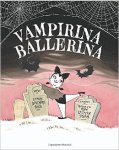


Anne Marie, congratulations on your newest VAMPIRINA book!
When you wrote the first VAMPIRINA BALLERINA, was it a standalone story, or did you have a picture book series in mind?
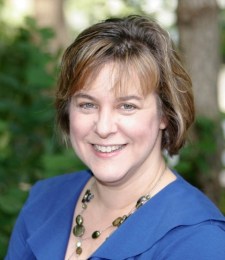 Conventional wisdom in the publishing industry, as far as I knew at the time, suggested writing one standalone, and if the publishers wanted more, they’d ask. So I definitely saw it as a one-off. I’m glad that kids have responded well to it so that I can come back to Vampirina’s world again and again. These days, I do think middle-grade and young-adult series are sometimes envisioned and sold as series, but that would be unusual for picture books.
When did Disney*Hyperion ask you to expand VAMPIRINA into a series? Was it when you first submitted, during production of the first book, or after it proved to be a popular seller?
When I saw this question, I couldn’t remember, so I did a quick search through old emails, and it seems it was about ten months before the first book came out, so that means during the production of the first book! I didn’t remember that! I would have guessed right around the time the first book came out, but I would have been wrong.
What about VAMPIRINA makes her a good subject for a series?
In many ways, Vampirina is like every other child: she wants to try new activities, be successful, have friends. All of those aspects of her character help kid readers relate to her as a peer. But the vampire element obviously makes her stand out from the crowd. She’s realistic and fantastic, all rolled into one.
Vampirina must be very relatable, since she went from book, to series, to TV. Can you tell us how that happened?
It was a long process, and I don’t know all the details. I can tell you what I assume and what I actually know. I have always assumed that because Disney*Hyperion is part of the publishing arm of The Walt Disney Company they send all their new books to the TV/film folks as a matter of course. Someone at Disney Junior must have thought it had series potential. What I know is that Disney Junior bought an option for the series fairly early on. That option was renewed several times while they considered development. At some point, they decided to acquire the TV rights. Even then, it wasn’t positive that it would be a series. So we waited longer until we knew the series was a go. The entire process, from the first time my agent called with the news of the option until the show premiered, was about four years.

Four years! Sounds like the picture book process.
Some PB writers may assume you write for the TV show. Do you?
No, I actually have nothing to do with writing the series. The Disney Junior folks do their thing for the show, and LeUyen Pham and I do our thing for our books. And that’s just fine—I don’t know how to write for television and I’m busy writing new books, both Vampirina and otherwise. Most of what I know about the series I find out on Twitter!
What has been the most surprising thing about Vampirina on TV?
Since I didn’t really know much about how TV works, I was surprised that it went worldwide right away and that there was merchandise right away. I had assumed that the show would have to do well first in the US, and then it might be translated and that there might be merchandise. I had no idea it would all happen at the same time.
Has the TV show increased your VAMPIRINA book sales?
What a great question, but I don’t really have an answer for you! From my vantage point, it seems that the books bring viewers to the TV show and the TV show brings readers to the book series.
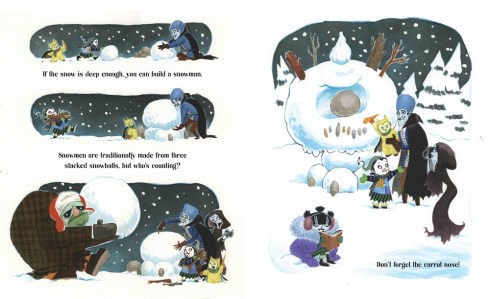
Often you see licensed early readers based on TV shows. Are there any for Vampirina and have you been tapped to write them?
There are quite a few licensed 8x8s and early readers, but no, I don’t write them. I believe some are written by the show’s writers because they are based on particular episodes. I know at least one is by Chelsea Beyl, who will be a co-executive producer of Season 3.

Wow, Season 3 already!
Have you spotted Vampirina in the wild? What are you going to do if kids dressed as Vampirina come to your door on Halloween?
Well, there are thousands of photographs on Instagram of adorable kids wearing Vee costumes or having a Vampirina party or singing into their Vee microphones, but I haven’t personally encountered a Vee in real life yet. If someone comes to my door on Halloween, I’ll probably just smile to myself. It’s a big leap to explain to the younger kids what it means to have written the Vampirina Ballerina book when TV Vampirina looks quite different.
Women in children’s publishing are finally opening up about how male authors & illustrators are given more attention and accolades. I think the fact that you have a book series and TV show should have received more coverage. Do you feel similarly?
 I have been both fascinated and concerned by the revelations and discussions that began publicly last spring with #kidlitwomen and that have continued to take place through the Kidlitwomen podcasts that Grace Lin has been facilitating. I’d urge anyone reading this interview who isn’t familiar with the podcast to check out the excellent content that Grace has been putting out with authors like Kate Messner, Tracey Baptiste, and Shannon Hale, who speak and write so eloquently about the issues. These conversations are much needed, not just in the publishing industry, but in our culture and our world overall, and I’m glad to see people opening up about their experiences.
But as important as those conversations are, I have to tell you that I could not begin to answer your question specifically in regards to my books and career. In our industry, there aren’t clear consistent guidelines for advances, for publicity dollars, for all the ways that books and authors get attention. If I’m working in a factory, and I produce 2734 doodads a day, and the man next to me produces 2734 doodads a day, and my doodads are identical and of equal quality to his doodads, it seems obvious that we should earn the same amount of money per doodad. But books are judged subjectively at every step of the journey, from acquisition to publicity to critical response; that judgment involves literally dozens of variables; and creators are generally not part of that conversation. The discussion about whether or not the creator’s gender affects that response absolutely needs to happen, but on a broader level than I am able to do.
Of course, when it all comes down to it, when I sit down to write a new Vampirina or revise the middle-grade novel I’ve been working on for sixteen+ years, it’s all about the work. I love that Vampirina is a brave and determined little vampire girl; I love that the protagonist in my MG historical fiction learns to speak up for herself and make waves the best way she knows how, given her time and place in history. I think I write them differently in 2018 than I would have in 1998 because I’m a stronger, more informed woman.
I think Grace Lin should ask you to speak on the Kidlitwomen podcast.
So do you feel like you know what it takes to write a book that gets picked up for other entertainment markets? What have your learned from this whole VAMPIRINA process?
Honestly, I don’t. Most books that are picked up for TV have a unique protagonist, like Arthur, Vampirina, Fancy Nancy, or Clifford. But beyond that, I have no idea why one character is picked up and another isn’t. To me, it feels more like a lightning strike than anything I made happen and I don’t mean to sound disingenuous when I say that It’s just that in publishing, the work is all you have control over. If you do good work consistently, sometimes good things happen. But other times, nothing happens at all. Don’t we all have manuscripts that we know are well-written and fun and child-friendly—but they simply don’t sell? I have a stack of them. The three manuscripts I believe to be the absolute best things I’ve written have never sold. I have heard authors who complain when others attribute someone’s success to luck. I understand where those authors are coming from, because they’ve done the work and they want credit for doing the work. But I can’t answer your question without recognizing the role that luck played in this whole scenario. Why Vampirina? Why now? I simply don’t have an answer for that. You can substitute the word “timing” for “luck” if you prefer—but either way, there were a lot of factors at play, and I controlled only one of them.
Anne Marie, thank you for answering these questions so thoroughly and honestly. I wish you continued success with all things Vampirina!
Happy VAMPIRINA IN THE SNOW release day!
Disney*Hyperion is giving away a copy of VAMPIRINA IN THE SNOW.
Leave one comment below to enter the giveaway (US postal addresses only, please).
A winner will be selected in two weeks.
Good luck!
In the meantime, you can learn more about Anne Marie Pace and her books at AnneMariePace.com.





 Writing for Kids (While Raising Them)