You are currently browsing the tag archive for the ‘Giveaways’ tag.
Today’s inspiration from author-illustrator Adam F. Watkins is purely visual. You figure out the story—and you can also win this signed illustration. Just leave a comment! A winner will be randomly selected one week from today.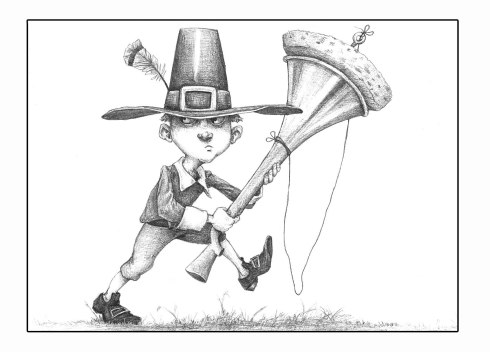 Adam lives in southern Ohio with his wife Amy and daughter Lucy. He graduated from the Columbus College of Art and Design in 2004, where he majored in illustration. He studied under C.F. Payne his junior and senior years. He worked for an advertising agency in Cincinnati after graduation and is now a full-time freelancer. He loves children’s books and the outdoors. Adam hopes to one day share his illustrations and stories with kids all over the world.
Some awards he has acquired along the way:
2003 – Society of Illustrators student show
2004 – Best in Show, Art of Illustration Show
2006 – Gold Addy Award
It’s not always about the cute bunnies.

I’ve been drawing a lot of bunnies lately. Well, actually one bunny in particular.
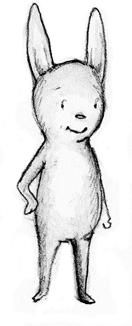 He is very persistent and keeps showing up when I’m doodling, waiting for his chance to star in a story. He is not what I am supposed to be drawing right now. I am supposed to be drawing chickens and mice and Christmas trees as well as coming up with a brilliant picture book idea everyday, none of which have had anything to do with bunnies so far. But he keeps showing up, begging for attention like a puppy who wants to go for a walk.
I have nothing against him, I think he is kind of cute. It’s just that I have no time right now for cute little bunnies. I really need to be working on these other things, before I can pay any attention to him.

So I am just trying to ignore him. And the more that I try to ignore him, the more I find myself thinking about him. Where did he COME from? Why does he keep BOTHERING me? What does he WANT? What does he NEED? WHO is this BUNNY?
Ideas are funny things. Sometimes it seems that you will never have another good idea again no matter how hard you try. Sometimes you need to wheedle an idea out of a germ of a thought. And sometimes they just burst through the door and kick you in the head. Who knows which ideas will grow into a full fledged story and which ones will just fizzle away. The best that you can do is listen to them, push them if they need it and give them a chance to shine.

I don’t know yet who this bunny is or if he will ever grow into his own story. All I know is that he’s been bugging me and pretty soon I am going to have to do something about it. The other characters are starting to complain.

 Sarah Dillard is an award-winning author/illustrator. Her latest book is Perfectly Arugula.
You can win Sarah’s signed illustration of Bunny and Mouse above! Leave a comment to enter. (One entry per person.) A winner will be randomly selected one week from today. Good luck!
Those of us you who were children once upon a time will surely remember how frustrating it was suddenly to have been plunked down in a world where everyone knew more than you did—about everything. Children spend a great deal of time trying to figure things out: where does snow come from? Why can’t dogs talk? What happens next? Or, as we say in our family: “Who ordered the veal cutlet?”*
Kids develop their own little GPS-like subroutines, constantly recalculating to keep themselves on track—but sometimes, inevitably, they get it wrong. Misperceptions and missed information lead to misunderstandings . . . and—I won’t sugar-coat this—little misunderstandings often lead to:
Major Disappointment!
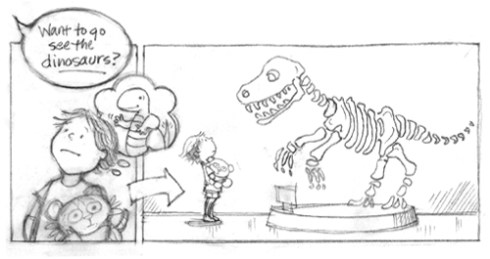 Total Humiliation!
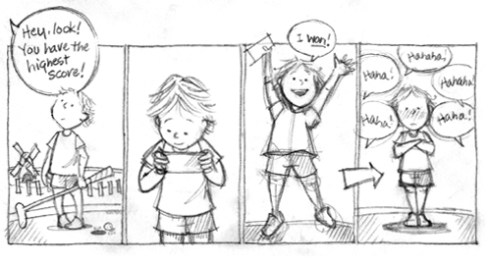 Nightmares!
 (Yeah, I was grown before I figured that one out.)
Thank goodness for picture books!
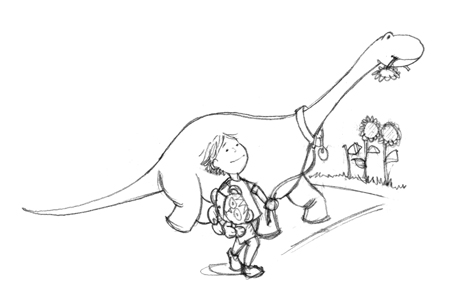
In a picture book, you can check out your own real-live dinosaur any time from the Storybook Lending Zoo.
 You can have the queen invite the golfer with the highest score to the palace for tea, and meet the prince, who is even worse at Goony Golf than you are.
 You can become a super-hero in training, and rid the world of evil, baby-eating furniture.
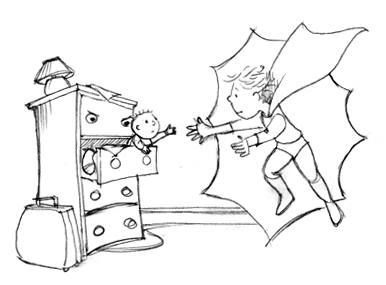 How cool is that? As children’s book writers and illustrators, we get to do this all the time. So, having aired three of my own neuroses . . . er, picture book ideas . . . here is a tip for today: think back to those times in your childhood when things were not quite what you expected them to be—and imagine what it would take to discover a new, old friend . . . or have the last laugh . . . or fly to the rescue.
And then, for the love of heaven, explain to the little person in your life that dinosaurs are really extinct; that, as silly as it sounds, low score wins at Goony Golf; and that, yes, if necessary, a very tiny baby can sleep safely in a dresser drawer . . . but only if you take the drawer OUT of the dresser first!
*A line from Mel Brooks’ Silent Movie . . . um, maybe you had to be there.
 Bonnie Adamson’s latest illustration project is BEDTIME MONSTER (¡A dormir, pequeño monstruo!) by Heather Ayris Burnell, released in September by Raven Tree Press.
Visit Bonnie’s soon-to-be-completely-overhauled website at www.bonnieadamson.net, or hang out with her on Twitter, where she co-hosts #kidlitchat on Tuesday nights and #kidlitart (for children’s book illustrators and friends) every Thursday.
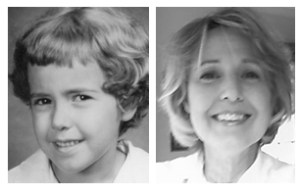 Bonnie then, practicing her skeptical glare; and now—-an older and wiser children’s book illustrator.
Prize Alert! Leave a comment to enter. One randomly-selected winner will choose one of the three picture-book-inspired sketches above for Bonnie to paint in watercolor (Dinosaur, Royalty, Superhero). One entry per person! Winner will be selected one week from today. Good luck!
 [UPDATE: The winner is Sheryl Tilley! Congratulations and enjoy!]
My story “The Juggler Triplets” will appear in the November issue of Abe’s Peanut, a micro-magazine for kids ages 6-10. Delivered in four postcard installments, the story appears on one side with full-color illustration by Lichen Frank on the other.
Independently published by editors Anna and Tess Knoebel, Abe’s Peanut launched this year after the success of Abe’s Penny, a micro-magazine for adults: “Off-set printed on double thick matte card stock, each issue dispenses art and literature while becoming a collectible, temporal object.” (In kidspeak: “They look cool tacked to your bedroom door.”)
Recent Abe’s Peanut contributors include Audrey Vernick, author of Is Your Buffalo Ready for Kindergarten?, and Lisa Tharpe, author of P is for Please: A Bestiary of Manners.
Kids love receiving their own mail, so here’s a chance to receive four postcards with your child’s name on the label.
Leave a comment naming your child’s favorite picture book for one contest entry. Mention the giveaway elsewhere for two additional entries. A winner will be chosen on Friday, October 22nd.
And stay-tuned for PiBoIdMo in November, when there will be several itty-bitty (plus some hugantic) giveaways!
 I love picture books with a touch of magic, so I was thrilled to speak with Patricia Storms, illustrator of the whimsical Edward and the Eureka Lucky Wish Company by Barbara Todd. Edward wishes he could fly, and by chance he gets three wishes–but he doesn’t use them wisely.
What a fun challenge to illustrate the Skyhopper 2000, a flying bike! Patricia, how did you land the contract to work on this book?
I’ve been very fortunate when it comes to getting book illustration jobs. Most of the time, publishers have approached me. If memory serves me correctly with the Eureka book, I had sent off a pamphlet of my recent work to various publishers in North America, and as luck would have it, Kids Can Press just happened to be looking for a humorous illustrator for this project. I believe they had been considering my work, since they were already familiar with my art (it’s a small world in Canadian publishing). My portfolio pamphlet just helped to seal the deal.
How did you get started illustrating children’s books?
Well, it was a very slow process for me. I always enjoyed drawing (especially cartoons) and took art all through high school, but for various reason (fear of failure being the big one) I initially took a different path, and studied to work in libraries instead (being a bibliophile and all, and settling for more ‘secure’ work).
But I continued to draw when I could, and slowly started selling art on the side, while working full-time in libraries. I ended up working for the Toronto Public Library cataloguing of all things–children’s books! That’s when I started dreaming about how it would be so much more enjoyable to illustrate the books, rather than catalogue them. Eventually in my mid-30s I went back to school and became a graphic designer, still selling the cartoon/humor work on the side.
About 6 years ago my freelance work really started to increase, mainly because I began putting my work online. My first few picture book illustration jobs were work-for-hire jobs, doing illustrations for the educational kid’s book market. In all those cases, I was approached by the publishers. I enjoyed doing the educational illustration but I really wanted to get into trade book illustration, because I knew I would have a much wider audience.
My first trade illustrated book was 13 Ghosts of Halloween, published by Scholastic Canada. Once again, they approached me. My upcoming illustrated picture book, The Pirate and the Penguin, which is completely my creation, will be my third trade picture book, and I hope I can do more in the future.
This job, more than anything else I have ever done, feels so right for me. Because for me, it’s not just a job. It is who I am. I view myself as a bit of a ‘late bloomer’ in this field. I still feel like a newbie in the kid’s book industry – there are many people my age (45) who have been doing it for 20 years or more. I have so much to learn. I hope I can continue to learn and grow in this industry, if the gods will allow it.
 What is the biggest challenge when translating someone else’s words into pictures? How much input does the editor have? Do you ever speak directly with the author?
I guess finding that perfect balance in which the editor and author are happy, but also where I get to add my own personal flavor without completely taking over the story…yet at the same time, where I’m not just being a “hired hand” doing grunt work.
How much input the editor has in developing the art for the story really depends upon the publisher and editor with whom you are working. Some editors will give some basic guidelines and then just let you fly, while others are much more hands-on, giving lots of direction and feedback. It’s never been the exact same experience for me.
The only time I’ve spoken directly with the author is when I have been illustrating the story written by me. It’s actually kind of hard to get away from myself. 😉
Generally, editors prefer to keep the author and the illustrator apart until the project is done. I’m not entirely sure of the reasons for doing this, but I suspect it is because they fear a) the author and illustrator will conspire together to give the editor and publisher grief or b) the author and illustrator will hate each other with a passion and disagree on everything and kill each other thus giving the editor and publisher grief.
It’s a tough, time-consuming (and expensive!) job creating a picture book so the last thing anyone working on the project needs is any added emotional stress.
The way I understand the process is that once the story has been accepted, the editor will work with the author to fine-tune the words, and then when the story is pretty much polished, that’s when the artist comes in to illustrate said words. By this point, the editor and art director work together to communicate with the illustrator concepts for the vision of the story, and of course the illustrator provides feedback, too. The script may still get edited a bit at this point, because once the pictures come into the equation, one discovers that very often the images can take the place of any extraneous words.
Once rough sketches are satisfactory for the editor and art director, they are shown to the author, just to make sure that the author doesn’t totally hate the artist’s vision. I’m pretty sure that if the author really were upset with the art, that something would have to be done, but once again, it all depends upon the publisher working on the project.
I only met the authors of my first two trade picture books AFTER the books were complete. Thankfully, both authors were happy with the final product. I do find it a stressful, worrisome experience, wondering whether or not the author is happy with my art. But I am a bit of a neurotic worry-wart, so I tend to let these things eat away at me.
 How and when did you make the decision to morph from illustrator to author-illustrator? Can you tell us about The Pirate and the Penguin, your first book as both author and artist?
Well, I’ve always enjoyed writing as well as drawing. As a kid I wrote and illustrated many comic strips, some of which were quite detailed, chock full of numerous characters. English and Art were my two favorite subjects all through school, and well, they still are! I think as soon as I realized that it was possible for me to get work in children’s book illustration, I knew in the back of my mind that I would eventually want to write my own stories. A lot of this stuff has been bouncing around in my head for a long time, and I really needed to let it out! That’s one of the reasons I started a blog a little over 4 years ago.
I became more determined about becoming an author/illustrator about two years ago. I began reading a lot online and in books about writing picture books, and of course, I read lots and lots of picture books that I brought home from the library. Around this time I joined an online critique group which was very helpful. Then about a year ago I took a “writing for children” course, which was also very helpful in teaching me about what worked in my writing, and what didn’t. During this time I would meet up with a wonderful writer friend of mine, Liam O’Donnell, from time to time. He writes pictures books and graphic novels and he’s just a really cool guy.
I was in one of my crabby moods, and I was kvetching to Liam about how tough it is to get published in the kid’s book biz. I made a flippant comment to him, something to the effect of, “If someone really wanted to cash in on two popular icons in kid’s books, they would write a story about a pirate and a penguin!”
Liam, being much smarter than me, actually thought it was a cool idea for a story, and urged me to write this crazy idea. I didn’t follow up on his suggestion right away, but every now and then he’d ask me “how’s that Pirate and Penguin story going?” So I figured I’d better do something.
When I finally thought of the story idea, I thought it was just too silly, but I mentioned it to Liam, and he loved it, and encouraged me to pursue it. So I did. And that’s how my upcoming picture book The Pirate and the Penguin came to be.
Of course it’s a fun story, because pretty much everything I write and draw is somehow touched by my wacky sense of humor. It’s a silly version of the classic The Prince and the Pauper, except that it involved a Penguin who hates the South Pole and a Pirate who can’t stand life on a pirate ship in the Caribbean. When they meet, lots of interesting stuff happens! And that’s all I’m going to say about the story for now, other than to say that I owe so much to Liam O’Donnell, and I’m eternally grateful to him for his guidance and encouragement.
There are many factors that come to play in getting published–knowledge, talent, perseverance, luck and patience. But it sure doesn’t hurt to have friends who are right there behind you, pushing you, rooting for you, and guiding you towards your dream.
That’s terrific advice! Thanks, Stormsy! (You don’t mind if I call you Stormsy, do you? No? Thanks.)
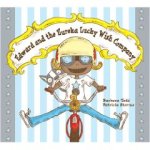 Patricia is generously giving away an autographed copy of Edward and the Eureka Lucky Wish Company!
Please leave a comment to be entered into the drawing.
Blog or Tweet about the interview and get another two entries–just let me know here or on Twitter. Winner will be picked by Random.org one week from today! Good luck!
Thanks to everyone who entered the Toni De Palma Under the Banyan Tree giveaway and the Corey Rosen Schwartz Hop! Plop! giveaway!
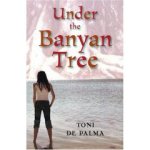 The winner of a signed copy of Under the Banyan Tree is Susan (The Book Chook)!
 The winner of an autographed Hop! Plop! is Kristi Valiant!
Congratulations! I’ll be contacting you shortly!
 And just a reminder, we have another book giveaway–technically, a four-book giveaway–going on now with author/illustrator Aaron Zenz.
 Aaron Zenz is the author/illustrator of Hiccupotamus and he’s the hip, groovy dad behind Bookie Woogie, a blog where he and his eldest three children review books and share their fan art. It’s obvious the Z-Family loves kidlit.
Aaron, have you always wanted to be an author/illustrator?
Hip and groovy! Lands sakes alive, I’ve never been called either of those before… I’m going to have to look up their definitions.
I’ve been writing and illustrating my own stories ever since I was a wee bitty guy. In fact the last time we were over at my folks’ house, the kids and I were looking at the little books my mom has saved that I made when I was as young as three. The creative drive has always been in me, but it wasn’t until later on in life that I thought about it vocationally. Storytelling was just so fun, I think I never really associated it with the “work” world.
It wasn’t even until part way through college that it dawned on me that I wanted a career in art. Later my attention became even more focused when I realized how much I loved the narrative aspect of illustration. I had already begun collecting picture books, long before I dreamed I’d have a chance to participate in that world.
Writing has been interesting. All through life I’d received more comments and recognition for my writing than for my art. I think people simply already knew me as the “art guy,” so my writing came as a surprise. But for me, writing and illustrating are very comparable. They’re both forms of storytelling, and the process for both seems very similar to me.
Speaking of collecting picture books, you’ve amassed nearly 3,000 of them. Who are some of your favorite author/illustrators? Whose work has inspired you?
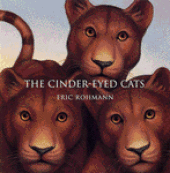 The picture book that changed everything for me was Eric Rohmann‘s The Cinder-Eyed Cats. From the moment I saw those golden felines staring out at me from the cover, I knew — “I want to do that.” Something inside me leapt from mere interest to passionate longing. I wanted to make images that had the power to summon emotions, be it a sense of mystery… or a belly laugh… or tears. Pictures are powerful. So I’ll always have a soft spot for Eric Rohmann’s work, particularly that book.
Another person whose work I find consistently engaging is Adam Rex. Whenever I catch wind of his next new project, I find myself waiting with the kind of anticipation people usually reserve for Hollywood’s summer blockbusters.
Many apologies for slipping into name-listing mode, but I’m also greatly inspired by the work of animator Glen Keane and the art of folks like PJ Lynch, Scott Gustafson, and Peter deSeve. Winsor McCay is amazing. And so is NC Wyeth…but for illustrators, loving Wyeth is a requirement.
On the writing side, I read a lot of Beverly Cleary growing up. I also loved HG Wells and Sir AC Doyle. But I think it was Lloyd Alexander who influenced me the most. I lived in his Chronicles of Prydain as a kid.
Your website features two picture book dummies for Hiccupotamus, one from 1996 and another from 2000. Your book was published in 2005. What kept you driving toward the goal of publication year after year?
In 1996 I took a college class on Children’s Literature. It was actually geared toward teachers — how to use books in the classroom kind of stuff. At the end of the course the teacher had everyone try their hand at writing a picture book. That’s where the first dummy came from — worked up over a weekend for that class.
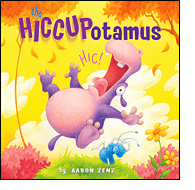 Over the years I continued to write and draw. I came up with scores of picture book ideas that I personally found way more exciting than Hiccupotamus. But when I shared things with people, they tended to gravitate to that first story. In fact people would randomly ask me years after seeing it — “Did you ever do anything with that hippo book?” I dinked around with it off and on over the years, pulling it out, working on the tricky rhyme, developing the characters further.
Eventually (and you’re not going to want to hear this…) out of the blue, it was a publisher who approached me. A friend of mine was participating in building a new publishing company. He had seen that first dummy years earlier when we worked together and wondered if I would “let” them publish it as their debut trade book. I had to think about that for all of three seconds!
So sadly, I don’t have a story about thousands of rejection letters and years of knocking on doors. I invested lots of time into it over those years, but had never yet tried submitting it anywhere.
The sad part of my story comes later when, after the book’s astonishing sales and whirlwind success, the company folded shortly after the release of Hiccupotamus due to the underhanded dealings of my friend’s partner. But from my understanding, it sold 17,000 copies in its first 4 months, and it continues to do well via a version in Scholastic’s book clubs.
And Marshall Cavendish plans to put it back in print this fall. Woo hoo! Hopefully sales pick up for them just as strong as where they left off. Be watching for it!
I will! And why wouldn’t I want to hear that? It’s an amazing story.
You’ve also illustrated the work of other writers. Can you tell us about the process of interpreting someone else’s words into pictures? How do you get started?
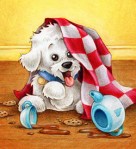
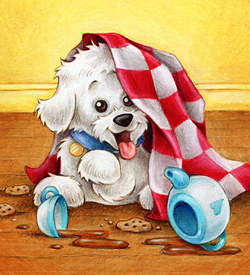
 For stories that are character-based, like with Howie, I’ll spend my first energies doing character development. This is my very favorite part of the whole process. I love all the pre-production work… designing the people and critters, trying to infuse them with life and personality. Sara Henderson had described such an energetic ball of fun when writing about Howie. I set two personal goals for myself on the visual side: attempt to make him the cutest little dog you ever saw, and to fill him bursting with life. Hopefully I came close. So before even thinking about the stories themselves, I spent a few days with a tottering stack of library reference books, filling a sketchbook with page after page of Bichon Frise doodles.
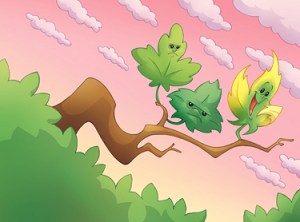 After all the doodling, I make model sheets of the characters with different poses and expressions. Then I’ll finally turn my attention to the actual story and create quick thumbnail sketches of the story, trying to achieve good variety in the compositions. Sometimes this is a challenge. I recently illustrated a story about three leaves, fastened into place on their branch throughout the entire 32 pages. Lots of work went into finding ways to make each page a fun surprise – through coloring and vantage point and framing devices.
The last step, actually making the final art, is the least fun for me — then it becomes work. The subject matter and timetable often dictate the medium. I like working in colored pencil and do it whenever I can, but sometimes I’ll create everything on the computer. For example, with my two Nascar books, it was so much better for me to create mechanical objects digitally – cars and trucks and racetracks. Other times when deadlines are tight, I work on the computer because it’s much faster. The way I use colored pencil is a very timely process.
What is your best advice for new author/illustrators just starting in the business? What do you know now that you wish you knew then?
Well, I’m still among those just starting out, so I myself am listening for anyone who’s got advice!

 I suggest making sure that you keep your creative endeavors fun. Don’t get caught up in checking off x-number of items on a list in order to obtain a successful career. Create what you love because you love it.
I also know that networking is just as important as what we produce. So try to find creative ways to cross paths with lots of other people. Blogging can be a great way to grow a circle of influence. Like hosting a month long “Love a Kidlit Author” celebration — perfect example of a creative way to strengthen contacts and increase a presence! Good thinkin’! Eventually, the right person will make an offer at the right time, so have a stack of things ready to go when that happens.
Aaron, it’s been a pleasure learning about your creative process. One last question…what’s your favorite kind of chocolate?
I’ll never be a coffee drinker, but I Love a big mug of hot chocolate. Oooo… I’m going to need one now.
 Me, too!
Aaron is generously giving away a signed four-book set of the Howie I Can Read series. Leave a comment to enter the drawing!
Blog or Twitter about Aaron’s interview and receive another two entries.
I’ll announce the winner one week from today!
And stop by again soon…Aaron will share his thoughts on sharing books as a family.
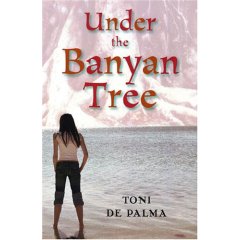
Toni De Palma’s debut YA novel Under the Banyan Tree is a New Voices Pick by the Association of Booksellers for Children. She joins me today to talk about her journey to publication.
First, a little about Banyan:
Irena’s not sure where she’s headed when she runs away—she just wants to leave the trailer she used to share with her mama and daddy far behind. But when she stumbles upon the Banyan Tree motel, something tells her it’s exactly where she’s meant to be. The elderly owner generously welcomes Irena, and the Banyan soon begins to feel like home. But trouble follows Irena wherever she goes, and the Banyan is no different: a mysterious guest, money problems, and secrets from her past soon threaten the stability of her new life. This moving story distills life’s joys and pains, and uncovers just what it really means to be a family.
Toni, your website bio says that you have always dreamed of being a writer, and you’ve accomplished so much with your first book. Can you tell us where Irena’s amazing story began?
The book was a very organic process. I don’t usually work with an outline and even when I jot down notes, I always tend to stray. The idea for Under the Banyan Tree came to me in my first semester of my M.F.A. program at Vermont College. Though I didn’t know it consciously at the time, Irena’s story reflected where I was emotionally in my life. As a young mother, who had given up her job to stay home and be a full time mom, I was feeling a little lost. No job to me meant no identity, no place in the world. I had begun writing, taking classes and submitting, but I didn’t honestly believe I was good enough to be a writer. When my son was five, I read about the Vermont College M.F.A. program in Writing for Children and Young Adults and I knew it was something I just had to do even though it would mean a lot of sacrifice. It might sound weird, but looking back I feel as if the Universe was compelling me to take on the challenge. So like my character, Irena, I sort of ran away (not to Key West, but to Vermont) and I embarked on a personal journey that taught me so much about myself.
After the M.F.A. program, how did you continue on your path to becoming an author? How did you balance motherhood and writing?
Balance? (Laugh, laugh.) What’s that? I’ll be honest. Every day is a struggle. Or come to think of it, maybe it’s not. I’m starting to think that, at least for me, there is a certain amount of normalcy to this ebb and flow, of those periods when I write a lot and those periods when I don’t, times when I rather be cooking or doing laundry and times when all I want to do is sit and write.
First drafts are always killers for me. I circle my computer like a vulture waiting, waiting. I much rather be revising, especially when I’ve had a great meeting with my writer’s group and they’ve given me feedback that’s stirred up my juices. I also seem to have cycles (maybe it has to do with the amount of serotonin in my system). I seem to write more in the Spring and Summer and drift off when it gets cold and all I want to do is snuggle under a blanket (I read a lot more during those times). I recently heard John Grisham say that he writes from April to Thanksgiving — a book a year. When I heard him say that, I felt validated.
I think the really cool thing for writers is that they learn what works best for them and to not judge themselves too harshly.
How long did you work on Under the Banyan Tree? How did you go about submitting it?
I worked on Banyan for two years and revised it about eight times (including the revisions I did with my editor). I was really fortunate with how Banyan played out. I submitted it to a few publishers who declined it and then met Margery Cuyler at the Rutgers One-On-One conference. Margery is the editor at Marshall Cavendish Children’s and she read Banyan, liked it, but didn’t feel it was quite right for her list. Margery suggested I send it to Regina Griffin at Holiday House. Margery knew Holiday House because she had been editor-in-chief there. Regina ended up liking it and offered me a contract.
What was it like to get “the call” from Regina Griffin?
I actually got “the call” from an assistant in her office, a nice girl who seemed genuinely delighted for me. I was happy too, but nervous about what would be expected of me next.
And what was expected of you next?
Well, a lot more waiting for one thing. From the time I received that first phone call to the time my book was published, close to three years had passed. The revision process was worth the wait though. Regina sent me an extensive editorial letter commenting on broader issues and she marked up the manuscript identifying smaller things I might want to consider. Regina did not make specific suggestions, but rather posed wonderful questions that made me see even more possibilities for my characters’ development as well as some plot points that I had never considered. Working with her made the manuscript better, deeper and I hope more satisfying for the reader.
After such a long (and rewarding) revision process, I’m sure you were thrilled once the book hit the shelves. How satisfying was it to hold the finished copy in your hands? What has surprised you most about being a published author? Is it everything you imagined it to be?
While it was wonderful to hold my book in my hand, it didn’t measure up to the very intimate, very personal moment that occurred when I wrote the last line and knew in my heart that I had brought my character to the finish line of her journey. I’m pretty emotional, so I cried, a great cathartic, super satisfying kind of YES! cry.
As for the post-publishing experience, that has been quite interesting and unexpected. I am fortunate that one of the local seventh grade teachers is using my book as part of her curriculum. After the kids read my book, I go in and do a presentation, then give the kids a chance to ask me questions. I’m always amazed at how the kids interpret the book and make it their own. Some kids get pretty incensed and emotional about the story, sometimes taking a character’s side. To elicit that kind of emotion, even though quite unintended is really cool for me because it makes me feel I’ve done my job. That same teacher has also used my book as a springboard to discuss a whole host of other topics such as the ecology of the Everglades (part of the story takes place there), the dangers of hitchhiking, Ernest Hemingway, and of course, banyan trees.
Toni, I sense that you feel it’s important to savor and enjoy each part of the creative process—it’s more about the journey than the destination. Would you agree? What other words of wisdom do you have for aspiring writers? And what can we expect next from you?
When I first started writing I must admit it was all about my ego and wanting to be a “famous” writer (this makes sense because J.K. Rowling had just hit the scene and her rags to riches story really captivated me). But the more I write and the more I see how my writing has helped me to have certain experiences, I view it as a both an intellectual challenge and a tool that is here to grow me both personally and spiritually.
Advice? Of course writing a book involves a great deal of skill that a person becomes better and better at each day with practice. Being part of a writer’s group has also been wonderful and reading, reading, reading. But the practice of writing is not limited to sitting down and hammering away at a keyboard. It involves trying to understand your world, staying curious and asking lots of questions not only with your head, but with your heart. My best writing comes when I’m feeling charged up over something and I just want to understand it.
Since writing Under the Banyan Tree, I’ve written a variety of other things that are now seeking a home: another contemporary YA novel, a historical fiction Middle Grade, as well as a Fantasy Middle Grade. Obviously, I like experimenting and playing with different genres. I’m also looking for an agent.
Toni, this has been a wonderful interview. You’ve helped me realize that I need to have peace and patience with the creative process.
Tara, thanks so much for this opportunity and the great conversation. Writing is sort of like that, a great conversation you have with your reader.
One final question. I promised to slip chocolate into my interviews, so what’s your favorite kind of chocolate candy?
Funny you’re asking about candy. From the age of five to eleven, I lived over a candy store in Brooklyn and I loved each and every sweet piece. Still do!
WOW! You lived above a candy store? That’s every kid’s dream come true! Have you ever written a story based on that experience?
Not yet, but who knows where my mind will wander…
Toni is generously giving away an autographed hardcover copy of Under the Banyan Tree. Leave a comment and you’ll be entered into the drawing.
Blog or Twitter about Toni’s interview, link back here and you’ll get TWO additional entries. Just let me know about the mentions in the comments field.
Good luck! I’ll draw a winner one week from today.
Thank you, Toni!
 Ah, February. The month of love.
I love that December’s bills have been paid off. I love that I don’t have to worry about fitting into a bathing suit quite yet. I love dreaming of ways to spend my tax refund (which has already been spent). And I love gettin’ cozy in front of the fire with my daughters and a good book.
So this February I’m hosting a celebration of children’s authors, new and old. (Well, maybe not old. Established.) It will be 28 days of author interviews, book reviews and giveaways beginning on February 1st.
And what would February be without chocolates? Besides the quintessential heart-shaped box, February 1st was the day Willy Wonka invited five kids to tour his chocolate factory for the very first time…
Do you have a new book coming out? Recently snagged your dream agent? I’m still looking for writers to feature, so please get in touch by leaving a comment!





 Writing for Kids (While Raising Them)